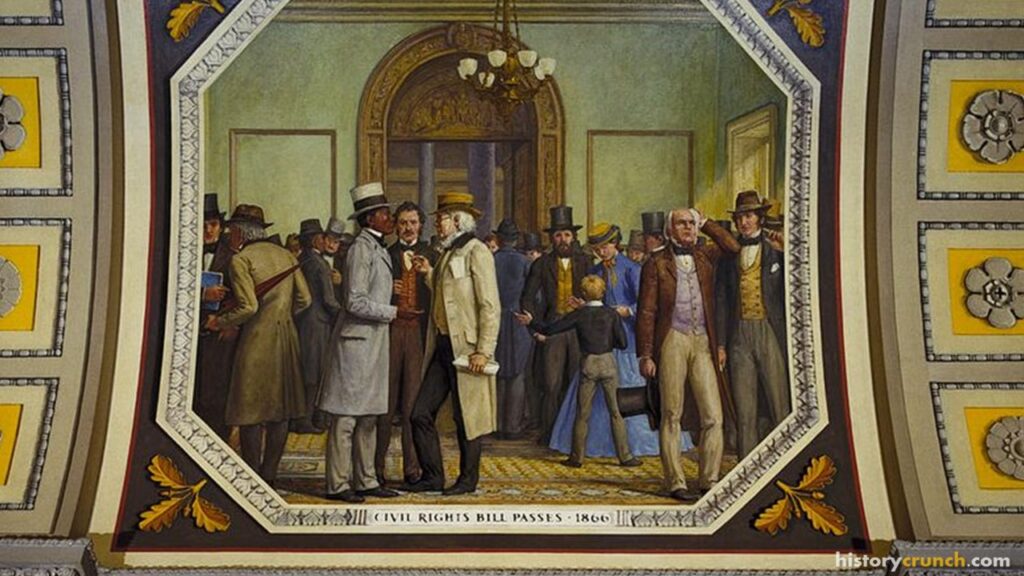
The Civil Rights Act of 1866 was enacted on April 9th in 1866 during the presidency of Andrew Johnson. It was created following the American Civil War as an attempt to help protect former slaves in the Reconstruction Era of American history. For instance, the act dealt with matters related to citizenship and protected all citizens as equal under the law. This was significant at the time because there was fear in the Northern states that the former slaves in the South were not going to be afforded the same rights as the white citizens. Due to the timeframe in which it was passed, the Civil Rights Act of 1866, is considered significant to other related events, such as: slavery in the United States, the American Civil War, and the Reconstruction Amendments.
CIVIL RIGHTS ACT OF 1866 – SUMMARY
The Civil Rights Act of 1866 was written by Lyman Trumbull, who was a United States Senator from Illinois. Trumbull also co-wrote the Thirteenth Amendment, which is one of the ‘Reconstruction Amendments’ that were passed in the years after the end of the Civil War. In fact, the Thirteenth Amendment officially abolished slavery in the United States. The Thirteenth Amendment was adopted on December 18th in 1865, and the Civil Rights Act of 1866 was written to support the overall goal of the Thirteenth Amendment. For instance, the Civil Rights Act of 1866’s main goal was to protect the rights of all people born in the United States regardless of their race, color, or previous condition of slavery. As such, the Civil Rights Act of 1866 was significant in terms of helping to protect former slaves who had recently been freed.

In terms of the civil rights that the act was intended to protect, it focused on promoting equality between all people in the United States. For example, the Civil Rights Act of 1866 stated that all citizens had the same rights, including: to own property, sell property and to participate in judicial matters. For instance, the act dealt with matters related to citizenship and protected all citizens as equal under the law. This was significant at the time, because there was fear in the Northern states that the former slaves in the South were not going to be afforded the same rights as the white citizens. The Civil Rights Act of 1866 was especially significant to the ‘Black Codes’. Following the end of the American Civil War, several Southern states passed laws that are commonly referred to as ‘Black Codes’ as a way of controlling the societal, political and economic activities of African Americans. In fact, the Black Codes were attempts by some states to continue with aspects of slavery after the passage of the Thirteenth Amendment. The Civil Rights Act of 1866 attempted to protect these civil rights by carrying out certain punishments for people who denied others their rights. These punishments included a fine of $1000 or up to one year in prison.
As stated above, the act was written by Illinois Senator Lyman Trumbull and introduced into the Senate. It eventually passed through the Senate and House of Representatives in 1865. However, United States President Andrew Johnson vetoed the it soon after in 1865. Johnson vetoed it again in 1866 after Congress attempted to pass it again. Johnson’s veto of the Civil Rights act of 1866 was related to the controversial nature of the bill. In fact, some in Congress argued that the government did not have authority to enact such a law. Others argued against the law on the grounds that they disagreed with extending rights to former slaves. Regardless, the President’s veto was overridden by Congress after a two-thirds majority of the members of both the Senate and the House of Representatives voted to make it law. This was significant, as it was the first time that Congress had ever overridden the veto of a President of the United States. The Civil Rights Act of 1866 was enacted on April 9th in 1866.
Regardless of its passage by Congress, the Civil Rights Act of 1866 was not formally ratified until two years later, in 1868, with ratification of the Fourteenth Amendment. This is because some worried that the act did not do enough to protect the equality of rights for all citizens, including African Americans. As such, the Fourteenth Amendment was introduced to further the protections laid out in the Civil Rights Act of 1866. For example, the Fourteenth Amendment dealt with citizenship rights and equal protection under the law for former slaves. It was ratified on July 8th, 1868, just three years after the Thirteenth Amendment, which had abolished slavery. There were many different proposals of the Fourteenth Amendment that were constructed throughout 1865 and 1866. The central issues of the time centered on voting rights for former slaves and equal protection under the law regardless of race. Finally, in April of 1866, a proposal was sent forward to Congress that included elements of both.