
The Korean War was the first hot war of the Cold War and the only war of the twentieth century that has never ended. It began on June 25th, 1950 when North Korea, with Stalin's plan and Mao's approval, crossed the 38th parallel to unite the country by force, and it drew in the United Nations, the United States, China and, in secret, the Soviet Union. In three years the front swept the length of the peninsula twice and Seoul changed hands four times; then it froze near the line where it had started and stayed there while 575 meetings failed to agree on the prisoners. About 2.5 million people died, most of them Korean civilians. This timeline runs from Japan's annexation in 1910 to the summits of the twenty-first century, and every card on it sits on a real date.
From a line drawn in thirty minutes to a war that has not ended.
The Korean War was the first hot war of the Cold War and the only war of the twentieth century that has never ended. It began on June 25th, 1950 when North Korea, with Stalin's plan and Mao's approval, crossed the 38th parallel to unite the country by force, and it drew in the United Nations, the United States, China and, in secret, the Soviet Union. In three years the front swept the length of the peninsula twice and Seoul changed hands four times; then it froze near the line where it had started and stayed there while 575 meetings failed to agree on the prisoners. About 2.5 million people died, most of them Korean civilians. This timeline runs from Japan's annexation in 1910 to the summits of the twenty-first century, and every card on it sits on a real date.
A country that had been one for a thousand years was cut in half by two colonels with a magazine map.
Cairo, the Soviet invasion, the 38th parallel, two occupying armies.
Three years after a temporary line, there were two governments, two armies and two men who each claimed all of Korea.
The Moscow plan, the joint commission, the UN vote, two proclamations.
A 33-year-old guerrilla in a Soviet uniform and a 70-year-old exile with a Princeton doctorate.
Their backgrounds, their patrons, their return, their states.
Stalin said no in 1949 and yes in 1950. The documents say why.
The Soviet bomb, the Chinese victory, the American withdrawal, Acheson's speech.
Koreans killing Koreans over who should rule Korea, with the world's two blocs choosing sides.
Jeju, the border battles, the invasion, the UN, the Chinese.
A line on a map that became a border, a trigger, a war aim, and a cease-fire.
Its drawing, its crossing, its recrossing, and the line that replaced it.
Sixteen countries under one flag, for the first and only time.
The empty Soviet chair, three resolutions, MacArthur's command, sixteen flags.
Two days, no vote of Congress, and a word he chose carefully: police action.
The doctrine, the news, the air and sea order, the ground troops, the price at home.
A plan Harry Truman had shelved in April was law by the winter, and the defense budget quadrupled.
Containment, NSC-68, the war, the treaty, the permanent army.
Ninety thousand men, 150 tanks, and a South Korean army with nothing to stop them.
The invasion, Seoul, the bridge, Task Force Smith, Taejon.
Six weeks on a river line with the sea at their backs and no line behind.
Walker's order, the Naktong, the reinforcements, the breakout.
Thirty-foot tides, a walled harbor, one channel, and every planner against it.
The plan, the argument, the landing, Seoul, the collapse of the north.
The war aim was to repel an invasion. On October 1st it became to end a state.
Seoul retaken, the crossing, the UN vote, Wake Island, Pyongyang.
A year-old government with a wrecked economy sent 300,000 men against the world's strongest power.
Mao's victory, the warnings, the crossing, Unsan, the offensive.
Thirty thousand men, minus 35 degrees, 120,000 Chinese, and one road to the sea.
The offensive, the trap, the march, the evacuation.
He arrived on December 26th to an army that was beaten. By March it was in Seoul.
Walker's death, the Third Offensive, Thunderbolt, Chipyong-ni, Seoul.
A five-star hero against an unpopular president, Harry Truman, over who decides how a war is fought.
The Wake Island promises, the retreat, the letters, the dismissal, the speech, the hearings.
The United States had the bomb and did not use it; China had a million men and did not send them all.
The atomic remark, the Yalu bridges, MiG Alley, the Spring Offensive, the talks.
Hills, cold, retreat and advance, then two years in bunkers.
Task Force Smith, Chosin, Heartbreak Ridge, Pork Chop, the rotation home.
Most of the dead were not soldiers. Most were Korean, and most have no monument.
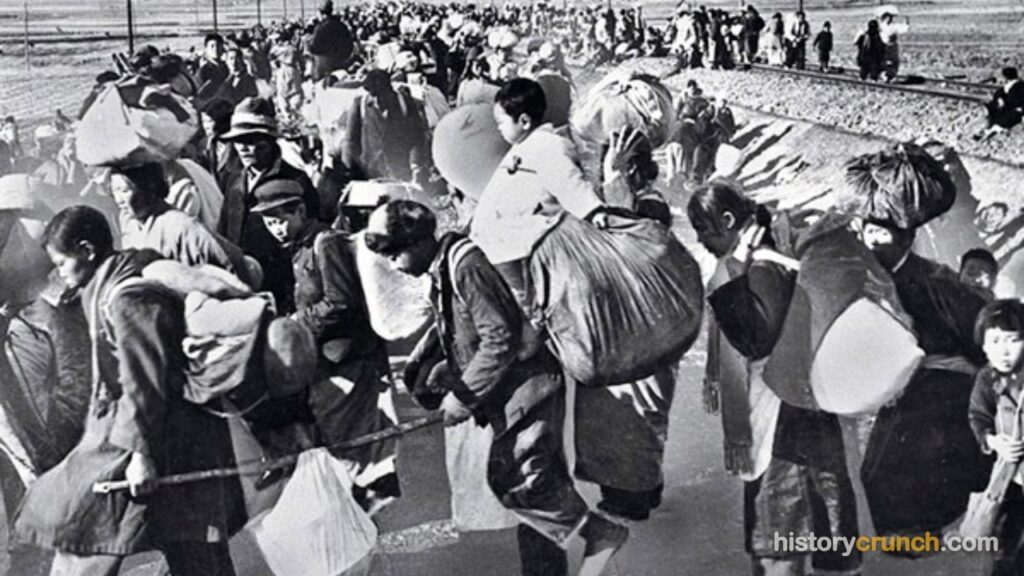
Refugees, No Gun Ri, Seoul's four changes of hands, Hungnam, the bombing.
No rationing, no victory parades, and a draft that took 1.5 million men.
The Defense Production Act, the fear of communists, the steel seizure, the election.
Every other question was settled by May 1952. The prisoners took fifteen months more.
The principle, the screening, Koje-do, Little Switch, Big Switch.
MiG-15 against F-86 Sabre over the Yalu, and B-29s driven from the daylight.
Suwon, MiG Alley, Black Thursday, the dams.
Soviet tanks against American bazookas in July; American artillery against Chinese bugles in November.
The T-34, the M26 and the bazooka, the jets, the trench war.
Five hundred and seventy-five meetings, and more dead than in the first year.
Kaesong, the line, the prisoners, the ridges, Pork Chop.
The side that owned the sea could land anywhere, leave anywhere and never be cut off.
Taiwan, Pusan, Inchon, Hungnam, the blockade.
Stalin died, Eisenhower arrived, the prisoners were solved in a sentence, and Rhee nearly wrecked it.
The election, Stalin, Little Switch, Rhee's release, the signing.
About 2.5 million dead in three years for a border that moved a few miles.
The dead, the cities, the divided families, the memorial.
One of the world's richest countries and one of its poorest, from the same war and the same people.
The north's plans, the south's coup, the miracle, the purges, the famine.
An armistice, no treaty, a million soldiers on the line, and seventy years of incidents.
The armistice, Geneva, the Pueblo, the axe, the summits.
Two superpowers fought each other without admitting it, through others, on someone else's land.
The Soviet plan, the volunteers, the secret pilots, the UN flag, Vietnam.
It made the Cold War military, the presidency warlike, Asia divided and Korea what it is.
The decision, the build-up, the firing, the armistice, the alliance.
Korea had been one kingdom for more than a thousand years and a Japanese colony for 35 when, on a night in August 1945, two American colonels with a magazine map cut it in half at the 38th parallel so that the Soviets would take the Japanese surrender in the north and the Americans in the south. It was meant to last weeks. The Allies had promised Korea freedom 'in due course' and planned a trusteeship instead; Koreans wanted neither. A guerrilla in a Soviet uniform came home to Pyongyang and an old exile with a Princeton doctorate came home to Seoul, and within three years each had a state, an army, and a constitution that claimed the other's capital.
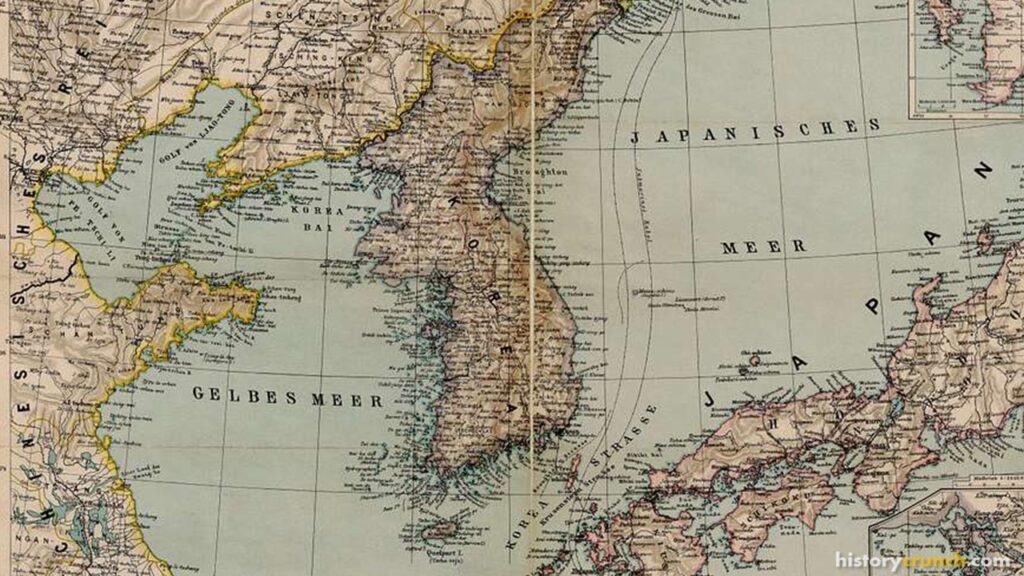
On August 29th, 1910 the Empire of Japan formally annexed Korea, ending a kingdom that had ruled itself for more than a thousand years. For the next 35 years Korea was a Japanese colony: its land surveyed and sold to Japanese settlers, its language pushed out of the schools, its people ordered in 1939 to take Japanese names, and about 700,000 Koreans taken to Japan as laborers during World War II.
LEARN MORESHOW LESSwhy it matters · key numbersPOLITICSEvery Korean leader of 1950, North and South, grew up under Japanese rule and defined himself by how he had fought it. Kim Il-Sung was a guerrilla; Syngman Rhee was an exile. The division of 1945 landed on a country that had not governed itself for two generations.
On March 1st, 1919 thirty-three Korean leaders read a Declaration of Independence in Seoul, and about two million people joined peaceful demonstrations across the country over the following weeks. The Japanese police and army answered with force: about 7,500 Koreans were killed and 46,000 arrested. In April, exiles in Shanghai set up a Korean Provisional Government and elected Syngman Rhee, then in the United States, as its first president.
LEARN MORESHOW LESSwhy it matters · key numbers · 1 key figureSOCIETYMarch 1st is Korea's national day in both the North and the South, and it made Rhee a name. It also settled who would speak for Korea in 1945: the exiles, not anyone who had stayed and worked with Japan.
On June 4th, 1937 about 150 Korean guerrillas of the Chinese communist Northeast Anti-Japanese United Army, led by a 25-year-old who called himself Kim Il-Sung, crossed the Yalu River from Manchuria and attacked the Japanese police post in the border town of Pochonbo, burning government buildings before withdrawing. It was a small raid. In North Korea it is taught as a turning point of world history.
LEARN MORESHOW LESSwhy it matters · 1 key figureWARThis is the story North Korea is built on. Kim's guerrilla years gave him his claim to rule, and when Japanese pressure drove him into the Soviet Union in 1940, they gave him the Soviet patrons who would put him in power in 1945.
On December 1st, 1943 Franklin Roosevelt, Winston Churchill and China's Chiang Kai-shek published the Cairo Declaration, which promised that after Japan's defeat Korea 'in due course shall become free and independent'. Roosevelt privately thought 'due course' meant a trusteeship of twenty to forty years under the great powers. Koreans read the three words as a betrayal before it had happened.
LEARN MORESHOW LESSwhy it mattersDIPLOMACYThe Allies promised Korea its freedom and planned to hold it in trust. That gap between the promise and the plan is where the division of 1945 came from.
On August 9th, 1945, three days after the atomic bomb on Hiroshima and the same day as the bomb on Nagasaki, the Soviet Union declared war on Japan and sent 1.5 million troops into Manchuria, the Chinese region north of Korea. Within days the Red Army was moving down the Korean coast. The nearest American troops were 600 miles (1,000 km) away on the Japanese island of Okinawa.
LEARN MORESHOW LESSwhy it matters · key numbers · 1 key figureWARKorea was divided because of who could get there. The Soviets could reach all of it in weeks and the Americans could reach none of it. Washington had to draw a line, fast, that Stalin would accept.
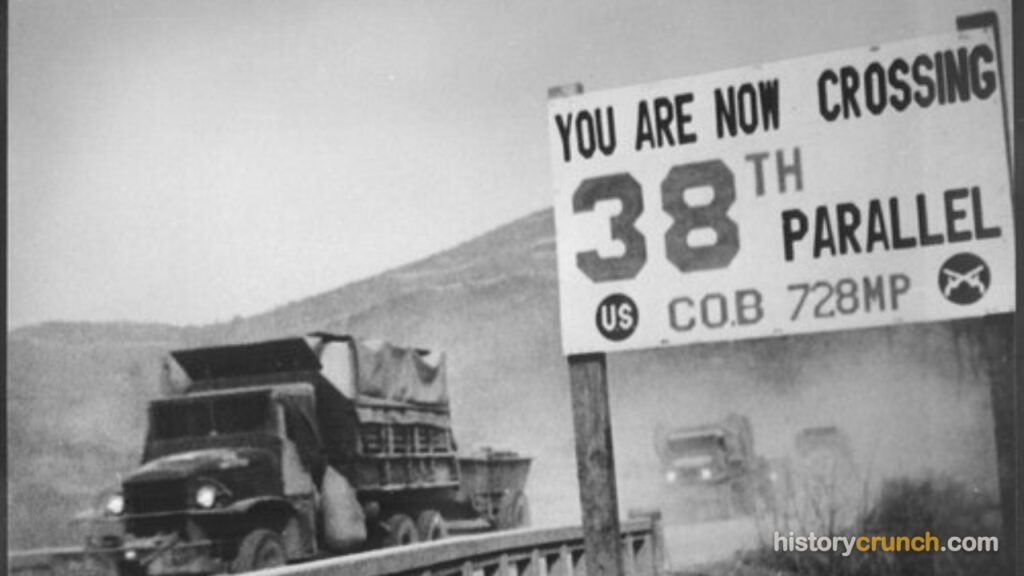
Late on the night of August 10th, 1945 two young colonels in the War Department in Washington, Dean Rusk and Charles Bonesteel, were given half an hour to propose a line dividing Korea into Soviet and American zones for accepting the Japanese surrender. Using a National Geographic wall map, they chose the 38th parallel because it put the capital, Seoul, in the American zone. No Korean was consulted. Stalin accepted the line without argument.
LEARN MORESHOW LESSwhy it matters · key numbersPOLITICSA line of latitude drawn by two men with a magazine map became the border between two states, the trigger for a war that killed millions, and, seventy-five years later, still the most heavily armed frontier on earth.
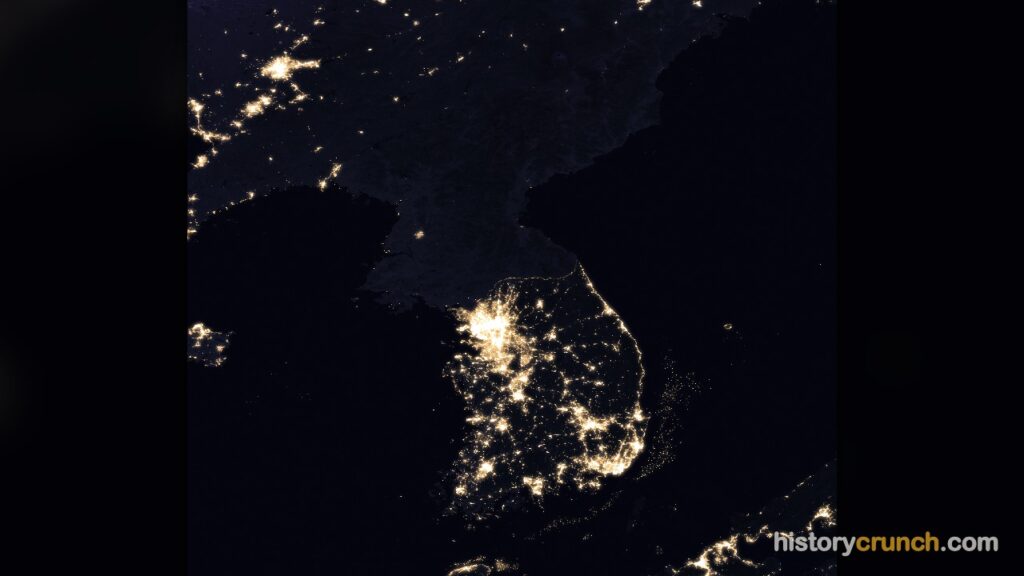
On August 15th, 1945 Japan's emperor announced the surrender and Japanese rule in Korea ended after 35 years. Koreans poured into the streets and set up local people's committees to run towns and cities. Soviet troops were already in the north; American troops did not land at Inchon until September 8th. In the three weeks between, Koreans governed themselves for the first time since 1910.
LEARN MORESHOW LESSwhy it mattersPOLITICSAugust 15th is Liberation Day in both Koreas. The people's committees proved that Koreans could and did organize their own government, which is why both occupying powers spent the next three years pushing them aside.
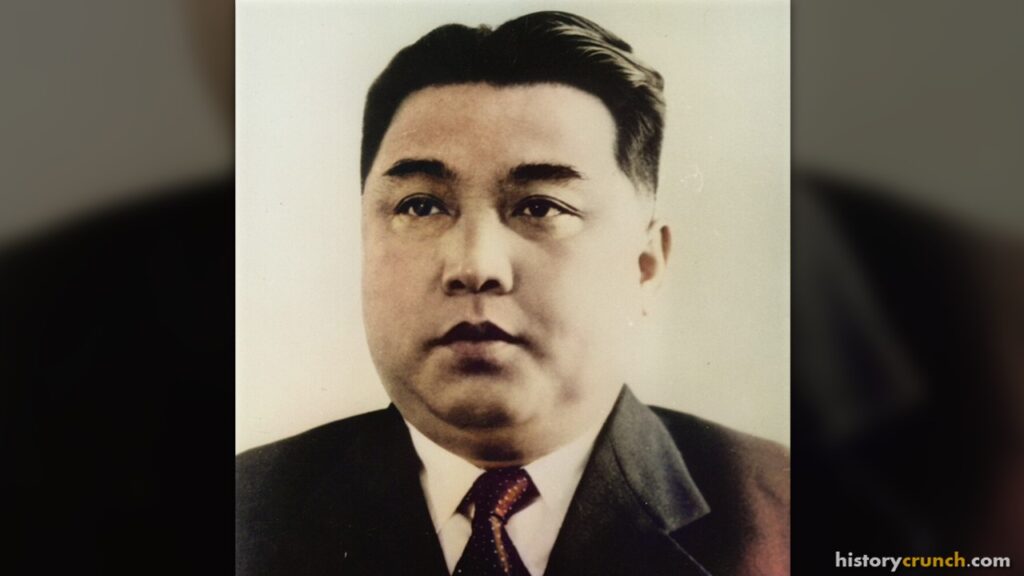
On September 19th, 1945 a 33-year-old Soviet army captain named Kim Il-Sung landed at Wonsan on a Soviet ship, after five years in the Soviet Union. On October 14th the Soviet occupation authorities presented him to a crowd in Pyongyang as a hero of the anti-Japanese struggle. By February 1946 he chaired the provisional government of the north. Older and better-known Korean communists were pushed aside, and some were later shot.
LEARN MORESHOW LESSwhy it matters · 2 key figuresPEOPLENorth Korea was not built by a Korean revolution. It was built by Soviet officers around a man they had picked, and everything from its army to its land reform came from that choice.
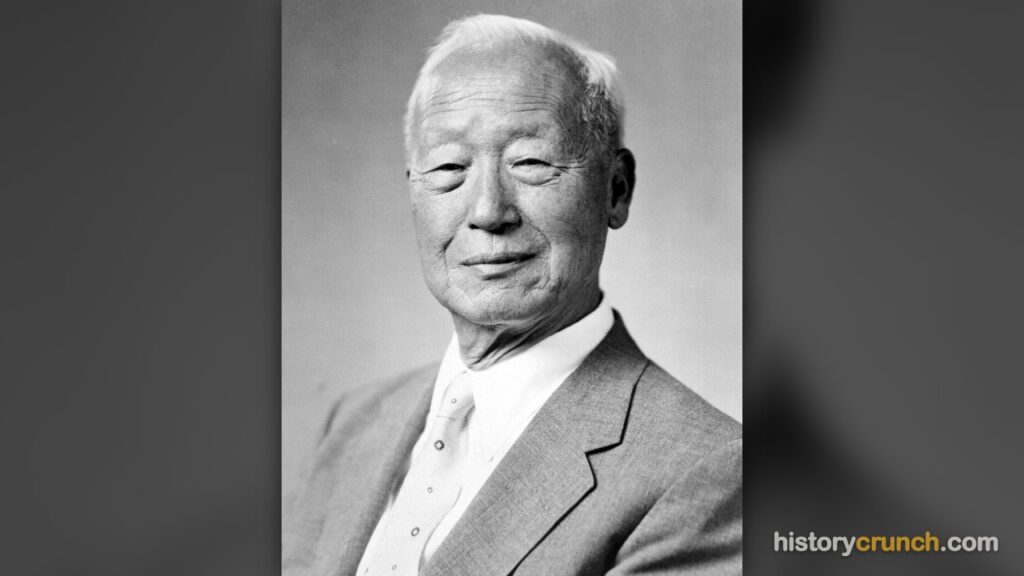
On October 16th, 1945 Syngman Rhee, aged seventy, landed in Seoul on an American military plane after 33 years abroad, most of them in the United States. He held a doctorate from Princeton, spoke fluent English, and was the best-known Korean alive. General John Hodge, the American commander, presented him to the public four days later. Rhee's message was simple: no trusteeship, no dealing with the Soviets, and no communists.
LEARN MORESHOW LESSwhy it matters · 1 key figurePEOPLEThe Americans had no plan for Korea and no Koreans they knew. Rhee was the one they knew. He used that to make himself the only possible president of the south, and to make any deal with the north impossible.
On December 27th, 1945 the foreign ministers of the United States, the Soviet Union and Britain agreed in Moscow that Korea would have a provisional government under a trusteeship of up to five years, worked out by a joint Soviet-American commission. In Seoul the news set off strikes and demonstrations against trusteeship of any length. The joint commission met in 1946 and 1947 and agreed on nothing, because each side wanted to exclude the other's Korean allies.
LEARN MORESHOW LESSwhy it mattersDIPLOMACYThis was the last plan for one Korea. It failed because neither superpower would let the other's friends into a Korean government, and because Koreans themselves, having just escaped one foreign master, refused to accept another.
On March 5th, 1946 the Soviet-backed provisional government in Pyongyang decreed a land reform: every holding over about 12 acres (5 hectares), and all land owned by Japanese and by Koreans who had worked for them, was confiscated without payment and divided among the peasants. About 2.4 million acres changed hands in a month. Landlords, Christians and businessmen fled south by the hundred thousand.
LEARN MORESHOW LESSwhy it matters · key numbersSOCIETYThe land reform made the north popular with its peasants and emptied it of its opponents, who went south and became the fiercest anti-communists in Rhee's Korea. Both states were shaped by this one decree.
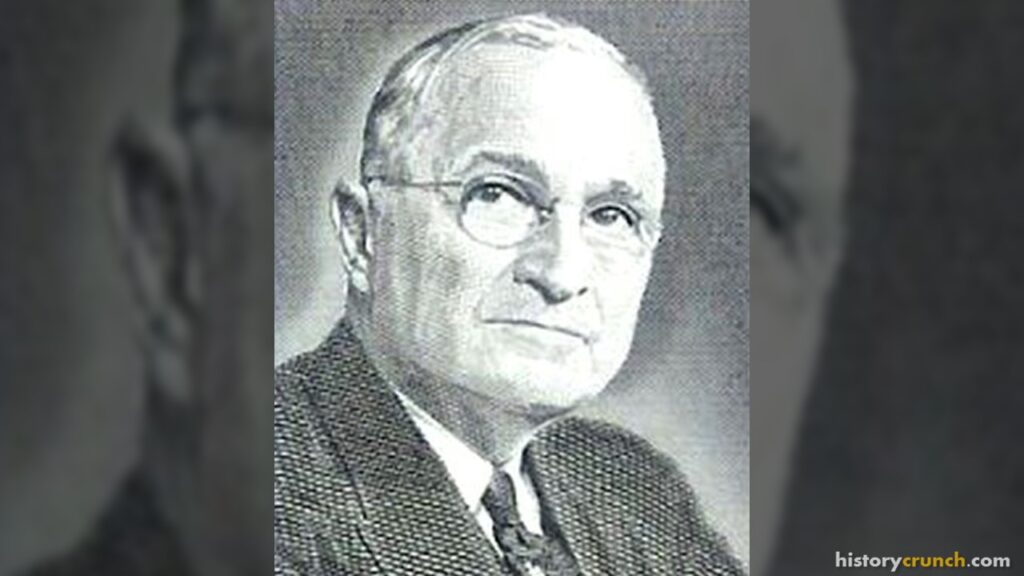
On March 12th, 1947 President Harry Truman asked Congress for $400 million to help Greece and Turkey against communist pressure, and declared that the United States would 'support free peoples who are resisting attempted subjugation by armed minorities or by outside pressures'. The policy behind it, containment, meant holding communism where it was rather than rolling it back or letting it spread.
LEARN MORESHOW LESSwhy it matters · a source · 1 key figureIDEASKorea was not mentioned. But when North Korea attacked in 1950, this was the sentence Truman was held to, and the reason he decided within hours that the United States would fight.
IN THEIR OWN WORDS“It must be the policy of the United States to support free peoples who are resisting attempted subjugation by armed minorities or by outside pressures.”
Harry Truman to Congress, March 12th, 1947
With the joint commission dead, the United States took the Korean question to the United Nations. On November 14th, 1947 the General Assembly voted to hold elections across all of Korea under a UN commission, followed by the withdrawal of both occupying armies. The Soviet Union refused to let the commission into the north. The UN then decided to hold the vote wherever it could, which meant the south alone.
LEARN MORESHOW LESSwhy it mattersDIPLOMACYFrom here the United Nations, not the United States, was formally in charge of Korea's future. That is why the UN could act within a day when the north invaded in 1950: Korea was already its responsibility.
On April 3rd, 1948 armed leftists on Jeju Island, off the southern tip of Korea, attacked police stations in protest at the coming separate elections in the south. The government's response, carried out by police, army and right-wing youth groups over the following year, killed somewhere between 14,000 and 30,000 of the island's 300,000 people and burned most of its mountain villages. A South Korean commission acknowledged the killings in 2003.
LEARN MORESHOW LESSwhy it matters · key numbersSOCIETYThe south was at war with its own left before the north ever crossed the parallel. Jeju is the reason historians call the Korean War a civil war that became an international one, rather than a simple invasion.
On May 10th, 1948 the American zone held Korea's first election under UN observation, for a National Assembly. Most of the left and many moderates boycotted it as a vote for permanent division, and about 100 people died in violence on election day. The new assembly wrote a constitution and on July 20th chose Syngman Rhee as president by 180 votes to 16.
LEARN MORESHOW LESSwhy it matters · 1 key figurePOLITICSElections in half a country create a state for half a country. From this day there were going to be two Koreas, and each would claim to be the only one.
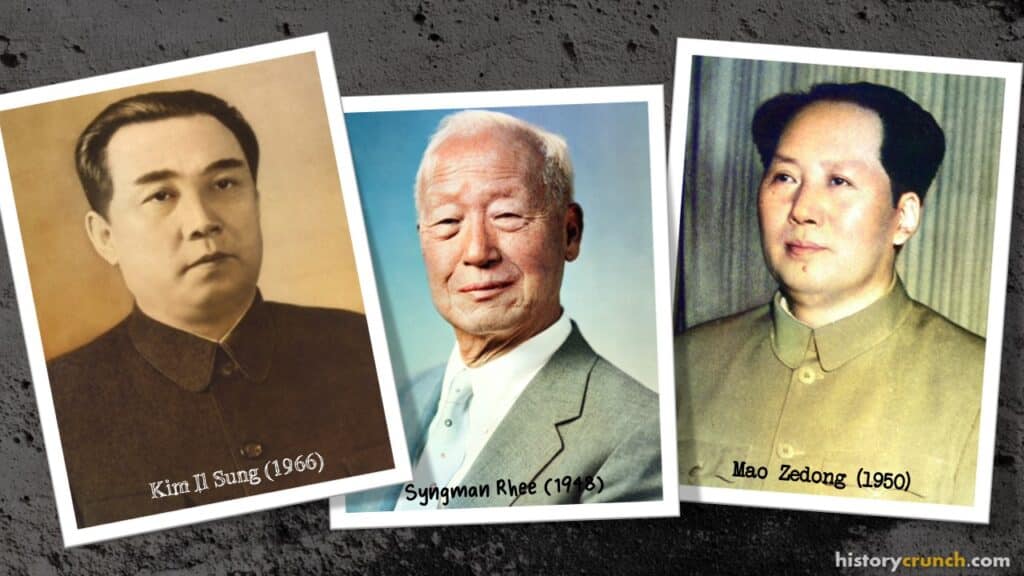
On August 15th, 1948, three years to the day after liberation, Syngman Rhee proclaimed the Republic of Korea, with Douglas MacArthur beside him on the platform. The American military government ended the same day. The new state claimed the whole peninsula and had an army of about 65,000 lightly armed men, no tanks and no combat aircraft, because Washington feared Rhee would use them to attack the north.
LEARN MORESHOW LESSwhy it matters · 2 key figuresPOLITICSSouth Korea was born claiming the north and unable to take it. Rhee talked of marching to the Yalu; the Americans made sure he could not, and in doing so left him unable to defend himself.
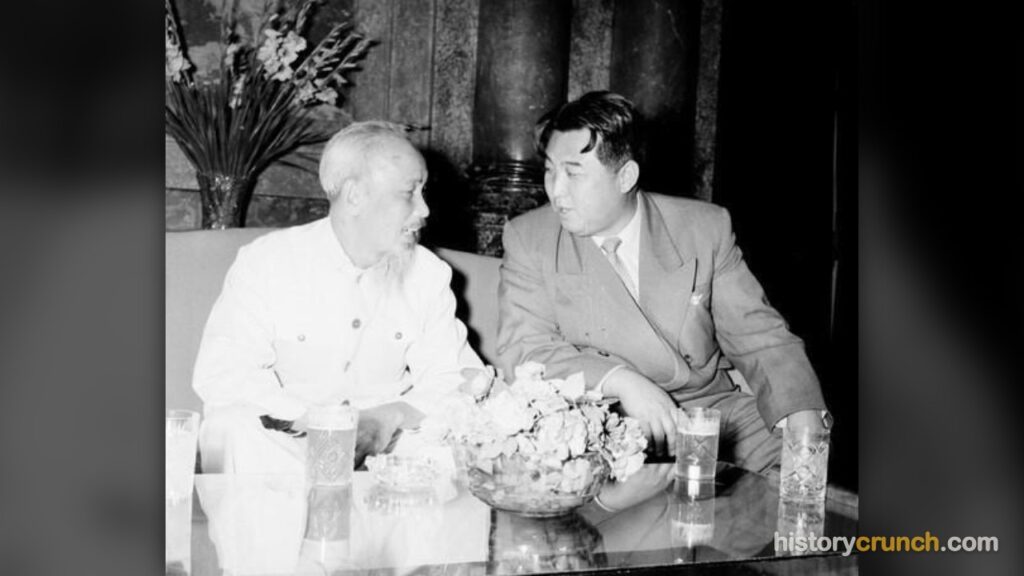
On September 9th, 1948 Kim Il-Sung proclaimed the Democratic People's Republic of Korea in Pyongyang, with himself as premier, three weeks after the south. The Korean People's Army had been founded in February with Soviet weapons and Soviet advisers. It claimed the whole peninsula too. The Soviet Union withdrew its troops in December 1948 and left the tanks behind.
LEARN MORESHOW LESSwhy it matters · 1 key figurePOLITICSTwo states, two armies, one country, and each with a constitution naming the other's capital as its own. There was no border between them in law, only a line neither accepted.
By 1949 the occupying armies had gone and the two Koreas were fighting battalion battles along the parallel, each promising its patron it could take the other in weeks. Everything that made the war possible happened in twelve months: the Americans left, the Soviets got the bomb, Mao won China and sent Kim Il-Sung 50,000 trained veterans, Acheson left Korea off the map of what America would defend, and in April 1950 Stalin, who had said no twice, said yes. Soviet officers wrote the plan. Two months later it was carried out.
On June 29th, 1949 the last American combat unit sailed from Korea, leaving a 500-man advisory group to train Rhee's army. The Joint Chiefs of Staff had decided in 1947 that Korea had 'little strategic interest' and the 45,000 troops were needed elsewhere. Rhee begged them to stay. Across the parallel the Soviets had left in December, but their tanks, artillery and training missions had not.
LEARN MORESHOW LESSwhy it matters · 1 key figureWARThe North Korean plan for 1950 depended on the Americans being gone. They were. Every argument in Pyongyang and Moscow about whether to attack started from this fact.
Through the summer of 1949 the two Korean armies fought each other along the 38th parallel in battalion-sized battles, the largest at Kaesong in May and on the Ongjin peninsula in August, where the fighting on August 4th involved thousands of men and artillery. Both sides started fights; both sides claimed the other had. In the south, an army regiment mutinied at Yosu in October 1948 and a guerrilla war ran in the southern mountains through 1949.
LEARN MORESHOW LESSwhy it mattersWARThe war did not begin on June 25th, 1950 from a clear sky. For a year the two Koreas had been shooting at each other across the line, and each had told its patrons the other was about to attack.
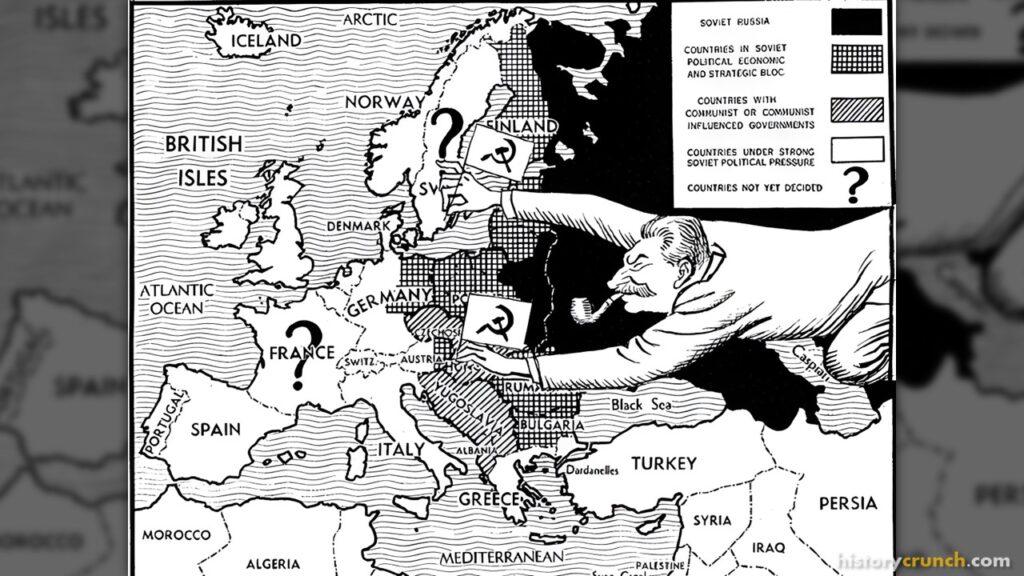
On August 29th, 1949 the Soviet Union exploded its first atomic bomb at Semipalatinsk in Kazakhstan, years before American intelligence expected it. The United States had lost its monopoly. Harry Truman announced the news on September 23rd.
LEARN MORESHOW LESSwhy it matters · 1 key figureWARStalin's willingness to let Kim attack in 1950 rested partly on this. With his own bomb, he could back a war in Asia without fearing the American one. In Washington, the same news made the loss of Korea feel like the start of something worse.
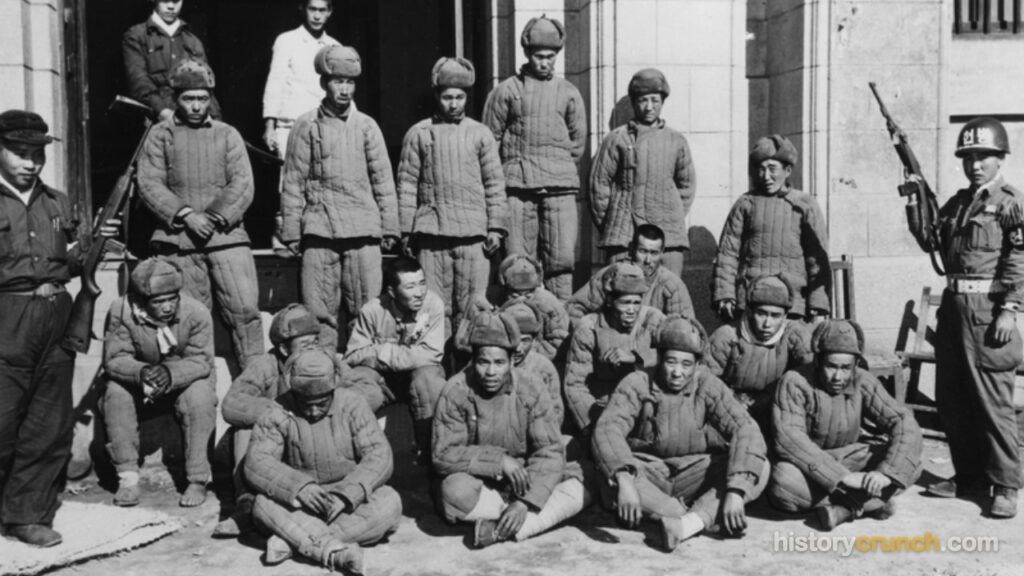
On October 1st, 1949 Mao Zedong stood on the Gate of Heavenly Peace in Beijing and proclaimed the People's Republic of China, after winning a civil war against Chiang Kai-shek's Nationalists, who fled to Taiwan. About 50,000 to 70,000 ethnic Korean veterans of Mao's army were released to North Korea over the following year with their weapons, giving Kim Il-Sung the core of an experienced army.
LEARN MORESHOW LESSwhy it matters · key numbers · 2 key figuresPOLITICSThe world's most populous country had gone communist, and it shared a border with North Korea. Kim now had two patrons, a trained army, and an American public asking 'Who lost China?' and determined not to lose anything else.
On January 12th, 1950 Secretary of State Dean Acheson told the National Press Club that America's defensive perimeter in the Pacific ran from the Aleutian Islands through Japan and the island of Okinawa to the Philippines. Korea and Taiwan were not on it. For places outside the line, he said, the first reliance must be on the people attacked and then on the United Nations. Stalin and Kim read the speech.
LEARN MORESHOW LESSwhy it matters · a debateDIPLOMACYWhether the speech caused the war is still argued. Stalin's approval to Kim came three months later, and Acheson's critics said he had invited the attack. His defenders answer that the North Koreans were already planning it and the speech only told them what they wanted to hear.
Did Acheson's speech invite the invasion?
Yes: Stalin and Kim read it as a promise that the United States would not fight for Korea, and Stalin's approval came three months later.
No: Soviet documents show Stalin had already changed his mind for other reasons, the bomb, China and the American withdrawal, and the speech only confirmed what he wanted to hear.
In April 1950 Kim Il-Sung spent two weeks in Moscow arguing that he could take the south in three days and that the Americans would not intervene. Stalin, who had refused him in March 1949 and again in September, now agreed, on condition that Mao Zedong also approved and that the Soviet Union would send no troops. In May Kim went to Beijing and Mao, told that Stalin had already said yes, agreed too. Soviet officers wrote the invasion plan.
LEARN MORESHOW LESSwhy it matters · 3 key figuresDIPLOMACYThe Korean War was planned in Moscow and approved in Beijing. Documents from the Soviet archives ended the argument about whether the north attacked on its own: it attacked with permission, a plan, and a promise that the Americans would stay out.
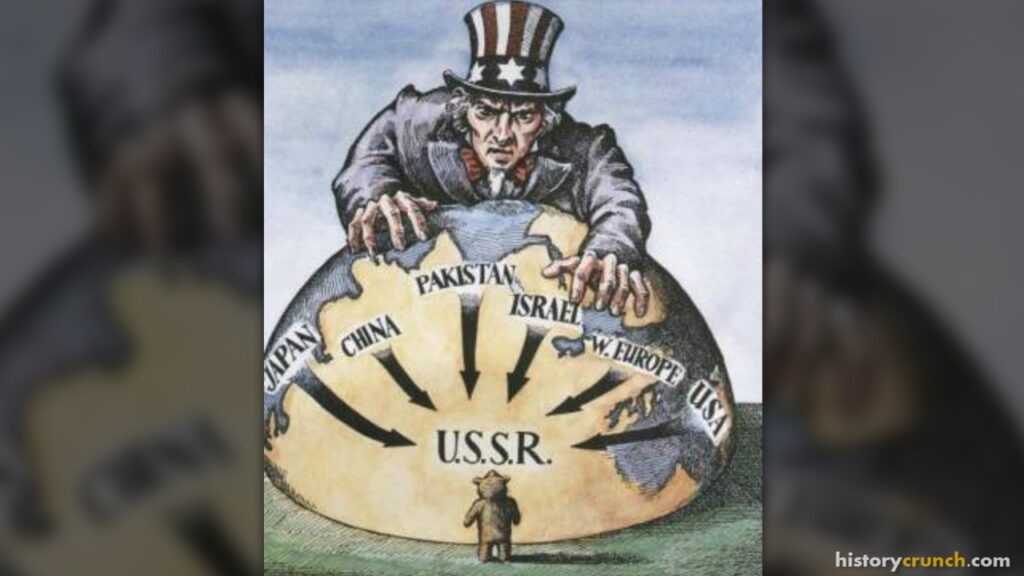
On April 14th, 1950 the National Security Council gave Truman a secret report, NSC-68, arguing that the Soviet Union was 'animated by a new fanatic faith' and seeking world domination, and that the United States should raise its defense spending from about $13 billion a year to $40 billion or more. Harry Truman thought the figure impossible and put the report aside. Ten weeks later North Korea attacked.
LEARN MORESHOW LESSwhy it matters · key numbers · 1 key figureIDEASKorea made NSC-68 happen. Defense spending rose to $50 billion by 1953, the army doubled, and the permanent Cold War military that lasted forty years was built during a war in Korea rather than for it.
At four in the morning on Sunday, June 25th, 1950, 90,000 North Korean troops and 150 Soviet tanks crossed the parallel, and for six weeks nothing stopped them. Seoul fell in three days. The first Americans, 540 men flown in from Japan, were brushed aside at Osan in seven hours. By August everything the United Nations held was a box 50 miles wide around the port of Pusan, and Walton Walker told his army there was no line behind them to retreat to. It held, because the port let in more men each week than the north could kill.
At about 4 a.m. on Sunday, June 25th, 1950, after an artillery barrage, about 90,000 North Korean troops with 150 Soviet-built T-34 tanks crossed the 38th parallel at six points along its length, from the Ongjin peninsula in the west to the east coast. The South Korean army had no tanks, no anti-tank guns that could stop a T-34, and a third of its men on weekend leave. Pyongyang radio announced that the south had attacked first and the north was counterattacking.
LEARN MORESHOW LESSwhy it matters · key numbers · 1 key figureWARThis is the day the Cold War turned hot, and the first proxy war of the age began: Koreans fighting Koreans with Soviet tanks and, within days, American planes. Every superpower crisis of the next forty years was read against it.
Within hours of the news the United States called the UN Security Council into session in New York, and on the afternoon of June 25th it passed Resolution 82 by nine votes to none, calling the invasion a breach of the peace and demanding that North Korea withdraw. The Soviet Union, which could have vetoed it, was boycotting the Council over its refusal to seat communist China, and its chair was empty.
LEARN MORESHOW LESSwhy it matters · a debateDIPLOMACYHad the Soviet delegate been in his seat, the United Nations could not have gone to war in Korea. Stalin's boycott, kept up for another six weeks, is one of the puzzles of the war: he may have wanted the Americans tied down in Asia.
Why did Stalin let the UN vote go through?
A blunder: the boycott was about China's seat, and Moscow did not expect the Council to act within a day.
On purpose: a letter Stalin wrote to the Czech leader in August 1950 says he wanted the United States tied down in a long Asian war that would push China closer to Moscow.
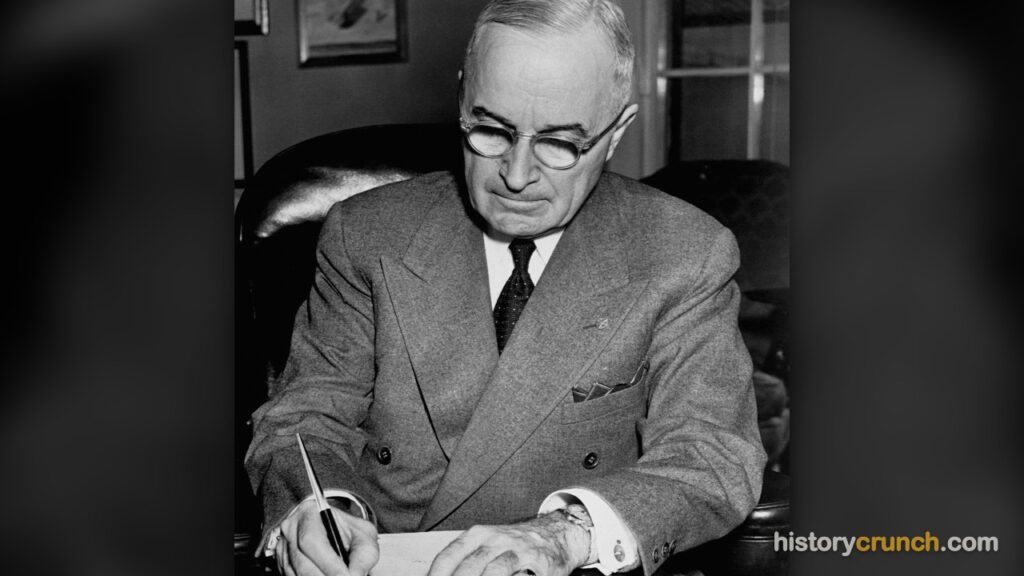
On June 27th, 1950 Harry Truman, back from a weekend in Missouri, announced that he had ordered American air and naval forces to support the South Korean army, and that the Seventh Fleet would guard Taiwan. The same day the Security Council passed Resolution 83, asking member states to help South Korea 'repel the armed attack'. Truman never asked Congress for a declaration of war; he called it a 'police action' under the United Nations.
LEARN MORESHOW LESSwhy it matters · a source · 1 key figurePOLITICSThe decision to fight was made in two days by one man, and the way it was made, by presidential order under a UN resolution rather than a vote of Congress, set the pattern for every American war since.
IN THEIR OWN WORDS“We are not at war. This is a police action.”
Harry Truman at a press conference, June 29th, 1950WHAT TO NOTICEHe was asked whether the country was at war, and answered no.
On June 27th, 1950 American F-82 Twin Mustang fighters covering the evacuation of civilians from Seoul shot down three North Korean aircraft over Suwon airfield, the first kills of the war. Within weeks American planes had destroyed most of North Korea's small air force of about 130 Soviet-built propeller aircraft on the ground and in the air.
LEARN MORESHOW LESSwhy it mattersAIR WARAir superiority was the one advantage the United Nations never lost, and it was won in the first fortnight. Everything that followed on the ground, from the Pusan Perimeter to the retreat from the Yalu, happened under friendly skies.
North Korean tanks entered Seoul on the morning of June 28th, 1950, three days after the attack. At 2:30 a.m. South Korean engineers had blown the main Han River bridge on orders from the army, while it was packed with fleeing soldiers and civilians; several hundred died in the explosion, and most of the South Korean army was trapped north of the river with its heavy equipment. Syngman Rhee had left the capital by train the day before while radio broadcasts told the people to stay.
LEARN MORESHOW LESSwhy it matters · 1 key figureWARThe south lost its capital and most of its army in 72 hours. The bridge is remembered in South Korea as the moment the government abandoned its people; the colonel who gave the order was shot for it in September.
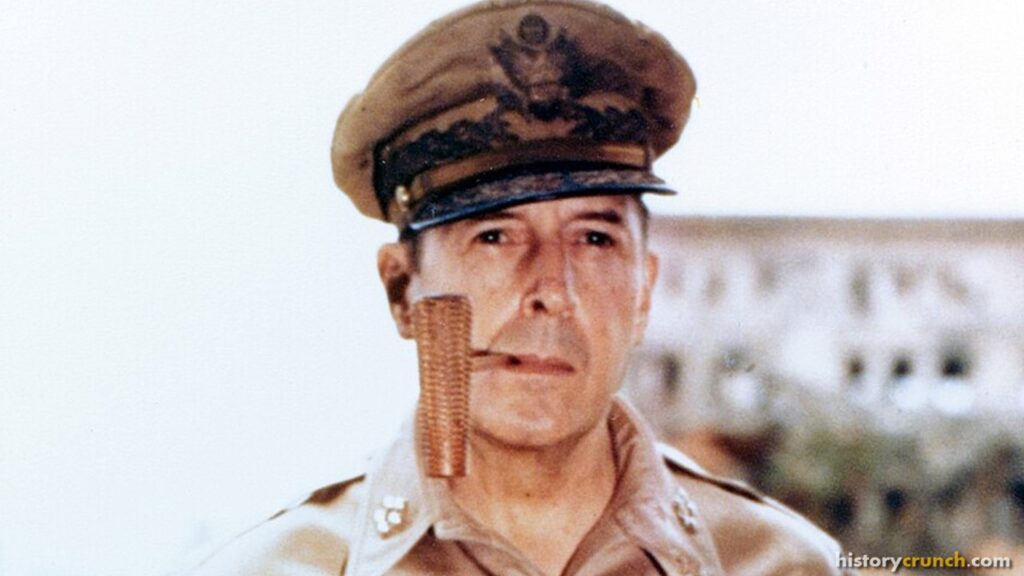
On June 30th, 1950, after Douglas MacArthur flew to Korea, watched the retreat from a hill south of the Han River and cabled that only American ground troops could hold the south, Harry Truman authorized him to commit the army from Japan. The four American divisions in Japan were under strength, soft from occupation duty, and equipped with weapons left over from 1945.
LEARN MORESHOW LESSwhy it matters · 2 key figuresPOLITICSAir and sea power had not stopped the T-34s. Committing infantry meant Americans would die, and it turned a police action into a war the United States could not walk away from.
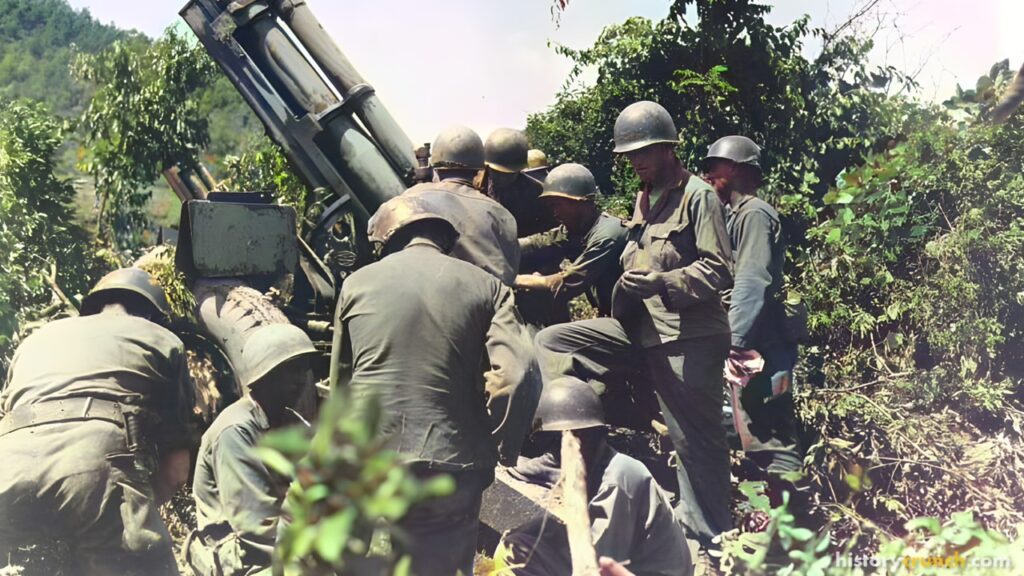
On the morning of July 5th, 1950, in the rain near Osan, 540 men of the 24th Infantry Division under Lieutenant Colonel Charles Smith, flown in from Japan two days earlier, met 33 T-34 tanks and 5,000 North Korean infantry. Their bazookas bounced off the tanks. After seven hours they broke and ran, leaving their wounded; about 180 were killed, wounded or captured. The North Koreans were delayed by a few hours.
LEARN MORESHOW LESSwhy it matters · key numbersWARThe first American battle of the war was a defeat, and it told both sides the same thing: the United States had come to fight, and had come unprepared. 'No more Task Force Smiths' became an army saying for fifty years.
On July 7th, 1950 the Security Council passed Resolution 84, placing all forces sent to Korea under a unified command led by the United States and flying the UN flag. Harry Truman named Douglas MacArthur its commander the next day. In the end 16 countries sent fighting units, from Britain, Turkey and Canada to Ethiopia, Colombia and Luxembourg, and five more sent medical teams. About 90 percent of the non-Korean troops were American.
LEARN MORESHOW LESSwhy it matters · key numbers · 1 key figureDIPLOMACYFor the first time the United Nations had an army in the field. It was mostly an American army under an American general answering to Washington, but the flag mattered: it made Korea the world's war, not one country's.
From July 14th to 20th, 1950 the 24th Infantry Division fought to hold the city of Taejon, buying time for reinforcements to land at Pusan. It lost the city on July 20th and about 3,600 men in the two weeks of fighting. Its commander, Major General William Dean, was separated from his troops while hunting tanks with a bazooka in the streets, wandered the hills for 36 days, and was betrayed to the North Koreans by two Koreans he asked for food. He was the highest-ranking American prisoner of the war.
LEARN MORESHOW LESSwhy it mattersWARTaejon was the price of the Pusan Perimeter. The 24th Division was destroyed as a fighting unit, but the week it bought let the Americans build a line they could hold.
Between July 26th and 29th, 1950 soldiers of the American 7th Cavalry, retreating near the village of No Gun Ri, fired on hundreds of South Korean refugees sheltering under a railway bridge, after orders that refugees approaching American lines were to be treated as possible enemy infiltrators. South Korean survivors put the dead at about 250 to 300. The United States Army acknowledged the killings in 2001 after an Associated Press investigation.
LEARN MORESHOW LESSwhy it mattersSOCIETYThe war was fought among a population of refugees, and both sides killed civilians they took for enemies. No Gun Ri was hidden for fifty years and is the reason many South Koreans remember the American rescue with mixed feelings.
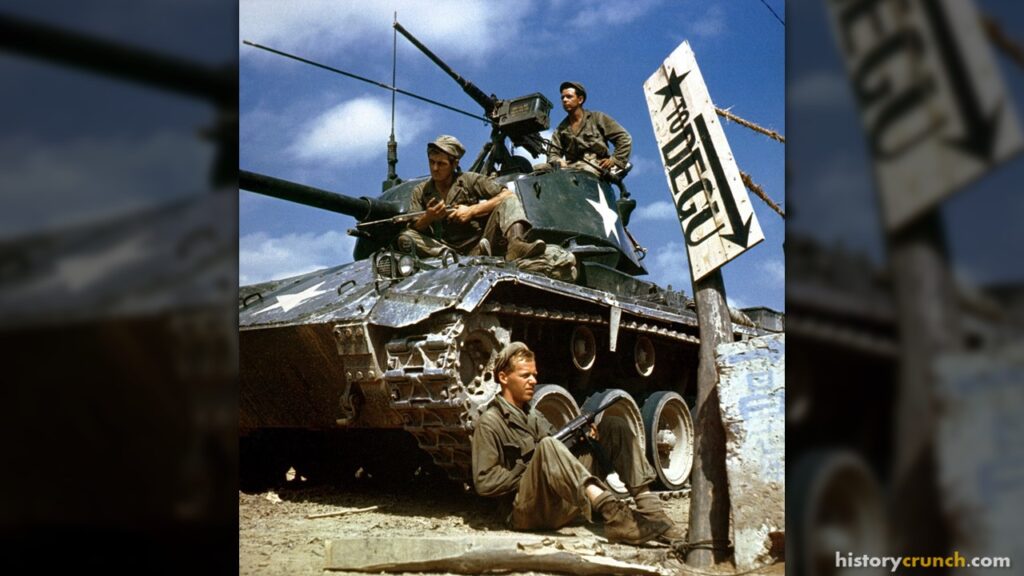
By August 4th, 1950 the United Nations forces had fallen back to a rectangle about 50 miles (80 km) wide and 100 miles (160 km) deep in the southeast corner of Korea, behind the Naktong River, around the port of Pusan. Walton Walker, commanding the Eighth Army, told his officers there would be no more retreating: 'a Dunkirk would be a terrible thing'. For six weeks the North Koreans, now down to about 70,000 exhausted men at the end of a 200-mile supply line, attacked the perimeter, and the Americans, reinforced daily through Pusan, held it.
LEARN MORESHOW LESSwhy it matters · key numbers · a sourceWARIf Pusan had fallen the war would have ended in August 1950 with a communist Korea. It held because the north had outrun its supplies and because the port let the Americans pour in more men than the north could kill.
IN THEIR OWN WORDS“There will be no more retreating, withdrawal, or readjustment of the lines. There is no line behind us to which we can retreat.”
Walton Walker to the 25th Infantry Division, July 29th, 1950WHAT TO NOTICEHis 'stand or die' order, given as the Eighth Army fell back on Pusan.
On August 29th, 1950 the British 27th Infantry Brigade, two battalions from Hong Kong, landed at Pusan, the first ground troops from a country other than the United States and South Korea. The same month the Americans began filling their thin divisions with South Korean soldiers, called KATUSAs, about 100 to a company. Turkish, Australian, Canadian, Thai, Philippine, Dutch, French, Greek and other contingents followed through the autumn and winter. Britain sent the most after the United States: about 14,000 men at peak strength and about 1,100 dead.
LEARN MORESHOW LESSwhy it mattersWARSixteen flags on the perimeter turned an American intervention into a United Nations war in fact as well as in name, which is what Harry Truman needed at home and abroad.
On September 8th, 1950 Congress passed the Defense Production Act, giving the president power to order factories to fill military contracts first, to allocate scarce materials, and to control prices and wages. Draft calls rose from about 10,000 a month to 50,000. Taxes went up. There was no rationing as in World War II, but a scare-buying wave that summer emptied shelves of sugar, tires and nylons.
LEARN MORESHOW LESSwhy it mattersHOME FRONTThe home front of the Korean War was quieter than 1942 but its machinery lasted longer. The Defense Production Act is still law and was used in the 2020 pandemic.
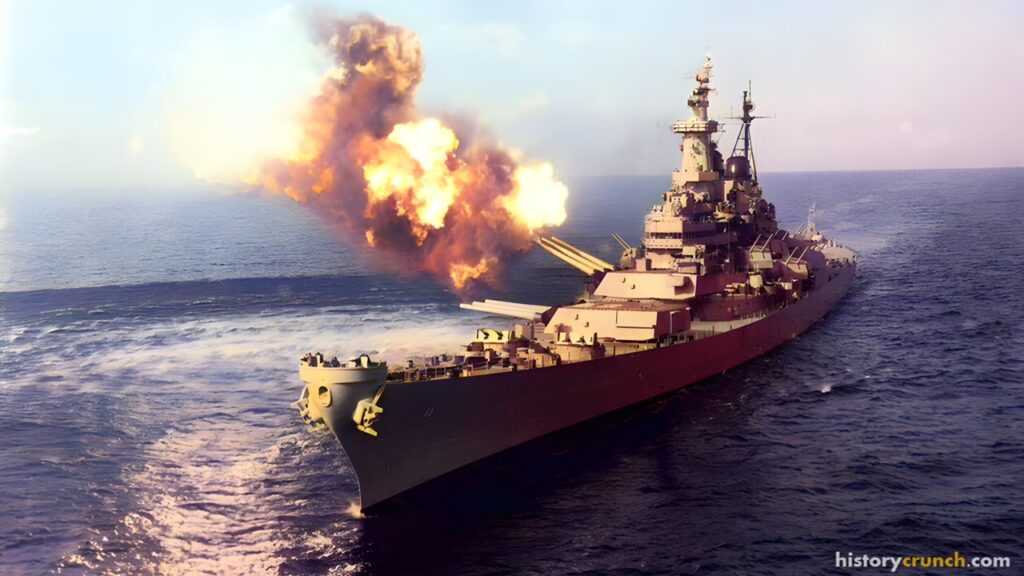
On September 15th, 1950 Douglas MacArthur landed 70,000 men at Inchon, a harbor with 30-foot tides that every planner in Washington had called impossible, 150 miles behind the North Korean army. Within two weeks that army had ceased to exist and Seoul was back in Rhee's hands. The war the north started was won. Then the United Nations changed its aim from repelling an invasion to ending a state: South Korean troops crossed the parallel on October 1st, Pyongyang fell on the 19th, and MacArthur told Harry Truman on Wake Island that China would not come in. That same week 300,000 Chinese soldiers were walking into North Korea by night.
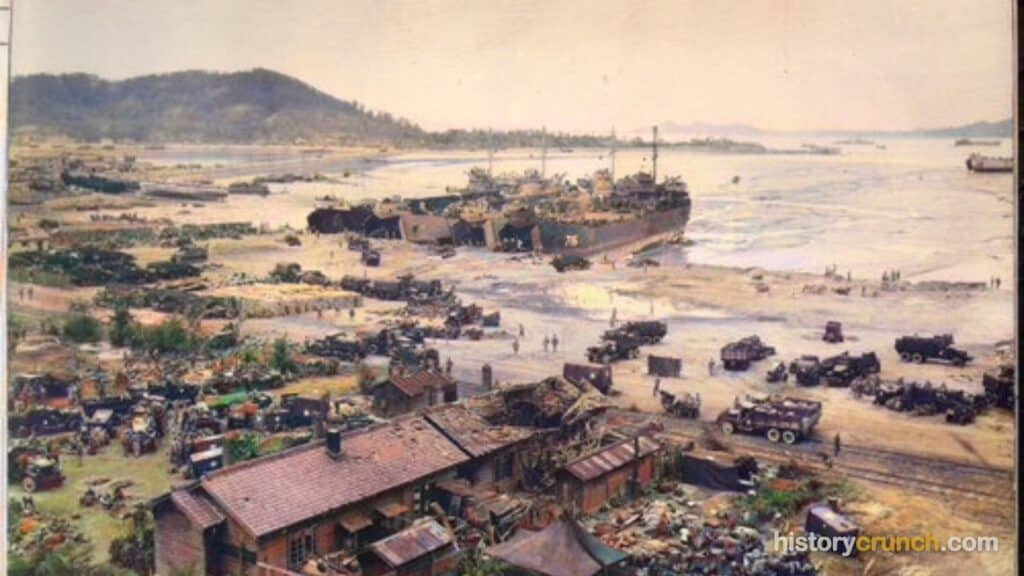
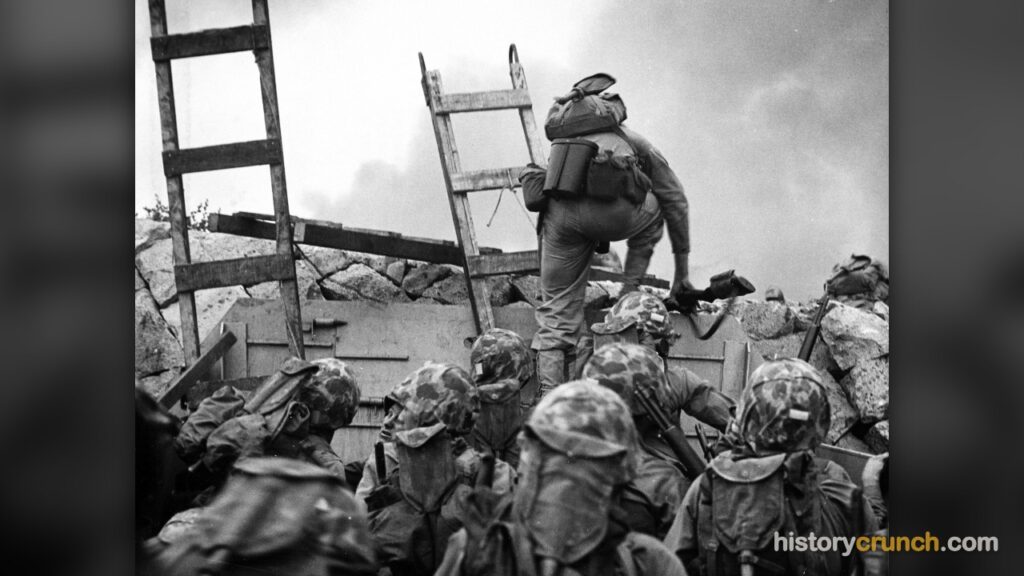
At dawn on September 15th, 1950 the 1st Marine Division landed at Inchon, the port of Seoul, 150 miles (240 km) behind the North Korean army at Pusan. Inchon had 30-foot (9 m) tides, a narrow channel, mud flats and sea walls, and every planner in Washington had told Douglas MacArthur it could not be done. That was his argument for doing it: the enemy would think the same. The Marines took the harbor island of Wolmi-do in the morning, the city by the next day, and Kimpo airfield on the 17th. North Korean resistance was light because almost every North Korean soldier was 150 miles south.
LEARN MORESHOW LESSwhy it matters · key numbers · a sourceWARInchon is the most famous stroke of the war and the one that saved South Korea. Within two weeks the North Korean army, cut off from its supplies, ceased to exist as a fighting force.
IN THEIR OWN WORDS“We shall land at Inchon, and I shall crush them.”
Douglas MacArthur to the Joint Chiefs' representatives, August 23rd, 1950WHAT TO NOTICEHis closing words to the generals and admirals sent to Tokyo to talk him out of the landing.
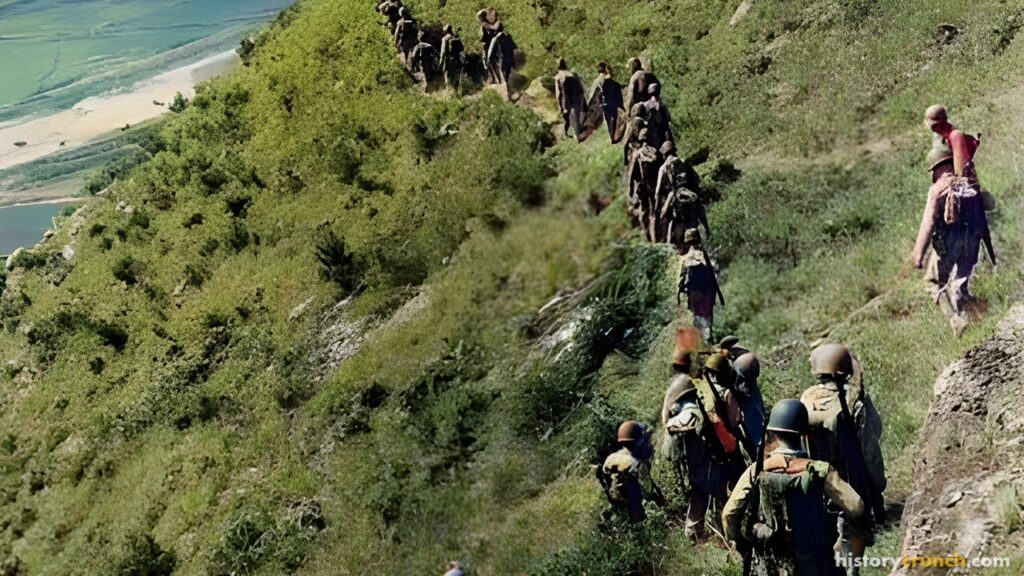
On September 16th, 1950, the day after Inchon, Walton Walker's Eighth Army attacked out of the Pusan Perimeter. For several days the North Koreans held; then, as the news from Inchon spread, their army broke. By the end of the month it was streaming north in small groups through the mountains, leaving its tanks and guns behind. Of the 70,000 men who had besieged Pusan, perhaps 25,000 reached the north.
LEARN MORESHOW LESSwhy it mattersWARThe war the north started was lost in two weeks. What made the next three years was the decision about what to do with the victory.
After a week of street fighting that wrecked much of the city, the Marines cleared Seoul on September 28th, 1950. The next day Douglas MacArthur flew in and formally returned the capital to Syngman Rhee in the shell-damaged National Assembly hall, ending with the Lord's Prayer as plaster fell from the ceiling. Then he flew back to Tokyo. The North Koreans, as they left, had shot thousands of prisoners and 'reactionaries'; the South Koreans, returning, shot thousands of 'collaborators'.
LEARN MORESHOW LESSwhy it matters · 2 key figuresWARThree months after the invasion the south had its capital and its border back. The United Nations' stated war aim, to repel the attack, was achieved on this day. The war did not stop.
On October 1st, 1950 South Korean troops crossed the 38th parallel on the east coast, on Rhee's orders and with MacArthur's approval, before the United Nations had said anything about going north. Harry Truman had already authorized MacArthur on September 27th to destroy the North Korean army, provided there was no sign of Soviet or Chinese intervention. The same day, Zhou Enlai warned that China would not 'supinely tolerate' an invasion of its neighbor. Washington took it as a bluff.
LEARN MORESHOW LESSwhy it matters · 3 key figuresPOLITICSThis is where the war changed from defending the south to conquering the north. The line that had been the war's cause was now just a line, and the goal became one Korea, under Rhee.
On October 7th, 1950 the UN General Assembly, by 47 votes to 5, authorized 'all appropriate steps' to ensure stability throughout Korea and the creation of a unified, independent and democratic government. It was written to let MacArthur go north without saying so. The same night, Mao ordered the Chinese army to move into Korea.
LEARN MORESHOW LESSwhy it matters · 1 key figureDIPLOMACYThe United Nations changed its war aim from repelling an invasion to ending a state. Mao's decision came the same night, and the two facts belong together.
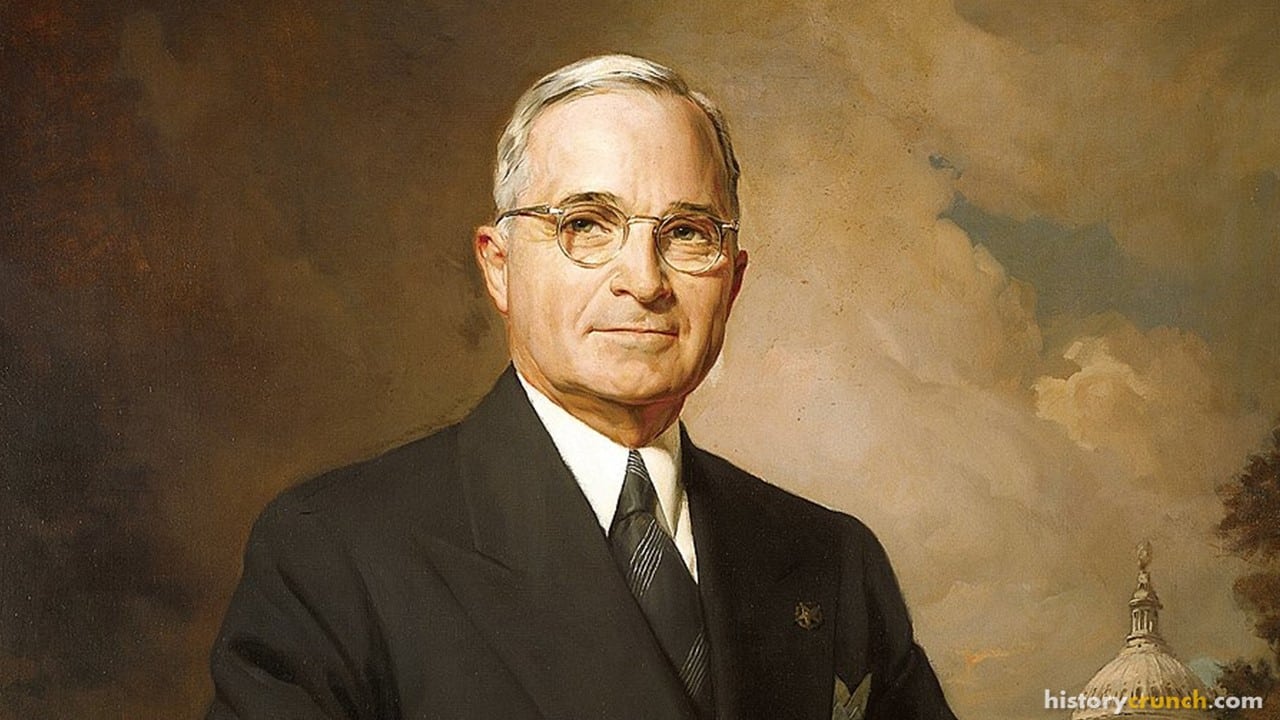
On October 15th, 1950 Harry Truman flew 7,000 miles to Wake Island in the Pacific to meet Douglas MacArthur, whom he had never met, for a two-hour conference. MacArthur said formal resistance would end by Thanksgiving, that the Eighth Army would be back in Japan by Christmas, and that if the Chinese tried to intervene, without an air force, 'there would be the greatest slaughter'. Chinese troops had been crossing the Yalu for a week.
LEARN MORESHOW LESSwhy it matters · a source · 2 key figuresPOLITICSThe meeting is remembered for how wrong it was. Truman flew home reassured; MacArthur flew home certain; and 300,000 Chinese soldiers were already in the mountains of North Korea.
IN THEIR OWN WORDS“We are no longer fearful of their intervention. We no longer stand hat in hand.”
Douglas MacArthur to Harry Truman at Wake Island, October 15th, 1950WHAT TO NOTICEHis answer when the president asked what the chances were of Chinese or Soviet intervention.
On the night of October 19th, 1950 the first units of the Chinese People's Volunteer Army under Peng Dehuai crossed the Yalu River bridges into North Korea, marching only at night, hiding in villages and forests by day, and forbidden to light fires. By November 1st about 180,000 men were in Korea; by the end of the month, 300,000. American reconnaissance planes saw almost nothing. They were called volunteers so that China and the United States would not formally be at war.
LEARN MORESHOW LESSwhy it matters · key numbers · 1 key figureWARThe largest army the United States had faced since 1945 walked into Korea unseen. Mao had decided that a hostile army on the Yalu was a threat he could not live with, and Stalin had promised air cover, then delayed it, then sent it in secret.
On October 19th, 1950 the American 1st Cavalry Division and the South Korean 1st Division entered Pyongyang, the North Korean capital, the same night the Chinese were crossing the Yalu 130 miles (210 km) to the north. Kim Il-Sung's government had fled to Sinuiju on the Chinese border. American paratroopers dropped north of the city the next day to cut off the retreat, and MacArthur flew in to watch.
LEARN MORESHOW LESSwhy it matters · 1 key figureWARFor five weeks the United Nations held the capital of North Korea, and the idea of a single Korea under Rhee looked like fact. It was the high point of the war for the south, and it lasted until Thanksgiving.
On the night of November 1st, 1950 Chinese troops attacked the American 8th Cavalry Regiment at Unsan, 60 miles (100 km) south of the Yalu, with bugles and whistles, coming through the hills on foot and cutting the road behind it. The regiment lost about 600 men and most of its equipment. Six days later the Chinese broke contact and disappeared into the mountains, and MacArthur's headquarters decided they had been a token force of perhaps 30,000 that had shot its bolt.
LEARN MORESHOW LESSwhy it mattersWARUnsan was a warning that was read as good news. The Chinese withdrew on purpose, to draw the United Nations deeper, and the trick worked completely.
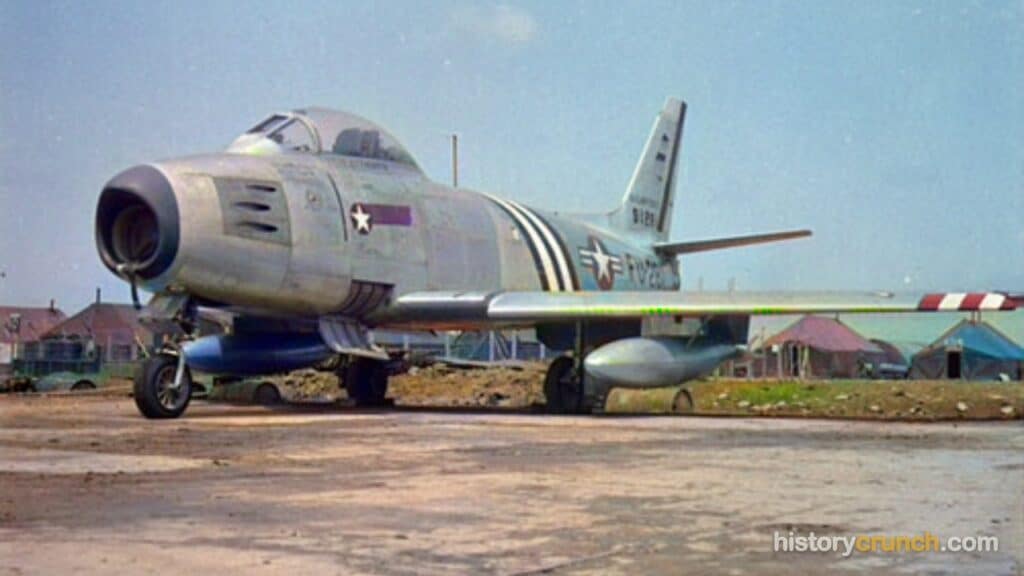
On November 8th, 1950, over the Yalu River, an American F-80 Shooting Star pilot, Lieutenant Russell Brown, shot down a Soviet-built MiG-15, the first victory of one jet fighter over another. The MiG-15 had appeared a week earlier and was faster and could climb higher than anything the Americans had in Korea. Its pilots, it later turned out, were mostly Soviet airmen in Chinese markings, a secret both governments kept for forty years. The F-86 Sabre arrived in December to meet it, and the stretch of sky along the Yalu became 'MiG Alley'.
LEARN MORESHOW LESSwhy it matters · key numbersAIR WARKorea was the first jet war, and the Soviet Union and the United States fought each other in it directly, in the air, for two and a half years, while both pretended they were not.
On November 24th, 1950, the day after Thanksgiving, Douglas MacArthur launched what he told reporters would be the final offensive to the Yalu, saying the troops could be home by Christmas. The Eighth Army in the west and X Corps in the east advanced up separate valleys 80 miles apart, in temperatures falling toward minus 30 F (minus 34 C), into mountains where 300,000 Chinese were waiting. The offensive lasted one day.
LEARN MORESHOW LESSwhy it matters · 1 key figureWARIt is remembered as the worst-judged attack of the war. MacArthur's intelligence chief counted the Chinese at 70,000; there were four times as many, and they attacked the next night.
On the night of November 25th, 1950, the day after MacArthur's 'Home by Christmas' offensive began, 200,000 Chinese attacked, and the Eighth Army fell back 120 miles in ten days, the longest retreat in American history. At the Chosin Reservoir the Marines fought 78 miles to the sea at minus 35 degrees. Seoul fell again in January. Then Matthew Ridgway, who took the Eighth Army three days after Walker died on an icy road, turned it around with artillery and stubbornness, and by March it was back on the parallel. In April Harry Truman fired MacArthur for arguing with him in public, and the Chinese threw 700,000 men at Seoul for the last time and broke.
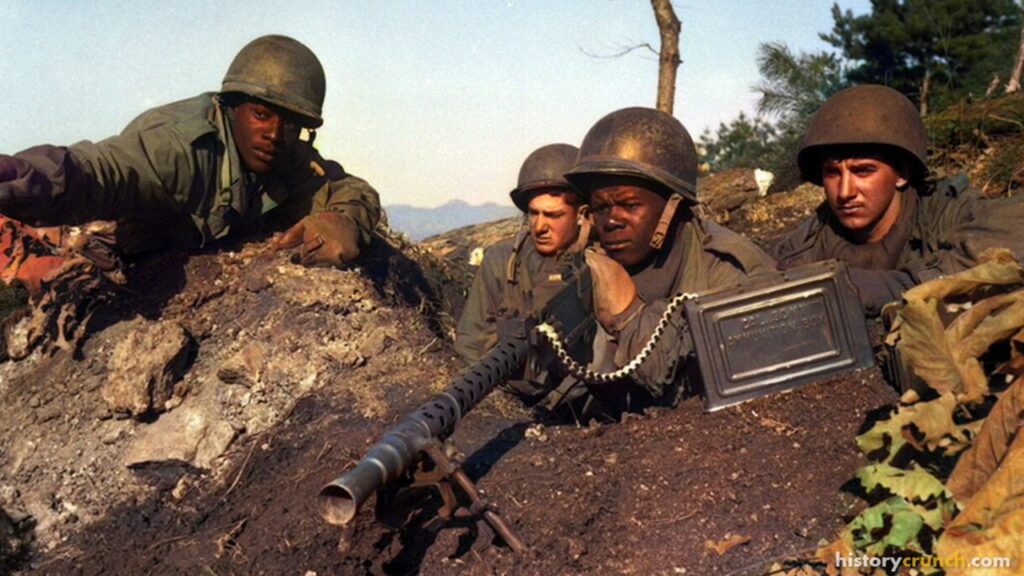
On the night of November 25th, 1950 about 200,000 Chinese troops attacked the Eighth Army along the Chongchon River, destroying the South Korean II Corps on its right flank and cutting the roads behind the Americans. At Kunu-ri on November 30th the 2nd Infantry Division ran a six-mile gauntlet of Chinese fire and lost 4,000 men and most of its guns. Walton Walker ordered a general retreat, and the Eighth Army fell back 120 miles (190 km) in ten days, the longest retreat any American army has made.
LEARN MORESHOW LESSwhy it matters · key numbersWARIn one week the war was reversed for the third time. The Chinese had done to the United Nations what Inchon had done to the north, and the question in Washington became whether to leave Korea altogether.
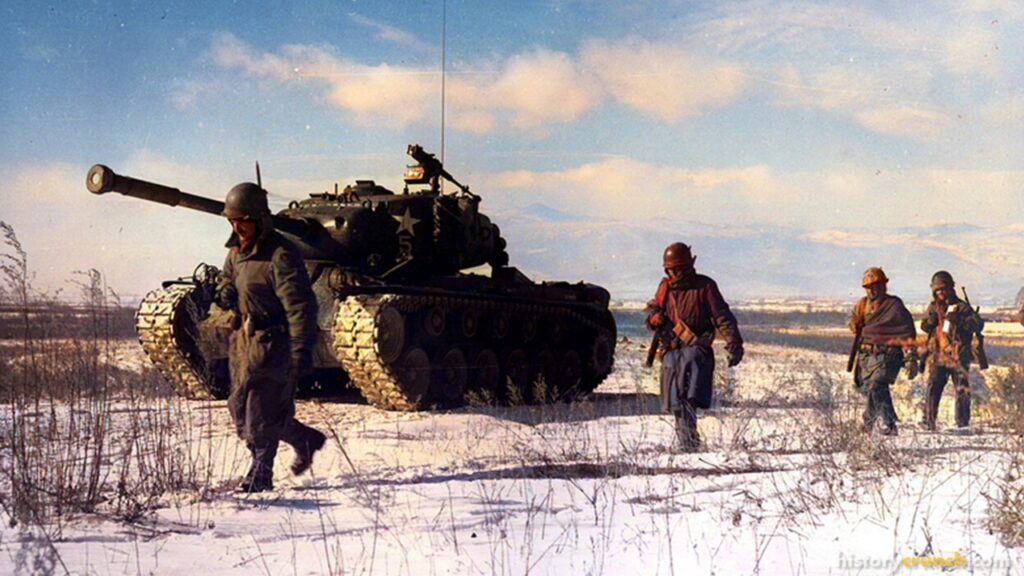
From November 27th to December 13th, 1950 about 30,000 United Nations troops, mostly the 1st Marine Division, were surrounded by 120,000 Chinese at the Chosin Reservoir in the mountains of northeast Korea, in temperatures of minus 35 F (minus 37 C). Weapons froze, wounds froze, and food had to be thawed against the body. The Marines fought 78 miles (125 km) down a single mountain road to the sea, bringing their wounded and their dead. About 1,000 were killed and 4,900 wounded; about 7,300 had frostbite. Chinese losses were perhaps 40,000, half of them to cold.
LEARN MORESHOW LESSwhy it matters · key numbers · a sourceWARChosin is the Marine Corps' proudest battle and the war's clearest picture of what it was like to fight: cold, mountains, and an enemy who kept coming. 'Retreat, hell,' said the division commander, Oliver Smith. 'We're just attacking in another direction.'
IN THEIR OWN WORDS“Retreat, hell! We're not retreating, we're just advancing in a different direction.”
Oliver Smith, commanding the 1st Marine Division, December 4th, 1950WHAT TO NOTICETo reporters at Hagaru-ri, as the division began its march to the coast.
At a press conference on November 30th, 1950, as the Eighth Army retreated, Harry Truman was asked whether the atomic bomb might be used in Korea and said its use was always under active consideration, and that the commander in the field would be in charge of the weapons. Within hours Britain's prime minister, Clement Attlee, announced he was flying to Washington. Truman spent four days assuring him the bomb would not be used without consultation.
LEARN MORESHOW LESSwhy it matters · 1 key figurePOLITICSThe war came closer to the bomb than any other, and the allies' alarm at this piece of brinkmanship was the first sign that a United Nations war had limits the United States could not set alone.
From December 15th to 24th, 1950 the United States Navy evacuated X Corps from the port of Hungnam in northeast Korea: about 105,000 troops, 17,500 vehicles and 350,000 tons of supplies. It also took off about 98,000 North Korean civilians who had begged to leave, packed into any ship that would float; one freighter, the Meredith Victory, built for 12 passengers, carried 14,000. On Christmas Eve the last ship left and the engineers blew up the port. The parents of a future South Korean president were on the Meredith Victory.
LEARN MORESHOW LESSwhy it matters · key numbersSOCIETYHungnam was a defeat turned into a rescue, and for the 98,000 who left, the last chance anyone in the north would have for seventy years to choose which Korea to live in.
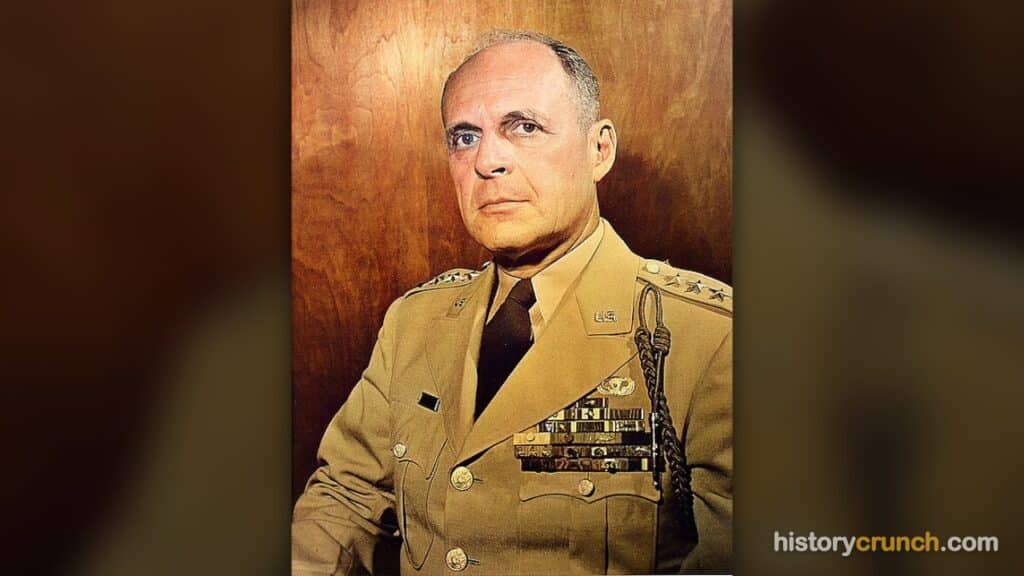
On December 23rd, 1950 Walton Walker, commander of the Eighth Army, was killed when his jeep collided with a South Korean army truck on an icy road north of Seoul. Matthew Ridgway, a paratroop general of World War II, was in Washington when the call came; he landed in Korea on December 26th and drove the front for three days. He found an army that had stopped believing it could win, and told his officers the retreat was over.
LEARN MORESHOW LESSwhy it matters · 1 key figurePEOPLERidgway's arrival is the point historians pick as the turn of the war. He changed nothing about the weapons or the numbers. He changed what the army thought it was for, and within three months it was going north again.
On the night of December 31st, 1950 about 170,000 Chinese and North Korean troops attacked across the 38th parallel in the Third Phase Offensive, breaking the South Korean divisions in the center of the line. Ridgway ordered the Eighth Army back across the Han River, and on January 4th, 1951 Seoul fell for the second time. The United Nations line stopped about 40 miles (65 km) south of the city.
LEARN MORESHOW LESSwhy it matters · 2 key figuresWARSeoul changed hands for the third time in six months. Mao, against his own commander's advice, had chosen to push south for total victory; the choice stretched his army past the point where it could be supplied.
On January 25th, 1951 Matthew Ridgway launched Operation Thunderbolt, a slow advance north on a broad front, with every unit in contact with its neighbors and artillery and air strikes doing the killing. He called it the 'meat grinder': the aim was not ground but Chinese dead. The Chinese, at the end of a 300-mile (480 km) supply line and living on a week's food carried on their backs, could attack for about a week and then had to stop.
LEARN MORESHOW LESSwhy it matters · 1 key figureWARRidgway had found the Chinese weakness. Their army could march and fight in a way no Western army could, but it could not be fed, and an enemy that stood and killed rather than ran would grind it down.
From February 13th to 15th, 1951 the American 23rd Infantry Regiment and a French battalion, about 5,000 men, were surrounded at the crossroads village of Chipyong-ni by about 25,000 Chinese. Ridgway ordered them to stay. For two nights they held a circle a mile across with artillery, air drops and bayonets, until an armored column broke through on the 15th. The Chinese lost about 5,000 men and withdrew.
LEARN MORESHOW LESSwhy it mattersWARIt was the first time a United Nations unit had been surrounded by the Chinese and won, and it ended the belief that the Chinese army could not be stopped. The war's second turning point was fought in a village most Americans have never heard of.
On March 15th, 1951 the Eighth Army re-entered Seoul without a fight; the Chinese had withdrawn north. The city of 1.5 million had about 200,000 people left in it. By the end of the month United Nations troops were back on the 38th parallel, nine months and four changes of hands after the war began there.
LEARN MORESHOW LESSwhy it mattersWARFrom here the front line moved by miles rather than hundreds of miles. The war for Korea was over; the war for a few hills, and for the terms of the peace, had two years and four months to run.
At 1 a.m. on April 11th, 1951 the White House announced that Harry Truman had relieved Douglas MacArthur of all his commands. MacArthur had spent the winter publicly disagreeing with the president: he wanted to bomb China, blockade its coast and use Chiang Kai-shek's army, and on April 5th a letter of his saying 'there is no substitute for victory' was read out in Congress. Truman said later that he fired him 'because he wouldn't respect the authority of the President'. Matthew Ridgway took his place.
LEARN MORESHOW LESSwhy it matters · a source · 3 key figuresPOLITICSA five-star general and national hero was dismissed by an unpopular president for defying civilian control of the military. The uproar was enormous, and the principle held: no American general since has argued policy with a president in public and kept his job.
IN THEIR OWN WORDS“I fired him because he wouldn't respect the authority of the President.”
Harry Truman, in a 1962 interviewWHAT TO NOTICETruman explaining, a decade later, why he dismissed MacArthur.
On April 12th, 1951 about 30 MiG-15s attacked 48 B-29 bombers, escorted by fighters, on a daylight raid against the Yalu bridges at Sinuiju. Three B-29s were shot down and seven so badly damaged they were written off. The B-29, which had burned Japan in 1945, could no longer survive in daylight where the MiGs flew, and from late 1951 the bombers went over by night.
LEARN MORESHOW LESSwhy it mattersAIR WARThe Soviet jet had taken the daytime sky over the Yalu from the world's most powerful air force. Korea was the first war in which a bomber fleet was driven from the day by fighters, and the last in which it tried.
On April 19th, 1951 Douglas MacArthur, home for the first time in fourteen years, addressed a joint session of Congress for 34 minutes, interrupted by applause thirty times, arguing that in war there is no substitute for victory and ending with the line from a barracks ballad: 'Old soldiers never die; they just fade away.' Seven million people watched his parade in New York. Senate hearings in May and June, at which the Joint Chiefs backed Harry Truman, let the excitement fade; General Omar Bradley told the senators that MacArthur's war with China would be 'the wrong war, at the wrong place, at the wrong time, and with the wrong enemy'.
LEARN MORESHOW LESSwhy it matters · a source · 1 key figurePOLITICSFor a month it looked as though a general might bring down a president. The hearings settled it the other way, and MacArthur faded as he had said he would. Bradley's sentence became the definition of a limited war.
IN THEIR OWN WORDS“Old soldiers never die; they just fade away.”
Douglas MacArthur to Congress, April 19th, 1951WHAT TO NOTICEThe closing words of his farewell address after Truman dismissed him.
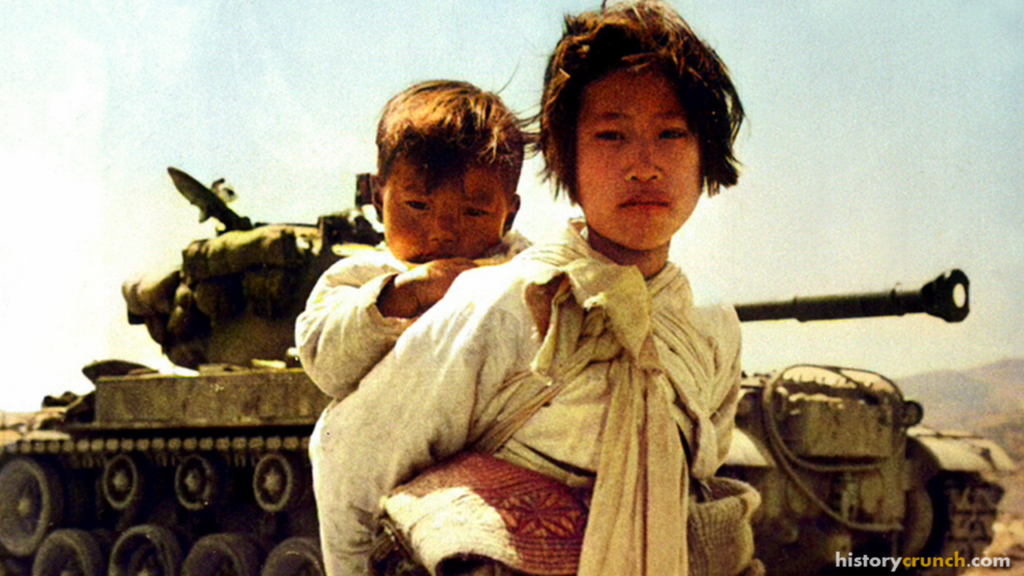
On April 22nd, 1951 about 700,000 Chinese and North Korean troops, the largest force of the war, attacked to take Seoul by May Day. At Kapyong the Canadian and Australian battalions held a valley for two days against a Chinese division, and on the Imjin River the British Gloucestershire Regiment was surrounded and destroyed after holding a hill for three days, buying the time that saved the capital. A second push in May in the east was broken by artillery and air power, with about 90,000 Chinese casualties. The offensive was the last time either side tried to win the war outright.
LEARN MORESHOW LESSwhy it matters · key numbersWARMao's army had attacked five times in six months and this time it broke. After May 1951 both sides knew that neither could drive the other off the peninsula, and both began to talk about stopping.
From July 1951 the war was two things at once: a negotiation at Panmunjom that took 575 meetings and two years, and a trench war for hills that would matter only when the line was drawn. Every question but one was settled by the spring of 1952. The one was the prisoners: the United Nations would not send back the 70,000 who refused to go, and the communists would not sign without them. It took Stalin's death, Dwight Eisenhower's election and 125,000 more United Nations casualties to solve it in a sentence, and then Rhee, who wanted no armistice at all, opened the prison gates to wreck it. The guns stopped on July 27th, 1953, where they had started.
On June 23rd, 1951 Jacob Malik, the Soviet delegate to the United Nations, said in a UN radio broadcast that the Korean War could be settled by a cease-fire and a withdrawal of troops from the 38th parallel. It was the first public sign that the communist side wanted to stop, and Washington had been sounding Moscow out in secret for a month. Ridgway broadcast an offer of talks on June 30th, and the Chinese and North Koreans accepted the next day.
LEARN MORESHOW LESSwhy it mattersDIPLOMACYA year after it began, the war reached the point at which both sides wanted out. It took two more years to agree on how, and more people died in those two years than in the first.
On July 10th, 1951 delegations led by Vice Admiral Turner Joy for the United Nations Command and General Nam Il for North Korea met at Kaesong, an old Korean capital in communist-held territory just south of the parallel. The first sessions were about chairs: the communists gave their side higher ones. Talks broke off in August after the communists accused the UN of bombing the site, and resumed on October 25th in a tent at the village of Panmunjom, in no man's land.
LEARN MORESHOW LESSwhy it matters · key numbersDIPLOMACYThe longest armistice negotiation in history began here: 575 meetings over two years and seventeen days. Every question, from the line to the prisoners, was argued while men died for the hills the line would run through.
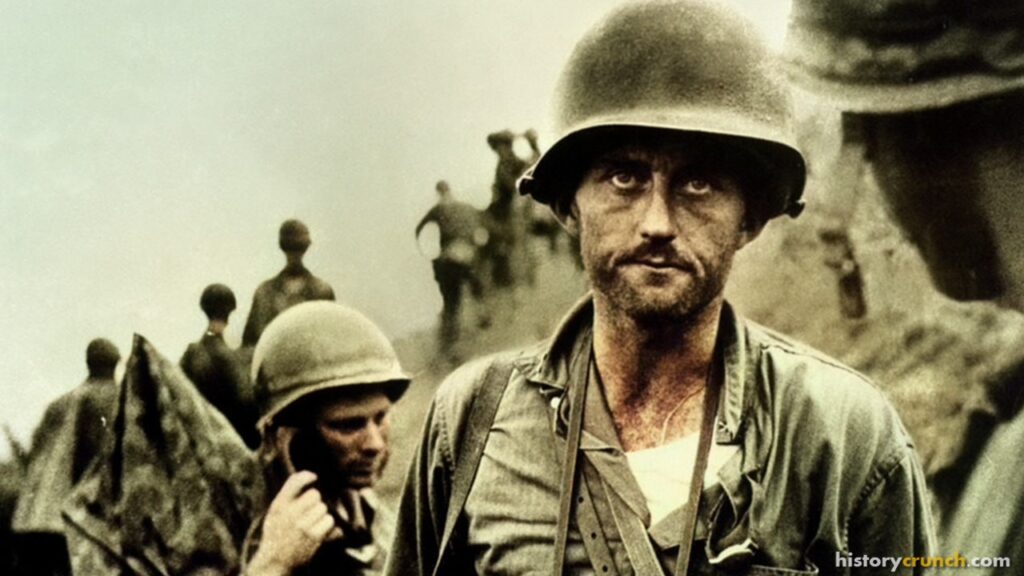
From August 18th to September 5th, 1951 the American 2nd Infantry Division and South Korean troops took a hill mass north of the Punchbowl valley that the soldiers named Bloody Ridge, at a cost of about 2,700 United Nations casualties. From September 13th to October 15th the same division fought for the next ridge north, which they named Heartbreak Ridge, at a cost of 3,700 more. The Chinese and North Koreans lost perhaps 25,000 on the two ridges. The line moved about two miles.
LEARN MORESHOW LESSwhy it matters · key numbersWARThis is what the war became after the talks began: bunkers, artillery, and infantry attacks up bare hills for positions that would matter only when the line was drawn. The names the soldiers gave the hills say what they thought of it.
On November 27th, 1951 the two sides at Panmunjom agreed that the cease-fire line would be the line of contact between the armies at the moment the armistice was signed, not the 38th parallel, with a demilitarized zone 2.5 miles (4 km) wide along it. The communists had wanted the parallel; the United Nations, which held ground north of it in the east, refused. Since the line would be wherever the armies stood, both sides went on fighting for hills for twenty more months.
LEARN MORESHOW LESSwhy it mattersDIPLOMACYThe agreement fixed the shape of Korea today. The Demilitarized Zone follows this line, which runs from south of the parallel in the west to about 40 miles (65 km) north of it in the east.
On January 2nd, 1952 the United Nations delegation proposed that prisoners of war be free to choose whether to go home. Of about 132,000 Chinese and North Korean prisoners in UN camps, a screening in April found that only about 70,000 wanted to return, and about two thirds of the 21,000 Chinese said they would rather go to Taiwan. The communists, for whom the figures were a humiliation, demanded that every prisoner be sent back as the Geneva Convention seemed to require. Harry Truman refused to force anyone: 'we will not buy an armistice by turning over human beings for slaughter or slavery'.
LEARN MORESHOW LESSwhy it matters · key numbers · a debateDIPLOMACYEvery other question was settled by the spring of 1952. The prisoners kept the war going for fifteen months and about 125,000 more United Nations casualties, on a principle both sides thought worth the cost.
Was the principle worth fifteen more months of war?
Yes: 22,000 prisoners were spared being sent back by force, and communist soldiers choosing the West was a defeat for the whole communist claim.
No: the delay cost more lives than it saved, and the screening was done under pressure from anti-communist prisoner gangs, so the numbers themselves were not clean.
On April 8th, 1952, hours before a nationwide steel strike that would have stopped shell and tank production, Harry Truman ordered the government to seize and run the steel mills, claiming the power as commander in chief in wartime. The steel companies sued. On June 2nd the Supreme Court ruled six to three in Youngstown Sheet and Tube v. Sawyer that the president had no such power without Congress. The mills were returned, the strike went ahead, and it lasted 53 days.
LEARN MORESHOW LESSwhy it matters · 1 key figureHOME FRONTThe Korean War produced the Supreme Court's most important ruling on the limits of presidential power in wartime, still cited whenever a president claims emergency authority.
On May 7th, 1952 communist prisoners in Compound 76 on Koje-do, the island off Pusan that held 170,000 prisoners of war, seized the camp commandant, Brigadier General Francis Dodd, when he came to the gate to hear complaints. They held him for three days and released him after his deputy signed a statement admitting mistreatment of prisoners. The camps had been run from inside by rival communist and anti-communist prisoner organizations for months, and hundreds of prisoners had been killed in their fights. The army broke up the compounds with tanks in June.
LEARN MORESHOW LESSwhy it mattersSOCIETYThe prisoner camps were a second front of the war, fought for the loyalty of the men inside them, and Koje-do was the communists' most successful battle on it. It was a gift to their case at Panmunjom that forced screening was a fraud.
On May 12th, 1952 Matthew Ridgway handed the United Nations Command to Mark Clark, who had led the Allied armies in Italy in World War II, and left to succeed Dwight Eisenhower as supreme commander of NATO in Europe. Clark would sign the armistice a year later and write that he was the first American commander to sign a cease-fire without a victory.
LEARN MORESHOW LESSwhy it matters · 2 key figuresPEOPLERidgway had turned the war around in three months and then held it. His reward was Europe, which is where Washington thought the real war would come.
On June 23rd, 1952 about 500 United Nations aircraft attacked the Suiho dam on the Yalu, the fourth-largest hydroelectric plant in the world, and three other power stations, in the largest air strike of the war. North Korea lost 90 percent of its electricity for two weeks. Britain's parliament protested that it had not been consulted. The 'air pressure' campaign went on through 1953: by the armistice, the United Nations had dropped more bombs on Korea than on Japan in World War II, and every town of any size in the north was rubble.
LEARN MORESHOW LESSwhy it matters · key numbersAIR WARWith the ground war frozen, the air force was the one weapon that could hurt the north, and it was used on the country rather than the army. North Korea's memory of the bombing is one of the roots of its hostility seventy years later.
On November 4th, 1952 Dwight Eisenhower, the general who had commanded the Normandy invasion, won the presidency by six million votes from the Democrat Adlai Stevenson, after promising on October 24th that if elected he would go to Korea himself to find a way to end the war. He went, in secret, from December 2nd to 5th, flew over the front in a small plane and ate with the troops. He came back convinced that the war could not be won at an acceptable price and that the enemy had to be made to want to stop.
LEARN MORESHOW LESSwhy it matters · key numbers · 2 key figuresPOLITICSKorea ended the Democrats' twenty years in the White House. Harry Truman had a 22 percent approval rating and did not run; the war that had begun with a 'police action' was the main reason.
On March 5th, 1953 Joseph Stalin died of a stroke at his dacha outside Moscow. Within two weeks his successors told Mao and Kim that the war should be ended, and on March 28th the communist side accepted a Red Cross proposal, which they had ignored for a month, to exchange sick and wounded prisoners. On March 30th Zhou Enlai proposed that prisoners who refused to go home be handed to a neutral state instead of being forced. The prisoner question was solved in a sentence.
LEARN MORESHOW LESSwhy it matters · 2 key figuresPOLITICSThe man who had approved the war in April 1950 was the man who had kept it going. Documents from his archive show he told the Chinese in 1952 that the war was good for them; his heirs wanted no part of it.
From April 16th to 18th, 1953, and again from July 6th to 11th, American and Chinese troops fought for Pork Chop Hill, a bare outpost 300 yards across in the western hills, which both sides knew would fall inside the demilitarized zone when the armistice was signed. The Americans held it in April at a cost of about 100 dead, and abandoned it in July after 243 more, with the armistice two weeks away. Chinese losses were about 1,500 in each fight.
LEARN MORESHOW LESSwhy it mattersWARThe last battles of the war were fought for nothing but the terms of the talks: each side attacked to show it could, so the other would sign. Pork Chop Hill became the symbol of that in America, through a book and a film.
From April 20th to May 3rd, 1953 the two sides exchanged sick and wounded prisoners at Panmunjom: 684 United Nations prisoners, including 149 Americans, for 6,670 Chinese and North Koreans. The Americans came back thin and told of death marches, winter camps on the Yalu where about 40 percent of prisoners had died in the first winter, and 'brainwashing' lectures. Full talks resumed on April 26th.
LEARN MORESHOW LESSwhy it mattersSOCIETYThe first prisoners home told America what captivity had been, and the word brainwashing entered the language. Twenty-one Americans would choose to stay in China at the final exchange, a fact the country argued about for years.
In the early hours of June 18th, 1953, with the armistice terms agreed and the signing days away, Syngman Rhee ordered South Korean guards to open the gates of the prison camps, and about 27,000 North Korean prisoners who had refused repatriation walked out into the countryside, where the population hid them. Rhee wanted no armistice that left Korea divided; he had threatened to fight on alone. The communists broke off the talks and launched a last offensive against South Korean divisions in July that cost about 14,000 South Korean casualties. Washington bought Rhee's silence with a defense treaty, $1 billion in aid and a promise to keep American troops in Korea.
LEARN MORESHOW LESSwhy it matters · key numbers · 1 key figurePOLITICSSouth Korea's president tried to sabotage the peace, and the price of stopping him was the American alliance that has guarded the south ever since. Rhee never signed the armistice, and South Korea still has not.
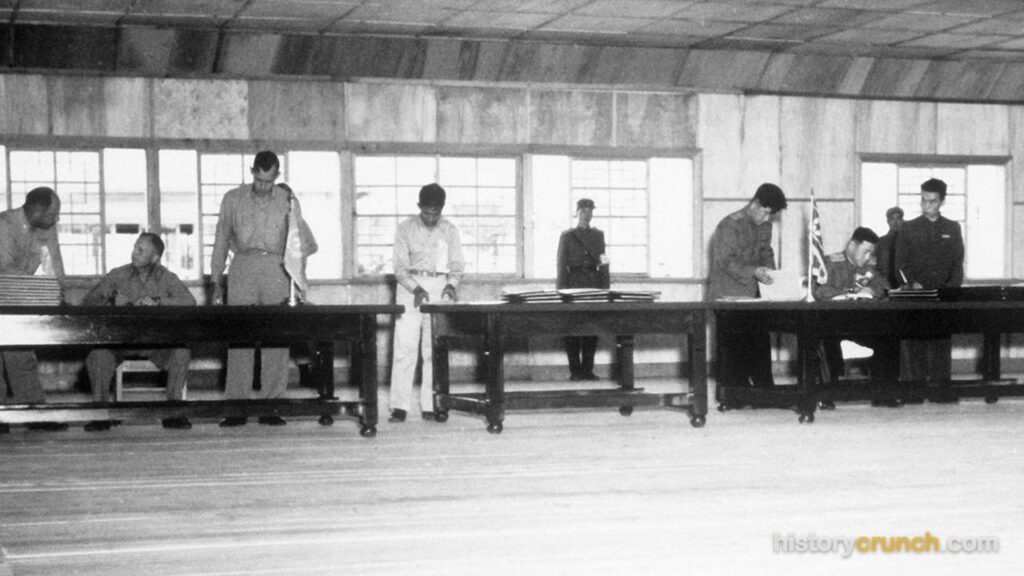
At 10 a.m. on July 27th, 1953 William Harrison for the United Nations Command and Nam Il for North Korea and China signed the armistice in a wooden hall built for the purpose at Panmunjom, in twelve minutes, without speaking or shaking hands. Mark Clark, Kim Il-Sung and Peng Dehuai signed separately. The guns stopped at 10 p.m. The agreement set the Demilitarized Zone along the line of contact, created a commission to police it, and called for a peace conference within three months. South Korea did not sign. No peace treaty has ever been made.
LEARN MORESHOW LESSwhy it matters · key numbers · a sourceDIPLOMACYThe war ended where it began, at the 38th parallel, after about 2.5 million dead, most of them Korean civilians, and nothing gained by either side but the state it had started with. It is still, in law, only paused.
IN THEIR OWN WORDS“I cannot find it in me to exult in this hour.”
Mark Clark, United Nations commander, on signing the armistice, July 27th, 1953WHAT TO NOTICEFrom his statement at Munsan-ni after he countersigned the agreement.
The war ended where it began, after about 2.5 million dead, with an armistice that has never become a peace. The north rebuilt on Soviet and Chinese money, purged every faction but Kim's, and became a state ruled by one family for three generations. The south overthrew Rhee, got a dictator, built an industrial economy under him, and became a democracy in 1987. Two American officers were killed with axes over a tree in 1976; a spy ship taken in 1968 is still a museum in Pyongyang; four summits have produced no treaty. About a million soldiers face each other across a line two colonels drew in thirty minutes.
From August 5th to September 6th, 1953 the two sides exchanged the prisoners who wanted to go home: 12,773 United Nations prisoners, 3,597 of them Americans, for 75,823 Chinese and North Koreans. The 22,604 communist prisoners who refused to return, and 359 United Nations prisoners who refused, were handed to an Indian custodial force for ninety days of persuasion. In the end 21 Americans and one Briton went to China, and 14,000 Chinese went to Taiwan.
LEARN MORESHOW LESSwhy it matters · key numbersSOCIETYThis exchange was what the last year and a half of the war had been fought over. Of about 7,200 Americans captured, about 2,800 had died in captivity, a death rate of nearly 40 percent.
On October 1st, 1953 the United States and the Republic of Korea signed a Mutual Defense Treaty in Washington, promising that each would act against an armed attack on the other, and allowing American forces to be stationed in Korea. It was the price of Rhee's acceptance of the armistice. About 28,000 American troops are still in South Korea under it.
LEARN MORESHOW LESSwhy it matters · key numbers · 1 key figureDIPLOMACYThe war made a permanent American commitment out of what had been, in 1949, a country of 'little strategic interest'. Seventy years later the alliance is the foundation of American power in northeast Asia.
In 1954 North Korea began a Three-Year Plan for reconstruction, followed by a Five-Year Plan in 1957, with about $1 billion in aid from the Soviet Union, China and Eastern Europe and the labor of Chinese troops, who stayed until 1958. Pyongyang was rebuilt from nothing as a planned city. By 1960 the north's industry had recovered and its economy was ahead of the south's, which stayed among the poorest in Asia into the 1960s.
LEARN MORESHOW LESSwhy it matters · 1 key figureSOCIETYFor its first fifteen years North Korea looked like the winner of the peace. The order reversed in the 1970s, and by the 1990s the north's economy had collapsed and the south's was the world's eleventh largest.
From April 26th to June 15th, 1954 nineteen countries met at Geneva to turn the Korean armistice into a peace, as the agreement had required. The communist side wanted all-Korea elections without UN supervision and the withdrawal of foreign troops first; the United Nations side wanted the opposite. The Korean part of the conference ended without agreement, and the delegates turned to the war in Indochina, where they succeeded in dividing Vietnam at the 17th parallel.
LEARN MORESHOW LESSwhy it mattersDIPLOMACYThe peace conference that was supposed to reunite Korea divided Vietnam instead, and in April 1954 Dwight Eisenhower gave the domino theory its name, with Korea as the proof. Korea has never had another conference; the armistice of 1953 is the only agreement there is.
On August 30th, 1956, at a meeting of the Korean Workers' Party central committee, party leaders with ties to the Soviet Union and China criticized Kim Il-Sung's cult of personality and his economic policy, encouraged by Khrushchev's attack on Stalin that February. Kim had them expelled that day; some fled to China, the rest were imprisoned or shot. A Soviet-Chinese delegation forced their reinstatement in September and Kim reversed it as soon as the delegation left. By 1961 every faction but his own guerrilla comrades was gone.
LEARN MORESHOW LESSwhy it matters · 1 key figurePOLITICSThis was the last time anyone inside North Korea challenged Kim Il-Sung. The state that came out of it, ruled by one man and his family, with no faction to answer to and Moscow and Beijing played against each other, is the one that exists today.
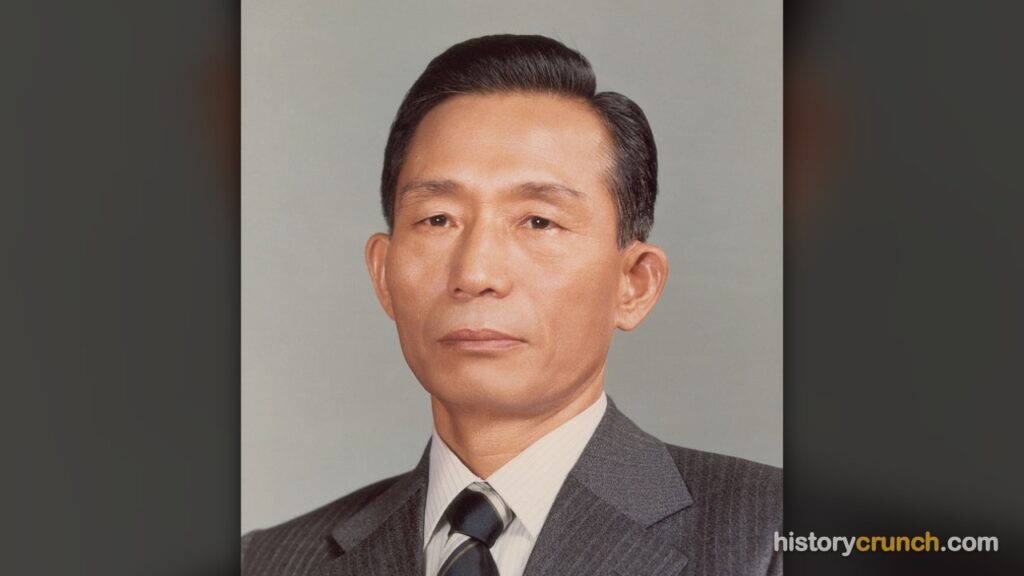
On March 15th, 1960 Syngman Rhee, aged 85, was elected to a fourth term in a vote so obviously rigged that protests broke out the same day. On April 11th the body of a student, Kim Ju-yul, was found in the harbor at Masan with a tear-gas grenade in his skull. On April 19th police fired on 100,000 students marching on the presidential palace in Seoul and killed about 180. On April 26th, with the army refusing to act and the United States withdrawing its support, Rhee resigned. An American plane flew him to Hawaii, where he died in 1965.
LEARN MORESHOW LESSwhy it matters · key numbers · 1 key figurePOLITICSThe war had made Rhee an ally the United States could not drop and a ruler his own people could not remove, until they did. The April Revolution is the founding event of South Korean democracy, and its date is in the country's constitution.
At dawn on May 16th, 1961 Major General Park Chung-hee, a former officer of the Japanese army in Manchuria, the Chinese region north of Korea, led about 3,500 troops across the Han River into Seoul and overthrew the elected government that had replaced Rhee a year earlier. Park ruled for eighteen years, turning South Korea from an aid-dependent farm economy into an industrial exporter with steel, shipbuilding and electronics, and jailing, torturing and sometimes killing those who opposed him. He was shot dead by his own intelligence chief on October 26th, 1979.
LEARN MORESHOW LESSwhy it mattersPOLITICSThe South Korean 'miracle' was built by a dictator the war had trained, and South Koreans still argue about whether the growth was worth the price. The country did not hold a free presidential election until 1987.
On January 21st, 1968 thirty-one North Korean commandos got within 100 yards of the Blue House, the South Korean presidential residence in Seoul, on a mission to kill Park; twenty-nine were killed, one captured, one escaped. Two days later, on January 23rd, North Korean patrol boats seized the American spy ship USS Pueblo off the east coast, killed one sailor and held the other 82 for eleven months. Between 1966 and 1969 about 300 South Korean and 43 American soldiers died in fighting along the Demilitarized Zone.
LEARN MORESHOW LESSwhy it mattersWARThe armistice was a pause, not a peace, and the late 1960s were the closest it came to breaking. The Pueblo is still in Pyongyang, moored on the river as a museum.
On December 27th, 1972 North Korea adopted a new constitution that created the office of president, filled by Kim Il-Sung, and wrote his philosophy of juche, or self-reliance, into the state's foundation in place of Marxism. In 1980 his son Kim Jong-Il was given senior party and military posts, making North Korea the first communist state with a hereditary succession. Kim Il-Sung died on July 8th, 1994, and the constitution of 1998 named him Eternal President.
LEARN MORESHOW LESSwhy it matters · 1 key figurePOLITICSKim Il-Sung had fought the war to unite Korea under himself. He failed at that and succeeded at the other thing: a state that answered to him alone, then to his son, then to his grandson.
On August 18th, 1976 North Korean guards attacked a United Nations work party pruning a poplar tree that blocked the view between two guard posts in the Joint Security Area at Panmunjom, and killed two American officers, Arthur Bonifas and Mark Barrett, with axes. Three days later the United States cut down the tree with a task force of 800 men, B-52 bombers overhead and an aircraft carrier offshore, in Operation Paul Bunyan. Kim Il-Sung expressed regret, the first time the north had done so. The Joint Security Area, where guards from both sides had mixed, was divided down the middle.
LEARN MORESHOW LESSwhy it matters · 1 key figureWARTwo men died over a tree, and the world's most dangerous border came within a day of a second war. The concrete line down the middle of Panmunjom dates from this week.
Through June 1987 millions of South Koreans demonstrated against the military government of Chun Doo-hwan, after the death under police torture of a student, Park Jong-chul, in January and the killing of another, Lee Han-yeol, by a tear-gas grenade on June 9th. With the Seoul Olympics fourteen months away and the army unwilling to fire, the government's candidate, Roh Tae-woo, announced on June 29th that the president would be directly elected and political prisoners freed. The election was held in December; the Olympics opened on September 17th, 1988.
LEARN MORESHOW LESSwhy it mattersPOLITICSThirty-four years after the armistice, the state the war had saved became a democracy, and the Olympics of 1988 were its announcement to the world. The contrast with the north, which boycotted the Games, has defined the peninsula since.
On July 8th, 1994 Kim Il-Sung died of a heart attack at 82, seventeen days before a planned summit with the South Korean president, the first ever. He had ruled North Korea for 46 years, longer than any other leader of the twentieth century. His son Kim Jong-Il took power, and a famine that began the next year killed somewhere between 600,000 and 2 million North Koreans. His grandson Kim Jong-Un has ruled since 2011.
LEARN MORESHOW LESSwhy it matters · 1 key figurePEOPLEThe guerrilla the Soviets picked in 1945 outlasted Stalin, Mao, Harry Truman, MacArthur and Rhee, the Soviet Union itself, and every other communist leader of his generation. His state outlasted him.
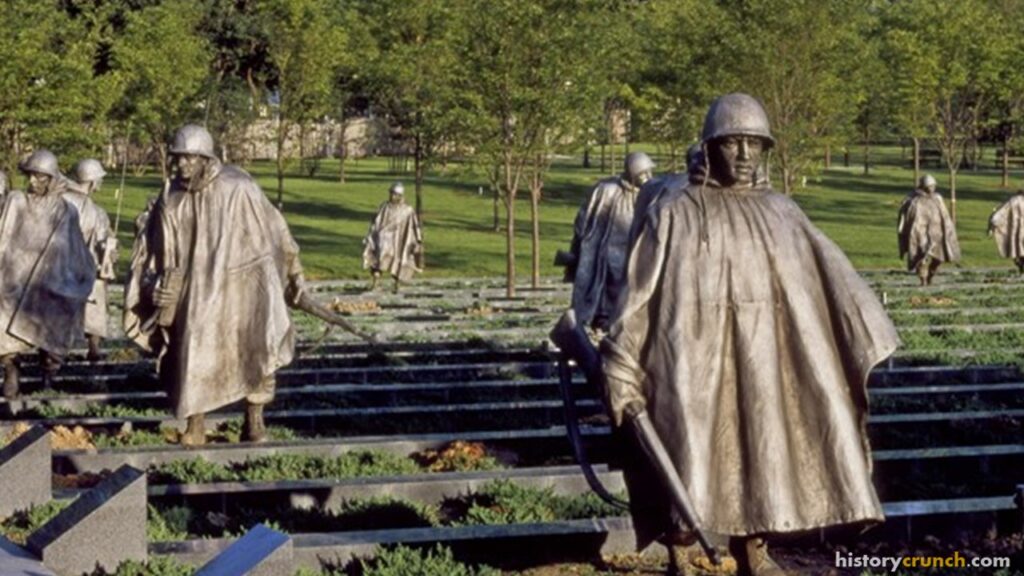
On July 27th, 1995, the forty-second anniversary of the armistice, President Bill Clinton and South Korea's president, Kim Young-sam, dedicated the Korean War Veterans Memorial on the National Mall in Washington: nineteen steel soldiers in ponchos walking through a field of juniper, beside a wall etched with the faces of 2,400 who served, and the words 'Freedom is not free'. It had taken 42 years. The Vietnam memorial, for a war that ended twenty-two years later, had been standing since 1982.
LEARN MORESHOW LESSwhy it matters · key numbersSOCIETYKorea was called the forgotten war within a decade of its end, sandwiched between the victory of 1945 and the argument over Vietnam. The memorial was the country's admission that 36,574 Americans had died in a war it had not remembered.
On June 13th, 2000 South Korea's president Kim Dae-jung flew to Pyongyang and was met at the airport by Kim Jong-Il, the first meeting between the leaders of the two Koreas since the division of 1945. They agreed on family reunions, economic projects and a vague commitment to reunification, and Kim Dae-jung won the Nobel Peace Prize that year. The north tested a nuclear weapon in 2006, and by 2010 relations had returned to hostility. A second summit in 2007 and a third in 2018, at Panmunjom, changed nothing lasting.
LEARN MORESHOW LESSwhy it mattersDIPLOMACYSeventy years after the armistice the two Koreas have met four times at the top and have no peace treaty, no diplomatic relations, and a border with about a million soldiers on it. The war of 1950 is the only war of the twentieth century that has not ended.

I'm the founder of History Crunch, which I first began in 2015 with a small team of like-minded professionals. I have an Education Degree with a focus in Social Studies education. I spent nearly 15 years teaching history, geography and economics in secondary classrooms to thousands of students. Now I use my time and passion researching, writing and thinking about history education for today's students and teachers.

I'm a passionate history and geography teacher with over 15 years of experience working with students in the middle and high school years. I have an Education Degree with a focus in World History. I have been writing articles for History Crunch since 2015 and love the challenge of creating historical content for young learners!
To cite this timeline as a source, use one of the formats below.
MLA: Millar, B., and Elias Beck. “Korean War Timeline.” HistoryCrunch, 15 September 2026, https://historycrunch.com/korean-war-timeline/.
APA: Millar, B., & Beck, E. (2026). Korean War Timeline. HistoryCrunch. https://historycrunch.com/korean-war-timeline/
Chicago: Millar, B., and Elias Beck. “Korean War Timeline.” HistoryCrunch. September 15, 2026. https://historycrunch.com/korean-war-timeline/
© History Crunch
A country that had been one for a thousand years was cut in half by two colonels with a magazine map.
Three years after a temporary line, there were two governments, two armies and two men who each claimed all of Korea.
A 33-year-old guerrilla in a Soviet uniform and a 70-year-old exile with a Princeton doctorate.
Stalin said no in 1949 and yes in 1950. The documents say why.
Whether Acheson's speech invited the attack is still argued. Critics said at the time that he had told Stalin Korea was free for the taking. Historians with the Soviet documents mostly find the decision was made for other reasons and the speech was, at most, confirmation.
Koreans killing Koreans over who should rule Korea, with the world's two blocs choosing sides.
A line on a map that became a border, a trigger, a war aim, and a cease-fire.
Sixteen countries under one flag, for the first and only time.
Two days, no vote of Congress, and a word he chose carefully: police action.
A plan Harry Truman had shelved in April was law by the winter, and the defense budget quadrupled.
Ninety thousand men, 150 tanks, and a South Korean army with nothing to stop them.
Six weeks on a river line with the sea at their backs and no line behind.
Thirty-foot tides, a walled harbor, one channel, and every planner against it.
The war aim was to repel an invasion. On October 1st it became to end a state.
A year-old government with a wrecked economy sent 300,000 men against the world's strongest power.
Thirty thousand men, minus 35 degrees, 120,000 Chinese, and one road to the sea.
He arrived on December 26th to an army that was beaten. By March it was in Seoul.
A five-star hero against an unpopular president, Harry Truman, over who decides how a war is fought.
The United States had the bomb and did not use it; China had a million men and did not send them all.
Hills, cold, retreat and advance, then two years in bunkers.
Most of the dead were not soldiers. Most were Korean, and most have no monument.
No rationing, no victory parades, and a draft that took 1.5 million men.
Every other question was settled by May 1952. The prisoners took fifteen months more.
MiG-15 against F-86 Sabre over the Yalu, and B-29s driven from the daylight.
Soviet tanks against American bazookas in July; American artillery against Chinese bugles in November.
Five hundred and seventy-five meetings, and more dead than in the first year.
The side that owned the sea could land anywhere, leave anywhere and never be cut off.
Stalin died, Eisenhower arrived, the prisoners were solved in a sentence, and Rhee nearly wrecked it.
About 2.5 million dead in three years for a border that moved a few miles.
One of the world's richest countries and one of its poorest, from the same war and the same people.
An armistice, no treaty, a million soldiers on the line, and seventy years of incidents.
Two superpowers fought each other without admitting it, through others, on someone else's land.
It made the Cold War military, the presidency warlike, Asia divided and Korea what it is.
Historians disagree about whether the war was worth fighting. One view is that it saved South Korea, held the line of containment, and made the Cold War's limits clear. Another is that a war to restore the parallel had been won by September 1950, and that the two and a half years after the crossing north bought nothing but the dead.
No question matches that word.
Research question 1A country that had been one for a thousand years was cut in half by two colonels with a magazine map.
Research question 2Three years after a temporary line, there were two governments, two armies and two men who each claimed all of Korea.
Research question 3A 33-year-old guerrilla in a Soviet uniform and a 70-year-old exile with a Princeton doctorate.
Research question 4Stalin said no in 1949 and yes in 1950. The documents say why.
Research question 5Koreans killing Koreans over who should rule Korea, with the world's two blocs choosing sides.
Research question 6A line on a map that became a border, a trigger, a war aim, and a cease-fire.
Research question 7Sixteen countries under one flag, for the first and only time.
Research question 8Two days, no vote of Congress, and a word he chose carefully: police action.
Research question 9A plan Harry Truman had shelved in April was law by the winter, and the defense budget quadrupled.
Research question 10Ninety thousand men, 150 tanks, and a South Korean army with nothing to stop them.
Research question 11Six weeks on a river line with the sea at their backs and no line behind.
Research question 12Thirty-foot tides, a walled harbor, one channel, and every planner against it.
Research question 13The war aim was to repel an invasion. On October 1st it became to end a state.
Research question 14A year-old government with a wrecked economy sent 300,000 men against the world's strongest power.
Research question 15Thirty thousand men, minus 35 degrees, 120,000 Chinese, and one road to the sea.
Research question 16He arrived on December 26th to an army that was beaten. By March it was in Seoul.
Research question 17A five-star hero against an unpopular president, Harry Truman, over who decides how a war is fought.
Research question 18The United States had the bomb and did not use it; China had a million men and did not send them all.
Research question 19Hills, cold, retreat and advance, then two years in bunkers.
Research question 20Most of the dead were not soldiers. Most were Korean, and most have no monument.
Research question 21No rationing, no victory parades, and a draft that took 1.5 million men.
Research question 22Every other question was settled by May 1952. The prisoners took fifteen months more.
Research question 23MiG-15 against F-86 Sabre over the Yalu, and B-29s driven from the daylight.
Research question 24Soviet tanks against American bazookas in July; American artillery against Chinese bugles in November.
Research question 25Five hundred and seventy-five meetings, and more dead than in the first year.
Research question 26The side that owned the sea could land anywhere, leave anywhere and never be cut off.
Research question 27Stalin died, Eisenhower arrived, the prisoners were solved in a sentence, and Rhee nearly wrecked it.
Research question 28About 2.5 million dead in three years for a border that moved a few miles.
Research question 29One of the world's richest countries and one of its poorest, from the same war and the same people.
Research question 30An armistice, no treaty, a million soldiers on the line, and seventy years of incidents.
Research question 31Two superpowers fought each other without admitting it, through others, on someone else's land.
Research question 32It made the Cold War military, the presidency warlike, Asia divided and Korea what it is.