The North African Theater of World War II was the line of fighting that occurred across the countries of North Africa, including Egypt, Libya, Tunisia, Algeria and Morocco. World War II was a global conflict that was fought on several fronts, including the European Theater, the Pacific Theater, and the North African Theater. The North African Theater developed following Italy’s declaration of war in June of 1940 and lasted until the final surrender of Axis forces in May of 1943.
North African Theater of World War II – Formation
World War II began in September of 1939 when Nazi Germany, under the leadership of Adolf Hitler, invaded Poland. In response, Britain and France declared war on Germany. Over the following months, Germany rapidly expanded its control across much of Western Europe. By June of 1940, France had fallen to Nazi Germany and Britain stood as the primary Allied power in the fight against the Axis in Europe.
It was at this point that Italy entered the war. On June 10th, 1940, Italy’s Fascist dictator, Benito Mussolini, declared war on Britain and France and sided with Nazi Germany. Italy had a significant colonial presenceWhen a country controls and governs foreign territory far from its own borders. in North Africa, controlling the territory of Libya, which shared a border with Egypt to the east. At the time, Egypt was under British military protection and was home to a large force of British and Commonwealth troops. Their main role was to defend the Suez CanalA human-made waterway in Egypt linking the Mediterranean Sea to the Red Sea, crucial for moving troops and supplies., a vital waterway that connected the Mediterranean Sea to the Red Sea and allowed Britain to move troops and supplies between Europe and Asia. As such, North Africa became a region of immediate strategic importance for both sides.
In September of 1940, Italian forces launched an invasion of Egypt from Libya, advancing east toward the Suez Canal. After a limited advance, the Italians halted and set up a series of fortified camps near Sidi Barrani in northern Egypt. In December of 1940, British and Commonwealth forces launched a major counter-offensiveA large military attack launched in response to an enemy’s earlier advance. known as ‘Operation Compass’. During ‘Operation Compass’, the Italian 10th Army was severely defeated and pushed back across Libya, with thousands of Italian soldiers taken prisoner.
Following the collapse of the Italian forces in Libya, Germany sent troops to North Africa to prevent a complete Axis defeat. In February of 1941, General Erwin Rommel arrived in North Africa to take command of a German armored force that became known as the ‘Afrika KorpsThe German armored force sent to North Africa in 1941, commanded by General Erwin Rommel.‘. Rommel proved to be a capable and daring commander and quickly launched a counter-offensive that pushed the Allied forces back toward Egypt. This means that from early 1941 onward, the North African Theater became a much more complex and contested fight, with both the Allied Powers and the Axis Powers trading advances and retreats across the desert.
The Allied forces fighting in North Africa were primarily drawn from Britain and the British Commonwealth, including troops from Australia, New Zealand, South Africa and India. The United States entered World War II in December of 1941 following the Japanese attack on Pearl Harbor and began contributing forces directly to the North African Theater in November of 1942. As well, Free French forces also participated in the fighting in North Africa throughout the campaign.
 FactsthatCrunch
Why did Italy lose its early advantage in North Africa so quickly?
North African Theater of World War II – Battles
The North African Theater was the site of some of the most significant battles of World War II outside of Europe. The fighting occurred across a vast stretch of desert and involved tank warfare, infantry combat, and air support on a large scale. The most significant battles and operations of the North African Theater are listed below. In these battles, the Allied Powers faced off against the Axis Powers of Nazi Germany and Fascist Italy.
- Operation Compass
- Siege of Tobruk
- Operation Crusader
- Battle of Gazala
- First Battle of El Alamein
- Battle of Alam el Halfa
- Second Battle of El Alamein
- Operation Torch
- Battle of Kasserine Pass
- Tunisia Campaign
FactsthatCrunchWhat happened in four of the key battles of the North African Theater?
North African Theater of World War II – Nature of Warfare
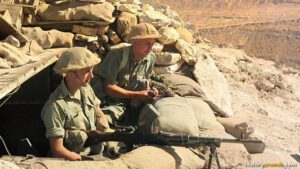
A defining feature of warfare in the North African Theater was the nature of desert combat. The North African Theater was characterized by rapid movement across vast open terrain. The desert landscape of Libya and Egypt allowed for mobile warfareA style of fighting that relies on fast-moving units, especially tanks, covering large distances quickly., in which armored tank units could advance and retreat over large distances in a short period of time. For instance, control of key towns, ports, and defensive positions shifted back and forth between the Allied and Axis forces multiple times throughout the campaign.
The geography of North Africa played a central role in the nature of the fighting. The main battle zone was along a narrow coastal strip of land bordered by the Mediterranean Sea to the north and the vast Sahara Desert to the south. The only paved road in the region ran along the coast, which meant that armies depended heavily on this road for the movement of troops and supplies. As such, whoever controlled this road generally controlled movement in the region.
Supplies and supply linesThe routes used to deliver food, fuel, water, and ammunition to armies in the field. were a critical factor in the North African Theater. Both the Allied and Axis forces found that the further they advanced across the desert, the harder it became to keep their forces supplied with fuel, food, water, and ammunition. Rapid advances were frequently followed by retreats, in part because armies had outrun their supply lines. The desert environment made this problem even worse. Natural water supplies were almost non-existent, and both sides had to transport water to their soldiers. Furthermore, the extreme heat during the day and cold temperatures at night, combined with sand and dust that damaged engines and equipment, made the campaign a physically demanding one for soldiers on both sides.
The port city of Tobruk in Libya was one of the most strategically important locations in the North African Theater. It had a deep-water harbor that could be used to supply armies operating in the region. As a result, Tobruk was the focus of intense fighting at multiple points in the campaign. For instance, Allied forces held Tobruk through an eight-month siege in 1941, and the fall of Tobruk to Rommel’s forces in June of 1942 was considered one of the most significant setbacks for the Allied Powers during the war.
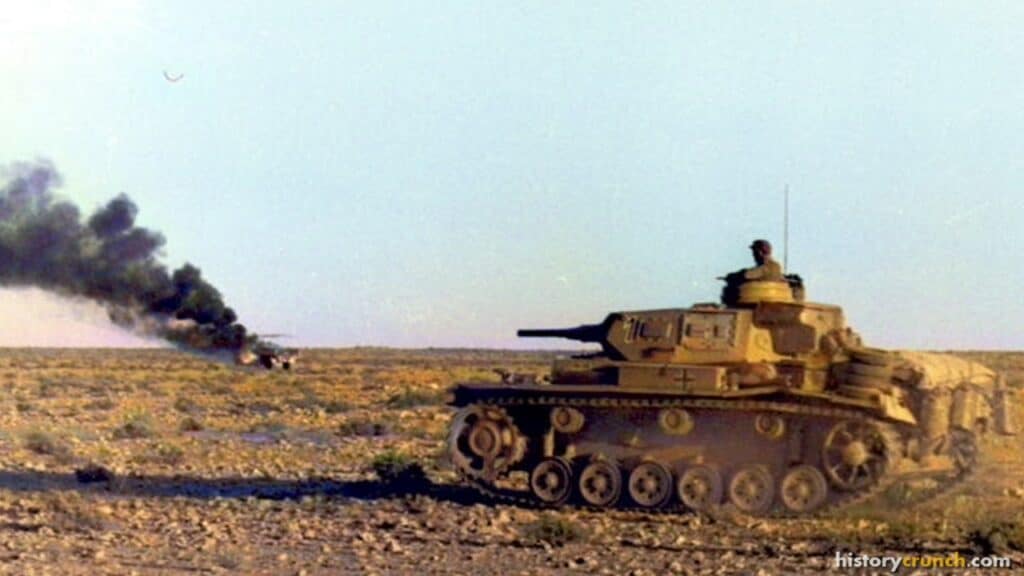
Tank warfare was also a defining feature of the North African Theater. Both sides deployed large numbers of tanks across the desert, and major battles often involved hundreds of tanks on each side. The open terrain of the desert allowed tanks to operate freely and made the North African Theater one of the most famous examples of armored warfareLarge-scale combat that centers on the use of tanks and other protected fighting vehicles. in World War II. General Erwin Rommel became particularly well known for his use of fast-moving armored units, earning him the nickname ‘The Desert Fox’.
Air power was also an important factor in the North African Theater. Both sides used airplanes to support their ground forces, to attack enemy supply lines, and to bomb ports and military positions. Control of the air above the battlefield often played a decisive role in the outcome of ground battles. As the campaign progressed, the Allied Powers increasingly gained the advantage in the air, which helped contribute to the eventual Allied victory.
FactsthatCrunchWhy did armies in the North African desert keep outrunning their supplies in World War II?
North African Theater of World War II – Significance
The North African Theater was an incredibly significant conflict in the overall events of World War II. The fighting along the North African Theater occurred from June 10th, 1940 until May 13th, 1943. During this time, hundreds of thousands of soldiers participated for both the Allied Powers and the Axis Powers, which led to substantial casualties on both sides. Historians estimate that the Allied Powers suffered approximately 220,000 casualties throughout the campaign, while the Axis Powers of Germany and Italy suffered approximately 620,000 casualties. There were also numerous civilian losses in the countries affected by the fighting.
The North African Theater was significant because it represented one of the first major Allied victories of World War II. The defeat of Axis forces in North Africa, particularly following the Second Battle of El Alamein in October and November of 1942, marked a turning point in the war. For much of the early years of the war, the Allied Powers had suffered a series of defeats and setbacks across Europe and North Africa. The Allied victory in North Africa demonstrated that the Axis Powers could be defeated and helped restore confidence among the Allied nations.
The North African Theater was significant because it directly enabled the Allied invasion of southern Europe. Following the surrender of Axis forces in Tunisia in May of 1943, the Allied Powers used North Africa as a base from which to launch the invasion of Sicily in July of 1943 and the invasion of the Italian mainland shortly after. This means that the victory in North Africa opened a new front against the Axis Powers in southern Europe and brought the war closer to Germany itself. Without the North African Theater, the Allied advance into Europe from the south would not have been possible.
The North African Theater was also significant because it marked the first major combined operation between American and British forces. When American troops landed in Morocco and Algeria as part of ‘Operation Torch’ in November of 1942, it was the first large-scale joint military operation between the two Allied nations in World War II. The experience gained from planning and executing this operation improved communication and cooperation between American and British commanders. These lessons proved valuable in later Allied operations, including the invasion of Sicily, the Italian Campaign, and ultimately the ‘D-Day’ landings in Normandy in June of 1944.
FactsthatCrunch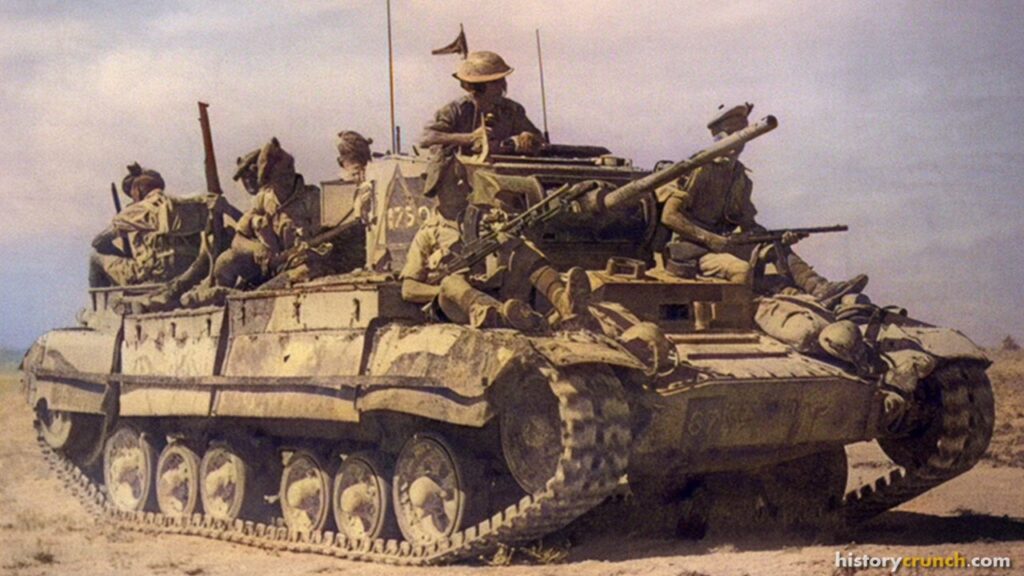 Black & whiteColor
Explore World War II · 1939 – 1945
Keep exploring World War II with these History Crunch resources.
Key Vocabulary
Colonial presence
Suez Canal
Counter-offensive
Afrika Korps
Mobile warfare
Supply lines
Armored warfare
Frequently Asked Questions
When did the North African Theater of World War II take place?
The fighting lasted from June 10th, 1940 until May 13th, 1943. It began when Italy declared war on Britain and France and joined Nazi Germany. The campaign ended when Axis forces surrendered in Tunisia after nearly three years of desert warfare.
Why was North Africa important during World War II?
North Africa mattered because it held the Suez Canal, a vital waterway that connected the Mediterranean Sea to the Red Sea. Britain used the canal to move troops and supplies between Europe and Asia. Control of the region also gave each side a base for future operations in southern Europe.
Who was Erwin Rommel and why was he called the Desert Fox?
Erwin Rommel was the German general who commanded the Afrika Korps starting in February of 1941. He earned the nickname “The Desert Fox” for his bold use of fast-moving armored units. His daring counter-offensives pushed Allied forces back toward Egypt several times during the campaign.
Why was fighting in the desert so difficult?
Desert combat was hard because armies struggled to keep soldiers supplied with fuel, food, water, and ammunition. Natural water was almost nonexistent, so both sides had to haul water to their troops. Extreme heat, cold nights, and blowing sand also damaged engines and wore down the men.
Why was the North African Theater a turning point in the war?
North Africa gave the Allies their first major victory of World War II, especially after the Second Battle of El Alamein. This success showed that the Axis Powers could be beaten and restored Allied confidence. It also opened the way for the invasions of Sicily and the Italian mainland in 1943.
What was Operation Torch?
Operation Torch was the Allied landing in Morocco and Algeria in November of 1942. It marked the first large-scale joint operation between American and British forces in the war. The teamwork gained from the operation helped shape later efforts, including the Italian Campaign and the D-Day landings.
Cite This Article
To cite this article as a source, use one of the formats below.
MLA: Millar, B. “North African Theater of World War II: A Detailed Summary.” HistoryCrunch, 2 October 2026, https://historycrunch.com/north-african-theater-of-world-war-ii/.
APA: Millar, B. (2026). North African Theater of World War II: A Detailed Summary. HistoryCrunch. https://historycrunch.com/north-african-theater-of-world-war-ii/
Chicago: Millar, B. “North African Theater of World War II: A Detailed Summary.” HistoryCrunch. October 2, 2026. https://historycrunch.com/north-african-theater-of-world-war-ii/
Sources
- Gerhard L. Weinberg, A World at Arms.
- Max Hastings, Inferno / All Hell Let Loose.
- The National WWII Museum
- Antony Beevor, The Second World War.