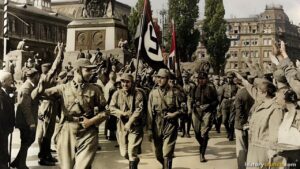
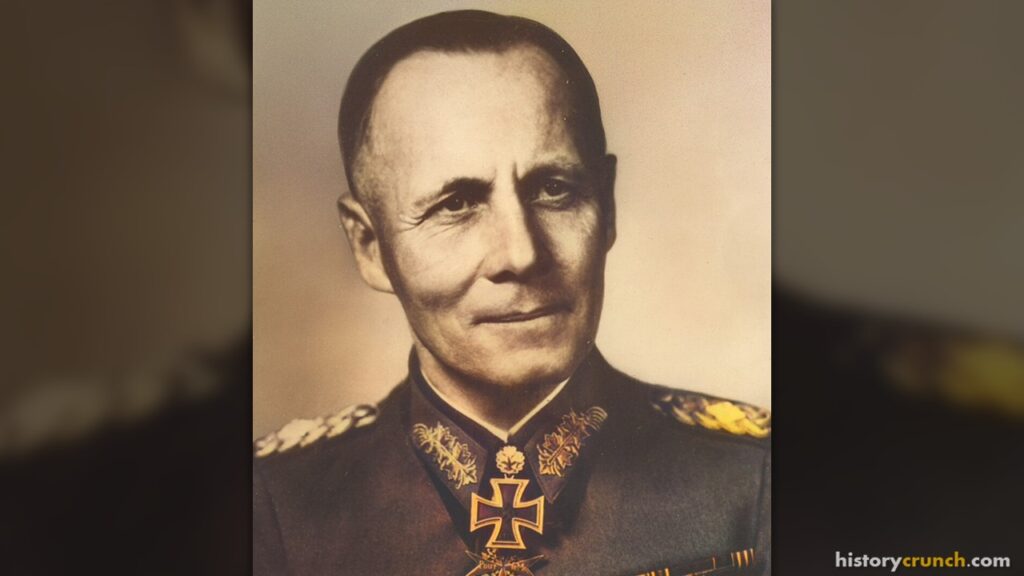
Erwin Rommel was a German military commander who became one of the most famous generals of World War II. He was born on November 15th, 1891 in Heidenheim, Germany, and he later rose to the rank of field marshalThe highest rank in the German army, awarded to Rommel by Hitler in June 1942. in the German army. Rommel is best known for his leadership in North Africa, where he earned the nickname ‘Desert Fox’. He served in the regime of Adolf Hitler, and his career cannot be separated from the wider history of Nazi Germany and its wars of aggression. Therefore, Rommel remains one of the most debated military figures of the Second World War.
 FactsthatCrunch
Rommel led German and Italian forces across North Africa and gained wide recognition for fast, aggressive armored tactics that repeatedly outmaneuvered larger Allied forces. He was linked to the July 20th, 1944 plot to remove Hitler and was forced to take poison by the Nazi government rather than face a public trial.
Erwin Rommel – Early Life
Erwin Rommel was born as Johannes Erwin Eugen Rommel on November 15th, 1891. He grew up in the German Empire and came from a middle-class family. As a young man, he chose a military career and entered the army before the start of World War I. This early decision shaped the rest of his life, since nearly all of his major achievements and controversies came through military service that would make up the rest of his life. Regardless, Rommel joined the Württemberg Infantry Regiment No. 124 in 1910, trained as an officer cadet, and received his commissionAn official appointment that makes someone an officer in the military. as a lieutenant in January of 1912. This was important because it placed him in the officer corps just before Europe descended into global war during the events of World War I.
Erwin Rommel – World War I
World War I was the first great test of Rommel’s military ability. The war began in 1914, following the assassination of Austrian archduke Franz Ferdinand. The German Empire was on the side of the Central Powers and faced off against the Allied Powers. For his part, Rommel fought on several fronts of the war and gained a reputation for bold leadership and aggressive tactics. For instance, he served in fighting in France, Romania, and especially Italy, where he became known for fast-moving attacks and personal bravery under fire. These experiences were important because they helped shape the style of command that later made him famous in World War II.
Rommel performed especially well during the fighting on the Italian Front in 1917, and he received the prestigious Pour le MériteA prestigious Prussian military medal awarded for exceptional bravery or achievement in battle. on December 10th, 1917. That award identified him as a highly successful officer in the German army. This resulted in Rommel emerging from World War I with a strong military reputation, which gave him a foundation for later advancement in the Interwar Period years.
FactsthatCrunchThe Pour le Merite was a Prussian military medal awarded for exceptional bravery or achievement in battle. It was one of the highest honors a soldier in the German army could receive during World War I. Officers had to show outstanding performance in combat to earn it.
Erwin Rommel received the Pour le Merite on December 10th, 1917, after his bold and successful fighting on the Italian Front.
Erwin Rommel – Interwar Period
After World War I, Rommel remained in the German military during the years of the Weimar Republic. Unlike many former officers who drifted into radical politics, he stayed focused mainly on his army career. For instance, he served in the ReichswehrThe smaller German army permitted after World War I under the restrictions of the Treaty of Versailles., the smaller German army allowed after the Treaty of Versailles. During these Interwar years, Rommel also wrote about military tactics. His book ‘Infanterie greift an’ (‘Infantry Attacks’) was published in 1937 and helped build his reputation as a talented military thinker since it included ideas for different infantry maneuvers and attack strategies.
Rommel’s career advanced rapidly after Adolf Hitler rose to power in January of 1933 and Germany began rearming following its refusal to meet the terms of the Treaty of Versailles. Although Rommel was not one of the most ideological Nazi leaders, he benefited from Hitler’s military expansion and gained important commands in the growing German army. In fact, he developed a favorable relationship with Hitler during the 1930s, which helped his rise inside the system. This led to his significance during World War II, which he is most famous for.
Erwin Rommel – World War II
As mentioned above, Rommel became widely known during World War II. For example, in May of 1940, during the Battle of France, he commanded the 7th Panzer Division and gained attention for fast, bold armored advances. For instance, his division moved so quickly that it sometimes became difficult even for the German high command to track its position. This helped establish Rommel’s image as an aggressive and highly mobile commander. This type of quick movement was an important aspect of Nazi German military strategy in World War II, and was referred to as ‘blitzkrieg‘ tactics. Simply put, this means ‘Lightning War’ and was the key military strategy of the Nazi regime during the major battles and operations of World War II.
Regardless, Rommel is most well known for his actions in North Africa during World War II. For instance, in February of 1941, Rommel was sent to Libya to command Nazi German forces that became known as the ‘Afrika KorpsThe German military force Rommel commanded in North Africa beginning in February 1941.‘. There he fought against British and Commonwealth forces in the desert war, and his campaigns included major battles around Tobruk, Gazala and El Alamein. It was during this theater of war that he became known as the ‘Desert Fox’, which was a nickname tied directly to his skill in desert warfare and surprise maneuver.
Rommel’s victories in 1941 and 1942 made him one of Nazi Germany’s most celebrated commanders. In June of 1942, after the Battle of Gazala and the capture of Tobruk on June 21st, 1942, Hitler promoted him to the rank of field marshal. This was the peak of Rommel’s military career and showed how valuable his successes in North Africa had become to Nazi German morale and propaganda.
However, Rommel’s fortunes changed later in 1942. At the Second Battle of El Alamein, fought from October 23rd, 1942 to November 11th, 1942, British forces under Bernard Montgomery defeated the Axis army in North Africa. This resulted in a major turning point in the African campaign, because Rommel and the German-Italian forces were pushed into retreat and never recovered their earlier position.
After the loss of North Africa in May of 1943, Rommel later received command responsibilities in western Europe. By 1944, he was involved in the defense of the French coast against the expected Allied invasion. In this role, he argued that Nazi Germany needed to defeat the invasion forces directly on the beaches, since he believed Allied air power would make a longer inland defense far more difficult.
When the Normandy Invasion began on June 6th, 1944, Rommel was one of the senior German commanders responsible for trying to stop the Allied advance in France. However, Nazi Germany failed to push the invaders back into the sea, and the Allied foothold in Normandy steadily expanded. This was important because the events of June of 1944 showed the limits of German defense in the west and marked the beginning of the final collapse of Nazi control in France and eventually the rest of Europe.
FactsthatCrunchRommel is sent to Libya to take command of the Afrika Korps
Erwin Rommel – Death
As the balance of power turned against Nazi Germany, Rommel grew increasingly critical of Hitler’s leadership. In fact, after a failed plot against Hitler on July 20th, 1944, Rommel was accused by the regime of being connected to the anti-Hitler conspiracy. Historians debate the full extent of his involvement, but it is clear that Hitler no longer trusted him. As a result, on October 14th, 1944, Rommel was forced to commit suicide by taking cyanideA fast-acting poison Rommel was forced to take to commit suicide on October 14th, 1944.. In return, the Nazi regime promised that his family would be protected and that he would receive a public funeral with the official explanation that he had died from wounds suffered earlier in the war.
FactsthatCrunchIt is October 14th, 1944, and you are Erwin Rommel, Germany's most famous field marshal of World War II. Two Nazi officers have arrived at your home in Herrlingen, Germany, and told you that the regime has linked you to the July 20th, 1944 plot to kill Adolf Hitler. They have given you a choice: take cyanide now and the regime will protect your family and give you a state funeral, or refuse and face a public trial before the People's Court. Your wife and son are in the house, and whatever you decide in the next few minutes will determine whether they survive the war.
Erwin Rommel – Significance
Erwin Rommel is remembered mainly for his battlefield leadership, especially in North Africa, where he became one of the most famous Nazi German generals of World War II. His reputation was based on speed, bold decision-making and the ability to inspire soldiers under difficult conditions. For that reason, his name became closely linked with the African campaign and with Nazi German armored warfare.
At the same time, Rommel remains a complicated historical figure. He was a gifted commander, but he also served a fascist dictatorship that launched aggressive wars across Europe and North Africa.
FactsthatCrunchMany British soldiers and commanders respected Rommel as a skilled and aggressive opponent. General Claude Auchinleck, the British commander, felt this respect had grown so strong that he issued a memo warning his officers to stop treating Rommel as a kind of military superman. British troops admired his speed and surprise tactics even as they fought hard to stop him.
The Nazi regime used Rommel's victories in North Africa to build his image into a symbol of German military strength. After the capture of Tobruk on June 21st, 1942 and his promotion to field marshal, state propaganda presented him as proof that Germany was winning the war. His fame served the regime's goal of keeping German civilian morale high during a long and costly conflict.
Key Vocabulary
Commission
Pour le Mérite
Reichswehr
Blitzkrieg
Afrika Korps
Field marshal
Cyanide
Frequently Asked Questions
Why was Erwin Rommel called the Desert Fox?
Rommel earned the nickname “Desert Fox” for his skill in desert warfare during the North Africa campaign. He led the German Afrika Korps against British and Commonwealth forces beginning in 1941. His quick surprise moves and clever tactics across the open desert made the name stick.
How did Erwin Rommel die?
Rommel was forced to commit suicide by taking cyanide on October 14th, 1944. The Nazi regime accused him of being linked to the July 20th plot against Hitler. In exchange for his death, the regime promised to protect his family and give him a public funeral.
What did Rommel do before World War II?
Rommel was a decorated officer in World War I before gaining fame in the second war. He joined the army in 1910 and won the Pour le Mérite for his bold fighting on the Italian Front in 1917. During the 1930s he wrote a respected book on infantry tactics called “Infantry Attacks.”
What was Rommel’s role in the Normandy Invasion?
Rommel was a senior German commander in charge of defending the French coast in 1944. He argued that Germany had to stop the Allies right on the beaches because of their strong air power. When the Normandy Invasion began on June 6th, 1944, German forces failed to push the Allies back into the sea.
Was Rommel a Nazi?
Rommel served Adolf Hitler’s regime but was not one of its most ideological leaders. He gained important commands as Germany rearmed and had a favorable relationship with Hitler during the 1930s. Even so, he served a dictatorship that launched aggressive wars, which makes him a debated figure today.
Cite This Article
To cite this article as a source, use one of the formats below.
MLA: Millar, B. “Erwin Rommel: A Detailed Biography.” HistoryCrunch, 3 October 2026, https://historycrunch.com/erwin-rommel/.
APA: Millar, B. (2026). Erwin Rommel: A Detailed Biography. HistoryCrunch. https://historycrunch.com/erwin-rommel/
Chicago: Millar, B. “Erwin Rommel: A Detailed Biography.” HistoryCrunch. October 3, 2026. https://historycrunch.com/erwin-rommel/
Sources
- Imperial War Museum
- Gerhard L. Weinberg, A World at Arms.
- The National WWII Museum
- Max Hastings, Inferno / All Hell Let Loose.