Italy in World War II played an important role for both the Axis Powers and the Allied Powers. Italy entered the war on June 10th, 1940, as an Axis Power alongside Nazi Germany, driven by the imperial ambitionsA leader’s desire to conquer new territories and build a powerful empire. of fascist dictator Benito Mussolini. However, a series of military disasters and growing public opposition to the war led to the removal of Mussolini from power in July of 1943. As a result, Italy signed an armisticeA formal agreement to stop fighting, used here as a step before a full peace treaty. with the Allied Powers on September 8th, 1943, and eventually declared war on Nazi Germany on October 13th, 1943, fighting on the Allied side for the remainder of the conflict. In total, Italian military deaths during World War II are estimated at approximately 319,000, while Italian civilian deaths are estimated at approximately 153,000.
Italy Enters World War II
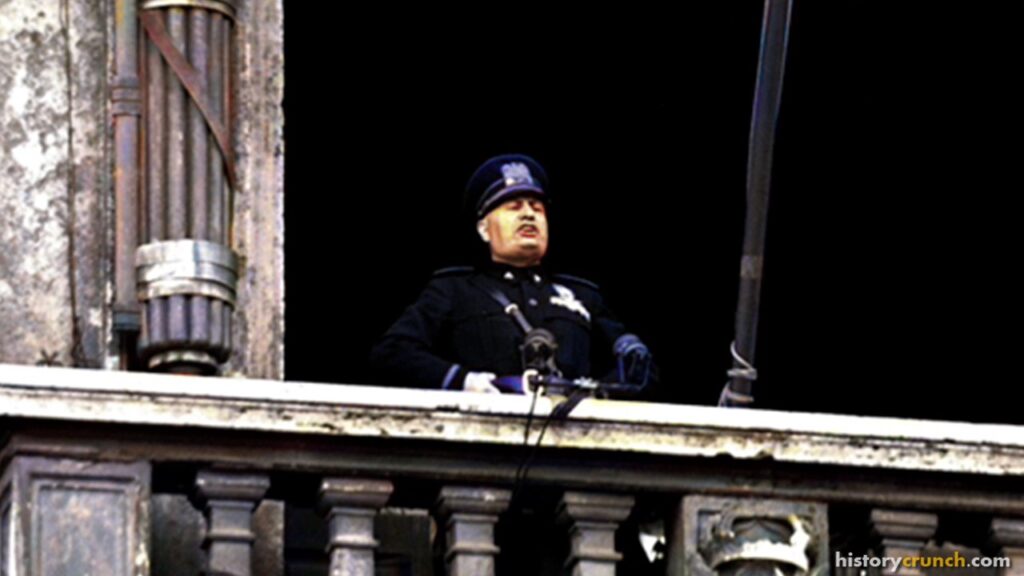
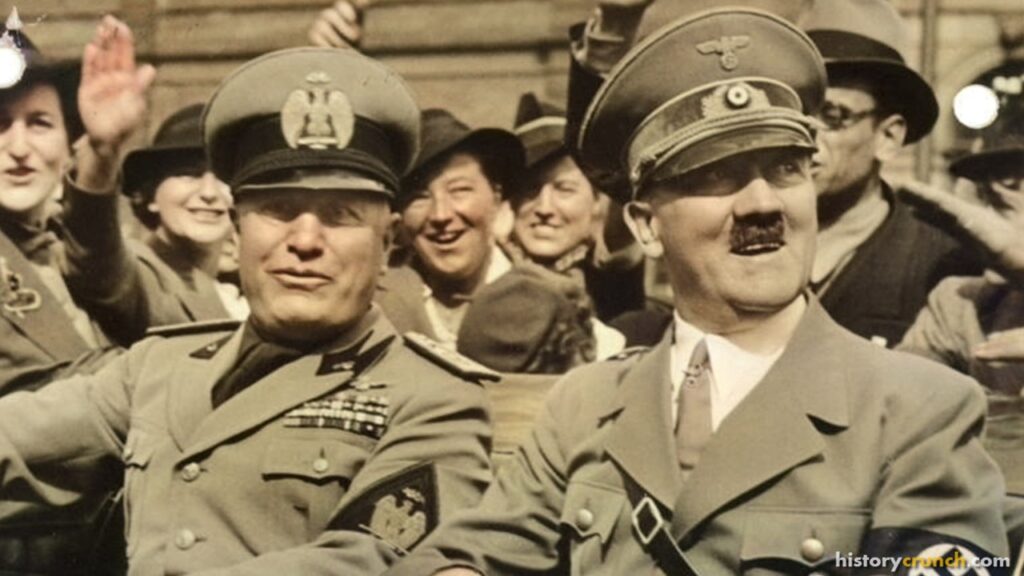
World War II began on September 1st, 1939, when Nazi Germany, under the leadership of Adolf Hitler, invaded the country of Poland. However, Italy did not immediately enter the war alongside its Nazi German ally. Mussolini recognized that Italy’s military was not prepared for a major conflict. It was not until June 10th, 1940, as France was on the verge of defeat, that Mussolini brought Italy into the war on the side of Nazi Germany. He calculated that the war was nearly over and that Italy could gain significant territorial rewards by joining what appeared to be the winning side at minimal cost.
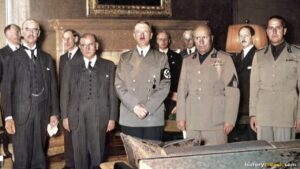
Mussolini’s decision was driven by his ambition to establish a new Italian empire in the Mediterranean region and in Africa. In fact, he hoped to expand Italian territory in North Africa, East Africa and the Balkans. As such, Italy’s entry into the war was guided by these imperial ambitions rather than by any deep ideological commitment to fighting alongside Nazi Germany, although the two nations had been aligned through the Rome-Berlin Axis since 1936.
 FactsthatCrunch
 Black & whiteColor
Italy in World War II – Army
At the time Italy entered the war in June of 1940, the Italian armed forces were significantly weaker than Mussolini’s public posturing suggested. The Italian military suffered from serious shortages of modern equipment, including tanks, anti-tank guns, vehicles and modern aircraft. Industrial production was limited, and the supply of fuel, coal and steel was insufficient to sustain prolonged military operations. As a result, Italian forces frequently relied on Nazi German support in the campaigns they undertook.
In total, Italy mobilized approximately 3.4 million men in its armed forces during World War II. Italian forces fought in multiple theaters across the war, including: North Africa, East Africa, the Balkans, Greece, the Soviet Union, and eventually on Italian soil itself after the Allied invasion of 1943.
Italy participated in World War II initially as one of the three main Axis PowersThe alliance of nations, led by Nazi Germany, Italy, and Japan, that fought against the Allies in World War II. alongside Nazi Germany and Imperial Japan. After the armistice of September of 1943, Italy changed its status to align with the Allied Powers, meaning that Italian forces fighting under the new government joined the Allies against Nazi Germany, while the Italian Social Republic in the north continued to fight on the Nazi German side.
FactsthatCrunchItaly put approximately 3.4 million men into its armed forces during World War II, and the country paid an enormous human cost across every theater it fought in.
Italian military deaths during the war are estimated at approximately 319,000. Civilian deaths add approximately 153,000 more, bringing the total loss of life to well over 470,000 people. Those deaths came from fighting in North Africa, Greece, the Soviet Union, East Africa, and on Italian soil itself after the Allied invasion of 1943.
Italy in World War II – Major Campaigns and Battles
The major campaigns and battles that Italian forces participated in included: the North African campaign, the invasion of Greece, the East African campaign, operations on the Eastern Front, and the Italian Campaign following the Allied invasion of 1943.
FactsthatCrunchIn which theaters around the world did Italian forces fight during World War II?
Tap a point to read its detail.
Italy in North Africa
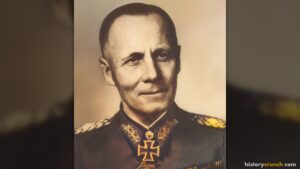
One of Italy’s most important and costly theaters of the war was North Africa. Italian forces in Libya invaded British-controlled Egypt in September of 1940 with the goal of capturing the Suez Canal and establishing Italian dominance over the eastern Mediterranean. The initial Italian advance made progress but was halted and then pushed back deep into Libya by a British counteroffensive in late 1940 and early 1941. The defeat of the Italian forces was so severe that Mussolini was forced to request Nazi German assistance, and in February of 1941 the German Afrika KorpsThe German military force sent to North Africa in 1941 to rescue struggling Italian troops. under General Erwin Rommel was sent to North Africa to support the Italian position.
The North African campaign continued as a back and forth struggle across the deserts of Libya and Egypt for the next two years. For instance, Italian and German forces advanced as far as El Alamein in Egypt in the summer of 1942, coming close to threatening the Suez Canal. However, the Second Battle of El Alamein in October and November of 1942 resulted in a decisive Allied victory and drove Axis forces back into Tunisia. Allied forces closed in from both east and west, and on May 13th, 1943, the remaining Axis forces in North Africa, including approximately 130,000 Italian soldiers, surrendered. The loss of the North African campaign was a serious blow to Italian military strength and public morale.
FactsthatCrunchIn Operation Compass, a British force of about 36,000 soldiers drove back an Italian army of about 150,000 in Egypt and Libya.
The British attack began on December 9th, 1940, and by February 1941 it had captured about 130,000 Italian prisoners. Germany then sent Erwin Rommel and the Afrika Korps to North Africa to rescue its ally.
Italy in the Invasion of Greece and the Balkans
It should also be noted that Mussolini launched an invasion of Greece from Italian-controlled Albania on October 28th, 1940, without informing Hitler in advance. The campaign was intended to demonstrate Italian military independence and expand Italian influence in the Balkans. However, the invasion quickly turned into a disaster. Greek forces repelled the Italian attack and launched a counteroffensive that drove Italian forces back into Albania. The Italian military struggled throughout the winter of 1940 and into 1941 to hold its position, suffering approximately 102,000 casualties including approximately 13,755 killed during the campaign. In April of 1941, Nazi Germany was forced to intervene with its own invasion of Greece to rescue the Italian position, which embarrassed Mussolini and exposed the weakness of Italian military planning.
FactsthatCrunchItaly on the Eastern Front
Italy also sent a significant military force to fight alongside Nazi Germany on the Eastern Front against the Soviet Union. The Italian Expeditionary Corps in Russia, later expanded into the Italian Army in Russia known as the ARMIR, eventually numbered approximately 235,000 soldiers. Italian forces suffered severely in the harsh conditions of the Russian winter, particularly during the Soviet counteroffensive that followed the Battle of Stalingrad in the winter of 1942 to 1943. Italian forces were overrun during the Soviet attack in December of 1942 and January of 1943, suffering approximately 114,000 casualties including killed, wounded, and prisoners. The remnants of the Italian force were withdrawn from the Eastern Front in the spring of 1943.
Italy and the Allied Invasion
The fall of Italy as an Axis Power began with the Allied invasion of Sicily on July 10th, 1943. The rapid Allied advance across Sicily, combined with the accumulated failures of the war and the heavy Allied bombing of Italian cities, produced a political crisis within the Italian government. On July 25th, 1943, the Fascist Grand Council passed a vote of no confidence in Mussolini, and King Victor Emmanuel III had Mussolini arrested and removed from power. He was replaced as Prime Minister by Marshal Pietro Badoglio, who immediately began secret negotiations with the Allied Powers.
Italy’s armistice with the Allied Powers was signed on September 3rd, 1943, and publicly announced on September 8th, 1943. The announcement triggered an immediate and decisive response from Nazi Germany. German forces rapidly disarmed the Italian military and occupied northern and central Italy. Of the approximately 615,000 Italian soldiers who refused to join the German side after the armistice, most were transported as forced labor to Germany. Mussolini was rescued from captivity by German paratroopers on September 12th, 1943, and was installed by Hitler as the leader of a new German-backed puppet stateA country that appears independent but is actually controlled by a foreign power. in northern Italy known as the ‘Italian Social Republic’, based in the town of Salò.
The Italian government in the south, now under Allied protection, declared war on Nazi Germany on October 13th, 1943. Italian forces fighting under the new government were organized into the Italian Co-Belligerent ArmyThe reorganized Italian military force that fought alongside the Allies after Italy switched sides in 1943., which fought alongside Allied forces in the Italian Campaign. At the same time, the Italian Resistance, consisting of approximately 350,000 partisansCivilian fighters who secretly resisted the German occupation inside Italy during the war., fought against the German occupation in northern and central Italy throughout 1944 and into 1945. On April 28th, 1945, Mussolini was captured by Italian partisans while attempting to flee to Switzerland and was executed by firing squad. Nazi German forces in Italy formally surrendered on May 2nd, 1945.
Can you put these key events in the fall of Mussolini and Italy's switch of sides in 1943 in the correct order?
Italy in World War II – Home Front
The Italian home front during World War II was shaped by the severe economic and military strain that the conflict placed on a country that was ill-prepared for prolonged warfare. Food shortages were widespread from an early stage in the war, and the standard of living declined steadily for ordinary Italians as the conflict dragged on. Allied bombing of Italian industrial cities and ports became increasingly intense from 1942 onward, causing significant destruction in cities including: Genoa, Turin, Milan, Naples, and Rome. For instance, an Allied air attack on the San Lorenzo district of Rome in July of 1943 killed more than 3,000 civilians.
Public support for the war and for Mussolini’s fascist regime collapsed rapidly as the military failures mounted. By the time of the Allied invasion of Sicily in July of 1943, civilian morale across Italy was very low and opposition to the regime was growing. The removal of Mussolini in July of 1943 was greeted with relief by much of the Italian population, and the subsequent German occupation of northern Italy produced a strong Italian Resistance movement. After the armistice, Italy experienced a period that some historians describe as a civil war, with Italian partisans fighting against both German forces and the forces of the Italian Social Republic in the north.
The period of German occupation brought the full impact of the Holocaust to Italy. Before 1943, Mussolini’s government had passed anti-Semitic laws and placed restrictions on Jewish people, but had generally not cooperated with Nazi German deportation policies. After the German occupation of September of 1943, however, German authorities began rounding up and deporting Italian Jews to death camps. Approximately 8,500 Jewish people were deported from Italy and Italian-occupied territories, the majority of whom did not survive. More than 40,000 Jewish people in Italy survived the Holocaust, in part because many were hidden by Italian civilians.
Italy in World War II – Significance
World War II was one of the most important events in the modern history of Italy. First, Italy’s experience of the war was uniquely complex among the major nations involved. Beginning as an Axis Power, suffering a series of military disasters, losing its fascist government, and ending the war fighting alongside the Allied Powers gave Italy an experience of the conflict that was shared by no other major participant. This complexity contributed to deep and lasting divisions within Italian society about responsibility, collaboration, and resistance that took many decades to process.
Second, World War II brought about the end of both fascism and the Italian monarchy. The defeat of Mussolini and the discrediting of the fascist regime created the conditions for a fundamental transformation of Italian government. In a constitutional referendum held on June 2nd, 1946, the Italian people voted to abolish the monarchy and establish a republic. This was a direct result of public anger at King Victor Emmanuel III for his role in supporting Mussolini’s rise and his decision to flee Rome at the time of the German occupation. As such, World War II produced a complete transformation of Italy’s political system.
Third, the Italian Resistance played an important role in shaping Italy’s postwar national identity. The approximately 350,000 Italians who fought as partisans against the German occupation provided the country with a narrative of active resistance that helped counterbalance the earlier history of fascist collaboration. The liberation of northern Italy by partisan forces on April 25th, 1945, known as the ‘Liberation Day’, became one of the most celebrated events in Italian national memory and continues to be commemorated as a national holiday in Italy to the present day.
FactsthatCrunchOn June 2nd, 1946, Italian voters chose by a majority to abolish the monarchy and establish a republic, ending over 80 years of rule by the House of Savoy. The vote was a direct result of public anger at King Victor Emmanuel III for supporting Mussolini's rise to power and for fleeing Rome when German forces occupied the city in 1943.
Italy ruled by a king under a constitutional monarchy, with the House of Savoy on the throne
Italy became a republic, with the monarchy abolished and the royal family sent into exile
Key Vocabulary
Imperial ambitions
Axis Powers
Armistice
Afrika Korps
Puppet state
Partisans
Co-Belligerent Army
Frequently Asked Questions
When did Italy enter World War II?
Italy entered World War II on June 10th, 1940, joining Nazi Germany as an Axis Power. Mussolini waited until France was close to defeat before declaring war. He believed the fighting was nearly over and that Italy could gain territory at little cost.
Why did Italy switch sides during World War II?
Italy switched sides after a string of military defeats destroyed support for Mussolini and the war. He was removed from power in July of 1943, and Italy signed an armistice with the Allies on September 8th, 1943. Italy then declared war on Nazi Germany on October 13th, 1943.
What happened to Benito Mussolini?
Mussolini was arrested and removed from power on July 25th, 1943, after the Fascist Grand Council voted against him. German paratroopers rescued him and made him leader of a puppet state in northern Italy. Italian partisans captured and executed him by firing squad on April 28th, 1945.
Why was the Italian military so weak in World War II?
Italy’s military lacked modern equipment such as tanks, aircraft, and anti-tank guns. Weak industry and shortages of fuel, coal, and steel made long campaigns hard to sustain. As a result, Italian forces often depended on Nazi German support in battle.
How did World War II change Italy’s government?
World War II ended both fascism and the Italian monarchy. In a referendum held on June 2nd, 1946, voters chose to abolish the monarchy and create a republic. Anger at King Victor Emmanuel III for backing Mussolini and fleeing Rome helped drive this change.
How many people from Italy died in World War II?
Italian military deaths are estimated at about 319,000, and civilian deaths at about 153,000. Many soldiers died in North Africa, Greece, and on the Eastern Front. Allied bombing and the German occupation also killed large numbers of civilians at home.
Cite This Article
To cite this article as a source, use one of the formats below.
MLA: Millar, B. “Italy in World War II: A Detailed Summary.” HistoryCrunch, 1 October 2026, https://historycrunch.com/italy-in-world-war-ii/.
APA: Millar, B. (2026). Italy in World War II: A Detailed Summary. HistoryCrunch. https://historycrunch.com/italy-in-world-war-ii/
Chicago: Millar, B. “Italy in World War II: A Detailed Summary.” HistoryCrunch. October 1, 2026. https://historycrunch.com/italy-in-world-war-ii/
Sources
- Gerhard L. Weinberg, A World at Arms.
- Imperial War Museum
- The National WWII Museum
- Antony Beevor, The Second World War.