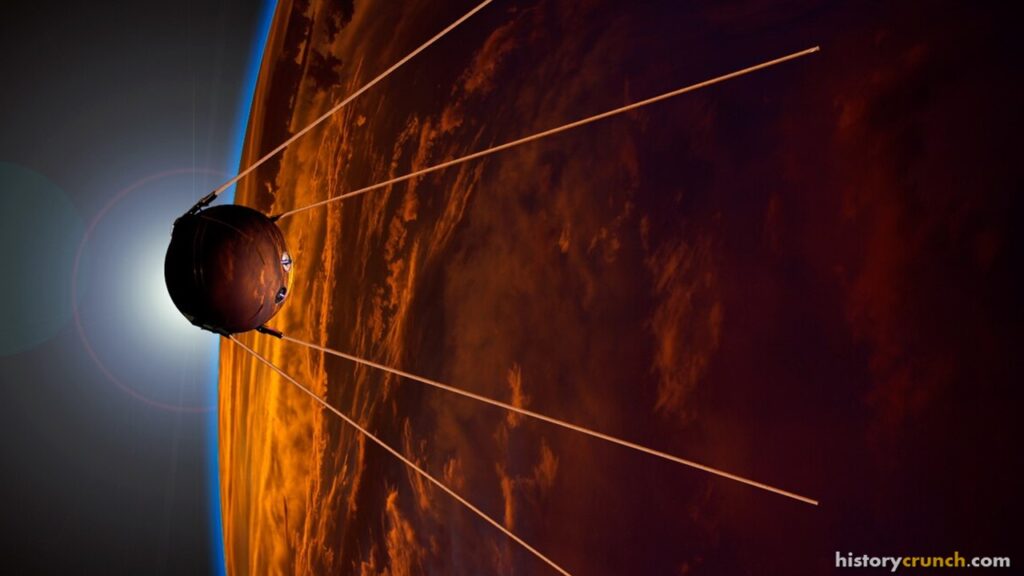
Sputnik was one of the most significant technological achievements of the Cold War era and a defining moment in the history of space exploration. On October 4th, 1957, the Soviet Union successfully launched Sputnik 1, the world’s first man-made satellite, into orbitThe curved path a satellite follows as it continuously circles the Earth in space. around the Earth. The satellite was a polished aluminum sphere approximately 23 inches (58 centimeters) in diameter, weighing approximately 184 pounds (83 kilograms), and fitted with four antennas that broadcast a steady radio signal. The launch shocked the American public and government, demonstrated that the Soviet Union possessed powerful rocket technology capable of reaching space, and triggered a period of intense competition between the two superpowers in space exploration that became known as the ‘Space Race‘. In general, historians consider Sputnik to have been significant for several reasons, including: the fear it generated in the United States about Soviet technological and military capabilities, the political propaganda value it provided to the Soviet Union, and the dramatic acceleration of both the American and Soviet space programs that it produced.
How many pounds did Sputnik 1 weigh when it launched into orbit in 1957?

What Was the Cold War?
The Cold War was a period of intense political, ideological, and military tension between the United States and the Soviet Union that lasted from the end of World War II in 1945 until the early 1990s. At its heart, the Cold War was a ‘face off’ or competition between the two superpowers, rooted in a fundamental ideological conflict between the capitalism and democracy of the United States and the communism and dictatorship of the Soviet Union. Although the Cold War never escalated into direct military conflict between the two nations, it involved proxy wars, nuclear arms races, and a series of dangerous confrontations and crises. As well as military and political competition, the two superpowers also engaged in a ‘prestige raceCompetition between the US and Soviet Union to prove their system’s superiority through scientific achievements.‘, in which they competed to demonstrate the superiority of their respective ideological systems through scientific and technological achievements. The launch of Sputnik was the opening move in the most dramatic phase of this prestige race, which became known as the Space Race.
Sputnik – Background
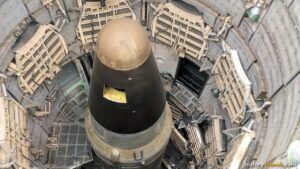
To fully understand the significance of Sputnik, it is first important to understand the conditions that led to its development. By the early 1950s, both the United States and the Soviet Union were investing heavily in rocket technology, primarily for military purposes. The development of intercontinental ballistic missilesLong-range rockets capable of carrying nuclear warheads across vast distances between continents., known as ICBMs, was a central priority for both nations, as these rockets could carry nuclear warheads across vast distances. The Soviet rocket program was led by Sergei Korolev, a brilliant engineer who had survived imprisonment in a Soviet labor camp in the late 1930s to become the chief architect of the Soviet space effort.
The R-7 Semyorka, which Korolev developed as the world’s first successful ICBM, was tested for the first time on August 21st, 1957. This rocket had significantly more lifting power than early American rockets, which gave the Soviet Union a substantial advantage in the early stages of the Space Race. As well, both the United States and the Soviet Union had publicly declared their intentions to launch a man-made satellite. For instance, American President Dwight D. Eisenhower announced in July of 1955 that the United States planned to launch a satellite, and Soviet scientists announced a similar goal shortly afterward.
When the development of a larger and more complex Soviet satellite fell behind schedule, Korolev made the decision to rapidly design and build a much simpler satellite that could be launched quickly. The result was Sputnik 1, which Korolev referred to internally as ‘PS-1’, meaning ‘simplest satellite’. As such, the simplicity of Sputnik 1 was a deliberate choice driven by the desire to beat the United States into space.
Sputnik – The Launch
On October 4th, 1957, Sputnik 1 was launched from the Baikonur CosmodromeA Soviet rocket launch facility, similar to what Americans call a launch site or spaceport. in Soviet Kazakhstan, atop a modified R-7 rocket. The launch took place in the evening, and within minutes of liftoff, Sputnik separated from the rocket’s upper stage and entered a low Earth orbit. The satellite orbited the Earth at an altitude ranging from approximately 141 miles (227 kilometers) at its lowest point to approximately 589 miles (948 kilometers) at its highest point, completing one full orbit of the Earth every 96 minutes. The only instrument on board was a simple radio transmitter that broadcast a steady beeping signal on two frequencies that amateur radio operators around the world could easily detect.
Soviet authorities initially reacted with relative calm to the success of the launch, as they had kept their space program largely secret and were uncertain of the international reaction. However, when the scale of the response in the Western world became apparent, the Soviet government quickly embraced Sputnik as a major propagandaInformation spread by a government to promote its own system and make rivals look inferior. achievement. For instance, Soviet citizens were encouraged to listen to the satellite’s radio signal and to watch for it passing overhead in the night sky. The Soviet government used the achievement to argue that it demonstrated the superiority of the Soviet system over the capitalist West.
Sputnik 1 continued to orbit the Earth until January 4th, 1958, when it re-entered the Earth’s atmosphere and burned up, having completed approximately 1,440 orbits and traveled a total distance of approximately 43 million miles (70 million kilometers). Its radio transmitter had fallen silent on October 26th, 1957, when its batteries ran out, after operating for 22 days.
FactsthatCrunchKorolev designed the R-7 Semyorka rocket and led the Soviet team that put the first satellite into orbit, giving the Soviet Union an early lead in the Space Race. His identity as lead engineer was kept secret by the Soviet government during his lifetime, and he was known publicly only as the anonymous 'Chief Designer.'
Sputnik – Sputnik 2 and Laika
Less than a month after the launch of Sputnik 1, the Soviet Union launched a second satellite on November 3rd, 1957. Sputnik 2 was significantly larger and heavier than its predecessor, weighing approximately 1,121 pounds (508 kilograms), and carried the first living creature to orbit the Earth, which was a dog named Laika. The launch of Sputnik 2 was ordered by Soviet Premier Nikita Khrushchev, who wanted to mark the 40th anniversary of the Russian Revolution with another space achievement. Sputnik 2 carried scientific instruments to measure solar radiation and cosmic rays, as well as the life support equipment needed to keep Laika alive in orbit. It should also be noted that due to the speed at which the mission was prepared, Soviet engineers had not been able to develop a system to return Laika safely to Earth. Laika survived for a short period in orbit before the environmental control system failed. Sputnik 2 eventually burned up on re-entry on April 14th, 1958.
FactsthatCrunchThe launch of Sputnik 2 on November 3rd, 1957 proved that the Soviet Union could put a living creature into orbit, showing the world that human spaceflight was within reach and deepening American fears about falling behind in the Space Race.
Sputnik 2 weighed approximately 1,121 pounds (508 kilograms), far heavier than Sputnik 1, which showed that Soviet rockets could lift far larger and more capable payloads than anything the United States had demonstrated at the time.
Soviet Premier Nikita Khrushchev ordered the launch to mark the 40th anniversary of the Russian Revolution, making clear that the Soviet Union intended to use space achievements as direct political statements about the strength of its system.
Laika, the dog aboard Sputnik 2, became the first living creature to orbit Earth, which signaled to both superpowers that sending a human into orbit was a near-term goal rather than a distant idea, pushing American planners to accelerate their own crewed spaceflight programs.
Soviet engineers had not been able to develop a way to return Laika safely to Earth before the mission launched, yet the Soviet government pressed ahead anyway, showing how urgently Soviet leadership prioritized beating the United States to each new milestone over other considerations.
Sputnik – American Reaction
For many Americans, the news that the Soviet Union had successfully placed a satellite in orbit was deeply unsettling. The same rocket technology that had launched Sputnik could also be used to deliver a nuclear warhead to any point on Earth, including targets within the United States. As such, Sputnik was not simply a scientific achievement but also a demonstration of Soviet military capability that raised serious concerns about America’s national security.
The political reaction in the United States was swift and far-reaching. For instance, a period of intense public debate erupted about the state of American science and education, with many critics arguing that the United States had fallen behind the Soviet Union because it was not investing enough in science, mathematics and engineering education. This debate led directly to the passage of the National Defense Education Act in September of 1958, which provided significant federal funding for science and mathematics education across the country. As well, the Vanguard rocket, which the United States had been developing as its launch vehicle for a satellite, suffered a highly public failure on December 6th, 1957, when it exploded just two seconds after ignition at Cape Canaveral, Florida. The incident was captured by cameras and broadcast on television, which deepened American anxiety and embarrassment in regards to the Space Race.
In response to the Sputnik challenge, President Eisenhower created the National Aeronautics and Space Administration, known as NASA, on October 1st, 1958, to coordinate and lead the American space program. The United States also successfully launched its first satellite, Explorer 1, on January 31st, 1958, from Cape Canaveral. Explorer 1 was significantly smaller than Sputnik, weighing just over 30 pounds (14 kilograms), but it carried scientific instruments and made an important discovery, which was detecting the Van Allen radiation beltsZones of charged particles surrounding Earth, discovered by the American satellite Explorer 1. that surround the Earth.
FactsthatCrunchThe launch of Sputnik 1 set off a chain of events that reshaped American science policy within a single year. Fear of Soviet rocket power pushed the government to reform education funding and build an entirely new federal space agency.
Sputnik – Significance
The creation and launch of Sputnik was significant for several important reasons. First, it was the opening event of the Space Race and demonstrated that the Soviet Union was capable of matching or surpassing the United States in key areas of science and technology. The shock that Sputnik produced in the United States directly accelerated American investment in science, education, and space exploration in ways that had lasting consequences for American society and the world.
Second, Sputnik represented an important milestone for all of humanity. For the first time in history, a human-made object had left the surface of the Earth and entered orbit around the planet. This achievement opened the door to the era of space exploration, which would produce the first human spaceflight, the first moon landing, and eventually the development of numerous other satellites. As such, Sputnik was not only a Cold War event but one of the most consequential technological achievements in the history of the human race.
Third, Sputnik demonstrated the important role that technological competition played in the Cold War. The prestige associated with being the first nation to launch a satellite gave the Soviet Union a significant propaganda victory, while the fear that the achievement generated in the United States led to a change in American scientific and educational priorities.
FactsthatCrunchWhen Sputnik 1 reached orbit on October 4th, 1957, it carried exactly one instrument: a simple radio transmitter that broadcast a steady beeping signal on two frequencies. The satellite completed one full orbit of Earth every 96 minutes, traveling between approximately 141 miles (227 kilometers) and 589 miles (948 kilometers) above the surface. Its entire mission lasted 22 days before the batteries ran out, and the satellite itself burned up on re-entry on January 4th, 1958.
Today, thousands of satellites orbit Earth simultaneously, operated by governments, militaries, universities, and private companies from dozens of countries. Modern satellites carry advanced instruments for weather forecasting, GPS navigation, communications, scientific research, and military reconnaissance, performing many tasks at once. Sputnik's single beeping transmitter has given way to spacecraft that relay phone calls, stream television, and track hurricanes in real time.
Sputnik proved that putting a human-made object into orbit was possible, and that single achievement opened the path to every satellite now circling Earth.
Explore Cold War · 1947 – 1991
Keep exploring Cold War with these History Crunch resources.
Key Vocabulary
Intercontinental ballistic missiles
Orbit
Cosmodrome
Proxy wars
Propaganda
Van Allen radiation belts
Prestige race
Frequently Asked Questions
What was Sputnik 1?
Sputnik 1 was the world’s first man-made satellite, launched by the Soviet Union on October 4th, 1957. It was a polished aluminum sphere about 23 inches (58 centimeters) wide and weighed around 184 pounds (83 kilograms). Four antennas broadcast a steady beeping radio signal that people around the world could detect.
Why was the launch of Sputnik so important?
Sputnik started the Space Race and proved the Soviet Union could match or beat the United States in technology. It also frightened Americans, because the same rockets could carry nuclear weapons across the globe. The event pushed the United States to spend far more on science, education, and space exploration.
Who was Laika and what happened to her?
Laika was a dog that became the first living creature to orbit the Earth aboard Sputnik 2 on November 3rd, 1957. Soviet engineers had prepared the mission so quickly that they built no way to return her safely. Laika survived only a short time in orbit before the environmental control system failed.
How did the United States respond to Sputnik?
The United States created NASA on October 1st, 1958, to lead its space program. Congress also passed the National Defense Education Act in September of 1958 to fund science and math education. America launched its first satellite, Explorer 1, on January 31st, 1958, from Cape Canaveral, Florida.
How long did Sputnik 1 stay in orbit?
Sputnik 1 orbited the Earth until January 4th, 1958, when it re-entered the atmosphere and burned up. It completed about 1,440 orbits and traveled roughly 43 million miles (70 million kilometers). Its radio signal stopped on October 26th, 1957, after the batteries died following 22 days of use.
Cite This Article
To cite this article as a source, use one of the formats below.
MLA: Millar, B. “Sputnik: A Detailed Summary.” HistoryCrunch, 9 October 2026, https://historycrunch.com/sputnik/.
APA: Millar, B. (2026). Sputnik: A Detailed Summary. HistoryCrunch. https://historycrunch.com/sputnik/
Chicago: Millar, B. “Sputnik: A Detailed Summary.” HistoryCrunch. October 9, 2026. https://historycrunch.com/sputnik/
Sources
- John Lewis Gaddis, The Cold War: A New History.
- State Department — Office of the Historian
- Odd Arne Westad, The Global Cold War.
- Wilson Center Digital Archive