
The Great Depression was the worst economic collapse in the history of the modern world. It began with the Wall Street crash of October 1929, put one American worker in four out of a job by 1932, spread to every trading country on earth, and ended only with the Second World War. The New Deal that Franklin Roosevelt built to fight it changed what Americans expect their government to do.
The Depression ran from 1929 to 1941. This timeline covers 1921 to 1944, because it also includes the boom that made the crash possible and the war that ended the slump.
The Great Depression began with the Wall Street crash of October 1929 and ended when the United States went to war in December 1941. The events below run from 1921, when the boom that made the crash possible began, to 1944, when unemployment fell to 1.2 percent and the story was over. Most of them are the result of something earlier on the list: a tariff, a loan that stopped, a bank that closed its doors, a president who believed the slump would cure itself and one who decided it would not.
The Dow Jones average peaked at 381 on September 3rd, 1929 and bottomed at 41 on July 8th, 1932, a fall of 89 percent. This timeline follows the numbers: the borrowed money that built the bubble, the four days in October that broke it, the false recovery of 1930, and the slide to one worker in four without a job. It runs on to 1944 so the recovery can be measured against the fall.
The crash hurt investors; the bank failures hurt everyone. About 9,000 American banks closed between 1930 and 1933, taking their depositors' savings with them, and the gold standard stopped the government from doing anything about it. This timeline follows the three waves of panic, the European collapse of 1931, the closing of every bank in the country in March 1933, and the laws that made sure it did not happen again.
Herbert Hoover was the most admired man in America when he took office in March 1929 and the most blamed when he left it four years later. This timeline follows what he did and did not do: the tariff he signed against his own judgment, the dam, the moratorium, the government bank that lent to banks, the relief he refused, and the summer afternoon in 1932 when the army drove the veterans out of Washington. It ends with the landslide against him.
The New Deal was Franklin Roosevelt's answer to the Depression, and it came in two waves: the emergency laws of 1933 that reopened the banks and put money and jobs into the country, and the lasting laws of 1935 to 1938 that gave Americans Social Security, the right to a union and a minimum wage. This timeline follows the laws and the agencies from the first bank holiday to the day the WPA closed because the war had given everyone a job.
This timeline is about the people the numbers stand for: the men in the soup lines, the families in the shacks, the boys on the freight trains, the women who took what work there was, the Mexican Americans put on trains south, the Okies on Route 66, and the writers and photographers who made sure the decade was not forgotten. It runs from the first soup kitchen of 1930 to the first Social Security check of 1940.
The Dust Bowl was a second disaster inside the first: a drought on the southern Plains that turned a hundred million acres of plowed-up grassland into dust and blew it as far as the Atlantic. This timeline follows the storms, the science that explained them, the trees and the contour plowing that answered them, and the 250,000 people who gave up and drove west to California, where a photographer and a novelist were waiting.
The Depression was American first and worldwide within a year, because the world's money ran through New York. This timeline follows it out: the loans that stopped, the tariff war, the banks of Vienna and Berlin, the British pound, and what the slump did to Canada, Australia, Britain and France, with light coverage of Germany, where six million unemployed put Hitler in power. Those countries' own stories are on their own timelines.
Behind every law in this story there is a person and an argument. This timeline follows the people who ran the Depression and the New Deal, from Herbert Hoover the engineer to Frances Perkins with her list, and the argument between John Maynard Keynes and Friedrich Hayek about whether a government should spend its way out of a slump, which the events of 1937 and 1938 settled for a generation.
In September 1929 the stock market was at a record. Five weeks later it had lost half its value. What broke?
The stock market crash of 1929 ran from the peak of September 3rd through Black Thursday, October 24th, and Black Tuesday, October 29th, to the bottom of July 8th, 1932, when the market had lost 89 percent of its value.
Stock markets crash and recover. Why did this one turn into ten years of mass unemployment?
The Great Depression, as distinct from the crash, was the collapse of production, banking and employment that ran from the autumn of 1929 to 1933 and did not fully lift until the war.
When was the Depression over? The market, the banks and the unemployed each give a different answer.
The Great Depression is usually dated from October 1929 to December 1941, but the stock market bottomed in 1932, the banks were safe from 1933, and unemployment did not fall below 10 percent until 1941.
Looking back, the crash had warnings for seven years. Which ones could people have seen at the time?
The stock market crash of 1929 came after a decade of boom, and historians have found its causes in the tariffs, the credit and the speculation of the 1920s, and in a series of smaller shocks in the year before it.
Nine thousand American banks failed between 1930 and 1933. What stopped it?
The banking crisis of the Great Depression came in three waves, in late 1930, 1931 and the winter of 1932 to 1933, and ended with the national bank holiday of March 1933 and federal deposit insurance.
Every major country in 1929 tied its money to gold. Why did the ones that gave it up first recover first?
The gold standard was the system under which a currency could be exchanged for a fixed weight of gold. Britain left it on September 21st, 1931, the United States on April 19th, 1933, and France in 1936, in the order in which their economies recovered.
What did the New Deal change so that 1929 could not happen the same way again?
The New Deal's financial reforms of 1933 and 1934 created deposit insurance, separated banking from stock trading, and set up the Securities and Exchange Commission to police the stock market.
Herbert Hoover was elected by a landslide in 1928 and lost by a landslide in 1932. What happened in between?
Herbert Hoover was president from March 1929 to March 1933, the years in which the crash became the Depression; his name was given to the shantytowns of the unemployed and the voters removed him by 472 electoral votes to 59.
In July 1932 the United States Army drove 15,000 veterans of the First World War out of the capital with tanks and tear gas. How did it come to that?
The Bonus Army was the march of First World War veterans on Washington in the summer of 1932 to ask for early payment of a bonus due in 1945; the army evicted them on July 28th, and Congress paid the bonus in 1936.
Congress raised tariffs in 1930 to protect American jobs. Why did exports fall by two thirds?
The Smoot-Hawley Tariff Act of June 1930 raised taxes on more than 20,000 imported goods; two dozen countries retaliated, world trade fell by two thirds, and the Reciprocal Trade Agreements Act of 1934 began to undo it.
Hoover is remembered as the president who did nothing. What did he actually do?
Herbert Hoover's response to the Depression included public works, a moratorium on war debts, and the Reconstruction Finance Corporation, but not federal relief for the unemployed, which he opposed on principle until the summer of 1932.
Congress passed fifteen major laws in a hundred days in 1933. What did they change?
The Hundred Days were the special session of Congress from March 9th to June 16th, 1933, which passed the first New Deal at Franklin Roosevelt's request: banking, relief, farm, public works and reform laws that no session before or since has matched.
The New Deal chose to give the unemployed jobs rather than money. Why, and did it work?
The New Deal's work programs, the Civilian Conservation Corps, the Civil Works Administration and the Works Progress Administration, employed about 11 million Americans between 1933 and 1943, when the war made them unnecessary.
Roosevelt had won by a landslide and passed fifteen laws. Why did he need a second New Deal in 1935?
The Second New Deal was the wave of laws passed in 1935 and 1936, including the WPA, the Wagner Act and Social Security, which shifted the New Deal from emergency relief to lasting reform.
The Supreme Court struck down the New Deal's biggest laws. How did the New Deal survive?
The fight between Franklin Roosevelt and the Supreme Court ran from the Schechter decision of May 1935, which struck down the NRA, to the court-packing plan of 1937, which failed, and the court's rulings of 1937 that upheld Social Security and the Wagner Act.
Franklin Roosevelt's programs put millions back to work. Farm workers and domestic servants were excluded from most of them, and most Black Americans worked in one of those two jobs. Was that an accident?
The price of getting the votes to pass it.
Unemployment under Franklin Roosevelt was around 25 percent in 1933 and still near 15 percent in 1940. Then the war came and it vanished. So what did the New Deal actually do?
Recovery, relief and an argument that is still running.
What did it mean to live through the Depression with no job and no help?
Life in the Great Depression, for the one family in four with no wage earner, meant soup lines, evictions, shantytowns, children leaving home and, for some, being sent out of the country; the pictures of the decade come from these years.
The Depression pushed women into work and turned public opinion against them working. How did that play out?
Women in the Great Depression took the jobs that survived, at half a man's pay, ran the households that stretched every dollar, and, for the first time, sat in the president's cabinet and shaped federal policy.
A quarter of a million teenagers rode the rails in 1932. What happened to them?
Young Americans in the Great Depression left school for work that did not exist, left home so their families could eat, and became the target of the New Deal's first and most popular program, the Civilian Conservation Corps.
Why do we remember the Depression in faces? Who took the pictures and wrote the books, and why?
The Great Depression is remembered through the photographs of the Farm Security Administration, the newspaper images of soup lines and shantytowns, and John Steinbeck's novel The Grapes of Wrath, most of it made to move the public to act.
The Plains had droughts before 1931. Why did this one blow the soil away?
The Dust Bowl was the series of dust storms that stripped the southern Plains from 1934 to 1939, caused by drought on a hundred million acres of grassland that had been plowed for wheat in the boom of the 1920s.
A quarter of a million people left the Plains for California. What did they find?
The Okie migration of 1935 to 1940 took about 250,000 people from Oklahoma, Texas, Arkansas and Missouri west on Route 66 to California, where a photographer and a novelist made them the face of the Depression.
American farms had been in a depression since 1920. What did the New Deal do for them?
The New Deal's farm programs paid farmers to plant less, built dams and power lines in regions that had never had electricity, taught the Plains to plow along the contour, and planted 220 million trees against the wind.
The crash was in New York. Why were there six million unemployed in Germany three years later?
The Great Depression spread from the United States to the rest of the world through the American loans that stopped, the tariffs that closed markets, the bank panics of 1931 and the gold standard that tied every currency together.
Three countries that spoke the same language answered the slump three different ways. Which one worked?
The Great Depression hit Canada and Australia, which sold raw materials to a world that stopped buying, harder than almost any country; Britain, which left gold in 1931, recovered earlier but left its industrial north behind.
Democracies and dictatorships faced the same slump. Why did Germany choose Hitler and America choose Roosevelt?
The Great Depression destroyed Germany's democracy and strengthened America's; the two countries hit bottom in the same winter, chose their leaders thirty-three days apart, and met in the war that ended the slump for both.
Should a government spend its way out of a slump? Two economists said opposite things in 1931, and the decade tested both.
John Maynard Keynes argued that a government must borrow and spend in a slump to restore jobs; Friedrich Hayek argued that spending only delayed the cure. Their quarrel began in 1931, Keynes's General Theory appeared in 1936, and the recession of 1937 was taken as the test.
Roosevelt was elected without a program and became the only president to win four times. What did he have?
Franklin D. Roosevelt was president from March 1933 until his death in April 1945, elected four times, and led the country through the Depression and the Second World War with the New Deal, the fireside chats and a coalition of voters that lasted a generation.
Roosevelt signed the laws. Who wrote them, and what did they want?
The New Dealers were the people Franklin Roosevelt brought in to design and run his programs: Frances Perkins at Labor, Harry Hopkins at relief, Eleanor Roosevelt as the conscience of the administration, and Mary McLeod Bethune for the Black Americans it was slow to reach.
The 1920s were the best decade the American economy had ever had: cars, radios and refrigerators in ordinary homes, a stock market that rose six times over, and three Republican presidents who believed that business, left alone, would keep it going. The boom had cracks. Farmers never shared in it, Europe was paying its war debts with borrowed American money, tariffs were rising, and by 1929 millions of people were buying shares with money they did not have. Herbert Hoover took office in March 1929 promising the end of poverty. The market peaked six months later.
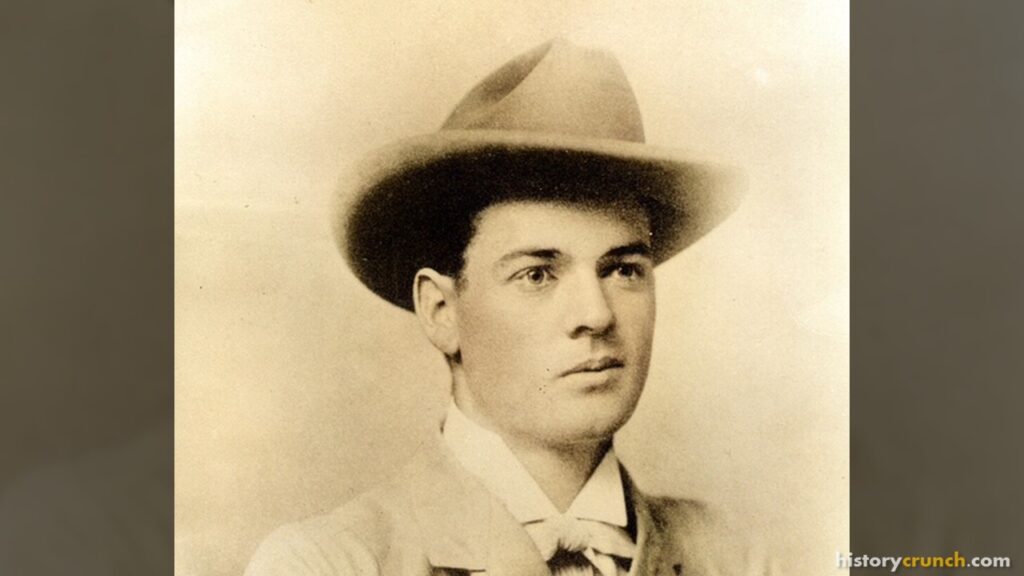
Warren Harding was sworn in as president on March 4th, 1921 and gave the Commerce Department to Herbert Hoover, the mining engineer who had fed occupied Belgium during the First World War and run America's food supply after it. Hoover kept the job for seven years, through Harding's death in August 1923 and Calvin Coolidge's presidency, and turned a quiet department into the busiest office in Washington.
LEARN MORESHOW LESSwhy it matters · key numbers · elsewherePOLITICALThe 1920s were run by three Republican presidents who believed business should be left alone, and Hoover was the one who actually did the work: standardizing everything from brick sizes to radio frequencies. When the boom broke in 1929 it broke on his watch, and the reputation he had built as the man who could organize anything did not survive it.
Germany was two years into paying reparations and a year away from the hyperinflation that would wipe out its middle class; the Nazi Germany timeline follows that side of the decade.
Congress passed the Fordney-McCumber Act on September 21st, 1922, pushing the average tax on imported goods to around 40 percent, one of the highest rates the country had seen. American farmers, who had done well selling food to Europe during the war and were now losing those markets as European farms recovered, had asked for protection and got it.
LEARN MORESHOW LESSwhy it matters · key numbersECONOMICHigh tariffs were the normal Republican policy of the 1920s, and they came with a trap. Europe owed America billions in war debts and could only pay by selling goods to Americans; a wall of taxes on those goods meant the debts could only be paid with new American loans. That circle of loans and tariffs is the one that broke in 1929.
On May 19th, 1924 Congress passed the Adjusted Compensation Act over President Coolidge's veto. Every veteran of the First World War got a certificate worth about $1,000 to make up for the low army pay of 1917 and 1918, but the certificates could not be cashed until 1945, twenty-one years away.
LEARN MORESHOW LESSwhy it matters · key numbers · 1 key figurePOLITICALVeterans called it the Tombstone Bonus, because many of them expected to be dead before it paid out. In 1924 that was a grievance. In 1932, with the same men jobless and hungry, it became a march on Washington, and the way the government treated that march helped end Herbert Hoover's presidency.
A committee led by the American banker Charles Dawes rescheduled Germany's reparations, the payments it owed for the First World War, and arranged an American loan of 800 million marks to restart its economy. The plan was signed in London on August 16th, 1924. Over the next five years American banks lent Germany about $2.5 billion more.
LEARN MORESHOW LESSwhy it matters · key numbers · elsewhereECONOMICThe recovery of Europe in the late 1920s ran on New York money. Germany paid its reparations to Britain and France with American loans, and Britain and France paid their war debts to America with the reparations. The whole circle depended on the loans continuing. When Wall Street crashed, the banks called the money home, and Europe fell with America.
The Nazi Germany timeline covers the same plan from the German side, as the start of the republic's five good years.
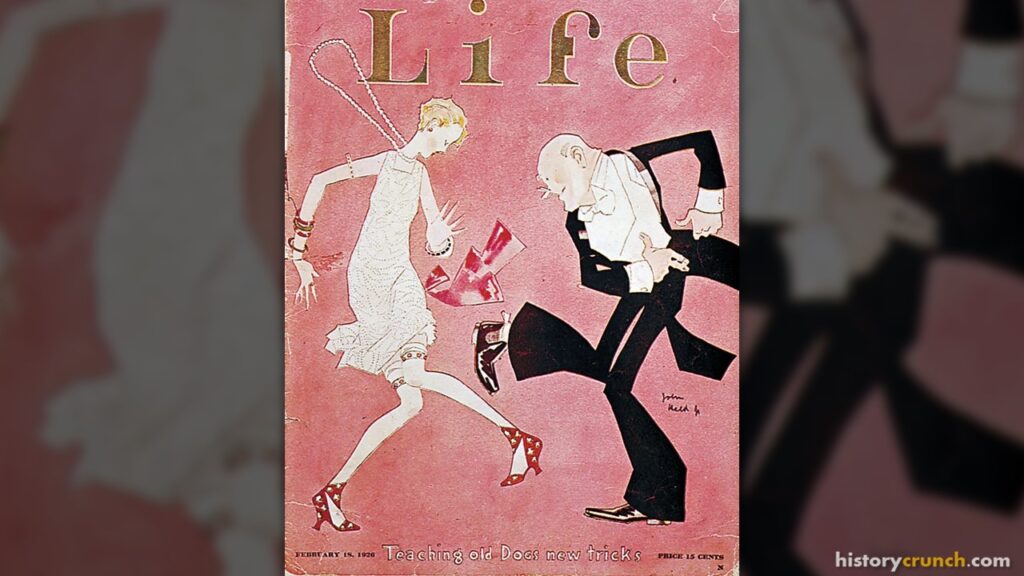
In 1926 the country's economy had grown by a third since the war, unemployment sat near 5 percent, and 20 million cars were on the road. Life magazine's cover that year showed the Charleston, the dance craze of the decade, and radios, refrigerators and stock certificates were selling to families who had never owned any of them.
LEARN MORESHOW LESSwhy it matters · key numbers · 2 key figuresCULTUREEvery Great Depression story starts here, because the crash was a fall from a height. The 1920s taught Americans that prices only went up and that buying on credit was safe. The people who lost everything in 1929 were, many of them, people who had believed that for ten years.
By 1928 an investor could buy $1,000 of stock with $100 of his own money and $900 borrowed from his broker, with the shares as security. As long as prices rose, the borrower sold at a profit and paid the loan back. Brokers' loans reached $8.5 billion by the autumn of 1929, more than all the money in circulation in the country.
LEARN MORESHOW LESSwhy it matters · key numbers · a debateIDEASMargin turned a fall in prices into a chain reaction. When shares dropped, brokers demanded more cash, investors sold to raise it, and the selling pushed prices down further. It is the first cause of the crash on every list, including the one on this site, and the practice was one of the first things the New Deal regulated.
Did borrowed money cause the crash?
Yes. Margin loans inflated the bubble and turned the fall into a chain reaction: every drop forced more selling, and the Federal Reserve was given power to cap margin for exactly that reason.
No. The stock market was a symptom. The real economy had already turned down in the summer of 1929, and the crash would have come, loans or no loans, when the buyers ran out.
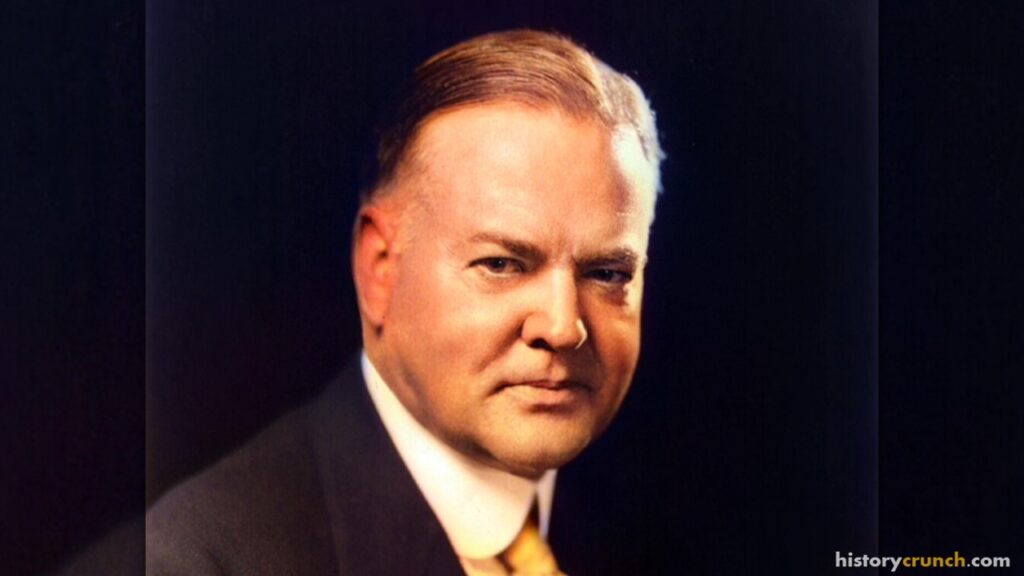
Herbert Hoover, running on the prosperity of the Coolidge years and a promise of help for struggling farmers, beat the Democrat Alfred E. Smith, the governor of New York, by 444 electoral votes to 87 on November 6th, 1928. He had never held elected office. His campaign said Republican rule meant a chicken in every pot and a car in every garage.
LEARN MORESHOW LESSwhy it matters · key numbers · a sourcePOLITICALHoover was elected as the manager of a boom. The country expected the engineer who had fed Belgium to keep the good years going, and eleven months later the boom was over. Everything he tried afterward was measured against the promise of 1928.
IN THEIR OWN WORDS“We in America today are nearer to the final triumph over poverty than ever before in the history of any land.”
Herbert Hoover, accepting the Republican nomination, August 11th, 1928WHAT TO NOTICEThe sentence followed him for the rest of his life. Fourteen months after he said it, the market crashed; three years after, a quarter of the country was out of work.
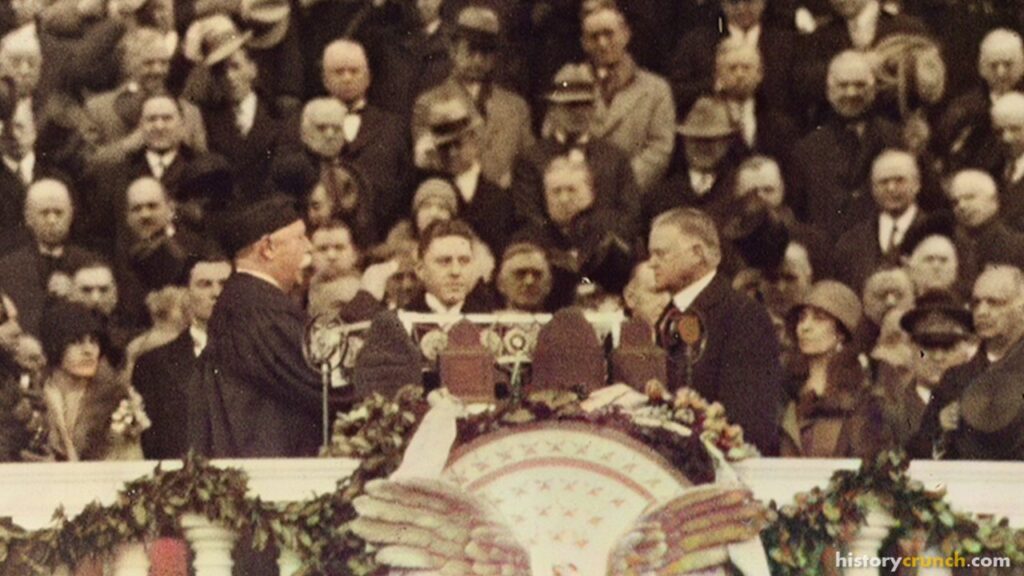
Herbert Hoover took the oath on the Capitol steps on March 4th, 1929, in a downpour, and told the crowd that the country had no cause to fear the future. He was 54, a Quaker from Iowa who had made a fortune in mines from Australia to China before he was 40, and who had spent the previous fifteen years in public service without a salary.
LEARN MORESHOW LESSwhy it matters · key numbers · a sourcePOLITICALHoover believed in what he called rugged individualism: people helping themselves and each other, with government as a last resort. The belief had made him a hero when he organized private relief for Europe. It made him look heartless when the same approach failed at home, and by 1932 the shantytowns were named after him.
IN THEIR OWN WORDS“I have no fears for the future of our country. It is bright with hope.”
Herbert Hoover, inaugural address, March 4th, 1929
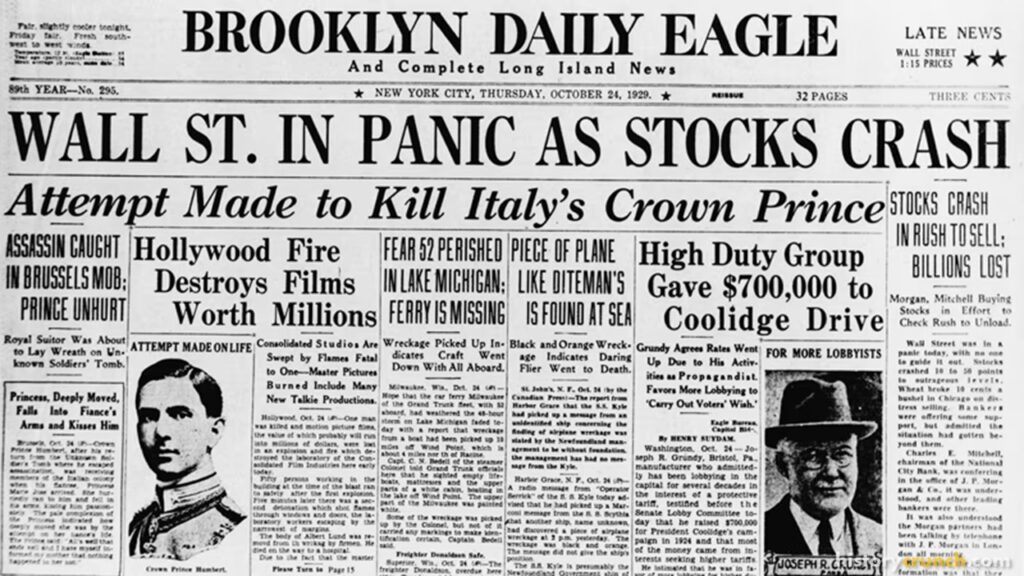
Three weeks after Herbert Hoover's inauguration, on March 25th, 1929, share prices fell sharply as the Federal Reserve warned banks about lending for speculation. Charles Mitchell of National City Bank, the country's biggest bank, announced $25 million of new loans to brokers and the market steadied within a day.
LEARN MORESHOW LESSwhy it matters · key numbers · 1 key figureECONOMICThe March scare was a rehearsal that nobody treated as a warning. A single banker had overruled the Federal Reserve and been thanked for it. Seven months later the same bankers tried the same trick on Black Thursday, and this time the market kept falling.
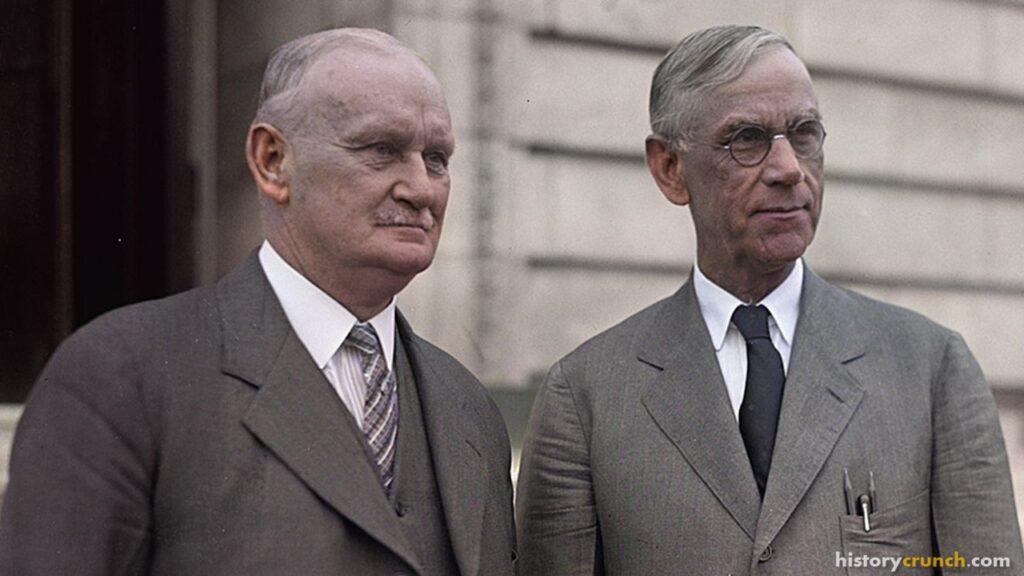
Senator Reed Smoot of Utah and Representative Willis Hawley of Oregon were photographed together on April 11th, 1929, as their bill to raise tariffs on farm goods went to the House of Representatives. Herbert Hoover had promised farmers protection in the 1928 campaign. The House passed the bill on May 28th, 1929, by 264 votes to 147.
LEARN MORESHOW LESSwhy it matters · key numbers · 1 key figurePOLITICALWhat began as help for farmers grew into a bill covering 20,000 products, as every industry with a lobbyist asked for its own tax on foreign goods. By the time it reached the Senate the crash had happened, and Congress pushed the tariff harder as a way to protect American jobs. It did the opposite.
Factory output in the United States peaked in the summer of 1929 and began to fall in August, while the stock market kept rising for another month. Car production, housing starts and steel orders were all down; farmers had been in trouble since the early 1920s. Economists at the Federal Reserve and the National Bureau of Economic Research now date the start of the Depression to August 1929, not October.
LEARN MORESHOW LESSwhy it matters · key numbers · a debateECONOMICThe crash did not cause the Depression by itself. The economy was already slowing, and the stock market was the last thing to notice. That order matters, because it means the market fell on a country that was already weaker than it looked.
Which came first, the crash or the slump?
The crash. October 1929 destroyed wealth and confidence, spending stopped, and the Depression followed from there. That is the older account and the one most textbooks still tell.
The slump. Production turned down in August, the market noticed in October, and it was the bank failures of 1930 to 1933, not the crash, that turned a recession into a catastrophe.
On September 3rd, 1929 the Dow Jones Industrial Average, the number that measures the whole American stock market, closed at 381.17. It had risen about six times over since 1921 and had doubled in the previous two years. Millions of ordinary Americans, many of them borrowing to do it, had put their savings into shares.
LEARN MORESHOW LESSwhy it matters · key numbers · a sourceECONOMICThis was the top. The market would not see 381 again until November 1954, twenty-five years later. Every number in the Depression story is measured from this day, and the fall from it, 89 percent by July 1932, is the reason a stock market crash became a national disaster.
IN THEIR OWN WORDS“Stock prices have reached what looks like a permanently high plateau.”
Irving Fisher, economist at Yale, October 16th, 1929WHAT TO NOTICEFisher was the country's most respected economist and said it six weeks after the peak and eight days before Black Thursday. He lost most of his own fortune in the crash.
On September 20th, 1929 the London Stock Exchange suspended the companies of Clarence Hatry, a financier who had forged share certificates to cover his debts, and prices across the exchange fell. British investors who had been buying American shares began selling them to cover their losses at home.
LEARN MORESHOW LESSwhy it matters · key numbersECONOMICThe London crash is the first crack in the story. It shook confidence in New York a month before the American market fell, and it is the reason historians say the crash of 1929 was already a world event before it reached Wall Street.
In the last week of October 1929 the New York stock market lost a quarter of its value, and by the middle of November half. The crash did not by itself cause the Depression, but it destroyed savings, confidence and the banks that had lent against shares, and the country's answer made things worse: a tariff that started a trade war, and a president who believed relief was a job for neighbors and churches. In November 1930 the banks began to fail, and a recession became something else.
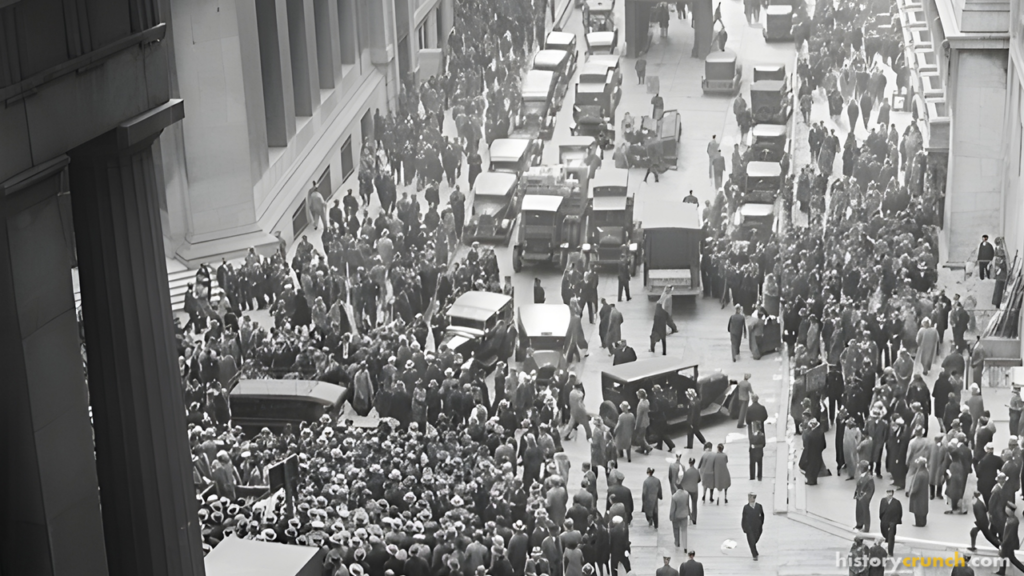
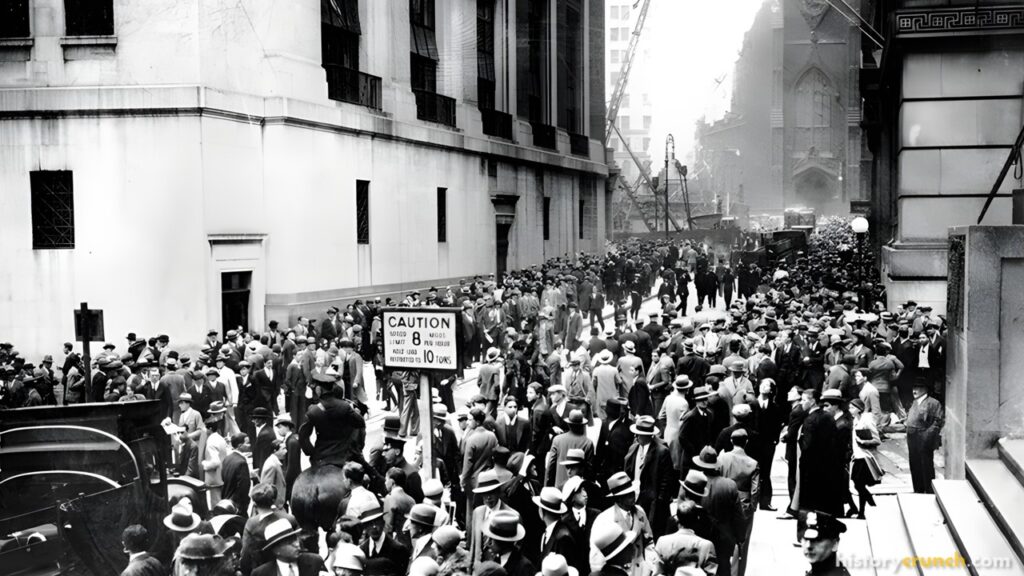
On Thursday, October 24th, 1929 the New York Stock Exchange opened to a wave of selling. Nearly 13 million shares were traded, three times a normal day, and the ticker that printed prices ran hours behind. At noon the heads of the biggest banks met at J.P. Morgan and sent a broker onto the floor to buy shares at above the asking price. The panic stopped and the day closed only 2 percent down.
LEARN MORESHOW LESSwhy it matters · key numbers · a sourceECONOMICBlack Thursday is the day most books name as the start of the Depression, and the FDR Library calls it the symbolic beginning. The bankers' rescue is what made it famous: it worked for two days, and its failure the next week is what turned a bad day into a collapse.
IN THEIR OWN WORDS“There has been a little distress selling on the Stock Exchange.”
Thomas Lamont of J.P. Morgan, to reporters, October 24th, 1929WHAT TO NOTICELamont said it at the bankers' meeting that afternoon, with crowds gathering outside the exchange. Newspapers printed it the next morning as proof that the panic was over.
After a calm Friday, the market opened on Monday, October 28th, 1929 to selling that the bankers could not stop. The Dow fell 38 points, nearly 13 percent, the largest one-day drop it had ever recorded. Investors who had bought on margin were now being told by their brokers to put up more cash or be sold out.
LEARN MORESHOW LESSwhy it matters · key numbersECONOMICMonday destroyed the confidence Thursday's rescue had bought. The bankers did not step in again, and the selling Monday night set up the record volume of Tuesday. Together the two days took a fifth of the market's value in forty-eight hours.
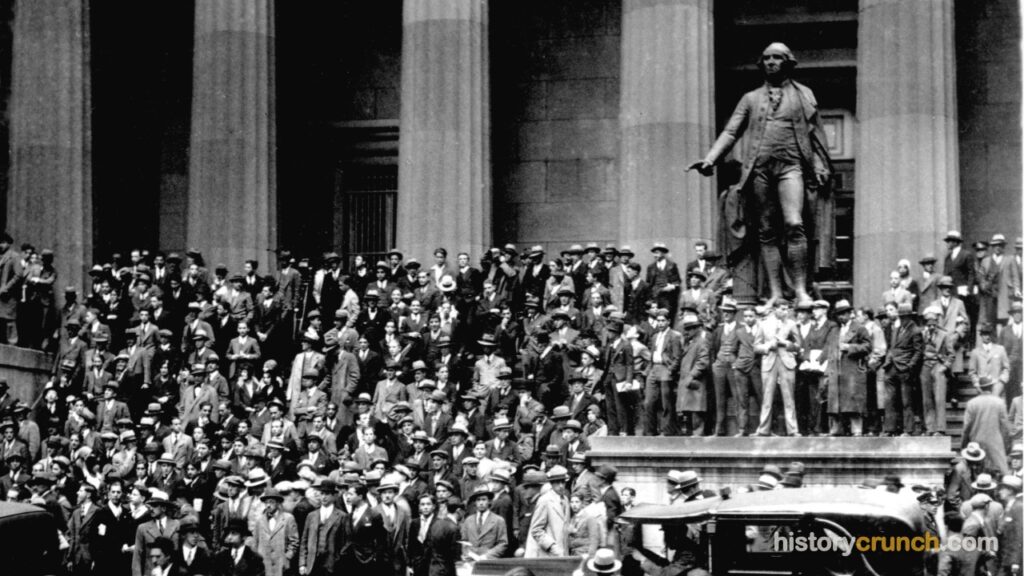
On October 29th, 1929 about 16 million shares were sold on the New York Stock Exchange, a record that stood for forty years, and the Dow fell another 12 percent. There were no buyers for some stocks at any price. By the end of the day $14 billion in value had disappeared, and by mid-November the market had lost about half of what it had been worth in September.
LEARN MORESHOW LESSwhy it matters · key numbers · a debateECONOMICBlack Tuesday is the day the boom ended and the name the country gave to the whole crash. It did not by itself cause the Depression, but it destroyed the savings of millions, wiped out the banks that had lent them money, and shattered the belief that prices only went up. The next three years were the working out of that.
How much did Black Tuesday matter?
Enormously. It began the Depression: savings vanished, spending stopped, and the banks that had lent against shares went down with the market.
Less than its fame suggests. The crash mostly hurt the rich, the economy might have recovered as it did after 1921, and it was the banking panics and the Federal Reserve's failure to stop them that made the Depression great.
The selling continued for two weeks after Black Tuesday. On November 13th, 1929 the Dow closed at 198, down 48 percent from its September peak of 381. Then it steadied and, over the winter, recovered about half of what it had lost. In April 1930 many people believed the crash was over.
LEARN MORESHOW LESSwhy it matters · key numbers · 1 key figureECONOMICThe recovery of early 1930 fooled almost everyone, including Herbert Hoover, who told the country in the spring that the worst was past. The real fall, to 41 in July 1932, came not from the stock market but from the banks.
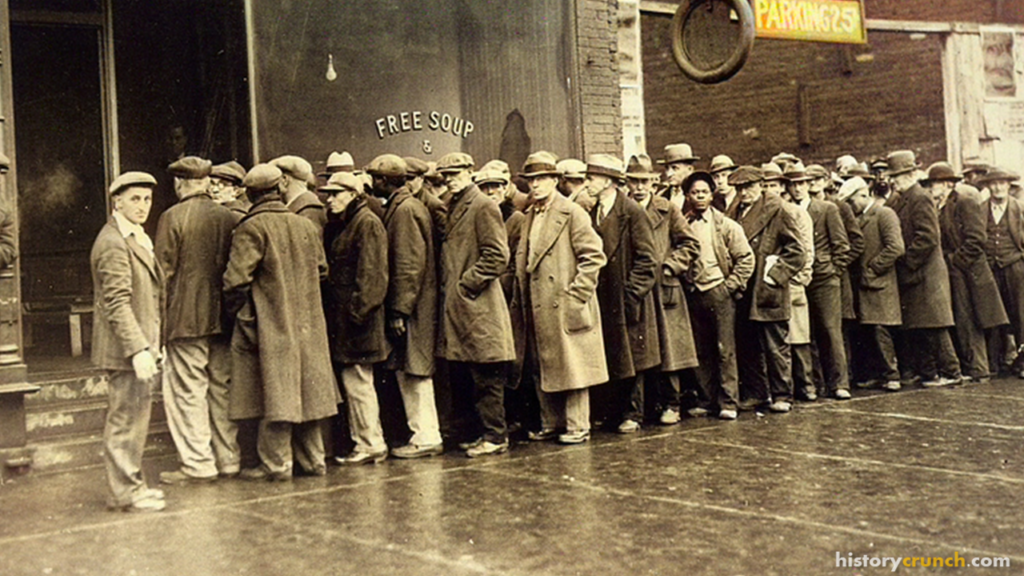
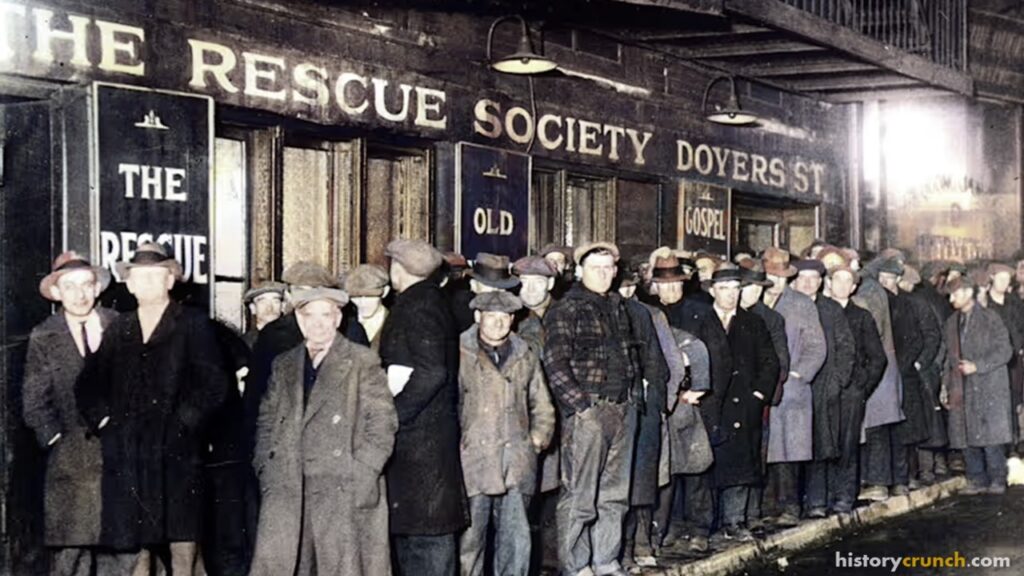
Soup kitchens opened in every American city in the winter of 1930 to 1931, run by churches, charities and, in Chicago, by the gangster Al Capone, who fed 2,000 people a day at his own expense while the city's relief funds ran out. The photograph of men in hats waiting in line outside his kitchen became the picture of the whole decade.
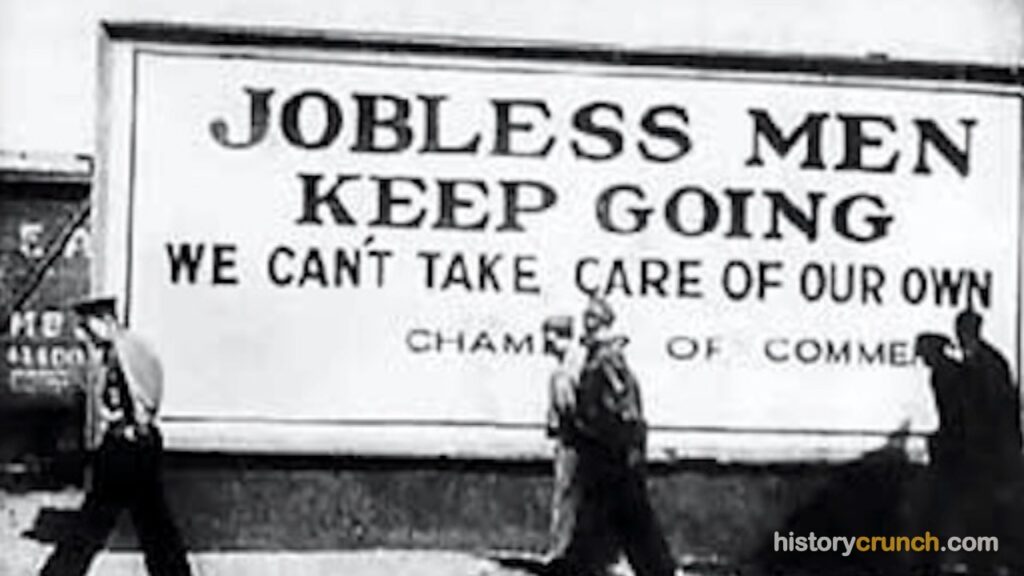
LEARN MORESHOW LESSwhy it matters · key numbers · 2 key figuresSOCIALBefore 1933 there was no federal relief at all. A man who lost his job had his savings, his family, his church and a soup line, in that order. The lines were the visible proof that private charity, which Herbert Hoover was counting on, could not feed a country with millions out of work.
The Smoot-Hawley Tariff Act raised taxes on more than 20,000 imported goods and Herbert Hoover signed it on June 17th, 1930, after the Senate passed it by 44 votes to 42. In May, 1,028 economists had signed an open letter begging him to veto it, and Henry Ford went to the White House to call it an economic mistake. Hoover had doubts but had promised the farmers a tariff.
LEARN MORESHOW LESSwhy it matters · key numbers · a debateECONOMICOther countries answered with tariffs of their own, and world trade fell by two thirds in four years. American exports dropped from $5.2 billion in 1929 to $1.7 billion in 1933. The tariff did not cause the Depression, which was already a year old, but most economists agree it spread it and deepened it, and it stands as the textbook example of the wrong answer to a slump.
Did the tariff deepen the Depression?
Yes. It started a trade war that cut American exports by two thirds and carried the slump to Canada, Europe and Australia. It is the textbook example of the wrong answer.
Only a little. Foreign trade was 5 percent of the American economy in 1930, and the gold standard and the bank failures did far more harm. Both sides agree it helped nobody.
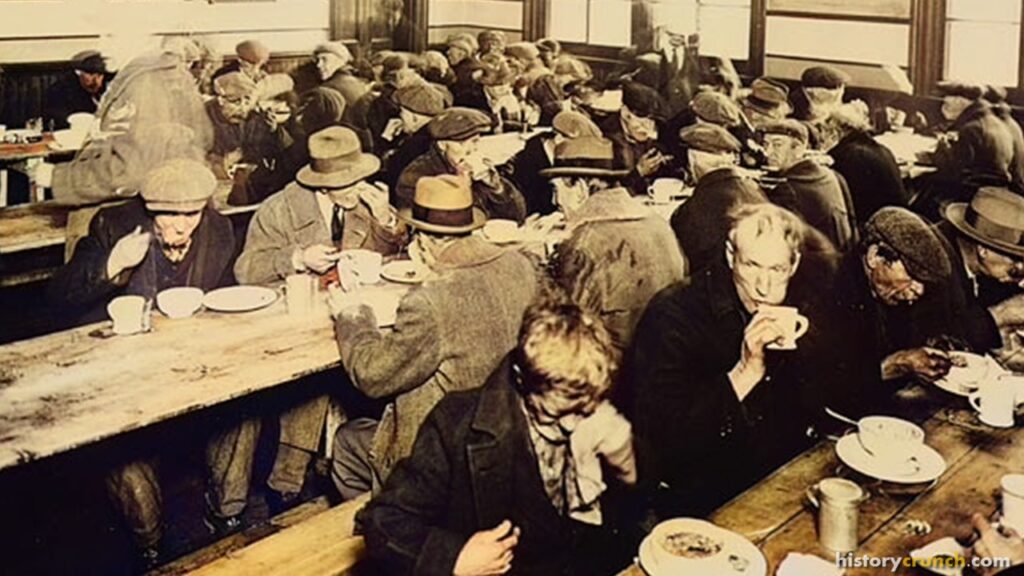
Prime Minister William Lyon Mackenzie King had told the provinces that relief for the unemployed was their problem, and Canadians voted him out on July 28th, 1930 for the Conservative Richard Bennett, who promised to blast his way into world markets with tariffs of his own. Canada's exports of wheat, timber and minerals had collapsed with American demand, and Smoot-Hawley had just shut its biggest customer's door.
LEARN MORESHOW LESSwhy it matters · key numbersPOLITICALCanada is the clearest example of how the American tariff spread the Depression: its whole economy was built on selling to the United States. Bennett's answer, higher Canadian tariffs, made things worse, and by 1933 more than one Canadian worker in four had no job.
Twenty-three countries had formally protested the American tariff before it was signed. Canada raised its duties on American goods within months, France and Spain taxed American cars, and within two years about two dozen countries had passed tariffs aimed at the United States. American sales to Europe fell from $2.3 billion in 1929 to $784 million in 1932.
LEARN MORESHOW LESSwhy it matters · key numbersECONOMICA tariff war is a game everyone loses. The countries that owed America money could no longer earn dollars to pay it, American farmers lost the foreign markets the tariff was meant to protect, and the collapse of trade dragged Europe, Canada and Australia down with the United States.
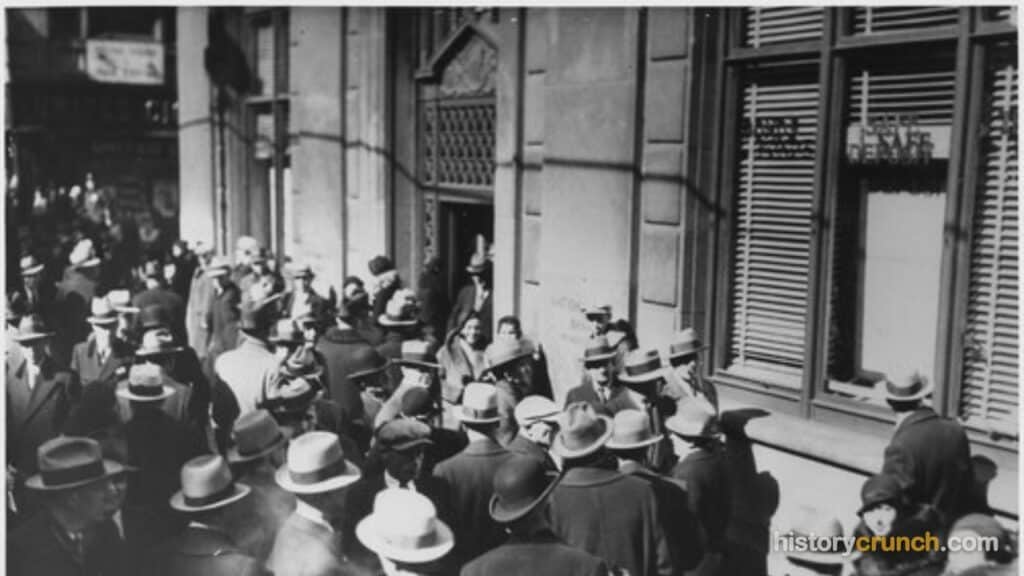
In the autumn of 1930 the economy looked ready to recover. Then on November 7th, 1930 the Bank of Tennessee in Nashville, owned by the investment house Caldwell and Company, closed its doors, and two more Caldwell banks in Knoxville failed five days later. Depositors across Tennessee, Kentucky, Arkansas and North Carolina lined up to take their money out, and about 1,350 banks failed before the year ended.
LEARN MORESHOW LESSwhy it matters · key numbersECONOMICThis is the moment a recession became the Great Depression, in the words of the Federal Reserve's own history. A bank run is a panic that makes itself true: a sound bank cannot pay every depositor at once, so the rumor that it will fail is enough to make it fail. Nothing in the law protected a depositor's savings, so every rumor started a line.
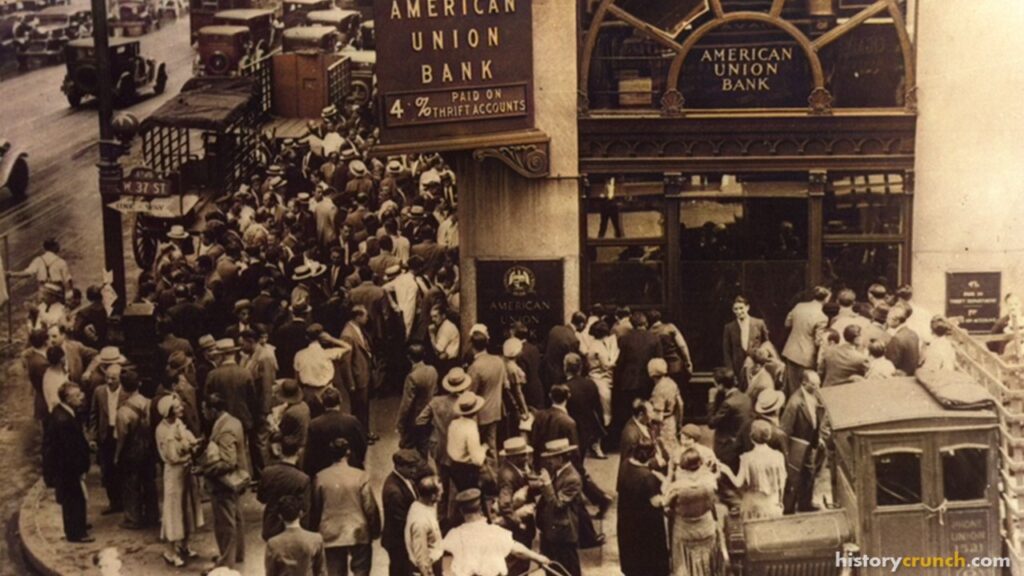
The Bank of the United States was a private New York bank with a grand name and 400,000 depositors, many of them immigrant families. On December 11th, 1930 it closed with $200 million in deposits, the biggest failure in American banking up to that day. The other New York banks had discussed a rescue and decided against it. Unemployment for the year reached 8.7 percent, double 1929.
LEARN MORESHOW LESSwhy it matters · key numbersECONOMICThe failure told the country that even a big city bank could vanish overnight and take a family's savings with it. Runs spread through 1931 and 1932, and by 1933 one bank in five that had been open in 1930 was gone. The FDIC, which now guarantees deposits, was created in 1933 because of what happened here.
For two years everything went down. Banks failed by the thousand, the panic crossed to Europe and brought down Austria's biggest bank and the British pound, and by 1932 one American worker in four had no job, with no federal help of any kind. The Depression's pictures come from these years: the Hoovervilles, the boys on the freight trains, the soup lines, and the veterans of 1918 driven out of Washington by the army. Herbert Hoover tried more than his critics admitted, and in November 1932 the country voted him out by a landslide.
From 1929 to 1936 somewhere between 400,000 and one million people of Mexican descent left the United States for Mexico, many of them pushed. Local officials in California, Texas, Colorado and the Midwest cut Mexican families off relief, raided workplaces and paid for one-way train tickets south. Historians estimate that around 60 percent of those who left were American citizens, most of them children born in the United States.
LEARN MORESHOW LESSwhy it matters · key numbers · 1 key figureSOCIALRepatriation is the part of the Depression that textbooks left out for decades. With one in four workers idle, Mexican Americans were blamed for taking jobs and using relief, and the federal government under Herbert Hoover encouraged the removals. California formally apologized in 2005.
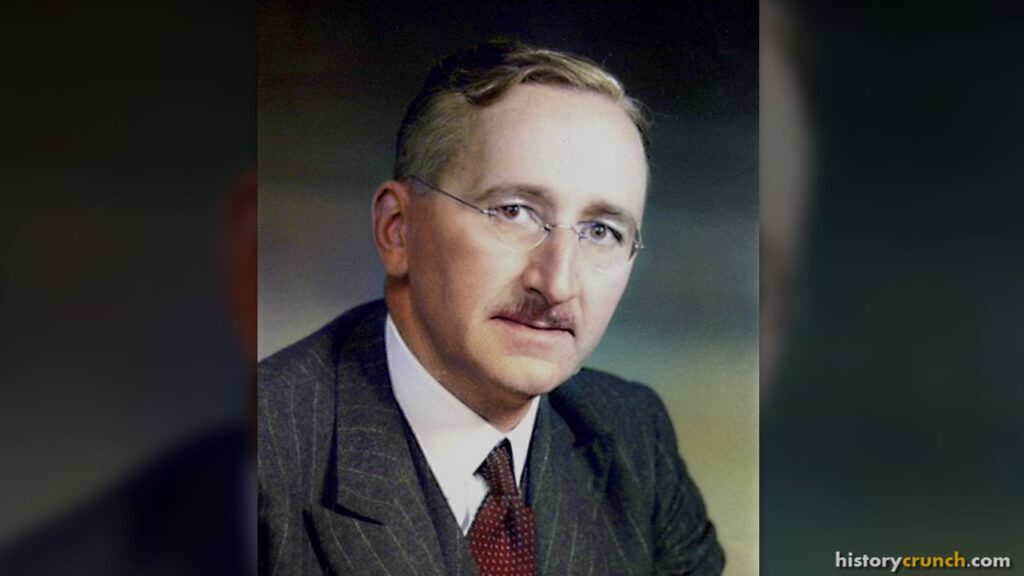
In 1931 the Austrian economist Friedrich Hayek, newly arrived at the London School of Economics, published a hostile review of John Maynard Keynes's Treatise on Money, and Keynes, at Cambridge, answered in kind. Hayek argued that a slump was the cure for a boom built on cheap credit and that government spending would only delay it. Keynes argued that a government which sat still in a slump was letting its people starve to prove a theory.
LEARN MORESHOW LESSwhy it matters · key numbers · a debateIDEASThe Hayek-Keynes quarrel is the argument every government has had about every recession since. Keynes won it in the 1930s and 1940s; Hayek's side came back in the 1970s and 1980s and remains the case against big government spending today.
Who was right, Keynes or Hayek?
Keynes. Government spending in the New Deal and the war brought the recovery, and thirty years of growth followed when governments ran their economies on his lines.
Hayek. The spending of the 1970s brought inflation without jobs, and the Depression itself was made worse by governments that would not let prices and wages fall.
Work on the dam in Black Canyon, on the Colorado River between Nevada and Arizona, began in March 1931, a year ahead of schedule because Herbert Hoover wanted the jobs. It employed about 5,000 men at its peak, who lived first in tents and then in the new town of Boulder City. The dam, the tallest in the world when it opened, was finished in 1936, two years early.
LEARN MORESHOW LESSwhy it matters · key numbers · 1 key figureECONOMICHoover Dam was the largest public works project the government had ever paid for, and it shows the limit of Hoover's thinking: he backed projects that paid for themselves through electricity and water sales, not relief. The dam also carried his name through the 1930s, was renamed Boulder Dam by the New Deal, and got its name back in 1947.
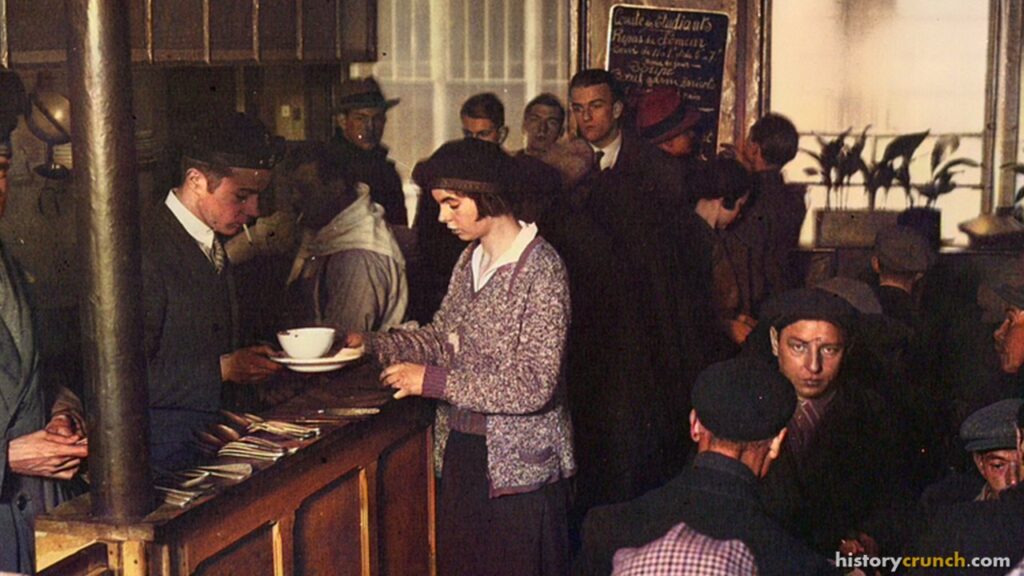
On May 11th, 1931 the Creditanstalt, Austria's largest bank and a lender to half the country's industry, announced it could not cover its losses. Depositors ran on banks across Austria, then Hungary, then Germany, where the Danat Bank failed in July and the government closed every bank for two days. The Bank of England lent Austria money and lost it.
LEARN MORESHOW LESSwhy it matters · key numbers · elsewhereECONOMICThe European panic of 1931 is what turned an American slump into a world depression. Money fled from Vienna to Berlin to London, and by September it was Britain's turn. American banks that had lent to Germany could not get their money back, which started the next American panic in the autumn.
The Nazi Germany timeline follows the same summer from Berlin: the bank closures were the moment German unemployment stopped being a problem and became a crisis.
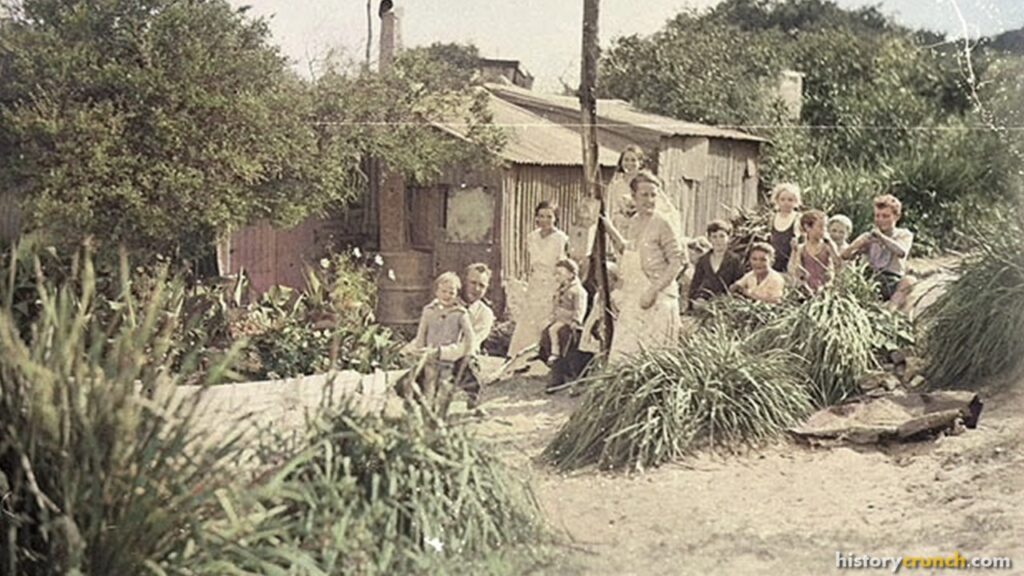
Australia sold wool and wheat to the world and borrowed from London to pay for it, so when prices and loans both collapsed the country could not pay its debts. In June 1931 the Prime Minister, James Scullin, and the state premiers agreed a plan that cut government spending and wages by 20 percent and raised taxes, on the advice of a visiting Bank of England official. Unemployment reached nearly 30 percent in 1932, among the worst in the world.
LEARN MORESHOW LESSwhy it matters · key numbersECONOMICAustralia's answer was the opposite of the New Deal: cut everything and wait for prices to recover. It kept the country's credit good in London and left a third of its workers idle. The Sydney Harbour Bridge, opened in 1932, was the one great public work of the period, and it had been started before the crash.
On June 20th, 1931, with the European banks failing, Herbert Hoover proposed that every government stop collecting war debts and reparations for one year. France, which was owed the most by Germany, argued for two weeks before agreeing. The moratorium took effect in July, and the payments never restarted: Germany stopped reparations for good in 1932 and every debtor except Finland stopped paying America in 1933.
LEARN MORESHOW LESSwhy it matters · key numbers · 1 key figureECONOMICThe moratorium was Hoover's boldest act, and it was too late to save the German banks or the British pound. It also marks the end of the reparations story that began at Versailles in 1919, and the beginning of the isolation that kept America out of Europe's problems for the rest of the decade.
On September 21st, 1931 Britain stopped exchanging pounds for gold at a fixed rate, after two months of runs on the Bank of England, and the pound lost a quarter of its value. Foreign governments and investors, afraid the United States would do the same, began cashing dollars for gold, and the Federal Reserve raised interest rates to stop them. American banks, already short of cash, failed at the rate of more than 500 a month that autumn.
LEARN MORESHOW LESSwhy it matters · key numbers · a debateECONOMICBritain's exit is the turning point of 1931. The gold standard, the system that tied every major currency to a fixed weight of gold, meant that a country could not print money or cut interest rates to fight a slump without losing its gold. Countries that left gold early, like Britain, began to recover in 1932. Countries that stayed, like the United States and France, kept falling.
Was leaving gold the right thing to do?
Yes. The gold standard forced governments to raise interest rates in a slump, and every country recovered in the order it left. Most economic historians now see it as the main reason the Depression was so deep and so long.
It looked like disgrace at the time. Leaving gold broke a promise to every holder of the currency, and Herbert Hoover fought for another eighteen months to keep the dollar on it for that reason.
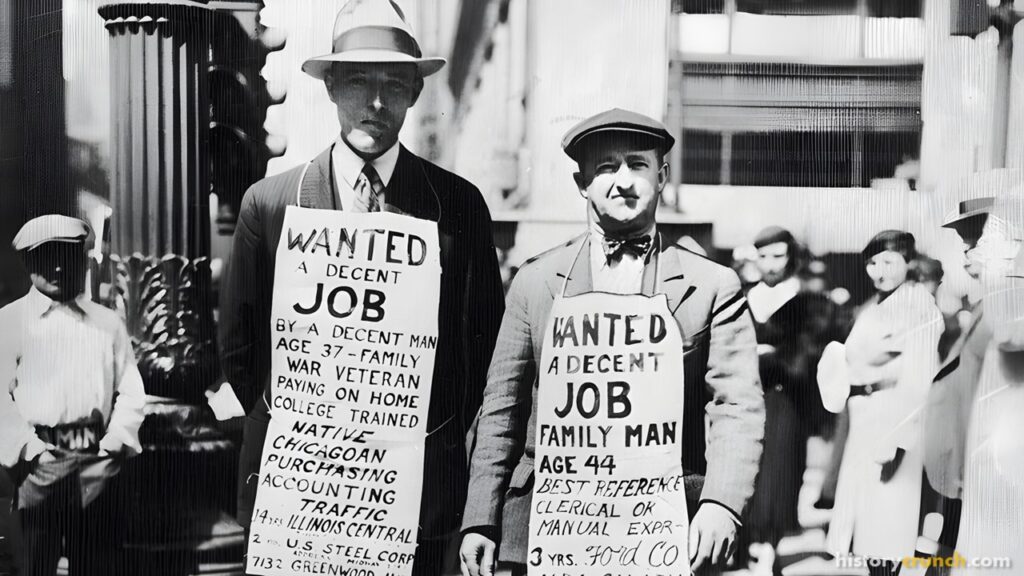
By 1932 about 12 million Americans, one worker in four, had no job, and many of those who did were working short weeks for cut pay. Industrial production had fallen by nearly half since 1929. In Germany six million were out of work, a third of the workforce, and in Britain nearly three million. There was still no federal relief in the United States; cities and charities had run out of money.
LEARN MORESHOW LESSwhy it matters · key numbers · elsewhereECONOMIC1932 is the bottom of the Depression in human terms: the year of the Hoovervilles, the Bonus Army and the rails. It is also the year the voters in the two hardest-hit countries made their choice. Americans elected Franklin Roosevelt in November. Germans made the Nazis the largest party in July.
The German figure is the one that mattered most for the rest of the century. The Nazi Germany timeline follows the two elections of 1932 that six million unemployed made possible.
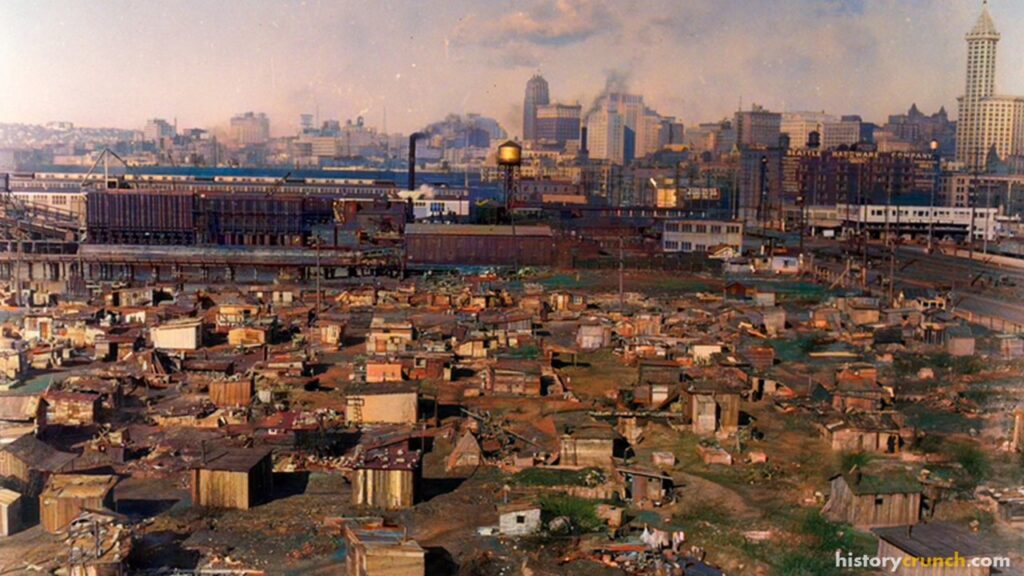
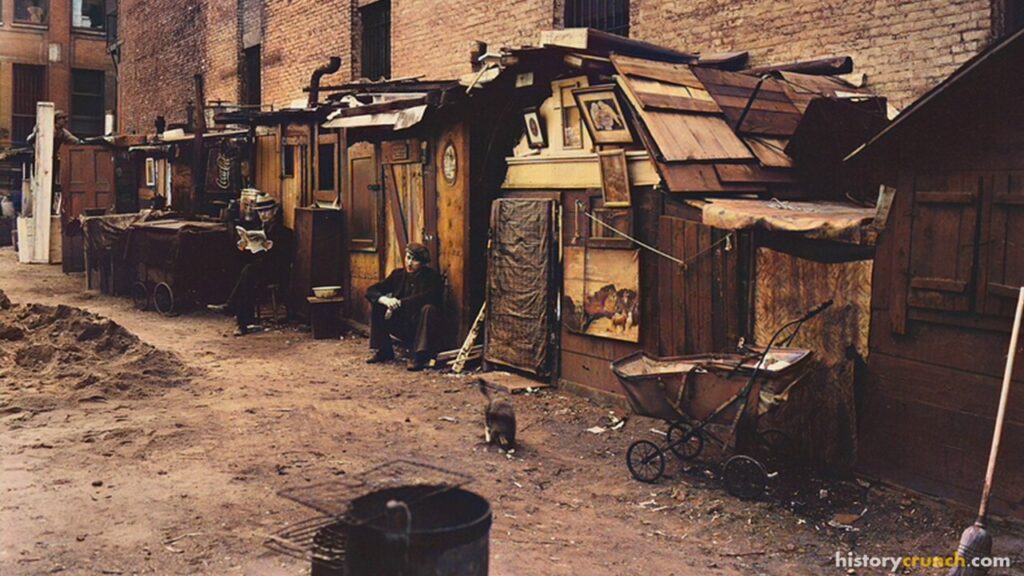
Families who lost their homes built shacks of scrap lumber, tin and cardboard on empty land at the edges of every American city. The one in Seattle held about 1,200 people on nine acres of the port; the one in Central Park in New York stood on the drained reservoir; St. Louis had one of 5,000. A Democratic publicity man, Charles Michelson, coined the name Hooverville in 1930, and it stuck.
LEARN MORESHOW LESSwhy it matters · key numbers · 1 key figureSOCIALThe name was the point. A shantytown was a Hooverville, an empty pocket turned inside out was a Hoover flag, a newspaper you slept under was a Hoover blanket. Herbert Hoover had been the most admired man in America in 1928, and by 1932 his name was the word for failure.
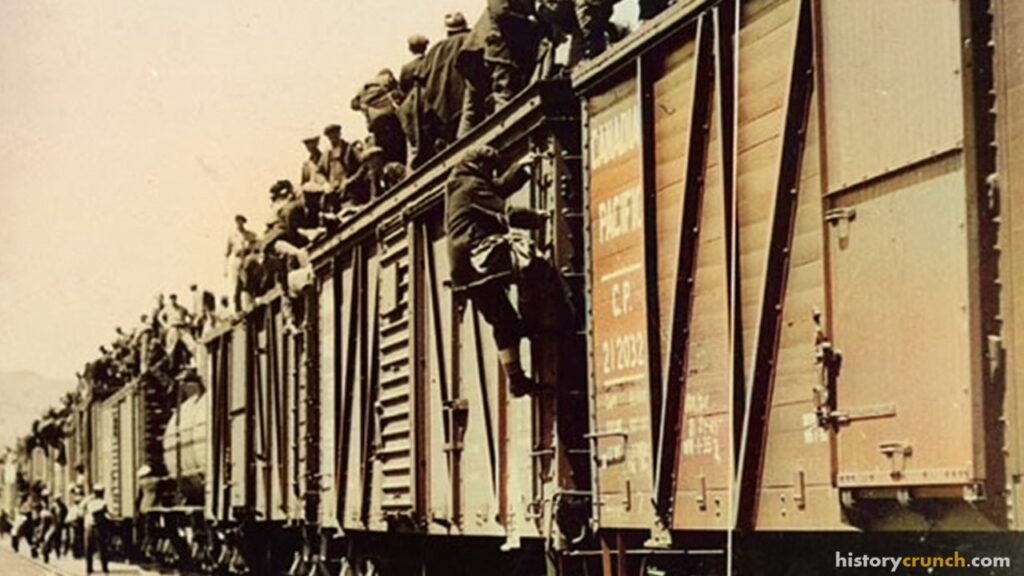
Around two million Americans, about 250,000 of them teenagers, spent the early 1930s riding freight trains from town to town in search of work. They climbed into empty boxcars or rode on top, dodged the railroad police, slept in camps by the tracks and ate what they could beg. Hundreds were killed each year falling under the wheels.
LEARN MORESHOW LESSwhy it matters · key numbersSOCIALThe rails were where the Depression was youngest. Boys of fourteen and fifteen left home so their families would have one less mouth to feed, and the sight of them was one of the things the Civilian Conservation Corps was created to answer in 1933.
On January 22nd, 1932 Herbert Hoover signed the law creating the Reconstruction Finance Corporation, a government bank with $2 billion to lend to banks, railroads and insurance companies that were about to fail. It was the largest peacetime government intervention in the economy to that point. In July Congress let it lend to the states for relief as well, over Hoover's objections.
LEARN MORESHOW LESSwhy it matters · key numbers · 2 key figuresECONOMICThe RFC is the exception to the story of Hoover doing nothing. It was big government by any earlier measure, and Franklin Roosevelt kept it and made it the bank that paid for much of the New Deal. Its flaw was that it lent to banks, not people, and critics called it a breadline for bankers.
In May 1932 Walter Waters, an unemployed former sergeant from Portland, Oregon, led about 300 veterans of the First World War east on freight trains to ask Congress to pay their bonus now instead of in 1945. They called themselves the Bonus Expeditionary Force, after the American Expeditionary Force they had served in. Other groups joined from every state as the news spread.
LEARN MORESHOW LESSwhy it matters · key numbersSOCIALThe men were not radicals; they were the soldiers of 1918, now in their thirties with families and no work, asking for money the government had already promised them. Their treatment in Washington that summer became the last straw for Herbert Hoover's presidency.
By mid-June 1932 between 15,000 and 20,000 veterans, some with wives and children, were living in Washington, most of them in a camp of shacks and tents on the Anacostia Flats across the river from the Capitol. The Washington police chief, Pelham Glassford, himself a veteran, found them food and let them stay. On June 15th the House of Representatives passed the bonus bill by 211 votes to 176.
LEARN MORESHOW LESSwhy it matters · key numbersSOCIALAnacostia was the largest Hooverville in the country, and the best run: streets, a newspaper, and a rule that no communists were allowed. The camp was orderly, which made what happened to it in July harder for the country to forgive.
On the evening of June 17th, 1932, with thousands of veterans waiting on the Capitol steps, the Senate voted down the bonus bill 62 to 18. Herbert Hoover had opposed it as too expensive, about $2.4 billion in the middle of a budget crisis. Walter Waters asked the crowd to sing America and go back to camp, and they did. Congress voted money for train fares home, and about half the marchers took it.
LEARN MORESHOW LESSwhy it matters · key numbers · 1 key figurePOLITICALThe Senate vote was the end of the bonus for 1932 but not the end of the march. Several thousand veterans had nowhere to go and stayed in Washington through July, and the government's patience ran out before theirs did.
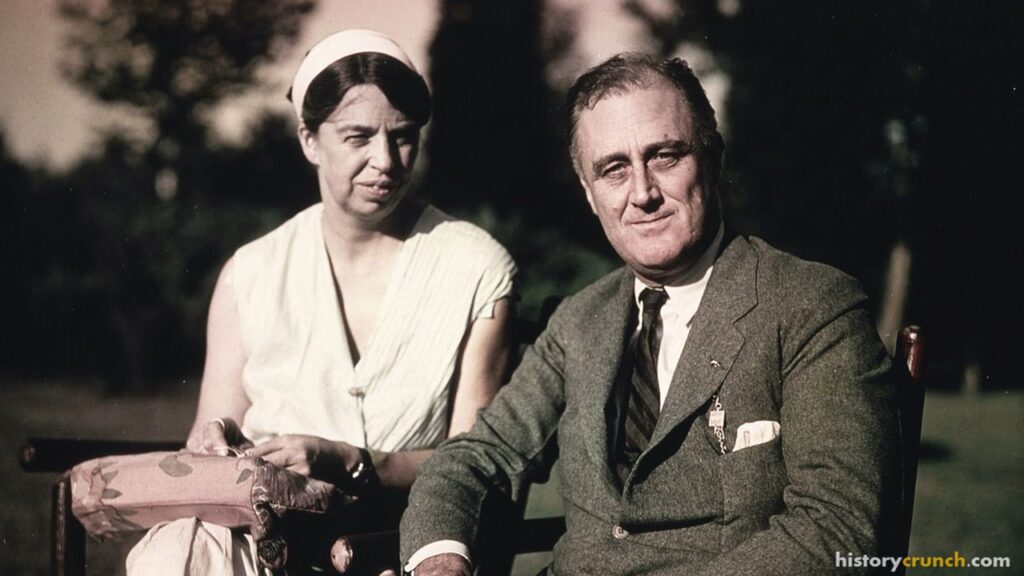
Franklin Roosevelt, the governor of New York, broke every tradition on July 2nd, 1932 by flying to Chicago to accept the Democratic nomination in person, instead of waiting weeks to be told. He was 50, a cousin of Theodore Roosevelt, and had lost the use of his legs to polio in 1921. New York's relief program under him was the largest of any state. He ended his speech with a phrase that named the next twelve years.
LEARN MORESHOW LESSwhy it matters · key numbers · a sourcePOLITICALRoosevelt was not elected for a program; nobody, including him, knew what the New Deal would be. He was elected for confidence, the sense that he would try things. The flight to Chicago was the first sign of it.
IN THEIR OWN WORDS“I pledge you, I pledge myself, to a new deal for the American people.”
Franklin Roosevelt, accepting the Democratic nomination, July 2nd, 1932WHAT TO NOTICEThe phrase was a throwaway line by a speechwriter. A cartoonist picked it up the next day, and by the election it was the name of everything Roosevelt stood for.
On July 8th, 1932 the Dow Jones Industrial Average closed at 41.22, its lowest point of the century. It had lost 89 percent of its value since September 1929, and shares that had sold for hundreds of dollars could be bought for a few. Trading was so thin that the exchange floor was half empty. From here the market began to rise, though it did not get back to its 1929 level until 1954.
LEARN MORESHOW LESSwhy it matters · key numbersECONOMICThis is the bottom of the crash, though not of the Depression, which went on for another year for the banks and another decade for the unemployed. The 89 percent figure is the one that makes 1929 the measure of every crash since; the fall of 2008, for comparison, was 54 percent.
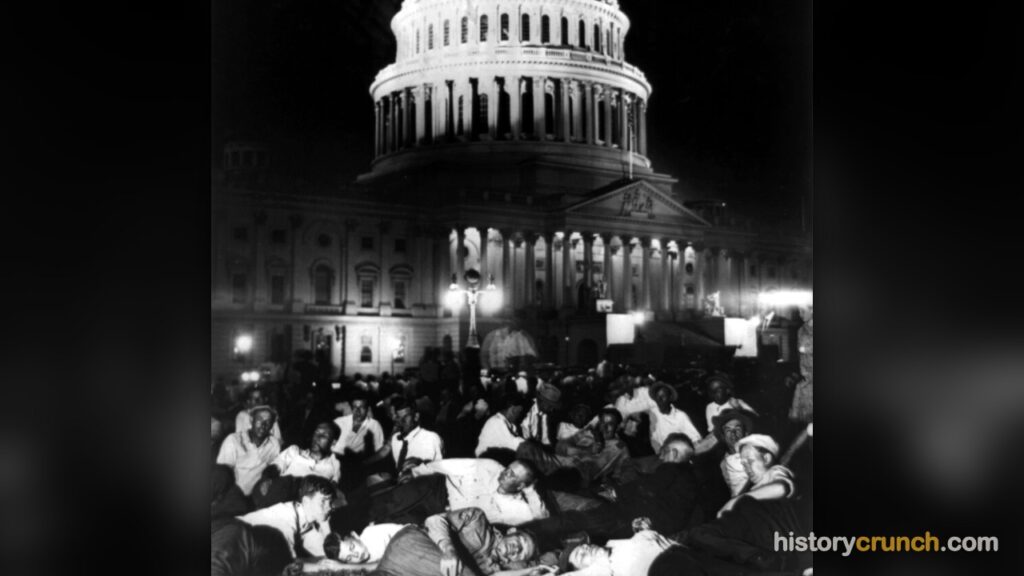
On July 28th, 1932 police tried to clear veterans from empty buildings in downtown Washington, a fight broke out and two veterans were shot dead. Herbert Hoover ordered the army to clear the downtown camps. General Douglas MacArthur, the army's chief of staff, did more than that: with 600 infantry and cavalry, six tanks and tear gas, and with Major Dwight Eisenhower and Major George Patton among his officers, he crossed the river that evening and burned the Anacostia camp to the ground. Hoover had ordered him not to.
LEARN MORESHOW LESSwhy it matters · key numbers · a sourceMILITARYNewsreels showed the army driving out the veterans of 1918 with bayonets and gas, and their families running from the fire. Hoover, who had not ordered the attack on Anacostia, defended it publicly, and the country decided he had done it. Franklin Roosevelt, watching the coverage, is said to have told an aide that the election was over.
IN THEIR OWN WORDS“What a pitiful spectacle is that of the great American Government, mightiest in the world, chasing unarmed men, women and children with Army tanks.”
Washington News editorial, July 29th, 1932
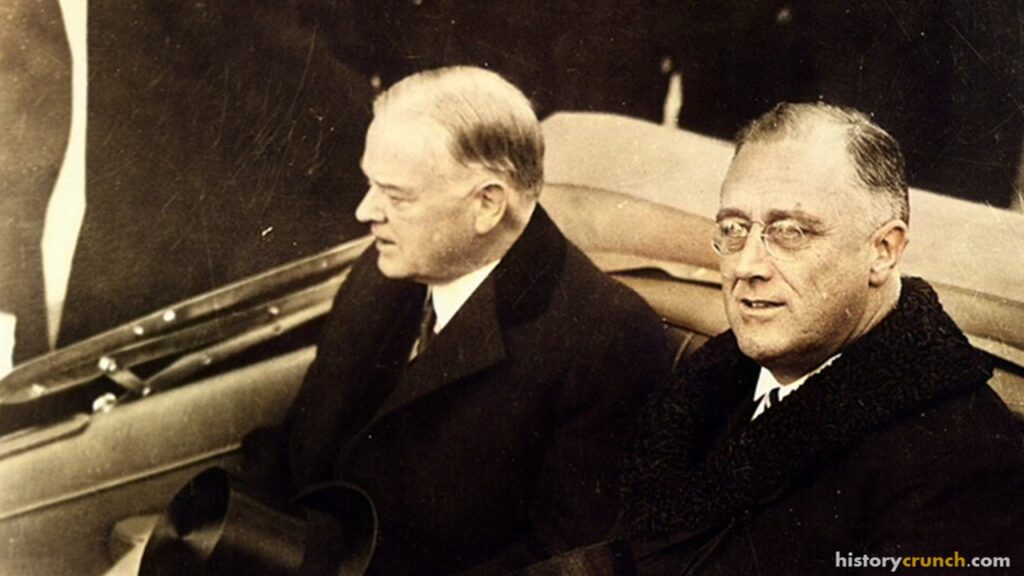
On November 8th, 1932 Franklin Roosevelt carried 42 of the 48 states and 57 percent of the vote; Herbert Hoover, who had been booed and pelted with eggs on the campaign trail, won six states in the Northeast. The Democrats took both houses of Congress. Roosevelt would not take office until March 4th, 1933, four months away, and in between the banks began to fail again.
LEARN MORESHOW LESSwhy it matters · key numbers · a sourcePOLITICALThe election reversed the politics of the 1920s. The Republicans had won three landslides on prosperity; Roosevelt won on its collapse, and the coalition he built that day, of working people, the cities, the South, farmers and, for the first time, Black voters in the North, ran American politics for the next thirty years.
IN THEIR OWN WORDS“This is the greatest night of my life.”
Franklin Roosevelt to his mother, November 8th, 1932
Franklin Roosevelt took office with every bank in the country closed and set a pace no president has matched since. In a hundred days Congress passed fifteen major laws: the banks reopened under federal guarantee, the dollar left gold, young men went to the forests, farmers were paid to plant less, the Tennessee Valley got its dams, and for the first time federal money went directly to the unemployed. Recovery began within months. Across the Atlantic, thirty-three days before Roosevelt's inauguration, Germany had answered its own six million unemployed with Adolf Hitler.
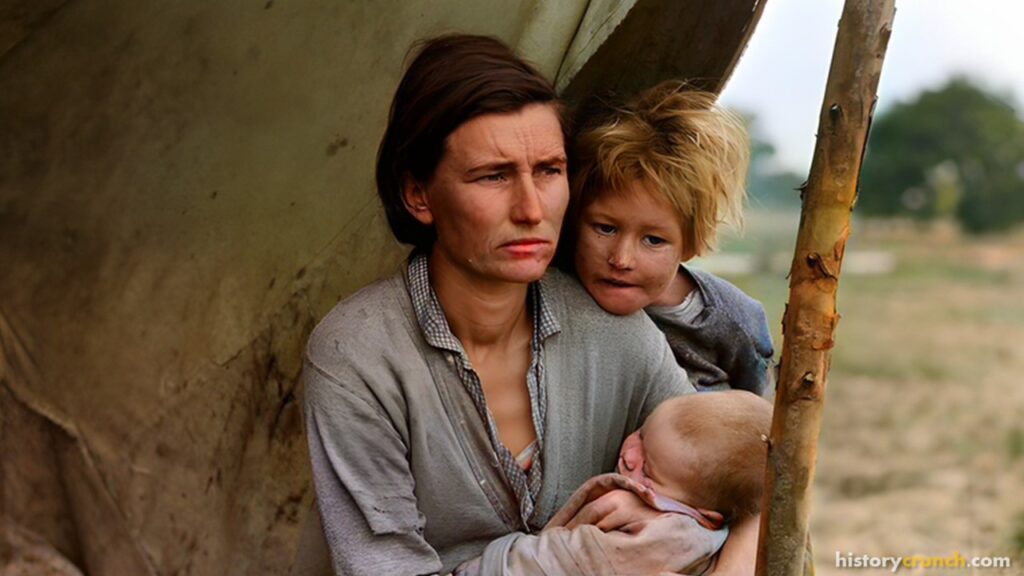
About 10.5 million women had paid work in 1930 and 13 million in 1940, because the jobs that survived were the ones women held: clerical work, teaching, nursing and domestic service, at wages about half of a man's. At the same time 26 states passed laws against hiring married women, and most school boards fired teachers who married. At home, women stretched food, took in boarders and sewed clothes from flour sacks.
LEARN MORESHOW LESSwhy it matters · key numbersSOCIALThe Depression cut both ways for women. It pushed them into the workforce because their families needed the money, and it turned public opinion against them working because they were seen as taking a man's job. The double standard lasted until the war.
Frances Perkins had run New York's labor department for Franklin Roosevelt when he was governor, and in March 1933 he made her Secretary of Labor, the first woman ever to sit in a president's cabinet. She took the job on the condition that he back a list she brought to the meeting: unemployment insurance, old-age pensions, a minimum wage, a ban on child labor and a 40-hour week. By 1938 every item on it was law.
LEARN MORESHOW LESSwhy it matters · key numbers · 1 key figurePOLITICALPerkins is the person behind the Social Security Act of 1935 and the Fair Labor Standards Act of 1938, the two New Deal laws still in force in every American workplace. She served all twelve years of Roosevelt's presidency, longer than any other Secretary of Labor.
Harry Hopkins, a chain-smoking social worker from Iowa who had run relief in New York for Franklin Roosevelt, came to Washington in May 1933 to run the Federal Emergency Relief Administration. He spent $5 million in his first two hours in office, from a desk in a hallway. He went on to run the Civil Works Administration in the winter of 1933 and the Works Progress Administration from 1935, and by 1940 had spent more federal money than any man in history.
LEARN MORESHOW LESSwhy it matters · key numbers · a sourcePOLITICALHopkins believed that a job was better than a handout and that people were hungry now, not in the long run. His agencies put more Americans to work than any other part of the New Deal. During the war he lived in the White House and became Roosevelt's closest adviser and his messenger to Winston Churchill and Joseph Stalin.
IN THEIR OWN WORDS“People don't eat in the long run. They eat every day.”
Harry Hopkins, 1933
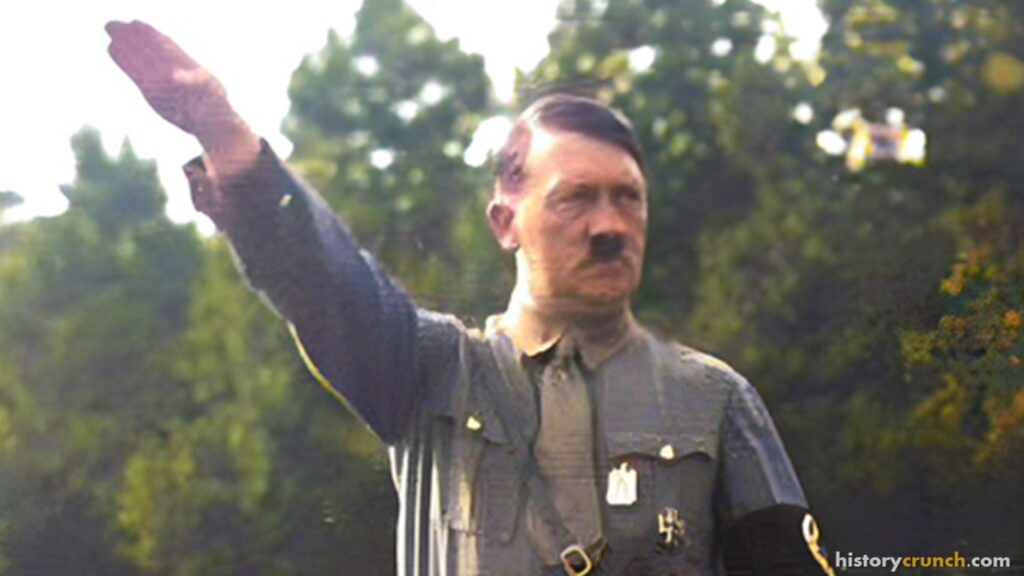
On January 30th, 1933 President Paul von Hindenburg appointed Adolf Hitler Chancellor of Germany, thirty-three days before Franklin Roosevelt took office in Washington. The Nazi Party had won 2.6 percent of the vote in 1928, when Germany was prosperous, and 37 percent in July 1932, when six million Germans were out of work. Within eighteen months Hitler had ended German democracy.
LEARN MORESHOW LESSwhy it matters · key numbers · elsewherePOLITICALThe Depression made Hitler possible. Germany's recovery in the 1920s had run on American loans, and when the loans stopped the republic that depended on them broke. Two countries hit the bottom in the winter of 1932 to 1933 and took opposite roads out of it, which is the reason the Depression is a world story and not only an American one.
The Nazi Germany timeline covers the appointment and the eighteen months that followed in full; this card is here because the six million unemployed were the Depression's doing.
On February 14th, 1933 the governor of Michigan closed every bank in the state for eight days to stop a run on the two big Detroit banks. Depositors in neighboring states, afraid their own banks were next, lined up to take their money out, and one governor after another declared a bank holiday. By the morning of Franklin Roosevelt's inauguration on March 4th, banks in 32 states were shut or limited and the New York Stock Exchange had closed.
LEARN MORESHOW LESSwhy it matters · key numbers · 2 key figuresECONOMICThis was the third and worst banking panic of the Depression, and it happened in the four-month gap between the election and the inauguration, while Herbert Hoover, a defeated president, and Franklin Roosevelt, not yet sworn in, could not agree on what to do. The country's money system had stopped, and it was the first thing the new president had to fix.
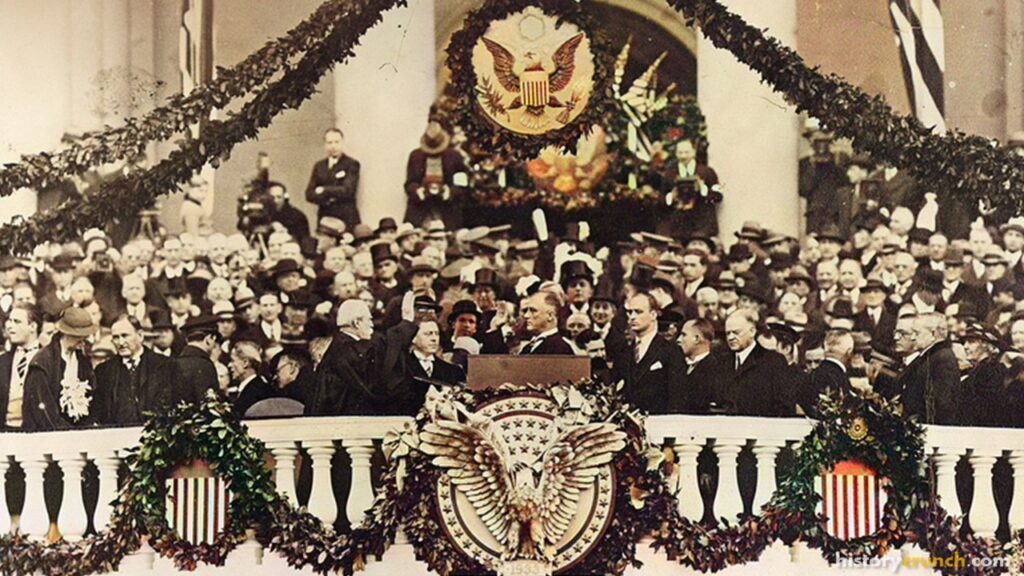
Franklin Roosevelt was sworn in on the east front of the Capitol at 1 p.m. on March 4th, 1933, on a gray cold day, with the banks of the country closed and 13 million people out of work. His speech, twenty minutes long, promised action, blamed the money changers for the crisis, and asked Congress for the kind of power a president would have in a war. Herbert Hoover sat behind him and did not applaud.
LEARN MORESHOW LESSwhy it matters · key numbers · a sourcePOLITICALThe first inaugural is the speech that ended the waiting. Half a million letters reached the White House in the following week, and Congress gave Roosevelt nearly everything he asked for in the next hundred days. It was the last inauguration held in March; the 20th Amendment moved the date to January 20th.
IN THEIR OWN WORDS“The only thing we have to fear is fear itself.”
Franklin Roosevelt, first inaugural address, March 4th, 1933WHAT TO NOTICEThe full sentence goes on: nameless, unreasoning, unjustified terror which paralyzes needed efforts to convert retreat into advance. Newspapers the next day barely mentioned it; the line that got the headlines was the one about the money changers.
At one in the morning on March 6th, 1933, thirty-six hours after taking office, Franklin Roosevelt declared a national bank holiday under a law from the First World War. Every bank in the United States closed for four days while Treasury inspectors decided which were sound. Nobody could cash a check, and cities printed scrip so people could buy food.
LEARN MORESHOW LESSwhy it matters · key numbers · 1 key figureECONOMICClosing the banks was the first act of the New Deal and the one that stopped the panic, by making it impossible to run on a bank. When the sound banks reopened on March 13th, depositors put money in instead of taking it out. The Federal Reserve calls it the end of the banking crisis of the Depression.
Two days after the inauguration, on March 6th, 1933, Eleanor Roosevelt met 35 reporters in the Red Room of the White House and told them she would do it every week. Only women were admitted, which forced newspapers to hire women to cover her. She went on to write a daily newspaper column from 1935, travel the country as her husband's eyes and legs, and press Franklin Roosevelt on relief for women, Black Americans and young people.
LEARN MORESHOW LESSwhy it matters · key numbers · 1 key figurePOLITICALNo First Lady before her had held a public role of her own. Eleanor Roosevelt used hers to reach the parts of the country the New Deal was slow to reach, and she is the reason the WPA and the National Youth Administration had programs for women and Black Americans at all.
Congress met in special session on March 9th, 1933 and passed the Emergency Banking Act the same day, the House in 38 minutes with a single printed copy of the bill, the Senate that evening. The law let the Treasury reopen banks it judged sound, back their deposits with government money and take over the ones that could not be saved. Franklin Roosevelt signed it at 8:36 that night.
LEARN MORESHOW LESSwhy it matters · key numbers · 1 key figureECONOMICMarch 9th was the first day of the Hundred Days, the three months in which Congress passed fifteen major laws at Roosevelt's request. The banking act worked: three quarters of the banks reopened within a week, and the ones that did not were closed for good, which is how the country lost about 4,000 banks in 1933.
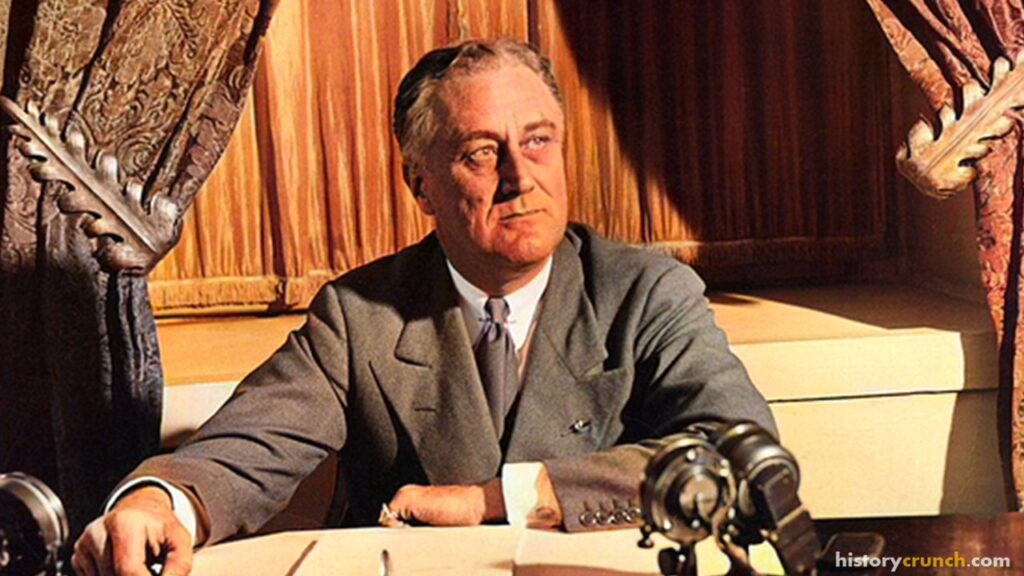
On the Sunday night of March 12th, 1933, the evening before the banks reopened, Franklin Roosevelt spoke on the radio for thirteen minutes to about 60 million people, explaining in plain words what a bank did with deposits and why the reopened ones were safe. A CBS executive named the talks fireside chats. Roosevelt gave about thirty of them over twelve years, on the New Deal, the drought, the war and the home front.
LEARN MORESHOW LESSwhy it matters · key numbers · a sourceCULTUREThe chats were the first time a president had talked to the whole country at once in its own kitchen, and the first time a leader had used radio to explain rather than to shout. The next morning, deposits at the reopened banks were larger than withdrawals. The banks were saved by the law, but the trust was restored by the voice.
IN THEIR OWN WORDS“I can assure you that it is safer to keep your money in a reopened bank than under the mattress.”
Franklin Roosevelt, first fireside chat, March 12th, 1933
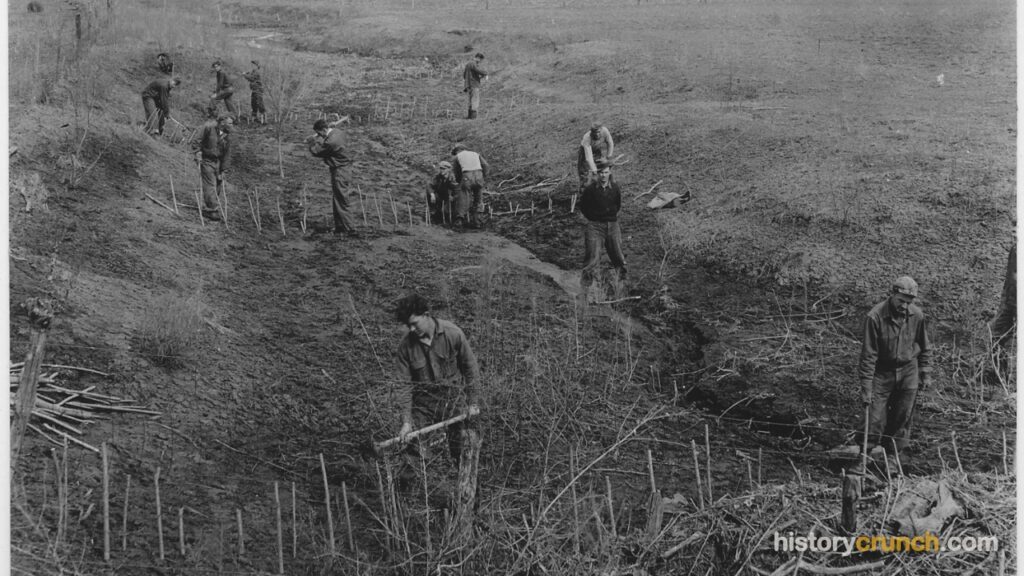
Franklin Roosevelt signed the law creating the Civilian Conservation Corps on March 31st, 1933, and the first camp opened in Virginia seventeen days later. Unmarried men aged 18 to 25 from families on relief lived in army-run camps, planted trees, fought fires, built trails and dams, and were paid $30 a month, of which $25 went home to their parents. Over nine years about three million young men served.
LEARN MORESHOW LESSwhy it matters · key numbers · 1 key figureECONOMICThe CCC was the most popular New Deal program and the one Roosevelt cared about most: it took the boys off the rails and put them in the forests. Its camps were segregated, and it took no women. The trees it planted, about three billion of them, and the parks it built are still there.
On April 19th, 1933 Franklin Roosevelt announced that the United States would no longer exchange dollars for gold at a fixed price, two weeks after ordering Americans to sell their gold coins to the Treasury. The dollar fell by about a third against gold, which raised prices, which was the point: three years of deflation had made every debt heavier, and farmers and businesses drowning in debt needed prices to stop falling. In January 1934 the dollar was fixed again at $35 an ounce, down from $20.67.
LEARN MORESHOW LESSwhy it matters · key numbers · a debateECONOMICLeaving gold is the New Deal decision most economists now rate highest, and the one almost nobody at the time understood. It let the Federal Reserve create money again, and prices, production and employment all turned up within months. Roosevelt's own budget director called it the end of Western civilization.
Was leaving gold the cure?
Yes. Every country recovered in the order it left gold, Britain in 1931, America in 1933, France last in 1936. Prices, production and jobs all turned up within months of Roosevelt's decision.
No. The recovery came from Roosevelt's other measures. Leaving gold merely broke a promise and frightened investors, and the New Deal would have worked without it.
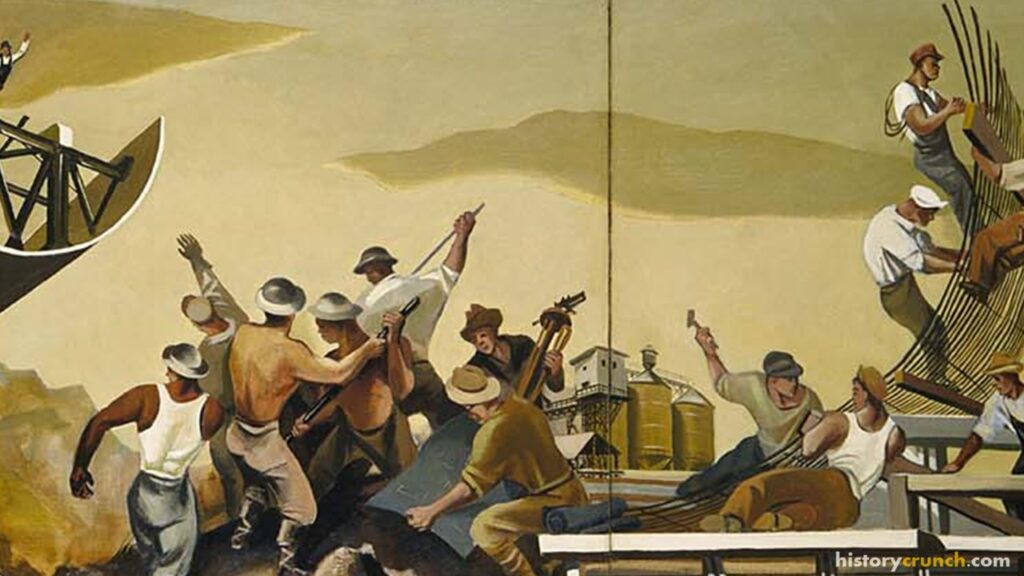
On May 12th, 1933 Franklin Roosevelt signed two laws. The Agricultural Adjustment Act paid farmers to plant less cotton, wheat, corn and tobacco and raise fewer hogs, to push prices back up; in its first year it paid for ten million acres of cotton to be plowed under and six million piglets to be killed. The Federal Emergency Relief Act gave the states $500 million for direct relief, the first federal money for the unemployed in American history.
LEARN MORESHOW LESSwhy it matters · key numbers · 1 key figureECONOMICFarm prices had fallen by half since 1929 and a third of farmers had lost or were losing their land. The AAA doubled farm income by 1936, but the money went to landowners, and in the South many pushed their tenants and sharecroppers off the land rather than share it. The Supreme Court struck the law down in 1936, and Congress passed a new one.
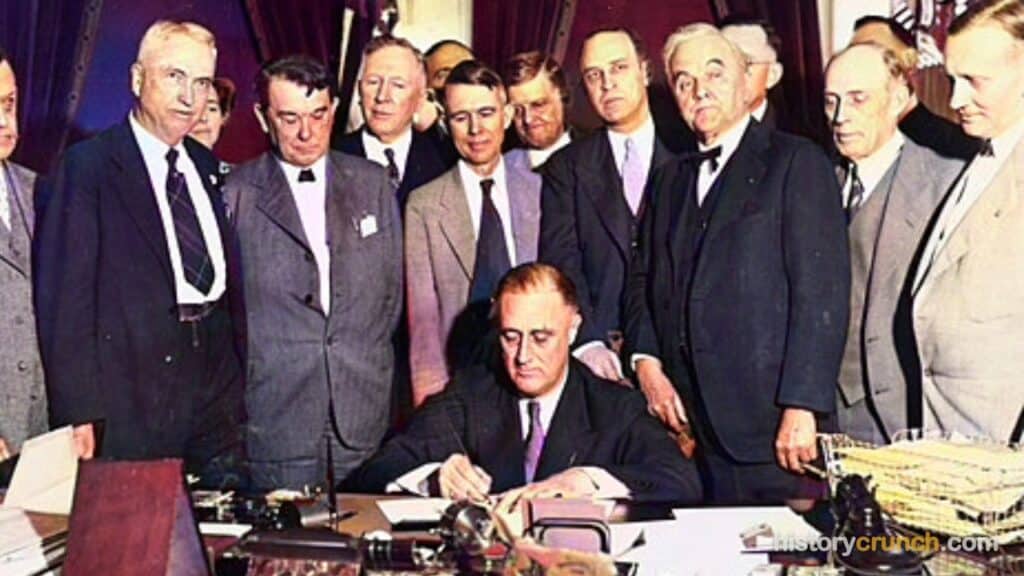
On May 18th, 1933 Franklin Roosevelt created the Tennessee Valley Authority, a government corporation to build dams on the Tennessee River and its branches across seven states, one of the poorest regions in the country. The dams controlled the floods that ruined the valley every spring, made the river navigable, and generated cheap electricity for farms that had never had it. The TVA built 16 dams by 1944 and still runs today.
LEARN MORESHOW LESSwhy it matters · key numbers · 1 key figureECONOMICThe TVA was the New Deal's biggest experiment in planning: the government did not just relieve a region, it rebuilt it. Private power companies fought it to the Supreme Court and lost. By the war it was supplying the electricity that made aluminum for bombers and enriched uranium at Oak Ridge.
Roughly a thousand homes a day were going through foreclosure in early 1933. On June 13th Franklin Roosevelt signed the law creating the Home Owners' Loan Corporation, which bought mortgages from banks that were about to foreclose and rewrote them as fifteen-year loans at lower interest. Over three years it refinanced about a million loans, one home mortgage in five in the country.
LEARN MORESHOW LESSwhy it matters · key numbers · 1 key figureECONOMICThe HOLC invented the long-term, fixed-rate mortgage that Americans still use to buy houses. It also drew the maps that rated neighborhoods for lending risk and colored Black neighborhoods red, the practice called redlining, whose effects on where Americans live have lasted into this century.
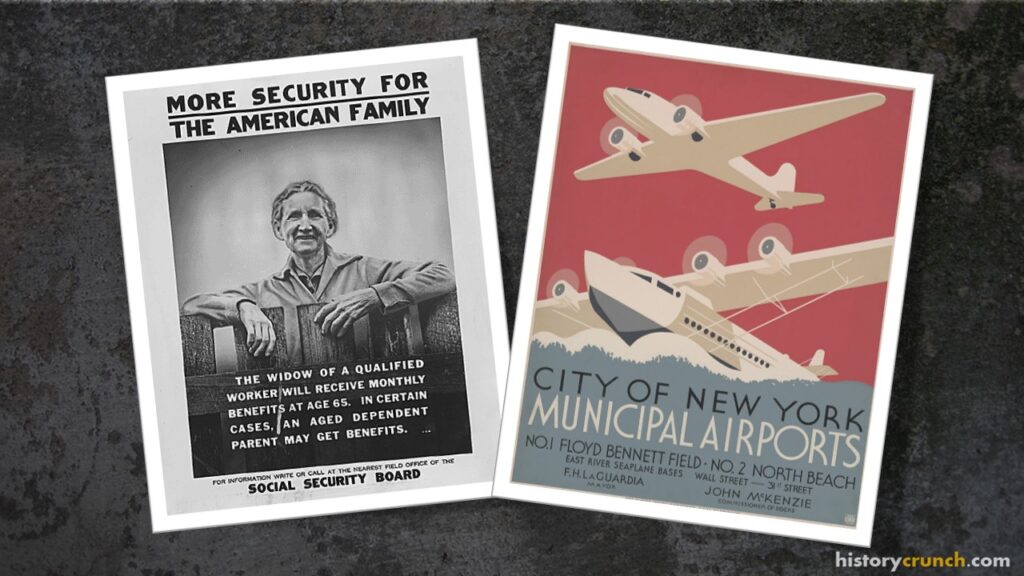
On June 16th, 1933, the hundredth day of the special session, Franklin Roosevelt signed the Glass-Steagall Banking Act, which separated ordinary banks from stock market trading and created the Federal Deposit Insurance Corporation to guarantee deposits up to $2,500, and the National Industrial Recovery Act, which set up codes of fair wages, hours and prices for every industry under a Blue Eagle emblem and a $3.3 billion public works program. Congress then went home.
LEARN MORESHOW LESSwhy it matters · key numbers · 1 key figureECONOMICDeposit insurance ended bank runs in the United States: from 4,000 failures in 1933 to nine in 1934. The NRA was the New Deal's biggest failure, a tangle of 500 codes that the Supreme Court struck down in 1935. Together the two laws close the Hundred Days, the most productive session Congress has ever held.
With winter coming and the public works program slow to start, Franklin Roosevelt created the Civil Works Administration on November 9th, 1933 and gave it to Harry Hopkins with $400 million. Within two months it had hired four million people to build and repair roads, schools, airports and playgrounds, at regular wages rather than relief. Roosevelt closed it in March 1934 because it cost too much.
LEARN MORESHOW LESSwhy it matters · key numbers · 1 key figureECONOMICThe CWA was the test run for the WPA: proof that the government could put millions to work in weeks and that the country would accept it. It was also the first New Deal program to hire women in numbers, about 300,000 of them.
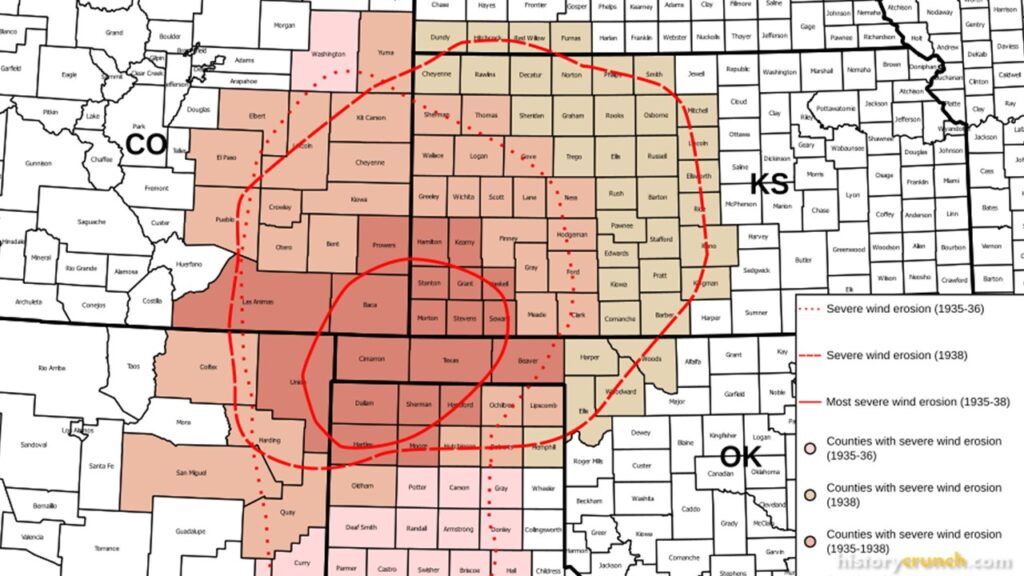
On May 9th, 1934 a storm lifted an estimated 350 million tons of topsoil off Montana, the Dakotas and the plains of Kansas, Colorado, Oklahoma and Texas and carried it east. Two days later dust fell on Chicago at four pounds per person, then on Washington and New York, and ships 300 miles out in the Atlantic reported it on their decks. Farmers had plowed up 100 million acres of grassland for wheat during the boom, and three years of drought had turned the bare soil to powder.
LEARN MORESHOW LESSwhy it matters · key numbersSCIENCEThe May 1934 storm is the day the Dust Bowl stopped being a regional problem. Members of Congress watched it darken the sky over the Capitol, and Hugh Bennett, the soil scientist who had been warning about erosion for years, got his Soil Conservation Service within a year.
On June 6th, 1934 Franklin Roosevelt signed the Securities Exchange Act, which created a federal commission to regulate the stock market: companies had to publish honest accounts, insider trading became a crime, and the Federal Reserve was given the power to limit buying on margin. Roosevelt made Joseph Kennedy, a stock speculator who had made a fortune in the 1920s, its first chairman, saying it took a thief to catch one.
LEARN MORESHOW LESSwhy it matters · key numbers · 1 key figureECONOMICThe SEC is the reason the crash of 1929 did not happen the same way again. The practices that built the bubble, borrowed shares, rigged prices and companies that hid their losses, were made illegal, and the agency that enforces the rules is still the one Roosevelt created.
On June 12th, 1934 Congress gave Franklin Roosevelt the power to cut tariffs by up to half in deals with countries that cut theirs, without a vote on each one. Cordell Hull, the Secretary of State, who believed the tariff war had helped cause the Depression, signed agreements with 21 countries by 1940, beginning with Cuba, Belgium and Canada.
LEARN MORESHOW LESSwhy it matters · key numbers · 1 key figureECONOMICThe act reversed a century of Congress setting tariffs line by line and put trade policy in the president's hands, where it has stayed. It is the beginning of the road that led to the world trading system built after the war, and the end of Smoot-Hawley as anything but a warning.
On June 18th, 1934 Franklin Roosevelt signed the Indian Reorganization Act, written by John Collier, his Commissioner of Indian Affairs. It stopped the breaking up of reservations into individual plots, which had cost Native Americans two thirds of their land since 1887, let tribes write constitutions and elect their own governments, and set up loans for tribal businesses. About 180 tribes accepted it and 77 voted it down.
LEARN MORESHOW LESSwhy it matters · key numbers · 1 key figurePOLITICALCollier called it the Indian New Deal, and it was the first time since the 1830s that federal policy had aimed to keep tribes together rather than dissolve them. It did not return most of the lost land, and critics inside the tribes said its model constitutions were Washington's idea of government, not theirs.
By 1935 the first New Deal had stopped the fall but not the misery, the Supreme Court was striking its laws down, and Huey Long, Father Coughlin and Dr. Townsend were telling millions it had not gone far enough. Franklin Roosevelt's answer was the Second New Deal: the WPA, which gave the unemployed jobs instead of relief; the Wagner Act, which gave workers unions; and Social Security, which gave the old a pension. On the Plains, meanwhile, the sky turned black, and in November 1936 the voters gave Roosevelt every state but two.
On February 23rd, 1934 Senator Huey Long of Louisiana went on the radio to launch Share Our Wealth, a plan to confiscate large fortunes and give every family $5,000 and a yearly income; within a year it claimed 7 million members. Father Charles Coughlin, a Catholic priest in Detroit, reached 30 million listeners a week attacking bankers and, increasingly, Franklin Roosevelt. Dr. Francis Townsend of California wanted $200 a month for everyone over 60, and 2 million people signed his petitions.
LEARN MORESHOW LESSwhy it matters · key numbers · a sourceIDEASBy 1934 the New Deal was being attacked from the left as too timid, and these three had the audiences to prove it. Roosevelt answered in 1935 with Social Security, higher taxes on the rich and the WPA, the Second New Deal, partly to take their followers away. Long was shot dead in Baton Rouge in September 1935.
IN THEIR OWN WORDS“Every man a king.”
Huey Long, the slogan of Share Our Wealth, 1934
In the summer of 1935 the WPA set up four arts projects, known together as Federal One, on the principle that an out-of-work painter was as hungry as an out-of-work carpenter. Over the next four years its artists painted 2,500 murals in post offices and schools, its writers produced guidebooks to every state, its theater staged plays for 30 million people, most of whom had never seen one, and its musicians gave free concerts in every city. Jackson Pollock, Orson Welles and Ralph Ellison all drew a WPA check.
LEARN MORESHOW LESSwhy it matters · key numbersCULTUREFederal One was the first time the United States had paid for art, and the last time on that scale. Congress killed the theater project in 1939 as too radical, and the rest closed with the WPA. The murals, the guidebooks and the 10,000 recordings of folk songs and former slaves' memories are still used.
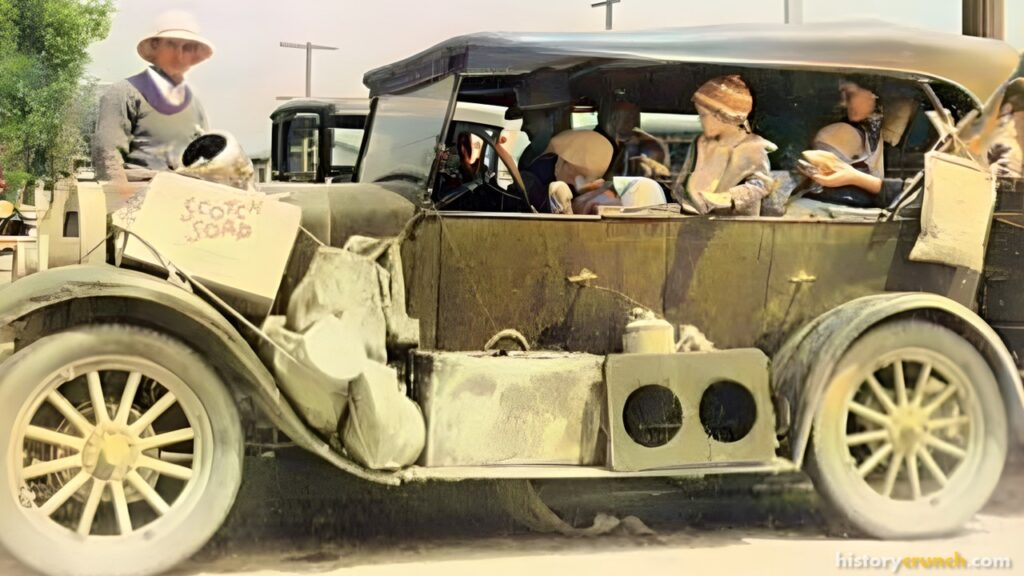
Between 1935 and 1940 about 250,000 people from Oklahoma, Texas, Arkansas and Missouri, driven off their farms by drought, dust and the tractor, drove west on Route 66 to California in loaded cars and trucks. Californians called them all Okies. They found the fruit and cotton fields already full of workers, wages of a dollar a day, and camps of tents and cardboard along the irrigation ditches. Los Angeles police set up a border patrol in 1936 to turn them back.
LEARN MORESHOW LESSwhy it matters · key numbersSOCIALThe Okie migration was the largest movement of Americans within the country since the Civil War, and it was the subject of the decade's most famous novel and its most famous photograph. The farms and orchards they went to work in are still picked by migrants today.
In five radio speeches in January 1935 the Canadian Prime Minister, Richard Bennett, who had spent four years telling Canadians that relief was not Ottawa's job, announced his own New Deal: unemployment insurance, a minimum wage, a maximum working week and support for farm prices. He had copied it from Franklin Roosevelt, and Canadians did not believe him. William Lyon Mackenzie King's Liberals won the October 1935 election in a landslide, and the courts then struck most of Bennett's laws down.
LEARN MORESHOW LESSwhy it matters · key numbers · 1 key figurePOLITICALCanada's Depression was as deep as America's, and its answer came late and from the wrong man. Unemployment insurance did not arrive until 1940 under King. The story shows how far the American New Deal reached: even a Conservative prime minister of a different country felt he had to copy it.
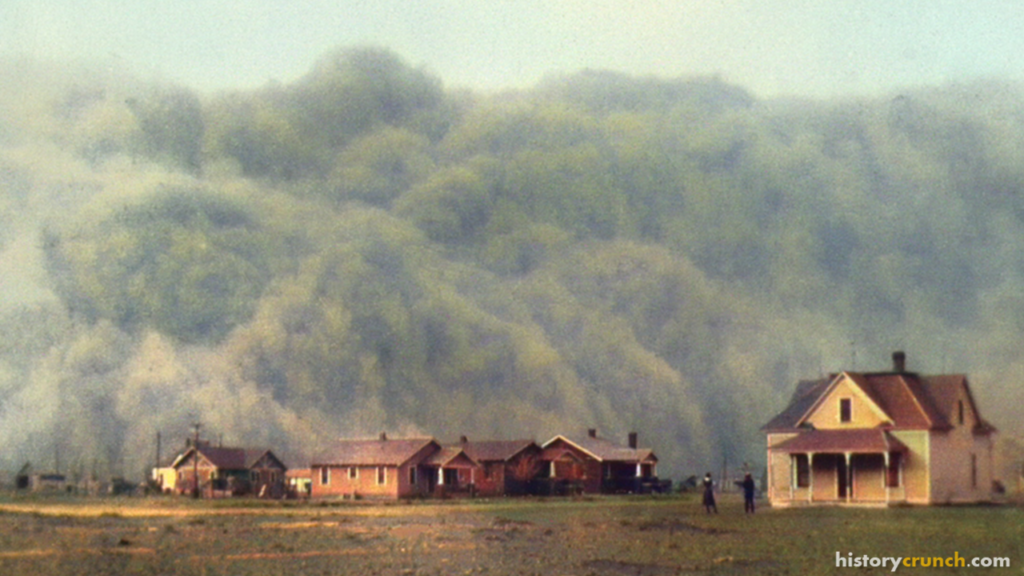
Sunday, April 14th, 1935 began clear and warm across the southern Plains, and families went outside for the first time in weeks. In the afternoon a wall of black dust a thousand feet high, driven by 60-mile-an-hour winds, rolled south from the Dakotas across Kansas, Oklahoma and Texas and turned day to night. People caught outside could not see their hands. A reporter writing about the storm the next day called the region the Dust Bowl, and the name stuck.
LEARN MORESHOW LESSwhy it matters · key numbers · a sourceSCIENCEBlack Sunday was the storm that gave the disaster its name and that finally moved Congress: the Soil Conservation Act passed thirteen days later. Hugh Bennett, the soil scientist, was testifying in the Senate as the dust from a later storm darkened the windows, and he pointed at it.
IN THEIR OWN WORDS“Three little words achingly familiar on a Western farmer's tongue, rule life in the dust bowl of the continent: if it rains.”
Robert Geiger, Associated Press, April 15th, 1935WHAT TO NOTICEThis is the sentence that named the Dust Bowl. Geiger was writing from Guymon, Oklahoma, the morning after the storm.
On April 27th, 1935 Congress passed the Soil Conservation Act, calling erosion a national menace, and created the Soil Conservation Service under Hugh Bennett. Its agents taught Plains farmers to plow along the contours of the land instead of in straight lines, to leave stubble on the fields, to rotate crops and to plant grass on land that should never have been broken. Farmers who followed the rules were paid to do it.
LEARN MORESHOW LESSwhy it matters · key numbersSCIENCEThe Dust Bowl was a man-made disaster, caused by plowing grassland that held the soil, and the answer was to change how the land was farmed. Soil losses fell by two thirds where the new methods were used. The service still exists as the Natural Resources Conservation Service.
Franklin Roosevelt created the Works Progress Administration by executive order on May 6th, 1935, with $4.9 billion from Congress, the largest single appropriation in American history to that point, and put Harry Hopkins in charge. It hired the unemployed directly, at about $50 a month, to build 650,000 miles of roads, 125,000 public buildings, 8,000 parks and 850 airports. At its peak in 1938 it employed 3.3 million people.
LEARN MORESHOW LESSwhy it matters · key numbers · a debateECONOMICThe WPA is the New Deal's biggest program and its most argued about. Supporters point to the schools, bridges and airports still in use; critics called it a boondoggle and said it built a political machine on federal pay. Either way it was the first time the United States had accepted that the government owed a job to people who could not find one.
Did the WPA work?
Yes. It fed 8.5 million families, built schools, bridges and airports still in use, and kept demand alive until the war finished the job. Cutting it in 1937 brought a recession.
Not as economics. Its spending was too small to lift an economy the size of America's, its jobs went where the votes were, and the word boondoggle was coined as its critics' verdict.
In 1935 nine American farms in ten had no electricity, because the power companies said stringing wires to scattered farmhouses did not pay. On May 11th Franklin Roosevelt created the Rural Electrification Administration, which lent money to farmers' cooperatives to build their own lines. By 1939 a quarter of farms had power; by 1950, nine in ten.
LEARN MORESHOW LESSwhy it matters · key numbers · 1 key figureSCIENCEElectricity changed farm life more than any New Deal program: running water, refrigerators, radios, milking machines and light to read by. The cooperatives the REA created still supply power to much of rural America.
On May 27th, 1935 the Supreme Court ruled 9 to 0 that the National Industrial Recovery Act was unconstitutional, in a case about a Brooklyn poultry business, the Schechter brothers, fined for selling sick chickens against the NRA's code. The court held that Congress could not hand its lawmaking power to the president and could not regulate business inside a single state. The Blue Eagle was dead. Franklin Roosevelt called it a horse-and-buggy reading of the Constitution.
LEARN MORESHOW LESSwhy it matters · key numbers · 1 key figurePOLITICALBlack Monday, as the New Dealers called it, was the first of a series of rulings that struck down the First New Deal: the AAA followed in January 1936. It pushed Roosevelt toward the laws of the Second New Deal, written to survive the court, and toward his attempt in 1937 to change the court itself.
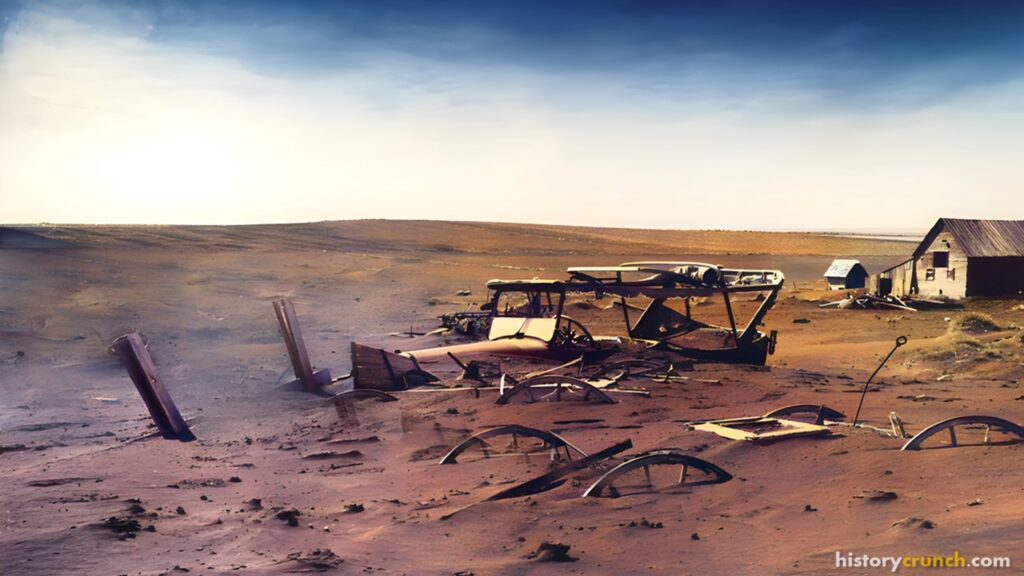
Franklin Roosevelt's own idea for the Dust Bowl was a wall of trees. From 1935 the Forest Service and WPA crews planted rows of cottonwood, elm and cedar along a belt 100 miles wide from the Canadian border to Texas, to slow the wind and hold the soil. By 1942 about 220 million trees had been planted on 30,000 farms, in strips 18,600 miles long in total.
LEARN MORESHOW LESSwhy it matters · key numbers · 1 key figureSCIENCEExperts laughed at the shelterbelt when it was announced, and most of the trees lived. The rains came back in 1939 and the dust stopped blowing, but the trees, the contour plowing and the grassland that was never plowed again are the reasons the Plains did not blow away in the droughts of the 1950s.
In June 1935 about 1,500 men walked out of Canada's relief camps in British Columbia, where single unemployed men were kept for 20 cents a day, and rode freight trains east to put their case to Prime Minister Richard Bennett. Bennett stopped them at Regina, Saskatchewan, met their leaders and called them radicals. On July 1st, Dominion Day, police moved in to arrest the leaders at a rally, and in the fighting that followed a city policeman was killed and 130 men were arrested.
LEARN MORESHOW LESSwhy it matters · key numbersSOCIALThe Regina Riot was Canada's Bonus Army: a march of the unemployed broken up by force, which cost the government that did it the next election. Bennett lost in October, and the relief camps were closed the following year.
On July 5th, 1935 Franklin Roosevelt signed the National Labor Relations Act, written by Senator Robert Wagner of New York, which gave workers the legal right to organize a union and to bargain with their employer, and created a board to hold elections and punish companies that fired organizers. Union membership rose from about 3 million in 1933 to 9 million in 1939, and the new industrial unions of the CIO organized steel, autos and rubber.
LEARN MORESHOW LESSwhy it matters · key numbers · 1 key figurePOLITICALThe Wagner Act is the law that built the American labor movement, and it is still the law. The Supreme Court upheld it in April 1937, in the middle of the court-packing fight, and the decision is usually taken as the moment the court gave up trying to stop the New Deal.
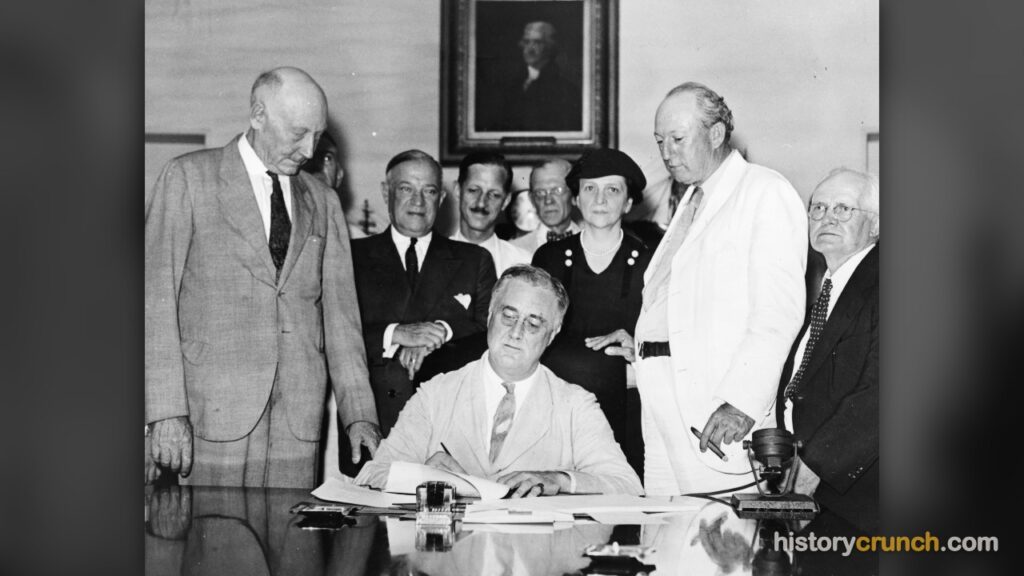
On August 14th, 1935 Franklin Roosevelt signed the Social Security Act, with Frances Perkins standing behind him. It created pensions for workers over 65, paid for by a tax on wages that workers and employers split, unemployment insurance run by the states, and aid to the blind, to dependent children and to mothers. Farm workers and domestic servants, who included most Black workers in the South, were left out, and the first pension checks were not due until 1942.
LEARN MORESHOW LESSwhy it matters · key numbers · a sourcePOLITICALSocial Security is the New Deal law that touches the most Americans today: about 70 million people receive a check every month. Roosevelt insisted it be paid for by a wage tax rather than from general taxes so that, as he said, no politician could ever scrap it. None has.
IN THEIR OWN WORDS“With those taxes in there, no damn politician can ever scrap my social security program.”
Franklin Roosevelt, to an adviser, 1941WHAT TO NOTICERoosevelt knew that a pension paid for by the workers themselves would be seen as earned, not given, and that is why it has survived every attempt to cut it.
Franklin Roosevelt had opposed paying the bonus early, like Herbert Hoover before him, and vetoed a bonus bill in 1935. In January 1936, an election year, Congress passed it again and overrode his veto on January 27th. About 3.5 million veterans got their money in June, $1.9 billion in bonds they could cash at once, and most did.
LEARN MORESHOW LESSwhy it matters · key numbers · 2 key figuresPOLITICALThe bonus was paid four years after the army burned the marchers out of Washington, and nine years before the certificates were due. The money reached the economy in the summer of 1936, one reason that year was the best of the decade, and the Bonus Army's argument, that veterans should be helped when they came home rather than decades later, became the GI Bill of 1944.
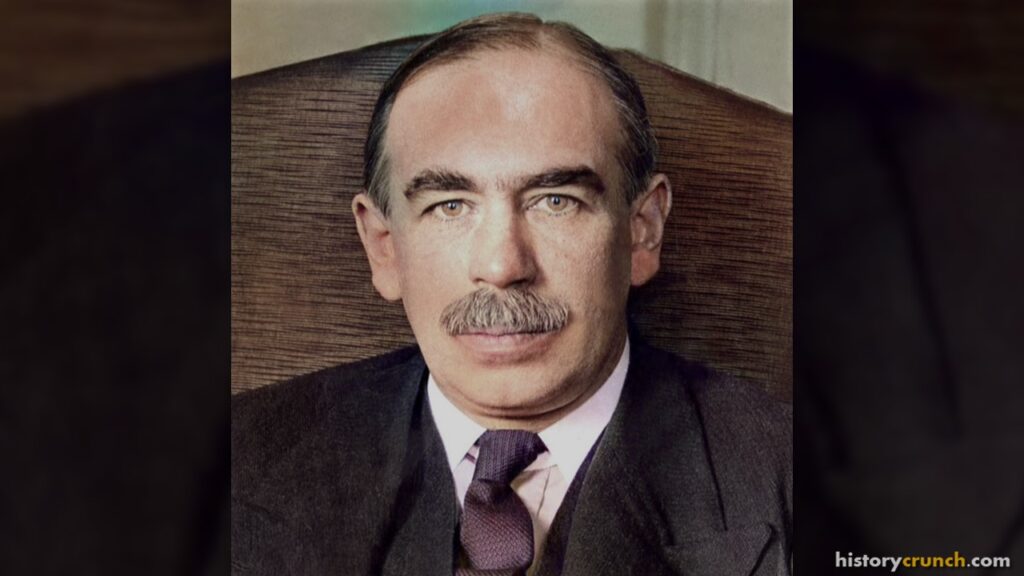
On February 4th, 1936 John Maynard Keynes, the Cambridge economist who had warned in 1919 that the Versailles treaty would ruin Europe, published The General Theory of Employment, Interest and Money. Its argument was that a slump could last forever if nobody spent: workers without wages could not buy, businesses without customers would not hire, and the only body big enough to break the circle was the government, borrowing and spending until people had jobs again.
LEARN MORESHOW LESSwhy it matters · key numbers · a sourceIDEASThe General Theory is the most influential economics book of the century. It gave a name and a theory to what the New Deal was already doing by instinct, and after the war every Western government ran its economy on Keynes's lines for thirty years. The 2008 crisis brought his ideas back again.
IN THEIR OWN WORDS“The long run is a misleading guide to current affairs. In the long run we are all dead.”
John Maynard Keynes, A Tract on Monetary Reform, 1923
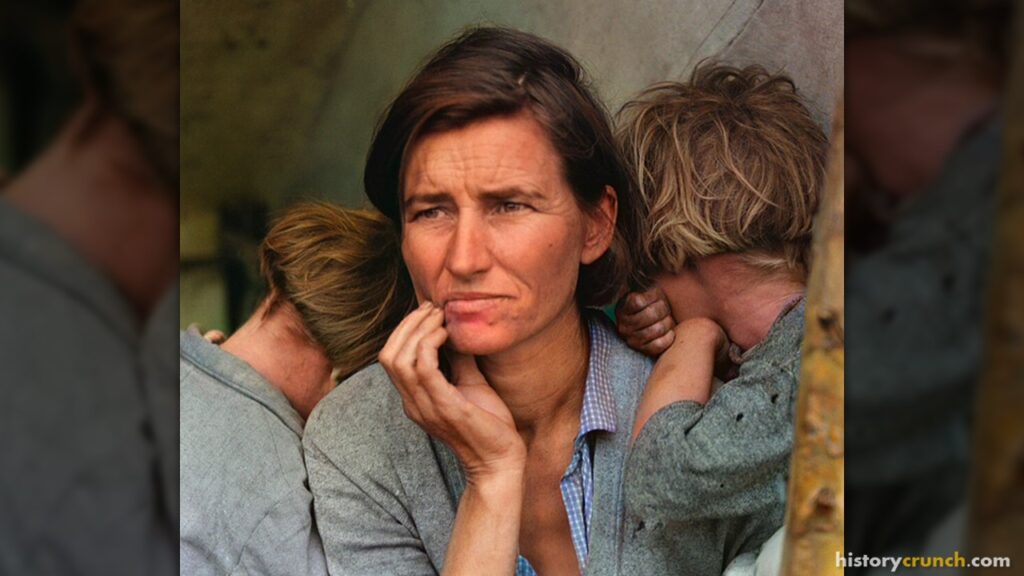
In March 1936 Dorothea Lange, a photographer working for the government's Resettlement Administration, pulled into a camp of pea pickers at Nipomo, California, where the crop had frozen and 2,500 people were stranded without work or food. She took six pictures of a 32-year-old mother of seven, Florence Owens Thompson, sitting in a tent with three of her children. The San Francisco News printed them, and the government sent 20,000 pounds of food to the camp.
LEARN MORESHOW LESSwhy it matters · key numbersCULTUREMigrant Mother is the most reproduced photograph of the Depression and among the best known pictures in the world. Lange and the other government photographers, Walker Evans, Arthur Rothstein and Gordon Parks among them, made 170,000 pictures that are the reason we know what the decade looked like. Thompson, who was Cherokee, was not identified until 1978 and never got a cent from the picture.
France, which stayed on the gold standard longest, was hit late and stayed down long. In May 1936 a coalition of Socialists, Radicals and Communists, the Popular Front, won the election, and two million workers occupied their factories to make sure the new government delivered. Leon Blum, the Socialist prime minister, gave them the 40-hour week, two weeks' paid holiday and the right to bargain, in the Matignon Agreements of June 1936. Employers fought back, the franc fell, and Blum was out in a year.
LEARN MORESHOW LESSwhy it matters · key numbersPOLITICALThe Popular Front was France's New Deal and its most lasting gift, the paid holiday, was one the American New Deal never gave. It also divided the country so bitterly that when the war came in 1940 many on the French right preferred Hitler to Blum.
On June 24th, 1936 Mary McLeod Bethune, the daughter of former slaves who had founded a college for Black girls in Daytona, Florida, in 1904, became director of Negro Affairs at the National Youth Administration, the highest federal post a Black woman had ever held. She steered $6 million in student aid and job training to Black young people, and led the Black Cabinet, an informal group of Black officials in New Deal agencies who met at her house.
LEARN MORESHOW LESSwhy it matters · key numbers · 1 key figurePOLITICALBlack Americans had the highest unemployment of any group in the Depression, about 50 percent in the cities, and the New Deal often reached them last. Bethune, with Eleanor Roosevelt's backing, is the reason it reached them at all, and the reason Black voters left the party of Lincoln for Franklin Roosevelt in 1936.
Jarrow, a shipbuilding town on the Tyne in the north of England, lost its shipyard in 1934 and with it seven jobs in ten. On October 5th, 1936, 200 men chosen for their fitness set out to walk 300 miles to London with a petition for a new steelworks, led by their Member of Parliament, Ellen Wilkinson. They arrived on October 31st, handed in the petition, and Parliament did nothing. Britain's Depression was a story of two countries: the coal, steel and shipbuilding north with a third of its men idle, and a south building new houses and car factories.
LEARN MORESHOW LESSwhy it matters · key numbersSOCIALBritain had left gold in 1931 and recovered earlier than America, but the recovery never reached the old industrial towns, and the Jarrow March is the picture of that. The marchers' cause was won by the war, which reopened the yards, and by the welfare state Britain built after it.
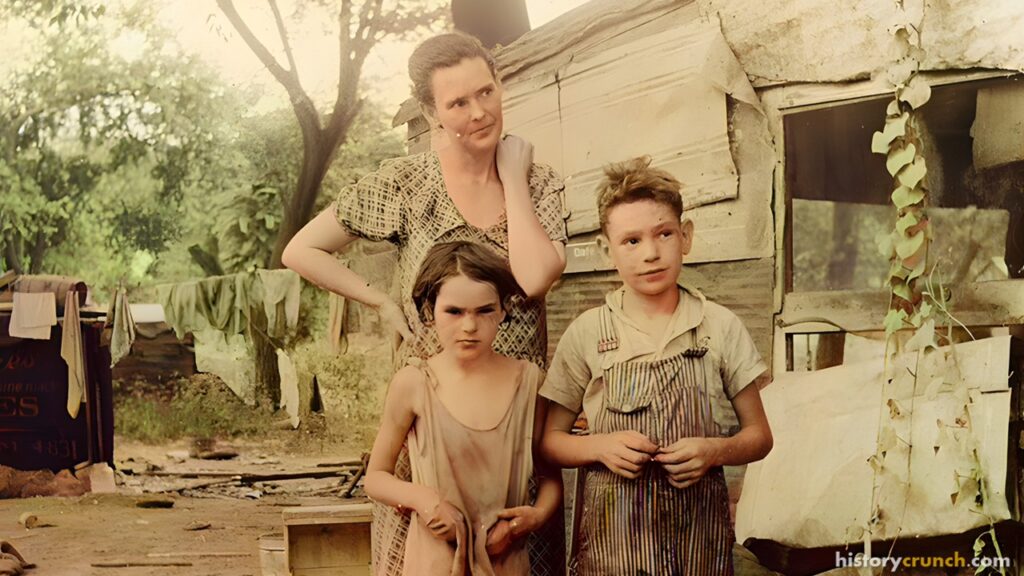
On November 3rd, 1936 Franklin Roosevelt beat the Republican Alf Landon, the governor of Kansas, by 523 electoral votes to 8, carrying every state but Maine and Vermont with 61 percent of the vote, the widest margin since 1820. Unemployment was still 17 percent, but it had been 25, and eleven million people had a New Deal job or a New Deal check. The Literary Digest, which had polled its readers and predicted a Landon win, went out of business.
LEARN MORESHOW LESSwhy it matters · key numbers · a sourcePOLITICALThe 1936 election settled the argument about whether Americans wanted the New Deal. Roosevelt's coalition of workers, farmers, the South, the cities and Black voters won by the largest margin in a century, and his campaign speech at Madison Square Garden welcomed the hatred of the bankers. It was also the last landslide before the Supreme Court fight and the recession broke his run.
IN THEIR OWN WORDS“They are unanimous in their hate for me, and I welcome their hatred.”
Franklin Roosevelt, Madison Square Garden, October 31st, 1936
The New Deal's last act began with a defeat. Franklin Roosevelt tried to pack the Supreme Court and lost, cut spending because recovery seemed sure, and watched the economy fall back toward 1932. The recession of 1937 taught him what John Maynard Keynes had written the year before: in a slump the government has to spend. The spending that finally ended the Depression came for guns, not jobs, after Germany invaded Poland and Japan struck Pearl Harbor. By 1944 unemployment was 1.2 percent, and the laws of the 1930s were still there.
On February 5th, 1937, three months after his landslide, Franklin Roosevelt asked Congress for the power to add a new justice to the Supreme Court for every sitting justice over 70, up to six, which would have given him a majority on a court that had struck down the NRA and the AAA. He said it was about the justices' workload; everyone knew it was about the New Deal. His own party revolted, the Senate killed the bill in July, and the Senate leader who carried it died of a heart attack in the fight.
LEARN MORESHOW LESSwhy it matters · key numbers · a debatePOLITICALCourt packing was Roosevelt's worst political defeat and, in a way, his victory: in the middle of the fight the court upheld the Wagner Act and Social Security, and by 1941 he had appointed seven justices the ordinary way. The New Deal survived. The idea that a president could remake the court to get his way did not, and it is still the example every later president is warned by.
Did the threat change the court's mind?
Yes. The justices saw the landslide of 1936 and the plan of 1937 together, understood they could not hold out, and the switch in time saved nine.
No. Justice Owen Roberts had already changed his vote before the plan was announced, so the court was moving on its own. The plan cost Roosevelt his party's trust and gained him nothing.
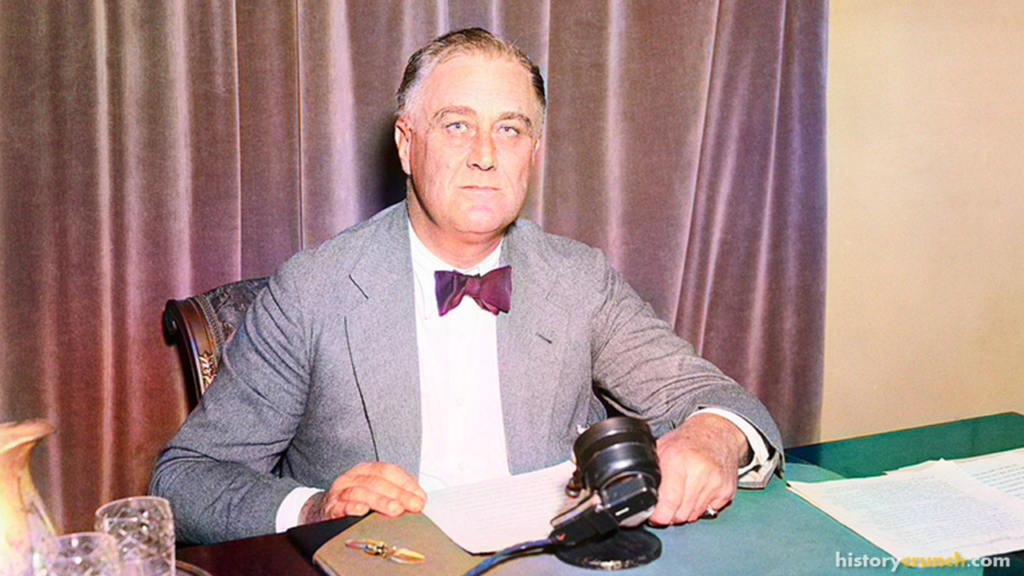
By the spring of 1937 industrial production was back to its 1929 level, unemployment had fallen from 25 percent to about 14, and farm income had doubled since 1932. Franklin Roosevelt, who had run deficits for four years and never liked them, decided the emergency was over: he cut the WPA rolls by half, the new Social Security tax began taking money out of paychecks, and the Federal Reserve tightened credit.
LEARN MORESHOW LESSwhy it matters · key numbers · 1 key figureECONOMIC1937 is the year the Depression looked over and was not. The recovery had been real but it ran on a budget deficit, and when the spending stopped so did the recovery. What happened next is the strongest evidence economists have for Keynes's argument.
On May 24th, 1937 the Supreme Court ruled, in two cases brought by employers, that the Social Security Act was constitutional: Congress could tax wages to pay pensions and could run unemployment insurance with the states, because providing for the general welfare was a federal power. Six weeks earlier the same court had upheld the Wagner Act. Justice Willis Van Devanter, one of the four who had voted against every New Deal law, retired the next month.
LEARN MORESHOW LESSwhy it matters · key numbersPOLITICALWith these decisions the fight between the court and the New Deal ended. The federal government's power to tax and spend for social programs, which the court had doubted for forty years, was settled, and every program since, from Medicare to disability insurance, rests on the 1937 rulings.
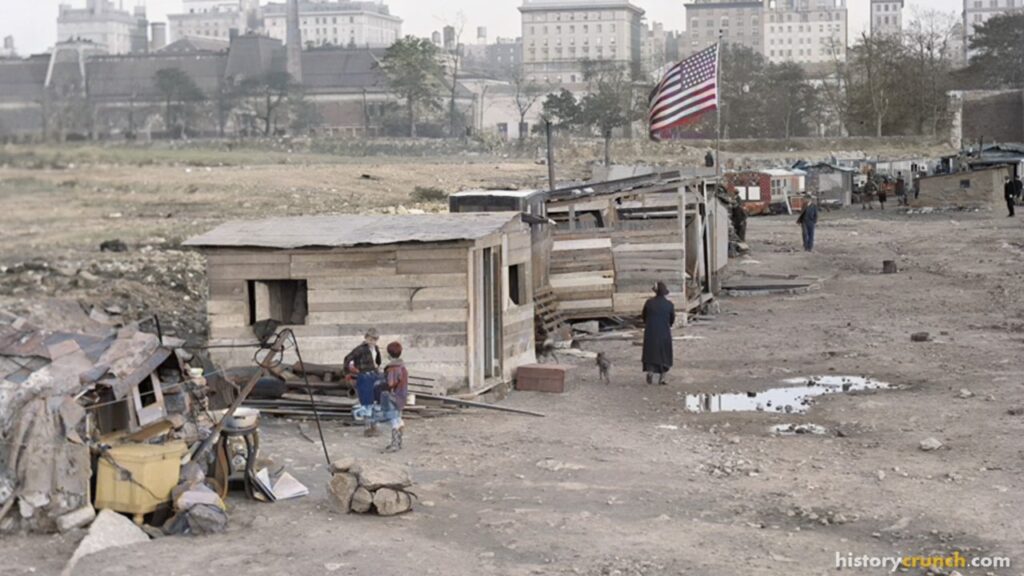
In August 1937 the stock market began to fall and did not stop until the following spring. Industrial production dropped by a third in ten months, faster than it had fallen after 1929, and unemployment rose from 14 percent to 19, putting four million people back out of work. Republicans called it the Roosevelt Recession. Franklin Roosevelt, who had been told by his Treasury Secretary that the budget could be balanced, was told by Harry Hopkins and Marriner Eccles of the Federal Reserve that it could not.
LEARN MORESHOW LESSwhy it matters · key numbers · a debateECONOMICThe recession of 1937 to 1938 is the Depression's second act and its clearest lesson: a recovery driven by government spending stopped when the spending did. It ended the idea that the New Deal had cured the Depression, and it turned Roosevelt, against his instincts, into the first president to spend his way out of a slump on purpose.
What caused the recession of 1937?
The cut in government spending and the new payroll tax, which took money out of the economy before the recovery could stand on its own. That is the Keynesian answer.
The Federal Reserve, which doubled the reserves banks had to hold in 1936 and 1937 and choked off lending. Most historians now say both, and the argument returns every time a budget is balanced too soon.
On April 14th, 1938 Franklin Roosevelt asked Congress for $3 billion in new spending on relief, public works and housing, and told the country in a fireside chat that night that the government had to spend to put money in people's hands. Congress passed it in June. The WPA rehired a million people, production turned up in the summer, and by 1939 the economy was back where it had been in 1937.
LEARN MORESHOW LESSwhy it matters · key numbers · 2 key figuresECONOMICThis is the first time an American government deliberately ran a deficit to end a recession, the policy John Maynard Keynes had written down in 1936. Keynes had met Roosevelt in 1934 and left thinking the president did not understand economics; Roosevelt thought Keynes was a mathematician. By 1938 the policy had won on the evidence.
On June 25th, 1938 Franklin Roosevelt signed the Fair Labor Standards Act, the last major law of the New Deal. It set a national minimum wage of 25 cents an hour, rising to 40 cents by 1945, a 44-hour week falling to 40, with time and a half for overtime, and banned most work by children under 16. Southern Democrats had fought it for a year because it would raise Black workers' wages. It was the last item on the list Frances Perkins had brought to her first meeting with Roosevelt in 1933.
LEARN MORESHOW LESSwhy it matters · key numbers · 1 key figurePOLITICALEvery paycheck in the United States is still governed by this law: the minimum wage, the 40-hour week and overtime pay all date from June 1938. After it, Congress passed no more New Deal laws; the 1938 elections cut the Democratic majority and the war took over.
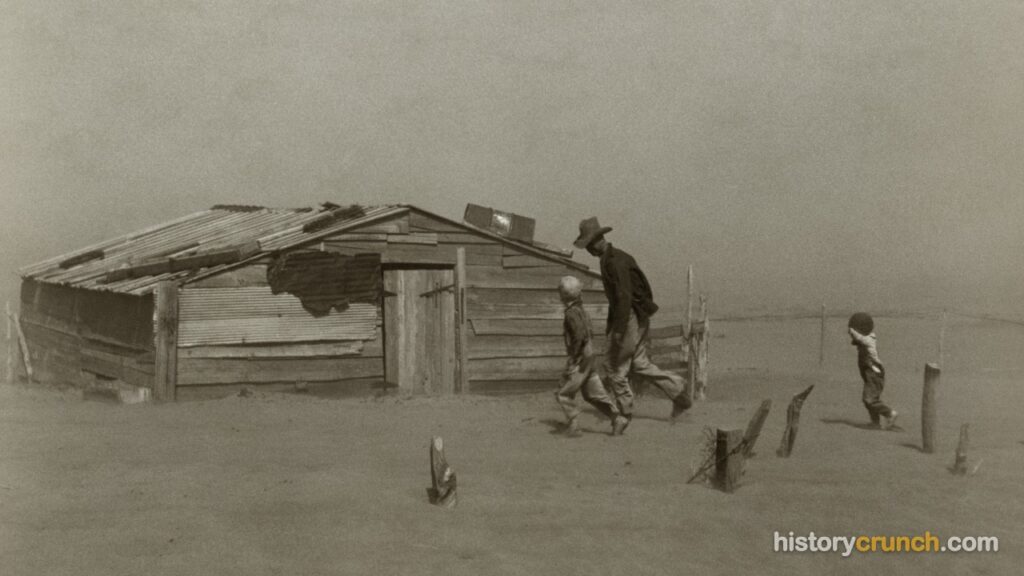
On April 14th, 1939, four years to the day after Black Sunday, John Steinbeck published The Grapes of Wrath, the story of the Joad family driven off their Oklahoma farm and west on Route 66 to the fields of California. Steinbeck had spent two years in the migrant camps reporting for the San Francisco News. The book sold 430,000 copies in its first year, was burned in Bakersfield, banned by the Kern County board, and won the Pulitzer Prize. John Ford's film came out in 1940.
LEARN MORESHOW LESSwhy it matters · key numbersCULTUREThe Grapes of Wrath is the book the Depression left behind, the one students still read. California growers called it a lie; Eleanor Roosevelt, the First Lady, visited the camps and said it was not, and Congress held hearings on migrant labor because of it. Steinbeck won the Nobel Prize in 1962.
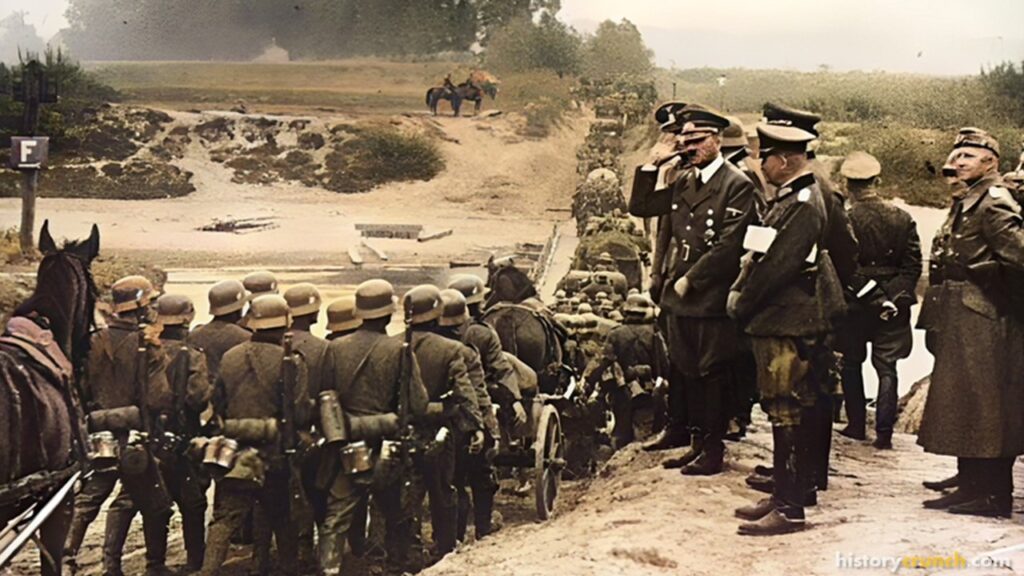
On September 1st, 1939 Germany invaded Poland, and Britain and France declared war two days later. The United States stayed out, but in November Congress let Britain and France buy American weapons for cash, and orders for planes, ships, steel and trucks began to fill the factories that had stood half empty for ten years. In 1940 Franklin Roosevelt asked for 50,000 planes a year, and unemployment fell below 10 percent for the first time since 1930.
LEARN MORESHOW LESSwhy it matters · key numbers · elsewhereMILITARYThe war ended the Depression, not the New Deal, and this is where that ending starts. The government spending that Keynes had asked for and Congress had refused came at last for guns instead of jobs, and on a scale ten times the WPA. Germany, which had rearmed since 1933, had reached full employment three years earlier.
The World War II timeline picks up here. Germany's rearmament, which is the other way the Depression ended, is in the Nazi Germany timeline.
On January 31st, 1940 Ida May Fuller, a retired legal secretary from Ludlow, Vermont, received Social Security check number 00-000-001, for $22.54. She had paid $24.75 in payroll taxes over three years. She lived to be 100 and collected $22,888. Congress had moved the first payments up from 1942 and added benefits for widows and children in 1939.
LEARN MORESHOW LESSwhy it matters · key numbersSOCIALFuller's check is the moment Social Security became real: a promise made in 1935 turned into money in a mailbox. Sixty-five million people a month receive one now, and it is the reason the poverty rate among old people, about 50 percent in the 1930s, is under 10 percent today.
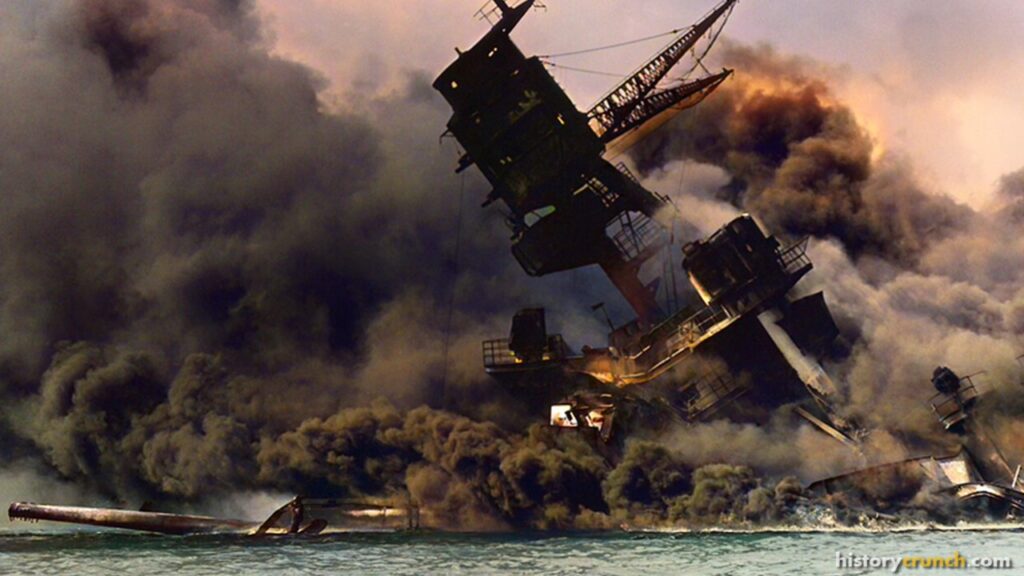
On December 7th, 1941 Japanese planes attacked the American fleet at Pearl Harbor in Hawaii, and the United States entered the Second World War the next day. Within a year the government was spending more every month than the whole New Deal had spent in a year, 16 million men and women were in uniform by 1945, and factories that had been idle in 1932 were building a plane every five minutes. Unemployment, still 10 percent in 1941, was below 2 percent by 1943.
LEARN MORESHOW LESSwhy it matters · key numbers · elsewhereMILITARYPearl Harbor is where the Great Depression ends. The war did what the New Deal could not, because it spent on a scale nobody would have accepted in peacetime, and it proved Keynes right by accident. It also left the New Deal's programs in place: Social Security, deposit insurance, the minimum wage and the SEC all survived the war and are still here.
The attack and the Pacific war are covered on the World War II timeline; this card marks its meaning for the Depression.
Congress cut off the Civilian Conservation Corps' money on June 30th, 1942, seven months after Pearl Harbor. The young men it had been created for were now in the army, and the camps were turned over to the military. In nine years the corps had enrolled about three million men, planted three billion trees, built 800 state parks and 125,000 miles of roads and trails, and fought fires across the West.
LEARN MORESHOW LESSwhy it matters · key numbersECONOMICThe CCC ended because the war made it unnecessary, which was the point of the whole New Deal. Its parks, trails and forests are used by millions every year, and every later youth service program, from the Peace Corps to AmeriCorps, was modeled on it.
Franklin Roosevelt gave the Works Progress Administration what he called an honorable discharge in December 1942, and it closed its books on June 30th, 1943. There was nobody left to hire: war factories were short of workers, and the 3.3 million people the WPA had employed at its peak in 1938 had jobs. In eight years it had spent about $11 billion and built or repaired 650,000 miles of road, 125,000 buildings and 8,000 parks.
LEARN MORESHOW LESSwhy it matters · key numbers · 1 key figureECONOMICThe WPA's closing is the New Deal's own verdict on itself: relief was for the emergency, and the emergency was over. The programs that were meant to last, Social Security, deposit insurance, the minimum wage and the labor law, stayed. The programs that were meant to carry people through, the CCC, the WPA and the NYA, closed with the war.
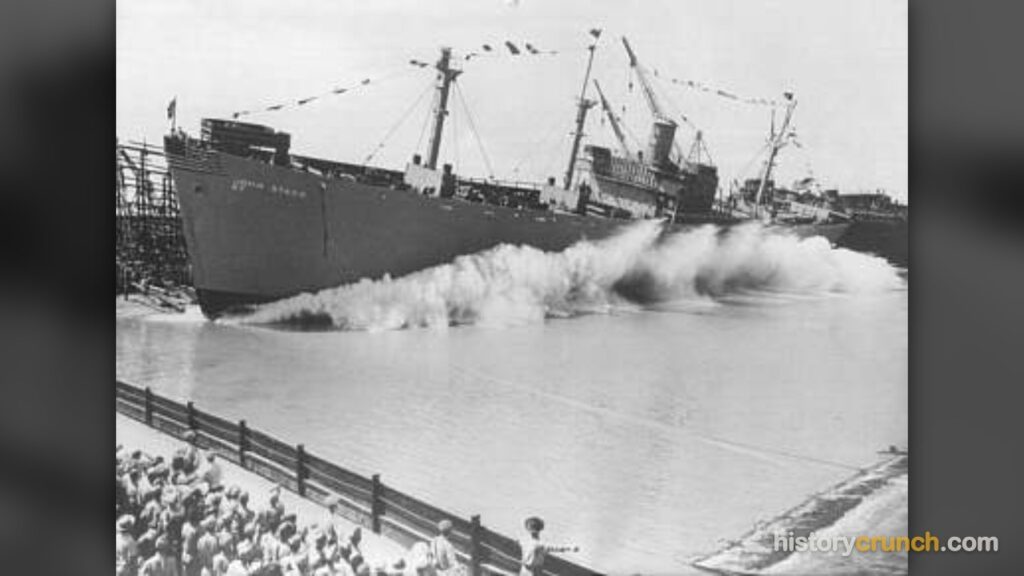
In 1944 American unemployment reached 1.2 percent, the lowest figure ever recorded, and the economy was almost twice the size it had been in 1939. Six million women had gone to work in war plants, Black workers had moved north to the factories by the hundreds of thousands, and wages were higher than in 1929. The government was borrowing $50 billion a year to pay for it, ten times the largest New Deal deficit.
LEARN MORESHOW LESSwhy it matters · key numbersECONOMICThe numbers of 1944 close the story that began with the Dow's peak in September 1929. Fifteen years of slump, recovery, relapse and war had settled what a modern government would do in a depression, and for the next generation Americans, Britons, Canadians and Australians all lived under laws written in the 1930s to make sure it never happened again.

I'm the founder of History Crunch, which I first began in 2015 with a small team of like-minded professionals. I have an Education Degree with a focus in Social Studies education. I spent nearly 15 years teaching history, geography and economics in secondary classrooms to thousands of students. Now I use my time and passion researching, writing and thinking about history education for today's students and teachers.

I'm a passionate history and geography teacher with over 15 years of experience working with students in the middle and high school years. I have an Education Degree with a focus in World History. I have been writing articles for History Crunch since 2015 and love the challenge of creating historical content for young learners!

K.L. is a content writer for History Crunch. She is a fantastic history and geography teacher that has been helping students learn about the past in new and meaningful ways since the mid-2000s. Her primary interest is Ancient History, but she is also driven by other topics, such as economics and political systems.
To cite this timeline as a source, use one of the formats below.
MLA: Millar, B., et al. “Great Depression Timeline.” HistoryCrunch, 11 September 2026, https://historycrunch.com/great-depression-timeline/.
APA: Millar, B., Beck, E., & Woida, K.L. (2026). Great Depression Timeline. HistoryCrunch. https://historycrunch.com/great-depression-timeline/
Chicago: Millar, B., Elias Beck, and K.L Woida. “Great Depression Timeline.” HistoryCrunch. September 11, 2026. https://historycrunch.com/great-depression-timeline/
© History Crunch
In September 1929 the stock market was at a record. Five weeks later it had lost half its value. What broke?
Economists disagree about why the market fell when it did. Some say the bubble simply ran out of buyers; some blame the Federal Reserve for raising interest rates in August 1929; some point to the London crash in September and the economy's turn in August. All agree that once it started, the borrowed money made it a collapse.
Stock markets crash and recover. Why did this one turn into ten years of mass unemployment?
The traditional account blames the crash. Most economic historians now blame the bank failures and the gold standard: the crash destroyed some wealth, but the panics of 1930 to 1933 destroyed the money supply, and the Federal Reserve, tied to gold, let them. A smaller school blames the tariff and the collapse of trade.
When was the Depression over? The market, the banks and the unemployed each give a different answer.
Historians argue about whether the New Deal ended the Depression. Its defenders point to the fall in unemployment from 25 percent to 14 by 1937 and say the war only finished the job. Its critics point out that unemployment was still 17 percent in 1939, six years in, and say the recovery came from the war and from leaving gold, not from the programs.
Looking back, the crash had warnings for seven years. Which ones could people have seen at the time?
Whether the crash could have been prevented is still argued. Some economists say the Federal Reserve should have raised interest rates hard in 1928 to stop the speculation; others say that would have caused the slump a year earlier. A few argue the boom was sound until the Federal Reserve tightened, and that the crash was the cure that killed the patient.
Nine thousand American banks failed between 1930 and 1933. What stopped it?
Who was to blame for the panics? Milton Friedman and Anna Schwartz argued in 1963 that the Federal Reserve could have stopped them by lending freely and let a third of the money supply disappear instead. Others say the gold standard tied the Fed's hands, and that the real fault was a banking system of thousands of tiny banks that no central bank could have saved.
Every major country in 1929 tied its money to gold. Why did the ones that gave it up first recover first?
Most economic historians now hold that the gold standard was the main reason the Depression was worldwide and so long, because it transmitted the American slump abroad and stopped every government from answering it. A minority argue the real fault was how central banks ran the system, hoarding gold in France and America, and that gold itself was not the problem.
What did the New Deal change so that 1929 could not happen the same way again?
Historians agree the reforms ended the bank panics. They disagree about how much they mattered afterward. Some credit the FDIC and SEC with fifty years without a financial crisis; others say the economy of those years was calm for other reasons, and point out that the crisis of 2008 came nine years after the Glass-Steagall wall was repealed, which either proves the point or does not.
Herbert Hoover was elected by a landslide in 1928 and lost by a landslide in 1932. What happened in between?
Hoover's reputation has been argued over for ninety years. To the New Dealers he was the do-nothing president. Later historians pointed out that he intervened more than any president before him, with the RFC, the moratorium and public works, and that Roosevelt kept most of it. The current view is that he did more than his enemies said and far less than the crisis needed, because he could not bring himself to give federal money to people.
In July 1932 the United States Army drove 15,000 veterans of the First World War out of the capital with tanks and tear gas. How did it come to that?
Hoover's defenders say he ordered only the downtown camps cleared and that MacArthur disobeyed him by crossing the river to Anacostia. MacArthur said he had acted to stop a communist revolt, which the evidence does not support. Historians agree the marchers were peaceful and that the attack was the single most damaging event of Hoover's presidency, whoever ordered it.
Congress raised tariffs in 1930 to protect American jobs. Why did exports fall by two thirds?
Economists disagree about how much damage Smoot-Hawley did. The usual view is that it set off a trade war that cut world trade by two thirds and helped carry the Depression abroad. Some reply that exports were only 5 percent of the American economy and that the gold standard and the bank failures did far more harm. Nobody argues it helped.
Hoover is remembered as the president who did nothing. What did he actually do?
Historians divide over Hoover. One school holds that he was a prisoner of his principles and let the country starve rather than break them. Another holds that he did more than any predecessor and that the New Deal was built on his foundations, the RFC above all. Both agree that he could not do the one thing the moment demanded, which was to look as if he cared.
Congress passed fifteen major laws in a hundred days in 1933. What did they change?
Historians argue about whether the Hundred Days were a plan or an improvisation. Roosevelt's admirers see a coherent program of relief, recovery and reform. Others point out that the laws contradicted each other, raising prices with one hand and cutting spending with the other, and that Roosevelt himself said he would try something and, if it failed, try something else.
The New Deal chose to give the unemployed jobs rather than money. Why, and did it work?
Whether the work programs helped the economy recover is disputed. Their defenders say they fed 11 million families and built the country's schools and roads. Their critics say the spending was too small to lift the economy and that the jobs went where the votes were. The evidence of 1937, when cutting the WPA was followed by a recession, is the strongest argument on the defenders' side.
Roosevelt had won by a landslide and passed fifteen laws. Why did he need a second New Deal in 1935?
Historians disagree about why the Second New Deal happened. Some see it as Roosevelt's plan all along, delayed by the emergency. Some see it as a response to the pressure from Long, Coughlin and Townsend, whose voters he needed in 1936. Some see it as forced by the Supreme Court. Most settle on all three.
The Supreme Court struck down the New Deal's biggest laws. How did the New Deal survive?
The switch in time that saved nine is the most argued question here. Did Justice Owen Roberts change his vote because of the court-packing threat, or had he decided before the plan was announced? The records suggest before, which means the court was already moving; but the landslide of 1936 was a threat of its own, and the justices had read the returns.
Franklin Roosevelt's programs put millions back to work. Farm workers and domestic servants were excluded from most of them, and most Black Americans worked in one of those two jobs. Was that an accident?
Historians disagree about intent. Some argue the exclusions were straightforwardly racial, demanded by southern committee chairmen who controlled whether anything passed. Others argue the categories were about administrative difficulty in collecting payroll taxes from scattered employers, with racial effects that were foreseen and accepted rather than designed.
Unemployment under Franklin Roosevelt was around 25 percent in 1933 and still near 15 percent in 1940. Then the war came and it vanished. So what did the New Deal actually do?
This is a live argument in economics. Keynesians say the New Deal worked as far as it went and failed only because it was too small and was cut short in 1937. Critics say it prolonged the Depression by raising costs and creating uncertainty. A third group emphasizes leaving the gold standard in 1933 as the decisive step, with the rest mattering less than either side claims.
What did it mean to live through the Depression with no job and no help?
How typical was the suffering? A quarter of workers had no job, which means three quarters did, and for people in work with falling prices the 1930s could be comfortable. Historians argue about whether the pictures of the decade, chosen by government photographers to make the case for the New Deal, show the Depression as it was or as the New Deal needed it to look.
The Depression pushed women into work and turned public opinion against them working. How did that play out?
Historians disagree about whether the New Deal was good for women. It put a woman in the cabinet and hired hundreds of thousands, but its programs paid women less, excluded domestic servants from Social Security, and assumed a family had a male breadwinner. Some call it the beginning of women's place in government; others say it wrote the 1930s' prejudices into law.
A quarter of a million teenagers rode the rails in 1932. What happened to them?
The CCC is the New Deal program with the fewest critics, and historians mostly argue about what it shows. Some see proof that the government could change young lives cheaply and well. Others note that it was run by the army, took only the fit, kept out women and segregated Black enrollees, and say it shows the limits of the New Deal as clearly as its reach.
Why do we remember the Depression in faces? Who took the pictures and wrote the books, and why?
Historians argue about the government photographs. Their director, Roy Stryker, sent photographers out with shooting scripts and killed negatives he did not like, and the pictures were made to win support for the New Deal. Some say that makes them propaganda; others say every photograph is a choice, and these were made by people who had seen what they showed.
The Plains had droughts before 1931. Why did this one blow the soil away?
How much was the farmers' fault? One view holds that plowing the grassland was reckless and that the farmers made the Dust Bowl. Another points out that the government had urged them to plant wheat during the First World War, that the tractor and the price of wheat left them little choice, and that nobody had lived on the Plains long enough to know the drought was coming.
A quarter of a million people left the Plains for California. What did they find?
The Okie story has been argued over since the novel. Steinbeck's critics said the migrants were not driven out by dust but drawn by California's relief payments, and that most came from the cotton country of eastern Oklahoma, not the Dust Bowl. Later historians confirmed that most Okies were not Dust Bowl farmers, and also that the camps were as bad as Steinbeck said.
American farms had been in a depression since 1920. What did the New Deal do for them?
Was the AAA fair? It doubled farm income by 1936, but the checks went to landowners, and in the South many used the money to buy tractors and push their sharecroppers off the land. Historians argue about whether the New Deal saved American farming or helped turn it into the large mechanized business it became.
The crash was in New York. Why were there six million unemployed in Germany three years later?
Economic historians agree the Depression was transmitted by the gold standard and the collapse of lending, and disagree about whether it was American in origin at all. Some argue Europe's problems, the war debts, reparations and Britain's overvalued pound, would have produced a slump without Wall Street. Others say that without the American crash the European banks would have muddled through.
Three countries that spoke the same language answered the slump three different ways. Which one worked?
Which country handled the Depression best is argued in all three. Britain's early exit from gold is usually judged the best single decision of the decade; Australia's wage cuts kept its credit and cost a third of its workers their jobs; Canada's tariffs are judged a mistake. All three built welfare states after the war on what the 1930s had taught them.
Democracies and dictatorships faced the same slump. Why did Germany choose Hitler and America choose Roosevelt?
Historians disagree about how much the Depression explains Hitler. Some say that without six million unemployed the Nazis would have stayed at 2.6 percent. Others point to the war, Versailles, the failure of the republic's institutions and the decisions of a few men around President Hindenburg, and say the slump gave Hitler his chance but did not make him inevitable. The Nazi Germany timeline follows that argument.
Should a government spend its way out of a slump? Two economists said opposite things in 1931, and the decade tested both.
Who won is still argued. Keynes's side points to the recovery that followed spending in 1938 and in the war, and to thirty years of growth afterward. Hayek's side points to the 1970s, when spending brought inflation without jobs, and argues that the Depression was prolonged by governments that would not let wages and prices fall. Both sides claim 2008.
Roosevelt was elected without a program and became the only president to win four times. What did he have?
Roosevelt's greatness is agreed on and his methods are not. Admirers see a leader who saved democracy and capitalism by reforming both. Critics on the right say he prolonged the Depression with regulation and uncertainty; critics on the left say he saved a system that should have been replaced. Historians of every view agree he was the most skilled politician of the century.
Roosevelt signed the laws. Who wrote them, and what did they want?
Historians disagree about who the New Deal was for. Its programs were written by reformers like Perkins and Hopkins for the working family, and they left out farm workers, domestic servants and most Black Southerners to get the votes of Southern Democrats. Some see the New Dealers as the builders of the modern welfare state; others say they built it for white industrial workers and left everyone else to wait.
No question matches that word.
Research question 1In September 1929 the stock market was at a record. Five weeks later it had lost half its value. What broke?
Research question 2Stock markets crash and recover. Why did this one turn into ten years of mass unemployment?
Research question 3When was the Depression over? The market, the banks and the unemployed each give a different answer.
Research question 4Looking back, the crash had warnings for seven years. Which ones could people have seen at the time?
Research question 5Nine thousand American banks failed between 1930 and 1933. What stopped it?
Research question 6Every major country in 1929 tied its money to gold. Why did the ones that gave it up first recover first?
Research question 7What did the New Deal change so that 1929 could not happen the same way again?
Research question 8Herbert Hoover was elected by a landslide in 1928 and lost by a landslide in 1932. What happened in between?
Research question 9In July 1932 the United States Army drove 15,000 veterans of the First World War out of the capital with tanks and tear gas. How did it come to that?
Research question 10Congress raised tariffs in 1930 to protect American jobs. Why did exports fall by two thirds?
Research question 11Hoover is remembered as the president who did nothing. What did he actually do?
Research question 12Congress passed fifteen major laws in a hundred days in 1933. What did they change?
Research question 13The New Deal chose to give the unemployed jobs rather than money. Why, and did it work?
Research question 14Roosevelt had won by a landslide and passed fifteen laws. Why did he need a second New Deal in 1935?
Research question 15The Supreme Court struck down the New Deal's biggest laws. How did the New Deal survive?
Research question 16Franklin Roosevelt's programs put millions back to work. Farm workers and domestic servants were excluded from most of them, and most Black Americans worked in one of those two jobs. Was that an accident?
Research question 17Unemployment under Franklin Roosevelt was around 25 percent in 1933 and still near 15 percent in 1940. Then the war came and it vanished. So what did the New Deal actually do?
Research question 18What did it mean to live through the Depression with no job and no help?
Research question 19The Depression pushed women into work and turned public opinion against them working. How did that play out?
Research question 20A quarter of a million teenagers rode the rails in 1932. What happened to them?
Research question 21Why do we remember the Depression in faces? Who took the pictures and wrote the books, and why?
Research question 22The Plains had droughts before 1931. Why did this one blow the soil away?
Research question 23A quarter of a million people left the Plains for California. What did they find?
Research question 24American farms had been in a depression since 1920. What did the New Deal do for them?
Research question 25The crash was in New York. Why were there six million unemployed in Germany three years later?
Research question 26Three countries that spoke the same language answered the slump three different ways. Which one worked?
Research question 27Democracies and dictatorships faced the same slump. Why did Germany choose Hitler and America choose Roosevelt?
Research question 28Should a government spend its way out of a slump? Two economists said opposite things in 1931, and the decade tested both.
Research question 29Roosevelt was elected without a program and became the only president to win four times. What did he have?
Research question 30Roosevelt signed the laws. Who wrote them, and what did they want?