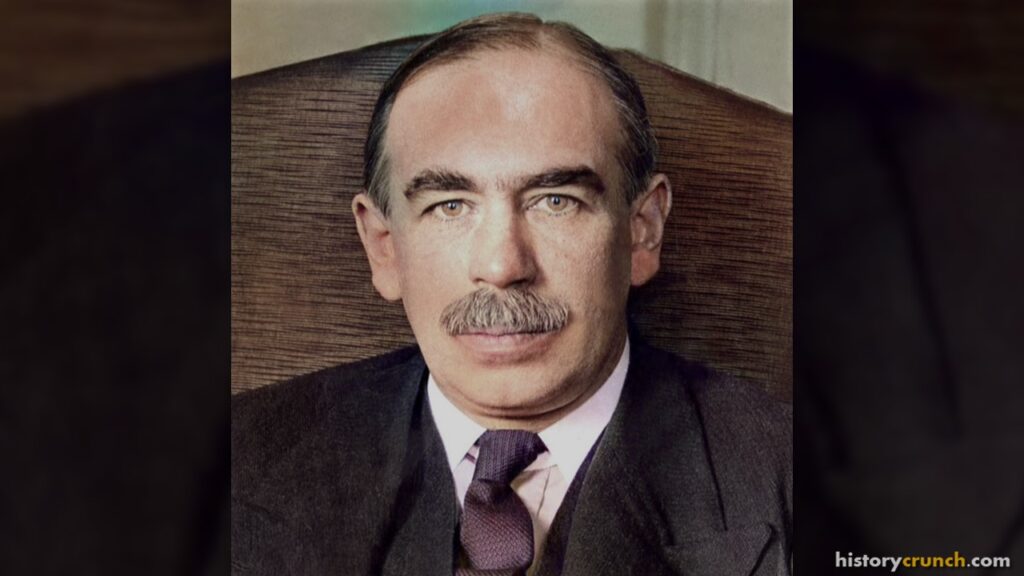
John Maynard Keynes was a British economist whose ideas had a profound impact on the way governments handle their economies. His theories, known as ‘Keynesian Economics’, challenged traditional economic beliefs and shaped modern economic policy around the world, especially during the Great Depression and post-World War II. More specifically, he advocated for the idea that governments should play an active role in stabilizing the economy, especially during an economic downturn. While his ideas were widely adopted in the 20th century, other thinkers argued against his beliefs, including Friedrich Hayek.
JOHN MAYNARD KEYNES – EARLY LIFE
John Maynard Keynes was born in Cambridge, England on June 5th, 1883. His family was very academic and pushed Keynes’ schooling. For instance, his father was an economist and his mother was the first female mayor of Cambridge. John Maynard Keynes himself was studious, doing well at school, and then graduating from Cambridge University with a degree in mathematics.
Following university, Keynes worked in the India Office and also worked on a dissertation which eventually earned him a fellowship at King’s College, Cambridge. Keynes quit the position after only a couple of years and returned to Cambridge in 1908. Soon after, World War I broke out and he joined the Treasury. In this role he identified a number of issues with the economy, and published a book which outlined his ideas. The book was titled ‘The Economic Consequences of the Peace’ and outlined Keynes’ argument against the severe reparations that were imposed on Germany after the First World War. Keynes’ predictions in the book were supported following Germany’s economic collapse which ultimately led to World War II.
JOHN MAYNARD KEYNES – ECONOMIC THEORIES
John Maynard Keynes is most remembered for his economic ideas and is considered one of the most influential economists of the 20th century. His most famous economic proposal and best known work, was published in 1936 and was titled ‘The General Theory of Employment, Interest and Money’. The book outlined Keynes’ idea that when national economies suffer a downturn, as happened in the Great Depression, governments should borrow and spend money to boost economic activity. Keynes argued that by doing so economic growth would occur, and some of the proceeds could be used to repay the debt incurred.
At the time, traditional economists believed markets would fix themselves, but Keynes disagreed. He said that when people stop spending, businesses stop producing, leading to unemployment. He argued that it created an economic downturn that only government action could break. This idea became known as ‘Keynesian Economics’ or demand-side economics.
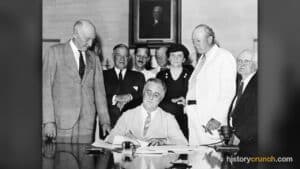
His ideas became incredibly popular throughout the period of the Great Depression and post-World War II era. In fact, Keynes’ ideas inspired programs such as Franklin D. Roosevelt’s ‘New Deal‘ in the United States and shaped economic policy in many Western nations after World War II. As such, historians and economists consider him to be one of the most influential economic minds of the 20th century.
JOHN MAYNARD KEYNES – LATER LIFE AND DEATH
During World War II, Keynes once again served the British government, helping to design financial plans for the war effort. As well, he played a major role in creating the Bretton Woods System in 1944, which established the International Monetary Fund (IMF) and the World Bank and the monetary system of the 20th century. In fact, the system established at the Bretton Woods Agreement and the institutions it created still play an important role in the global economy today.
John Maynard Keynes died on April 21st, 1946, at the age of 62, due to heart problems.
JOHN MAYNARD KEYNES – SIGNIFICANCE
As stated above, John Maynard Keynes was one of the most influential economic thinkers of the 20th century. His ideas played a crucial role in how governments around the world responded to the economic crisis of the Great Depression and the post-World War II era. Even today, when economies face recessions and downturns in productivity, world leaders turn to Keynesian principles, such as stimulus spending, as an attempt to restore growth.