The Social Security Act of 1935 was one of the most important laws in American history, and it permanently changed the relationship between the federal government and everyday citizens. Signed into law during the Great Depression, it created a national system that provided old-age pensions, unemployment insurance, and financial aid for vulnerable groups such as children, the blind, and the poor elderly. Before this point, the federal government took little responsibility for the economic security of ordinary Americans, and support for the aged was left mostly to families, local charities, and individual states.
In simple terms, the Social Security Act was a federal law that set up a permanent system of social insurance and public assistance funded largely through payroll taxes. Social insurance means that workers and their employers pay a small tax during a person’s working years, and in return that person becomes eligible for benefits later in life. This idea of a government-run safety net was new in the United States, even though many nations in Europe had already adopted similar systems.
What Was the New Deal During the Great Depression?
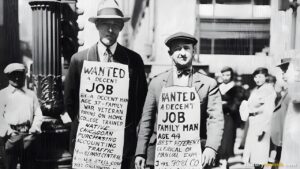
To understand the Social Security Act, it helps to first understand the era that produced it. The Great Depression was one of the worst economic crises in modern history, and it lasted from 1929 through much of the 1930s. It began with the collapse of the American stock market in October of 1929 and quickly spread, wiping out jobs, businesses, and savings on a massive scale. At its worst, nearly one quarter of the American workforce was unemployed, and millions of families struggled to afford food, housing, and basic needs.
In response to this suffering, President Franklin D. Roosevelt launched a series of government programs known as the New Deal. The New Deal was aimed at ending the economic devastation of the Great Depression through three main goals, which were relief for those in need, recovery of the economy, and reform to prevent another collapse. Historians often divide the New Deal into two stages. The First New Deal ran from 1933 to 1934 and focused heavily on the banking crisis and immediate relief, while the Second New Deal ran from 1935 to 1938 and focused on longer-lasting reforms.
The Social Security Act belonged to the Second New Deal, which marked a shift in emphasis from emergency recovery toward permanent social welfare. In fact, the Second New Deal included several landmark measures, such as the Works Progress Administration, which created jobs, and the National Labor Relations Act, also called the Wagner Act, which protected the rights of workers to form unions. Among all of these programs, the Social Security Act became the most lasting and the most far-reaching.
Why Was the Social Security Act Created?
Before the 1930s, most Americans believed that caring for the elderly and the poor was the job of families, churches, and local charities rather than the national government. As stated above, the widespread hardship of the Great Depression changed public opinion. When millions of older Americans lost their savings and had no way to earn a living, the idea of a national retirement system gained enormous support.
Pressure for reform also came from popular movements led by reformers and activists. For instance, a physician named Francis Townsend promoted a plan to give large monthly payments to older citizens, and his idea attracted millions of followers in clubs across the country. These movements pushed the elderly and their needs to the center of national politics and helped convince lawmakers that the federal government had to act.
In June of 1934, President Roosevelt appointed a group called the Committee on Economic Security to design a plan. This committee was led by Frances Perkins, the Secretary of Labor, who was the first woman ever to serve in a presidential cabinet. On January 17th, 1935, Roosevelt sent a message to Congress asking for social security legislation, and the committee’s report and a proposed bill went to Congress that same day.
How Did the Social Security Act Become Law?
The bill that became the Social Security Act was introduced in the House of Representatives in April of 1935. It faced strong opposition from several directions. Fiscal conservatives attacked the bill as too costly and as an unwelcome expansion of federal power, while some critics viewed it as a government invasion of private life. Certain business groups also objected to the new payroll taxes that employers would have to pay.
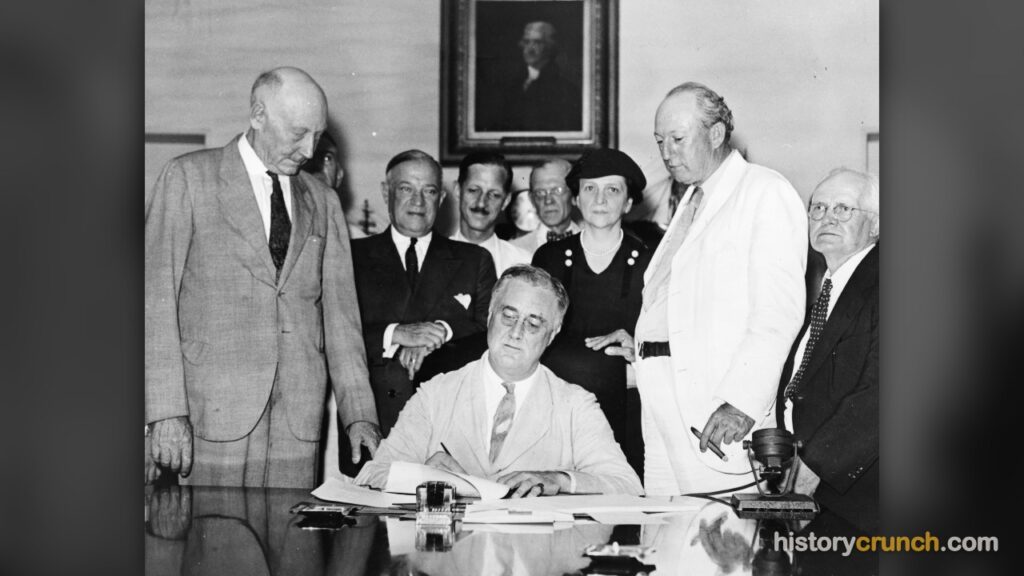
Despite these attacks, the bill passed by wide margins in both houses of Congress, thanks in large part to the huge Democratic majority. The House approved the measure by a vote of 372 to 33, and the Senate approved it by a vote of 77 to 6. On August 14th, 1935, President Franklin D. Roosevelt signed the Social Security Act into law.
The new law also created a Social Security Board to run the program. The government began collecting the Social Security payroll tax from workers in 1937, and it began making regular monthly payments to beneficiaries in 1940. Because the system was designed to pay for itself through contributions, early enrollees had to wait several years before they could collect benefits.
What Did the Social Security Act Do?
The Social Security Act was a broad law that combined several different programs into one system. Its most famous feature was old-age insurance, which provided monthly pension payments to retired workers beginning at age 65. This part of the program was funded by a payroll tax that was divided between employers and employees, meaning both sides paid a small percentage of wages into a national fund.
The act also created a nationwide system of unemployment insurance. This program was run jointly by the federal government and the states, and it provided temporary payments to workers who lost their jobs. More specifically, the law encouraged each state to set up its own unemployment program while the federal government helped fund and guide the effort.
Beyond retirement and unemployment, the act provided public assistance for groups that could not support themselves. For example, it gave federal money to help states care for needy elderly people, dependent children, and the blind. It also funded programs for maternal and child welfare and for public health, which extended help to mothers, young children, and disabled individuals. In this way, the law reached far beyond retirees and touched millions of Americans in need.
Was the Social Security Act Challenged in Court?
Like several New Deal programs, the Social Security Act faced legal challenges soon after it passed. Critics questioned whether the federal government had the constitutional power to create such a system and to collect the taxes that funded it. Some argued that the payroll tax was unconstitutional, while others claimed the benefit payments went beyond the government’s authority.
In 1937, the United States Supreme Court settled the question. In two important decisions, the Court upheld the Social Security Act as constitutional. These rulings confirmed that the federal government could operate the program, and they allowed Social Security to move forward and grow into a permanent part of American life.
Significance of Social Security Act of 1935
The Social Security Act of 1935 is often called the foundation of the modern American welfare system. For the first time, the federal government took direct responsibility for protecting citizens against the risks of old age, unemployment, and poverty. This was a dramatic change from earlier times, when such care was left almost entirely to families and local communities.
The law also proved to be the most lasting achievement of the entire New Deal. While many New Deal programs ended after the Great Depression, Social Security endured and expanded over the following decades. Later amendments added benefits for survivors and the disabled, and the program eventually grew to include health coverage for older Americans.
In reality, the Social Security Act helped set a precedent that shaped the role of the federal government for generations. It established the idea that the national government should provide a basic safety net for its people during hard times. Today, Social Security remains one of the largest and most important government programs in the United States, and it continues to affect the lives of nearly every American family.
Frequently Asked Questions
Who signed the Social Security Act of 1935?
President Franklin D. Roosevelt signed the Social Security Act into law on August 14th, 1935. He considered it a cornerstone of his New Deal, and he wanted a system that would pay for itself through worker and employer contributions rather than depend only on general tax money.
What year did people start receiving Social Security payments?
Regular monthly Social Security payments to beneficiaries began in 1940, several years after the law passed. The government first started collecting the payroll tax in 1937, which allowed the program to build up funds before it began paying out benefits.
Who was Frances Perkins and why is she important to Social Security?
Frances Perkins was the Secretary of Labor under President Roosevelt and the first woman to serve in a United States presidential cabinet. She led the Committee on Economic Security, the group that designed the plan that became the Social Security Act, which makes her one of the key figures behind its creation.
How is Social Security funded?
Social Security is funded mainly through a payroll tax that is split between workers and their employers. This money is collected during a person’s working years and placed into a national fund that later pays out benefits, so the program is designed to support itself over time.
Why was the Social Security Act controversial?
The Social Security Act was controversial because critics feared it gave the federal government too much power and placed a heavy tax burden on workers and businesses. Some opponents believed retirement and welfare should remain the job of families and states, while others challenged the law in court before the Supreme Court upheld it in 1937.
Cite This Article
To cite this article as a source, use one of the formats below.
MLA: Millar, B. “Social Security Act of 1935: A Detailed Summary.” HistoryCrunch, 14 August 2026, https://historycrunch.com/social-security-act-of-1935/.
APA: Millar, B. (2026). Social Security Act of 1935: A Detailed Summary. HistoryCrunch. https://historycrunch.com/social-security-act-of-1935/
Chicago: Millar, B. “Social Security Act of 1935: A Detailed Summary.” HistoryCrunch. August 14, 2026. https://historycrunch.com/social-security-act-of-1935/
Sources
- J.M. Roberts & Odd Arne Westad, The Penguin History of the World.
- Jerry Bentley & Herbert Ziegler, Traditions & Encounters: A Global Perspective on the Past.