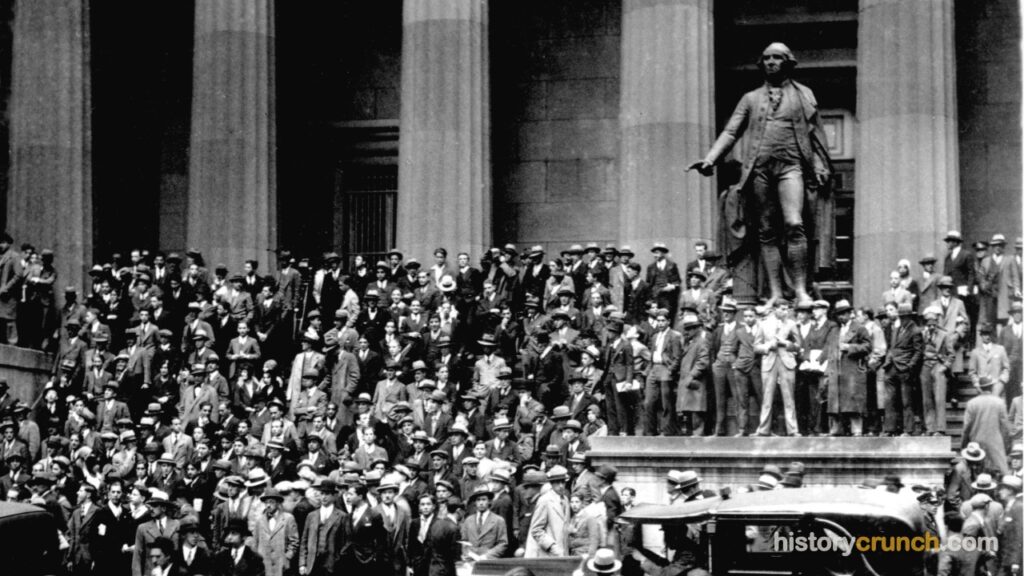
Black Tuesday was the single worst day of the Stock Market Crash of 1929 and one of the most important turning points in American economic history. The Stock Market Crash of 1929 set the Great Depression in motion, and Black Tuesday, which fell on October 29th, 1929, was the day the collapse reached its peak. On that Tuesday, panicked investors dumped a record number of shares on the New York Stock Exchange, and stock prices fell so far and so fast that billions of dollars in wealth simply vanished.
In simple terms, Black Tuesday is the name given to the day the American stock market crashed most severely. A stock market is a place where people buy and sell small pieces of ownership in companies, called stocks or shares. When many people rush to sell their shares at the same time and few people want to buy them, prices fall sharply, and this is what is meant by a crash. Black Tuesday was the most dramatic day of that crash, and it helped push the United States and much of the world into the deepest economic downturn of the twentieth century.
What Was the Roaring Twenties?
Black Tuesday came at the very end of a period of history known as the Roaring Twenties. The Roaring Twenties refers to the decade of the 1920s, a time of great economic prosperity and optimism in the United States after the end of World War I. During these years, factories produced huge amounts of new goods, such as automobiles, radios, and household appliances, and many Americans felt that good times would continue forever.
In fact, this sense of confidence spread directly into the stock market. In general, people were making large sums of money in the stock market by purchasing shares in companies. When a person owns a stock, they own a small part of that company. If the company grows and becomes more successful, the value of the stock rises, but if the company struggles, the value of the stock falls.
Throughout the 1920s, stock prices climbed higher and higher. More specifically, the Dow Jones Industrial Average, which is a common measure of how the overall stock market is doing, rose about six times over between 1921 and its peak in September of 1929. Many people believed that stock prices would keep rising forever, so they bought shares in the hope of selling them later for a profit.
What Led to Black Tuesday?
One of the main causes that led to Black Tuesday was a risky practice called buying stocks on margin. Many investors did not have enough money to buy all the stocks they wanted, so banks and other financial institutions allowed them to buy shares on margin. Buying on margin means paying only a small part of a stock’s price in cash and borrowing the rest, with the stock itself acting as security for the loan.
This system worked well as long as prices kept going up. However, it was extremely dangerous if prices fell. In reality, when a stock’s value dropped, the investor still owed the borrowed money, which meant that a falling market could quickly ruin someone who had bought heavily on margin.
As stated above, stock prices reached their highest point in the late summer of 1929. After that peak, the market began to slide, and investors slowly grew nervous. By the fall of 1929, production in American factories had already begun to slow and unemployment had started to rise, which meant that the true value of many companies was far lower than their soaring stock prices suggested.
The Days Before Black Tuesday
Black Tuesday did not happen on its own. Instead, it was the climax of several days of falling prices and growing panic. The trouble began on Thursday, October 24th, 1929, a day that became known as Black Thursday, when a record number of shares changed hands and prices dropped sharply.
On Black Thursday, a group of leading bankers stepped in and bought large blocks of stock in an effort to calm the market. For a short time, this seemed to work, and prices steadied on Friday. The panic, however, returned with even greater force the following week.
On Monday, October 28th, 1929, known as Black Monday, the market fell again, and the Dow Jones Industrial Average dropped nearly 13 percent in a single day. This sharp decline destroyed the fragile confidence that the bankers had tried to restore. By the end of Black Monday, many investors were desperate to sell their shares before prices fell any lower.
What Happened on Black Tuesday?
On Tuesday, October 29th, 1929, the stock market collapsed completely. Investors rushed to sell their shares all at once, and the trading floor of the New York Stock Exchange was overwhelmed with panic selling. Around 16 million shares changed hands that day, which was a record at the time and far more than the market machinery could handle.
Because so many people wanted to sell and almost no one wanted to buy, prices fell dramatically, dropping nearly another 12 percent. The Dow Jones Industrial Average sank to a fraction of its former height, and billions of dollars in wealth disappeared in a matter of hours. Thousands of investors were financially wiped out, including many who had bought stocks on margin and now owed money they could not repay.
The scene in New York City was one of shock and confusion. Crowds gathered outside the New York Stock Exchange as news of the collapse spread, and the machines that printed stock prices, called tickers, ran hours behind because they could not keep up with the enormous volume of trading. By the end of the day, it was clear that the boom of the Roaring Twenties had come to a violent end.
What Happened After Black Tuesday?
The damage from Black Tuesday did not stop when the trading day ended. Prices continued to fall in the weeks and months that followed, and by the middle of November of 1929 the Dow had lost roughly half of its value. The slide continued for years, and by 1932 stocks were worth only about a fifth of what they had been in the summer of 1929.
The crash also struck a heavy blow to the banking system. Many banks had invested their own money in the stock market and now suffered huge losses. Amid the panic, there was a series of bank runs, which is when a large group of people all try to pull their money out of a bank at the same time.
These bank runs created a crisis because a bank does not keep enough actual cash on hand to give every customer their money at once, since much of it has been loaned out or invested. As a result, many banks failed and closed their doors, wiping out the savings of ordinary families. This chain of events helped turn a stock market crash into the long and painful economic downturn known as the Great Depression.
Significance of Black Tuesday
Black Tuesday is significant because it is remembered as the day the American economy tipped into the Great Depression. While the crash was not the only cause of the Depression, it shattered public confidence, destroyed enormous amounts of wealth, and set off a chain reaction of bank failures and business closures. In the years that followed, unemployment soared and millions of Americans struggled to find work or feed their families.
The events of Black Tuesday also changed the way the United States government viewed the stock market. Before the crash, there were few rules to control speculation or protect ordinary investors. Afterward, leaders created new laws and agencies to watch over the stock market and to prevent the reckless practices that had helped cause the disaster.
Today, Black Tuesday stands as a lasting warning about the dangers of unchecked speculation and easy credit. It showed how quickly confidence can turn to panic and how deeply the troubles of the stock market can spread into the everyday lives of ordinary people. For this reason, Black Tuesday remains one of the most studied moments in the history of the United States and the wider world.
Frequently Asked Questions
When did Black Tuesday happen?
Black Tuesday happened on October 29th, 1929. It fell near the end of the same week as two other terrible days for the stock market, Black Thursday on October 24th and Black Monday on October 28th. Together these days made up the worst part of the Stock Market Crash of 1929.
Why is it called Black Tuesday?
It is called Black Tuesday because it fell on a Tuesday and was a dark, disastrous day for the country. The word “black” has long been used to describe days when something terrible or tragic occurs. Because the crash was so severe, the name Black Tuesday stuck and is still used today.
How many shares were traded on Black Tuesday?
About 16 million shares were traded on Black Tuesday, which was a record at the time. The number was so high that the stock tickers, which were machines that printed out prices, fell hours behind. This showed just how many people were rushing to sell their stocks all at once.
Did Black Tuesday cause the Great Depression?
Black Tuesday helped trigger the Great Depression, but it was not the only cause. Weak farm prices, a wide gap between rich and poor, risky bank lending, and the practice of buying stocks on margin all played a part. The crash pushed an already fragile economy over the edge and made the downturn far worse.
Could Black Tuesday happen again?
A crash like Black Tuesday is less likely today because of the rules and safeguards created after 1929. Government agencies now watch the stock market closely, and there are limits meant to slow trading during a sudden panic. Even so, stock markets can still rise and fall sharply, which is why the lessons of Black Tuesday remain important.
Cite This Article
To cite this article as a source, use one of the formats below.
MLA: Millar, B. “Black Tuesday: A Detailed Summary.” HistoryCrunch, 14 August 2026, https://historycrunch.com/black-tuesday/.
APA: Millar, B. (2026). Black Tuesday: A Detailed Summary. HistoryCrunch. https://historycrunch.com/black-tuesday/
Chicago: Millar, B. “Black Tuesday: A Detailed Summary.” HistoryCrunch. August 14, 2026. https://historycrunch.com/black-tuesday/
Sources
- Federal Reserve History
- J.M. Roberts & Odd Arne Westad, The Penguin History of the World.