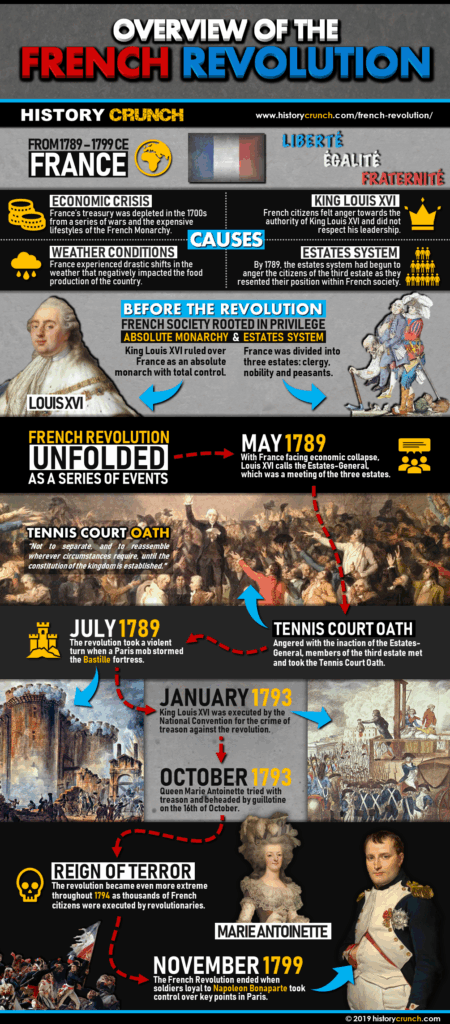
The French Revolution was one of the most significant events in the history of Western civilization. Beginning in 1789, it saw the French people overthrow the absolute monarchy of Louis XVI and work to build a new republic based on the principles of equality, liberty and fraternity. Over the course of the revolution, France was transformed by a series of dramatic and often violent events including the storming of the Bastille, the execution of the king and queen, and the brutal Reign of Terror. Its ideas about democracy, individual rights and the role of government spread across Europe and the world and continue to shape political thought today. This infographic was designed for students to visually summarize the key aspects of the French Revolution and is based on the History Crunch articles on the French Revolution.
French Revolution Overview Infographic
About This Infographic
This French Revolution overview infographic was created by the History Crunch team to help students and teachers quickly understand the causes, key events and significance of one of the most dramatic and far-reaching revolutions in world history. It is designed as a visual learning and study tool, summarizing the essential information covered in our full articles on the French Revolution. Teachers may use it as a classroom display, a discussion prompt, or a study aid for students preparing for assessments.
What This Infographic Covers
The infographic begins with the causes of the French Revolution. French society before 1789 was organized under the Estates System, which divided the population into three rigid social classes. The First Estate was the clergy, the Second Estate was the nobility, and the Third Estate included everyone else, roughly 98 percent of the French population, including peasants, urban workers and the growing middle class known as the bourgeoisie. Despite making up the vast majority of the population the Third Estate paid the heaviest tax burden and had the least political power, while the clergy and nobility enjoyed significant privileges and were largely exempt from taxation. This deep inequality was a central cause of the revolution. Additional causes included the influence of Enlightenment ideas about liberty and individual rights, the economic crisis and poor harvests of the 1780s, the enormous debts France had accumulated from wars including the American Revolution, and the inability of Louis XVI to effectively manage the crisis.
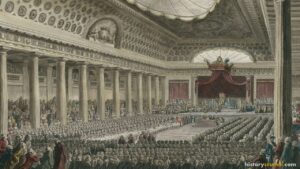
The infographic covers the outbreak of the revolution in 1789. When Louis XVI called the Estates-General in May 1789 to address France’s financial crisis, the meeting quickly collapsed over disputes about voting rights. Frustrated representatives of the Third Estate broke away and formed the National Assembly in June 1789, taking the Tennis Court Oath and pledging not to disband until they had written a new constitution for France. The first major act of violence came with the storming of the Bastille on July 14th, 1789, which became the defining symbol of the revolution. The National Assembly passed the Declaration of the Rights of Man and of the Citizen, which directly challenged the authority of the monarchy and laid out a series of individual rights protected by law.
The infographic covers the four revolutionary governments that replaced the monarchy. The National Assembly (1789) was followed by the Legislative Assembly, then the more radical National Convention (1792 to 1795) which abolished the monarchy, declared France a republic and put Louis XVI on trial for treason. Louis XVI was executed by guillotine on January 21st, 1793. The National Convention was dominated by the radical Jacobins under Maximilien Robespierre and oversaw the Reign of Terror from September 1793 to July 1794, during which over 40,000 people were executed, including Queen Marie Antoinette. The Terror ended when Robespierre himself was arrested and guillotined. The final revolutionary government, the Directory, replaced the National Convention in 1795 and governed until Napoleon Bonaparte seized power in 1799.
How to Use This Infographic in the Classroom
This infographic works well as a visual introduction to the French Revolution before students read the full articles, or as a review tool before an assessment. It can also be used as a discussion prompt asking students to consider which cause of the revolution they think was most significant, or to compare the French Revolution with other revolutions they have studied such as the American Revolution. Teachers may also use it alongside the French Revolution Governments infographic to give students a more detailed picture of the different stages of the revolution.
Related Articles
To learn more about the topics covered in this infographic, visit the following History Crunch articles:
- French Revolution Overview
- Causes of the French Revolution
- Estates System of France
- Estates-General of 1789
- Tennis Court Oath
- National Assembly
- Declaration of the Rights of Man and of the Citizen
- Storming of the Bastille
- Execution of Louis XVI
- Reign of Terror
- Jacobins
- Maximilien Robespierre
- Marie Antoinette
- Guillotine and the French Revolution
- National Convention