The Women’s March on Versailles was one of the earliest and most important events of the French Revolution, and it marked a turning point in the struggle between the French people and their king. On October 5th, 1789, thousands of women from the marketplaces of Paris set out on foot for the Palace of Versailles, angry over the high price and scarcityA situation where something is in very short supply and hard to find. of bread. What began as a protest over food quickly grew into a demand for political change, and it ended with the royal family being forced to leave Versailles and return to Paris under the control of the people.
The march is sometimes called the October March or the October Days, and it stands alongside the Storming of the Bastille as a symbol of the power that ordinary people held during the revolution. In fact, it was women, often overlooked in histories of the period, who led this uprising and reshaped the direction of France.
 FactsthatCrunch
The market women came with immediate needs, scarce bread and rising prices, but their pressure produced a lasting political result. Louis XVI lost the freedom to govern from Versailles and spent the rest of his reign in Paris under the close watch of the people and the National Assembly.
What Was the French Revolution?
The French Revolution was a major event in the history of Western societies, and it has a profound effect on the world today. Beginning in 1789, the French Revolution saw the French people overthrow their absolute monarchy and work to build a republic based on the principles of equality, liberty, and fraternity. Before the revolution, France was ruled by an absolute monarch, King Louis XVI, who held nearly total power over the government and the people.
Historians generally point to several causes of the revolution, including the ideas of the Age of Enlightenment, the unfair estates-system that divided French society, resentment toward the absolute monarchy of Louis XVI, poor weather that ruined harvests, and a severe economic crisis. The EnlightenmentAn intellectual movement in which thinkers challenged the traditional authority of kings and questioned rigid class divisions. was an intellectual movement in which thinkers challenged the traditional authority of kings and questioned the rigid class divisions of the old order. These new ideas caused ordinary French people to question why Louis XVI should rule when he did not have the support of many of his own subjects.
The revolution unfolded as a series of dramatic events. The first came in the summer of 1789, when a Paris crowd carried out the Storming of the Bastille on July 14th, an act often considered the beginning of the revolution. The Women’s March on Versailles followed just a few months later, and it pushed the revolution into a new and more radical stage.
Why Did the Women of Paris March?
The most immediate cause of the march was the shortage of bread in Paris. Bread was the main food of the common people, known as the Third EstateThe common people of France, the largest social group, who had almost no political power before the revolution., and years of poor harvests had driven prices so high that many families could no longer afford to eat. Women were usually the ones who went to the markets each day to buy bread for their families, so they felt the crisis most directly.
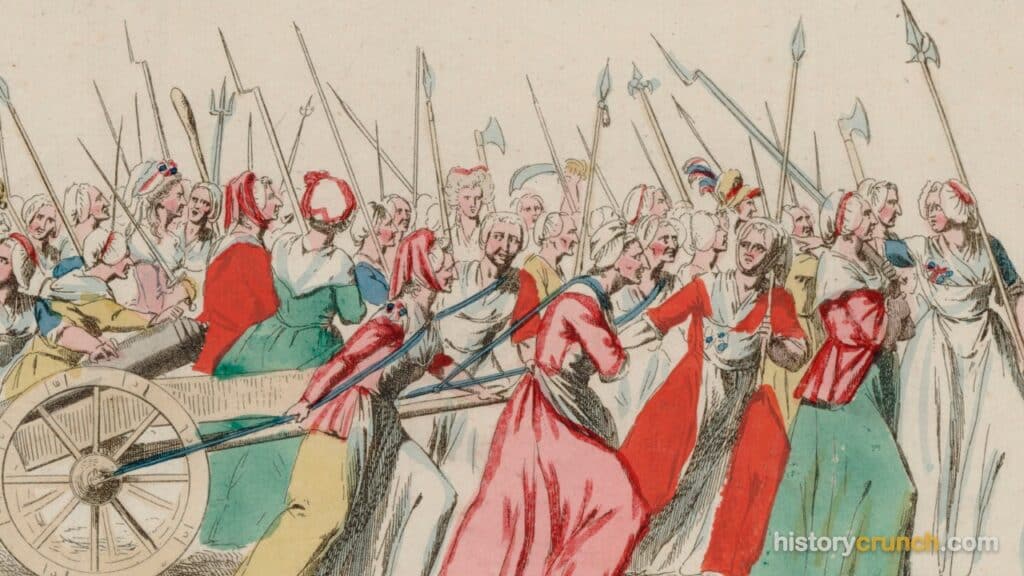
On the morning of October 5th, 1789, a large group of women in a Paris marketplace found the bakeries empty or selling bread at prices they could not pay. In their anger they began to gather in the streets and demand action. They marched first to the Hôtel de Ville, the City Hall of Paris, where they harassed officials and demanded change. Growing frustrated, the crowd raided the building for weapons and supplies before deciding to take their complaints directly to the king.
There was also a political spark behind the march. A few days earlier, on October 1st, royal officers had held a lavish banquet at Versailles to welcome soldiers newly arrived at the palace. When news of the feast reached hungry Parisians, they were outraged that the king’s soldiers were celebrating while ordinary people starved. Many also feared that the king was gathering troops to crush the National AssemblyThe new revolutionary governing body created by the French people to challenge the king’s absolute power., the new revolutionary body, and undo the reforms the revolution had already won.
FactsthatCrunchOn October 1st, 1789, royal officers at Versailles held a lavish banquet to welcome newly arrived soldiers, and news of the feast reached hungry Parisians who could not afford bread.
In the fall of 1789, bread prices in Paris were so high that many families could not eat. A royalist military banquet at Versailles gave the food crisis a political edge, linking the king's court directly to the suffering of ordinary people.
How Did the March to Versailles Unfold?
As the women left Paris, their numbers grew rapidly. Church bells were rung to call more people to join, and by the time the crowd set out it had swelled to thousands. Many marchers were armed with kitchen knives, pikesLong wooden poles with a metal point on the end, used as weapons by the marchers., clubs, and other homemade weapons, and some even hauled cannons taken from the city. The distance from Paris to Versailles was roughly 12 miles (19 km), and the marchers walked it in the pouring rain over about six hours.
One of the leaders who emerged was Stanislas-Marie Maillard, a man who had taken part in the Storming of the Bastille. He helped organize and guide the marchers as they moved toward the palace. Behind the main crowd came a much larger force. Later in the day, the Marquis de Lafayette, commander of the National Guard, reluctantly led some fifteen thousand of his soldiers to Versailles as well, hoping to protect the king and keep order.
When the exhausted and rain-soaked crowd reached Versailles, they were allowed into the hall where the National Assembly met, and many collapsed onto the benches. A small group of women was chosen to meet with King Louis XVI directly. He agreed to hand over food from the royal stores and promised more bread in the future. He also agreed to approve reforms passed by the Assembly, including the Declaration of the Rights of Man and of the Citizen, a foundational document of the revolution.
FactsthatCrunchWhen part of the crowd broke into the Palace of Versailles in the early hours of October 6th, 1789, two royal bodyguards were killed during the fighting before the Marquis de Lafayette restored order.
The marchers had arrived the evening before, exhausted after roughly six hours of walking 12 miles (19 km) in heavy rain, and thousands stayed through the night outside the palace gates. When a group found an unguarded entrance and forced their way in, the Gardes du Corps, the king's personal bodyguard unit, tried to hold them back. Lafayette and the National Guard ended the violence, but the deaths marked the only lethal clashes of the entire two-day event.
What Happened at the Palace?
Even after the king’s promises, much of the crowd refused to leave. Many people distrusted the king and believed that any promise he made would later be reversed, especially by Queen Marie Antoinette, whom they blamed for the country’s problems. As a result, thousands stayed outside the palace through the rainy night.
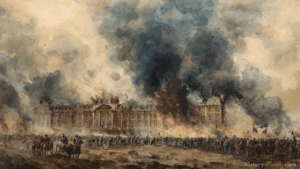
Early on the morning of October 6th, part of the crowd discovered an unguarded entrance and broke into the palace. Fighting broke out with the royal guards, and several guards were killed. Marie Antoinette fled from her chambers to the safety of the king’s rooms just before the mob reached them, and some in the crowd called for her death. The violence only ended when Lafayette and his National Guardsmen restored order.
To calm the angry crowd, Lafayette brought the king and queen out onto a balcony in view of the people. In a dramatic moment, he knelt and kissed the queen’s hand, and the crowd, impressed by her courage, began to cheer. Still, the people made their central demand clear. They insisted that the king leave Versailles and return with them to live in Paris, where the people could keep watch over him.
FactsthatCrunchIt is the night of October 5th into October 6th, 1789, and you are King Louis XVI, sheltered inside the Palace of Versailles as thousands of people from Paris fill the courtyards and grounds outside. The Women's March on Versailles, one of the key turning points of the French Revolution, has brought an exhausted, rain-soaked, and angry crowd to your door. You have already promised to release grain from the royal stores and to approve the National Assembly's reforms, yet most of the crowd refuses to leave, and your guards have already exchanged blows with marchers who broke into the palace. The choice you make in the next few hours will determine whether you keep any real power at all.
Return of the King to Paris
Faced with the massive crowd, Louis XVI had little choice but to agree. On the afternoon of October 6th, a huge processionA large, organized group of people moving together along a route. set out from Versailles for Paris. The royal family traveled in the middle of the column, surrounded by the National Guard, thousands of marchers, and a train of wagons loaded with flour and bread from the palace stores.
As they walked, many in the crowd joked that they were bringing “the baker, the baker’s wife, and the baker’s boy” back to Paris, a reference to the king, the queen, and their son. The comment reflected the belief that the royal family, now living among the people, would finally make sure that bread was available. The king and queen were settled into the Tuileries Palace in Paris, where they lived essentially as prisoners of the revolution.
For over one hundred years, French kings had lived at Versailles, far from their subjects. By forcing Louis XVI back to the capital, the marchers ended that separation and placed the monarchy under the direct eye of the people. From this point forward, the king was no longer truly in control of his own government.
FactsthatCrunchWhy did the crowd joke about bringing 'the baker, the baker's wife, and the baker's boy' back to Paris during the Women's March on Versailles?
The crowd used those nicknames for King Louis XVI, Queen Marie Antoinette, and their young son as they escorted the royal family from Versailles to Paris on the afternoon of October 6th, 1789. The joke reflected a simple but pointed idea: if the king and his family lived in Paris among the people, they would finally feel pressure to make sure bread was available and affordable. It was a way for the marchers to express both their victory over the monarchy and their expectation that the royal family would now be held directly accountable for the food supply.
Significance of Women’s March on Versailles
The Women’s March on Versailles was one of the most significant turning points of the French Revolution. More specifically, it stripped King Louis XVI of much of his remaining power and independence, since he now lived in Paris under the watch of the revolutionaries and the National Assembly. In this way, the march struck a heavy blow against the system of absolute monarchy known as the Ancien RégimeThe old system of absolute monarchy and unequal social order that the French Revolution sought to destroy..
The event was also important because it showed the enormous power of ordinary people, and especially of women, in shaping the course of the revolution. As stated above, it was market women who began the uprising and forced the king to give in to their demands. The march proved that a determined crowd could challenge a king, and it inspired future generations who saw it as an example of the strength of popular movements.
Finally, the march pushed the revolution into a more radical direction. After October of 1789, the National Assembly followed the king to Paris, where its work was surrounded by the pressure of the city’s crowds. In reality, the balance of power in France had shifted for good, moving away from the king and the nobility and toward the common people of the Third Estate.
FactsthatCrunchTap each impact to read what it led to.
French Revolution timeline · 1789 – 1799
Key Vocabulary
Scarcity
Third Estate
Enlightenment
National Assembly
Pikes
Ancien Régime
Procession
Frequently Asked Questions
When did the Women’s March on Versailles happen?
The Women’s March on Versailles took place on October 5th and 6th, 1789. The women set out from Paris on October 5th and reached the palace that evening, and the king agreed to return to Paris on the afternoon of October 6th. The event came just under three months after the Storming of the Bastille on July 14th, 1789.
Why is it called the Women’s March on Versailles?
It is called the Women’s March on Versailles because women from the markets of Paris started and led the protest. Since women were responsible for buying the family’s bread each day, they were the first to feel the effects of shortages and rising prices. Men, including members of the National Guard, joined later, but the march is remembered for the leading role played by women.
How far did the marchers walk to Versailles?
The marchers walked about 12 miles (19 km) from Paris to Versailles. The journey took roughly six hours and was made in heavy rain, which left the crowd exhausted and soaked by the time they arrived. Many of them carried weapons such as knives, pikes, and clubs, and some even dragged cannons along the route.
What role did Marie Antoinette play in the march?
Marie Antoinette was a central target of the crowd’s anger, though she did not take an active part in the events. Many of the marchers blamed the queen for the country’s economic troubles and for the lavish spending of the royal court. When the crowd broke into the palace, she narrowly escaped harm, and only Lafayette’s efforts on the balcony helped calm the crowd’s rage toward her.
What was the result of the Women’s March on Versailles?
The main result was that King Louis XVI was forced to leave Versailles and move to Paris, where he lived under the control of the revolutionaries. This greatly weakened his authority and marked a major step in the decline of the French monarchy. The march also secured promises of bread for Paris and the king’s approval of important revolutionary reforms.
Cite This Article
To cite this article as a source, use one of the formats below.
MLA: Millar, B. “Women's March on Versailles: A Detailed Summary.” HistoryCrunch, 11 August 2026, https://historycrunch.com/womens-march-on-versailles/.
APA: Millar, B. (2026). Women's March on Versailles: A Detailed Summary. HistoryCrunch. https://historycrunch.com/womens-march-on-versailles/
Chicago: Millar, B. “Women's March on Versailles: A Detailed Summary.” HistoryCrunch. August 11, 2026. https://historycrunch.com/womens-march-on-versailles/
Sources
- William Doyle, The Oxford History of the French Revolution.
- Peter McPhee, Liberty or Death: The French Revolution.
- Jeremy D. Popkin, A New World Begins: The History of the French Revolution.
- Liberty, Equality, Fraternity: Exploring the French Revolution (George Mason University)