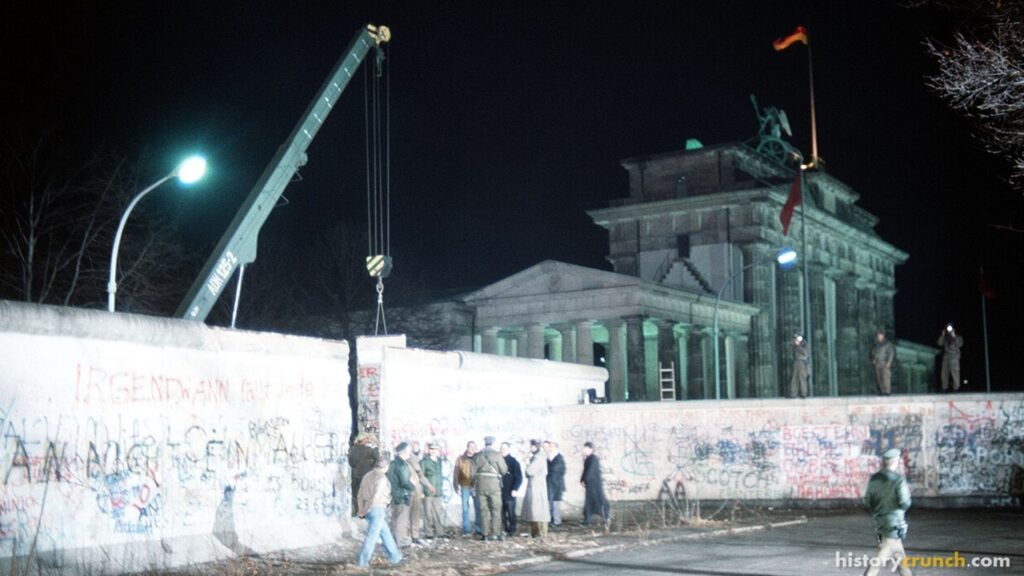
The fall of the Berlin Wall in November of 1989 was a defining moment in modern world history and the Cold War. In fact, the Berlin Wall had stood as one of the most powerful physical symbols of the ideologicalRelated to a set of political or social beliefs that shapes how a government or group thinks society should be organized. conflict of the Cold War, representing the division between the communist East and the democratic West. Historians consider several key factors to have contributed to the fall of the Berlin Wall, including: the reform policies of Soviet leader Mikhail Gorbachev, the economic struggles of East Germany, the growth of pro-democracy protest movements, and a dramatic and unexpected series of events on the evening of November 9th, 1989.
 FactsthatCrunch
Over the course of 28 years, more than 140 people died trying to cross the Berlin Wall, a barrier built not to keep enemies out but to keep a country's own citizens in.
The East German government began building the wall on the night of August 12th, 1961, after millions of East Germans had already fled to the West. Armed border guards were stationed along a heavily guarded strip of land between two parallel barriers, with orders to shoot anyone attempting to escape. The wall stood approximately 13 feet (4 meters) tall and stretched over 96 miles (155 kilometers). Every one of those deaths happened because a government treated the act of leaving as a crime.
What Was the Cold War?
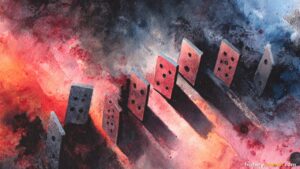
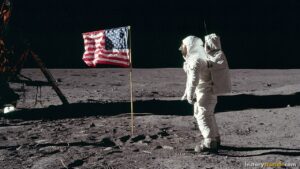
In general, the Cold War was a period of intense political and ideological tension between the United States and the Soviet Union that lasted from the end of World War II in 1945 until the early 1990s. This conflict often emerged in the form of espionage, political and economic pressure and proxy wars. Regardless, the fall of the Berlin Wall marked the beginning of the end of that conflict and set in motion the collapse of communist governments across Eastern Europe. As such, many people associate the fall of the Berlin Wall with the end stages of the overall Cold War and the tensions between the United States and the Soviet Union.
Fall of the Berlin Wall – Background
To fully understand the significance of the fall of the Berlin Wall, it is first important to understand how and why it was built. After World War II ended in 1945, the defeated nation of Nazi Germany was divided into four occupation zones controlled by the Allied Powers, which included: the United States, Britain, France, and the Soviet Union. The city of Berlin, located deep within Soviet-controlled East Germany, was similarly divided into four sectors. The western sectors of Berlin fell under the control of the United States, Britain, and France, while the eastern sector was controlled by the Soviet Union.
East Germany, officially known as the German Democratic Republic (GDR), was a communist state characterized by a command economyA system where the government controls what is produced, how much, and at what price, rather than letting markets decide., limited personal freedoms, and authoritarian rule by the Socialist Unity Party. In contrast, West Germany developed into a prosperous democratic nation aligned with the values of capitalism and democracy that characterized the western side of the Cold War’s ideological conflict. As such, as the Cold War progressed, thousands of East Germans began crossing into West Berlin in search of better opportunities and greater freedoms. By 1961, millions had fled to the west, creating a serious political crisis for the East German government and the Soviet Union.
In response, on the night of August 12th, 1961, the East German government began sealing off the border around West Berlin with barbed wire and then with a concrete wall. The Berlin Wall eventually stretched over 96 miles (155 kilometers) in length and stood approximately 13 feet (4 meters) tall. Furthermore, it was not simply a single wall but two, separated by a heavily guarded strip of land that became known as the ‘death stripThe heavily guarded strip of land between the two Berlin Wall barriers where guards were authorized to shoot anyone trying to escape.‘. Armed East German border guards were stationed along the death strip and were authorized to shoot anyone attempting to escape to the West. Over the course of its 28-year history, more than 140 people died attempting to cross the Berlin Wall. As a result, the Berlin Wall became a symbol of the ideological conflict between the two superpowers.
FactsthatCrunchMany people believe the Berlin Wall was a single concrete wall that ran along the border between East and West Berlin.
The Berlin Wall was actually two parallel walls with a wide strip of open ground between them. This gap was called the death strip, and armed East German border guards were stationed there with orders to shoot anyone attempting to cross. The full barrier stretched over 96 miles (155 kilometers) in length, making it far larger and more complex than a single wall.
Fall of the Berlin Wall – Causes
By the late 1980s, a combination of factors had begun to weaken the foundations of East Germany and its ability to maintain the Berlin Wall. In general, historians point to several main causes of the fall of the Berlin Wall, including: the reform policies of Mikhail Gorbachev, economic stagnation in East Germany, and the rise of pro-democracy protest movements throughout Eastern Europe.
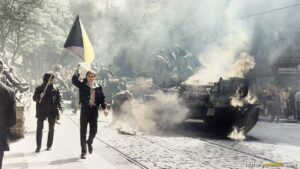
One of the most significant causes was the policies introduced by Soviet leader Mikhail Gorbachev, who came to power in 1985. More specifically, he introduced two policies known as ‘perestroika’ and ‘glasnost’. PerestroikaA Soviet policy introduced by Gorbachev meaning ‘restructuring,’ aimed at reforming the struggling Soviet economy and government., meaning ‘restructuring’, referred to attempts to reform the struggling Soviet economy and government. GlasnostA Soviet policy introduced by Gorbachev meaning ‘openness,’ encouraging freer speech and less censorship across the Soviet Union., meaning ‘openness’, encouraged greater freedom of speech, more open discussion and less censorship throughout the Soviet Union and its sphere of influence. Furthermore, Gorbachev signaled that the Soviet Union would no longer use military force to suppress reform movements in Eastern Europe, moving away from the policy of Soviet interventionismA policy in which a powerful country uses military force to control or suppress movements in other countries. that had previously been used to crush pro-democracy movements in Hungary in 1956 and Czechoslovakia in 1968. As such, Gorbachev’s reforms fundamentally weakened Soviet control over East Germany and led to public pressure for change.
As stated above, economic hardship also played an important role in the fall of the Berlin Wall. East Germany’s command economy was struggling significantly by the late 1980s. In general, the planned economy was characterized by shortages of consumer goods, low productivity and limited economic opportunities for ordinary citizens. In contrast, West Germany had developed into one of the most prosperous economies in the Western world. This difference in economic conditions created widespread anger with the East German government and fueled growing demands for political and economic reform.
FactsthatCrunchFollow the chain from top to bottom. Tap any step to read what happened.
Fall of the Berlin Wall – Pro-Democracy Protests
As conditions in East Germany worsened throughout 1989, public protests began to grow significantly. A series of peaceful demonstrations, known as the ‘Monday Demonstrations’, began in the city of Leipzig in September of 1989. Each week, growing numbers of East Germans gathered in the streets to call for political reform, freedom of movement, and an end to the authoritarian rule of the Socialist Unity Party. For instance, by October of 1989, the Monday Demonstrations had grown to include hundreds of thousands of participants, making them one of the largest protest movements in East German history.
The protest movement in East Germany was also influenced by similar pro-democracy movements taking place elsewhere in Eastern Europe. For example, in Poland a trade union called ‘Solidarity’ had been organizing strikes and protests since 1980 and in 1989 successfully pressured the Polish communist government to allow partially free elections. These developments inspired East Germans and demonstrated that peaceful protest could bring about meaningful political change.
In response to the growing unrest, the East German leader Erich Honecker was removed from power in October of 1989 and replaced by Egon Krenz. The new leadership recognized that change was necessary but struggled to respond effectively to the demands of protesters. Furthermore, throughout the summer and fall of 1989, thousands of East Germans had begun fleeing the country through neighboring states such as Hungary and Czechoslovakia, which had relaxed their own border controls. This mass emigration further demonstrated the inability of the East German government to maintain control over its own population.
FactsthatCrunchThe Monday Demonstrations that helped bring down the Berlin Wall began in the East German city of Leipzig.
Fall of the Berlin Wall – November 9th, 1989
The immediate events that led to the fall of the Berlin Wall on November 9th, 1989, unfolded in an unexpected and dramatic fashion. On that evening, an East German government spokesman held a live press conference in East Berlin. At the press conference, he announced new travel regulations intended to ease restrictions on East Germans wishing to travel to the West. However, the spokesman had not been fully briefed on the details of the policy. When a reporter asked when the new regulations would come into effect, he replied that they would take effect “immediately, without delay.”
This announcement was broadcast live on television and radio throughout East and West Germany, causing an immediate reaction from the German public. Within hours, thousands of East Berliners flooded the border checkpoints, demanding to be allowed to cross into West Berlin. The border guards, who had received no official orders to open the checkpoints, were quickly overwhelmed by the size of the crowds. For instance, at one checkpoint, the commander ultimately made the decision to open the gates and allow people to pass through freely. Shortly after, checkpoints across the city followed. As such, the Berlin Wall that had divided Berlin for 28 years fell not through military force or formal political decision, but through a combination of miscommunication and the unstoppable will of the people.
Fall of the Berlin Wall – Significance
The fall of the Berlin Wall on November 9th, 1989, had profound and far-reaching consequences for Germany, Europe, and ultimately the entire world. In terms of its most immediate impact, the fall of the Berlin Wall led directly to the reunification of Germany. In fact, East and West Germany were formally reunified on October 3rd, 1990, just under a year after the Berlin Wall came down.
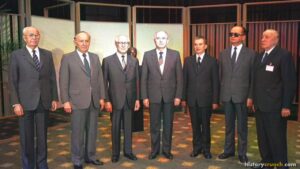
Beyond Germany, the fall of the Berlin Wall also led to the collapse of communist governments throughout Eastern Europe. For example, in the weeks and months that followed, communist governments fell in Czechoslovakia, Romania, Bulgaria and other nations across the Eastern BlocThe group of communist countries in Eastern Europe that were allied with and heavily influenced by the Soviet Union during the Cold War.. Furthermore, the events of 1989 contributed to the eventual dissolution of the Soviet Union itself on December 26th, 1991, which led to the end of the Cold War.
FactsthatCrunchWhich communist governments collapsed across the Eastern Bloc after the Berlin Wall fell?
Explore Cold War · 1947 – 1991
Keep exploring Cold War with these History Crunch resources.
Key Vocabulary
Ideological
Command economy
Perestroika
Glasnost
Interventionism
Death strip
Eastern Bloc
Frequently Asked Questions
When did the Berlin Wall fall?
The Berlin Wall fell on the evening of November 9th, 1989. That night thousands of East Berliners crossed into West Berlin after a confusing announcement about new travel rules. The wall had divided the city for 28 years before it came down.
Why was the Berlin Wall built in the first place?
The Berlin Wall was built in 1961 to stop East Germans from fleeing to the West. By that year millions of people had crossed into West Berlin for better jobs and more freedom. The East German government began sealing the border on the night of August 12th, 1961.
What caused the fall of the Berlin Wall?
Several factors caused the fall of the Berlin Wall by 1989. These included the reform policies of Soviet leader Mikhail Gorbachev, a weak East German economy, and growing pro-democracy protests. A rushed announcement about travel rules then triggered the final collapse.
What were the Monday Demonstrations?
The Monday Demonstrations were peaceful protests that began in Leipzig in September of 1989. Each week more East Germans gathered to demand reform and freedom of movement. By October the crowds had grown to hundreds of thousands of people.
What happened after the Berlin Wall fell?
The fall of the wall led to the reunification of Germany on October 3rd, 1990. Communist governments also collapsed across Eastern Europe in the months that followed. These events helped bring about the end of the Soviet Union on December 26th, 1991.
How long was the Berlin Wall and how many people died crossing it?
The Berlin Wall stretched more than 96 miles (155 km) and stood about 13 feet (4 meters) tall. It was actually two walls with a guarded strip in between known as the death strip. More than 140 people died trying to cross it during its 28-year history.
Cite This Article
To cite this article as a source, use one of the formats below.
MLA: Millar, B. “Fall of the Berlin Wall: A Detailed Summary.” HistoryCrunch, 13 October 2026, https://historycrunch.com/fall-of-the-berlin-wall/.
APA: Millar, B. (2026). Fall of the Berlin Wall: A Detailed Summary. HistoryCrunch. https://historycrunch.com/fall-of-the-berlin-wall/
Chicago: Millar, B. “Fall of the Berlin Wall: A Detailed Summary.” HistoryCrunch. October 13, 2026. https://historycrunch.com/fall-of-the-berlin-wall/
Sources
- Odd Arne Westad, The Global Cold War.
- John Lewis Gaddis, The Cold War: A New History.