
The Vietnam War was the twenty-year fight over whether Vietnam, divided in 1954, would be reunited under the communist government in Hanoi. The United States sent advisers, then bombers, then half a million soldiers to prevent it, and lost 58,000 of them before leaving in 1973. Saigon fell in 1975. It was the first war America lost, and it divided the country at home more than any event since the Civil War.
The Vietnam War ran from 1955 to 1975. This timeline covers 1887 to 1995, from the French colony to the wall in Washington.
The Vietnam War was fought over whether a country divided in 1954 would be one country under communist rule, and the United States spent twenty years, 58,000 lives and its own confidence trying to make sure it would not be. The events below run from the French colony Ho Chi Minh grew up in to the black wall in Washington with the names on it. Most of them are the result of something earlier on the list: a promise about an election, a report of an attack that did not happen, a decision to send more, a decision to leave.
The Vietnam War did not begin with an invasion; it began with a colony, a promise and a line on a map. This timeline follows the road from France's conquest of Vietnam to the coup that made South Vietnam America's responsibility: Ho Chi Minh's forty years of fighting for independence, the French war the United States paid for, the election that was never held, and the eight years in which Ngo Dinh Diem lost his own country.
This timeline is the military war: the French fortress that fell, the destroyer in the Gulf of Tonkin, the bombing campaign that lasted three and a half years, the first Marines on the beach, the helicopter battle in the Ia Drang, the siege in the hills, the night the enemy came into every city, the tanks across the DMZ, the B-52s over Hanoi, and the three weeks in 1975 in which an army of a million men came apart.
No war since the Civil War divided Americans like this one, and this timeline is about what it did at home: the vote in Congress that started it, the marches and the draft, the president who gave up, the students shot on a campus in Ohio, the veterans who threw back their medals, the newspaper that printed the government's secrets, the vote for 18-year-olds, the law that tried to make sure it could not happen again, and the films that decided how it would be remembered.
Vietnam's neighbors were supposed to be neutral, and both were bombed more heavily than Vietnam itself. This timeline follows the war across the border: the Trail that ran through Laos and Cambodia, the secret air wars, the coup in Phnom Penh, the invasion that set off Kent State, the South Vietnamese failure in Laos, and the Khmer Rouge, who came out of the wreckage to kill a fifth of Cambodia's people before Vietnam's army stopped them.
About 2.7 million Americans served in Vietnam, most of them for a year, and 58,000 did not come back. This timeline follows the war as they met it: the beach at Da Nang, the helicopter battle, the prison in Hanoi and the code tapped through its walls, the chemicals that fell from the aircraft, the village of My Lai, the lottery that chose who went, the planes that brought the prisoners home, the lawsuit, and the wall.
Five American presidents, one Vietnamese revolutionary, one South Vietnamese president and the general and the secretary who ran the war: this view follows the people whose choices the timeline is made of. Ho Chi Minh's forty years, Diem's refusal to hold an election, Kennedy's advisers, Johnson's resolution and his withdrawal, McNamara's numbers and his doubts, Westmoreland's promise, Nixon's plan and Kissinger's secret talks, and Ford, who could only watch.
It took the United States eight years to get into Vietnam and five to get out, and this timeline follows the getting out: the talks in Paris that began over the shape of the table, the troop withdrawals announced on an island in the Pacific, the secret apartment where the real negotiating happened, the policy called Vietnamization, the announcement twelve days before an election that peace was at hand, the bombing that followed, and the agreement that ended America's war without ending Vietnam's.
South Vietnam fell in fifty-five days. This timeline follows the ending in order: the test at Phuoc Long that the Americans failed, the attack in the Highlands, the retreat that became a rout, the fall of the cities, the president's farewell, the helicopters on the roofs, the tank at the palace gates, and then the one country that came after, the boat people, and the day twenty years later when the two enemies restored relations.
Vietnam was a small country nine thousand miles from California with no oil and no army that could reach the United States. Why did five presidents decide it was worth fighting for?
The American commitment to Vietnam was made in steps between 1950 and 1965, each one small and each one taken to protect the one before, from money for the French to Marines on the beach at Da Nang.
Ho Chi Minh left Vietnam in 1911 as a kitchen hand and died in 1969 as the leader of a state that had beaten France and was beating the United States. How did he do it, and what did he want?
Ho Chi Minh's life ran from a French colony to a communist republic, by way of Paris, Moscow, China and a cave on the border, and his movement was the constant on the Vietnamese side of the whole war.
The United States chose Ngo Dinh Diem to run South Vietnam in 1954, called him a miracle man in 1957, and let his generals kill him in 1963. What went wrong?
Diem's nine years as ruler of South Vietnam ran from the Geneva Accords to his murder in the November 1963 coup, and the American decision to remove him is the decision that made the war America's.
Two destroyers, three torpedo boats, one real attack and one that never happened. How did the events of a week in August 1964 give the United States a war it fought for nine years?
The Gulf of Tonkin incident ran from the attack on the USS Maddox on August 2nd, 1964 to the Senate vote on August 7th, and the resolution it produced was the legal basis of the whole American war.
The United States dropped more bombs on Vietnam, Laos and Cambodia than all sides dropped in the Second World War. Why did the strongest air force on earth not break a country with no air force of its own?
The air war ran from Operation Rolling Thunder in March 1965 through the halt of November 1968 to the Christmas bombing of 1972, and it never did what it was meant to do, which was to make Hanoi give up.
The Tet Offensive was thrown back in days and cost the communists about 40,000 men. Within two months the American president had stopped the bombing and given up his office. How does a side lose a battle and win the war?
Tet ran from the siege of Khe Sanh in January 1968 through the attacks of January 30th and the battle for Hue to Johnson's withdrawal on March 31st, and it changed the war from one the United States was trying to win into one it was trying to leave.
The United States dropped more bombs on the Ho Chi Minh Trail than were dropped in all of World War II. Supplies kept coming. Why?
A network of paths through two countries that could not be closed.
In 1965 the war's opponents were a few thousand students. By 1969 two million Americans took part in one day of protest. What made the movement grow, and did it end the war?
The anti-war movement ran from the first teach-ins of 1965 through the March on the Pentagon, the Moratorium, Kent State and the veterans' protest of 1971, and it was the largest protest movement in American history until then.
About 27 million American men came of draft age during the war. About 2.2 million were drafted, and most of them were poor. How did the draft work, and what did it do to the country?
The draft ran through the whole war, from the deferments of the early 1960s through the lottery of December 1969 to its end on January 27th, 1973, and it is the reason the war reached every family and every campus.
A secret history written by the government, copied by one of its authors and printed by a newspaper the government tried to stop. What did the Pentagon Papers show, and why did the leak matter more than the secrets?
The Pentagon Papers ran from McNamara's order for the study in June 1967 through the New York Times' first article in June 1971 to the Supreme Court's ruling seventeen days later, and the crimes committed to punish the leaker led to Watergate.
Vietnam was the first war fought in front of cameras every evening. Did that change what happened, or only what people remember?
From the monk in the street to the evening news after Tet.
Cambodia was neutral. By 1979 it had been bombed by the United States, invaded by the United States and South Vietnam, taken by the Khmer Rouge, emptied of its cities and invaded by Vietnam, and a fifth of its people were dead. How?
Cambodia's war ran from the secret bombing of March 1969 through the coup, the invasion and the fall of Phnom Penh in April 1975 to the genocide and the Vietnamese invasion of December 1978.
The United States dropped more bombs on Laos than on Germany and Japan together, and never admitted it was at war there. What was it fighting for, and what did it leave behind?
The war in Laos ran from the opening of the Ho Chi Minh Trail in 1959 through the neutrality agreement of 1962 and the bombing that began in 1964 to the communist takeover of December 1975, and it was kept secret from Congress and the public for most of that time.
About 800 American airmen were held in North Vietnam, some for more than eight years, in solitary cells and under torture. How did they survive, and why did their homecoming matter so much?
The prisoners' war ran from the first American captured in August 1964 through the invention of the tap code in June 1965 to Operation Homecoming in the spring of 1973, when 591 came home.
The United States sprayed 20 million gallons of herbicide and dropped 388,000 tons of napalm on Vietnam. What were they for, what did they do, and why were Americans still arguing about them thirty years later?
The chemical war ran from the first Ranch Hand spray mission in January 1962 through the napalm protests of 1967 to the veterans' lawsuit of 1979 and the Agent Orange Act of 1991.
On one morning in March 1968 American soldiers killed about 500 unarmed villagers. One man was convicted and served three years at home. What happened, why, and what did the country do with it?
My Lai ran from the massacre of March 16th, 1968 through the cover-up and Seymour Hersh's reports of November 1969 to Lieutenant Calley's conviction in March 1971 and Nixon's decision to release him.
The draft called up millions, and the people who ended up in combat were not a cross-section of America. Who went, and who did not?
Deferments, the lottery, and who was standing in the rice paddy.
It is remembered as an American war. South Korea sent 300,000 men, Australia sent troops, and the Vietnamese on both sides did most of the fighting and dying. Who is missing from the story?
The armies that get left out of the film version.
Millions of gallons of herbicide were sprayed to remove cover. The spraying stopped in 1971. The consequences did not.
Ranch Hand, the lawsuits, and a war that kept going after the shooting ended.
Lyndon Johnson won the largest presidential landslide in a century in 1964 and did not dare run in 1968. What did Vietnam do to him, and what did he do to it?
Johnson's war ran from the day he took office in November 1963 through the Tonkin Resolution, the escalation of 1965 and the promise of 1967 to his withdrawal on March 31st, 1968.
Richard Nixon was elected in 1968 to end the war and it went on for four more years and 21,000 more American dead. What was his plan, and did it work?
Nixon's war ran from his election in November 1968 through the secret bombing of Cambodia, Vietnamization, the invasion of 1970 and the Christmas bombing to the Paris agreement of January 1973 and his own resignation in August 1974.
The secretary who ran the war by the numbers and the general who counted the bodies both told the country it was winning. One came to believe it was lost and said nothing; the other never stopped believing. What did each of them get wrong?
McNamara and Westmoreland ran the American war from 1964 to 1968, McNamara from the Pentagon and Westmoreland from Saigon, and both left it in 1968 within four months of each other.
America had nuclear weapons, could have invaded the north and could have mined the harbours years earlier. Why fight with one hand tied?
Every escalation was measured against the risk of a much larger war.
Peace talks opened in May 1968 and the agreement was signed in January 1973. About 20,000 Americans and hundreds of thousands of Vietnamese died in between. What took so long?
The Paris talks ran from May 1968 through Kissinger's secret channel of 1969, the October 1972 draft and the Christmas bombing to the signing on January 27th, 1973, and the terms changed little across those years.
Nixon's plan was to hand the war to South Vietnam's army and leave. The army grew to a million men with American equipment. Why did it collapse in fifty-five days?
Vietnamization ran from Nixon's speech of November 1969 through its tests in Laos in 1971 and against the Easter Offensive of 1972 to the aid cuts of 1974 and the collapse of March and April 1975.
America never lost a major battle and lost the war. Was there any strategy that would have produced a different result?
The question every American commander has been asked since 1975.
The United States never declared war on Vietnam. Congress passed a resolution after a naval incident that was reported inaccurately. Who was actually deciding?
From the Tonkin Resolution to the War Powers Act.
South Vietnam had one of the largest armies in the world in January 1975 and no government in April. How does a country of twenty million people fall in fifty-five days?
The fall of South Vietnam ran from the loss of Phuoc Long on January 6th, 1975 through the attack on Ban Me Thuot of March 10th and the retreat from the Highlands to the surrender in Saigon on April 30th.
Saigon fell in 1975 and the last card on this timeline is dated 1995. What happened to Vietnam, Cambodia and the United States in the twenty years between, and how did the war finally end?
The aftermath ran from the fall of Saigon through reunification, the boat people, the Cambodian Genocide and its ending, the veterans' fight over Agent Orange and the building of the wall to the restoration of relations in 1995.
The war ended in April 1975. For hundreds of thousands of Vietnamese, the hardest part started then. What happened next?
Re-education camps, the boat people and a second war within four years.
France took Vietnam a province at a time between 1858 and 1887 and ruled it for sixty-seven years, and the war that America fought there grew out of the war the Vietnamese fought to be rid of France. Ho Chi Minh founded a communist party in 1930 and an independence movement in 1941, declared a republic in 1945 with Jefferson's words and American officers beside him, and fought the French for eight years. When the French army surrendered at Dien Bien Phu in May 1954, the United States, which had paid for that war, had to decide whether to take it over.
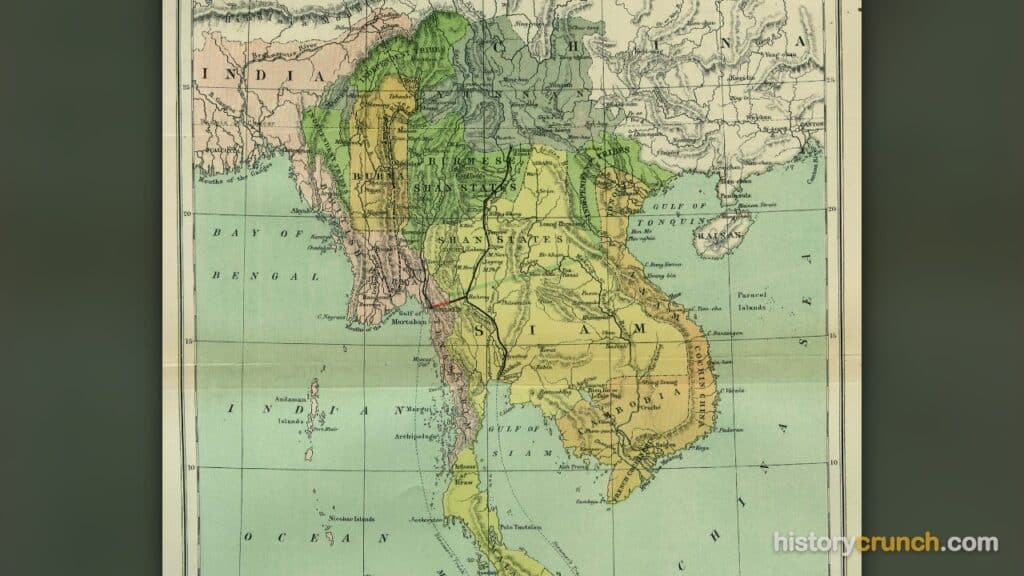
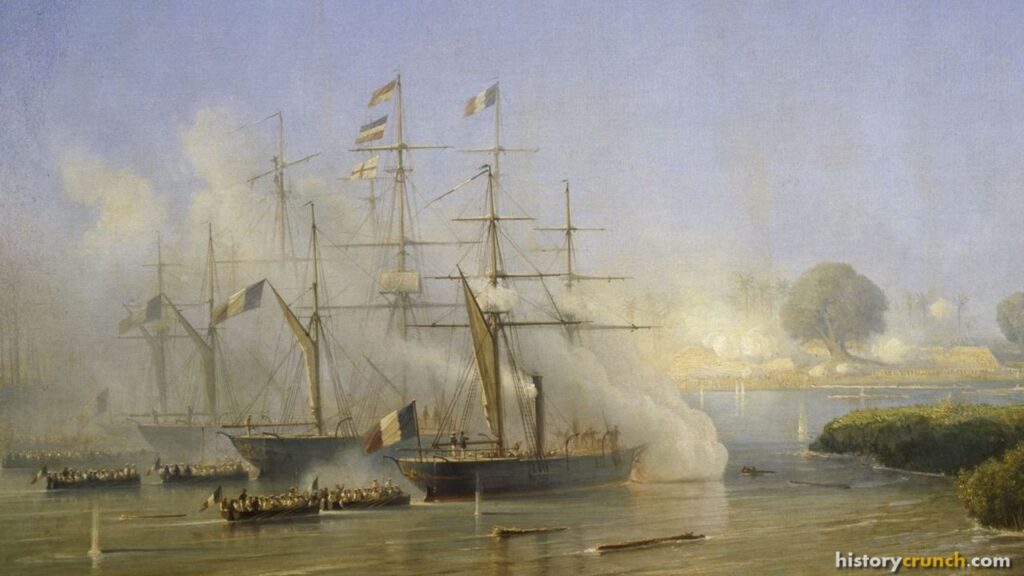
France took Vietnam a piece at a time. Its warships bombarded the port of Da Nang in 1858 to avenge executed Catholic missionaries, its troops occupied Saigon in 1860, and by 1867 it held the six southern provinces it called Cochinchina. Cambodia became a French protectorate in 1863, the north followed after a short war with China in 1884, and on October 17th, 1887 Paris joined the pieces into one colony, the Union Indochinoise. Laos was added in 1893.
LEARN MORESHOW LESSwhy it matters · key numbersPOLITICALFrench Indochina was the country the Vietnam War was fought over. The colony shipped rice and rubber to France and gave the Vietnamese no vote, and the men who would lead the war against America, Ho Chi Minh among them, grew up inside it.
Ho Chi Minh had left Vietnam in 1911 as a ship's cook, worked in London and Paris, tried to hand a petition for Vietnamese rights to the peacemakers at Versailles in 1919, and joined the French Communist Party in 1920 because it was the only party that promised the colonies independence. On February 3rd, 1930, in Hong Kong, he brought Vietnam's quarreling communist groups together into the Indochinese Communist Party.
LEARN MORESHOW LESSwhy it matters · key numbers · 1 key figureIDEASFrom 1930 the fight for Vietnamese independence had an organization, and the organization was communist. That fact decided how Washington would see Vietnam twenty years later: not as a colony asking to be free but as a front in the Cold War.
Germany defeated France in June 1940, and on September 22nd Japan, Germany's ally, marched into the northern part of French Indochina. The French colonial government, now answering to the German-controlled government at Vichy, stayed in office and did as it was told, and by 1941 Japanese forces had the run of the whole colony. Vietnam spent the Second World War with two masters, one French and one Japanese.
LEARN MORESHOW LESSwhy it matters · key numbers · elsewhereMILITARYThe war broke French authority in Vietnam without removing the French, and it gave Ho Chi Minh's movement an enemy that every Vietnamese could agree on. When Japan surrendered in August 1945 there was nobody in charge, and the Viet Minh walked into the gap.
The World War II timeline covers the fall of France and the Pacific war; this card is what they did to Vietnam.
On May 19th, 1941, thirty years after he left, Ho Chi Minh crossed the Chinese border into northern Vietnam and, in a cave near the village of Pac Bo, founded the League for the Independence of Vietnam, the Viet Minh. It was a communist-led movement open to anyone who would fight the Japanese and the French. During the war its guerrillas rescued downed American pilots, and American officers trained them.
LEARN MORESHOW LESSwhy it matters · key numbers · 1 key figurePOLITICALThe Viet Minh was the army that beat France in 1954 and the government that ruled North Vietnam after it. Its wartime work with the Americans is the part of the story the Cold War erased: in 1945 Ho expected the United States to be on his side.
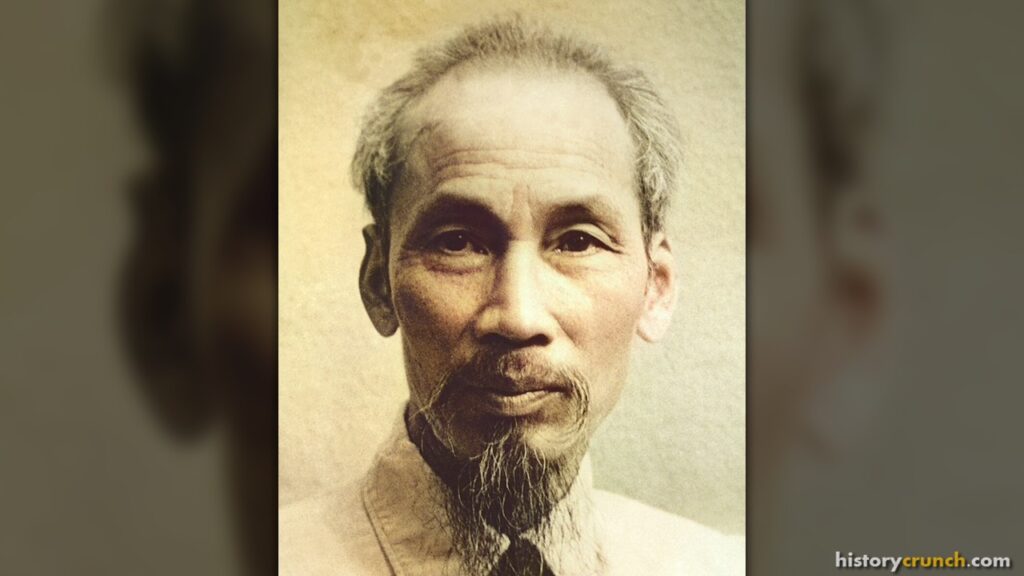
Japan surrendered on September 2nd, 1945, and the same day Ho Chi Minh stood before a crowd of hundreds of thousands in Ba Dinh Square in Hanoi and declared the Democratic Republic of Vietnam. He began with a sentence from the American Declaration of Independence, that all men are created equal, and American officers stood on the platform. France did not accept it, and within a year the two sides were at war.
LEARN MORESHOW LESSwhy it matters · key numbers · a sourcePOLITICALThis is the day Vietnam's twentieth century turns on. Ho asked the United States to back an independent Vietnam; the United States, which needed France in Europe, backed France instead, and the war that followed became America's own twenty years later.
IN THEIR OWN WORDS“All men are created equal. They are endowed by their Creator with certain unalienable rights, among these are Life, Liberty and the pursuit of Happiness.”
Ho Chi Minh, opening the Vietnamese Declaration of Independence, September 2nd, 1945WHAT TO NOTICEHe was quoting Thomas Jefferson on purpose, to the Americans on the platform.
The World War II timeline carries Japan's surrender; this card is what happened in Hanoi that day.
France came back to Vietnam in force in 1945 and 1946, and a year of talks between Ho Chi Minh and the French produced nothing either side would keep. In November 1946 French warships shelled the port of Haiphong, killing thousands, and on December 19th the Viet Minh attacked the French in Hanoi. The First Indochina War had begun. It lasted almost eight years and killed about 400,000 people.
LEARN MORESHOW LESSwhy it matters · key numbers · 1 key figureMILITARYThe French war set the pattern for the American one: a Western army with aircraft and artillery, a peasant army that hid in the villages and the jungle, and a war that could not be won by holding cities. It is also where American containment reached Asia, because Washington paid for most of it. The United States paid for most of it by 1954.
China had gone communist in October 1949 and was arming the Viet Minh. On May 8th, 1950 Harry Truman approved $10 million in military aid to the French in Indochina, and in September an American advisory group opened in Saigon. By 1954 the United States was paying about three quarters of the cost of France's war. The Pentagon Papers, published in 1971, showed how early the commitment had begun.
LEARN MORESHOW LESSwhy it matters · key numbers · 1 key figurePOLITICALAmerica entered Vietnam by paying France's bills, quietly and without a vote, to stop communism from spreading in Asia. Every later step, advisers, bombers, half a million men, was taken to protect the one before it.
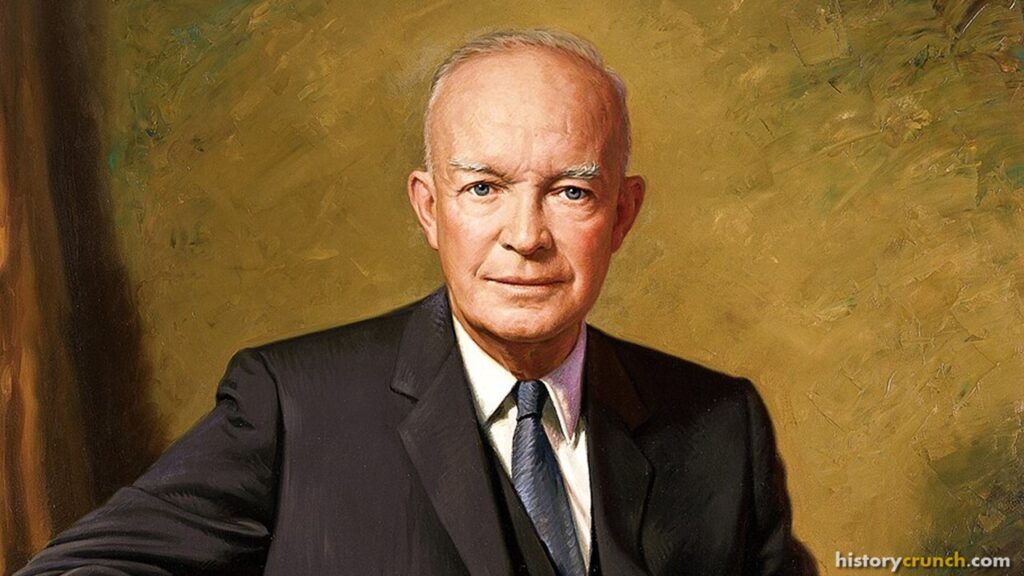
With the French garrison at Dien Bien Phu surrounded, a reporter asked Dwight Eisenhower on April 7th, 1954 why Indochina mattered. He answered with a row of dominoes: knock over the first and the rest go over one after another. If Vietnam fell, he said, Laos, Cambodia, Thailand, Burma and Indonesia could follow. The idea already guided policy; now it had a name.
LEARN MORESHOW LESSwhy it matters · key numbers · a sourceIDEASThe domino theory was the argument for the Vietnam War, used by four presidents to explain why a small country was worth American lives. When Saigon fell in 1975 the neighbors did not fall in a row, and the theory went with it.
IN THEIR OWN WORDS“You have a row of dominoes set up, you knock over the first one, and what will happen to the last one is the certainty that it will go over very quickly.”
Dwight D. Eisenhower, press conference, April 7th, 1954
The Cold War timeline carries the domino theory as policy; this card is the day it was named.
France had built a fortress in a valley at Dien Bien Phu, near Laos, to draw the Viet Minh into an open battle. The Viet Minh general Vo Nguyen Giap dragged artillery up the hills around it, by hand, and opened fire on March 13th, 1954. For 56 days the French were shelled and cut off, supplied only by air, and on May 7th the last position surrendered. About 11,000 French troops were captured. Dwight Eisenhower had refused to send American bombers.
LEARN MORESHOW LESSwhy it matters · key numbers · elsewhereMILITARYDien Bien Phu ended French rule in Vietnam and put a question in front of the United States: let Vietnam go communist, or take France's place. The answer was given in stages over the next eleven years, and this valley is where it starts.
The Cold War timeline carries Dien Bien Phu as the day containment reached Asia; this card is the battle.
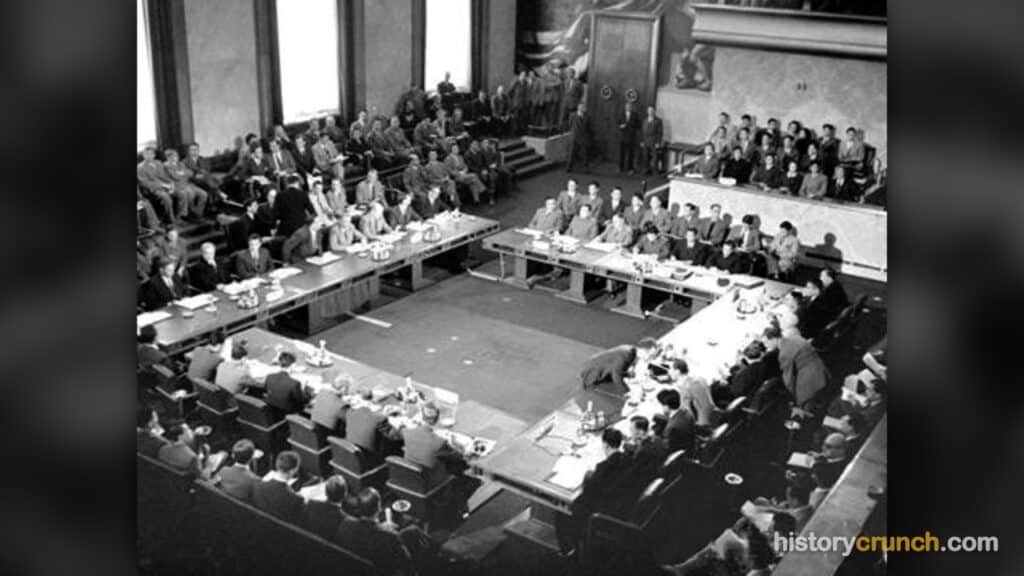
Ten weeks after Dien Bien Phu, at a conference in Geneva, France agreed to leave. The accords of July 21st, 1954 drew a line across Vietnam at the 17th parallel: Ho Chi Minh's government north of it, a French-backed state under Emperor Bao Dai south of it, and a promise that the two halves would vote on one government by July 1956. The line was meant to last two years. The United States refused to sign and said only that it would not upset the agreement by force.
LEARN MORESHOW LESSwhy it matters · key numbers · a debatePOLITICALThe division of Vietnam was written as temporary and became the border of a war. The election that would have ended it was never held, because everyone expected Ho to win it, and the two Vietnams spent the next twenty-one years trying to undo the line by force.
Did the United States break the Geneva Accords?
It never signed them, and it said so at the time; it was free to back a separate South Vietnam.
It promised not to disturb the settlement, then built a state whose whole purpose was to prevent the election the settlement required.
The Geneva Accords of 1954 cut Vietnam in half at the 17th parallel and promised an election in 1956 to put it back together. The election was never held, because Ho Chi Minh would have won it, and the United States built a country in the South instead, under Ngo Dinh Diem. Diem rigged his votes, jailed his critics and lost his Buddhist majority; the communists in the South took up arms and Hanoi opened a supply road through Laos; John F. Kennedy sent 16,000 advisers. In November 1963 Diem was murdered in a coup Washington had approved, and three weeks later Kennedy was dead too.
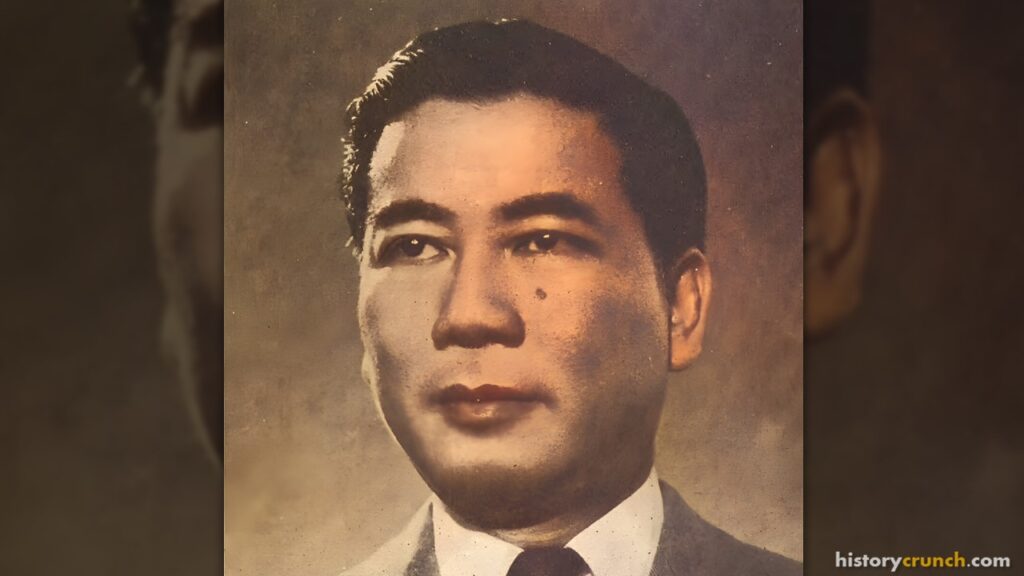
Ngo Dinh Diem, a Catholic nationalist who had spent the French war in exile, became prime minister of the southern state in 1954 with American backing. On July 16th, 1955 he announced that his government had not signed the Geneva agreement and would not take part in the reunification vote due the next summer. Dwight Eisenhower later wrote that Ho Chi Minh would have won perhaps 80 percent of it.
LEARN MORESHOW LESSwhy it matters · key numbers · 1 key figurePOLITICALWith no election there was no peaceful road to one Vietnam, and the communists in the south turned to arms. The United States accepted Diem's decision because it feared the result, and from here on it was defending a border rather than a promise.
On October 23rd, 1955 South Vietnamese voters were asked to choose between Emperor Bao Dai and Ngo Dinh Diem. Diem's brother ran the count and Diem won with 98 percent, including more votes in Saigon than there were voters. Three days later, on October 26th, Diem proclaimed the Republic of Vietnam with himself as president. The United States recognized it at once and began paying its army.
LEARN MORESHOW LESSwhy it matters · key numbersPOLITICALSouth Vietnam was now a country, with a flag, an army and an American guarantee, and a president who ruled through his family and jailed his critics. Washington had bet the domino theory on Diem, and it would spend eight years finding out what that cost.
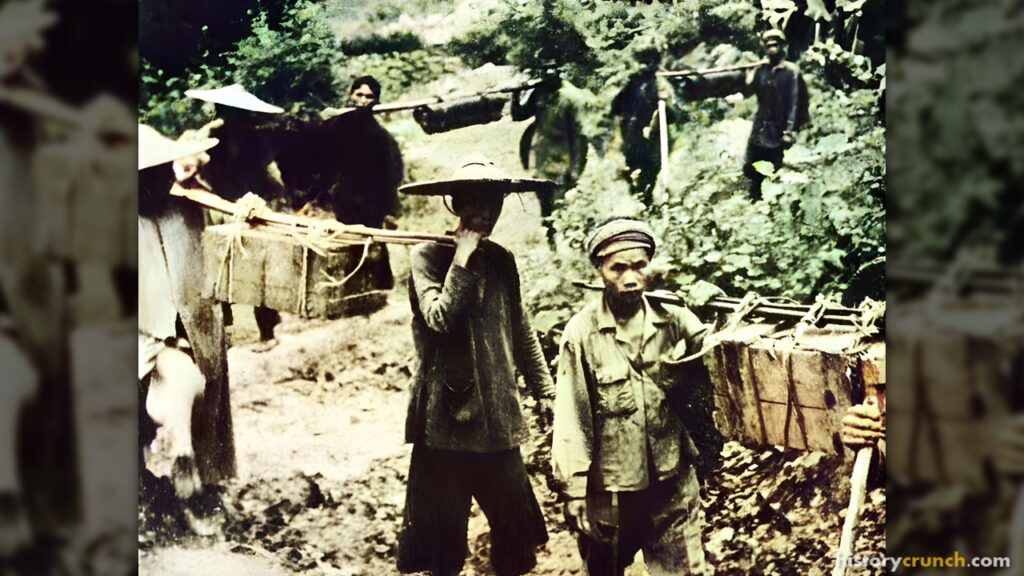
In May 1959 North Vietnam formed a unit called Group 559 to build a supply route to the south that avoided the fortified border at the 17th parallel. It ran through the mountains and jungle of Laos and Cambodia, neutral countries, and it began as footpaths used by porters and bicycles. Over the next fifteen years it grew into a network of roads, depots and fuel pipelines thousands of miles long.
LEARN MORESHOW LESSwhy it matters · key numbersMILITARYThe Trail was how the North fought a war in the South, and no amount of American bombing closed it. It also dragged Laos and Cambodia into the war, because the only way to cut the Trail was to fight in them.
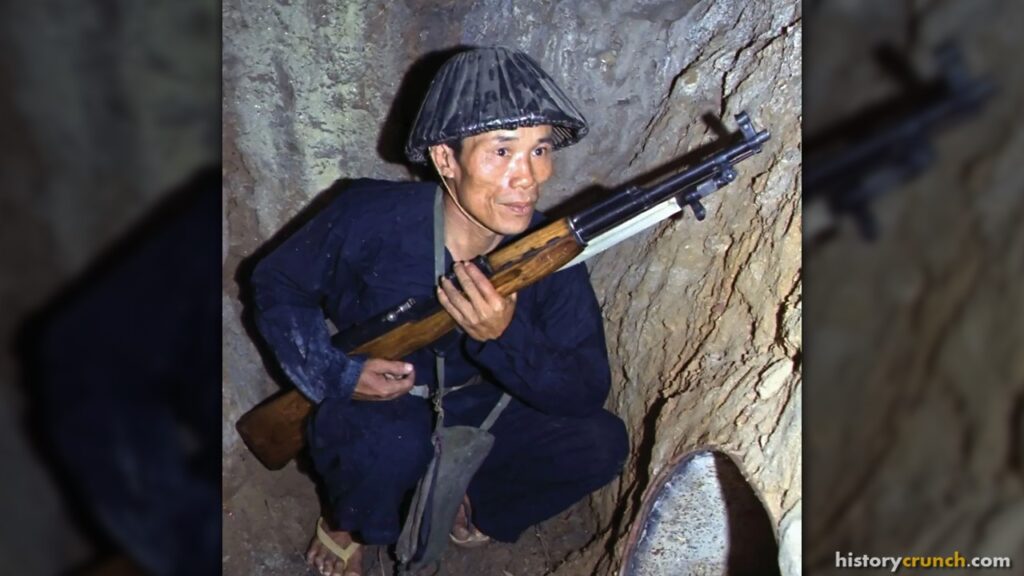
On December 20th, 1960 communists and other opponents of Diem in South Vietnam founded the National Liberation Front, a political movement with a guerrilla army. Saigon called them Viet Cong, Vietnamese communists, and the name stuck. They were directed and supplied from Hanoi but recruited in the villages of the south, where Diem's land policies and arrests had made him hated.
LEARN MORESHOW LESSwhy it matters · key numbersPOLITICALThe Viet Cong were the enemy American soldiers actually fought for most of the war: an insurgency rather than an invading army, fighting guerrilla warfare of ambush and mine, farmers by day and fighters by night in the same villages the Americans were trying to protect. The war against them could not be won by taking ground, because they did not hold any.
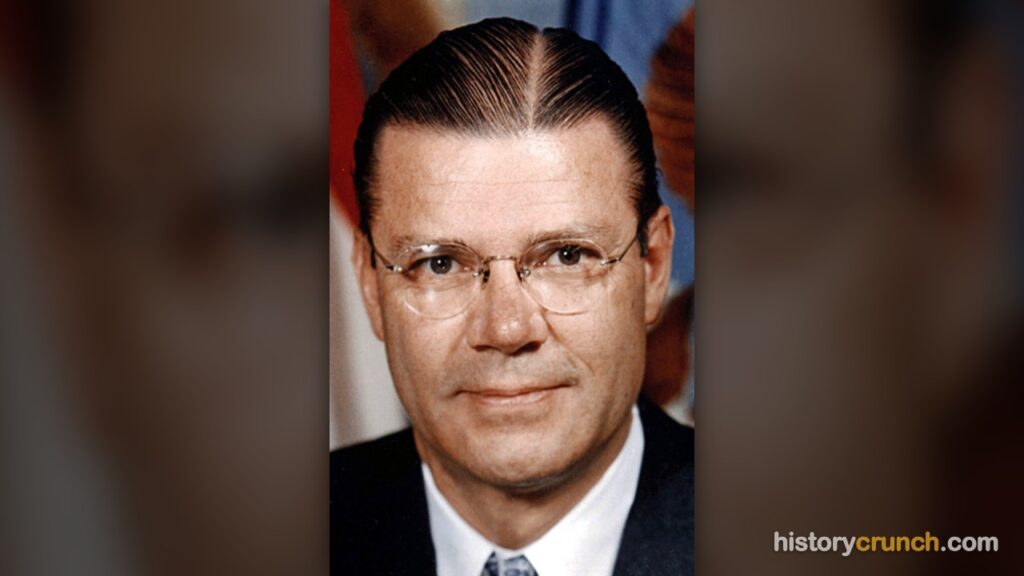
Robert McNamara had been president of the Ford Motor Company for five weeks when John F. Kennedy asked him to run the Pentagon. He took office on January 21st, 1961 and brought the methods of the car business with him: statistics, systems analysis and the belief that any problem could be counted and managed. He served Kennedy and then Lyndon Johnson for seven years, longer than any defense secretary before him.
LEARN MORESHOW LESSwhy it matters · key numbers · 2 key figuresPOLITICALMcNamara ran the Vietnam War the way he had run Ford, by the numbers, and the numbers, body counts and bombing tonnages, told him it was being won when it was not. He was the architect of the escalation and, in private, the first in the government to say it had failed.
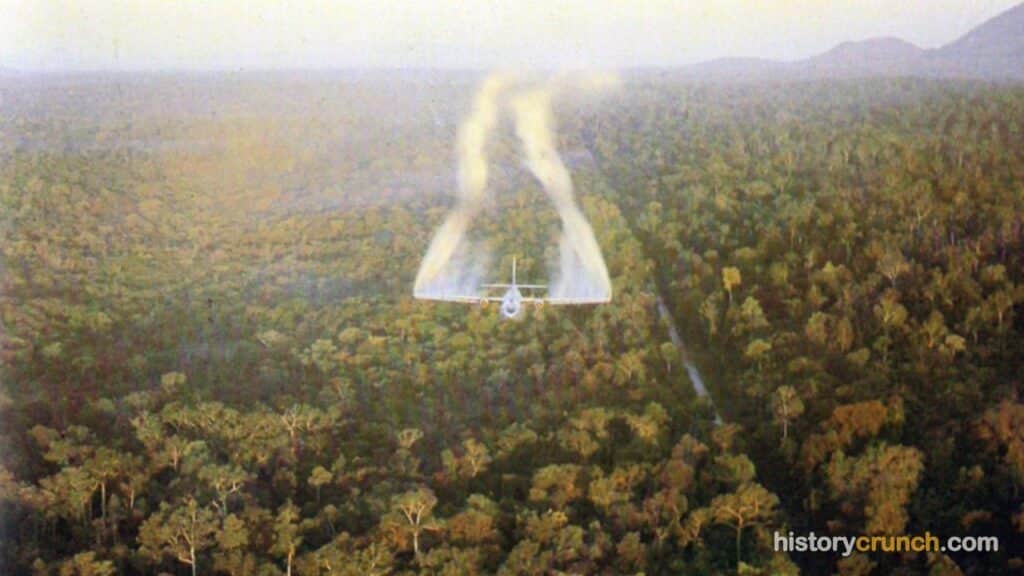
On January 13th, 1962 American aircraft flew the first mission of Operation Ranch Hand, spraying chemical herbicides to strip the jungle that hid the Viet Cong and to kill the crops that fed them. The most used mix was Agent Orange, named for the stripe on its barrels. Over ten years about 20 million gallons fell on Vietnam, Laos and Cambodia, and a large operation in September 1962 cleared the mangrove forests of the Mekong Delta.
LEARN MORESHOW LESSwhy it matters · key numbersSCIENCESpraying the crops that fed a village sat badly beside pacification, the other half of American strategy, which was meant to win those same villages over. Agent Orange contained dioxin, a poison, and it stayed in the soil, the water and the people. Vietnamese families and American veterans were still getting sick from it decades later, and the lawsuits and the law that followed are on this timeline's last cards.
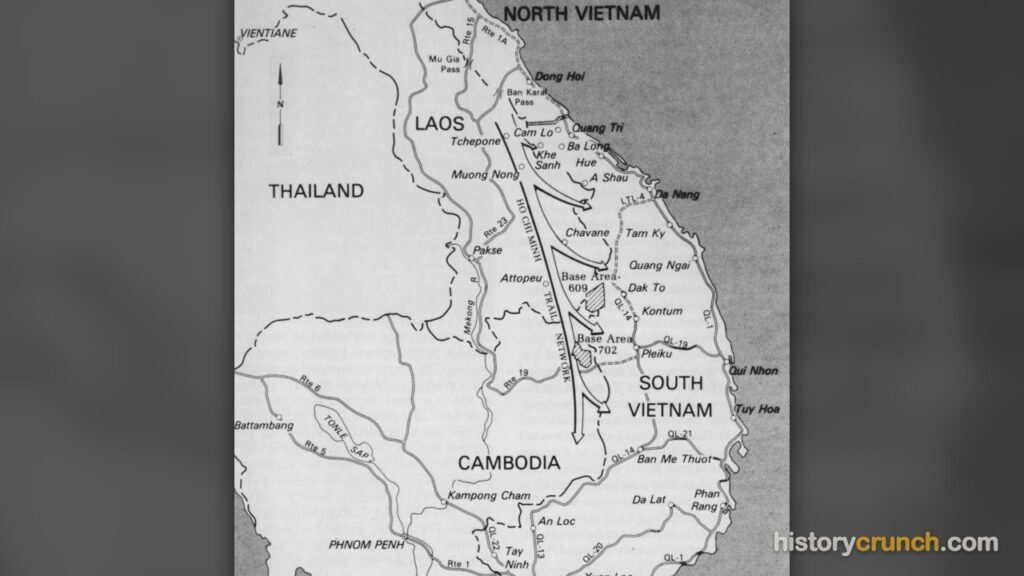
Laos, independent from France since 1953, had a civil war of its own between a royal government and the communist Pathet Lao. On July 23rd, 1962 fourteen countries, including the United States and North Vietnam, signed an agreement in Geneva making Laos neutral and ordering all foreign troops out. North Vietnam kept its soldiers on the Ho Chi Minh Trail, and the United States kept its CIA officers and its secret army of Hmong hill people.
LEARN MORESHOW LESSwhy it matters · key numbersPOLITICALThe agreement gave Laos the worst of both worlds: a war nobody admitted to fighting. From 1964 to 1973 American aircraft dropped more bombs on Laos than fell on Germany in the Second World War, and the unexploded ones are still killing people.
Diem was a Catholic ruling a mostly Buddhist country, and in May 1963 his police fired on Buddhists in Hue who were flying their flag against his orders, killing nine. On June 11th, 1963 a 66-year-old monk named Thich Quang Duc sat down at a Saigon intersection, was doused in gasoline by other monks, and burned to death without moving. A photograph by Malcolm Browne of the Associated Press was on front pages around the world the next day.
LEARN MORESHOW LESSwhy it matters · key numbers · a sourceRELIGIONThe photograph turned American opinion against Diem faster than any report from the embassy. When Diem's sister-in-law called it a barbecue, Kennedy's government began to ask whether the man it had backed for nine years could be replaced.
IN THEIR OWN WORDS“No news picture in history has generated so much emotion around the world as that one.”
John F. Kennedy, on Malcolm Browne's photograph, 1963
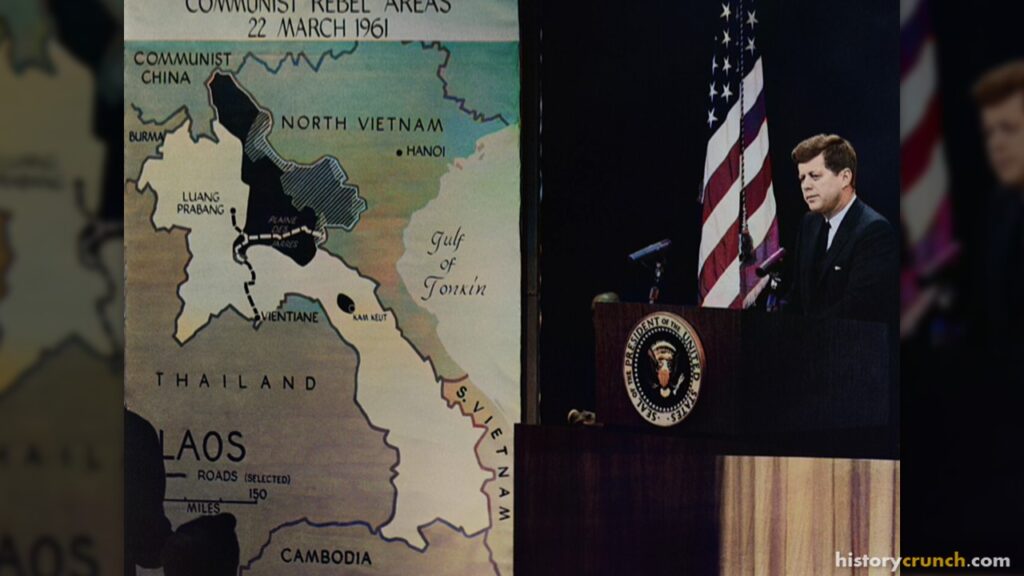
Dwight Eisenhower had left about 700 American military advisers in South Vietnam in 1960. Kennedy, who believed the war could be won with training, helicopters and Special Forces rather than American divisions, raised the number to about 16,000 by the autumn of 1963. Advisers were not supposed to fight, but they flew the helicopters, went on patrol and died: 195 Americans had been killed in Vietnam by the end of 1963.
LEARN MORESHOW LESSwhy it matters · key numbers · a debateMILITARYThe adviser years are how a limited commitment became an open one. Each increase was small and each was meant to avoid a larger war, and by the time Kennedy died the United States had a stake in South Vietnam that his successor felt he could not abandon.
Would Kennedy have pulled out of Vietnam?
He had ordered 1,000 advisers home in October 1963 and told friends he would withdraw after the 1964 election.
He had raised the number from 700 to 16,000, approved the coup against Diem, and never said in public that he would leave.
In August 1963 Washington told its ambassador in Saigon that it would not object if South Vietnam's generals removed Diem. On November 1st the generals surrounded the palace; Diem and his brother Nhu fled, surrendered the next morning on a promise of safe passage, and were shot in the back of an armored car on November 2nd. Kennedy, who had expected exile rather than murder, was shaken by the news.
LEARN MORESHOW LESSwhy it matters · key numbers · a debatePOLITICALThe coup made South Vietnam America's responsibility. Having removed Diem, Washington could not walk away from what replaced him, and what replaced him was seven governments in eighteen months. Kennedy himself was dead three weeks later.
Was the coup a mistake?
Diem had lost the Buddhists, the peasants and his own army; no war could be won with him.
The generals who followed were worse, and the coup told every South Vietnamese officer that power came from Washington, not from the people.
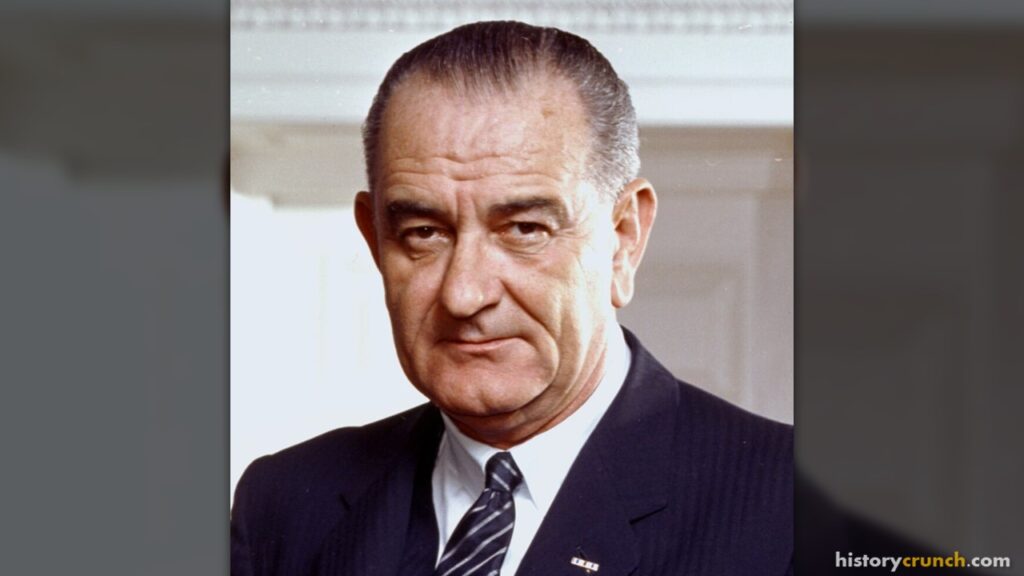
John F. Kennedy was shot dead in Dallas on November 22nd, 1963, and Lyndon Johnson took the oath on the plane home. Johnson was a Texan and a master of the Senate whose ambitions were at home, civil rights and the war on poverty, and he told an aide that he was not going to be the president who saw Southeast Asia go the way China went. He kept Kennedy's advisers and Kennedy's commitment.
LEARN MORESHOW LESSwhy it matters · key numbers · elsewherePOLITICALJohnson inherited 16,000 advisers and a South Vietnam in chaos, and he inherited the fear that losing it would destroy him the way losing China had destroyed Harry Truman's party. That fear, more than any plan, is what took him from advisers to half a million men.
The Cold War timeline carries the assassination; this card is what it meant for the war.
Lyndon Johnson did not want a war in Vietnam and did not intend to lose one. A confused night in the Gulf of Tonkin in August 1964 gave him a resolution from Congress that he used as a declaration of war; in March 1965 the bombing of the North began and the Marines landed at Da Nang; by the end of 1967 there were nearly 500,000 Americans in Vietnam under a general who counted progress in enemy dead. The first battles were won, napalm and Agent Orange fell, the prisoners in Hanoi invented a code, 100,000 people marched on the Pentagon, and in November 1967 the general told the country the end was in view.
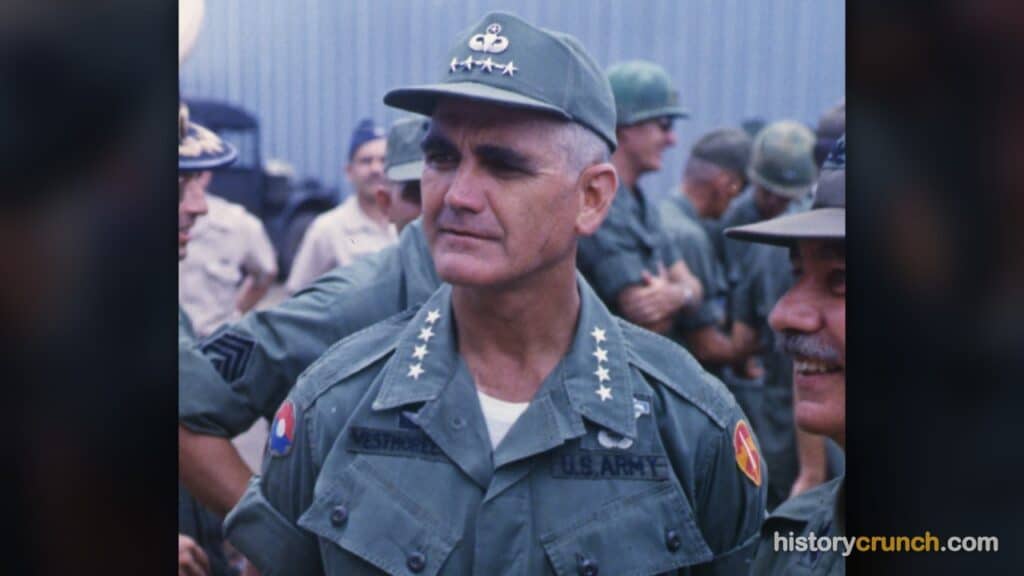
William Westmoreland, a West Point graduate who had commanded artillery in North Africa and Sicily and paratroopers in Korea, became commander of Military Assistance Command, Vietnam, known as MACV, on August 1st, 1964. He was 50, the youngest major general in the army when promoted, and he arrived believing that American firepower and mobility could grind the enemy down faster than Hanoi could replace him. He would command for four years.
LEARN MORESHOW LESSwhy it matters · key numbers · 1 key figureMILITARYWestmoreland's strategy of attrition, measuring progress in enemy dead, is the strategy the United States fought the war with from 1965 to 1968. It produced the body counts, the search-and-destroy sweeps and, in the end, the promise of victory that the Tet Offensive destroyed.
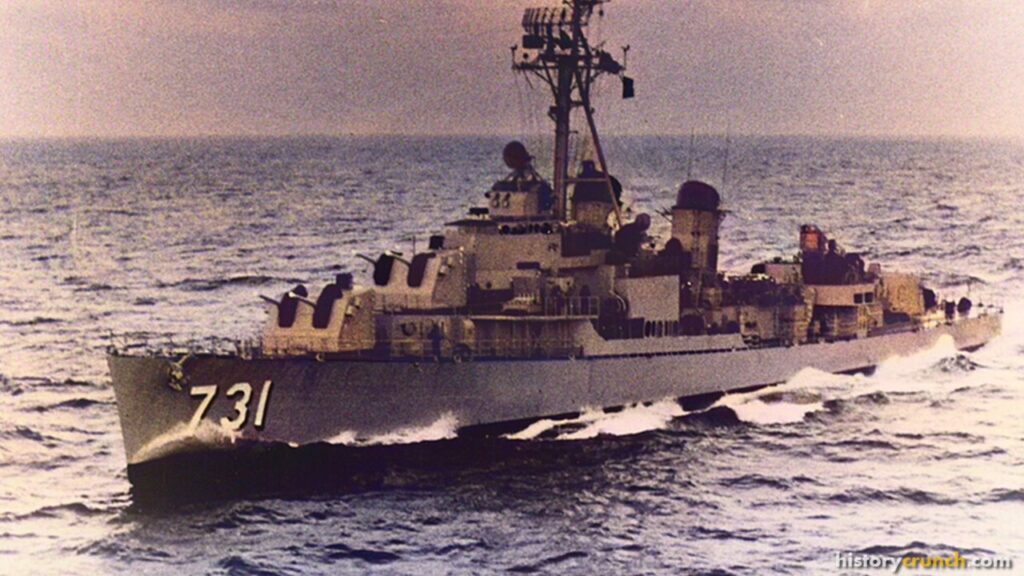
On August 2nd, 1964 three North Vietnamese torpedo boats attacked the destroyer USS Maddox, which was gathering intelligence off the North Vietnamese coast while South Vietnamese commandos raided nearby. The Maddox drove them off. On the night of August 4th the Maddox and a second destroyer reported another attack in heavy weather; their captain doubted it within hours, and the records later showed there had been none. Johnson ordered air strikes on the North the same night.
LEARN MORESHOW LESSwhy it matters · key numbers · 1 key figureMILITARYThe second attack was the one that mattered, and it did not happen. Lyndon Johnson used it to ask Congress for a resolution he already had drafted, and the war that followed rested on a report the navy itself did not believe.
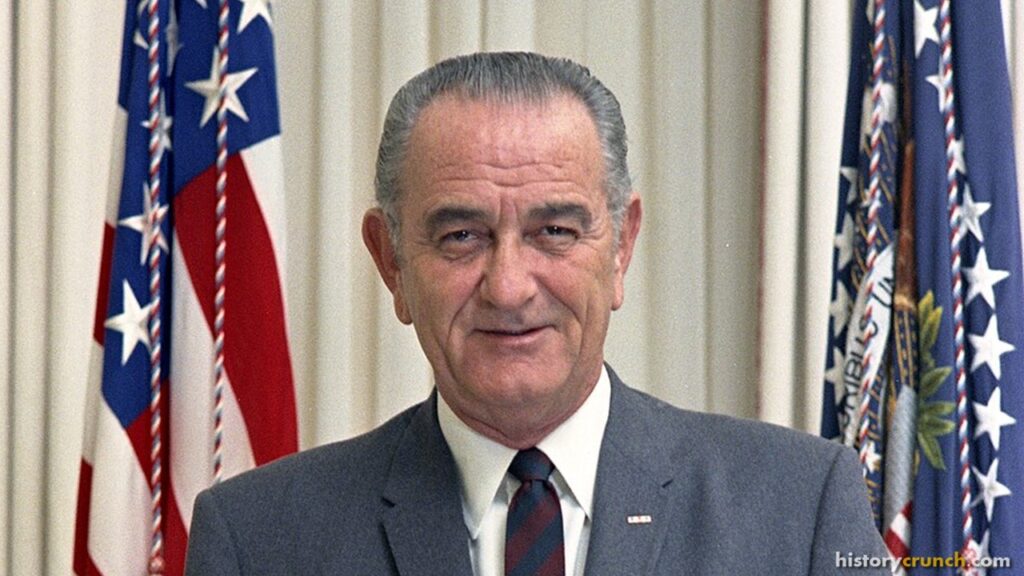
On August 7th, 1964 Congress passed the Gulf of Tonkin Resolution, 416 to 0 in the House and 88 to 2 in the Senate, authorizing the president to take all necessary measures to repel any armed attack against American forces and to prevent further aggression. Lyndon Johnson signed it on August 10th. He was running for president that autumn as the peace candidate against Barry Goldwater, and he won 44 states.
LEARN MORESHOW LESSwhy it matters · key numbers · elsewherePOLITICALThe resolution was the only vote Congress ever took on going to war in Vietnam, and it was taken on a story that was not true. Johnson used it to send half a million men without ever asking again; Congress repealed it in 1971 and passed the War Powers Act in 1973 so it could not happen twice.
The Cold War timeline carries the resolution as the decision that made Vietnam America's war; this card is the vote.
On December 14th, 1964 American aircraft began Operation Barrel Roll, bombing the Ho Chi Minh Trail where it ran through northern Laos, a country the United States had promised in 1962 to leave alone. The bombing was kept secret from Congress and the public and run in part by the CIA from a base in Thailand. It went on for nine years and grew to 580,000 missions.
LEARN MORESHOW LESSwhy it matters · key numbersMILITARYLaos was the first country the war spread into, and the bombing there began three months before the bombing of North Vietnam. The secrecy set a habit: the air war over Laos and Cambodia was hidden from the American public until the 1970s.
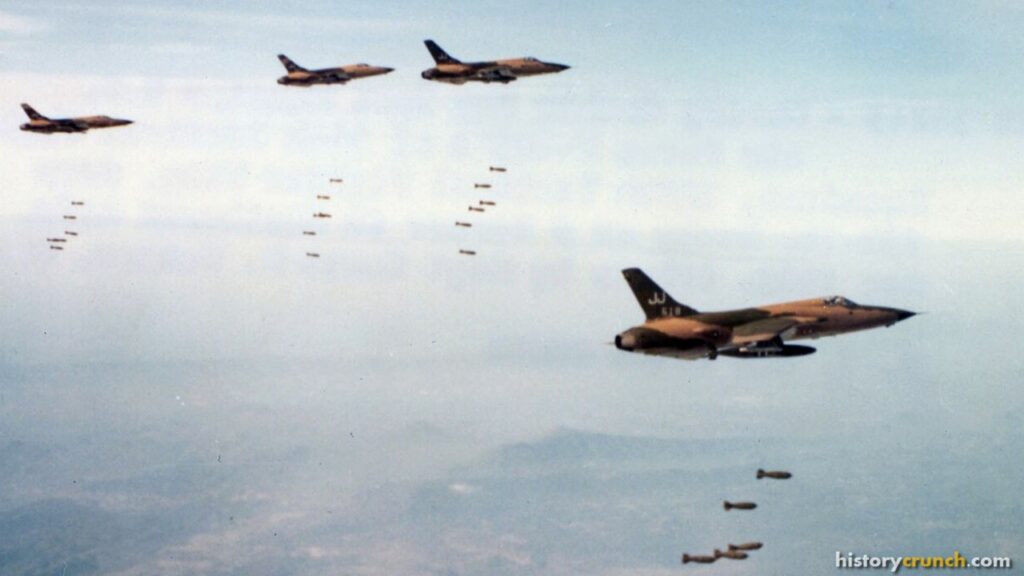
After Viet Cong attacks on American bases at Pleiku and Qui Nhon in February 1965, Lyndon Johnson ordered a sustained bombing campaign against North Vietnam. Rolling Thunder began on March 2nd, 1965 and lasted three years and eight months. It was meant to break Hanoi's will and cut the supplies going south; Johnson chose the targets himself, at Tuesday lunches, and kept the cities of Hanoi and Haiphong mostly off the list for fear of drawing in China.
LEARN MORESHOW LESSwhy it matters · key numbers · elsewhereMILITARYRolling Thunder was the beginning of the American war rather than the adviser war, and it failed at its purpose: North Vietnam rebuilt, dispersed and dug in, and supplies down the Trail increased. About 900 American aircraft were lost and most of the prisoners in Hanoi were their crews.
The Cold War timeline carries Rolling Thunder in a line; this card is the campaign.
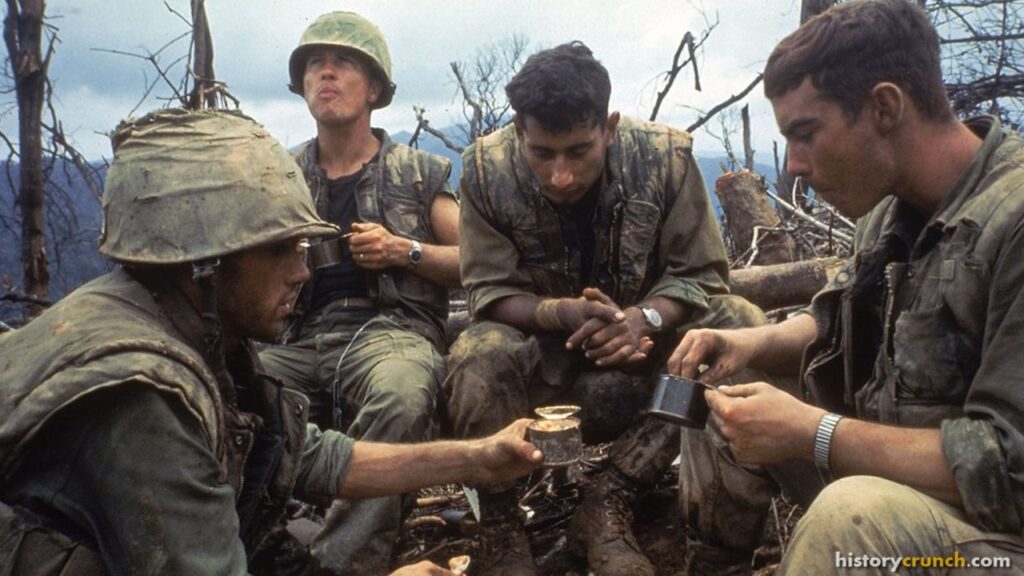
On March 8th, 1965 two battalions of Marines, 3,500 men, waded ashore at Da Nang to guard the air base the Rolling Thunder bombers flew from. They were the first American ground combat units in Vietnam, and Vietnamese girls met them on the beach with flower garlands. Their orders were to defend the base. Within a month they were patrolling beyond it, and by July Lyndon Johnson had agreed to send 50,000 more men and to let them fight.
LEARN MORESHOW LESSwhy it matters · key numbers · 1 key figureMILITARYThe Marines at Da Nang are the moment the United States stopped advising and started fighting. Every decision after it was about how many more, and the number went from 3,500 in March 1965 to 184,000 by the end of the year.
American pilots shot down over the North were held in Hoa Lo prison in Hanoi, which they named the Hanoi Hilton, in solitary cells and forbidden to speak. In June 1965 four of them, Carlyle Harris, Phillip Butler, Robert Peel and Robert Shumaker, worked out a code: the alphabet in a five-by-five grid, each letter tapped as a row and a column on the wall. It spread through every cell and every camp.
LEARN MORESHOW LESSwhy it matters · key numbersSOCIALThe tap code kept the prisoners an organized unit for up to eight years, with a chain of command, news and jokes passed through the walls, and it is the reason most of them came home whole. About 800 airmen were captured during Rolling Thunder alone.
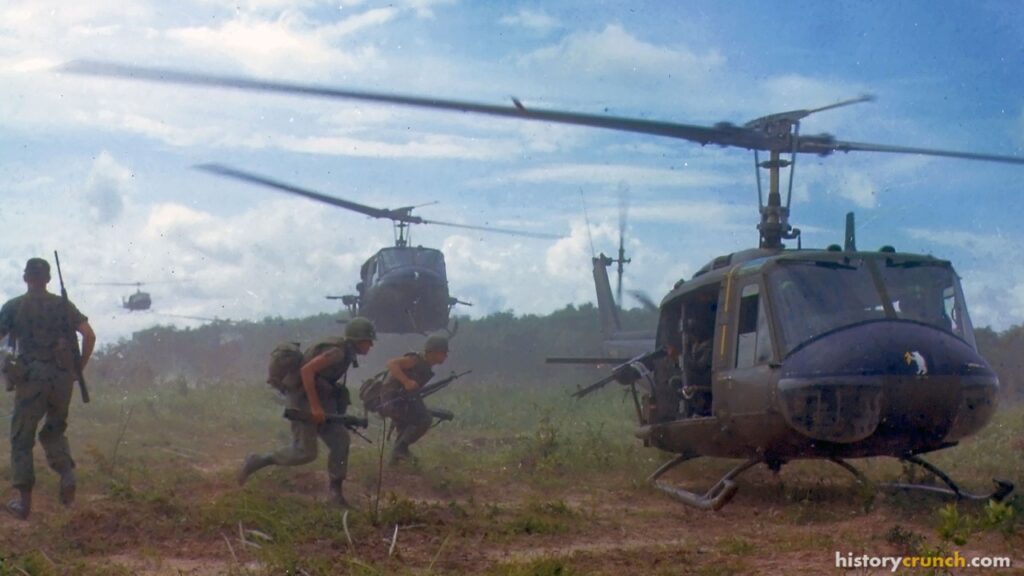
On November 14th, 1965 helicopters of the 1st Cavalry Division landed about 450 men in a clearing in the Ia Drang valley near the Cambodian border, and about 2,000 North Vietnamese regulars attacked them. For four days the Americans held with artillery, air strikes and helicopters flying in ammunition and flying out wounded. The Americans lost 234 dead in the valley; the North Vietnamese lost far more, and a second American battalion was ambushed on the march out.
LEARN MORESHOW LESSwhy it matters · key numbers · 1 key figureMILITARYBoth sides learned their war at Ia Drang. Westmoreland saw a kill ratio that proved attrition could work; Hanoi's generals saw that if they fought close in, grabbing the Americans by the belt, the bombers and guns could not be used, and that they could afford the losses.
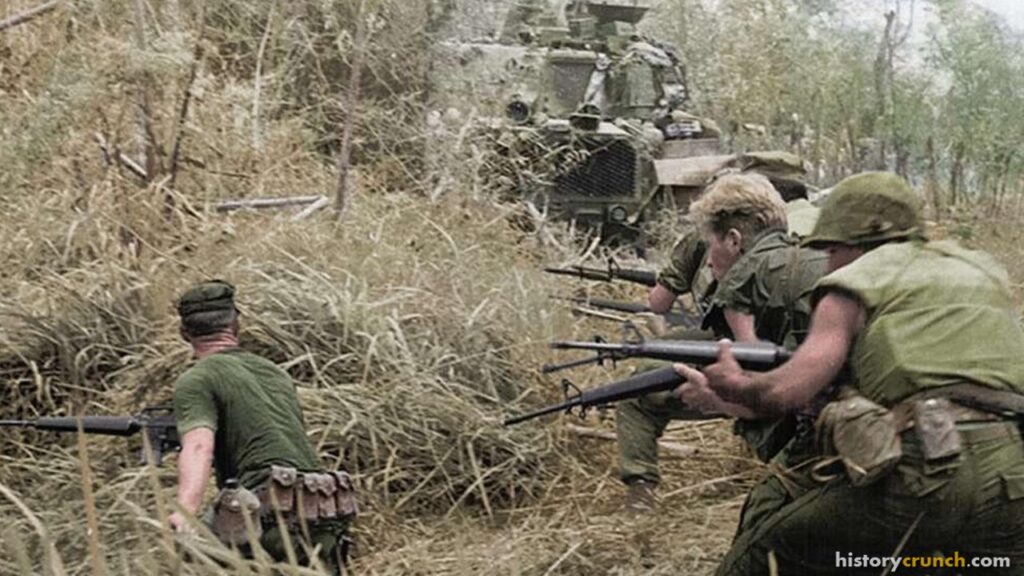
By the end of 1965 the United States had about 184,000 troops in Vietnam, and Westmoreland was asking for more. His method was search and destroy: helicopters carried units into the countryside to find the enemy, kill him and fly out, and success was counted in bodies. Time magazine made Westmoreland its Man of the Year. Draft calls doubled, and the first big campus protests began at the University of Michigan and in Washington.
LEARN MORESHOW LESSwhy it matters · key numbers · 1 key figureMILITARY1965 is the year America went to war in Vietnam, and the year it chose to fight it with numbers: more troops, more sorties, more enemy dead. The numbers rose every year until 1968 and never added up to a victory.
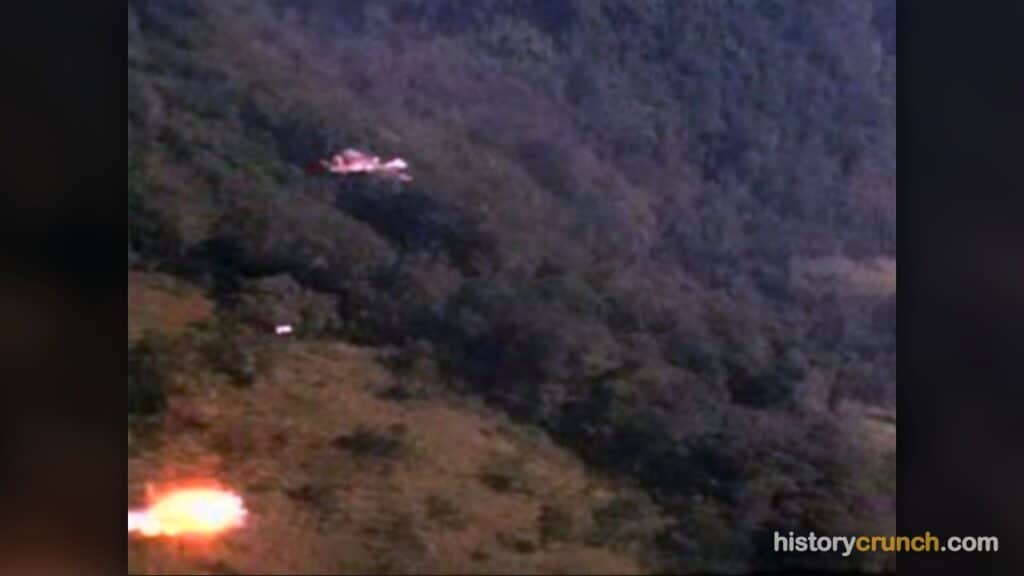
Napalm is jellied gasoline that sticks to what it hits and burns at about 1,500 degrees. By 1966 American aircraft were dropping about 4,500 tons of it a month across Indochina, and about 388,000 tons fell on Vietnam between 1963 and 1973, ten times the amount used in Korea. In January 1967 Ramparts magazine printed color photographs of Vietnamese children burned by it, and students began picketing the Dow Chemical Company, which made it, when its recruiters came to campus.
LEARN MORESHOW LESSwhy it matters · key numbersMILITARYNapalm became the war's symbol at home before the war was lost: the weapon that made the pictures. The protests against Dow at the University of Wisconsin in October 1967 were among the first campus demonstrations that turned violent.
By the middle of 1967 Robert McNamara no longer believed the war could be won, and he had begun to say so to Lyndon Johnson in private. On June 17th, 1967 he ordered a small team to write a history of how the United States had gotten into Vietnam, from 1945 to the present, using the government's own secret documents. It ran to 47 volumes and about 7,000 pages, and it was finished after he had gone.
LEARN MORESHOW LESSwhy it matters · key numbers · 2 key figuresPOLITICALMcNamara meant the study for future historians. Instead one of the men who worked on it, Daniel Ellsberg, gave it to the New York Times in 1971, and the Pentagon Papers showed four administrations saying one thing in public and another in private.
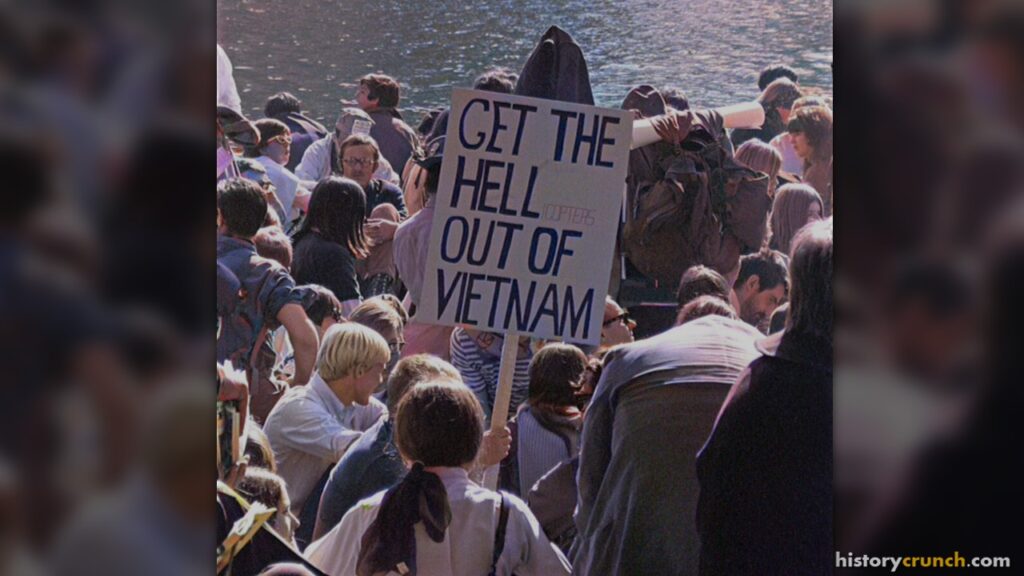
On October 21st, 1967 about 100,000 people rallied at the Lincoln Memorial against the war, and about 35,000 of them marched across the Potomac to the Pentagon, where soldiers and marshals held the steps. Protesters put flowers in rifle barrels, the writer Norman Mailer was arrested, and about 680 people were taken into custody. Nearly 500,000 American troops were in Vietnam and about 9,000 had died that year.
LEARN MORESHOW LESSwhy it matters · key numbersSOCIALThe march was the first national protest that could not be dismissed as students: it brought clergy, veterans and writers to the doors of the building that ran the war. It also gave the war its most famous protest photograph, a young man placing a flower in a gun.
Lyndon Johnson brought Westmoreland home in November 1967 to reassure a country losing patience. On November 21st, at the National Press Club in Washington, the general said the enemy was losing, that a new phase had been reached in which the end begins to come into view, and that American troops could start coming home within two years. Ten weeks later the Tet Offensive struck every major city in South Vietnam.
LEARN MORESHOW LESSwhy it matters · key numbers · a sourcePOLITICALThe speech is why Tet was a shock. Americans had been told the war was being won by the man running it, and when the enemy appeared inside the American embassy the gap between the words and the pictures became the war's credibility gap.
IN THEIR OWN WORDS“We have reached an important point when the end begins to come into view.”
William Westmoreland, National Press Club, November 21st, 1967
In the early hours of January 30th, 1968 the Viet Cong and North Vietnamese army attacked more than a hundred cities and towns at once, including the American embassy in Saigon. They were beaten back everywhere, lost about 40,000 men and never recovered as a force. It did not matter: Americans had been told the enemy was finished and watched him on television inside the embassy. In March Robert McNamara left, American soldiers killed the village of My Lai, and Lyndon Johnson stopped most of the bombing and gave up the presidency. Peace talks opened in Paris; Richard Nixon was elected promising to end the war.
On January 21st, 1968 North Vietnamese artillery opened fire on the Marine base at Khe Sanh, in the hills near the Laotian border, and about 20,000 North Vietnamese troops surrounded its 6,000 defenders. Lyndon Johnson had a model of the base built in the White House basement and made his generals promise it would not be another Dien Bien Phu. American aircraft dropped about 100,000 tons of bombs around it in 77 days, and the siege was lifted on April 8th.
LEARN MORESHOW LESSwhy it matters · key numbers · 1 key figureMILITARYKhe Sanh held, but it may have been a decoy: nine days after it began, the Tet Offensive hit the cities while American attention was fixed on the hills. Historians still argue which was the real target. The base was abandoned in July 1968.
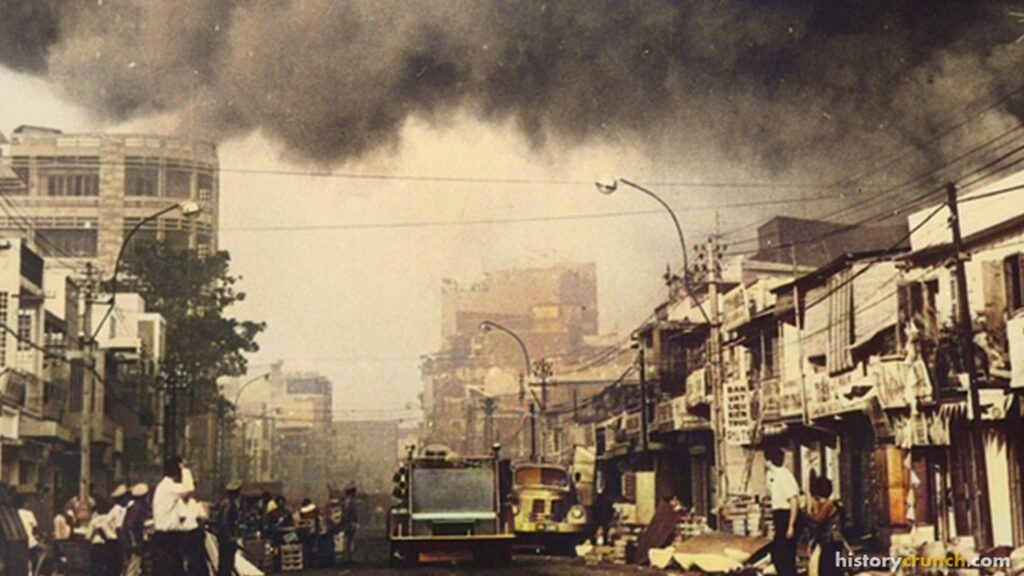
Tet is the Vietnamese new year, and both sides had agreed a truce for it. In the early hours of January 30th and 31st, 1968 about 80,000 Viet Cong and North Vietnamese troops attacked more than 100 towns and cities across South Vietnam, including Saigon, where a squad blew a hole in the wall of the American embassy and fought in its courtyard for six hours. The attackers were driven out of every city but Hue within days and lost about 40,000 men, but the offensive continued in waves until September 23rd.
LEARN MORESHOW LESSwhy it matters · key numbers · a sourceMILITARYTet was a military defeat for the communists and the turning point of the war, because Americans had been told the enemy was beaten and watched him inside the embassy on television. After Tet the question in Washington was no longer how to win but how to leave.
IN THEIR OWN WORDS“To say that we are mired in stalemate seems the only realistic, yet unsatisfactory, conclusion.”
Walter Cronkite, CBS Evening News, February 27th, 1968
The Cold War timeline carries Tet as the day America's Cold War confidence broke; this card is the offensive.
Who won the Tet Offensive?
The United States and South Vietnam: the attackers were thrown out of every city, the people did not rise, and the Viet Cong never recovered from the losses.
North Vietnam: the point was political, to break American confidence, and within two months the president had stopped the bombing and given up his office.
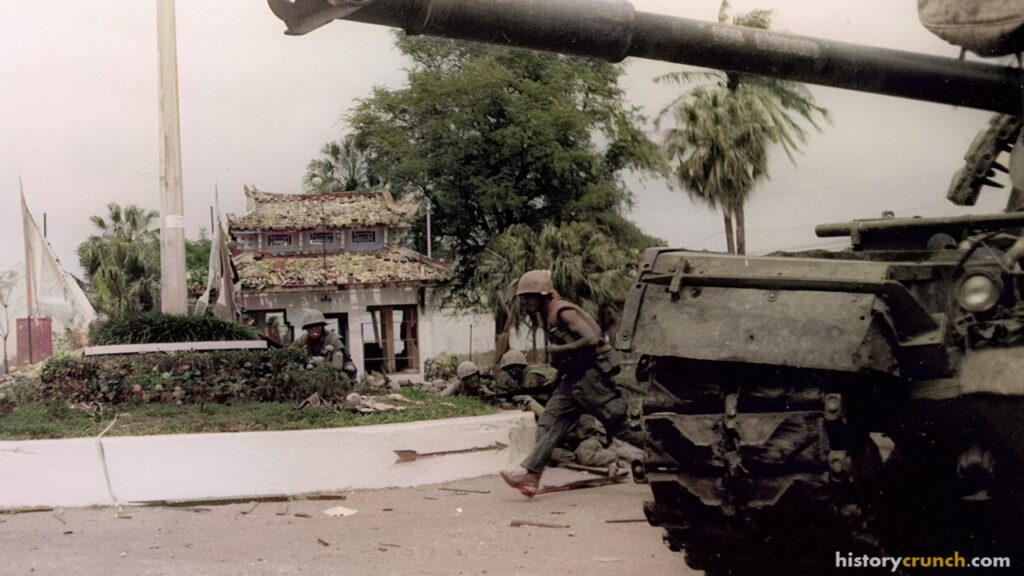
Communist forces took most of Hue, the old imperial capital, on January 31st, 1968 and held it for 25 days. Marines and South Vietnamese troops fought back street by street through the walled Citadel, with artillery and naval guns reducing much of the old city to rubble, and retook it on March 2nd. While they held the city the communists rounded up and killed about 2,800 officials, teachers, priests and others; the mass graves were found over the following months.
LEARN MORESHOW LESSwhy it matters · key numbersMILITARYHue was the longest battle of Tet and the one that looked most like a conventional war, and the massacre there is the strongest evidence of what a communist victory would mean for the South's people. About 5,000 communist troops, 216 Americans and 384 South Vietnamese soldiers died in the city.
Robert McNamara had told Lyndon Johnson in a memo in November 1967 that the bombing should stop and the troop level be frozen, and Johnson, who could not accept the advice, arranged for him to become president of the World Bank instead. He left the Pentagon on February 29th, 1968, in tears at his farewell ceremony, after seven years. Clark Clifford, who replaced him, reached the same conclusion within weeks.
LEARN MORESHOW LESSwhy it matters · key numbers · 2 key figuresPOLITICALThe man who had built the war had turned against it in private, and his departure a month after Tet was the first sign at the top that the strategy had failed. He said nothing in public for 27 years.
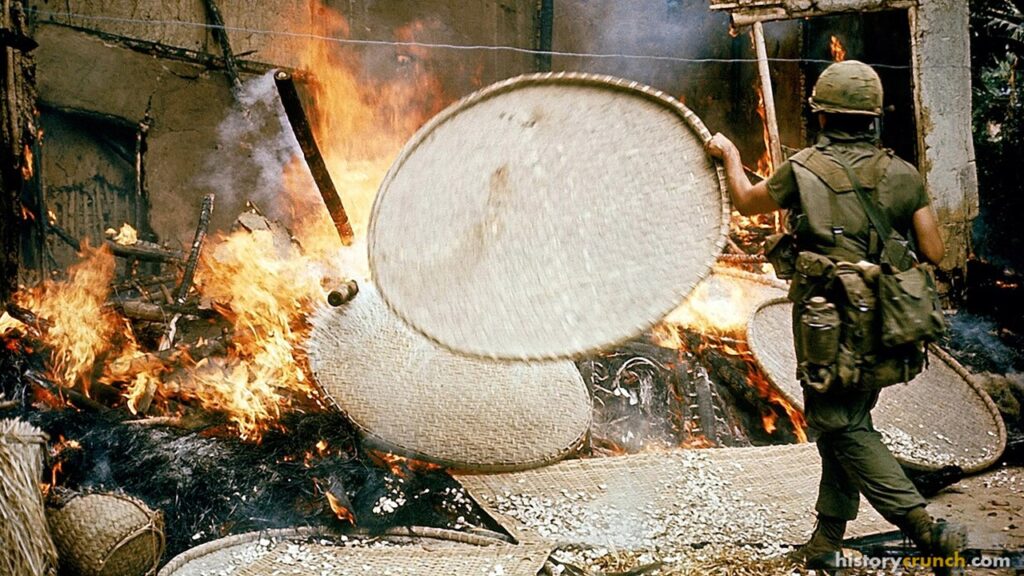
On March 16th, 1968 a company of the Americal Division, told to expect Viet Cong in the hamlet of My Lai, found only women, children and old men and killed about 500 of them over four hours. A helicopter pilot, Hugh Thompson, landed between the soldiers and a group of villagers and ordered his crew to fire on the Americans if they attacked. The army covered it up for twenty months, until a former soldier's letters and the reporter Seymour Hersh brought it out in November 1969.
LEARN MORESHOW LESSwhy it matters · key numbersMILITARYMy Lai showed Americans what the war had done to their own soldiers, and the cover-up showed them what the army would do to hide it. Of 26 men charged, one, Lieutenant William Calley, was convicted, on March 29th, 1971; his life sentence became three and a half years of house arrest.
On March 31st, 1968 Lyndon Johnson spoke to the country on television about Vietnam. He announced that bombing of North Vietnam would stop above the 20th parallel, that he would send only 13,500 more troops instead of the 206,000 Westmoreland had asked for, and that he was ready for peace talks. Then, in a paragraph his aides had not seen, he said he would not seek and would not accept his party's nomination for another term.
LEARN MORESHOW LESSwhy it matters · key numbers · a sourcePOLITICALTet had cost Johnson the country: Eugene McCarthy had nearly beaten him in the New Hampshire primary on March 12th and Robert Kennedy had entered the race four days later. The speech ended the escalation and the presidency of the man who ran it, and it began the five years of talking that led to Paris.
IN THEIR OWN WORDS“I shall not seek, and I will not accept, the nomination of my party for another term as your President.”
Lyndon B. Johnson, television address, March 31st, 1968
North Vietnam accepted Lyndon Johnson's offer of talks three days after his speech, and on May 13th, 1968 American and North Vietnamese delegations met at the Hotel Majestic in Paris. The first months were spent arguing about who could sit at the table and what shape it should be; South Vietnam and the Viet Cong were not admitted until January 1969. The talks would run for four years and eight months.
LEARN MORESHOW LESSwhy it matters · key numbersPOLITICALParis made the war a negotiation as well as a battle, and from now on every offensive on both sides was fought for position at the table. The fighting killed more Americans after the talks opened than before them.
Lyndon Johnson announced in March 1968 that Westmoreland would come home to be Army Chief of Staff, a promotion that everyone understood as removal, and on June 10th General Creighton Abrams took command in Vietnam. Abrams dropped search and destroy for smaller patrols, put more weight on protecting villages and on building up the South Vietnamese army, and told his officers that the body count was not the measure.
LEARN MORESHOW LESSwhy it matters · key numbers · 2 key figuresMILITARYThe change of commanders was the end of the attrition strategy and the beginning of the approach Richard Nixon would call Vietnamization. Westmoreland spent the rest of his life defending his war, and sued CBS in 1982 over a documentary that said he had understated enemy strength before Tet.
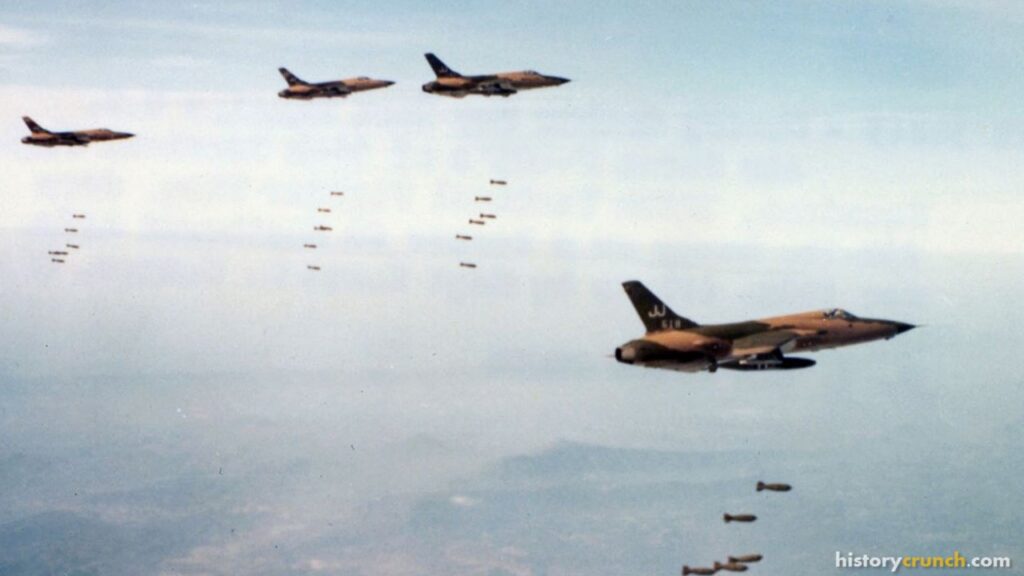
On October 31st, 1968, five days before the election, Lyndon Johnson announced that all bombing of North Vietnam would stop the next day in return for progress at the Paris talks. Rolling Thunder ended on November 1st after 44 months, about 305,000 sorties and 643,000 tons of bombs. The North had lost bridges, rail yards and power plants and rebuilt most of them; supplies moving south had not stopped.
LEARN MORESHOW LESSwhy it matters · key numbers · 1 key figureMILITARYThe halt was the admission that bombing had not worked as a way of making Hanoi give up. North Vietnam would not be bombed again until 1972, and when it was, under Nixon, the targets Johnson had spared were hit.
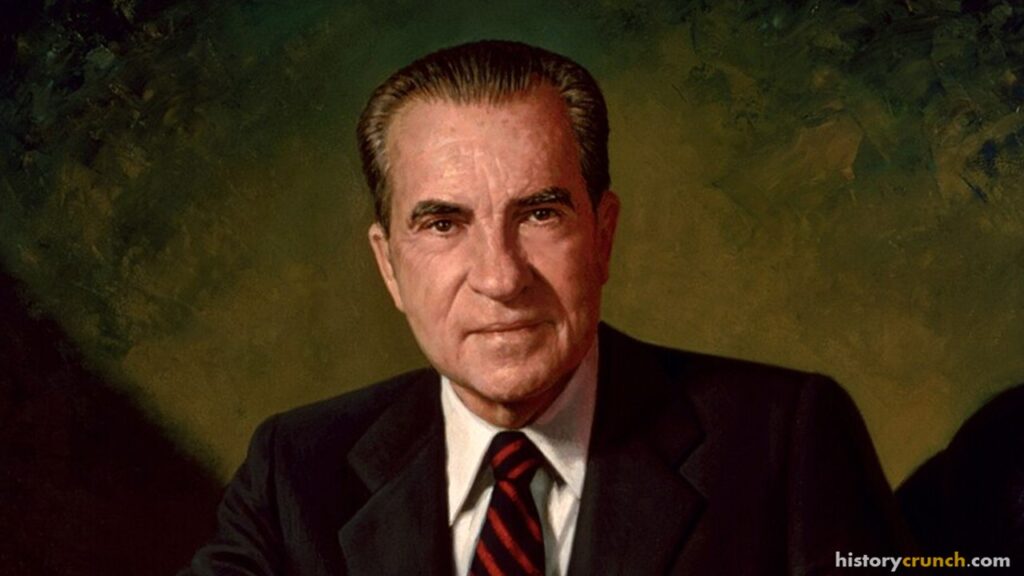
Richard Nixon won the presidency on November 5th, 1968 by about 500,000 votes over Hubert Humphrey, Johnson's vice president, in a year that had seen the assassinations of Martin Luther King and Robert Kennedy and riots at the Democratic convention in Chicago. He had promised peace with honor and let it be understood that he had a plan to end the war. He did not say what it was.
LEARN MORESHOW LESSwhy it matters · key numbers · 2 key figuresPOLITICALNixon inherited 536,000 troops and a war he had decided he could not win outright. His plan, as it turned out, was to withdraw slowly, hand the fighting to South Vietnam, widen the war into Cambodia and Laos, and bomb harder: four more years and 21,000 more American dead.
Richard Nixon's plan was to leave without seeming to lose: bring the troops home in stages, hand the fighting to South Vietnam, and hit the enemy harder in the meantime. He bombed Cambodia in secret and invaded it in the open, and the invasion brought Kent State. Draft numbers were drawn from a jar, veterans threw their medals at the Capitol, the Pentagon Papers showed the war had been built on lies, and the vote went to 18-year-olds. In 1972 the North attacked with tanks, the South held with American aircraft, Henry Kissinger said peace was at hand, and Nixon bombed Hanoi at Christmas.
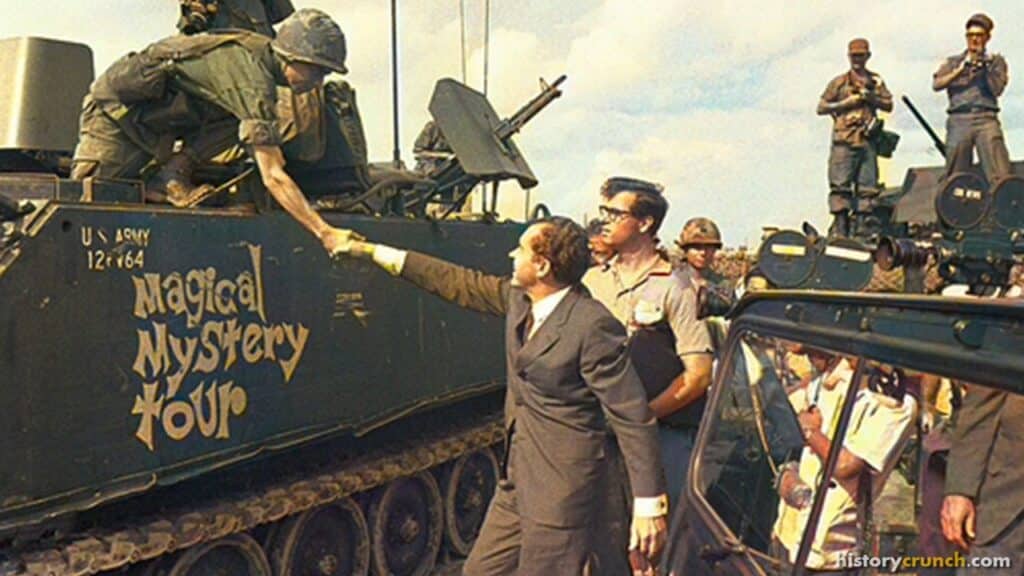
American troop strength in Vietnam reached its peak of about 549,000 in April 1969. On June 8th, meeting South Vietnam's president Nguyen Van Thieu on Midway Island, Richard Nixon announced that 25,000 American troops would come home by the end of August, the first withdrawal of the war. Another 35,000 followed in September, and by March 1970 he was promising 150,000 more over the next year.
LEARN MORESHOW LESSwhy it matters · key numbers · 1 key figurePOLITICALFrom this day the American war was ending, slowly: the question was no longer whether to leave but how to leave without South Vietnam collapsing before the last plane left. The withdrawals also made the draft, the protests and the fighting harder to justify for the men still there.
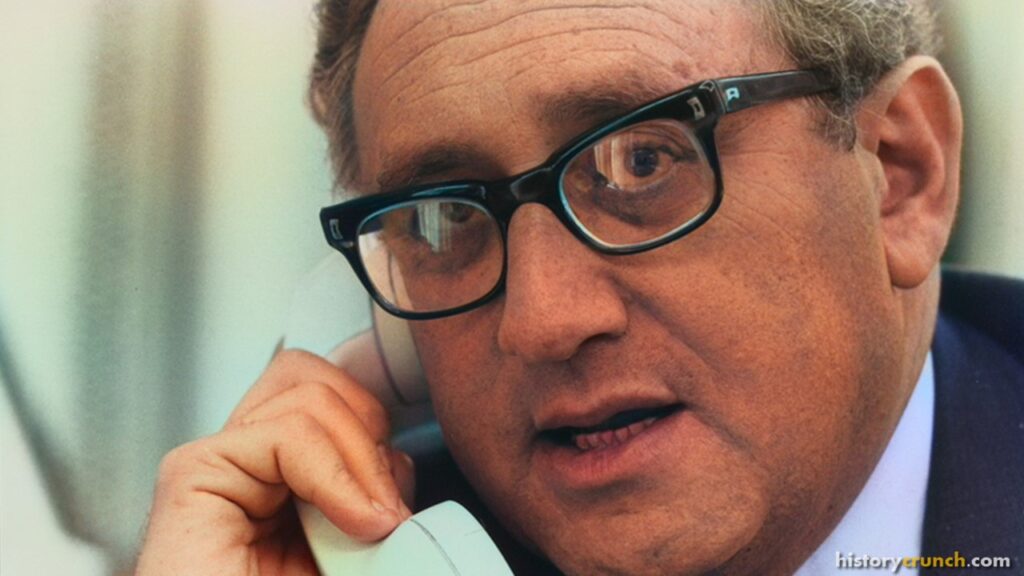
The public talks in Paris were going nowhere, so on August 4th, 1969 Richard Nixon's national security adviser, Henry Kissinger, met a North Vietnamese negotiator secretly in a Paris apartment. From February 1970 his counterpart was Le Duc Tho, a founding member of Vietnam's Communist Party who had spent years in French prisons. The two men met in secret for three and a half years, and the agreement of 1973 was theirs.
LEARN MORESHOW LESSwhy it matters · key numbers · 2 key figuresPOLITICALThe secret channel was where the war was actually settled, and it settled it on Hanoi's main terms: North Vietnamese troops could stay in the South. South Vietnam was not told what was being negotiated about it until the deal was nearly done.
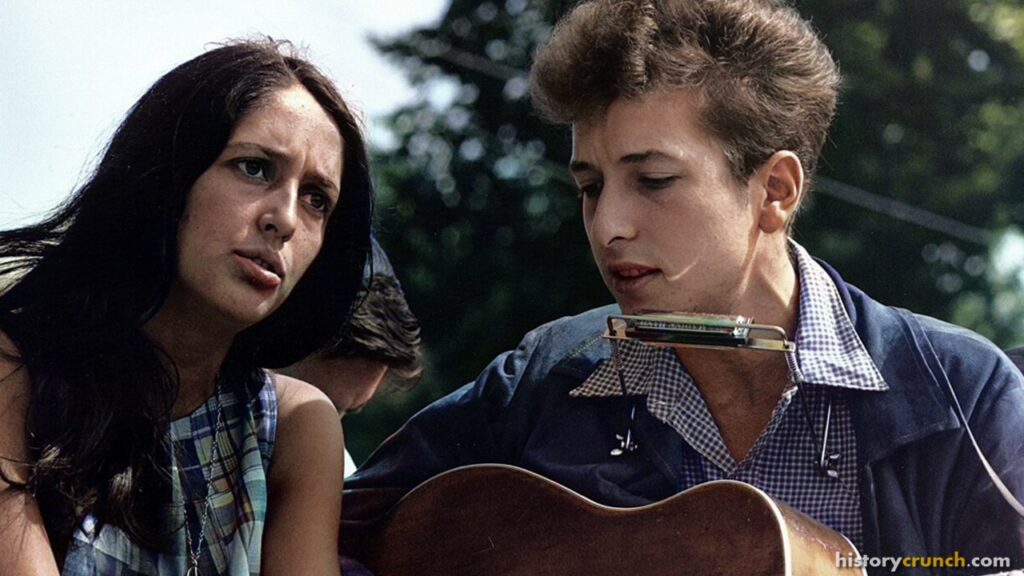
From August 15th to 18th, 1969 about 400,000 people gathered on a dairy farm in Bethel, New York for the Woodstock Music and Art Fair. The war ran through it: Country Joe McDonald led the crowd in his I-Feel-Like-I'm-Fixin'-to-Die Rag, a sarcastic marching song for draftees, and Jimi Hendrix closed the festival with a Star-Spangled Banner full of the sounds of bombs and sirens. Bob Dylan's Blowin' in the Wind of 1962 and John Lennon's Give Peace a Chance of 1969 were the movement's anthems.
LEARN MORESHOW LESSwhy it matters · key numbersCULTUREWoodstock was the counterculture at its largest, and the counterculture and the anti-war movement had become the same thing to most Americans, for and against. The music is how the war is remembered by people who were not there.
Ho Chi Minh died of heart failure in Hanoi on September 2nd, 1969, at 79, twenty-four years to the day after he had declared Vietnam's independence. He had been a figurehead for some years, with power in the hands of Le Duan and the Politburo, but he was the face of the revolution to the Vietnamese and to the world. His will asked to be cremated; instead his body was embalmed and put on display in a mausoleum in Ba Dinh Square.
LEARN MORESHOW LESSwhy it matters · key numbers · 1 key figurePOLITICALHo did not live to see the war won, but his death changed nothing in Hanoi's determination, which was the point Washington kept missing: the war was not one man's. When Saigon fell in 1975 it was renamed for him.
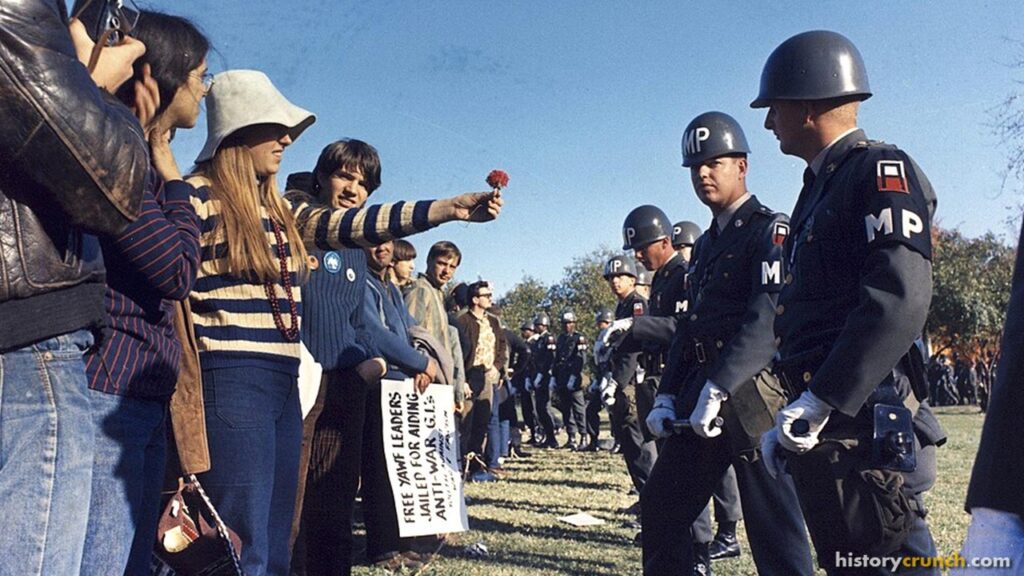
On October 15th, 1969 about two million Americans took part in the Moratorium to End the War in Vietnam, not in one place but in thousands: rallies, church services, teach-ins and vigils in cities, towns and campuses across the country. A month later, on November 15th, about 250,000 people marched in Washington, the largest anti-war demonstration in American history to that point. Richard Nixon said he watched football.
LEARN MORESHOW LESSwhy it matters · key numbers · 1 key figureSOCIALThe Moratorium was the moment the anti-war movement stopped being a minority of students and became a large part of the country: people in suits and church clothes, in small towns as well as Berkeley. Nixon answered it with his silent majority speech.
On November 3rd, 1969 Richard Nixon went on television to explain his plan: American troops would come home in stages while the ARVN, South Vietnam's own army, enlarged and rearmed, took over the fighting. He called it Vietnamization. He asked the great silent majority of Americans to support him against the protesters, and said that only Americans could defeat or humiliate the United States. His approval rating rose to 68 percent.
LEARN MORESHOW LESSwhy it matters · key numbers · a sourcePOLITICALVietnamization was the policy that ended the American war, and it was a bet that South Vietnam could do in three years what it had not done in fifteen. The bet was lost in 1975. The phrase silent majority became the name for the voters who would elect Republican presidents for a generation.
IN THEIR OWN WORDS“And so tonight, to you, the great silent majority of my fellow Americans, I ask for your support.”
Richard Nixon, television address, November 3rd, 1969
About 2.2 million men were drafted during the war, chosen by local boards under rules that let college students, and so the better off, defer. On December 1st, 1969, to make the system fairer, 366 capsules holding the days of the year were drawn from a glass jar in Washington, on television; men born on September 14th, the first date drawn, would be called first. Deferments were narrowed the next year and the draft ended on January 27th, 1973.
LEARN MORESHOW LESSwhy it matters · key numbersSOCIALThe draft is how the war reached every American family, and the resentment of its unfairness fed the protests. About 100,000 men fled the country or went to prison rather than serve; among them was the boxer Muhammad Ali, stripped of his title in 1967 for refusing.
Prince Norodom Sihanouk had kept Cambodia out of the war by letting both sides use it: the North Vietnamese had bases along the border and the Americans bombed them. On March 18th, 1970, while he was abroad, his prime minister, General Lon Nol, deposed him with the National Assembly's vote. Lon Nol demanded the North Vietnamese leave and turned to the United States; Sihanouk, from Beijing, allied himself with the Khmer Rouge, the small communist guerrilla movement he had been fighting.
LEARN MORESHOW LESSwhy it matters · key numbersPOLITICALThe coup turned Cambodia from a neutral with a problem into a battlefield with a civil war. The North Vietnamese pushed deeper into the country, the Americans invaded six weeks later, and the Khmer Rouge, with the prince's name behind them, grew from a few thousand into an army.
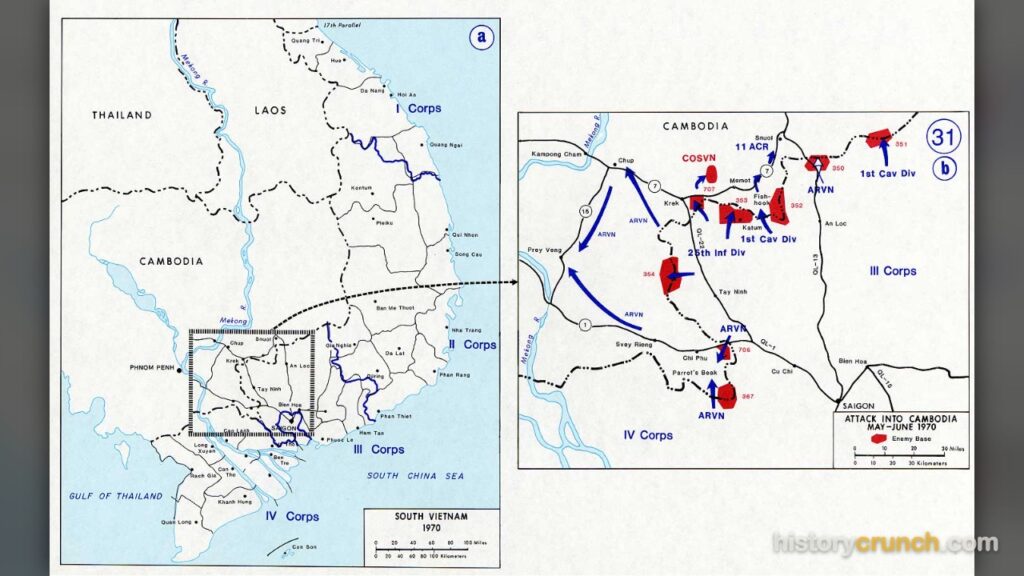
On the evening of April 30th, 1970 Richard Nixon told the country that American and South Vietnamese troops were attacking the North Vietnamese bases inside Cambodia, to buy time for Vietnamization; South Vietnamese units had crossed on April 29th and about 30,000 Americans followed on May 1st. He said the United States would not act like a pitiful, helpless giant. The troops found and destroyed large supply depots but not the headquarters they were looking for, and were out by June 30th.
LEARN MORESHOW LESSwhy it matters · key numbers · a sourceMILITARYThe invasion of a neutral country by a president who had promised to wind the war down set off the largest protests of the war: hundreds of campuses closed, and four students were shot dead at Kent State four days later. Congress, for the first time, voted to limit where the war could be fought.
IN THEIR OWN WORDS“If, when the chips are down, the world's most powerful nation acts like a pitiful, helpless giant, the forces of totalitarianism and anarchy will threaten free nations.”
Richard Nixon, television address, April 30th, 1970
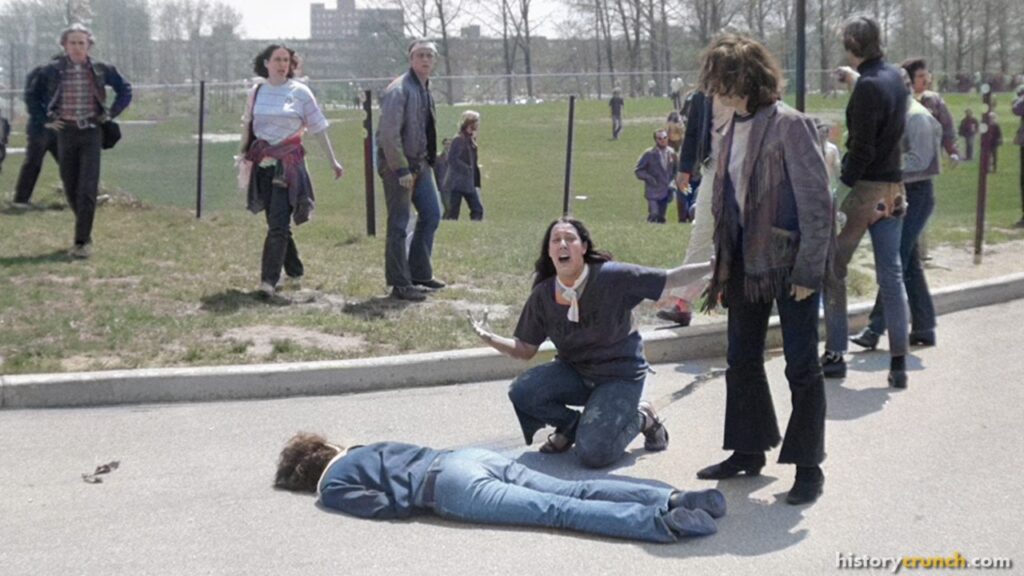
Protests against the Cambodian invasion began at Kent State University in Ohio on May 1st, 1970; the campus ROTC building was burned on May 2nd and the governor sent in the National Guard. At 12:24 in the afternoon of May 4th, after tear gas failed to clear a rally, 28 guardsmen turned and fired 67 shots in 13 seconds into the crowd. Four students died, two of them walking to class, and nine were wounded. A presidential commission called the shooting unjustified.
LEARN MORESHOW LESSwhy it matters · key numbers · a debateSOCIALKent State was the day the war came home with rifles. About 450 colleges closed in the strike that followed, 100,000 people marched on Washington within the week, and a photograph of a girl kneeling over a body became the image of a country at war with itself. Ten days later police killed two students at Jackson State in Mississippi.
Why did the guardsmen fire?
They said they feared for their lives from a crowd throwing rocks; a jury acquitted eight of them in 1974.
The nearest student killed was 265 feet away; the Scranton Commission found the shooting unnecessary, unwarranted and inexcusable.
On February 8th, 1971 about 17,000 South Vietnamese troops crossed into Laos to cut the Ho Chi Minh Trail at Tchepone, with American helicopters and aircraft but, by a new law, no American ground troops. It was Vietnamization's first test. The North Vietnamese met them with tanks and heavy artillery, and after six weeks the South Vietnamese retreated in disorder, some clinging to helicopter skids, with about half their force dead, wounded or missing.
LEARN MORESHOW LESSwhy it matters · key numbers · 1 key figureMILITARYLam Son 719 showed what South Vietnam's army could and could not do without Americans beside it, and both Hanoi and Washington drew the conclusion. Nixon called it a success on television; the pictures said otherwise.
In April 1971 about 1,000 members of Vietnam Veterans Against the War camped on the Mall in Washington for a week of protest they called Dewey Canyon III. On April 22nd a 27-year-old former navy lieutenant, John Kerry, told the Senate Foreign Relations Committee how do you ask a man to be the last man to die for a mistake. On April 23rd about 800 veterans walked to the Capitol and threw their medals and ribbons over a fence in front of it, one by one.
LEARN MORESHOW LESSwhy it matters · key numbers · a sourceSOCIALThe veterans took away the argument that protest was for people who had not served. Two days later about 500,000 people marched in Washington, and the following week the May Day protests brought 12,000 arrests in three days.
IN THEIR OWN WORDS“How do you ask a man to be the last man to die for a mistake?”
John Kerry, Senate Foreign Relations Committee, April 22nd, 1971
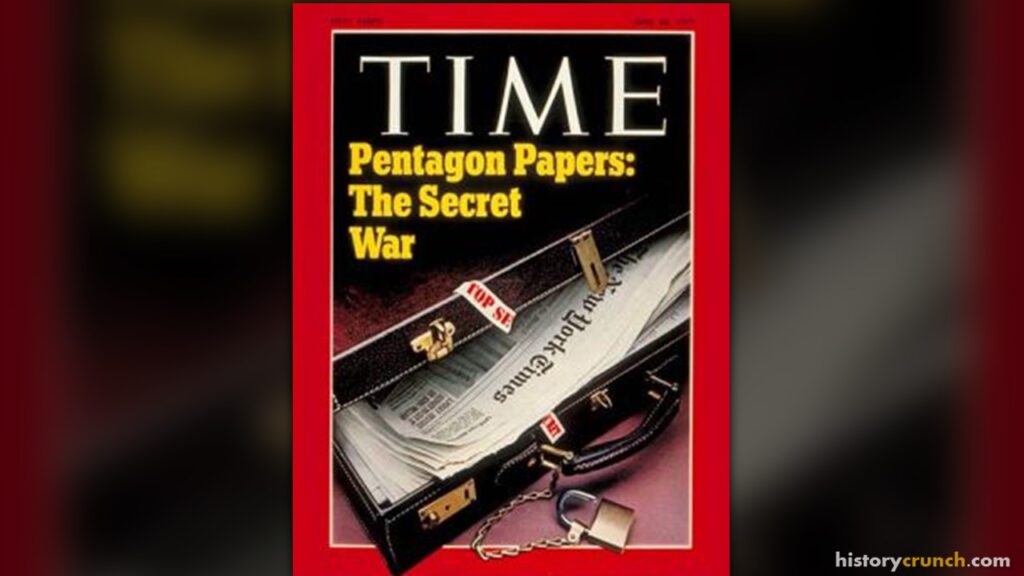
Daniel Ellsberg, a former Marine and Pentagon analyst who had worked on McNamara's study, photocopied it in secret in 1969 and gave 43 volumes to the New York Times. The first article ran on Sunday, June 13th, 1971. The Nixon administration got a court order stopping publication after three days, the first time the government had censored a newspaper in advance, and on June 30th the Supreme Court ruled 6 to 3 that the papers could print. Ellsberg surrendered and was charged under the Espionage Act.
LEARN MORESHOW LESSwhy it matters · key numbers · elsewherePOLITICALThe Pentagon Papers revealed four administrations that had misled the public about Vietnam, from the aid to France in 1950 to the Tonkin Resolution. The case set the rule that the government cannot stop a story before it runs, and Nixon's response, a burglary of Ellsberg's psychiatrist's office by the White House Plumbers, led to Watergate.
The Cold War timeline carries the Pentagon Papers as a home front card; this card is the story of the leak.
The draft took men at 18; the vote came at 21. Old enough to fight, old enough to vote had been a slogan since the Second World War, and the Vietnam draft made it a demand. Congress passed the 26th Amendment on March 23rd, 1971, 94 to 0 in the Senate and 401 to 19 in the House, and the states ratified it in 100 days, the fastest ever. It became law on July 1st, 1971, giving the vote to about 11 million people aged 18 to 20.
LEARN MORESHOW LESSwhy it matters · key numbers · elsewherePOLITICALThe amendment is the war's most lasting change to American law, and it came from the simplest argument the anti-war movement made. In 1972, the first election with the new voters, Richard Nixon won them anyway.
The Cold War timeline carries the amendment as a home front card; here it is the draft's answer.
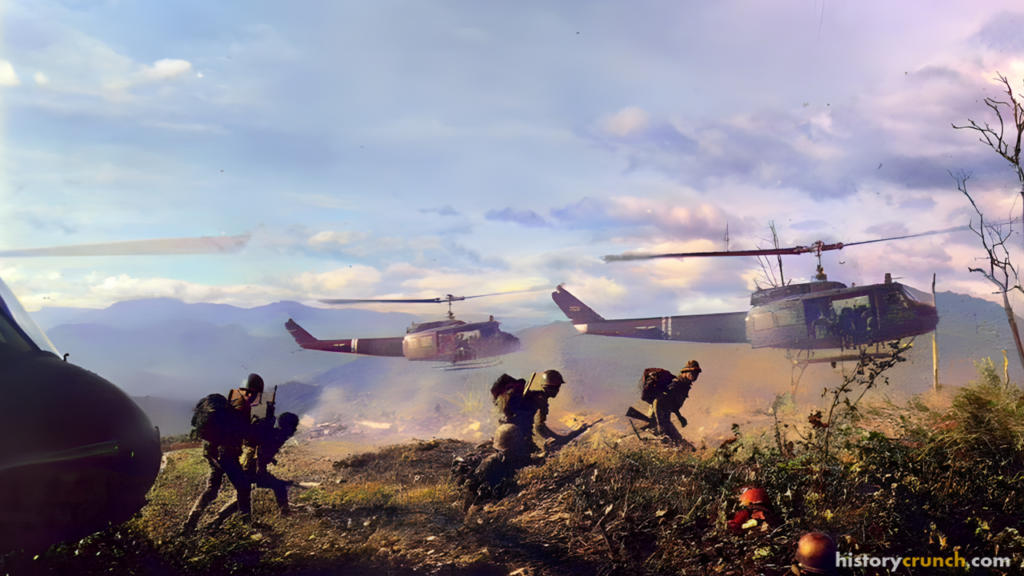
On March 30th, 1972, with only about 70,000 Americans left in Vietnam and almost none in combat units, North Vietnam sent about 120,000 troops and hundreds of Soviet tanks across the demilitarized zone and out of Laos and Cambodia in three thrusts. Quang Tri city fell on May 1st. South Vietnam's army broke in places and held in others, at An Loc and Kontum, and American air power, including B-52s over the battlefield, stopped the offensive by summer. Quang Tri was retaken in September.
LEARN MORESHOW LESSwhy it matters · key numbers · 1 key figureMILITARYThe Easter Offensive was Vietnamization's real test, and the result was mixed: South Vietnam survived, but only because American aircraft did much of the fighting. It also brought the bombing of the North back, and pushed both sides to settle in Paris before the American election.
In October 1972 Henry Kissinger and Le Duc Tho reached a draft agreement in Paris: a ceasefire, American withdrawal within 60 days, the return of prisoners, and North Vietnamese troops left in place in the South. President Thieu of South Vietnam, shown the terms, refused them. On October 26th, twelve days before the American election, Kissinger told reporters at the White House that peace is at hand. Richard Nixon won 49 states on November 7th.
LEARN MORESHOW LESSwhy it matters · key numbers · a sourcePOLITICALThe announcement won an election and then came apart: Thieu would not sign, Hanoi accused Washington of bad faith and walked out in December, and the war's last and heaviest bombing followed. The agreement signed in January 1973 was, in almost every line, the one of October.
IN THEIR OWN WORDS“We believe that peace is at hand.”
Henry Kissinger, White House press briefing, October 26th, 1972
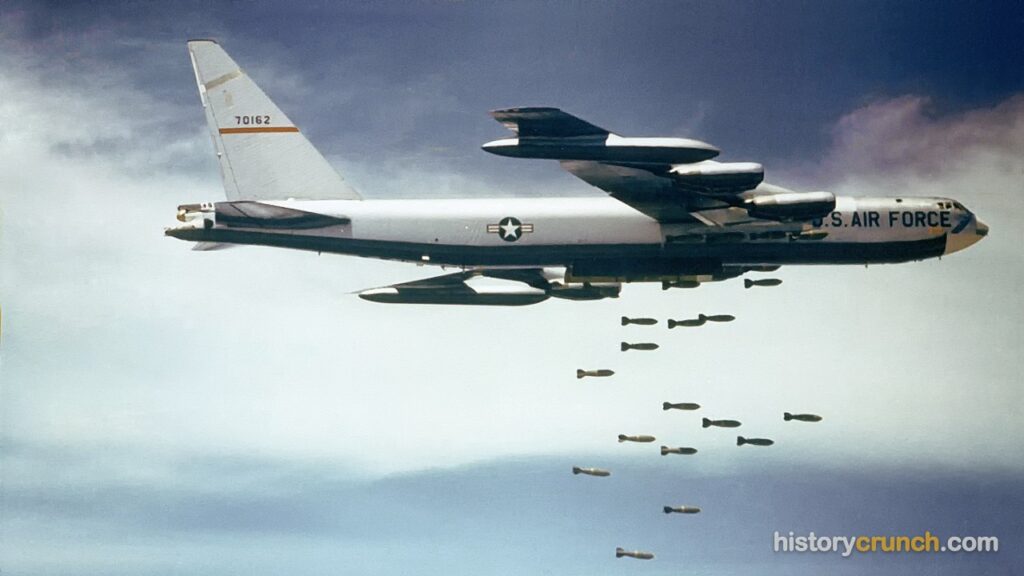
When the Paris talks broke down in December 1972, Richard Nixon ordered Operation Linebacker II. From December 18th to 29th, with a pause on Christmas Day, B-52s bombed Hanoi and Haiphong, the targets Lyndon Johnson had spared, in about 730 sorties with about 20,000 tons of bombs. Fifteen B-52s were shot down by Soviet-made missiles. North Vietnam said about 1,600 civilians were killed. Talks resumed on January 8th.
LEARN MORESHOW LESSwhy it matters · key numbers · a debateMILITARYNixon said the bombing forced Hanoi back to the table; Hanoi had agreed to return before it began, and the terms did not change. What it did do was show Thieu that the United States would punish the North for breaking the agreement, which got his signature. It was the last big American operation of the war.
Did the Christmas bombing work?
The talks resumed within ten days and the agreement was signed within a month.
The agreement was the one on the table in October; the bombing changed Thieu's mind, not Hanoi's.
The Paris Peace Accords of January 27th, 1973 ended the American war: the last troops left in March, the prisoners came home, the draft ended, and Congress passed laws to make sure no president could go back. The Vietnamese war went on. South Vietnam had a large army and no money to run it; North Vietnam had 150,000 troops in the South and a promise from Washington that no longer meant anything after Nixon resigned. In March 1975 the North attacked, the South's army collapsed in three weeks, and on April 30th a tank drove through the palace gates in Saigon.
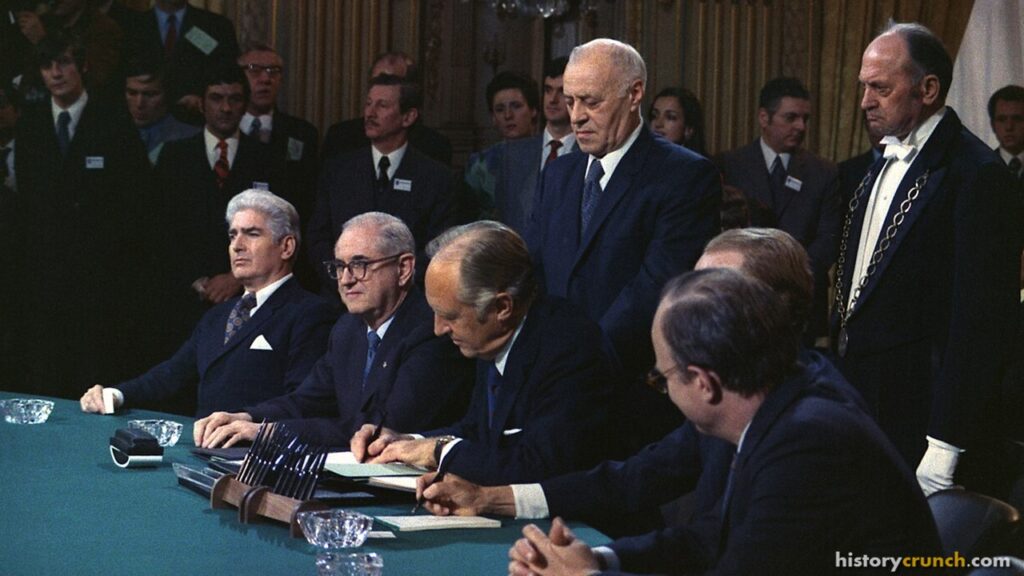
On January 27th, 1973 the United States, North Vietnam, South Vietnam and the Viet Cong signed the Agreement on Ending the War and Restoring Peace in Vietnam at the Hotel Majestic in Paris. A ceasefire began at midnight; all American troops would leave within 60 days and all prisoners would be returned; about 150,000 North Vietnamese troops stayed where they were in the South. The same day the Secretary of Defense announced the end of the draft. The last American killed in the war, Lieutenant Colonel William Nolde, died of shrapnel eleven hours before the ceasefire.
LEARN MORESHOW LESSwhy it matters · key numbers · a debatePOLITICALThe accords ended the American war and not the Vietnamese one. Henry Kissinger and Le Duc Tho were awarded the Nobel Peace Prize for them in October; Tho refused it, saying there was no peace, and he was right. Richard Nixon called it peace with honor.
The Cold War timeline carries the accords as detente's Vietnam chapter; this card is the agreement itself.
Was it peace with honor or a decent interval?
The agreement got every American out and every prisoner home, which is what the country wanted, and it gave South Vietnam a chance.
It left the North's army in the South and no way to enforce anything; Kissinger's own aides used the phrase decent interval for the gap between American withdrawal and the fall.
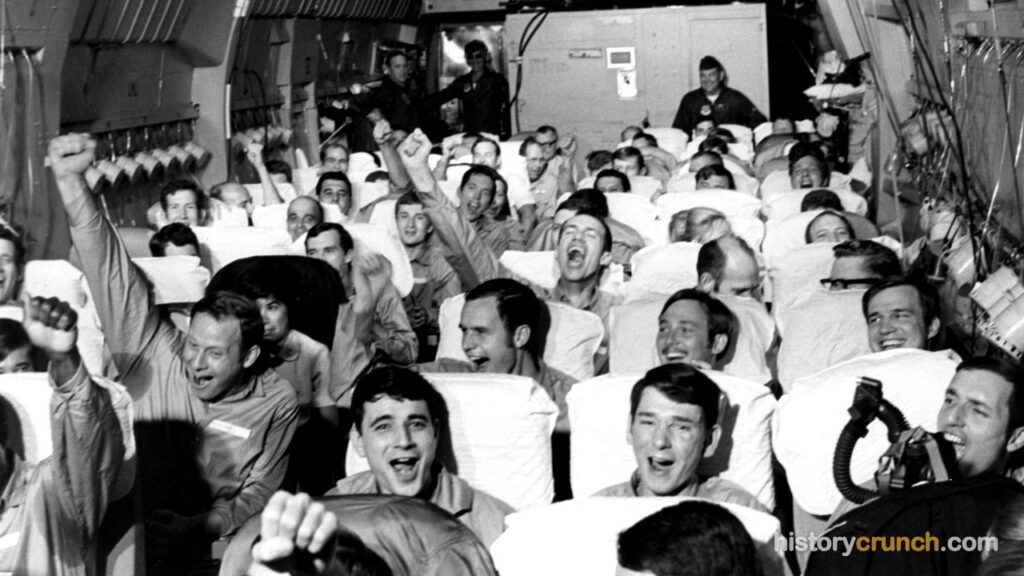
On February 12th, 1973 the first C-141 transport lifted off from Hanoi's Gia Lam airport with 40 American prisoners aboard, the longest-held first. Over the next seven weeks 54 flights brought home 591 men, most of them pilots, some of whom had been in Hoa Lo prison for more than eight years. Americans watched them walk or be carried off the planes at Clark Air Base in the Philippines and at home. The last flight was on April 4th.
LEARN MORESHOW LESSwhy it matters · key numbersSOCIALHomecoming was the one part of the ending the whole country could celebrate, and the prisoners, who had kept discipline through the tap code, were treated as the war's heroes. About 2,500 Americans were still listed as missing, and the question of whether any were left behind was investigated by the Senate until 1993, which found no evidence that any were.
On March 29th, 1973, sixty days after the ceasefire, the last American combat troops flew out of Tan Son Nhut air base and Military Assistance Command, Vietnam, the headquarters that had run the war since 1962, closed its doors. About 8,500 Americans stayed as embassy staff and civilian contractors. In eight years about 2.7 million Americans had served in Vietnam; 58,220 had died there.
LEARN MORESHOW LESSwhy it matters · key numbersMILITARYThe American war ended on this day, quietly, with no parade. The South Vietnamese army it left behind was one of the largest in the world and could not pay for its own fuel and ammunition once Congress cut the aid the next year.
On June 19th, 1973 the Senate passed the Case-Church Amendment, forbidding any American military action in Vietnam, Laos or Cambodia after August 15th without the approval of Congress. Richard Nixon, weakened by the Watergate hearings that had opened in May, signed it on July 1st. He had privately promised President Thieu that the United States would respond with full force if the North broke the ceasefire; the promise was now illegal to keep.
LEARN MORESHOW LESSwhy it matters · key numbers · 1 key figurePOLITICALCase-Church is the law that made the fall of South Vietnam certain, or that ended a war Congress should never have let start, depending on who is telling it. When the final offensive came in 1975 the president could do nothing, and Hanoi knew it.
After the Paris agreement the American bombing that had stopped in Vietnam went on in Cambodia, now openly, to keep the Khmer Rouge from taking Phnom Penh: about 250,000 tons in the first seven months of 1973 alone, more than fell on Japan in the Second World War. Congress ordered it to stop on August 15th, 1973, and it did. The Khmer Rouge, who had been about 4,000 men in 1970, were now about 60,000.
LEARN MORESHOW LESSwhy it matters · key numbersMILITARYThe bombing held Phnom Penh for two more years and helped fill the Khmer Rouge with recruits from the villages it destroyed. The full scale of it was not known until the records were released in 2000: about 2.7 million tons on Cambodia since 1965.
The Constitution gives Congress the power to declare war, and Vietnam had been fought for eight years without one, on the Tonkin Resolution. On November 7th, 1973 Congress passed the War Powers Resolution over Richard Nixon's veto: a president must tell Congress within 48 hours of sending troops into combat and bring them home within 60 days unless Congress approves. Nixon, who had been at war with Congress since the Cambodia invasion, called it unconstitutional.
LEARN MORESHOW LESSwhy it matters · key numbers · 1 key figurePOLITICALThe War Powers Act is Vietnam's answer to the question of who decides to fight, and it has been argued about ever since: every president since Nixon has said it does not bind him, and Congress has never enforced it. It stands as the war's lasting mark on the presidency.
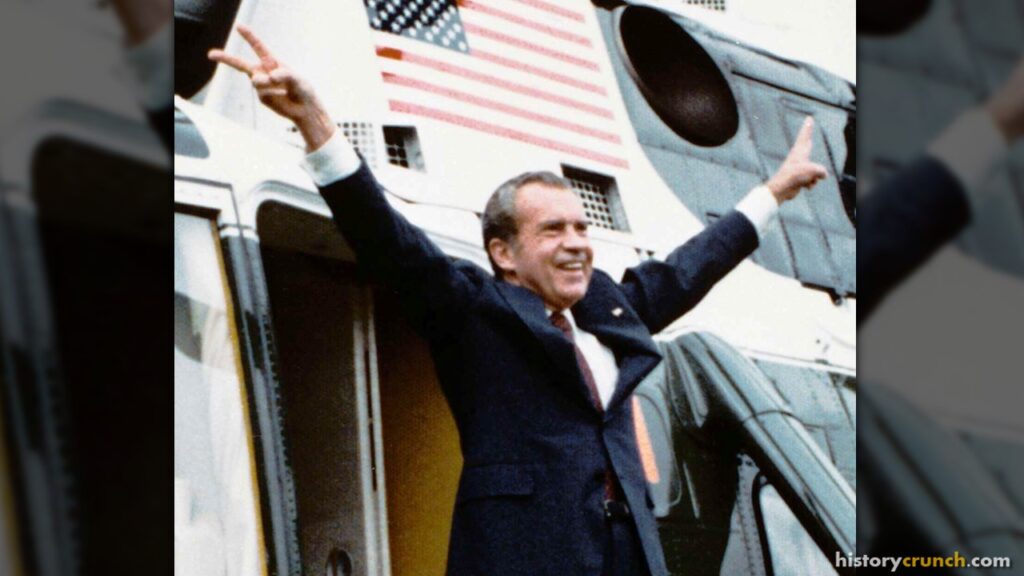
Richard Nixon resigned on August 9th, 1974 to avoid impeachment over Watergate, the burglary and cover-up that had grown from the White House Plumbers formed to stop leaks like the Pentagon Papers. Gerald Ford became president. In Saigon the news was read for what it was: the man who had promised Thieu in writing that the United States would answer any North Vietnamese attack was gone, and Congress cut military aid to South Vietnam from $2.2 billion to $700 million that autumn.
LEARN MORESHOW LESSwhy it matters · key numbers · elsewherePOLITICALHanoi's leaders concluded that autumn that the Americans would not come back, and planned a two-year campaign to take the South. It took 55 days. Watergate and Vietnam are one story: the secrecy of the war produced the crimes that ended the presidency.
The Cold War timeline carries Watergate; this card is what the resignation meant in Saigon and Hanoi.
In December 1974 North Vietnam attacked Phuoc Long, a province north of Saigon, as a test: would the Americans respond? The provincial capital fell on January 6th, 1975, the first in South Vietnam to be lost outright since 1972. Gerald Ford protested and asked Congress for $300 million in extra aid, which it refused. No American aircraft flew. Hanoi's Politburo read the answer and moved its main offensive forward from 1976 to March.
LEARN MORESHOW LESSwhy it matters · key numbers · 1 key figureMILITARYPhuoc Long was the small battle that decided the big one. Once Hanoi knew the B-52s were not coming, the only question about the South was how long its army would stand, and the answer turned out to be weeks.
On March 10th, 1975 North Vietnamese forces took Ban Me Thuot in the Central Highlands in two days. President Thieu ordered the Highlands abandoned, and the retreat down a single mountain road became a rout of soldiers and refugees under fire. Hue fell on March 25th and Da Nang, South Vietnam's second city, on March 30th, with troops fighting civilians for places on the last planes. In three weeks South Vietnam lost half its territory and most of its army.
LEARN MORESHOW LESSwhy it matters · key numbersMILITARYThe collapse was faster than either side had thought possible, and it settled the argument about Vietnamization: an army built to American specifications, without American fuel, spare parts and air cover, came apart in a month. Hanoi, which had planned for 1976, ordered the drive on Saigon.
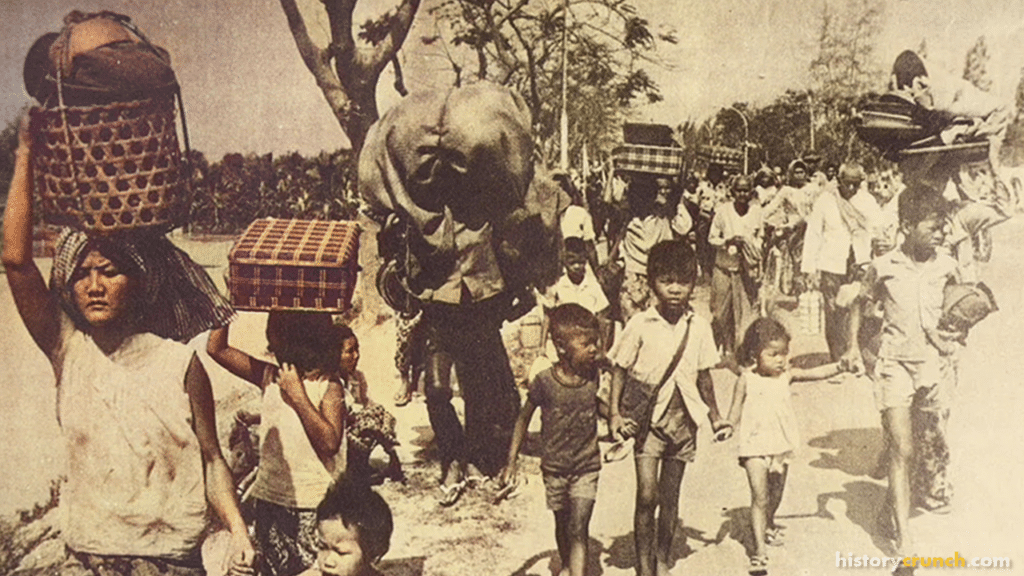
The Khmer Rouge entered Phnom Penh on April 17th, 1975, thirteen days before Saigon fell, and were cheered by a city that thought the war was over. Within hours they ordered everyone out, about two million people, including hospital patients, on foot into the countryside, to become farm laborers in a new society with no money, no schools, no religion and no cities. The American embassy had been evacuated by helicopter five days earlier.
LEARN MORESHOW LESSwhy it matters · key numbers · 1 key figureMILITARYThis was the beginning of the Cambodian Genocide, in which about 1.7 million people, a fifth of the country, died of execution, starvation and overwork in under four years. The war in Vietnam had spilled into Cambodia; what followed there was worse than the war.
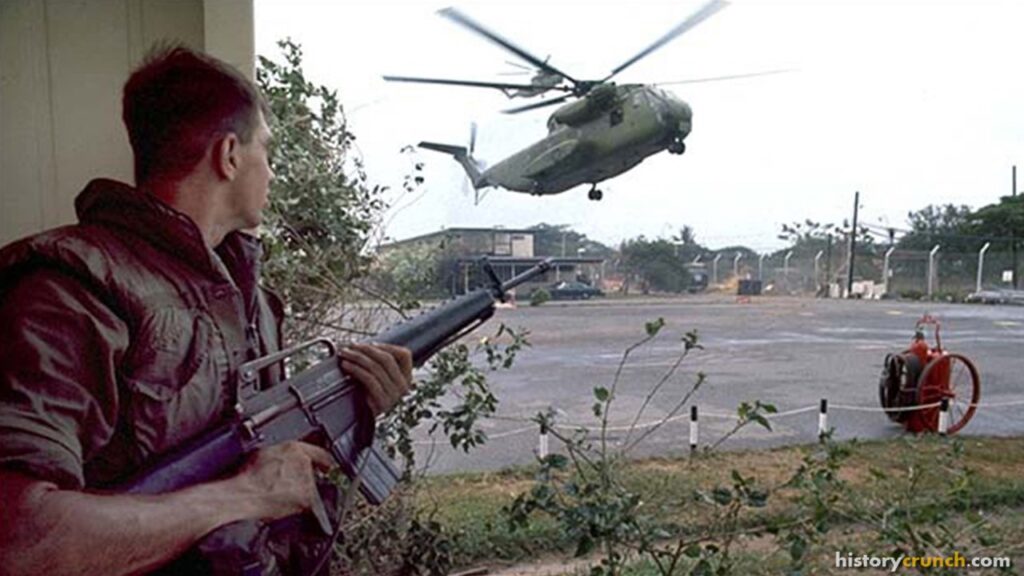
At Xuan Loc, forty miles east of Saigon, the South Vietnamese 18th Division held off three North Vietnamese divisions for twelve days, the last real battle of the war; it fell on April 21st, 1975. The same evening President Nguyen Van Thieu resigned on television, blaming the United States for abandoning him, and flew to Taiwan with his family. The Americans began Operation Frequent Wind, the evacuation of Saigon, eight days later.
LEARN MORESHOW LESSwhy it matters · key numbers · a sourcePOLITICALThieu had led South Vietnam for ten years and left it with a week to live. His farewell speech, that the Americans had promised and had not kept their word, is the South's own account of why it lost, and it is not the only one.
IN THEIR OWN WORDS“The United States has not respected its promises. It is inhumane. It is untrustworthy. It is irresponsible.”
Nguyen Van Thieu, resignation speech, April 21st, 1975
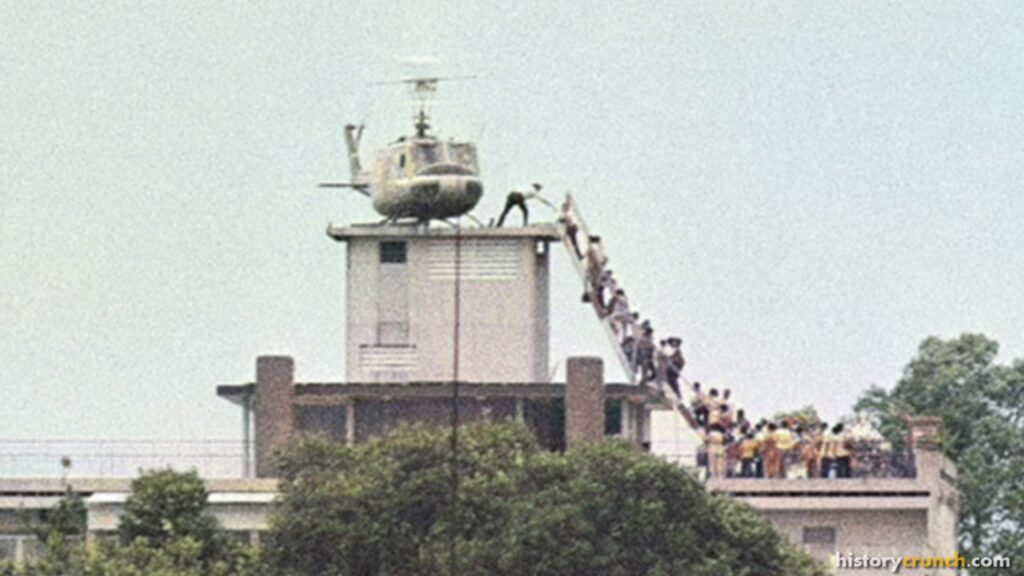
On April 29th, 1975, with North Vietnamese shells falling on the airport, American helicopters began lifting people from the embassy roof and other rooftops to ships offshore: about 7,000 Americans and Vietnamese in 19 hours, while thousands more who had worked for the Americans were left at the gates. The last Marines flew off the embassy at dawn on April 30th. At about 11:30 that morning a North Vietnamese tank crashed through the gates of the Independence Palace and the South Vietnamese government surrendered. The city was renamed Ho Chi Minh City.
LEARN MORESHOW LESSwhy it matters · key numbers · a debateMILITARYThe fall of Saigon ended the Vietnam War thirty years after Ho Chi Minh declared independence and twenty-one years after the country was divided. It was the first war the United States had lost, and the pictures of the helicopters became the shorthand for it.
The Cold War timeline carries Saigon as containment's defeat; this card is the last day.
Why did South Vietnam fall?
Because Congress cut the aid and the air cover it had been built to depend on, after promising both.
Because it was a state built from outside, with a corrupt government and an army that would not fight for it, and no amount of aid could change that.
Vietnam became one country in 1976, with prison camps and an exodus of boat people. Cambodia, which the war had broken, got the Khmer Rouge and a genocide that killed a fifth of its people before Vietnam's army ended it in 1979. In America the war was fought over again in films and books, in lawsuits over Agent Orange, and in the argument about a black granite wall with 58,000 names that became, once it was built, the place the country went to grieve. In 1995 the two countries restored relations, and the man who had run the war wrote that it had been wrong.
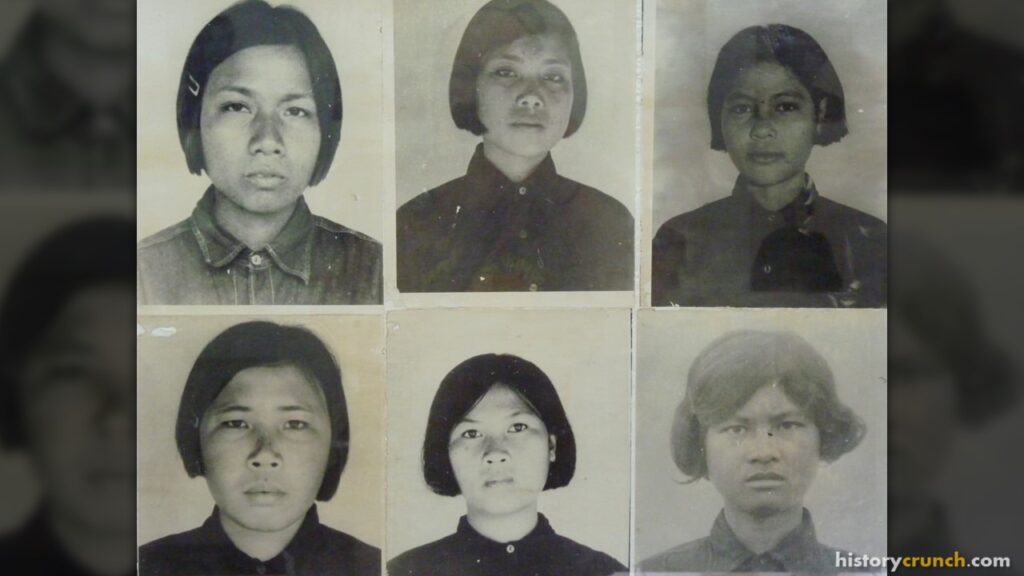
On January 5th, 1976 the Khmer Rouge proclaimed Democratic Kampuchea, and in April Pol Pot, a former schoolteacher who had studied in Paris, became prime minister. Cambodia was turned into one farm: cities emptied, families split, teachers, doctors, monks and anyone with glasses or soft hands killed as enemies. At Tuol Sleng, a Phnom Penh high school made into a prison, about 14,000 people were photographed, tortured and taken to be killed; about twelve survived.
LEARN MORESHOW LESSwhy it matters · key numbers · 1 key figurePOLITICALThe Cambodian Genocide killed between 1.5 and 3 million people out of about 8 million, and it happened while the world was looking away from Indochina. The photographs from Tuol Sleng are the faces of it.
On July 2nd, 1976 North and South Vietnam were formally joined as the Socialist Republic of Vietnam, one communist country with its capital in Hanoi, twenty-two years after the Geneva Conference had divided it. About 300,000 South Vietnamese who had served the old government were sent to reeducation camps, some for more than a decade, and over the next twenty years about 800,000 people fled the country by sea, the boat people.
LEARN MORESHOW LESSwhy it matters · key numbersPOLITICALReunification was what Ho Chi Minh had declared in 1945 and what the war had been about, and it came with prison camps and an exodus. The country the United States had fought to keep divided is now one, and it trades with America.
Hollywood had mostly avoided the war while it was on. The Deer Hunter, released on December 8th, 1978, followed three steelworkers from Pennsylvania into captivity and won the Academy Award for best picture; Apocalypse Now in 1979 turned the war into a river journey into madness. Platoon in 1986, by the veteran Oliver Stone, and Full Metal Jacket in 1987 followed. Michael Herr's Dispatches of 1977 and Tim O'Brien's The Things They Carried of 1990 did the same in print.
LEARN MORESHOW LESSwhy it matters · key numbersCULTUREFor most Americans born after 1960 the Vietnam War is these films and books, more than any history. They set the image of the war as a nightmare that damaged the men sent to it, an image the veterans themselves had mixed feelings about.
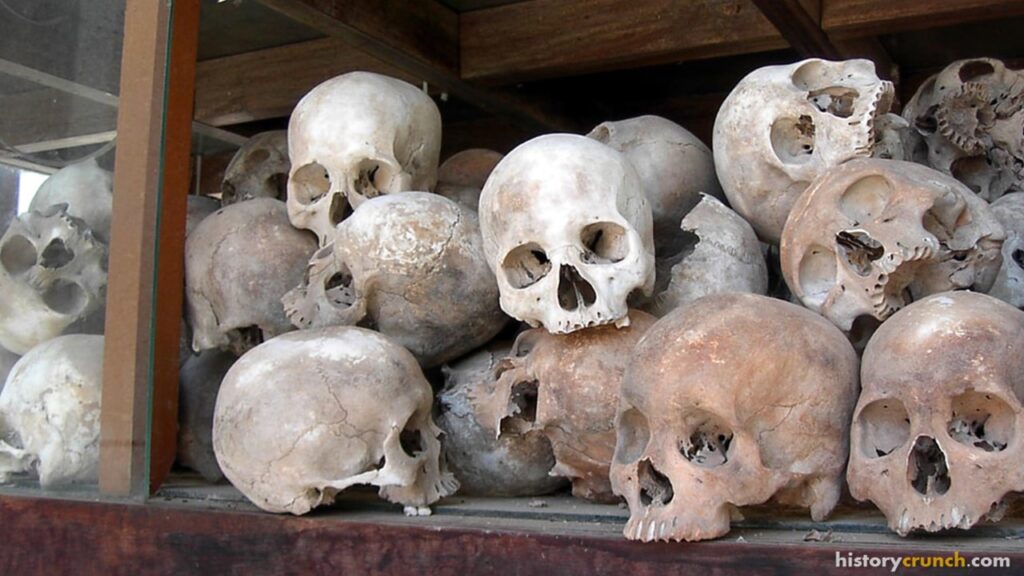
The Khmer Rouge had been raiding across the Vietnamese border and killing Vietnamese villagers, and on December 25th, 1978 Vietnam invaded with about 150,000 troops. Phnom Penh fell on January 7th, 1979 and the Khmer Rouge retreated to the Thai border, where they fought on for another twenty years. The Vietnamese found the mass graves, the killing fields, and the prison at Tuol Sleng with its files and its photographs.
LEARN MORESHOW LESSwhy it matters · key numbers · 1 key figureMILITARYThe genocide was ended by the communist neighbor the Khmer Rouge had been fighting, not by the outside world, which went on seating the Khmer Rouge at the United Nations until 1991. Pol Pot died in 1998 without a trial; the tribunal that tried his lieutenants began in 2006.
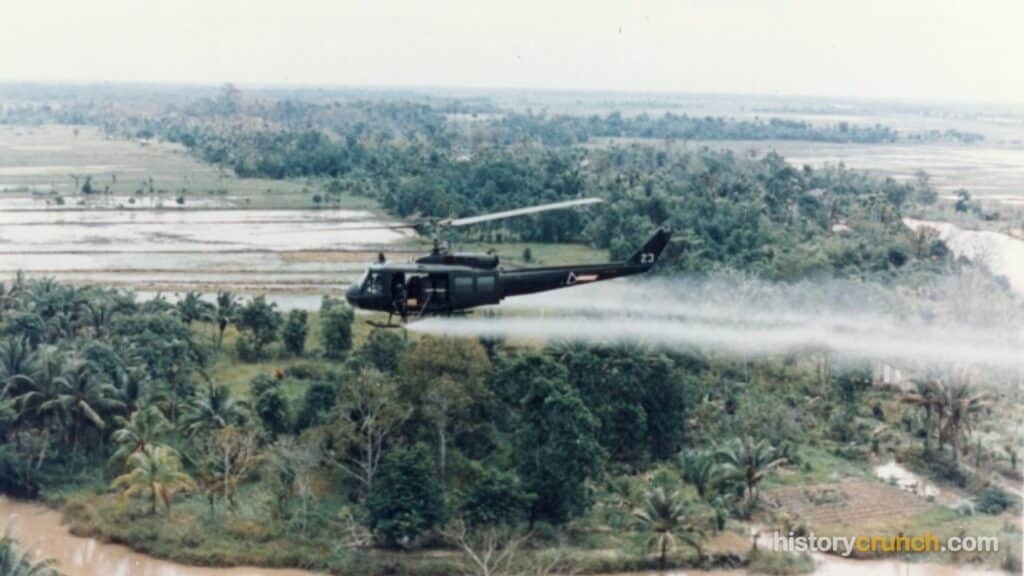
In 1979 Vietnam veterans with cancers, skin disease and children born with defects filed a class action against Dow Chemical, Monsanto and the other companies that had made Agent Orange. The companies settled in May 1984, on the morning the trial was to begin, for $180 million, without admitting harm. On February 6th, 1991 George H.W. Bush signed the Agent Orange Act, which presumed that certain diseases in Vietnam veterans were caused by the spraying and paid for their care.
LEARN MORESHOW LESSwhy it matters · key numbersSOCIALAgent Orange was the war's slowest wound, and the veterans had to fight their own government and the companies for a decade to have it recognized. In Vietnam, where the spraying happened, about three million people are estimated to have been affected, and the United States began cleaning up the old air bases only in 2012.

A veteran named Jan Scruggs raised the money, Congress gave the land on the Mall in 1980, and a 21-year-old architecture student, Maya Lin, won the design competition with two black granite walls sunk into the ground and carrying the name of every American who died, in the order they died. Veterans' groups called it a black gash of shame and a statue of three soldiers was added nearby in 1984. The wall was dedicated on November 13th, 1982, after a week of ceremonies in which every name was read aloud.
LEARN MORESHOW LESSwhy it matters · key numbersSOCIALThe wall became the most visited memorial in Washington and the place where the country made its peace with the men it had sent, if not with the war. People leave letters, medals and photographs at it; the National Park Service keeps them all.
Twenty years after Saigon fell, on July 11th, 1995, President Bill Clinton announced full diplomatic relations with Vietnam, with the support of two senators who had fought there, John McCain, a prisoner for five and a half years, and John Kerry. The trade embargo had been lifted in 1994. The same year Robert McNamara published In Retrospect, the memoir in which he wrote that the war had been wrong, terribly wrong.
LEARN MORESHOW LESSwhy it matters · key numbers · a sourcePOLITICALNormalization is where the timeline ends because it is where the war finally did: the two countries that had fought it shook hands, and the man who had run it said it had been a mistake. Vietnam is now one of America's larger trading partners in Asia.
IN THEIR OWN WORDS“We were wrong, terribly wrong. We owe it to future generations to explain why.”
Robert McNamara, In Retrospect, 1995

I'm the founder of History Crunch, which I first began in 2015 with a small team of like-minded professionals. I have an Education Degree with a focus in Social Studies education. I spent nearly 15 years teaching history, geography and economics in secondary classrooms to thousands of students. Now I use my time and passion researching, writing and thinking about history education for today's students and teachers.

I'm a passionate history and geography teacher with over 15 years of experience working with students in the middle and high school years. I have an Education Degree with a focus in World History. I have been writing articles for History Crunch since 2015 and love the challenge of creating historical content for young learners!
To cite this timeline as a source, use one of the formats below.
MLA: Millar, B., and Elias Beck. “Vietnam War Timeline.” HistoryCrunch, 12 September 2026, https://historycrunch.com/vietnam-war-timeline/.
APA: Millar, B., & Beck, E. (2026). Vietnam War Timeline. HistoryCrunch. https://historycrunch.com/vietnam-war-timeline/
Chicago: Millar, B., and Elias Beck. “Vietnam War Timeline.” HistoryCrunch. September 12, 2026. https://historycrunch.com/vietnam-war-timeline/
© History Crunch
Vietnam was a small country nine thousand miles from California with no oil and no army that could reach the United States. Why did five presidents decide it was worth fighting for?
Historians argue about whether the war was a mistake from the start or a good policy badly carried out. One view holds that containment was right and Vietnam was the wrong place to apply it: a nationalist revolution mistaken for a Soviet plot. Another holds that the commitment was reasonable in 1954 and 1961 and became a trap only when Johnson chose to fight rather than negotiate. A third, held by the war's defenders, is that the war was winnable and was lost at home.
Ho Chi Minh left Vietnam in 1911 as a kitchen hand and died in 1969 as the leader of a state that had beaten France and was beating the United States. How did he do it, and what did he want?
Was Ho Chi Minh a Vietnamese George Washington or a Vietnamese Stalin? His admirers point to forty years of fighting foreign rule, his modest life and his refusal to build a cult in his lifetime. His critics point to the land reform of 1955 and 1956, which killed thousands, the one-party state he built, and the fact that his movement destroyed every non-communist nationalist rival. Both are true, and the American war was fought by people who saw only one.
The United States chose Ngo Dinh Diem to run South Vietnam in 1954, called him a miracle man in 1957, and let his generals kill him in 1963. What went wrong?
Was the coup against Diem the moment the war was lost? One school says yes: Diem, for all his faults, was a nationalist with real authority, and the generals who replaced him were creatures of Washington whom nobody in Vietnam respected. Another says Diem had already lost the war in the villages and the cities, and no ruler who had made enemies of the Buddhists and the peasants could have been kept. Kennedy's own doubts, on the tape he made after the coup, come down on both sides.
Two destroyers, three torpedo boats, one real attack and one that never happened. How did the events of a week in August 1964 give the United States a war it fought for nine years?
Did Johnson lie about the Gulf of Tonkin? The evidence, including a National Security Agency study released in 2005, is that the second attack did not happen and that the intelligence was mishandled rather than invented, and that Johnson believed the reports on the night. What is not in doubt is that he used an attack he came to doubt within days to get a resolution he had written in advance, and never told Congress either thing.
The United States dropped more bombs on Vietnam, Laos and Cambodia than all sides dropped in the Second World War. Why did the strongest air force on earth not break a country with no air force of its own?
Airmen have argued since 1968 that the bombing failed because politicians restricted it, and that the Christmas bombing, unrestricted, showed what air power could do. Critics answer that the Christmas bombing changed nothing in the Paris terms, and that North Vietnam, a farming country with a small industry and an ally supplying everything it needed, simply had no targets whose loss would make it quit.
The Tet Offensive was thrown back in days and cost the communists about 40,000 men. Within two months the American president had stopped the bombing and given up his office. How does a side lose a battle and win the war?
Was Tet a communist defeat that American reporting turned into a victory, as Westmoreland and many veterans argued? Or was it a communist victory because its goal was political, to break American will, and it did? Most historians now hold that Hanoi hoped for a general rising and did not get it, that the offensive was a military disaster for the Viet Cong, and that it won anyway, because the war was always about whether the United States would stay.
The United States dropped more bombs on the Ho Chi Minh Trail than were dropped in all of World War II. Supplies kept coming. Why?
Historians and analysts argue about whether interdiction could ever have worked. Some say more bombing, earlier and without political limits, would have strangled the supply. Others argue that the target was too dispersed, the labor to repair it effectively unlimited, and that the bombing's main achievement was to devastate Laos and Cambodia without changing the outcome.
In 1965 the war's opponents were a few thousand students. By 1969 two million Americans took part in one day of protest. What made the movement grow, and did it end the war?
Did the anti-war movement end the war? Its veterans say it forced Johnson out and kept Nixon from escalating further. Nixon's defenders say it prolonged the war by telling Hanoi that America would quit, and that his silent majority speech showed most Americans were against the protesters. Historians mostly find that public opinion turned against the war because of casualties and Tet, not because of the marches, but that the marches made the turn impossible to ignore.
About 27 million American men came of draft age during the war. About 2.2 million were drafted, and most of them were poor. How did the draft work, and what did it do to the country?
Was the draft the war's great injustice or its great check? Critics say it sent the poor to fight while the well-off got deferments, and that ending it was the war's one clear reform. Others answer that a drafted army is a citizen army, that the draft is what made the country care about the war and end it, and that an all-volunteer force has let later presidents fight long wars that most Americans never notice.
A secret history written by the government, copied by one of its authors and printed by a newspaper the government tried to stop. What did the Pentagon Papers show, and why did the leak matter more than the secrets?
Was Daniel Ellsberg a hero or a criminal? He broke the law and said so, and he chose which secrets to reveal. His defenders say the secrets were the government's lies to its own people and that a democracy cannot fight a war it is not allowed to know about. His critics, then and since, say that officials who leak what they personally disapprove of make government impossible. The Supreme Court decided only the narrower question, and decided it for the newspaper.
Vietnam was the first war fought in front of cameras every evening. Did that change what happened, or only what people remember?
This is a genuine dispute. One argument, popular with the war's supporters afterwards, is that the press lost a war the army was winning. Studies of actual coverage found most reporting was neutral or supportive until officials themselves began to disagree in public. The stronger version of the argument now is that television made the gap between official statements and visible reality impossible to sustain.
Cambodia was neutral. By 1979 it had been bombed by the United States, invaded by the United States and South Vietnam, taken by the Khmer Rouge, emptied of its cities and invaded by Vietnam, and a fifth of its people were dead. How?
Did the American bombing cause the Khmer Rouge? One side holds that the bombing killed tens of thousands of peasants, destroyed the villages and drove the survivors into the arms of the only people fighting the bombers, and that Pol Pot's own recruiters said so. The other holds that the Khmer Rouge were a fanatical movement with a plan already written, that Sihanouk's endorsement did more for them than the bombs, and that blaming Washington takes responsibility off the men who did the killing.
The United States dropped more bombs on Laos than on Germany and Japan together, and never admitted it was at war there. What was it fighting for, and what did it leave behind?
Was the secret war in Laos necessary? Its defenders say the Trail had to be attacked somewhere and Laos was where it was, and that the secrecy protected a neutral government that wanted the help but could not admit it. Its critics say a war hidden from Congress is unconstitutional whatever its purpose, that the bombing killed tens of thousands of Laotian villagers who had nothing to do with the Trail, and that it did not stop the trucks.
About 800 American airmen were held in North Vietnam, some for more than eight years, in solitary cells and under torture. How did they survive, and why did their homecoming matter so much?
Were the prisoners used? Nixon made their return the war's stated purpose from 1969, and critics said he was using 600 men to justify keeping 300,000 in the field for four more years. The prisoners themselves mostly rejected the charge and supported the war and the bombing that they believed got them out. The question of whether any were left behind was raised for twenty years, and a Senate committee that included two former prisoners found no evidence that any were.
The United States sprayed 20 million gallons of herbicide and dropped 388,000 tons of napalm on Vietnam. What were they for, what did they do, and why were Americans still arguing about them thirty years later?
Were the chemicals a war crime? Their defenders say herbicides were legal, were used to save American lives by removing ambush cover, and were not known at the time to contain a dangerous poison. Critics say the army knew about dioxin by 1965 and kept spraying, that crop destruction starved civilians on purpose, and that napalm on villages was a deliberate terror. The Agent Orange Act settled the veterans' question; the Vietnamese victims have never been compensated.
On one morning in March 1968 American soldiers killed about 500 unarmed villagers. One man was convicted and served three years at home. What happened, why, and what did the country do with it?
Was My Lai an aberration or the war's logic? The army's inquiry treated it as a breakdown in one unit under bad officers, and the veterans of the Americal Division mostly agreed. Critics, including many soldiers, said that free-fire zones, body counts and a war in which the enemy looked like everyone else made My Lai the extreme case of an ordinary thing. Calley's public support, over 70 percent thought his sentence too harsh, suggests most Americans blamed the war rather than the man.
The draft called up millions, and the people who ended up in combat were not a cross-section of America. Who went, and who did not?
Historians disagree about how unequal the burden really was. Detailed studies show deferments skewed service toward the less wealthy, though the gap is smaller than popular memory suggests, and volunteers made up a large share of those who served. What is not disputed is that the perception of unfairness drove much of the opposition.
It is remembered as an American war. South Korea sent 300,000 men, Australia sent troops, and the Vietnamese on both sides did most of the fighting and dying. Who is missing from the story?
Historians increasingly argue that calling this the Vietnam War from an American perspective distorts it. Vietnamese scholarship treats it as one phase of a thirty-year struggle over independence and unification. The disagreement is about whether the Cold War framing or the anti-colonial framing explains more.
Millions of gallons of herbicide were sprayed to remove cover. The spraying stopped in 1971. The consequences did not.
The science and the law diverged here. Reviews have found sufficient evidence of association for some conditions and limited evidence for others, and the uncertainty is genuine. Critics argue the burden of proof was set so that veterans and Vietnamese civilians could not meet it. Defenders of the manufacturers argue they supplied what the government specified.
Lyndon Johnson won the largest presidential landslide in a century in 1964 and did not dare run in 1968. What did Vietnam do to him, and what did he do to it?
Was Johnson trapped or did he choose? His defenders say he inherited a commitment from two presidents and a Congress and a public that would have destroyed him for losing Vietnam, and that every choice he made was the least bad one available. His critics say the tapes show a man who knew in 1964 the war could not be won and escalated anyway to protect his domestic program and his reputation, and that a president who knows that and does it is not trapped.
Richard Nixon was elected in 1968 to end the war and it went on for four more years and 21,000 more American dead. What was his plan, and did it work?
Did Nixon prolong the war for four years to protect his own election, or fight it to a settlement that gave South Vietnam a chance? His defenders point to the withdrawal of 500,000 men, the prisoners returned and the agreement signed, and blame Congress for cutting the aid that would have held the South. His critics point to 21,000 Americans and hundreds of thousands of Vietnamese and Cambodians killed for terms that were available in 1969, and to the phrase decent interval in his own adviser's papers.
The secretary who ran the war by the numbers and the general who counted the bodies both told the country it was winning. One came to believe it was lost and said nothing; the other never stopped believing. What did each of them get wrong?
Was McNamara's silence a failure of courage or a duty? He believed by 1967 that the war could not be won and said nothing in public for 27 years, on the grounds that a cabinet officer serves the president. His critics say that 30,000 Americans died after he knew, and that his memoir asked forgiveness from the wrong people. Westmoreland's case is the mirror: he never doubted, and his defenders say the country's loss of will, not his strategy, lost the war.
America had nuclear weapons, could have invaded the north and could have mined the harbours years earlier. Why fight with one hand tied?
Military critics argue that gradualism gave the enemy time to adapt and that decisive force early would have worked. Others reply that the Korean experience made a wider war with China a genuine risk, and that the limits were the price of keeping the conflict contained.
Peace talks opened in May 1968 and the agreement was signed in January 1973. About 20,000 Americans and hundreds of thousands of Vietnamese died in between. What took so long?
Could the war have been ended in 1969 on the terms of 1973? Critics of Nixon and Kissinger say yes: Hanoi's basic demand, that its troops stay in the South, was the same throughout, and the four years bought only a decent interval. Their defenders say Hanoi also demanded Thieu's removal until October 1972 and dropped it only after the Easter Offensive failed, so the years of fighting did change the terms. The question is which demand mattered more, and the fall of 1975 suggests the troops did.
Nixon's plan was to hand the war to South Vietnam's army and leave. The army grew to a million men with American equipment. Why did it collapse in fifty-five days?
Was Vietnamization a real strategy or a way to leave? Its defenders, including many South Vietnamese officers, say the ARVN of 1972 was a real army that beat a full-scale invasion and would have held in 1975 with the aid and air support it had been promised. Its critics say an army that needs another country's air force to survive is not an army, that the South's government never earned its soldiers' loyalty, and that Vietnamization was always a decent interval with a training program attached.
America never lost a major battle and lost the war. Was there any strategy that would have produced a different result?
Two schools argue about this. The revisionist case holds that the war was winnable, that Vietnamization was working by 1972, and that Congress lost it by cutting aid. The orthodox case holds that no amount of force could create a legitimate South Vietnamese state, and that the war was unwinnable at any acceptable cost from the beginning.
The United States never declared war on Vietnam. Congress passed a resolution after a naval incident that was reported inaccurately. Who was actually deciding?
Constitutional historians disagree about the War Powers Act. Some see it as a necessary correction restoring Congress's role. Others argue it is unconstitutional in the other direction, or simply ineffective, since presidents have largely continued to act first and inform Congress afterwards.
South Vietnam had one of the largest armies in the world in January 1975 and no government in April. How does a country of twenty million people fall in fifty-five days?
Who lost South Vietnam? Thieu and his defenders blamed the United States, which had promised force and money and sent neither. Americans who had fought there often blamed Congress. Historians mostly find a state that had never had its people's loyalty and an army that had been built to fight an American war, and a leadership whose one big decision, to abandon the Highlands, turned a loss into a rout. The North's generals, for their part, said they had planned for two years and needed two months.
Saigon fell in 1975 and the last card on this timeline is dated 1995. What happened to Vietnam, Cambodia and the United States in the twenty years between, and how did the war finally end?
Did the domino theory turn out to be wrong? After 1975 Laos and Cambodia went communist, which the theory predicted, and Thailand, Malaysia and Indonesia did not, which it also predicted would happen. Within four years the communist dominoes, Vietnam, Cambodia and China, were at war with each other. Most historians hold that the theory mistook nationalism for a single communist plan; a few argue that the American stand bought Southeast Asia the years it needed to stabilize.
The war ended in April 1975. For hundreds of thousands of Vietnamese, the hardest part started then. What happened next?
Historians argue about how to weigh the aftermath. Critics of the war point out that the predicted bloodbath in Vietnam was far smaller than warned, and that the worst killing was in Cambodia, destabilized partly by American bombing. Defenders of the war argue the camps and the exodus vindicate the warnings. Both sides agree the human cost did not end in 1975.
No question matches that word.
Research question 1Vietnam was a small country nine thousand miles from California with no oil and no army that could reach the United States. Why did five presidents decide it was worth fighting for?
Research question 2Ho Chi Minh left Vietnam in 1911 as a kitchen hand and died in 1969 as the leader of a state that had beaten France and was beating the United States. How did he do it, and what did he want?
Research question 3The United States chose Ngo Dinh Diem to run South Vietnam in 1954, called him a miracle man in 1957, and let his generals kill him in 1963. What went wrong?
Research question 4Two destroyers, three torpedo boats, one real attack and one that never happened. How did the events of a week in August 1964 give the United States a war it fought for nine years?
Research question 5The United States dropped more bombs on Vietnam, Laos and Cambodia than all sides dropped in the Second World War. Why did the strongest air force on earth not break a country with no air force of its own?
Research question 6The Tet Offensive was thrown back in days and cost the communists about 40,000 men. Within two months the American president had stopped the bombing and given up his office. How does a side lose a battle and win the war?
Research question 7The United States dropped more bombs on the Ho Chi Minh Trail than were dropped in all of World War II. Supplies kept coming. Why?
Research question 8In 1965 the war's opponents were a few thousand students. By 1969 two million Americans took part in one day of protest. What made the movement grow, and did it end the war?
Research question 9About 27 million American men came of draft age during the war. About 2.2 million were drafted, and most of them were poor. How did the draft work, and what did it do to the country?
Research question 10A secret history written by the government, copied by one of its authors and printed by a newspaper the government tried to stop. What did the Pentagon Papers show, and why did the leak matter more than the secrets?
Research question 11Vietnam was the first war fought in front of cameras every evening. Did that change what happened, or only what people remember?
Research question 12Cambodia was neutral. By 1979 it had been bombed by the United States, invaded by the United States and South Vietnam, taken by the Khmer Rouge, emptied of its cities and invaded by Vietnam, and a fifth of its people were dead. How?
Research question 13The United States dropped more bombs on Laos than on Germany and Japan together, and never admitted it was at war there. What was it fighting for, and what did it leave behind?
Research question 14About 800 American airmen were held in North Vietnam, some for more than eight years, in solitary cells and under torture. How did they survive, and why did their homecoming matter so much?
Research question 15The United States sprayed 20 million gallons of herbicide and dropped 388,000 tons of napalm on Vietnam. What were they for, what did they do, and why were Americans still arguing about them thirty years later?
Research question 16On one morning in March 1968 American soldiers killed about 500 unarmed villagers. One man was convicted and served three years at home. What happened, why, and what did the country do with it?
Research question 17The draft called up millions, and the people who ended up in combat were not a cross-section of America. Who went, and who did not?
Research question 18It is remembered as an American war. South Korea sent 300,000 men, Australia sent troops, and the Vietnamese on both sides did most of the fighting and dying. Who is missing from the story?
Research question 19Millions of gallons of herbicide were sprayed to remove cover. The spraying stopped in 1971. The consequences did not.
Research question 20Lyndon Johnson won the largest presidential landslide in a century in 1964 and did not dare run in 1968. What did Vietnam do to him, and what did he do to it?
Research question 21Richard Nixon was elected in 1968 to end the war and it went on for four more years and 21,000 more American dead. What was his plan, and did it work?
Research question 22The secretary who ran the war by the numbers and the general who counted the bodies both told the country it was winning. One came to believe it was lost and said nothing; the other never stopped believing. What did each of them get wrong?
Research question 23America had nuclear weapons, could have invaded the north and could have mined the harbours years earlier. Why fight with one hand tied?
Research question 24Peace talks opened in May 1968 and the agreement was signed in January 1973. About 20,000 Americans and hundreds of thousands of Vietnamese died in between. What took so long?
Research question 25Nixon's plan was to hand the war to South Vietnam's army and leave. The army grew to a million men with American equipment. Why did it collapse in fifty-five days?
Research question 26America never lost a major battle and lost the war. Was there any strategy that would have produced a different result?
Research question 27The United States never declared war on Vietnam. Congress passed a resolution after a naval incident that was reported inaccurately. Who was actually deciding?
Research question 28South Vietnam had one of the largest armies in the world in January 1975 and no government in April. How does a country of twenty million people fall in fifty-five days?
Research question 29Saigon fell in 1975 and the last card on this timeline is dated 1995. What happened to Vietnam, Cambodia and the United States in the twenty years between, and how did the war finally end?
Research question 30The war ended in April 1975. For hundreds of thousands of Vietnamese, the hardest part started then. What happened next?