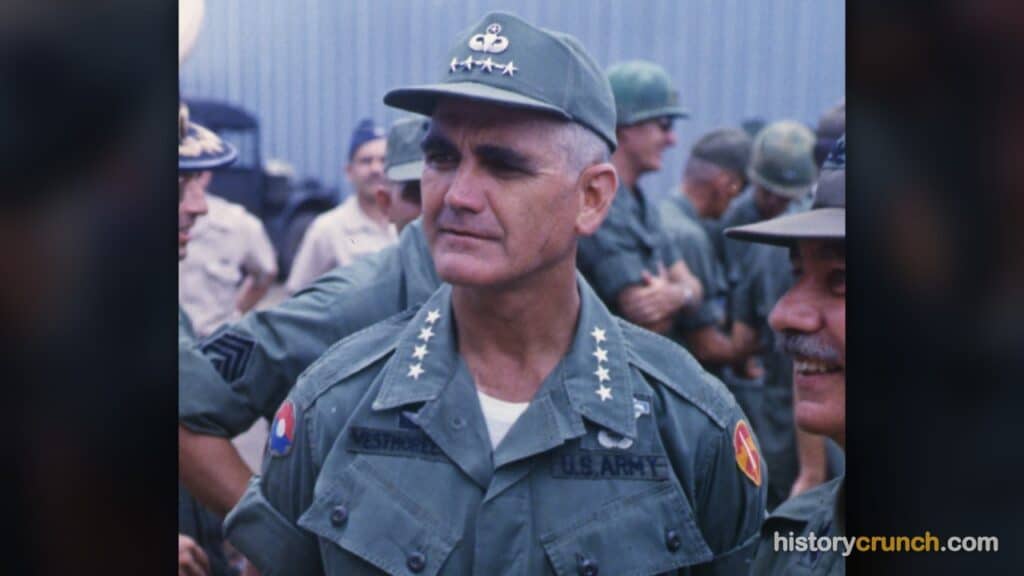
William Westmoreland was the American general who commanded United States forces during the most intense years of the Vietnam War, and his decisions helped shape how that conflict was fought and how it was remembered. As the commander of the U.S. Military Assistance Command, Vietnam, often shortened to MACV, he directed the enormous buildup of American troops and the overall military strategy from 1964 to 1968. General William Westmoreland, the American commander of Military Assistance Command Vietnam from 1964 through 1968, remains one of the most contentious personalities of the Vietnam War, still the subject of intense debate among veterans and historians of the war. His name became closely tied to the war’s rising costs, its public controversy, and the difficult question of why the world’s strongest military could not win.
Early Life and Background
William C. Westmoreland was born in Saxon, South Carolina, on March 26, 1914. Westmoreland was born into an affluent middle-class family in South Carolina, his father a textile plant manager. Growing up in the American South during the early 20th century, he showed an early interest in leadership and service. As a teenager, Westmoreland was heavily involved in the Boy Scouts movement.
His education pointed him toward a military career from a young age. After graduating from The Citadel, a state-supported military college in Charleston, South Carolina, he attended the US Military Academy at West Point. West Point is the training academy where the United States Army educates its future officers. Westmoreland graduated from West Point in 1936, receiving the Pershing Sword for military proficiency, and was commissioned as a Second Lieutenant in the Field Artillery. The Pershing Sword was an award given to the top cadet in military ability, which marked him early on as a promising young officer.
Rise Through the Army
Westmoreland first saw combat during World War II, the global conflict that lasted from 1939 to 1945. He joined the 9th Infantry Division in 1941 and saw action during WWII in North Africa and Sicily as Battalion commander of the unit’s 34th Field Artillery. He was present at the Battle of Kasserine Pass in early 1943, one of the first major clashes between American and German forces in the war. After further exploits in France and Germany, Westmoreland returned to the U.S. to complete his airborne training at Fort Benning before serving as the 82nd Airborne Division’s Chief of Staff from 1947 to 1950.
He continued to build his reputation during the Korean War, which was fought from 1950 to 1953. In 1952 he led the 187th Airborne Regimental Combat Team in three campaigns across the Korean peninsula and was decorated for his effective leadership. His rise afterward was remarkably fast for a peacetime army. In December 1956 he was promoted to major general; at 42 years old, he was then the youngest person holding that rank in the U.S. Army.
By the start of the 1960s, Westmoreland had reached the very top ranks of the officer corps. After commanding the 101st Airborne Division from 1958 to 1960, he was made superintendent at West Point. This role placed him in charge of the academy where he had once trained. In fact, his record of steady promotion and combat experience made him a natural choice when the United States began looking for a commander to lead its growing effort in Southeast Asia.
Command in Vietnam
The Vietnam War grew out of the Cold War struggle between communist and non-communist powers. After France lost control of its colony, France was defeated at the battle of Dien Bien Phu in 1954 and North Vietnam came under the control of Ho Chi Minh and his communist forces. The country was then split in two. As well, in 1954, at a conference in Geneva, the country of Vietnam was officially divided along the 17th parallel. The United States backed South Vietnam in an effort to stop communism from spreading through the region.
Westmoreland arrived as the American role was expanding quickly. In January 1964 Westmoreland was named Deputy Commander of Military Assistance Command, Vietnam (MACV). Six months later, following the departure of General Harkins, he became Acting Commander and on 1st August 1964 he was promoted to General and Commander of MACV. As stated above, this happened just as tensions were rising sharply. The Gulf of Tonkin incident in 1964 would ultimately see the tensions in the region rapidly increase and cause the United States to take an increased role.
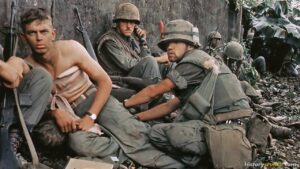
Under Westmoreland’s command, the number of American troops in Vietnam soared. Over the next four years, the general directed much of U.S. military strategy during the Vietnam War, spearheading the buildup of American troops in the region from 16,000 to more than 500,000. His central plan was a strategy of attrition, meaning he aimed to kill enemy fighters faster than they could be replaced. His strategy of attrition aimed to inflict heavy losses on North Vietnamese and Viet Cong forces using superior U.S. firepower, but resulted in a costly stalemate by late 1967.
To carry out this plan, Westmoreland relied heavily on mobility and technology. Beginning in 1965, Westmoreland sent large numbers of soldiers on “search and destroy” operations using helicopters and high-tech weapons to find and kill Viet Cong forces. The Viet Cong were communist guerrilla fighters operating inside South Vietnam. The goal was not to seize and hold territory, but to inflict more losses than the Communist forces could sustain. For a time this approach appeared to be working, and Time magazine named him its Man of the Year for 1965.
In reality, the strategy struggled against the kind of war the enemy chose to fight. Westmoreland’s “war of attrition” overlooked the enemy’s skill for irregular or guerrilla warfare and drastically underestimated the nationalist zeal and will to fight that motivated North Vietnamese and Viet Cong forces. As the fighting dragged on, the enemy simply kept sending more soldiers. As American troop levels were raised, the enemy matched the numbers.
The Tet Offensive and Its Aftermath
The turning point of Westmoreland’s command came in early 1968. The Tet Offensive was a major turning point in the Vietnam War and began on January 30th, 1968, when the Viet Cong and North Vietnamese Army launched a series of surprise attacks across South Vietnam. The attacks struck across the country at once. The offensive expanded on January 31st, 1968, and eventually struck more than 100 towns and cities, including Saigon, Huế, and many provincial capitals.
American and South Vietnamese forces eventually pushed back the attackers and inflicted heavy losses on the communist side. Even so, the shock of the offensive damaged public confidence in the war. Though U.S. and South Vietnamese forces managed to hold off the attacks, news coverage of the massive offensive shocked the American public and eroded support for the war effort. For many Americans, the scale of the assault seemed to contradict the optimistic reports they had been hearing.
The offensive directly undercut Westmoreland’s public claims of progress. The enemy’s ambitious Tet Offensive in early 1968 cast serious doubt on Westmoreland’s claims of progress in the war effort, even as he called for some 200,000 more troops. This large new request troubled leaders in Washington and helped end his time as commander. In June, President Johnson replaced Westmoreland in command of the MACV.
Rather than being demoted, Westmoreland was moved into the Army’s highest job at home. Several months later Westmoreland was posted back to Washington and replaced by General Creighton Abrams. He served as US Army chief of staff until 1972. As chief of staff, he helped manage the difficult period when the United States began pulling its forces out of Vietnam.
Later Life
After leaving active duty, Westmoreland remained a public figure who defended his record. In retirement, Westmoreland was a resolute defender of both the Vietnam War and his own service. He also became a strong supporter of the men who had served under him. Back in the United States, Westmoreland fought off criticisms of his conduct of the war (including a libel lawsuit against CBS News) and became a dedicated supporter of Vietnam veterans.
The lawsuit against CBS became one of the most famous legal battles of his later years. It began after a 1982 television documentary called “The Uncounted Enemy: A Vietnam Deception” suggested that Westmoreland had misled leaders about enemy troop strength. He sued the network for a very large sum, but the trial ended without a verdict. Faced with the prospect of a lengthy legal battle against difficult odds, Westmoreland settled his case with CBS out of court on February 18, 1985. Both sides agreed to pay their own legal fees, and of the $120 million for which Westmoreland had sued, he got nothing.
Westmoreland never wavered in his belief that he had done his duty. For some Westmoreland was irrevocably tainted by the war, so much so that in 1985 he told the Associated Press “I have no apologies, no regrets. I gave my very best efforts.” He lived to an advanced age, remaining a symbol of a war that many Americans still argued about. He died in July 2005, aged 91.
Significance of William Westmoreland
Westmoreland’s importance comes from the fact that he commanded American forces during the years when the United States committed most fully to the Vietnam War. General William C. Westmoreland presided over the buildup of U.S. forces in Vietnam. More specifically, he was the officer most closely identified with the strategy, the troop levels, and the public promises of that period. The highest profile American general of the Vietnam War, William Westmoreland oversaw the U.S. troop build up and was a key architect of the military strategy.
His career also shows how a strategy can fail even when a military wins most of its battles. His reliance on firepower and attrition against a determined guerrilla enemy is often studied as an example of misjudging the true nature of a conflict. In fact, the debate over whether he lacked strategic vision or was simply given an impossible task continues among historians today.
Finally, Westmoreland became a lasting symbol of the wider tragedy of Vietnam. His confident statements before the Tet Offensive, followed by the shock of that offensive, helped mark the moment when American public opinion turned against the war. For that reason, his name remains tied to one of the most painful and divisive chapters in United States history.
Frequently Asked Questions
Who Was William Westmoreland?
William Westmoreland was a United States Army general who commanded American forces in Vietnam from 1964 to 1968. He had already served in World War II and the Korean War before Vietnam, and he later became the Army’s chief of staff. He is best remembered for leading the huge buildup of American troops during the war’s most intense years.
What Was Westmoreland’s War Strategy in Vietnam?
Westmoreland used a strategy of attrition, which meant trying to kill more enemy soldiers than the communist side could replace. He measured progress partly through body counts rather than through capturing and holding land. This approach depended on American advantages in helicopters, artillery, and air power, but it struggled against an enemy willing to absorb heavy losses.
Why Was Westmoreland Removed From Command?
Westmoreland was reassigned in 1968 largely because of the fallout from the Tet Offensive and his request for about 200,000 more troops. Leaders in Washington doubted that sending so many additional soldiers would bring victory. Instead of being punished, he was promoted to Army chief of staff, the service’s top position.
What Was the Westmoreland CBS Lawsuit About?
The lawsuit came after a 1982 CBS documentary accused Westmoreland of deliberately underreporting enemy troop numbers. He sued the network for $120 million, claiming the program had wrongly damaged his reputation. The case was settled out of court in 1985 with no money paid and each side covering its own legal costs.
Did Westmoreland Ever Regret His Role in Vietnam?
No, Westmoreland publicly said he had no regrets about his service in Vietnam. He spent his later years defending both the war and his own decisions, even as many Americans criticized him. He also worked to support Vietnam veterans until his death in 2005 at the age of 91.
Cite This Article
To cite this article as a source, use one of the formats below.
MLA: Millar, B. “William Westmoreland: A Detailed Biography.” HistoryCrunch, 16 August 2026, https://historycrunch.com/william-westmoreland/.
APA: Millar, B. (2026). William Westmoreland: A Detailed Biography. HistoryCrunch. https://historycrunch.com/william-westmoreland/
Chicago: Millar, B. “William Westmoreland: A Detailed Biography.” HistoryCrunch. August 16, 2026. https://historycrunch.com/william-westmoreland/
Sources
- Jerry Bentley & Herbert Ziegler, Traditions & Encounters: A Global Perspective on the Past.
- J.M. Roberts & Odd Arne Westad, The Penguin History of the World.