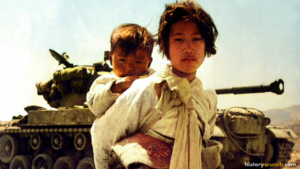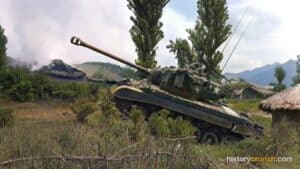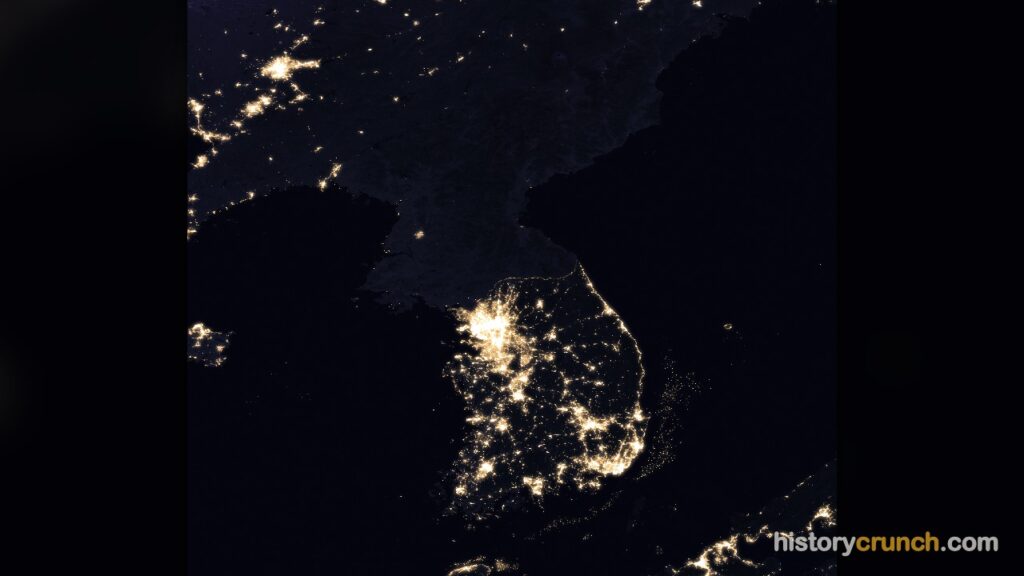
The division of Korea is one of the most important developments of the early Cold War, and its effects are still felt today. A single country with a shared language, culture, and thousands of years of history was split into two rival states along an imaginary line on a map. That division soon led to a devastating war, and it left behind a border that remains one of the most heavily guarded places on Earth. Understanding how Korea came to be divided helps explain the origins of the Korean War and the long standoff between North Korea and South Korea.
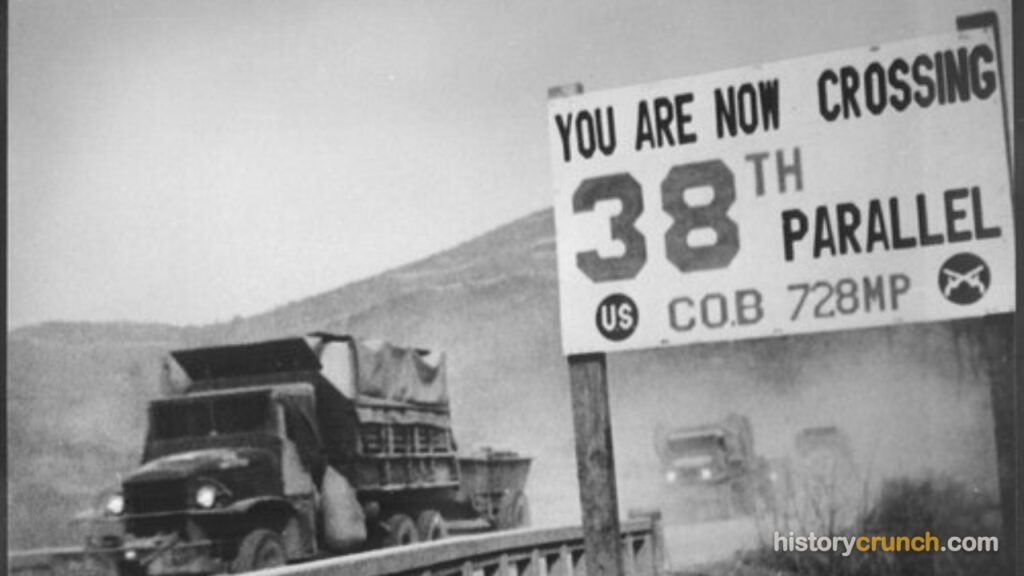
The division of Korea refers to the splitting of the Korean Peninsula into two occupation zones in 1945, at the end of World War II, and the creation of two separate governments in 1948. The northern zone became a communist state supported by the Soviet Union, while the southern zone became a capitalist state supported by the United States. The two superpowers used a line of latitude called the 38th parallelA line of latitude used as the dividing line between the Soviet and American occupation zones in Korea after 1945. as the dividing line between their zones.
The 38th parallel was chosen because it followed an ancient border between historical Korean kingdoms.

What Was the Cold War?
The Cold War was the long period of tension and competition between the United States and the Soviet Union that lasted from the end of World War II in 1945 until the early 1990s. At its heart, the Cold War was a face-off between two very different ways of organizing a country. The United States was a democratic nation based mainly on individual freedom and capitalism, while the Soviet Union was a communist nation based on collectivism and government control of the economy.
This clash of ideas shaped much of the world in the second half of the twentieth century. Throughout the Cold War, the Soviet Union tried to spread communism to new regions, and the United States tried to stop it through a policy called containmentA U.S. foreign policy aimed at preventing communism from spreading to new countries or regions.. In fact, the two sides rarely fought each other directly. Instead, they backed opposing groups in smaller conflicts around the globe, and Korea became one of the very first places where this larger struggle turned into open war.
FactsthatCrunchWhy Was Korea Under Foreign Control?
For centuries, Korea existed as an independent kingdom with its own rulers and traditions. That independence came to an end in 1910, when the Empire of Japan annexedTook control of another country or territory and made it part of your own nation by force or legal declaration. Korea and turned it into a colony. During the 35 years of Japanese rule that followed, Korea’s people faced harsh treatment. The Japanese government worked to suppress the Korean language and culture, exploited Korean workers, and violently crushed Korean movements for independence.
This period of colonial rule pushed many Koreans into resistance, but the resistance itself was divided. Some fighters were communists who operated from the north and from nearby areas under Soviet influence. Others were nationalists who organized abroad, including in the United States. As a result, Korean politics were already split between communist and nationalist camps long before any line was drawn across the country.
FactsthatCrunchAnnexation is when one country takes control of another territory and adds it to itself, usually by force or political pressure, without the agreement of the people living there. The absorbed territory loses its separate status and comes under the laws and government of the country that seized it. Annexation differs from an alliance because the territory is no longer independent.
Japan's annexation of Korea in 1910 ended Korean self-rule, placed the peninsula under Japanese law, and set conditions that lasted until Japan's defeat in 1945, directly shaping the division that led to the Korean War.
How Did the Division Begin in 1945?
The division of Korea grew directly out of the end of World War II. When Japan surrendered in August of 1945, its colonial rule over Korea suddenly collapsed, leaving the country without a government. In the final days of the war, the Soviet Union declared war on Japan and pushed its powerful army south into Korea. The United States grew alarmed at how quickly Soviet troops were advancing.
To keep the Soviet Union from taking control of the entire peninsula, American officials proposed dividing Korea along the 38th parallel. Under this plan, Soviet forces would accept the Japanese surrender north of the line and American forces would accept it south of the line. The Soviets agreed to the proposal. Importantly, the arrangement placed the capital city of Seoul inside the American zone.
The division was only meant to be temporary. The plan was to eventually reunite Korea under a single government once the major powers could work out the details. American troops landed in the south in September of 1945, and the two zones began to take shape. In reality, however, the line hardened as the Cold War deepened, and the temporary border slowly became permanent.
FactsthatCrunchHow did two U.S. officers draw the 38th parallel in about 30 minutes?
What Was the Trusteeship Plan?
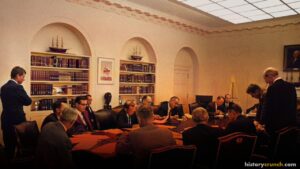
In December of 1945, the foreign ministers of the United States, the Soviet Union, and the United Kingdom met in Moscow to decide Korea’s future. They agreed to place Korea under a trusteeshipAn arrangement where outside powers temporarily govern or guide a country until it is ready for full independence., which meant that outside powers would guide the country for up to five years before it became fully independent. A joint commissionA shared committee of Soviet and American officials meant to help create a single unified Korean government. of Soviet and American officials was supposed to help form a single Korean government.
The plan failed almost from the start. Many Koreans strongly opposed the idea of being controlled by foreign powers for even a few more years, and the two superpowers could not agree on which Korean groups should take part in a new government. As the joint commission broke down, the gap between north and south grew wider. More specifically, each zone began building its own institutions along the lines favored by the superpower that occupied it.
FactsthatCrunchWhy Did the Trusteeship Plan for Korea Fail?
The Soviet side on the Joint Commission insisted that only Korean political groups that had already supported the trusteeship could join the talks, which shut out most of the political parties in the south and caused the commission to deadlock through 1946 and 1947. At the same time, many Korean leaders in the south rejected the plan outright, because they saw a five-year foreign guardianship as another delay of the independence they had waited decades to gain. With no agreement reached, the United States handed the matter to the United Nations in September 1947, and separate governments formed on each side of the 38th parallel by 1948.
How Were Two Governments Created in 1948?
When talks between the superpowers collapsed, the United States brought the Korea question to the United Nations in 1947. The United Nations called for elections across all of Korea to create a single unified government. However, Soviet authorities refused to let United Nations observers enter the northern zone, which made a nationwide vote impossible.
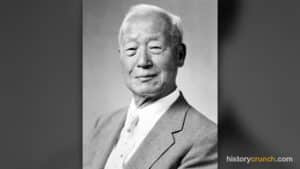
As a result, elections were held only in the south in May of 1948. This vote led to the creation of the Republic of Korea, or South Korea, on August 15th, 1948, with Syngman Rhee as its first president. In response, the north held its own elections and proclaimed the Democratic People’s Republic of Korea, or North Korea, on September 9th, 1948, with Kim Il-Sung as its leader.
Both new governments claimed to be the only rightful ruler of the entire peninsula, and neither recognized the other. By 1949, both Soviet and American combat troops had largely withdrawn. Yet they left behind two hostile states that were armed, trained, and eager to reunite the country on their own terms. The 38th parallel had changed from a simple administrative boundary into a tense military frontier.
FactsthatCrunchWhy were the May 1948 elections that created South Korea's government held only in the south?
How Did the Division Lead to War?
With two rival governments both claiming all of Korea, tension along the border kept rising. Small skirmishes broke out at the 38th parallel as each side probed the other for weakness. Kim Il-Sung repeatedly asked the Soviet leader Joseph Stalin for permission to invade the south and reunite Korea by force.
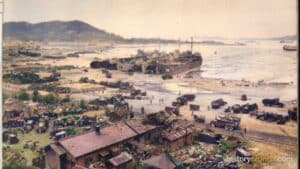
On June 25th, 1950, North Korean forces launched a large invasion across the 38th parallel and pushed south toward Seoul. This attack began the Korean War, which quickly grew far larger than a civil conflict inside Korea. The United Nations Security Council condemned the invasion, and the United States led an international force to defend the south. China later entered the war on the side of North Korea, turning Korea into a major Cold War battleground.
FactsthatCrunchIn what order did these steps from Japan's surrender to the Korean War's outbreak unfold?
What Happened After the Korean War?
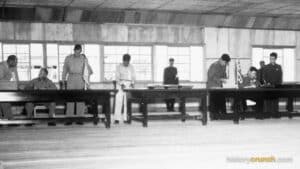
The Korean War ended not with a peace treaty but with an armisticeAn agreement between warring sides to stop fighting, without officially ending the war with a peace treaty., which is an agreement to stop fighting. The armistice was signed on July 27th, 1953, by the United States led United Nations Command, North Korea, and China. South Korea’s president, Syngman Rhee, refused to sign because he would not accept a divided Korea.
The armistice created a demilitarized zoneA strip of land where military forces and heavy weapons are banned, used as a buffer between two hostile states., often called the DMZ, along the front line where the fighting ended. Both sides pulled their forces back to form a buffer zone about 2.5 miles (4 km) wide that runs across the peninsula for roughly 150 miles (250 km). The actual border inside this zone is called the Military Demarcation LineThe actual boundary line running through the middle of the DMZ that marks the official border between North and South Korea.. Because no peace treaty was ever signed, North Korea and South Korea technically remain at war to this day.
FactsthatCrunchSignificance of Division of Korea
The division of Korea is significant because it directly caused the Korean War and created two nations that still exist today. A line that was first meant to be temporary became one of the most permanent and dangerous borders in the world. In fact, the split turned a single people with a shared past into two societies that developed in completely opposite directions.
Over the decades, North Korea grew into a tightly controlled communist dictatorship under the Kim family, while South Korea eventually became a wealthy democracy with a powerful economy. The division also separated countless families, many of whom have never been able to see one another again. As stated above, the border remains heavily guarded, and the rivalry between the two Koreas continues to shape global politics.
The division of Korea also stands as one of the clearest examples of how the Cold War reshaped the world. What began as a disagreement between the United States and the Soviet Union over how to handle a defeated colony ended in the lasting split of an entire nation. For this reason, Korea remains one of the most powerful reminders of how deeply the Cold War affected ordinary people far from Washington or Moscow.
FactsthatCrunchWhen Kim Il-sung took power in the north and Syngman Rhee took power in the south in 1948, both leaders built separate economies and governments along opposite lines. North Korea followed a Soviet-style command economy, with the state controlling all factories, farms, and resources, while South Korea built a capitalist system backed by American aid and private business. By the early 1950s, the two states had already grown apart in law, land ownership, and daily life, even before the war widened the gap further.
Today South Korea ranks among the world's largest economies, with major global companies in electronics, shipbuilding, and automobiles driving its growth. North Korea remains a tightly controlled state where the government directs the economy, and most citizens have little access to outside information or trade. The gap in average income between the two countries is estimated at more than 25 to 1, making the Korean Peninsula a sharp example of how political systems shape economic outcomes over time.
The choice of economic and political systems made in 1948 set the two Koreas on paths that are still visible in their living standards, freedoms, and global standing today.
Korean War timeline · 1950 – 1953
Key Vocabulary
Containment
Annexed
38th parallel
Trusteeship
Armistice
Demilitarized zone
Military Demarcation Line
Frequently Asked Questions
Why Was Korea Divided at the 38th Parallel?
Korea was divided at the 38th parallel because American officials picked that line of latitude in 1945 as a quick way to split the peninsula into Soviet and American occupation zones. The line was chosen partly because it left the capital, Seoul, in the American zone. It was never based on any natural border or on the wishes of the Korean people, which is one reason the division caused so much later conflict.
When Did Korea Split Into North and South?
Korea split into two occupation zones in 1945 and into two separate governments in 1948. The Republic of Korea in the south was founded in August of 1948, and the Democratic People’s Republic of Korea in the north was founded about three weeks later in September of 1948. The split became even more fixed after the Korean War ended in 1953.
Who Was Responsible for Dividing Korea?
The United States and the Soviet Union were mainly responsible for dividing Korea. The United States proposed the split along the 38th parallel to stop the Soviet advance, and the Soviet Union agreed to it. Korean leaders had little say in the decision, since the country had no government of its own after Japan’s colonial rule ended.
Is North Korea Still Technically at War With South Korea?
Yes, North Korea and South Korea are still technically at war because the Korean War ended with an armistice rather than a peace treaty. An armistice only stops the fighting, so no formal end to the war has ever been agreed upon. This is why the demilitarized zone between the two countries remains so heavily defended.
What Is the DMZ Between North and South Korea?
The DMZ, or demilitarized zone, is a buffer strip of land that separates North Korea and South Korea. It was created by the 1953 armistice and runs across the peninsula for about 150 miles (250 km), with the Military Demarcation Line marking the actual border in the middle. Even though heavy weapons are banned inside it, the DMZ is one of the most heavily guarded borders in the world.
Cite This Article
To cite this article as a source, use one of the formats below.
MLA: Millar, B. “Division of Korea: A Detailed Summary.” HistoryCrunch, 15 August 2026, https://historycrunch.com/division-of-korea/.
APA: Millar, B. (2026). Division of Korea: A Detailed Summary. HistoryCrunch. https://historycrunch.com/division-of-korea/
Chicago: Millar, B. “Division of Korea: A Detailed Summary.” HistoryCrunch. August 15, 2026. https://historycrunch.com/division-of-korea/
Sources
- J.M. Roberts & Odd Arne Westad, The Penguin History of the World.
- Jerry Bentley & Herbert Ziegler, Traditions & Encounters: A Global Perspective on the Past.