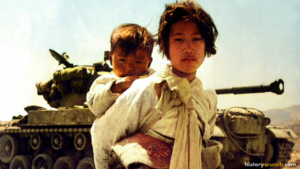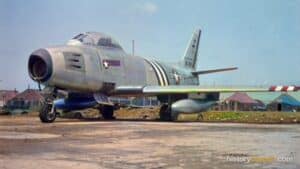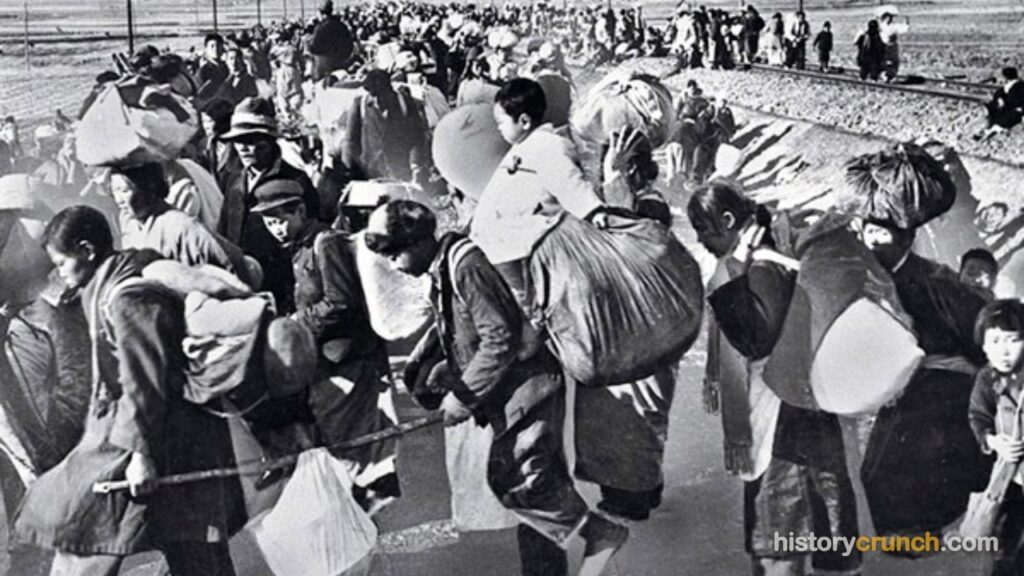
The Invasion of South Korea was the event that launched the Korean War, the first major armed conflict of the Cold War and the first war fought after World War II between the forces of the United States and those aligned with the Soviet Union. On June 25th, 1950, the army of communist North Korea crossed the 38th parallelA line of latitude cutting across the middle of the Korean Peninsula that separated the Soviet-controlled north from the American-controlled south. and poured into South Korea in a surprise attack. Within days the invasion had thrown the region into chaos and drawn in the United States, the United Nations, the Soviet Union, and eventually China. In fact, the invasion set off three years of fighting that would cost millions of lives and leave Korea divided to this day.
The Invasion of South Korea refers to the military attack by North Korea against the Republic of Korea in the summer of 1950. It was a coordinated assault at several points along the 38th parallel, the line that divided the communist north from the non-communist south. The goal of the invasion was to conquer South Korea by force and unite the entire Korean Peninsula under a single communist government led by North Korea.
 FactsthatCrunch
What Was the Cold War?
The Cold War was a long period of tension and rivalry between the United States and the Soviet Union that lasted from the end of World War II in 1945 until the early 1990s. It was called a “cold” war because the two superpowers never fought each other directly in a full-scale battle. Instead, they competed through smaller conflicts, an arms race, propaganda, and support for opposing sides in wars around the world.
At the heart of the Cold War was a clash between two ideas about how societies should be organized. The United States promoted capitalism and democracy, while the Soviet Union promoted communism, a system in which the government controls the economy. More specifically, the United States followed a policy called containmentThe American Cold War policy of doing everything possible to stop communism from spreading to new countries., which meant doing everything possible to stop communism from spreading to new countries. The Invasion of South Korea became one of the first places where this global struggle turned into open warfare.
FactsthatCrunchWhy was the Cold War called 'cold' even though real fighting happened in Korea?
The term 'Cold War' described the overall conflict between the United States and the Soviet Union, which never became a direct war between the two superpowers themselves. In Korea, American and communist forces fought, but the Soviet Union and the United States did not officially declare war on each other or send their armies into direct battle against each other. Korea was a shooting war within a cold rivalry, where the superpowers backed opposing sides without fighting each other directly.
How Was Korea Divided Before the Invasion?
To understand the invasion, it helps to look at how Korea became split in the first place. Japan had ruled Korea as a colony for decades before and during World War II. When Japan was defeated in 1945, the peninsula was suddenly freed from Japanese control, but there was no Korean government ready to take over.
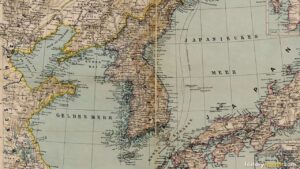
As a result, the Soviet Union moved into the northern half of Korea and the United States moved into the southern half. The two occupation zones were separated at the 38th parallel, a line of latitude that cut across the middle of the peninsula. By 1948, two separate governments had formed. The north became the communist Democratic People’s Republic of Korea, led by the dictator Kim Il-Sung, while the south became the Republic of Korea, led by the anti-communist president Syngman Rhee.
Between 1948 and 1950, tensions grew steadily worse. Both governments claimed the right to rule the entire peninsula, and clashes broke out along the border. In reality, neither side accepted the division as permanent, and Kim Il-Sung became convinced that he could reunite Korea through military force.
FactsthatCrunchWhy Did North Korea Invade the South?
North Korea invaded South Korea because Kim Il-Sung wanted to unify the peninsula under communist rule, and he believed the time was right to strike. He had spent years secretly building up his army and preparing for war. However, he could not launch such a large attack without the approval and help of his powerful ally, the Soviet Union.
At first, the Soviet leader Joseph Stalin was cautious. He feared that an invasion might drag the Soviet Union into a major war with the United States. By early 1950, though, Stalin changed his mind. The Soviet Union had recently tested its first atomic bomb, which made Stalin more confident, and he also had reason to believe the United States might not step in to defend South Korea. In fact, an American official had given a speech that seemed to leave Korea outside the area the United States was committed to protecting.
The Soviet Union supplied North Korea with weapons, tanks, and training, and Soviet advisors helped plan the attack. When the Chinese communists under Mao Zedong won their civil war in 1949, they too were able to help by sending back experienced Korean soldiers who had fought in China. As a result, North Korea entered the war far better prepared than the south.
FactsthatCrunchIt is early 1950, and you are Joseph Stalin, leader of the Soviet Union. Kim Il-Sung, the leader of North Korea, has been pressing you for months to approve his plan to invade South Korea and reunify the peninsula by force during the Korean War era. If you approve the plan and it succeeds, communism expands in Asia; if it fails or drags in the United States, the Soviet Union could face a direct confrontation with a nuclear-armed enemy.
How Did the Invasion Begin?
The invasion began early in the morning on June 25th, 1950, when tens of thousands of North Korean soldiers surged across the 38th parallel at several points at once. Supported by Soviet-made tanks and artillery, the North Korean People’s Army struck with overwhelming force. The South Korean army was caught completely by surprise and was poorly equipped to stop the advance.
The attack moved with alarming speed. Within just three days, North Korean troops captured Seoul, the capital of South Korea. South Korean forces, outgunned and overwhelmed, were pushed back again and again toward the southern tip of the peninsula. For a time it looked as though the entire country would fall under communist control.
FactsthatCrunchBy June 28th, 1950, North Korean People's Army forces had pushed south through the Korean War's opening days and captured Seoul, the South Korean capital, just three days after crossing the 38th parallel. South Korean and American commanders scrambling to respond had already lost the Han River bridge, which South Korean engineers destroyed prematurely, trapping soldiers and civilians north of the river. The question now was whether North Korean forces would press south immediately or pause to consolidate their hold on the city.
How Did the United States and United Nations Respond?
The invasion alarmed the United States, which saw it as a direct challenge from international communism. Following its policy of containment, the American government decided to act quickly. President Harry S. Truman ordered air and naval forces into action, and just a few days later he approved the use of ground troops to help defend South Korea.
At the same time, the United States brought the crisis before the United Nations. The United Nations Security Council called on member nations to help defend South Korea against the attack. As a result, the war became an international effort, with the United States providing the largest share of troops and supplies while other nations also contributed forces under the United Nations Command.
The first American units to arrive were understrength and hastily sent over from Japan, and they could not stop the North Korean advance on their own. Loss after loss piled up as the North Koreans pressed forward. By August of 1950, the defenders had been driven into the far southeastern corner of the peninsula.
FactsthatCrunch
What Was the Pusan Perimeter?
The Pusan PerimeterA last defensive line protecting the southeastern port city of Pusan, where UN and South Korean forces held out against North Korean advances. was a defensive line set up around the vital port city of Pusan in the southeastern corner of South Korea. As stated above, the North Korean advance had pushed American and South Korean troops nearly off the peninsula. By early August of 1950, the defenders dug in along a line that roughly followed the Naktong River and protected Pusan, which was their last stronghold.
Holding the Pusan Perimeter was a desperate struggle. For weeks, United Nations and South Korean troops fought off repeated North Korean attacks, including fierce battles along the Naktong River. Reinforcements and supplies streamed in through the port of Pusan, which allowed the defenders to hold on. Even so, to a shocked world it appeared that the American-led forces might be driven into the sea.
FactsthatCrunchWhich defensive positions held the Pusan Perimeter line during the Korean War?
How Was the Invasion Turned Back?
The invasion was reversed by a bold surprise attack far behind enemy lines. General Douglas MacArthur, the commander of the United Nations forces, proposed an amphibious landingA military assault launched from the sea onto a shore, combining naval and ground forces attacking at the same time. at Inchon, a port on the west coast of Korea near Seoul. Many other military leaders were nervous about the plan because the harbor had a narrow channel and extreme tides. MacArthur argued that these very difficulties meant the North Koreans would never expect an attack there.
On September 15th, 1950, United States Marines and other forces landed at Inchon in an operation code-named Operation Chromite. The landing was a stunning success and quickly captured the port. The day after the landing, the defenders at the Pusan Perimeter broke out and went on the attack, trapping the North Korean army between two forces. By late September, United Nations troops had recaptured Seoul and driven the North Koreans back across the 38th parallel, bringing the invasion of the south to an end.
FactsthatCrunchWhy did General MacArthur choose Inchon as the site for the amphibious landing in September 1950?
Significance of Invasion of South Korea
The Invasion of South Korea was significant because it started the Korean War and marked the first time the Cold War turned into a large-scale shooting war. It showed that the United States was willing to fight to contain the spread of communism, and it set the pattern for later Cold War conflicts fought through proxy warsConflicts in which two rival powers support opposing sides rather than fighting each other directly. around the world.
The invasion also drew China into the conflict later in 1950, after United Nations forces pushed north toward the Chinese border. This turned the war into an even larger struggle that dragged on until an armisticeAn agreement to stop fighting, signed on July 27th, 1953, that ended the active combat of the Korean War. was signed on July 27th, 1953. The fighting ended near the same 38th parallel where the invasion had begun, meaning that years of bloodshed left Korea divided much as it had been before.
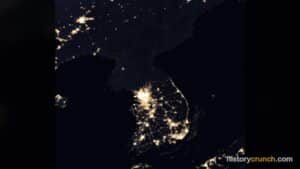
Finally, the invasion left a lasting mark on the Korean Peninsula that can still be seen today. A heavily guarded demilitarized zoneA heavily guarded strip of land separating North and South Korea where military forces are restricted. continues to separate North and South Korea, and no formal peace treaty was ever signed. In reality, the two Koreas remain technically at war, and the memory of the 1950 invasion still shapes the fears and policies of both nations.
FactsthatCrunchThe Korean Demilitarized Zone, known as the DMZ, was created by the Armistice Agreement signed on July 27th, 1953. It runs roughly along the 38th parallel and stretches approximately 155 miles (250 kilometers) across the Korean peninsula. Each side pulled its military forces back 1.2 miles (about 2 kilometers) from the ceasefire line, creating a buffer zone about 2.5 miles (4 kilometers) wide.
The DMZ remains one of the most heavily fortified borders in the world, with thousands of troops, landmines, and fencing on both sides. Wildlife has thrived inside the zone because humans have largely stayed out for more than seven decades, making it an unplanned nature preserve. Talks between North and South Korea in 2018 led to the removal of some guard posts, but the zone still functions as an active military boundary with no peace treaty in place.
The DMZ is a daily reminder that the Korean War ended with a ceasefire, not a permanent peace, leaving the peninsula technically still at war.
Korean War timeline · 1950 – 1953
Key Vocabulary
Containment
38th parallel
Amphibious landing
Pusan Perimeter
Proxy wars
Demilitarized zone
Armistice
Frequently Asked Questions
When did North Korea invade South Korea?
North Korea invaded South Korea on June 25th, 1950. The attack came early in the morning and caught the South Korean army by surprise. It marked the official start of the Korean War, which would last for just over three years.
Who was the leader of North Korea during the invasion?
The leader of North Korea during the invasion was Kim Il-Sung, who ruled the country as a dictator. He spent years planning the attack and personally traveled to Moscow to win Soviet approval. His family has continued to rule North Korea for generations after his death.
What is the 38th parallel?
The 38th parallel is a line of latitude that was used to divide Korea into a northern zone and a southern zone in 1945. The Soviet Union controlled the area north of the line and the United States controlled the area to the south. This line became the border between the two Korean governments and the starting point of the 1950 invasion.
Why did the United States get involved in Korea?
The United States got involved to stop the spread of communism, following its Cold War policy of containment. American leaders feared that if South Korea fell, other countries in Asia might follow. The United States led a United Nations coalition to defend the south and turn back the invasion.
How did the invasion of South Korea end?
The invasion of the south was reversed after the United Nations landing at Inchon in September of 1950. That surprise attack allowed United Nations forces to trap the North Korean army and push it back across the 38th parallel. However, the overall war continued for nearly three more years before an armistice was signed in 1953.
Cite This Article
To cite this article as a source, use one of the formats below.
MLA: Millar, B. “Invasion of South Korea: A Detailed Summary.” HistoryCrunch, 15 August 2026, https://historycrunch.com/invasion-of-south-korea/.
APA: Millar, B. (2026). Invasion of South Korea: A Detailed Summary. HistoryCrunch. https://historycrunch.com/invasion-of-south-korea/
Chicago: Millar, B. “Invasion of South Korea: A Detailed Summary.” HistoryCrunch. August 15, 2026. https://historycrunch.com/invasion-of-south-korea/
Sources
- J.M. Roberts & Odd Arne Westad, The Penguin History of the World.
- Jerry Bentley & Herbert Ziegler, Traditions & Encounters: A Global Perspective on the Past.