One of the most important and often confusing aspects of the French Revolution is that France did not simply replace its monarchy with a single new government. Instead, the revolution unfolded through four distinct revolutionary governments, each representing a different phase and political direction of the revolution. From the moderate National Assembly of 1789 to the radical National Convention that oversaw the Reign of Terror, to the more conservative Directory that ended with Napoleon seizing power in 1799, each government reflected the shifting and often violent politics of revolutionary France. This infographic was designed for students to visually summarize the four revolutionary governments and is based on the History Crunch articles on the French Revolution.
French Revolution Governments – Infographic
About This Infographic
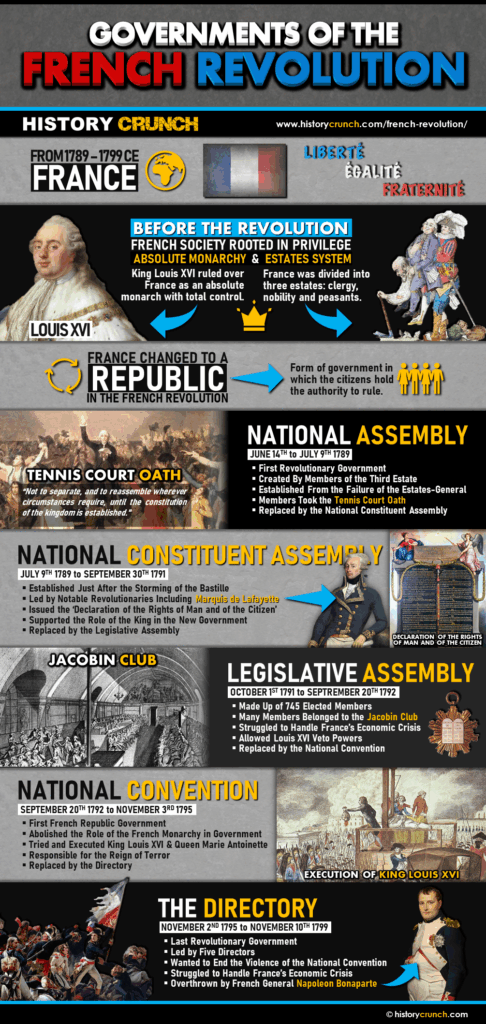
This French Revolution governments infographic was created by the History Crunch team to help students and teachers quickly understand the four different governments that governed France during the revolution. It is designed as a visual learning and study tool, summarizing the essential information covered in our full articles on the French Revolution. Teachers may use it as a classroom display, a discussion prompt, or a study aid for students preparing for assessments.
What This Infographic Covers
The infographic covers each of the four revolutionary governments in chronological order, showing how the political direction of the French Revolution shifted dramatically from its beginning in 1789 through to the rise of Napoleon in 1799.
The first government covered is the National Assembly, which existed from June 14th to July 9th, 1789. It was established by representatives of the Third Estate who broke away from the failing Estates-General and took the Tennis Court Oath, pledging not to disband until they had written a new constitution for France. Though short-lived as the National Assembly, it quickly transformed into the National Constituent Assembly, which lasted until September 1791. This body is best remembered for passing the Declaration of the Rights of Man and of the Citizen in August 1789, a landmark document that challenged the authority of Louis XVI and set out a series of individual rights protected by law. The National Constituent Assembly also oversaw the early abolition of feudal privileges of the Ancien Regime. Clergy and nobility representatives joined the body as anger at the monarchy spread, giving it a broader political base than the original Third Estate gathering.
The second government is the Legislative Assembly, which governed from October 1791 to September 1792. It was the first government established under the new constitutional monarchy created by the National Constituent Assembly. The Legislative Assembly faced enormous pressures including ongoing economic crisis, conflict with the king over his remaining powers and growing pressure from war with neighboring European powers who feared the spread of revolutionary ideas. Political divisions between moderate and radical factions deepened during this period, with the Jacobin Club growing in influence as moderate solutions repeatedly failed. A major turning point came in August 1792 when the monarchy was overthrown, which effectively ended the constitutional monarchy experiment and led to the creation of the National Convention.
The third and most dramatic government is the National Convention, which governed from September 1792 to October 1795. It was the first government in France based on universal male suffrage, with all males 25 years and older able to vote for its representatives regardless of social class. Its first major act was to abolish the absolute monarchy and declare France a republic. The National Convention tried and convicted Louis XVI of treason, executing him by guillotine on January 21st, 1793. Queen Marie Antoinette was executed in October 1793. Dominated by the radical Jacobins under Maximilien Robespierre, the National Convention oversaw the Reign of Terror from September 1793 to July 1794, during which over 40,000 people were executed. The Terror ended when Robespierre was arrested and guillotined in July 1794, after which the National Convention moved in a more moderate direction before being replaced.
The fourth government is the Directory, which governed from October 1795 until Napoleon Bonaparte seized power in November 1799. The Directory was a more moderate and conservative government than the National Convention, established in the aftermath of the excesses of the Reign of Terror. It was governed by a five-member executive committee and represented an attempt to stabilize France after years of revolutionary violence. The Directory faced ongoing economic difficulties and political instability throughout its existence and was ultimately ended by Napoleon’s coup in November 1799, which marked the close of the French Revolution and the beginning of the Napoleonic Era.
How to Use This Infographic in the Classroom
This infographic works well as a visual companion to the French Revolution Overview infographic, allowing students to see both the broad sweep of the revolution and the specific details of each government side by side. It can be used as a chronology activity asking students to place the four governments in order and describe what changed between each one. Teachers may also use it as a discussion prompt asking students to consider why France went through four different governments in just ten years, and what this tells us about the difficulty of replacing a centuries-old monarchy with a stable new system of government.
Related Articles
To learn more about the topics covered in this infographic, visit the following History Crunch articles: