The Civil Constitution of the Clergy was one of the most important and divisive laws of the French Revolution, because it turned the powerful Catholic Church in France into a branch of the government almost overnight. Passed in 1790, it reorganized the Church, changed how priests and bishops were chosen, and forced clergy to place loyalty to the French nation above their old ties to the pope in Rome. In doing so, it split French Catholics into two hostile camps and turned many devout believers against the Revolution itself.
In simple terms, the Civil Constitution of the Clergy was a law that placed the Catholic Church in France under the control of the French government. It made priests and bishops into public officials who were elected by voters and paid by the state, and it required them to swear an oath of loyalty to the new government. Before this law, the Church answered to the pope, but afterward it was expected to answer first to France.
 FactsthatCrunch
What Was the French Revolution?
The French Revolution was one of the most significant events in world history. Beginning in 1789, it transformed France from an absolute monarchy into a republic, ended the power of the nobility and the Church over everyday life, and introduced ideas about liberty, equality, and democracy that spread across the globe. It lasted roughly ten years, until the rise of Napoleon Bonaparte at the end of the 1790s.
Before the Revolution, French society was organized under a rigid class structure known as the Estates System, a leftover from the age of feudalism. The First Estate was the clergy, the Second Estate was the nobility, and the Third Estate was everyone else, including peasants, workers, and the middle class. Even though the Third Estate made up over 96% of the population, it held very little political or economic power, which caused deep anger toward King Louis XVI.
Several forces pushed France toward revolution at the same time. The ideas of the Age of Enlightenment led people to question the authority of kings and the fairness of the class system. Meanwhile, poor harvests, rising bread prices, and a government that was nearly bankrupt created widespread desperation. In fact, it was this financial crisis that first forced Louis XVI to call together the representatives of the three estates in 1789, an event that helped spark the Revolution.
Why Did the Revolution Target the Church?
The Catholic Church in France was enormously wealthy and powerful, which made it an early target of the revolutionary government. The Church owned roughly 6% of all the land in France, and it also collected a tax on the people called the titheA tax collected by the Church that took a share of everyone’s income or crops., which took a share of everyone’s income or crops. As stated above, the government was nearly bankrupt, so many revolutionaries looked at the Church’s riches as a way to solve the nation’s money problems.
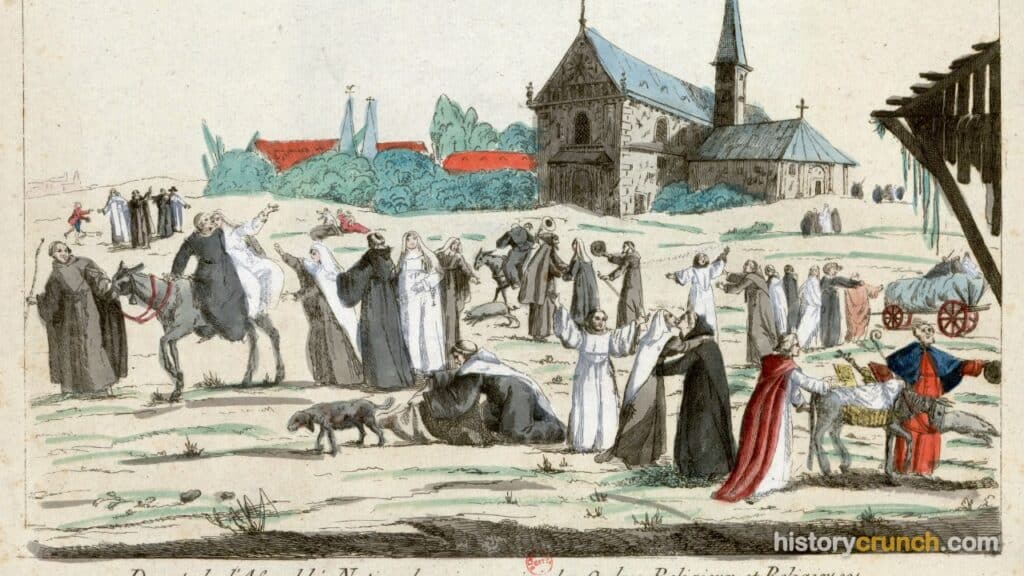
Beginning in the first weeks of the new National Assembly, lawmakers took a series of steps against the Church. In 1789, they abolished the tithe and then declared that all Church property belonged to the nation, allowing the state to seize and sell it. In February of 1790, they went further and banned monastic vowsPromises taken by monks and nuns to live under Church rules in a religious community., dissolving most religious orders except those that taught children or nursed the sick.
These actions created a serious problem. Once the Church lost its lands and its tithe income, there was no longer a clear way to pay priests or run the parishes. The National Assembly therefore needed a brand-new system to organize and fund the Church, and the Civil Constitution of the Clergy was its answer.
FactsthatCrunchHow much of France's land did the Catholic Church own before the Revolution?
What Did the Civil Constitution of the Clergy Do?
The National Assembly passed the Civil Constitution of the Clergy on July 12th, 1790. Its goal was to reorganize the Catholic Church along the same lines as the new French government, to end corruption, and to reduce the Church’s political power. More specifically, the law reshaped almost every part of how the Church operated in France.
First, the law reorganized the map of the Church. Each of France’s new administrative districts, called departments, was made into a single dioceseThe geographic area of churches and parishes overseen and managed by a single bishop., which is the area overseen by a bishop. This reduced the number of bishops from about 135 down to 83, so that Church boundaries matched government boundaries exactly.
Second, the law changed how clergy were chosen. Instead of being appointed by the king or approved by the pope, bishops and parish priests were now to be elected by the voters, just like other public officials. For instance, a bishop would be chosen by the same voters in a department who elected local government leaders, a dramatic break from centuries of tradition.
Third, the law made the clergy employees of the state. Because the Church had lost its lands and tithes, the government would now pay clergy a salary directly. In many cases this actually raised the pay of ordinary parish priests, but it also meant that a priest was now a paid worker of the French nation rather than a servant of Rome. Finally, the law required bishops to live within their own dioceses and to focus on their spiritual duties.
FactsthatCrunchThe Civil Constitution of the Clergy, passed on July 12th, 1790, set up a new system for choosing bishops and priests that treated them as elected public officials rather than servants of Rome.
Oath of Loyalty and the Split in the Church
The most explosive part of the reform came on November 27th, 1790, when the National Assembly ordered every bishop and priest in France to swear an oath of loyalty to the new constitution. Any clergyman who refused would lose his position and his salary. This turned the reform from a plan on paper into a personal test of loyalty for every clergyman in the country.
The result was a deep split in the French Church. When the oath-taking began in early 1791, only about half of the parish priests and just seven of the bishops agreed to swear. Those who took the oath became known as the constitutional clergyPriests and bishops who swore the oath of loyalty to the new French government, also called jurors., or “jurors.” Those who refused became known as refractory priestsClergy who refused to swear the oath of loyalty and remained loyal to the pope instead of the state., or “non-jurors,” and they were concentrated heavily in western France.
King Louis XVI, a devout Catholic, reluctantly gave his approval to the law in late 1790, a decision he later deeply regretted. The crisis grew even worse when Pope Pius VI formally condemned the Civil Constitution in the spring of 1791. The pope declared that clergy who had sworn the oath were suspended from their duties unless they took it back, which made the divide between the two churches permanent.
From that point on, France effectively had two rival Catholic churches. One was the official state-backed constitutional church, and the other was an underground church loyal to the pope. In reality, refractory priests were increasingly treated as enemies of the Revolution, and many later faced arrest, exile, or death, especially during the violent years that followed.
FactsthatCrunchWhen the oath of loyalty was ordered in early 1791, only about half of parish priests agreed to swear it.
Significance of Civil Constitution of the Clergy
The Civil Constitution of the Clergy is significant because it became one of the most divisive policies of the entire French Revolution. More than any other single law, it turned ordinary, faithful Catholics against the revolutionary government. Many people who had welcomed the early reforms of 1789 now felt that the Revolution was attacking their religion itself.
This division had lasting effects on the course of the Revolution. Regions filled with refractory priests, especially in the west, became centers of resistance and even open rebellion against the government in Paris. The question of loyalty to the state or to the pope became a fault line that ran through French society for years, deepening the conflicts of the Revolution.
The schismA formal and lasting split that divides a religious institution into two opposing groups. the law created was not repaired until 1801, when Napoleon Bonaparte reached an agreement with the pope that restored a working relationship between France and the Catholic Church. In the long run, the Civil Constitution of the Clergy stands as a powerful example of what can happen when a government tries to reshape a deeply rooted religious institution. It shows how reforms meant to modernize a nation can instead spark bitter conflict and lasting division.
FactsthatCrunchFrench Revolution timeline · 1789 – 1799
Key Vocabulary
Tithe
Monastic vows
Diocese
Constitutional clergy
Refractory priests
Schism
Frequently Asked Questions
When was the Civil Constitution of the Clergy passed?
The Civil Constitution of the Clergy was passed by the National Assembly on July 12th, 1790. It was one of a series of reforms aimed at the Catholic Church during the early years of the French Revolution, and it followed earlier laws that had already ended the tithe and seized Church lands.
What is the difference between juring and refractory priests?
Juring priests were those who swore the oath of loyalty to the constitution, while refractory priests were those who refused. Juring priests were also called the constitutional clergy, and refractory priests were also called non-jurors. This single choice divided friends, families, and whole villages across France.
Why did the pope oppose the Civil Constitution of the Clergy?
Pope Pius VI opposed the law because it removed the Church in France from his authority and placed it under the French government instead. He objected that priests and bishops would be elected by voters rather than approved by Rome, and he condemned the seizure of Church property. His condemnation in 1791 made many uncertain Catholics reject the reform outright.
How did the Civil Constitution of the Clergy affect King Louis XVI?
The law placed King Louis XVI in a painful position, because he was a devoted Catholic who felt forced to approve a policy that attacked his faith. He gave his approval reluctantly and later regretted it deeply. Many historians point to this crisis as a moment that pushed the king further away from the Revolution and closer to trying to flee France.
When did the split in the Church finally end?
The split created by the Civil Constitution of the Clergy was not healed until 1801. In that year, Napoleon Bonaparte reached an agreement with the pope that restored the relationship between France and the Catholic Church. This agreement ended more than a decade of religious conflict that the law had first set in motion.
Cite This Article
To cite this article as a source, use one of the formats below.
MLA: Millar, B. “Civil Constitution of the Clergy: A Detailed Summary.” HistoryCrunch, 11 August 2026, https://historycrunch.com/civil-constitution-of-the-clergy/.
APA: Millar, B. (2026). Civil Constitution of the Clergy: A Detailed Summary. HistoryCrunch. https://historycrunch.com/civil-constitution-of-the-clergy/
Chicago: Millar, B. “Civil Constitution of the Clergy: A Detailed Summary.” HistoryCrunch. August 11, 2026. https://historycrunch.com/civil-constitution-of-the-clergy/
Sources
- James M. McPherson, Battle Cry of Freedom.
- National Archives
- American Battlefield Trust