The collapse of the Soviet Union was a major event in world history that occurred on December 25th, 1991, when Soviet leader Mikhail Gorbachev resigned and the Soviet Union formally ended. What had been one of the two most powerful nations on earth for nearly half a century dissolved into fifteen separate independent nations, with Russia emerging as the largest and most significant successor state. The collapse ended the Cold War, reshaped the political map of Europe and Central Asia, and marked the end of communism as a governing system across much of the world. Understanding the collapse of the Soviet Union is essential to understanding the history of the late 20th century and the political world that exists today.
How Did Glasnost Weaken Communist Party Control in the Soviet Union?

What Was the Soviet Union?
The Soviet Union, formally known as the Union of Soviet Socialist Republics or USSR, was a communist state that existed from 1922 until 1991. It was formed in the aftermath of the Russian Revolution of 1917, in which the Bolsheviks under Vladimir Lenin overthrew the Provisional Government and established a communist government. The Soviet Union encompassed an enormous territory spanning from Eastern Europe to the Pacific Ocean and was made up of fifteen constituent republicsThe separate member territories that were joined together to form the Soviet Union as one country., the largest and most dominant of which was Russia. At its height, the Soviet Union was one of the two global superpowers of the Cold War era, the other being the United States, and its military, nuclear arsenal, and political influence made it one of the most powerful entities in the world.
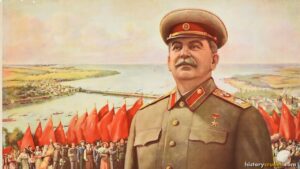
The Soviet Union was a one-party state governed by the Communist Party, meaning no other political parties were permitted to exist and citizens had no ability to vote the government out of power. The economy was a command economy, meaning the government controlled all aspects of economic production and distribution rather than allowing private ownership and free markets. Throughout its history the Soviet Union was marked by the repressive rule of leaders such as Joseph Stalin, who imprisoned and executed millions of his own citizens, and by the constant tension of the Cold War rivalry with the United States and its allies in the West.
FactsthatCrunchDuring the Cold War, the Soviet Union ran a command economy while the United States ran a market economy. By the 1980s, the Soviet command economy had fallen seriously behind Western nations in productivity and could not reliably supply its own citizens with everyday goods.
Causes of the Collapse of the Soviet Union
The collapse of the Soviet Union was not caused by a single event but rather by a combination of long-term structural problems and short-term political developments that together made the survival of the Soviet state impossible.
The first and most fundamental cause was the Soviet Union’s severe economic problems. By the 1980s the Soviet economy was in serious decline. Decades of central planning had produced a system that was deeply inefficient and unable to respond effectively to the needs of its citizens. The Soviet Union had fallen significantly behind the United States and other western nations in terms of technological development and economic productivity. Ordinary Soviet citizens faced persistent shortages of basic goods such as food and clothing, while the government continued to spend enormous amounts of money on its military and nuclear arsenal in order to keep pace with the United States. By some estimates the Soviet Union was spending as much as half of its national budget on military expenditure, leaving very little for the needs of the civilian population. The Soviet Union was also fighting a costly and unsuccessful war in Afghanistan, which it had invaded in 1979 and which had become a draining and demoralizing conflict with no clear path to victory.
The second major cause was the political impact of the reforms introduced by Mikhail Gorbachev after he became the leader of the Soviet Communist Party in 1985. Gorbachev recognized that the Soviet system was in serious trouble and introduced two major reform policies intended to save it. The first was glasnostA Soviet reform policy allowing citizens more honest information and open public debate about their government., meaning openness, which allowed for greater freedom of information and public debate within the Soviet Union. The second was perestroikaA Soviet reform policy aimed at rebuilding the political and economic systems to make them work more efficiently., meaning restructuring, which aimed at rebuilding the Soviet political and economic systems to make them more efficient and responsive. These reforms, while intended to strengthen the Soviet Union, instead set in motion forces that Gorbachev could not control. As citizens gained access to more honest information about the failures of their government and the poor state of their country, public disillusionment with communism grew rapidly. The Communist Party lost its monopoly on information and, with it, much of its ability to control public opinion and political life.
The third major cause was the rise of nationalist movements within the Soviet Union and the countries of Eastern Europe. The Soviet Union was made up of many different ethnic groups and nationalities, many of whom had been incorporated into the Soviet state by force and had never fully accepted Soviet rule. As glasnost loosened political restrictions, these nationalist movements began to assert themselves more openly, with many of the constituent republics of the Soviet Union pushing for greater autonomy or outright independence. In the Baltic states of Estonia, Latvia, and Lithuania, which had been forcibly annexed by the Soviet Union in 1940, independence movements gained enormous popular support. Similar movements emerged in Ukraine, Georgia, Armenia, and other republics.
FactsthatCrunchEstonia, Latvia, and Lithuania chose to join the Soviet Union.
Summary of the Collapse
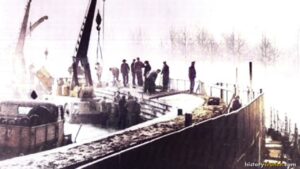
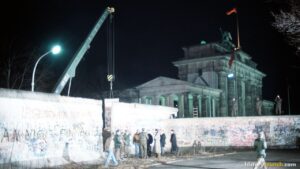
The process of collapse unfolded over several years in the late 1980s and early 1990s. The revolutions of 1989 were the first dramatic sign that the Soviet system was losing its grip on Eastern Europe. In that year, communist governments fell one after another across the Eastern BlocThe group of communist countries in Eastern Europe that were under Soviet political domination during the Cold War. as popular uprisings swept through Poland, Hungary, East Germany, Czechoslovakia, Bulgaria, and Romania. In most cases these transitions occurred relatively peacefully, though the revolution in Romania turned violent and ended with the execution of the communist president Nicolae Ceausescu. The most iconic event of 1989 was the fall of the Berlin Wall in November, when East Germans stormed and began tearing down the concrete barrier that had divided East and West Berlin since 1961. The fall of the Berlin Wall became one of the most powerful symbols in modern history, representing the collapse of the Iron Curtain and the end of the Cold War divide in Europe.
Within the Soviet Union itself, the situation continued to deteriorate through 1990 and 1991. The Baltic states declared independence, with Lithuania doing so in March of 1990, and Gorbachev found himself increasingly unable to hold the country together. In August of 1991, a group of hardline Communist Party members who opposed Gorbachev’s reforms attempted a coup against him, placing him under house arrest at his holiday home in Crimea. The coup was poorly organized and quickly collapsed in the face of public resistance, led most visibly by Boris Yeltsin, who had been elected president of the Russian Republic and who famously stood on top of a tank outside the Russian parliament building to rally opposition to the coup plotters. The failure of the coup dramatically weakened the Communist Party and accelerated the disintegration of the Soviet Union. Republic after republic declared independence in the weeks that followed.
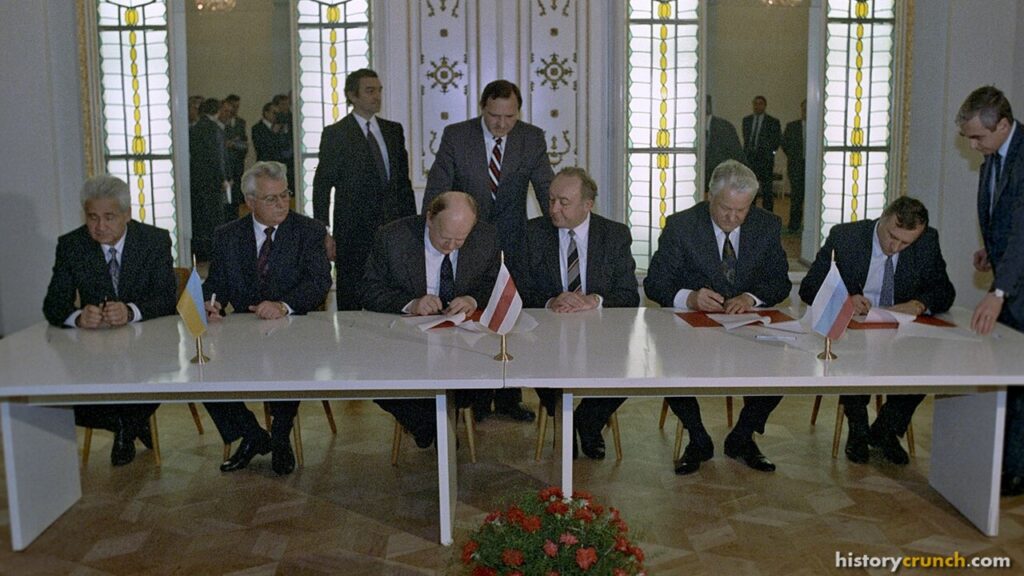
On December 8th, 1991, the leaders of Russia, Ukraine, and Belarus met and signed the Belavezha AccordsA 1991 agreement signed by Russia, Ukraine, and Belarus that formally declared the Soviet Union dissolved., an agreement that declared the Soviet Union dissolved and established the Commonwealth of Independent States as a looser successor organization. On December 25th, 1991, Mikhail Gorbachev resigned as president of the Soviet Union, acknowledging that the country he led no longer existed. The Soviet flag was lowered over the Kremlin in Moscow and replaced by the Russian flag, marking the formal end of the Soviet Union after nearly 70 years of existence.
The Soviet Union’s fifteen constituent republics all became independent nations: Russia, Ukraine, Belarus, Moldova, Estonia, Latvia, Lithuania, Armenia, Azerbaijan, Georgia, Kazakhstan, Kyrgyzstan, Tajikistan, Turkmenistan, and Uzbekistan. Boris Yeltsin became the first president of the new Russia, and the enormous task of transitioning from a communist command economyA system where the government controls all production and distribution of goods instead of letting private businesses compete freely. to a market-based democratic system began, a process that proved enormously difficult and painful for many Russian citizens in the years that followed.
FactsthatCrunchIn August 1991, a group of hardline Communist Party members placed Soviet leader Mikhail Gorbachev under house arrest at his holiday home in Crimea and seized control of state television and key buildings in Moscow. Boris Yeltsin, president of the Russian Republic, climbed on top of a tank outside the Russian parliament building and called on citizens to resist the coup plotters. The coup had already begun to collapse under public pressure, and the fate of the Communist Party and the Soviet Union itself hung on what happened next.
Significance of the Collapse of the Soviet Union
The significance of the collapse of the Soviet Union was enormous and its consequences are still being felt around the world today. Most immediately, the collapse brought the Cold War to an end, concluding nearly half a century of dangerous rivalry between the two superpowers that had kept the entire world under the threat of nuclear war. The United States emerged from the Cold War as the world’s sole superpower, and the ideological competition between capitalism and communism that had dominated global politics since World War II was effectively resolved in favor of the democratic capitalist model.
The collapse also freed millions of people in Eastern Europe and Central Asia from communist rule, allowing them to build democratic governments and market economies for the first time. Countries that had been under Soviet domination for decades, such as Poland, Hungary, the Czech Republic, and the Baltic states, were able to join the European Union and NATO in the years that followed, integrating themselves into the broader community of democratic nations. For many of these countries the collapse of the Soviet Union represented a moment of genuine liberation.
However, the collapse also created significant instability and hardship in many of the successor states. Russia itself experienced a turbulent transition in the 1990s, with economic collapse, rising crime, and political uncertainty making life extremely difficult for many ordinary citizens. Conflicts broke out in several regions of the former Soviet Union, including in Chechnya, Georgia, and between Armenia and Azerbaijan, as newly independent nations struggled to define their borders and manage their ethnic and political divisions. Many of these tensions continue to affect the region to the present day.
For all of these reasons, the collapse of the Soviet Union remains one of the most important and consequential events in the history of the modern world, and its legacy continues to shape international relations, political systems, and the lives of hundreds of millions of people across Eurasia and beyond.
FactsthatCrunchHow many independent countries replaced the Soviet Union in 1991?
Fifteen. Each of the Soviet Union’s fifteen republics became its own country: Russia, Ukraine, Belarus, Moldova, Estonia, Latvia, Lithuania, Armenia, Azerbaijan, Georgia, Kazakhstan, Kyrgyzstan, Tajikistan, Turkmenistan, and Uzbekistan. Russia was the largest, and Boris Yeltsin became its first president.
Explore Cold War · 1947 – 1991
Keep exploring Cold War with these History Crunch resources.
Key Vocabulary
Constituent republics
Command economy
Glasnost
Perestroika
Eastern Bloc
Iron Curtain
Belavezha Accords
Frequently Asked Questions
When did the Soviet Union officially collapse?
The Soviet Union formally ended on December 25th, 1991, when Mikhail Gorbachev resigned as president. That same day the Soviet flag was lowered over the Kremlin and replaced by the Russian flag. The country had existed for nearly 70 years, from 1922 until 1991.
What were the main causes of the collapse of the Soviet Union?
The collapse grew out of severe economic decline, failed reforms, and rising nationalist movements. Decades of central planning left the economy weak, while huge military spending drained the budget. Gorbachev’s reforms then opened the door to criticism, and many republics began to push for independence.
What were glasnost and perestroika?
Glasnost and perestroika were two reform policies introduced by Mikhail Gorbachev after 1985. Glasnost meant openness, which allowed more freedom of information and public debate. Perestroika meant restructuring, which aimed to rebuild the political and economic systems to make them work better.
How many countries formed after the Soviet Union broke apart?
Fifteen independent nations emerged from the former Soviet Union. These included Russia, Ukraine, Belarus, Moldova, Estonia, Latvia, Lithuania, Armenia, Azerbaijan, Georgia, Kazakhstan, Kyrgyzstan, Tajikistan, Turkmenistan, and Uzbekistan. Russia was the largest and most powerful successor state.
How did the collapse affect the Cold War?
The collapse brought the Cold War to an end after nearly half a century of superpower rivalry. The United States was left as the world’s only superpower. The long contest between capitalism and communism was effectively settled in favor of democratic capitalism.
What happened during the 1991 coup against Gorbachev?
In August of 1991, hardline Communist Party members tried to seize power and placed Gorbachev under house arrest in Crimea. The coup was poorly planned and quickly fell apart as the public resisted. Boris Yeltsin led the opposition, famously standing on a tank outside the Russian parliament.
Cite This Article
To cite this article as a source, use one of the formats below.
MLA: Millar, B. “Collapse of the Soviet Union: A Detailed Summary.” HistoryCrunch, 13 October 2026, https://historycrunch.com/collapse-of-the-soviet-union/.
APA: Millar, B. (2026). Collapse of the Soviet Union: A Detailed Summary. HistoryCrunch. https://historycrunch.com/collapse-of-the-soviet-union/
Chicago: Millar, B. “Collapse of the Soviet Union: A Detailed Summary.” HistoryCrunch. October 13, 2026. https://historycrunch.com/collapse-of-the-soviet-union/
Sources
- John Lewis Gaddis, The Cold War: A New History.
- Wilson Center Digital Archive
- Odd Arne Westad, The Global Cold War.
- Vladislav Zubok, A Failed Empire.