The Battle of Iwo Jima in World War II was a major battle in the Pacific Theater and occurred from February 19th to March 26th, 1945. The battle was an American amphibiousA military operation that launches an attack from the sea onto land. invasion of the Japan-held island of Iwo Jima which was approximately 750 miles (1,200 km) south of Tokyo. The United States wanted to take control over the island of Iwo Jima, and its three airfields, in hopes of using the island as a staging ground for the United States’ attack against mainland Japan.
 FactsthatCrunch
Iwo Jima Sat 750 Miles From Tokyo, About the Same as Flying Across a Large Slice of the United States
The US military needed Iwo Jima because it was close enough to Tokyo for American fighter planes to escort B-29 bombers on raids over Japan. To picture that distance, think of the straight-line flight from New York City to Chicago, which runs about 713 miles, and then add roughly 37 more miles. Capturing the island in the spring of 1945 gave American bombers a nearby base and an emergency landing strip just 750 miles from the Japanese capital.
Battle of Iwo Jima in World War II – Background
The Battle of Iwo Jima was a major event in World War II. The Second World War began on September 1st, 1939 when Nazi Germany invaded the country of Poland. In the years that followed, Europe underwent a series of significant battles, including: Battle of France, Battle of Britain and Operation Barbarossa. During this time, though, the United States remained out of the direct fighting in the war. Instead, the United States, under the leadership of President Franklin D. Roosevelt, practiced a policy of isolationismA government policy of staying out of other countries’ affairs and avoiding foreign conflicts.. This saw the United States limit its involvement in international affairs. As such, when World War II began in Europe in 1939, the United States remained on the sidelines, except for its supply shipments under the Lend-Lease Act.
At the same time, the United States opposed Japan’s expansionismA nation’s push to grow its territory or power beyond its current borders., and viewed Japan as a legitimate threat in the Pacific Ocean. In response to this perceived threat, the United States imposed economic sanctionsPenalties one country places on another by cutting off trade or financial dealings. against Japan and stopped all oil exports to Japan in 1941. This was devastating to the Japanese Empire, because Japan lacked the necessary oil reserves to continue its expansion in the Pacific. As such, Japan viewed these sanctions as a direct threat to its national survival and economic stability. This ultimately was one of several factors that pushed Japan to surprise attack the United States at Pearl Harbor in 1941.
The attack on Pearl Harbor on December 7th, 1941 was the event that ultimately brought the United States into the fighting of World War II. As well, it essentially launched the Pacific Theater of World War II, which resulted in many more conflicts, such as: the Battle of Midway and the Battle of Guadalcanal. Furthermore, after the attack on Pearl Harbor, Japan rapidly expanded across the Pacific, capturing key territories including the Philippines, Malaya, Singapore, and parts of New Guinea. In fact, by mid-1942, Japanese forces threatened to isolate Australia and dominate the entire Pacific.
However, by 1945, Japan was struggling due to significant losses at both the Battle of Midway and the Battle of Guadalcanal. In fact, these losses allowed the American forces to advance towards the Japanese home-islands through the use of ‘island-hopping‘. As such, this eventually led to the arrival of American forces on the island of Iwo Jima, which is a small island with three airfields and close to the Japanese home-islands. This made Iwo Jima an important strategic asset in the Pacific Theater of the war. For instance, it provided an emergency landing site for American bombers returning from missions over Japan.
FactsthatCrunchU.S. military planners in 1944 determined that capturing Iwo Jima's three airfields would give American forces a base close enough to Japan to support the planned bombing campaign against the Japanese home islands.
The U.S. Joint Chiefs of Staff approved the invasion of Iwo Jima in October 1944, seeing the island's airfields as essential to air operations against Japan. The battle began on February 19th, 1945, and lasted until March 26th, 1945, with the United States securing all three airfields at a high cost in casualties on both sides.
Battle of Iwo Jima in World War II – Summary
The Battle of Iwo Jima began with an American bombardment of the island. However, the 23,000 Japanese defenders moved to the interior of the island and defended themselves in a series of tunnels and caves in which they could hide. As such, the Americans easily captured the beaches of Iwo Jima but soon were faced with intense and bloody fighting against the Japanese defenders in the interior.
Nearly 70,000 American soldiers from the 3rd, 4th, and 5th Marine Divisions landed on Iwo Jima’s southern beaches. The terrain made movement difficult, and the Marines were immediately pinned down by heavy fire from the fortified Japanese positions. This led to a period of brutal fighting. In fact, American progress was slow and costly, with intense close-quarters combat in bunkers, caves, and trenches. The fight to capture Mount Suribachi, the island’s highest point, on February 23rd, where Marines famously raised the American flag was an important point in the battle.
For their part, the Japanese forces fought a war of attritionA strategy of wearing down the enemy by causing steady losses until they can no longer fight., and refused to surrender even as supplies dwindled. In fact, by March 26th, the island was officially declared secured by the Americans, although isolated resistance continued for weeks. As such, despite the Japanese resistance, the United States was able to obtain victory relatively quickly due to its overwhelming control over the air of Iwo Jima and due to its military superiority on the island. For example, the 23,000 Japanese defenders had to face over 110,000 American troops and sailors as well as the United States Army Air Forces.
FactsthatCrunchBattle of Iwo Jima in World War II – Significance
Today, the Battle of Iwo Jima is remembered for several different reasons. First, it had some of the fiercest fighting of World War II in the Pacific. For example, the United States suffered over 6,800 dead in the battle and another 19,200 were wounded. However, of the original 23,000 Japanese defenders, fewer than 1,100 were taken prisoner, meaning that the vast majority died in battle. It was common practice for Japanese soldiers to charge the American infantry when their supplies were gone. The Japanese code of fighting, bushidoThe Japanese warrior code that required soldiers to fight to the death rather than surrender., held that the soldiers should fight to defend their homeland until their death and not surrender. This view caused the death of most of the Japanese on the island.
The Battle of Iwo Jima is also remembered for the famous photograph of six United States Marines raising the American flag on top of Mount Suribachi, the highest point on the island. The image has become iconic and has been widely used in popular culture and for war memorials. Finally, the Battle of Iwo Jima is also notable for the odd story of two Japanese soldiers that hid in the caves and tunnels of the island after the battle ended.
FactsthatCrunch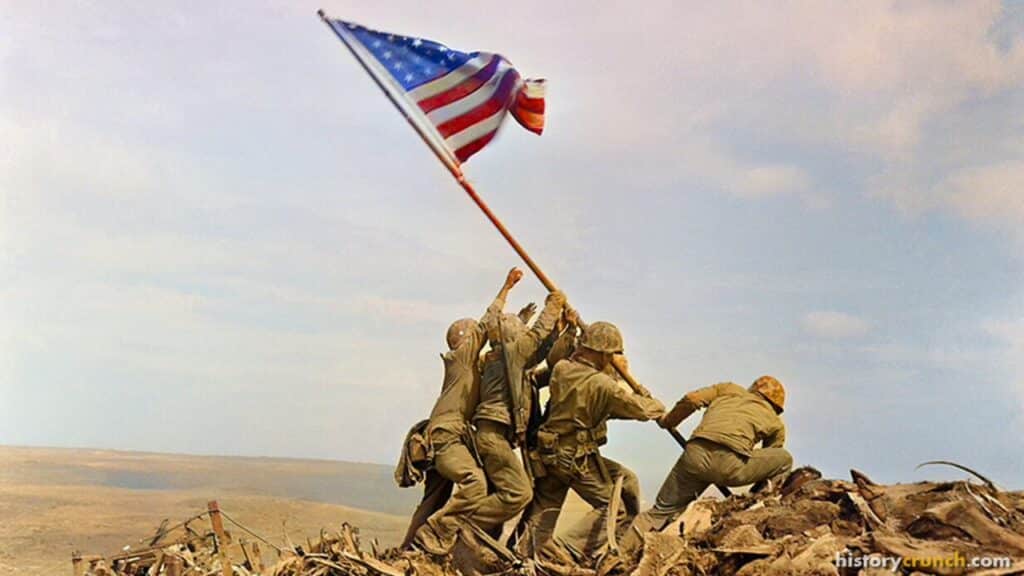 Black & whiteColour
Explore World War II · 1939 – 1945
Keep exploring World War II with these History Crunch resources.
Key Vocabulary
Isolationism
Expansionism
Economic sanctions
Amphibious
War of attrition
Bushido
Island-hopping
Frequently Asked Questions
When was the Battle of Iwo Jima?
The Battle of Iwo Jima lasted from February 19th to March 26th, 1945. It was fought late in World War II during the Pacific Theater. The United States declared the island secured on March 26th, though scattered Japanese resistance continued for weeks.
Why did the United States want to capture Iwo Jima?
The United States wanted Iwo Jima mainly for its three airfields and its location near Japan. The island sat about 750 miles (1,200 km) south of Tokyo. It could serve as a staging ground for attacks and as an emergency landing site for American bombers returning from Japan.
Why was the fighting on Iwo Jima so deadly?
The fighting was deadly because the roughly 23,000 Japanese defenders fought from tunnels and caves inside the island. This forced the Marines into brutal close-quarters combat in bunkers and trenches. The Japanese code of bushido told soldiers to fight to the death rather than surrender.
What happened on Mount Suribachi?
Marines captured Mount Suribachi, the island’s highest point, on February 23rd, 1945. There, six Marines raised the American flag in a moment that became famous. The photograph of that flag raising is now one of the most recognized images of World War II.
How many soldiers died at Iwo Jima?
The United States suffered more than 6,800 dead and about 19,200 wounded in the battle. Of the roughly 23,000 Japanese defenders, fewer than 1,100 were taken prisoner. This means most of the Japanese soldiers died rather than surrender.
Cite This Article
To cite this article as a source, use one of the formats below.
MLA: Beck, Elias. “Battle of Iwo Jima in World War II: A Detailed Summary.” HistoryCrunch, 4 October 2026, https://historycrunch.com/battle-of-iwo-jima-in-world-war-ii/.
APA: Beck, E. (2026). Battle of Iwo Jima in World War II: A Detailed Summary. HistoryCrunch. https://historycrunch.com/battle-of-iwo-jima-in-world-war-ii/
Chicago: Beck, Elias. “Battle of Iwo Jima in World War II: A Detailed Summary.” HistoryCrunch. October 4, 2026. https://historycrunch.com/battle-of-iwo-jima-in-world-war-ii/
Sources
- Gerhard L. Weinberg, A World at Arms.
- The National WWII Museum