The Middle Ages was a period of European history that lasted from approximately 500 CE to 1500 CE. It began with the fall of the Western Roman Empire and ended with the beginning of the Renaissance. The term Middle Ages was first used by scholars in the 15th century to describe the period that came between the classical world of Ancient Rome and Greece and the modern world they saw emerging around them. For a long time, historians called it the Dark Ages, suggesting it was a period of ignorance and decline. In reality, the Middle Ages was a complex and dynamic era that produced some of the most important political, religious, cultural, and social developments in the history of Western civilization.
The Middle Ages is rightly called the Dark Ages because it was a period of ignorance and decline.

What Were the Middle Ages?
The Middle Ages was the period of European history lasting from approximately 500 CE to 1500 CE. It began when the Western Roman Empire collapsed under pressure from Germanic invasions and internal instability, and it ended as the Renaissance, the Age of Exploration, and the Protestant Reformation began to transform European society in the 15th and 16th centuries. During the Middle Ages, Europe was shaped above all by two dominant forces: the feudal system, which organized political and social life around land ownership and military obligation, and the Catholic Church, which exercised enormous spiritual, cultural, and political authority over the lives of virtually every European. The period also saw major conflicts including the Crusades and the Hundred Years War, as well as devastating disasters such as the Black Death.
Periods of the Middle Ages
Historians generally divide the Middle Ages into three main periods: the Early Middle Ages, the High Middle Ages, and the Late Middle Ages.
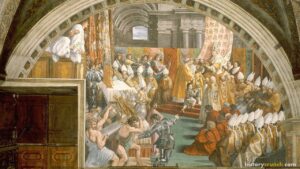
The Early Middle Ages lasted from approximately 500 CE to 1000 CE. This was a period of significant disruption following the fall of Rome. Without the unifying authority of the Roman Empire, Europe split into a patchwork of smaller kingdoms ruled by Germanic tribes including the Franks, the Visigoths, and the Lombards. Trade declined, towns shrank, and literacy became rare outside the Church. The most important political figure of the Early Middle Ages was Charlemagne, the Frankish king who united much of Western Europe under his rule in the late 8th and early 9th centuries and was crowned Holy Roman Emperor on Christmas Day in 800 CE. Charlemagne’s empire laid the foundations of the feudal system and helped spread Christianity and Latin learning across Europe. However, after his death his empire fragmented, and Europe faced new waves of invasion from Vikings in the north, Magyars in the east, and Saracens in the south.
The High Middle Ages lasted from approximately 1000 CE to 1300 CE and was a period of significant growth and development. The population of Europe increased substantially, driven by improvements in agricultural technology such as the heavy plow and the three-field crop rotationAn agricultural method used in the High Middle Ages that increased food production by dividing fields into thirds and rotating what was grown. system. Towns and trade expanded. The first universities were established, including those at Bologna, Paris, and Oxford. Gothic cathedrals were built across the continent, representing one of the greatest architectural achievements in European history. In fact, the High Middle Ages also saw the launch of the Crusades in 1095, the series of religious military campaigns in which Christian armies from Europe attempted to recapture the Holy Land from Muslim control. The period also saw significant political developments, including the signing of the Magna Carta in England in 1215, which placed important limits on royal power.
The Late Middle Ages lasted from approximately 1300 CE to 1500 CE and was defined by a series of overlapping crises that transformed European society. The most devastating was the Black Death, the outbreak of bubonic plague that swept across Europe between 1347 and 1351 and killed approximately one third of the continent’s population. The Black Death caused enormous social disruption, weakened the feudal systemA way of organizing medieval society around who owned land and who owed military service in return., and shook the authority of the Catholic Church. At the same time, the Hundred Years War between England and France, lasting from 1337 to 1453, produced one of the most famous figures of the period in Joan of Arc, a French peasant girl who claimed divine guidance and led French forces to several important victories before being captured and executed. By the end of the Late Middle Ages, the forces of the Renaissance, the printing press, and European exploration were beginning to transform the world in ways that would bring the medieval era to a close.
FactsthatCrunchHow do historians divide the 1,000 years of the Middle Ages into three distinct periods?
Tap a point to read its detail.
Society in the Middle Ages
Society in the Middle Ages was organized around the feudal system, which structured political, economic, and social life in a rigid and hierarchical way. At the top of the feudal hierarchy was the monarch, who claimed ultimate authority over all the land in the kingdom. Below the monarch were the great lords and nobles, who received large grants of land from the king in exchange for military service and loyalty. Below the nobility were knights, who provided military service to the lords above them. At the very bottom of the feudal hierarchy were the peasants and serfsPeasants legally tied to a lord’s land who could not leave without permission and had to perform unpaid labor., who made up the vast majority of the population and worked the land that supported everyone above them.
Serfs were peasants who were legally bound to the land they worked. They could not leave without their lord’s permission, and they were required to perform unpaid labor on the lord’s own fields as well as pay various fees and dues. In return, they received the lord’s protection and the right to farm a portion of the land for their own use. Life for medieval peasants was hard and largely defined by the rhythms of agricultural work, the seasons, and the religious calendar.
Women in the Middle Ages occupied a subordinate position within both the family and society more broadly. Wealthy noblewomen might exercise some influence within their households and occasionally in politics, while women of the lower classes worked alongside men in farming and crafts. The Church offered one alternative path for women through religious life, with convents providing communities in which some women achieved positions of learning and even authority as abbesses.
Role of the Catholic Church
One of the defining features of the Middle Ages was the enormous power and influence of the Catholic Church. In the absence of strong centralized governments, the Church filled many of the functions that modern states provide, including education, healthcare through its hospitals and monasteries, care for the poor, and the recording of important documents and events. The Church was the largest landowner in Europe and collected a tax known as the titheA Church tax requiring all Christians to give one tenth of their income or produce to the Catholic Church., which required all Christians to give one tenth of their income or produce to the Church.
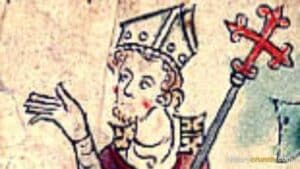
The Church also exercised significant political power. The Pope, based in Rome, claimed authority not just over spiritual matters but over the conduct of kings and emperors. In 1077 CE, the Holy Roman Emperor Henry IV was forced to stand barefoot in the snow at Canossa for three days to beg Pope Gregory VII for forgiveness after a dispute over who had the right to appoint church officials. The incident illustrated how far papal authority could extend in the Middle Ages.
In 1054 CE, the Christian church split in a major division known as the Great Schism, which separated the Roman Catholic Church in the west from the Eastern Orthodox Church centered in Constantinople. This split reflected deep theological and political differences between the eastern and western halves of the old Roman Empire and has never been fully healed.
FactsthatCrunchIn 1077, Holy Roman Emperor Henry IV stood in the snow at Canossa to beg the Pope for forgiveness.
The Crusades
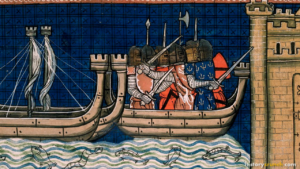
One of the most significant events of the High Middle Ages was the series of religious military campaigns known as the Crusades. The Crusades were launched in 1095 CE when Pope Urban II called on Christian warriors to travel to the Holy Land and recapture Jerusalem from Muslim rule. Jerusalem was considered the holiest city in Christianity, and the Pope’s call was answered by tens of thousands of knights and ordinary people across Europe.
The First Crusade, which lasted from 1096 to 1099 CE, succeeded in capturing Jerusalem, and a series of Crusader states were established in the region. However, holding these states against Muslim powers proved extremely difficult, and subsequent Crusades had much less success. The city of Jerusalem was recaptured by the Muslim leader Saladin in 1187 CE, and despite further Crusades it was never permanently retaken by Christian forces. The last Crusader stronghold in the Holy Land fell in 1291 CE.
The Crusades had far-reaching consequences for European society that went well beyond their military results. They stimulated trade between Europe and the Islamic world, bringing back goods, ideas, and technologies that enriched European civilization. They exposed Europeans to the mathematical, scientific, and philosophical achievements of Islamic scholars and helped reintroduce the works of ancient Greek philosophers to Western Europe. In fact, many historians argue that the intellectual exchange stimulated by the Crusades contributed to the intellectual revival of the High Middle Ages and laid groundwork for the Renaissance.
FactsthatCrunchIn what order did these key events in the Crusades happen?
The Black Death
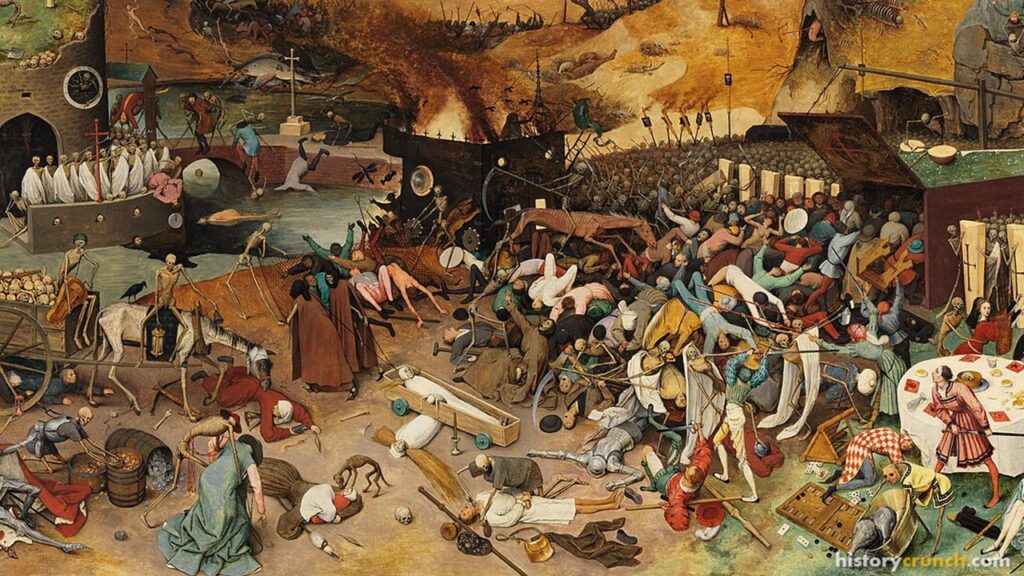
The most devastating event of the Late Middle Ages was the Black Death, the outbreak of bubonic plague that swept across Europe between 1347 and 1351 CE. The disease, which was spread primarily by fleas carried on rats, caused painful swellings called buboesPainful swellings in the lymph nodes caused by bubonic plague, a key symptom of the Black Death. in the lymph nodes, followed by fever, vomiting of blood, and death within days. It killed with terrifying speed and without apparent logic, striking rich and poor, clergy and layman alike.
The Black Death is estimated to have killed between one quarter and one third of Europe’s entire population within a few years. Some regions lost even higher proportions of their people. Entire villages were wiped out. The social effects were enormous. With so many agricultural workers dead, surviving peasants found themselves in much greater demand and were able to negotiate better wages and conditions, weakening the feudal system significantly. The Church, which seemed unable to explain or prevent the disaster, suffered a serious loss of authority in the eyes of many people. In fact, some historians argue that the Black Death was one of the most important factors in bringing the medieval era to a close, since the social and economic disruption it caused accelerated changes that were already beginning to undermine the feudal order.
Warfare in the Middle Ages
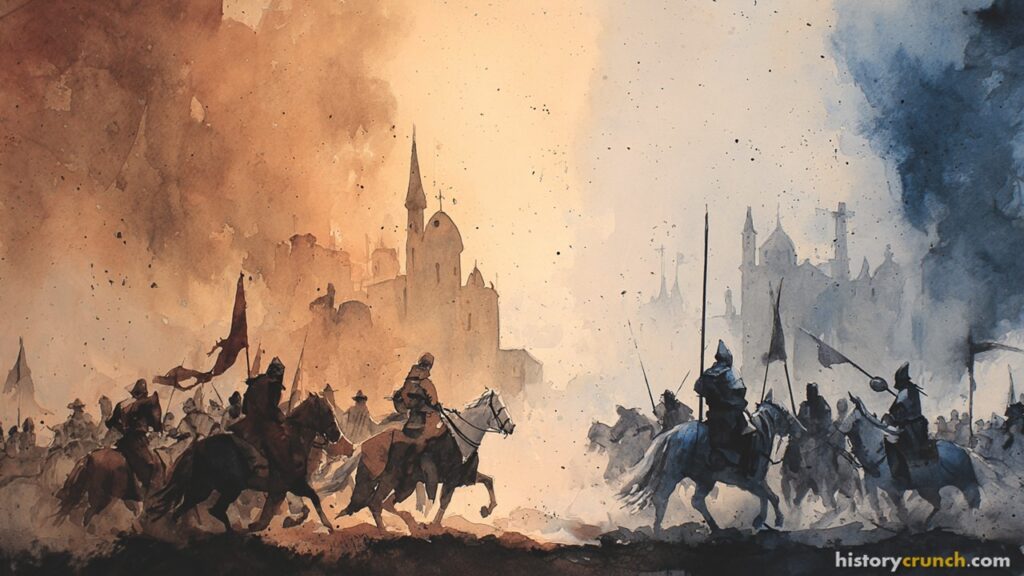
Warfare was a constant feature of the Middle Ages, fought between kingdoms, nobles, and religious forces for land, power, and faith. The methods and tools of medieval warfare changed significantly over the course of the period, from the cavalry charges and shield walls of the Early Middle Ages to the sophisticated siege warfare, longbows, and early gunpowder weapons of the later period.
The Norman Conquest of England in 1066 CE, when William the Conqueror defeated the Anglo-Saxon King Harold II at the Battle of Hastings, was one of the most consequential military events of the High Middle Ages. It transformed England’s language, aristocracy, and political system and introduced a stronger form of feudalism than had previously existed. The Battle of Agincourt in 1415 CE, during the Hundred Years War, demonstrated the devastating effectiveness of the English longbow when a relatively small English army under King Henry V defeated a much larger French force.
The medieval period also saw significant advances in the technology of defense, including the construction of massive stone castles that transformed the landscape of Europe. Knights, the heavily armored mounted warriors who formed the elite military force of the feudal system, became the defining image of medieval warfare, though they were increasingly supplemented and eventually replaced by infantry and missile weapons as the period progressed.
FactsthatCrunchWhy was the English longbow decisive at the Battle of Agincourt in 1415?
People of the Middle Ages
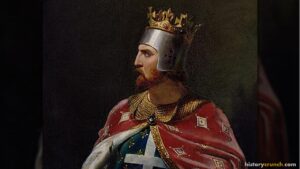
The Middle Ages produced many significant rulers, military leaders, and religious figures who shaped the course of European and world history. Among the rulers, Charlemagne stands out as the most important figure of the Early Middle Ages, unifying much of Western Europe and laying the foundations of both France and Germany. William the Conqueror transformed England through the Norman Conquest of 1066 CE. Richard the Lionheart of England became one of the most celebrated warriors of the Crusades. Frederick Barbarossa of the Holy Roman Empire was one of the most powerful rulers of the 12th century.
Among the military and religious figures, Saladin stands out as the Muslim commander who recaptured Jerusalem from the Crusaders in 1187 CE and became admired even by his Christian opponents for his chivalry. Joan of Arc, a French teenage peasant girl who claimed to hear the voices of saints directing her to save France, led French armies to several important victories during the Hundred Years War before being captured, tried for heresy, and burned at the stake in 1431 CE. She was later canonizedOfficially declared a saint by the Catholic Church, as happened to Joan of Arc after her death. as a saint by the Catholic Church. Pope Urban II launched the First Crusade. Thomas Becket, the Archbishop of Canterbury, was murdered in his own cathedral on the orders of King Henry II of England in 1170 CE, becoming one of the most celebrated martyrs of the medieval Church.
FactsthatCrunch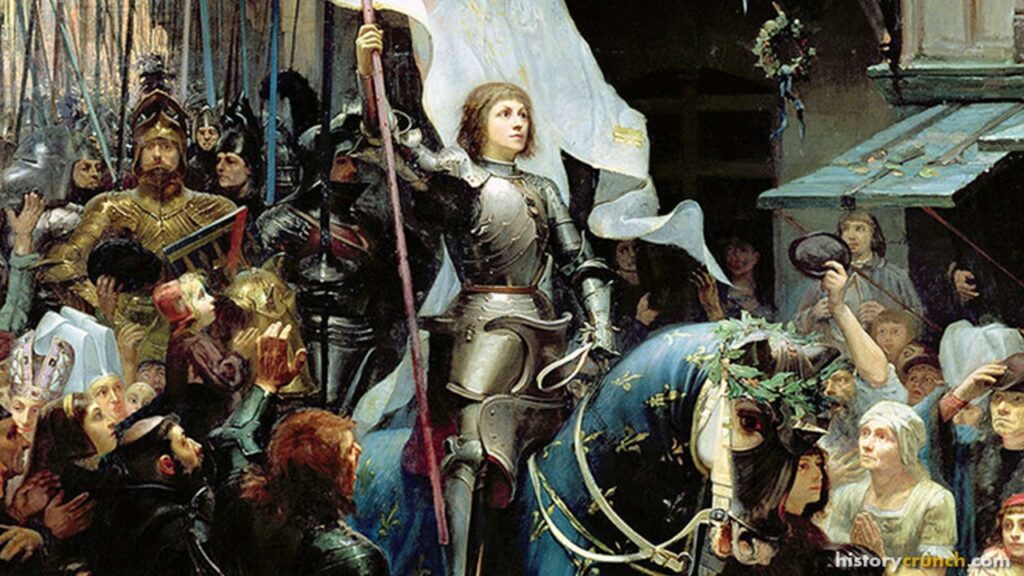
Significance of the Middle Ages
The significance of the Middle Ages in the history of Europe and the modern world is considerable. Despite its reputation as the Dark Ages, the medieval period was in fact an enormously creative and productive era that shaped virtually every aspect of the modern Western world.
The political institutions developed during the Middle Ages, including parliaments, common law, and constitutional limits on royal power represented by documents such as the Magna Carta, form the direct ancestors of modern democratic government. The universities founded in the High Middle Ages are the direct predecessors of modern universities. The architectural achievements of the medieval period, from the great cathedrals of France and England to the castles of the Rhine Valley, remain among the most impressive buildings in the world. The recovery and transmission of ancient Greek and Islamic learning during the Crusades and through the translation movement contributed directly to the intellectual revolution of the Renaissance.
The Middle Ages also laid the social and economic foundations from which modern European nations grew. The decline of feudalism, the growth of towns and trade, and the emergence of a merchant middle class during the later medieval period all pointed toward the commercial and industrial society that would develop in the centuries that followed. Furthermore, the trauma of the Black Death and the social disruptions of the Late Middle Ages accelerated changes that helped bring the medieval world to a close and opened the door to the early modern era of exploration, reformation, and scientific revolution. As such, the Middle Ages stands as one of the most important and consequential periods in the history of the Western world.
FactsthatCrunchThe first universities appeared during the High Middle Ages, with institutions at Bologna, Paris, and Oxford among the earliest to be established. These early universities were closely tied to the Catholic Church, which controlled much of education in Europe at the time. Students typically studied a fixed set of subjects drawn from ancient Greek and Roman scholarship, including logic, grammar, and theology.
Universities today exist on every continent and offer thousands of different programs across sciences, arts, technology, business, and many other fields. They are generally run by governments or independent boards rather than by any religious authority, though some church-affiliated universities still operate. The core idea, a place where students gather to study and earn recognized qualifications, traces directly back to the medieval institutions founded in Bologna, Paris, and Oxford.
The medieval university, shaped by the Church and ancient texts, became the model for the modern university system used around the world today.
Explore Middle Ages · 476 – 1500 CE
Keep exploring Middle Ages with these History Crunch resources.
Key Vocabulary
Feudal system
Serfs
Tithe
Buboes
Great Schism
Three-field crop rotation
Canonized
Frequently Asked Questions
When did the Middle Ages begin and end?
The Middle Ages lasted from about 500 CE to 1500 CE in European history. It started with the fall of the Western Roman Empire and ended as the Renaissance began. Historians divide the whole span into three parts: the Early, High, and Late Middle Ages.
Why were the Middle Ages called the Dark Ages?
The term suggested a time of ignorance and decline after the fall of Rome. Scholars once believed little progress happened between the classical and modern worlds. In truth, the period produced universities, Gothic cathedrals, and major political ideas that still shape life today.
What was the feudal system?
The feudal system organized medieval society around land ownership and military service. The monarch stood at the top, followed by lords, then knights, and finally peasants and serfs. Serfs were legally bound to the land and could not leave without their lord’s permission.
How many people did the Black Death kill?
The Black Death killed between one quarter and one third of Europe’s population from 1347 to 1351 CE. The bubonic plague spread mainly through fleas carried by rats. The massive loss of workers weakened the feudal system and shook the authority of the Catholic Church.
Why was the Catholic Church so powerful in the Middle Ages?
The Church filled many roles that governments provide today, such as education, healthcare, and care for the poor. It was the largest landowner in Europe and collected a tax called the tithe. The Pope even claimed authority over kings and emperors.
What were the Crusades?
The Crusades were religious military campaigns launched in 1095 CE to recapture the Holy Land from Muslim rule. The First Crusade took Jerusalem, but later campaigns had much less success. These wars also opened trade and brought Greek and Islamic learning back to Europe.
Cite This Article
To cite this article as a source, use one of the formats below.
MLA: Millar, B. “Middle Ages: A Detailed Overview.” HistoryCrunch, 13 October 2026, https://historycrunch.com/middle-ages-overview/.
APA: Millar, B. (2026). Middle Ages: A Detailed Overview. HistoryCrunch. https://historycrunch.com/middle-ages-overview/
Chicago: Millar, B. “Middle Ages: A Detailed Overview.” HistoryCrunch. October 13, 2026. https://historycrunch.com/middle-ages-overview/
Sources
- The Met (Heilbrunn Timeline) — medieval art
- Chris Wickham, Medieval Europe.
- Fordham Medieval Sourcebook
- Barbara Rosenwein, A Short History of the Middle Ages.