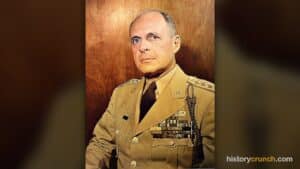
Hideki Tojo was the head of Japan’s government during most of World War II. This position made him the general of the Imperial Japanese Army (IJA) and the Prime Minister of Japan. As such, historians refer to Hideki Tojo as the ‘Military Leader’ of Japan during World War II. This is because some authority in Japan also rested with Emperor Hirohito. For instance, the Emperor of Japan was the official head of state of the country and viewed as a living god. Despite this, Hideki Tojo was responsible for the military actions carried out by Japan. For instance, Hideki Tojo was responsible for one of the most significant events of World War II, the Japanese Attack on Pearl Harbor.
 FactsthatCrunch
Hideki Tojo served as Japan's Prime Minister when the country attacked Pearl Harbor in December 1941 and held authority over both military and civilian government for most of the Pacific War. He was convicted of war crimes by the International Military Tribunal for the Far East in November 1948 and sentenced to death.
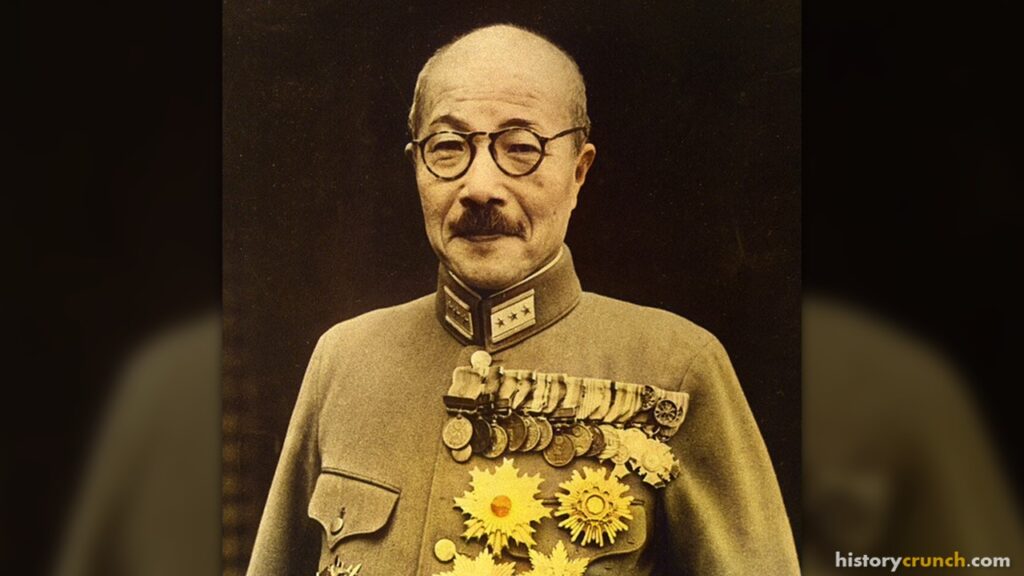
Hideki Tojo – Early Life
Hideki Tojo was born on December 30th, 1884 in Tokyo, Japan. His father, Hidenori Tojo, was a lieutenant general in the Imperial Japanese Army. As a child, Hideki Tojo received an education that focused heavily on military training. This was common in Japan at the time, as the country promoted the importance of warriors who were loyal to the Emperor. In fact, Japanese boys were always taught to fight for the honor of the Emperor. As stated above, the Emperor was viewed as a living god, and Japanese soldiers were expected to die for the honor of the Emperor.
Historians have noted that Tojo was known to be stubborn as a child and worked tirelessly towards goals that he hoped to achieve. As such, he was known to be very competitive and work extremely hard. For instance, Tojo has been quoted as saying “I am just an ordinary man possessing no shining talents. Anything I have achieved I owe to my capacity for hard work and never giving up”.
Tojo furthered his military training in 1899 when he began training at the Army Cadet School. He graduated from the school six years later in 1905 and immediately was positioned as a second lieutenant in the infantry of the Imperial Japanese Army.
Tojo married Katsuko Ito in 1909 and the couple had seven children (three sons and four daughters) together. His role in the Imperial Japanese Army allowed him to travel, including trips to Germany and the United States. Tojo traveled to Germany in the 1920s, where he was impressed by German military advances. Japan had modeled its own military after the German military since the 19th century. Around the same time, Tojo took a trip to the United States where he witnessed American society. This was important, because based on this trip Tojo formed an opinion that Americans were weak and undisciplined. This was likely due to Tojo’s own tremendous work ethic, which was an important part of his personality. This attention to detail and strong work ethic proved positive for Tojo as he advanced in his military career.
FactsthatCrunchAfter traveling to the United States in the 1920s, Tojo concluded that Americans were weak and undisciplined. He likely reached this view because his own identity was built on hard work, military training, and total loyalty to the Emperor, values he did not see reflected in American life. This low opinion of American resolve shaped his confidence that Japan could defeat the United States in a war.
Hideki Tojo – Rise to Power
Throughout the 1930s, Tojo worked his way up in the Imperial Japanese Army. For instance, he was promoted to the position of major general in 1934. With this position he was also given command of the 24th Infantry Brigade of the Imperial Japanese Army. As well, Tojo was known for being a supporter of strong expression of nationalismStrong pride and loyalty toward one’s own country, often used to justify putting that country above others. for Japan. This was common among Japanese military leaders at the time. Furthermore, Tojo supported a militaristic viewpoint, in which Japan could obtain its goals and expand its territory through militaristic expansion.
Tojo furthered his rise to power in 1935 when he was made commander of the military police of the Kwantung Army in Manchuria, which was a region in northeastern China. This position allowed him to use his militaristic insights to expand Japanese influence in China. He was later promoted to the position of Chief of Staff of the Kwantung Army in 1937. He returned to Japan in 1938 and continued to gain influence in the Japanese military.
In July of 1940, Tojo was appointed as Army Minister for Japanese Prime Minister Fumimaro Konoe. This was significant because Tojo’s military successes had also gained him political influence in the Japanese government. Konoe had chosen Tojo because he believed that Tojo was a strong-minded commander who would promote honor and devotion to the Emperor. Furthermore, Tojo was known to be a strong ultranationalist, which aligned with Konoe’s own personal views. UltranationalismAn extreme form of nationalism demanding total loyalty to the nation, even if it promotes hatred or violence against others. is an extreme form of nationalism that promotes total loyalty to the nation, even if it means promoting hatred and violence against others.
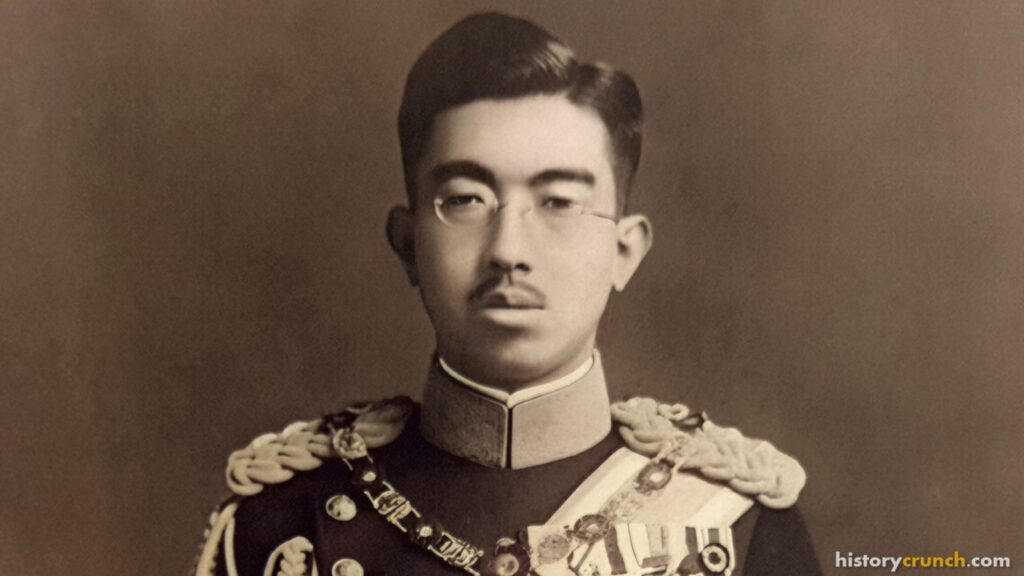
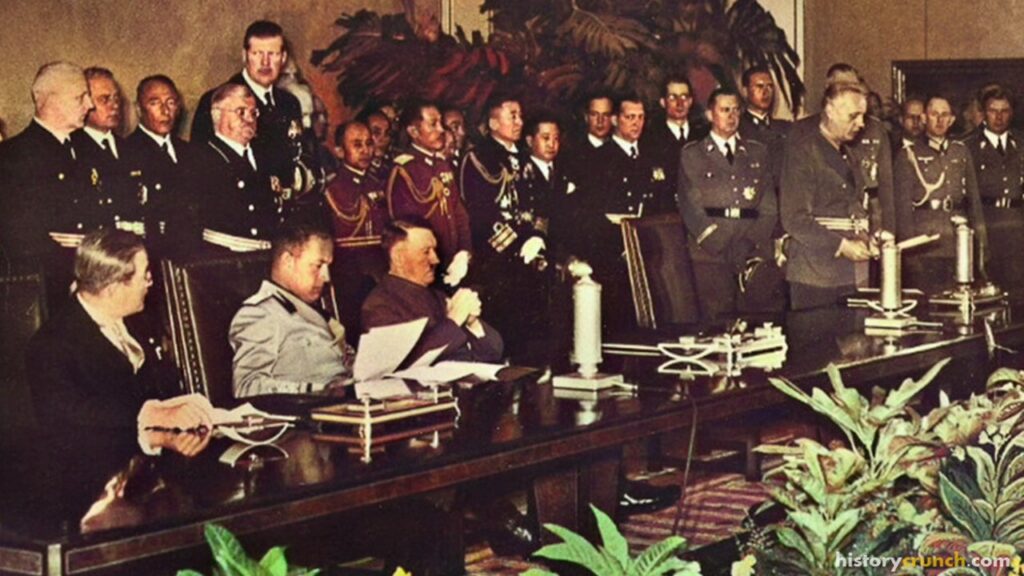
Under Tojo’s guidance as Army Minister, Japan aligned itself militarily with Nazi Germany and fascist Italy. For instance, the three countries agreed to a defensive military alliance in September of 1940, referred to as the Tripartite Pact. At the same time, Tojo was tasked with seeking a form of peace with the Allied Powers of World War II and the United States. However, the growing tensions from the start of World War II made this unlikely. This proved important, as Prime Minister Konoe came under increased pressure due to the growing likelihood of a war with the Allied Powers. As a result, Konoe resigned as Prime Minister in October of 1941 and was replaced by Hideki Tojo after he was chosen by Emperor Hirohito.
 FactsthatCrunch
Konoe's resignation in October 1941 put Hideki Tojo in charge of Japan at the exact moment the country was deciding whether to go to war with the United States.
Konoe stepped down because he faced growing pressure over the rising likelihood of war with the Allied Powers and the United States, and Emperor Hirohito chose Tojo to replace him.
Tojo was selected because of his clear loyalty to Emperor Hirohito and his pro-war stance toward the United States, making him the candidate most willing to take Japan into open conflict.
As Prime Minister, Tojo immediately began preparations for Japan's entry into World War II, leading directly to the attack on Pearl Harbor on December 7th, 1941.
Tojo's appointment concentrated military and political power in one person, since he also served as his own minister in several government departments, shaping Japan's wartime direction without sharing authority.
Hideki Tojo – Leadership
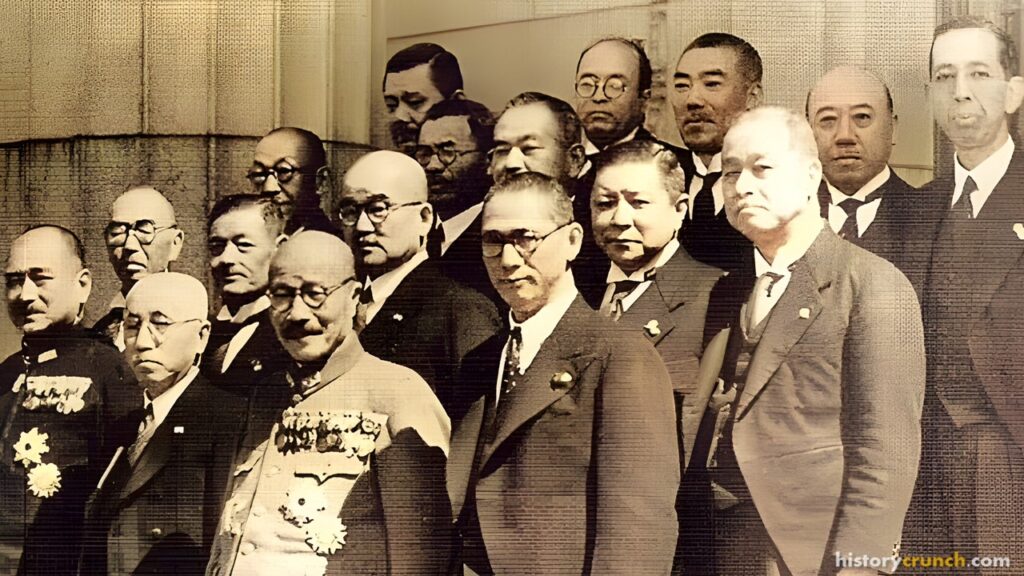
Hideki Tojo ruled Japan as a militaristic dictator. Tojo’s leadership over Japan was based on several key principles. First, Tojo expressed, and demanded, extreme loyalty to Emperor Hirohito. For Tojo, as with most Japanese people at the time, the Emperor was a living god and deserved the utmost respect. For instance, Tojo would have expected his soldiers to die before being captured as a sign of respect for the Emperor. Tojo, and other government officials, promoted this to the Japanese soldiers through powerful propaganda. Tojo also supported the long-held belief of ‘bushidoA Japanese warrior code that required soldiers to die before dishonoring their Emperor rather than surrender.’. In short, ‘bushido’ translates to ‘the way of the warrior’ and refers to a set of expectations for Japanese soldiers. For instance, it was expected that soldiers would die before dishonoring their Emperor.
As such, the Japanese bushido code of honor, coupled with effective propaganda which portrayed American soldiers as ruthless animals, prevented surrender for many Japanese soldiers. Instead of surrendering, many Japanese soldiers would kill themselves. For example, Japanese soldiers were known to charge at the American defensive lines even when they were outnumbered and lacked weapons. They were essentially running to their deaths as the American soldiers shot and killed them. Also, Japanese soldiers were known to kill themselves by ritual suicide. This would involve them either carrying out seppukuA form of Japanese ritual suicide in which a person thrusts a samurai sword into their own abdomen. (which involved them thrusting a samurai sword into their own abdomen) or they would kill themselves by pulling the pin of a grenade and holding it until it exploded. This extreme loyalty can also be viewed as a form of ultranationalism, since the Japanese soldiers were expressing extreme loyalty to their nation.
Tojo’s leadership was also centered on his own control over several aspects of Japanese society. For instance, while he was Prime Minister, Tojo also served as his own minister in several different ministries, including: Foreign Affairs, Education and Commerce. This displays Tojo’s controlling nature since he preferred to hold power over the society than have it shared with other influential members of his government.
Another example of his nationalistic nature can be seen in how he organized the education of Japanese youth during his years as Prime Minister. For example, Tojo carried out indoctrinationThe process of teaching people to accept a set of beliefs without questioning them, used here to spread militaristic values in schools. in the education system by promoting Japanese militaristic values. He did this as a measure of gaining widespread support for the war on the home front and as a means of preparing young people for war.
Finally, Tojo was also known to support the policies of eugenicsThe practice of controlling who can reproduce in a society in order to promote certain genetic traits considered desirable., which were famously practiced by Nazi Germany. In short, eugenics is the practice of promoting certain genetic traits in a society by preventing some people from reproducing. The Nazis promoted eugenics in their society with the events of the Holocaust. For his part, Tojo supported the sterilization of people he deemed to be ‘mentally unfit’. As such, Tojo was hoping to produce a stronger country by not allowing some people to reproduce and have children. The practice of eugenics has been widely denounced across the world as a prejudiced and cruel action. However, it highlights Tojo’s nationalistic and totalitarian rule.
 FactsthatCrunch
Tap each impact to read what it led to.
Hideki Tojo – World War II
Hideki Tojo was chosen to be the next Prime Minister due to his expressions of loyalty to the Emperor and because of his pro-war stance against the United States. As a result, when Tojo became the Prime Minister he began preparations for Japan’s entrance into World War II. For instance, Japan entered the fighting of World War II on December 7th, 1941 with the Attack on Pearl Harbor. Tojo oversaw the operations of the attack due to his role as Prime Minister. The Attack on Pearl Harbor was a vitally important event as it set the stage for the war in the Pacific Theater while also causing the United States to enter World War II on the side of the Allies. With that said, while Japan had achieved the element of surprise at Pearl Harbor, it failed to knock out the American Pacific Fleet.
Following the attack on Pearl Harbor, the Japanese enjoyed a series of victories. For instance, the Imperial Japanese Navy (IJN) famously sank two British Royal Navy ships on December 10th of 1941, the HMS Prince of Wales and the HMS Repulse. Furthermore, in 1942, the Imperial Japanese Navy carried out a series of successful attacks against Australian targets, including the Sydney Harbor. These victories created a feeling within Tojo’s government that Japan was undefeatable. However, 1942 also proved to be a difficult year for Japan, as it suffered a major defeat at the Battle of Midway. The Battle of Midway was a terrible loss for Japan, as it was never able to recover following it. As such, historians often refer to the Battle of Midway as a ‘turning point’ in the Pacific Theater, because it shifted the power of the war from Japan to the United States.
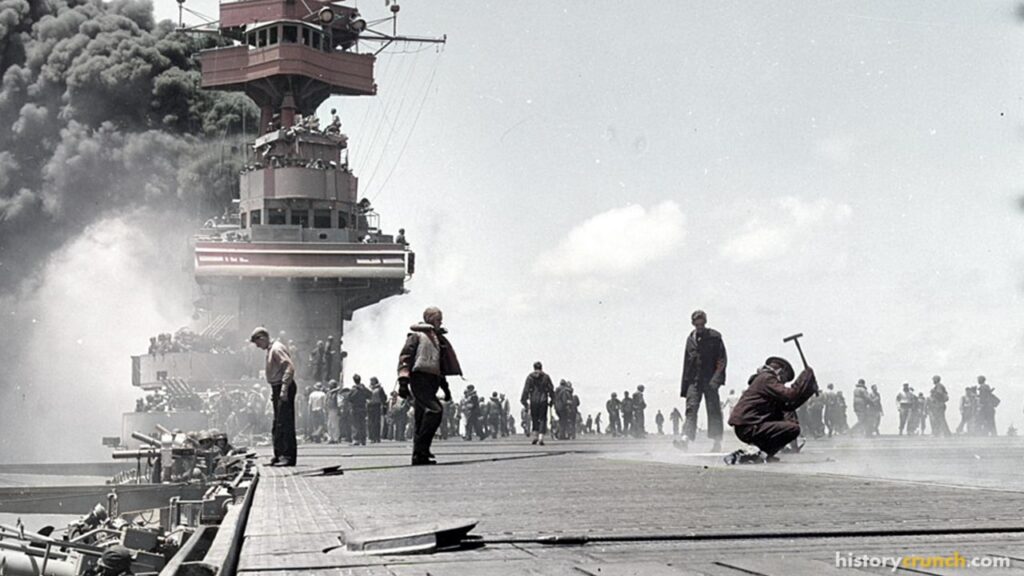
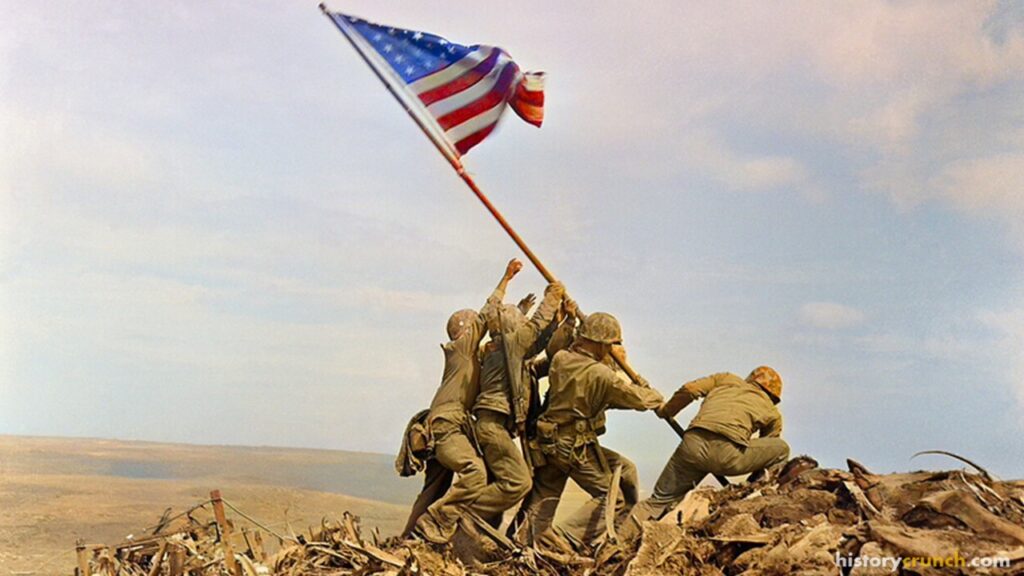
The loss at the Battle of Midway in June of 1942 was not only a massive loss militarily for Japan but it was also a difficult loss for Tojo and his leadership over the country. Several influential people in Tojo’s government began to question his authority and his ability to deal with the growing uncertainty about the war. This caused Tojo to push harder for what he believed was necessary for Japan to win the war. Regardless, throughout the remaining years of the war (1943 to 1945) Japan suffered a series of major losses. For instance, at its height Japan had controlled large areas of the South Pacific, but the United States successfully pushed through these regions and forced Japan back to its home islands. The United States famously used a strategy called ‘island-hopping’, which saw its forces only capture main islands on its way to the Japanese homeland. In response to these losses, Tojo ordered his forces back to guard the homeland and protect the Emperor. In fact, he pulled troops back from China to help in the defense. Tojo had hoped that these returning soldiers would help the Japanese forces push back the Americans and force their retreat. However, following a series of major losses, Tojo realized that Japan had all but lost the war. For instance, the Battle of Saipan took place from June 15th to July 9th in 1944 and was a major loss for Japan. This loss proved to be too much for Tojo’s continued leadership and just days later on July 18th Emperor Hirohito forced him to resign as Prime Minister. General Kuniaki Koiso replaced Tojo as Prime Minister.
 FactsthatCrunch
By June of 1942, Japan's Imperial Navy had won victory after victory across the Pacific, and many in Prime Minister Hideki Tojo's government believed Japan was undefeatable. Japan then launched a major naval operation targeting Midway Atoll, hoping to finish off American power in the Pacific for good. The outcome of that battle would determine whether Japan kept the upper hand in the Pacific or lost it for good.
Hideki Tojo – Death & Legacy
Japan finally surrendered to the United States in 1945 following the atomic bombing of the Japanese cities of Hiroshima and Nagasaki. Following the end of the war, Hideki Tojo was arrested by American forces on the orders of United States General Douglas MacArthur. Tojo actually tried to commit suicide when he was arrested by shooting himself in the chest, but he survived.
Tojo had been arrested for war crimesExtreme acts committed during wartime that go beyond what is considered acceptable under international standards.. The term ‘war crimes’ is when a person or group of people commit extreme acts during a time of war that are considered to be beyond what is acceptable. For his part, Tojo was tried and convicted of several different war crimes, including: starting a war of aggression, unprovoked war against other nations, and ordering the inhumane treatment of prisoners of war. He was tried before the International Military Tribunal for the Far East, which had been set up to hold Japanese war criminals accountable. In fact, historians estimate that millions of people died as a result of Hideki Tojo’s decisions.
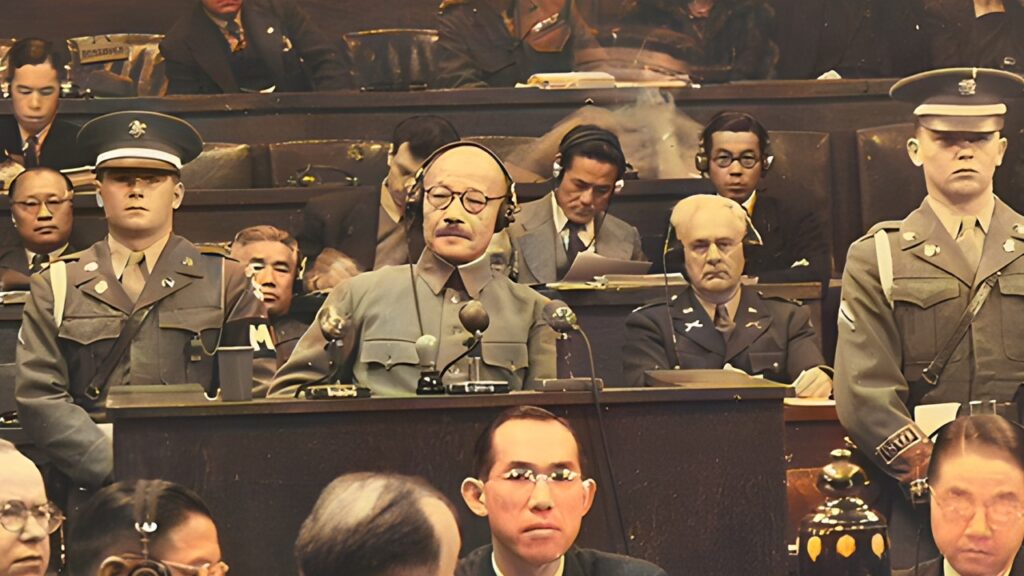
Ultimately, Tojo accepted responsibility for his actions in the war and asked the Americans to help Japan recover following the two atomic bombings in the country. For instance, he famously stated the following:
“It is natural that I should bear entire responsibility for the war in general, and, needless to say, I am prepared to do so. Consequently, now that the war has been lost, it is presumably necessary that I be judged so that the circumstances of the time can be clarified and the future peace of the world be assured. Therefore, with respect to my trial, it is my intention to speak frankly, according to my recollection, even though when the vanquished stands before the victor, who has over him the power of life and death, he may be apt to toady and flatter. I mean to pay considerable attention to this in my actions, and say to the end that what is true is true and what is false is false. To shade one’s words in flattery to the point of untruthfulness would falsify the trial and do incalculable harm to the nation, and great care must be taken to avoid this.”
In the end, Hideki Tojo was sentenced to death for his role in war crimes and was executed on December 23rd in 1948 by hanging. Today, Tojo is remembered as an ultranationalist who ruled over Japan with a devout loyalty to the Emperor. However, he also led Japan into a major conflict that it ultimately could not win.
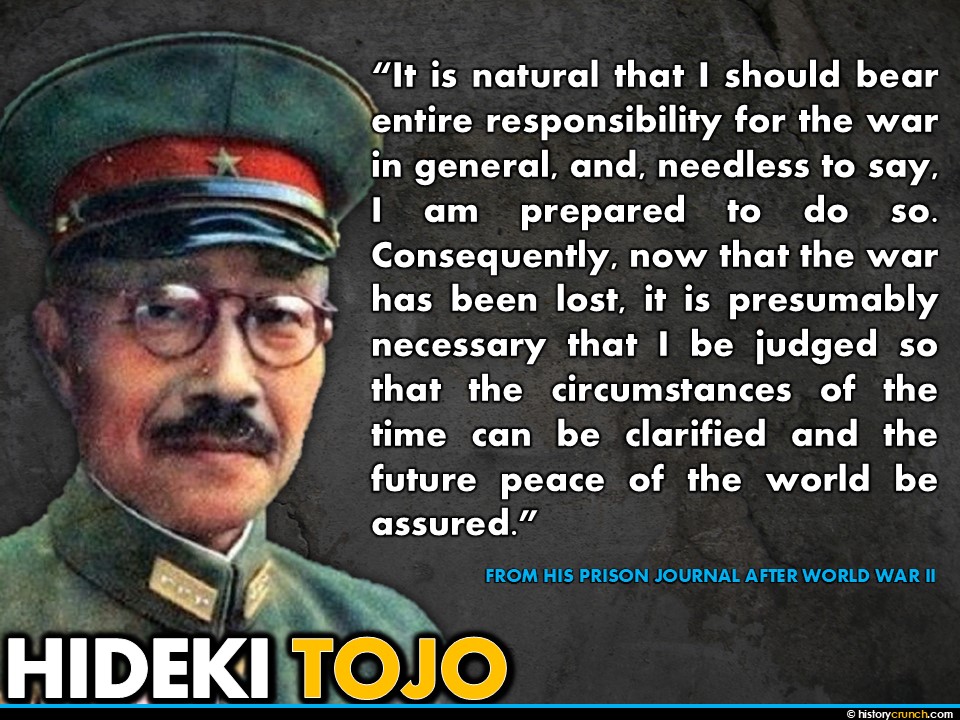
It is natural that I should bear the entire responsibility for the war.
Key Vocabulary
Nationalism
Ultranationalism
Bushido
Indoctrination
Eugenics
Seppuku
War crimes
Frequently Asked Questions
Who was Hideki Tojo?
Hideki Tojo was the Prime Minister of Japan during most of World War II and a general in the Imperial Japanese Army. He was often called the military leader of Japan, though some authority still rested with Emperor Hirohito. Tojo was responsible for many of Japan’s military actions, including the attack on Pearl Harbor.
When did Hideki Tojo become Prime Minister of Japan?
Hideki Tojo became Prime Minister of Japan in October of 1941 after Fumimaro Konoe resigned. Emperor Hirohito chose Tojo because of his loyalty and his pro-war stance against the United States. Soon after taking power, Tojo began preparing Japan to enter World War II.
What was Tojo’s role in the attack on Pearl Harbor?
Tojo oversaw the attack on Pearl Harbor on December 7th, 1941, in his role as Prime Minister. The surprise strike brought the United States into World War II on the side of the Allies. While Japan caught the Americans off guard, it failed to destroy the American Pacific Fleet.
Why was Hideki Tojo forced to resign?
Emperor Hirohito forced Tojo to resign on July 18th, 1944, after a string of major defeats. The loss at the Battle of Saipan convinced many leaders that Tojo could no longer win the war. General Kuniaki Koiso replaced him as Prime Minister.
How did Hideki Tojo die?
Hideki Tojo was executed by hanging on December 23rd, 1948, after being convicted of war crimes. He was tried before the International Military Tribunal for the Far East for crimes such as starting a war of aggression and mistreating prisoners of war. When American forces first arrested him, he tried to kill himself by shooting his chest but survived.
Cite This Article
To cite this article as a source, use one of the formats below.
MLA: Beck, Elias. “Hideki Tojo: A Detailed Biography.” HistoryCrunch, 3 October 2026, https://historycrunch.com/hideki-tojo/.
APA: Beck, E. (2026). Hideki Tojo: A Detailed Biography. HistoryCrunch. https://historycrunch.com/hideki-tojo/
Chicago: Beck, Elias. “Hideki Tojo: A Detailed Biography.” HistoryCrunch. October 3, 2026. https://historycrunch.com/hideki-tojo/
Sources
- Imperial War Museum
- Gerhard L. Weinberg, A World at Arms.
- The National WWII Museum
- Max Hastings, Inferno / All Hell Let Loose.