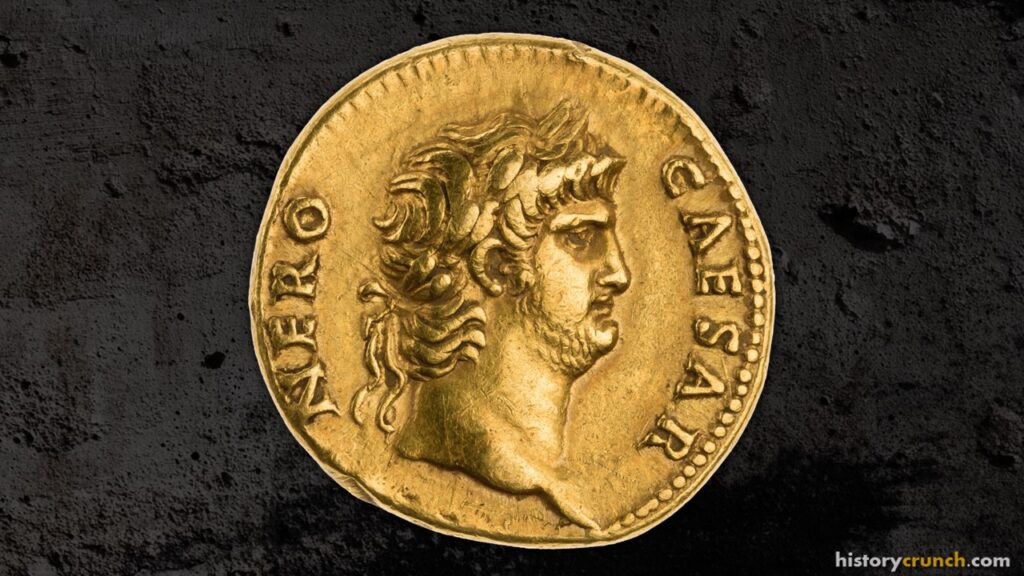
Nero, the emperor of Ancient Rome, was one of the most significant figures in Ancient Roman history. He ruled as emperor of the Roman Empire from 54 CE to 68 CE and is remembered today for his chaotic and infamous reign. For instance, the most famous event of Nero’s reign was the Great Fire of Rome in 64 CE, which destroyed much of the city. As such, historians consider him to be one of the most important emperors in the history of Ancient Rome.
EMPEROR NERO – EARLY LIFE
Nero was born, Lucius Domitius Ahenobarbus, in Antium on the 15th of December in 37 CE. Antium was a settlement, close to Rome, and is located in modern-day Italy. Nero’s mother was Agrippina the Younger, the younger sister of Emperor Caligula. She was exiled from Rome when Nero was a child. Nero’s father, Gnaeus Domitius Ahenobarbus, was charged with a number of crimes but escaped persecution because the Emperor Tiberius who had charged him, died before the trials took place. Regardless, Gnaeus died when Nero was just a young child. As a result, Nero was adopted by Emperor Claudius, who was his great uncle.
As a result of the adoption by Claidus, Nero became Claudius’ heir and successor. As such, Nero took the throne and became emperor of Rome in 54 CE.
EMPEROR NERO – EMPEROR OF ROME
When Nero became the Emperor of Rome in 54 CE, he was just 16 years old. This made him one of the youngest Roman leaders. The beginning of Nero’s reign was regarded as a time of progress and peace. For instance, at the time, he was guided by capable tutors, including: the philosopher Seneca and the commander Burrus. In fact, during this period, Nero introduced reforms, reduced taxes and promoted the arts and public entertainment. He did this by ordering the construction of numerous theaters across the vast Roman Empire. During this time, he was popular among the people for organizing festivals, theatrical performances and chariot races. However, his relationship with his mother and advisors soon changed as Nero grew more independent.
Although Nero set a number of policies in place that pleased the lower classes in Rome, he was not liked by the majority of the Roman population. This became even more noticeable as time passed. For instance, as Nero matured into adulthood, his reign as emperor became dark and chaotic. For instance, he supposedly became increasingly paranoid, cruel and self-indulgent. In 59 CE, he ordered the murder of his mother, Agrippina, out of fear that she might challenge his authority. Furthermore, He later forced his wife, Octavia, to commit suicide and executed many senators and political rivals.
Another significant part of Nero’s reign, as the Emperor of Rome, was that the Great Fire of Rome occurred during this time. In fact, the fire occurred in 64 CE and destroyed much of the city. It was thought by some Romans that Nero started the fire himself in order to clear land for more construction. In fact, according to the historian Tacitus, Nero was seen playing his lyre and singing while the city burned. It should be noted that this image may have been exaggerated by his enemies.
After the fire, Nero blamed the Christians for the destruction and ordered brutal persecutions that made him one of the earliest figures to target the new religion of Christianity. Despite the tragedy, he used the opportunity to rebuild Rome according to his own vision. For instance, he constructed the grand Domus Aurea, which was a luxurious palace complex. For many Romans, it represented the extravagance of Nero’s rule as emperor.
EMPEROR NERO – DEATH AND SIGNIFICANCE
Over time, Nero’s behavior led to widespread anger across many different groups in Roman society. For instance, his high taxation, executions of noblemen and erratic rule caused him to have enemies among the poor, noblemen and Senators. In 68 CE, a rebellion broke out under Gaius Julius Vindex in Gaul, soon followed by uprisings in Spain and other parts of the empire. The Roman Senate declared Nero a public enemy and supported Galba, a governor in Spain, as the new emperor.
Abandoned by his guards and fearing capture, Nero fled the city of Rome. He was falsely told that he was to be executed and out of fear Nero committed suicide on the 9th of June in 68 CE. Nero was the first Roman Emperor to have killed himself. Finally, Nero’s death marked the end of the Julio-Claudian Dynasty. As such, historians consider Nero to be one of the most controversial and significant figures in Ancient Rome.