The Flight to Varennes was one of the most important turning points of the French Revolution, because it destroyed public trust in King Louis XVI and pushed France further toward becoming a republic. It refers to the failed attempt by the French royal family to secretly escape from Paris on the night of June 20th, 1791. Louis XVI, his wife Marie Antoinette, and their children slipped out of the city in disguise, hoping to reach loyal troops near the eastern border. Their carriage was stopped in the small town of Varennes, and the family was arrested and marched back to Paris in humiliation.
In simple terms, the Flight to Varennes was an escape attempt that failed. It mattered so much because it seemed to prove that the king was working against the very revolution he had publicly promised to accept. Before the escape, many French people still hoped that Louis XVI could rule as a constitutional monarchA king or queen whose power is limited by a written constitution and a lawmaking assembly., meaning a king whose power is limited by a constitution and a lawmaking assembly. After Varennes, that hope began to collapse.
 FactsthatCrunch
Why did the royal family's disguise fail to save them at Varennes during the French Revolution?
The disguise failed mainly because King Louis XVI's face appeared on French coins and paper money used all across France, making him extremely hard to hide no matter what clothes he wore. A local postmaster named Jean-Baptiste Drouet spotted the king at a stop along the route and raced ahead to warn officials in Varennes, who then blocked the carriage and questioned the passengers. Once officials searched the carriage and confirmed the family's true identity, the escape was over.
What Was the French Revolution?
The French Revolution was one of the most significant events in world history, and it stretched from 1789 to 1799. During this period, the French people overthrew their absolute monarchy and worked to build a republic based on the ideas of liberty, equality, and fraternity. An absolute monarchyA system in which a single ruler holds nearly total power over the government and the people. is a system in which a single ruler, in this case the king, holds nearly total power over the government and the people.
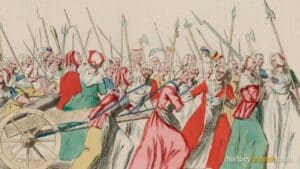
The revolution had several main causes, including the ideas of the Age of Enlightenment, the unfair estates-system that divided French society into three groups, the failures of King Louis XVI, poor harvests, and a severe economic crisis. In fact, these problems came together in 1789 when the government was nearly bankrupt and ordinary people could barely afford bread. That year, revolutionaries stormed the Bastille, a royal fortress and prison in Paris, in an event now seen as the beginning of the revolution.
In the years that followed, the National Constituent Assembly, an elected body of lawmakers, worked to write a constitution and reshape the country. More specifically, it abolished feudalism, reduced the power of the Catholic Church, and tried to turn France into a constitutional monarchy. The Flight to Varennes took place in the middle of this process, and it helped push the revolution in a far more radicalWanting extreme or complete political change, such as removing the king entirely. direction. Readers can learn more about the wider event in the causes of the French Revolution.
Why Did the Royal Family Want to Escape?
By 1791, King Louis XVI and his family were living in the Tuileries Palace in Paris, where they had been kept since October of 1789. Although they were officially free, in reality they were watched closely and behaved like prisoners. The king felt trapped and increasingly frustrated with the changes the revolution was forcing upon him.
One of the deepest sources of anger for Louis XVI was the revolution’s treatment of the Catholic Church. New laws placed the Church under government control and required priests to swear an oath of loyalty to the state. As a devoutDeeply committed to religious faith and practice. Catholic, the king viewed these changes as a personal betrayal of his faith.
Marie Antoinette also urged her husband to act. She feared for the safety of the family and believed that escaping Paris was the only way to protect them. The plan was to reach the fortress town of Montmédy near France’s eastern border, where loyal soldiers were waiting. From there, the king hoped to gather royalistA person who supports keeping the king in power. forces and negotiate with the revolutionaries from a position of strength, rather than as a captive.
FactsthatCrunchThe National Constituent Assembly passed the Civil Constitution of the Clergy in 1790, which placed the Catholic Church under government control and required all priests to swear an oath of loyalty to the state rather than to the Pope.
The Civil Constitution of the Clergy was a turning point for Louis XVI personally. His religious objections pushed him from reluctant cooperation with the revolution toward secret plans to flee France and seek outside help.
How Was the Escape Planned?
The escape was carefully arranged in secret, with help from loyal supporters of the monarchy. A large, comfortable carriage was prepared for the long journey, and loyal army officers were supposed to be stationed along the route to protect the family as it traveled east. The goal was to move quickly and quietly before anyone in Paris noticed the king was gone.
On the night of June 20th, 1791, the royal family slipped out of the Tuileries Palace in disguise. The king dressed as a servant, and the family pretended to be ordinary travelers rather than royalty. In reality, this disguise was meant to help them pass through the countryside without being recognized.
The plan had serious weaknesses, however. The heavy carriage moved slowly, and the family got a late start, which threw off the careful timing. As stated above, soldiers were supposed to escort the family along the way, but the delays meant the troops were not always where they were expected to be.
FactsthatCrunchThe royal family's plan to escape Paris in a heavy disguised carriage during the French Revolution had both reasons that seemed sound at the time and serious flaws that doomed it to failure.
What Happened at Varennes?
As the carriage traveled east, its timing fell further and further behind. Near the town of Châlons, the loyal soldiers who were supposed to guard the family could not be found, so the carriage continued on without protection. This left the royal family exposed as they passed through a series of small towns.
At one of these stops, a local postmaster named Jean-Baptiste Drouet believed he recognized the king’s face. For instance, the king’s image appeared on French coins and paper money, which made him difficult to disguise. Drouet raced ahead to warn officials in the next town.
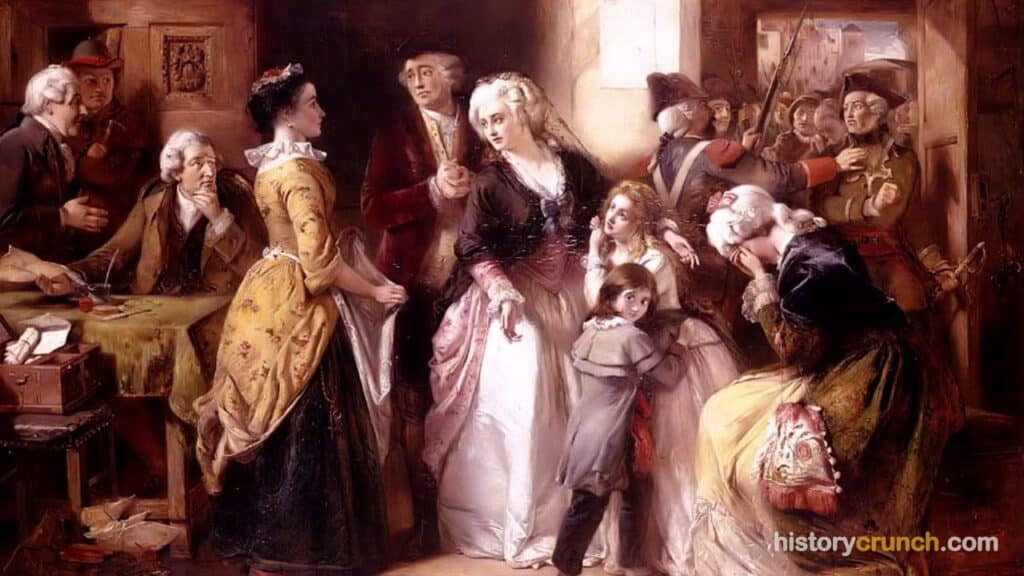
When the carriage stopped in Varennes to get fresh horses, local officials moved to block its path. A town official searched the carriage and questioned the passengers, and the family’s true identity was soon confirmed. The king and queen, who had traveled roughly 150 miles (240 km) from Paris, were placed under guard and could go no farther. Within a short time, the National Guard escorted the humiliated royal family back to Paris.
FactsthatCrunchHow Was King Louis XVI Recognized During the Flight to Varennes? What allowed a local postmaster to identify the king despite his disguise?
What Were the Results of the Flight to Varennes?
The return journey to Paris was tense and gloomy. Crowds gathered along the roads to watch the captured family pass, and many people stayed silent or glared rather than cheer. In reality, this cold reception showed how quickly the public mood had turned against the monarchy.
At first, the National Constituent Assembly tried to protect the king’s reputation. Leaders spread the story that Louis XVI had been kidnapped rather than escaping on his own, hoping to save the fragile plan for a constitutional monarchy. Few people truly believed this excuse, and trust in the king continued to fall.
The escape attempt also deepened the split among the revolutionaries themselves. More and more people began openly calling for a republic, meaning a government with no king at all. In July of 1791, a crowd gathered in Paris to demand that the king be removed from power, and the National Guard fired on the demonstrators in an event known as the Champ de Mars Massacre.
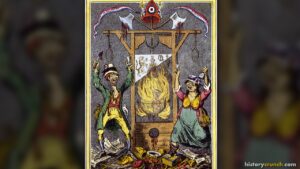
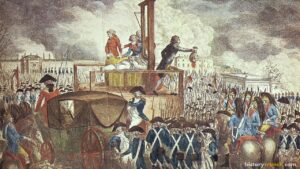
Fears of foreign invasion also grew after Varennes, since many believed the king had been trying to link up with foreign powers who opposed the revolution. These fears helped lead to war between France and other European nations less than a year later. Within about a year, the monarchy was abolished, and in January of 1793 Louis XVI was executed. Marie Antoinette followed him to the guillotineA device used during the French Revolution to execute people by beheading. in October of that same year.
FactsthatCrunchSignificance of Flight to Varennes
The significance of the Flight to Varennes lies in how it changed the direction of the entire French Revolution. Before the escape, many French people still hoped that Louis XVI could rule fairly as a constitutional monarch. Afterward, his secret attempt to flee made him look like a traitor to his own country.
In fact, the event is often described as the moment that doomed the idea of a constitutional monarchy in France. Once the public no longer trusted the king, moderate revolutionaries who supported keeping a limited monarchy lost much of their influence. In their place, radical leaders who wanted a republic gained strength and support.
The Flight to Varennes also helped push France toward violence and war. It increased fear of foreign enemies, fueled the anger that led to the Champ de Mars Massacre, and set the stage for the eventual trial and execution of the king. For all these reasons, the failed escape stands as one of the key turning points on the road from monarchy to republic.
FactsthatCrunchTap each impact to read what it led to.
French Revolution timeline · 1789 – 1799
Key Vocabulary
Constitutional monarch
Absolute monarchy
Devout
Royalist
Radical
Guillotine
Frequently Asked Questions
When Did the Flight to Varennes Happen?
The Flight to Varennes took place on the night of June 20th, 1791, and ended the next day, June 21st. The royal family left Paris after dark to avoid being noticed, and they were arrested in Varennes only about a day later. The whole event unfolded quickly, over roughly 24 hours.
Where Was the Royal Family Trying to Go?
The royal family was trying to reach the fortress town of Montmédy near France’s eastern border. There, loyal royalist soldiers were waiting to protect the king. Louis XVI hoped to use this safe base to bargain with the revolutionaries or even to lead a counter-revolution against them.
How Was Louis XVI Recognized?
A local postmaster named Jean-Baptiste Drouet recognized the king and raised the alarm. One reason the king was hard to disguise is that his portrait appeared on coins and paper money used across France. Drouet hurried ahead to Varennes and helped make sure the carriage was stopped and searched.
Why Did the Flight to Varennes Fail?
The escape failed mainly because of poor timing and a heavy, slow carriage. The family started late, which meant the loyal soldiers meant to guard the route were not in the right places at the right times. These delays gave officials enough time to recognize the king and block the carriage before it reached safety.
What Was the Champ de Mars Massacre?
The Champ de Mars Massacre was a deadly clash in Paris in July of 1791, about one month after the Flight to Varennes. A large crowd gathered to demand that the king be removed from power, and the National Guard opened fire on the demonstrators. The event showed how the failed escape had inflamed public anger and deepened the divide between moderate and radical revolutionaries.
Cite This Article
To cite this article as a source, use one of the formats below.
MLA: Millar, B. “Flight to Varennes: A Detailed Summary.” HistoryCrunch, 11 August 2026, https://historycrunch.com/flight-to-varennes/.
APA: Millar, B. (2026). Flight to Varennes: A Detailed Summary. HistoryCrunch. https://historycrunch.com/flight-to-varennes/
Chicago: Millar, B. “Flight to Varennes: A Detailed Summary.” HistoryCrunch. August 11, 2026. https://historycrunch.com/flight-to-varennes/
Sources
- Jerry Bentley & Herbert Ziegler, Traditions & Encounters: A Global Perspective on the Past.
- J.M. Roberts & Odd Arne Westad, The Penguin History of the World.