Fascism in Italy is one of the most important topics related to the history of World War II. During the early decades of the 20th century, Italy became the birthplace of fascism as a political ideology, and the country’s fascist movement under Benito Mussolini would go on to influence events across all of Europe. Understanding fascism in Italy is important for students of history because it helps explain how one of the most destructive wars in human history came to be, and how a democratic country could fall under the control of a dictator.
 FactsthatCrunch
What were the main methods of totalitarian control that Mussolini used to hold power in Italy?
What Was Fascism?
Fascism was an authoritarian political ideology that emerged in Europe during the 20th century, particularly in the years following World War I. At its core, fascism rejected the values of liberal democracy, including individual rights and freedoms, and instead argued that the needs of the state were more important than the needs of any single person. In a fascist country, citizens were expected to act in the best interests of the nation and to follow the leadership of a powerful central ruler without question. Fascism also promoted extreme nationalism, meaning a very strong and often aggressive pride in one’s country, as well as the buildup of military power and the expansion of national territory. On the political spectrum, fascism is generally placed on the far right. While fascism shared some surface similarities with other authoritarianA system where one ruler or party holds total power and citizens must obey without question. ideologies like communism, the two were quite different. Unlike communist countries, which placed all economic ownership in the hands of the government, fascist states allowed citizens to own private businesses, so long as those businesses served the larger goals of the state.
Rise of Fascism in Italy
Italy was the first country in the world to experience a fascist movement, and its rise was closely tied to the aftermath of World War I. Although Italy had fought on the side of the Allied Powers during the war, many Italians felt deeply disappointed by the peace settlement that followed. Italy had hoped to gain significant new territories as a reward for its involvement in the conflict, but those expectations went largely unmet. This sense of national humiliation, combined with serious economic problems and political instability, created widespread public discontent across the country.
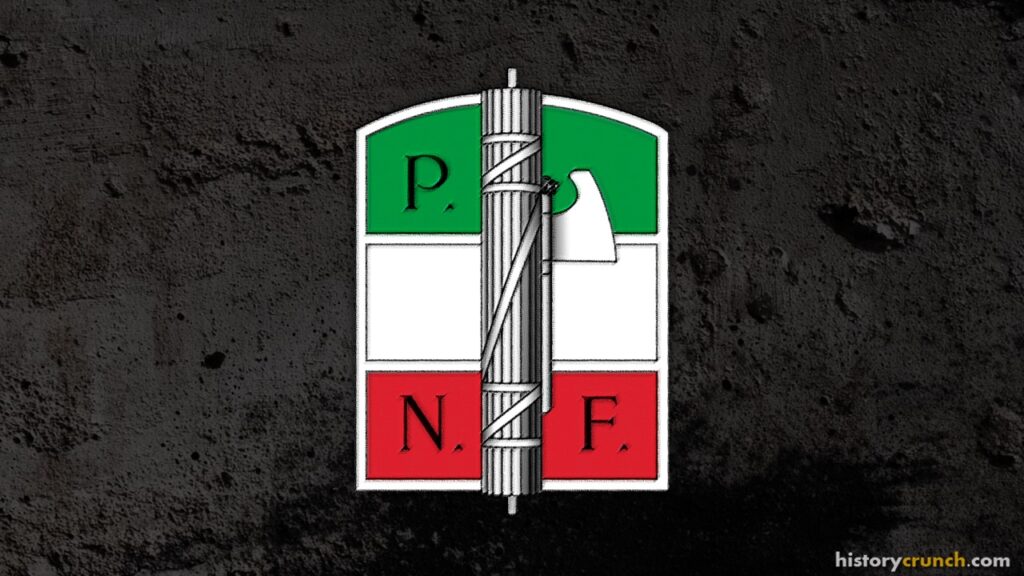
It was in this environment that Benito Mussolini began to build his fascist movement. Mussolini had been a socialist earlier in his life, but his views shifted dramatically during and after World War I, and he developed a new ideology centered on extreme Italian nationalism. In 1919, he founded the fascist movement that became the National Fascist Party in 1921, and he worked quickly to grow its influence across the country. One of his most important tools during this period was the paramilitaryAn unofficial armed group organized like a military but not part of the official national army. group known as the Blackshirts. The Blackshirts were largely made up of Italian veterans from World War I who supported Mussolini’s ideas. Their role was to terrorize political opponents, break up rival political gatherings, and help spread the influence of the Fascist Party through intimidation and violence.
By 1921, Mussolini’s National Fascist Party had gained enough support to win seats in the Italian parliament, known as the Chamber of Deputies. The following year, Mussolini made his decisive move for power. In October of 1922, approximately 30,000 Blackshirts marched on the Italian capital of Rome in what became known as the March on Rome. The sitting Prime Minister, Luigi Facta, attempted to use the military to stop the uprising but was denied support by King Victor Emmanuel III. Facta quickly resigned, and King Victor Emmanuel III handed control of the government to Mussolini. Through this violent takeover, known as a coup d’étatA sudden, often violent seizure of government power by a small group outside normal legal processes., Mussolini became the Prime Minister of Italy.
FactsthatCrunchBenito Mussolini’s Fascist Dictatorship
After coming to power, Mussolini spent the following years systematically dismantling Italy’s democratic institutions and replacing them with a fascist totalitarianA system in which a single party rules with absolute authority and denies individual rights to citizens. state. A totalitarian state is one in which a single party rules with absolute authority, and the individual rights of citizens are denied. By 1926, all other political parties in Italy had been banned, making the National Fascist Party the only legal party in the country. Mussolini would eventually be referred to as “Il Duce,” which translates to “the Leader,” and by 1929 he had made himself the undisputed dictator of Italy.
Mussolini used several key methods to maintain control over Italian society. The first was the construction of a cult of personality, which is a form of propaganda in which the leader is presented to the public in a very positive and almost god-like way. Mussolini was always portrayed as a powerful and commanding figure, and his image was used throughout Italy to reinforce his authority. His cult of personalityA propaganda method that presents a leader to the public in an almost god-like, always positive way. was also strengthened through his control of the media. Italy’s main newspaper at the time was run by Mussolini’s own brother and only published content that supported his leadership.
The second major method was censorshipThe banning of media or publications that challenge or oppose those in power.. Mussolini banned any media publications that did not support his views, ensuring that Italians had very limited access to information that might challenge his authority. The third method was the use of secret police. In 1927, Mussolini established the Organization for Vigilance and Repression of Anti-Fascism, which is better known by its Italian acronym, OVRA. OVRA was Italy’s secret police force, and its job was to identify, monitor, and take action against anyone in Italy who was considered to be acting against the fascist regime. Finally, Mussolini promoted extreme Italian nationalism through large public works projects and by developing youth organizations modeled on the Blackshirts, which were designed to instill fascist values in younger generations.
FactsthatCrunchWhat Was the OVRA in Fascist Italy?
In 1927, Mussolini established a secret police force called the Organization for Vigilance and Repression of Anti-Fascism, known by its Italian acronym OVRA. OVRA's job was to identify, monitor, and act against anyone in Italy who was considered to be opposing the fascist regime. It was one of the main tools Mussolini used to silence political opponents and keep the Italian population under control.
Fascism and Imperial Expansion
An important element of Mussolini’s fascism was his belief in racial superiority and Italy’s right to expand its territory. Mussolini developed the concept of “spazio vitaleMussolini’s concept that Italy needed more territory to function and grow as a nation.,” which translates to “vital space.” This was the idea that Italy required more territory to operate and grow as a nation, and it was tied directly to the regions once controlled by the ancient Roman Empire. This belief in vital space was also linked to a larger ideology of racial superiority. While Mussolini was not as extreme in his racial views as Adolf Hitler and Nazi Germany, he did argue that some peoples were superior to others and that it was justified for superior peoples to rule over those he considered inferior.
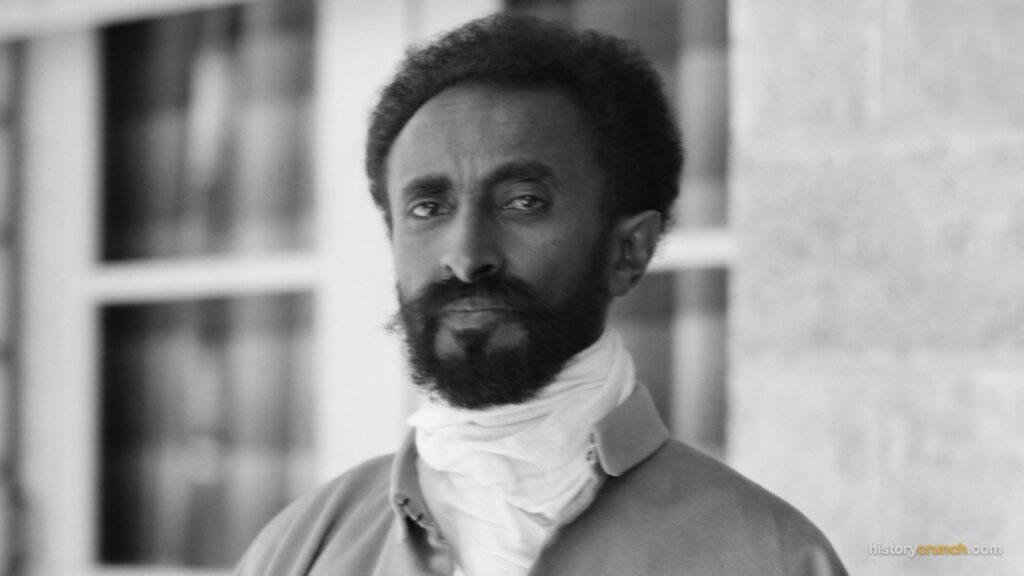
These beliefs drove Italy’s foreign policy during the 1930s. In 1935, Mussolini ordered the invasion of Ethiopia, also known as the Abyssinia Crisis. His goal was to establish a larger Italian empire in Africa, continuing the tradition of European imperialism on the continent. The invasion was condemned internationally, but the League of Nations, which had been established after World War I to prevent future conflicts, failed to hold Italy accountable. This failure to stop Mussolini’s aggression weakened the League of Nations and pushed Europe closer to another large war.
Italy and World War II
As tensions across Europe grew throughout the 1930s, Mussolini’s Italy and Hitler’s Nazi Germany drew increasingly close together. Although Mussolini had initially been wary of Hitler, the two leaders eventually formed a strong alliance. On October 25th, 1936, Italy and Germany announced the Rome-Berlin Axis, a political agreement that aligned the two countries together. This alliance was further strengthened in 1939 when Italy and Germany signed the Pact of Steel on May 22nd, which was a formal military agreement between the two nations. World War II broke out just months later in September of 1939.
Italy formally entered the war on June 10th, 1940, when Mussolini declared war on Britain and France. However, Italy’s military performance during the war was poor. The country lacked the industrial capacity needed to sustain major military operations, and Italy struggled to compete with the other major powers involved in the conflict. While Italy achieved some early successes, particularly alongside German forces, it suffered serious defeats as the war went on, especially in North Africa.
The war took a decisive turn against Italy in the summer of 1943, when Allied forces carried out the invasion of Sicily. The Allied victory there opened a new front in Europe and dealt a major blow to the fascist government in Italy. In late July of 1943, Mussolini was removed from power by King Victor Emmanuel III following pressure from within his own government. He was imprisoned at a remote location in central Italy. Shortly after, Adolf Hitler ordered a raid to rescue Mussolini, and he was reinstated as the leader of a new territory in northern Italy called the Italian Social Republic, also known as the Salò Republic. However, this new state was little more than a puppet of Nazi Germany, and Mussolini held very little real power during these final years.
End of Fascism in Italy
As Allied forces advanced through Italy in 1945 and the war neared its end, Mussolini attempted to flee to Switzerland to escape capture. He was caught on April 27th, 1945, by communist loyalists. The following day, he was executed by firing squad in the Italian region of Lombardy. His body was later taken to Milan, where it was publicly displayed. Mussolini’s death effectively marked the end of fascism as a governing force in Italy.
FactsthatCrunchIn late July 1943, King Victor Emmanuel III removed Benito Mussolini from power during World War II and had him imprisoned at a remote location in central Italy. Adolf Hitler learned of his ally's arrest and faced a choice about how to respond. Hitler ordered a raid to rescue Mussolini, but it was not yet clear what role Mussolini would play after that rescue.
Significance of Fascism in Italy
The significance of fascism in Italy extends far beyond the borders of the country itself. Italy under Mussolini was the first fascist state in the world, and this fact alone makes it one of the most historically important case studies of the 20th century. By establishing a working model of fascist government, Mussolini demonstrated to other extreme nationalists across Europe that it was possible to seize control of a democratic country and replace it with a totalitarian dictatorship. This had enormous effects, most notably in Germany, where Adolf Hitler directly studied and admired Mussolini’s methods. Hitler even modeled aspects of his own rise to power and his system of government after what Mussolini had built in Italy. Without the example set by Italian fascism, the history of Nazi Germany and World War II may have looked very different.
The significance of fascism in Italy is also important in terms of what it revealed about the vulnerabilities of democratic societies. Italy in the early 1920s was a functioning democracy, yet economic hardship, political instability, and public discontent were enough to allow Mussolini and his Blackshirts to dismantle it within just a few years. This serves as an important lesson for students of history, as it shows that democracy is not something that can be taken for granted. When institutions are weak and citizens lose faith in their government, it creates an opening for extremist leaders to take control.
Finally, fascism in Italy is significant because of the role it played in causing World War II. Mussolini’s aggressive foreign policy, including the invasion of Ethiopia and his alliance with Nazi Germany through the Rome-Berlin Axis and the Pact of Steel, helped create the conditions that led to the most destructive conflict in human history. The failure of the international community to stop Italian aggression in the 1930s also contributed to the larger collapse of peace in Europe. For all of these reasons, the history of fascism in Italy remains one of the most important topics in the study of modern world history.
FactsthatCrunch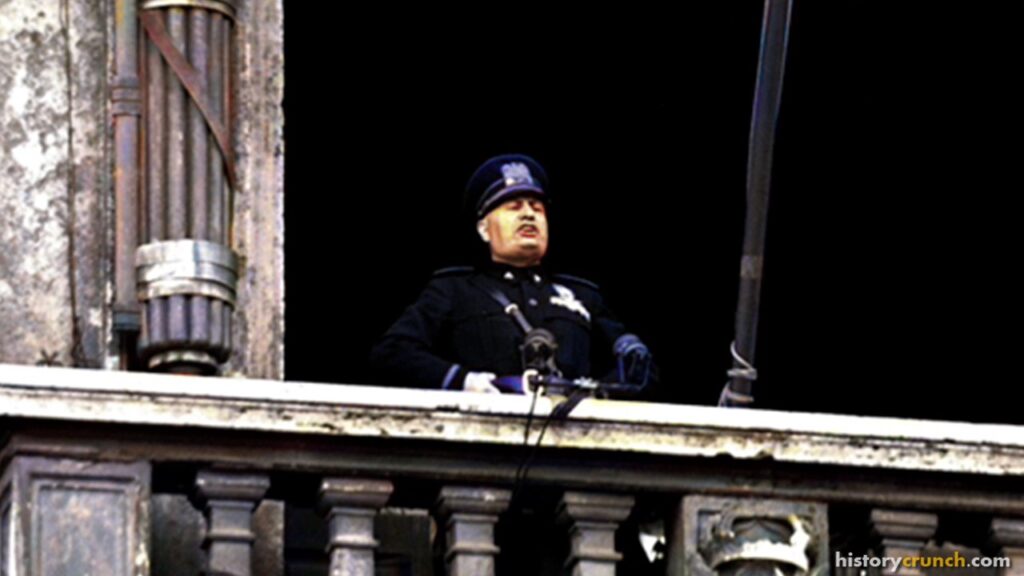 Black & whiteColor
Explore World War II · 1939 – 1945
Keep exploring World War II with these History Crunch resources.
Key Vocabulary
Authoritarian
Paramilitary
Coup d’état
Totalitarian
Cult of personality
Spazio vitale
Censorship
Frequently Asked Questions
Who was Benito Mussolini?
Benito Mussolini was the fascist dictator who ruled Italy from 1922 until 1943. He founded the fascist movement in 1919, which became the National Fascist Party in 1921, and he became prime minister after the March on Rome. Italians later called him “Il Duce,” which means “the Leader.” He turned Italy into a totalitarian state with himself at the top.
What is fascism?
Fascism is an authoritarian political ideology that places the needs of the state above the rights of individuals. It emerged in Europe after World War I and is placed on the far right of the political spectrum. Fascism promotes extreme nationalism, military power, and the expansion of territory. Citizens were expected to follow one powerful leader without question.
How did Mussolini come to power in Italy?
Mussolini came to power in October of 1922 through the March on Rome. About 30,000 of his Blackshirts marched on the capital to demand control of the government. King Victor Emmanuel III refused to stop them and handed Mussolini the role of prime minister. This takeover is known as a coup d’etat.
Who were the Blackshirts?
The Blackshirts were a paramilitary group that supported Mussolini and the Fascist Party. Many of them were Italian veterans of World War I. Their job was to terrorize political opponents, break up rival meetings, and spread fascist influence through violence. They played a key role in Mussolini’s rise to power.
How did fascism in Italy end?
Fascism in Italy ended with Mussolini’s capture and death near the close of World War II. He was removed from power in July of 1943 after the Allied invasion of Sicily. He later tried to flee to Switzerland but was caught on April 27th, 1945. He was executed by firing squad the next day in Lombardy.
Why is fascism in Italy historically important?
Fascism in Italy is important because Italy was the first fascist state in the world. Mussolini showed other extreme nationalists that a democracy could be turned into a dictatorship. Adolf Hitler studied and admired Mussolini’s methods in Germany. The example also shows how weak institutions and public discontent can threaten democracy.
Cite This Article
To cite this article as a source, use one of the formats below.
MLA: Millar, B. “Fascism in Italy: A Detailed Summary.” HistoryCrunch, 1 October 2026, https://historycrunch.com/fascism-in-italy/.
APA: Millar, B. (2026). Fascism in Italy: A Detailed Summary. HistoryCrunch. https://historycrunch.com/fascism-in-italy/
Chicago: Millar, B. “Fascism in Italy: A Detailed Summary.” HistoryCrunch. October 1, 2026. https://historycrunch.com/fascism-in-italy/
Sources
- Antony Beevor, The Second World War.
- Gerhard L. Weinberg, A World at Arms.