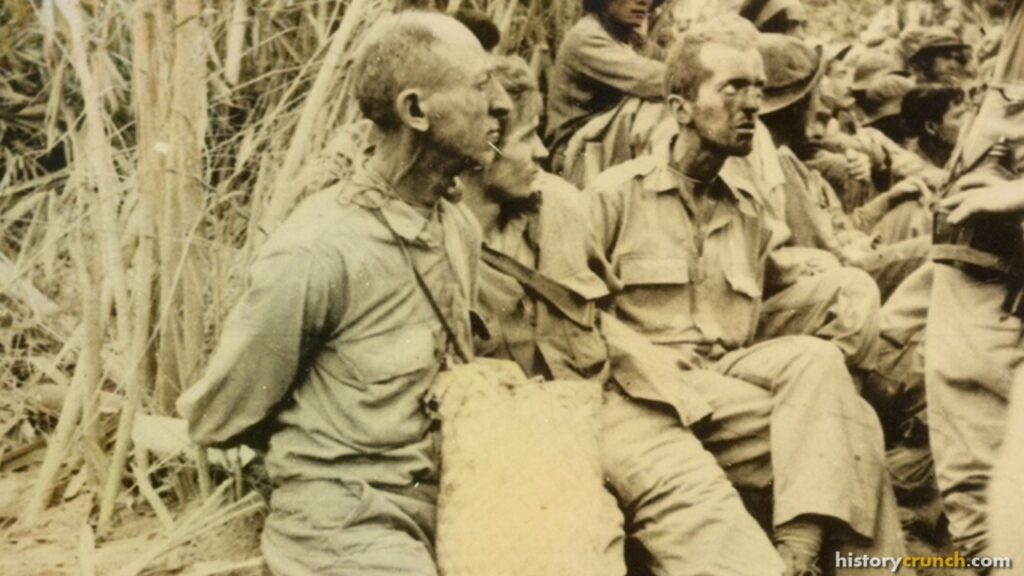
The Bataan Death March took place in April of 1942 and stands as one of the most horrific events of the Pacific Theater of World War II. Following the fall of the Bataan PeninsulaA piece of land nearly surrounded by water, connected to the mainland on one side. in the Philippines, approximately 76,000 Filipino and American prisoners of war were forced by Japanese forces to march over 65 miles (105 kilometers) under brutal conditions, resulting in the deaths of thousands. In general, historians argue that the Bataan Death March had lasting consequences for the relationship between Japan and the Allied Powers and became a defining moment of suffering and endurance in both Filipino and American history.
What Was the Pacific Theater of World War II?
The Pacific TheaterThe area of World War II fighting across the Pacific Ocean and Southeast Asia between the Allied Powers and Imperial Japan. of World War II refers to the campaigns and conflicts fought across the Pacific Ocean and Southeast Asia between the Allied Powers (primarily American forces) and Imperial Japan. The Pacific Theater began on December 7th, 1941, when Japan launched a surprise attack on the American naval base at Pearl Harbor, Hawaii, bringing the United States formally into World War II. In general, the Pacific Theater was characterized by a series of island campaigns, naval battles, and jungle warfare that stretched from the coast of China to the islands of the central and western Pacific. As such, the fall of the Philippines and the events of the Bataan Death March were among the earliest and most significant episodes of the Pacific Theater.
Bataan Death March – Background
To fully understand the Bataan Death March, it is first important to understand the events that led to it. Following Japan’s attack on Pearl Harbor on December 7th, 1941, Japanese forces launched a rapid invasion of the Philippine Islands. At the time, the Philippines was closely tied to the United States and its defense was placed under the command of General Douglas MacArthur. The defending forces consisted of both Filipino and American troops, but they were poorly supplied, incompletely trained, and vastly outnumbered by the advancing Japanese forces.
As the Japanese invasion progressed, the defending forces were pushed back onto the Bataan Peninsula on the island of Luzon, Philippines. The defenders of Bataan held out for approximately three months under extremely difficult conditions, including severe food shortages, disease, and a lack of outside reinforcement or resupply. For instance, rationsFixed, limited portions of food given to soldiers or prisoners when supplies are scarce. were cut repeatedly as supplies ran low, and diseases such as malaria and dysenteryA serious intestinal disease causing severe diarrhea, common in places with poor sanitation or contaminated water. spread rapidly through the weakened troops. Furthermore, on March 11th, 1942, MacArthur was ordered to withdraw to Australia.
By early April of 1942, the situation on Bataan had become hopeless. On April 9th, 1942, Major General Edward King made the decision to surrender the Bataan Peninsula to Japanese forces, resulting in the largest surrender under American command in history. Approximately 76,000 Filipino and American prisoners of war fell into Japanese hands, setting the stage for what would become the Bataan Death March.
 FactsthatCrunch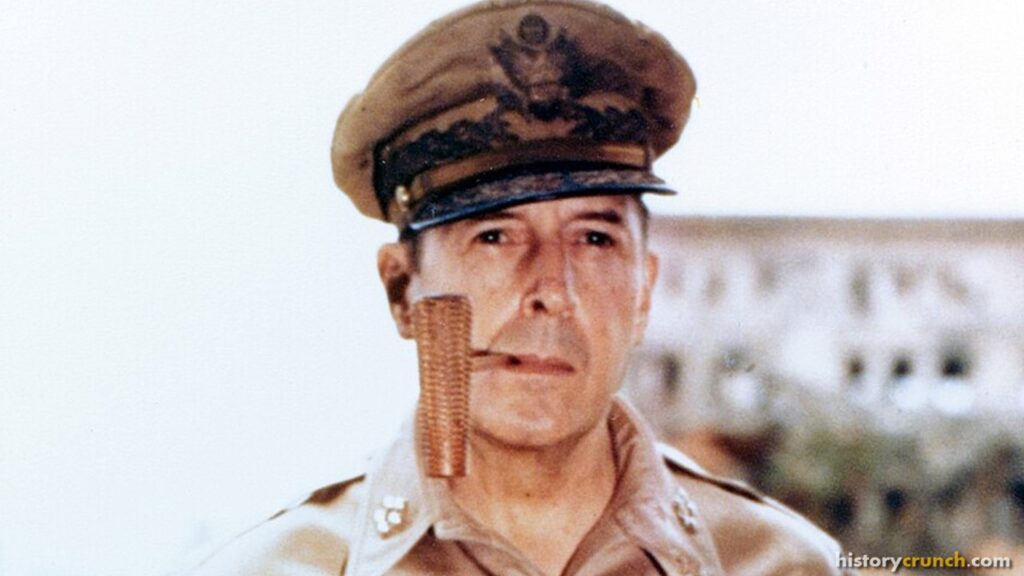
Bataan Death March – the March
Following the surrender on April 9th, 1942, Japanese forces began organizing the transfer of prisoners from the southern tip of the Bataan Peninsula to prison camps in the north. The plan was to march the prisoners approximately 65 miles (105 kilometers) north to the town of San Fernando, Philippines, where they would then be loaded onto rail cars and transported to Camp O’Donnell, a prison facility in the province of Tarlac, Philippines.
The conditions of the march were brutal from the very beginning. The prisoners, many of whom were already severely weakened by months of starvation and disease on Bataan, were given little to no food or water during the march. The tropical heat of the Philippine summer made the conditions even more severe, with temperatures regularly exceeding 100 degrees Fahrenheit (38 degrees Celsius). Furthermore, the march was not organized in a single column but rather in a series of groups that set off at different times, meaning that conditions and treatment varied somewhat depending on which Japanese unit was overseeing a particular group.
Japanese guards subjected the prisoners to widespread violence and abuse throughout the march. For instance, prisoners who fell behind or collapsed from exhaustion were often beaten, bayoneted or shot. In some cases, prisoners who stopped to drink from roadside streams or ditches were killed. Prisoners were also denied the opportunity to rest during the hottest parts of the day and were given almost no medical treatment for their wounds and illnesses. This harsh treatment was a direct violation of the rules of war as outlined by the Geneva ConventionInternational rules of war that require soldiers to treat prisoners of war humanely., which required the humane treatment of prisoners of war. As such, historians would consider this as an example of a war crimeAn act committed during war that violates international laws meant to protect soldiers and civilians., as well as an example of a crime against humanity.
The march took between five and twelve days to complete, depending on the group and the conditions they encountered. Upon reaching San Fernando, Philippines, the prisoners were packed tightly into small rail cars and transported north in extreme heat and with little to no ventilation. Many prisoners died during this phase of the transfer as well. Upon arriving at Camp O’Donnell, the survivors faced continued harsh conditions, with inadequate food, water, shelter and medical care. As a result, thousands more died in the weeks and months that followed their arrival at the camp.
FactsthatCrunchFollow the chain from top to bottom. Tap any step to read what happened.
Bataan Death March – Casualties
The exact number of deaths from the Bataan Death March and its immediate aftermath is difficult to determine precisely, but historians estimate that between 5,000 and 18,000 Filipino soldiers and between 500 and 650 American soldiers died during the march itself. Furthermore, thousands more died in the weeks following their arrival at Camp O’Donnell due to the ongoing effects of starvation, disease and general mistreatment. In total, the death toll from the march and its immediate aftermath is considered to be one of the highest of any single episode involving prisoners of war in the Pacific Theater of World War II.
The high death toll was the result of several combined factors. As stated above, the prisoners were already severely weakened before the march began due to months of inadequate food and rampant disease on the Bataan Peninsula. The extreme physical demands of the march, combined with the tropical heat, lack of food and water, and the systematic violence of the Japanese guards, proved fatal for thousands. In general, the Bataan Death March revealed the extreme brutality that could result when the rules governing the treatment of prisoners of war were ignored entirely.
How many prisoners were forced to begin the Bataan Death March in April 1942?
Bataan Death March – Significance
The Bataan Death March had significant and lasting consequences for World War II and its aftermath. In terms of its immediate impact, news of the march reached the American public in January of 1944, when the United States government officially released survivor accounts of what had taken place. The public reaction was one of widespread outrage, and the Bataan Death March became one of the most powerful rallying points for the American war effort in the Pacific. For instance, it strengthened public support for the continued fight against Japan and reinforced the determination of American forces in the Pacific to achieve total victory.
Following Japan’s defeat in World War II, several Japanese officers who had been responsible for organizing and overseeing the Bataan Death March were put on trial as war criminals. For example, General Masaharu Homma, the commander of Japanese forces in the Philippines during the invasion, was found responsible for the atrocitiesExtremely cruel and violent acts, especially those committed against people who cannot defend themselves. committed during the march and was executed by firing squad on April 3rd, 1946. These trials were part of the wider effort by the Allied Powers to hold Japanese military leaders accountable for war crimes committed during the conflict.
FactsthatCrunchIn January 1944, the United States government released survivor accounts of the Bataan Death March to the American public.
Explore World War II · 1939 – 1945
Keep exploring World War II with these History Crunch resources.
Key Vocabulary
Pacific Theater
Peninsula
Rations
Dysentery
Geneva Convention
War crime
Atrocities
Frequently Asked Questions
When did the Bataan Death March take place?
The Bataan Death March took place in April of 1942, soon after the surrender of the Bataan Peninsula. Major General Edward King surrendered his forces on April 9th, 1942. The march of prisoners began shortly after that date and lasted between five and twelve days.
How long was the Bataan Death March?
Prisoners were forced to march about 65 miles (105 km) north to the town of San Fernando. From there they were packed into hot rail cars and carried to Camp O’Donnell. Many prisoners died during both the walk and the crowded train ride.
How many people died during the Bataan Death March?
Historians estimate that between 5,000 and 18,000 Filipino soldiers and between 500 and 650 American soldiers died during the march. Thousands more died at Camp O’Donnell in the weeks that followed. Starvation, disease, heat, and violence from guards all drove the death toll higher.
Why were conditions on the march so deadly?
Prisoners were already weak from months of hunger and disease on Bataan before the march even began. During the walk they received little food or water in heat above 100 degrees Fahrenheit (38 degrees Celsius). Guards beat, bayoneted, or shot those who fell behind or stopped to drink.
Was anyone punished for the Bataan Death March?
Yes, several Japanese officers were tried as war criminals after Japan’s defeat. General Masaharu Homma, who commanded Japanese forces in the Philippines, was found responsible and executed by firing squad on April 3rd, 1946. These trials were part of a larger Allied effort to hold military leaders accountable.
Cite This Article
To cite this article as a source, use one of the formats below.
MLA: Millar, B. “Bataan Death March: A Detailed Summary.” HistoryCrunch, 4 October 2026, https://historycrunch.com/bataan-death-march/.
APA: Millar, B. (2026). Bataan Death March: A Detailed Summary. HistoryCrunch. https://historycrunch.com/bataan-death-march/
Chicago: Millar, B. “Bataan Death March: A Detailed Summary.” HistoryCrunch. October 4, 2026. https://historycrunch.com/bataan-death-march/
Sources
- Antony Beevor, The Second World War.
- The National WWII Museum
- Max Hastings, Inferno / All Hell Let Loose.