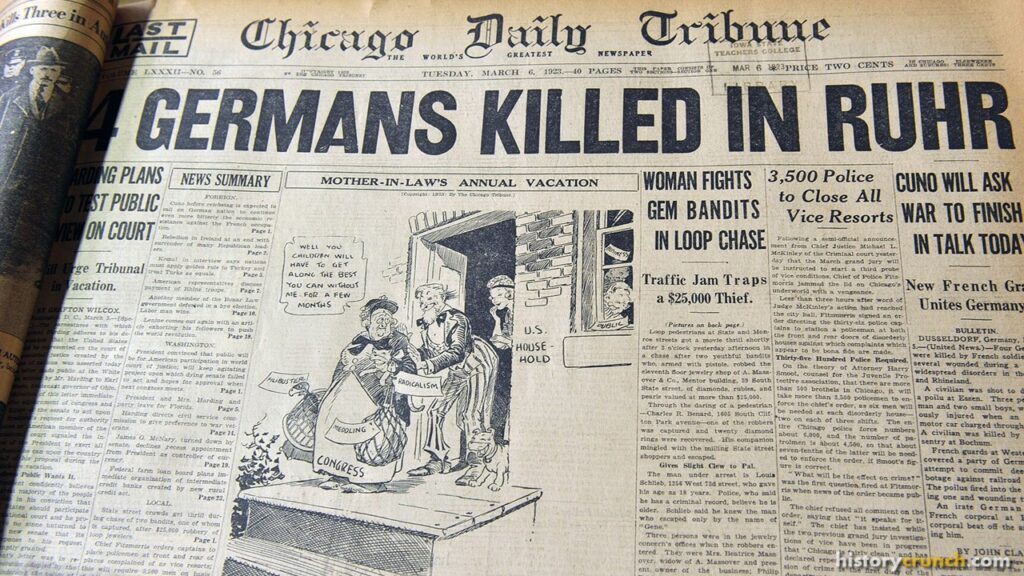
The Ruhr Crisis was one of the most serious political and economic crises of the Weimar Republic in the early 1920s. The Ruhr Crisis began in January of 1923 when French and Belgian troops occupied the Ruhr region in Germany. France and Belgium did this after Germany fell behind on reparation payments that were a result of the terms of the Treaty of Versailles following the events of World War I. Regardless, the Ruhr Crisis led to economic issues and hyperinflation in Germany. As a result, historians consider the Ruhr Crisis to be significant in relation to the timeframe of the Interwar Years and to the rise of Adolf Hitler and the Nazi Party in Germany.
 FactsthatCrunch
What were the main consequences of reparations imposed on Germany after World War I?
Ruhr Crisis – Background
The Ruhr Crisis grew out of the events that followed World War I. For instance, under the terms of the Treaty of Versailles, Germany had to pay reparationsPayments in money, coal, timber, and other goods that a defeated country is forced to make to the winners after a war. to the Allied Powers of World War I, including France and Belgium. These payments included money, coal, timber and other industrial goods. Many Germans thought the reparations were unfair and humiliating, which ultimately led to widespread anger against the Treaty of Versailles among the German public. At the same time, France believed Germany was trying to avoid its obligations and weaken the peace settlement that had been established at the end of World War I.
The Ruhr region was one of the most important industrial areas in Germany. It contained coal mines, steel plants, factories, and rail networks that were important to the German economy. As such, the Ruhr Crisis had a significant impact on the economy of Germany during the Interwar Years.
By 1922 and early 1923, Germany had fallen behind on some of the deliveries required by the reparations system. French leaders argued that Germany was deliberately refusing to comply. Raymond Poincaré, the French prime minister, decided that stronger action was necessary. As a result, the Ruhr Crisis moved from diplomatic argument to direct military occupationWhen a foreign military force moves into and takes control of another country’s territory by force..
Ruhr Crisis – Occupation of the Ruhr
The Ruhr Crisis began on January 11th, 1923, when French and Belgian troops marched into the Ruhr region of Germany and occupied it. Their goal was to take control of production and force Germany to deliver reparations in coal and raw materials. The occupation was not a full attempt to conquer Germany, but it was a major use of force against German territory after the events of World War I.
For many Germans, the occupation caused anger and humiliation. The Weimar government under Chancellor Wilhelm Cuno did not respond with military resistance because Germany was too weak to fight France and Belgium directly. Instead, the government called for passive resistanceA way of fighting back by refusing to cooperate, striking, and obstructing rather than using weapons or military force.. Workers were encouraged to strike. Officials were told not to cooperate and railway employees were expected to refuse help to the occupiers.
This was important because the Ruhr Crisis quickly became a national struggle for the German people. The German government hoped that non-cooperation would make the occupation too costly and difficult for France and Belgium to continue. In practice, passive resistance shut down large parts of the region’s economy. Mines slowed or stopped production and rail transport was disrupted.
The Ruhr Crisis therefore became a battle of endurance. France and Belgium tried to force compliance. Germany tried to make the occupation fail through refusal and obstruction.
FactsthatCrunchIt is early August 1923, during the Ruhr Crisis, and you are Gustav Stresemann, the newly appointed Chancellor of Germany. For months, the German government has encouraged workers in the Ruhr to strike and refuse cooperation with French and Belgian troops who occupied the region on January 11th, 1923. The policy of passive resistance has shut down mines and disrupted rail transport, but Germany's currency is collapsing, prices are rising at a shocking speed, and ordinary families cannot afford bread or coal. If you keep passive resistance going, the economy may fall apart completely and the Weimar Republic may not survive the year.
Ruhr Crisis – Passive Resistance and Hyperinflation
The most damaging part of the Ruhr Crisis came from the economic consequences of passive resistance. The government of the Weimar RepublicThe democratic government that ruled Germany from after World War I until the rise of Adolf Hitler. promised to support striking workers and businesses in the Ruhr while they refused to cooperate with the occupation. However, the government did not have enough money to pay for this policy.
Instead, it relied heavily on printing more paper currency. Unfortunately, Germany was already suffering from financial weakness after the war, but the Ruhr Crisis made the situation much worse. As more and more money was printed, the value of the German currency (German Mark) collapsed. Prices rose at a shocking speed and people’s savings became worthless. As a result, ordinary families found it difficult to buy bread, coal, or other basic necessities.
This was one of the clearest results of the Ruhr Crisis. While hyperinflation did not begin only because of the occupation in the Ruhr, it was a contributing factor that caused hyperinflationAn extreme and rapid rise in prices that makes a country’s currency almost worthless and wipes out people’s savings. in Germany to reach a dramatic level in 1923. Middle-class Germans were hit especially hard because savings that had taken years to build disappeared almost overnight. This, obviously, caused hardship among many German people as they faced economic uncertainty.
The political effects were just as serious. The Weimar Republic already faced criticism from the political left and the right in Germany. As a result, the events of the Ruhr Crisis made the government look even weaker and more ineffective. Some Germans blamed France and Belgium, while others blamed the Weimar leaders. Historians generally agree that the Ruhr Crisis helped create the atmosphere of fear, anger, and instability that damaged confidence in the democratic government during the Weimar period.
One example came in November of 1923 when Adolf Hitler and the Nazi Party tried to seize power in Munich, Germany, in the Beer Hall Putsch. The putschA sudden, violent attempt to seize control of a government, used here to describe Hitler’s failed 1923 takeover attempt in Munich. failed, but the wider unrest of 1923 helped give extremist movements more attention and support than they had earlier.
FactsthatCrunch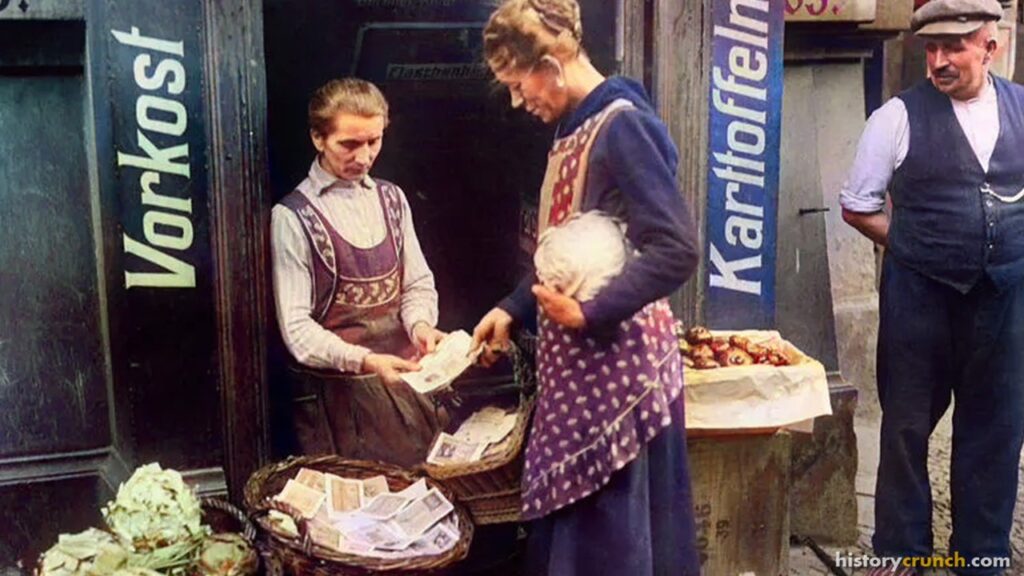 Black & whiteColor
Ruhr Crisis – End of Passive Resistance
By the late summer of 1923, it was clear that passive resistance could not continue forever. The policy had not forced France to withdraw, and Germany’s economy was collapsing. In August of 1923, Gustav Stresemann became chancellor, and he recognized that the crisis had reached a breaking point.
As a result, on September 26th, 1923, Stresemann called off passive resistance. This was an unpopular decision among many Germans, because it looked like surrender. However, it was necessary if Germany was to restore order and rebuild its finances. Soon afterward, the government introduced a new currency and began stabilizing the economy. This did not solve every economic problem facing Germany, but it helped end the worst phase of hyperinflation.
The Ruhr Crisis did not end immediately with the end of passive resistance. French and Belgian troops remained in the Ruhr while diplomatic talks continued. In 1924, the Dawes PlanA 1924 international agreement that restructured Germany’s reparation payments to make them more realistic and manageable. restructured German reparations and made payments more realistic. This was important because it shifted the issue away from direct confrontation and toward international negotiation. Once the new system was accepted, the occupation became harder to justify. French and Belgian forces finally completed their withdrawal from the Ruhr in August of 1925.
FactsthatCrunchWhen Germany introduced the Rentenmark on November 15th, 1923, one new Rentenmark was worth one trillion of the old paper marks.
The new currency came less than two months after Chancellor Gustav Stresemann ended passive resistance in the Ruhr. It stopped the hyperinflation and gave Germany a stable currency again.
Ruhr Crisis – Significance
The Ruhr Crisis was important because it exposed the weakness of the post-World War I peace settlement in Europe. The reparations issue had already caused years of tension, but the occupation of the Ruhr turned that tension into open confrontation. It showed how unstable Europe remained only a few years after the destruction of World War I.
The Ruhr Crisis was also important because it had a dramatic impact on Germany’s economy and political life. Passive resistance and the collapse of the currency brought enormous suffering to ordinary people. Confidence in the Weimar Republic weakened further, and extremist groups gained a better chance to attract support. In that sense, the Ruhr Crisis became one of the major early disasters of Weimar Germany.
At the same time, the Ruhr Crisis also pushed European leaders toward a different approach. After the crisis, there was greater recognition that endless confrontation over reparations could destroy stability on all sides. The Dawes Plan and later agreements moved France and Germany toward negotiation rather than open pressure. For that reason, the Ruhr Crisis stood at a turning point. It showed the danger of postwar conflict, but it also helped push Europe toward a short period of greater cooperation in the mid-1920s.
In the end, the Ruhr Crisis was more than a dispute over coal and payments. It became a struggle over power, national pride, and the future of postwar Europe. Its effects were felt in the collapse of the German currency, the weakening of the Weimar Republic, and the growing political bitterness that shaped Germany in the years before the rise of Adolf Hitler.
FactsthatCrunchThe Weimar government printed large amounts of paper money to pay striking workers during the 1923 Ruhr occupation, causing the German Mark to collapse and wiping out the savings of ordinary and middle-class Germans.
The Ruhr Crisis of 1923 turned an already fragile political situation into a full economic disaster. The suffering it caused gave extremist movements a much larger audience than they had held before the crisis.
Explore World War II · 1939 – 1945
Keep exploring World War II with these History Crunch resources.
Key Vocabulary
Reparations
Passive resistance
Hyperinflation
Occupation
Weimar Republic
Dawes Plan
Putsch
Frequently Asked Questions
What was the Ruhr Crisis?
The Ruhr Crisis was a political and economic crisis in Germany during 1923. It began when French and Belgian troops occupied the Ruhr, an important industrial region. They did this because Germany had fallen behind on reparation payments set by the Treaty of Versailles.
Why did France and Belgium occupy the Ruhr?
France and Belgium occupied the Ruhr to force Germany to deliver reparations in coal and raw materials. By late 1922 and early 1923, Germany had missed some required deliveries. French leaders believed Germany was deliberately avoiding its obligations, so Prime Minister Raymond Poincaré chose military action.
How did Germany respond to the occupation?
Germany responded with a policy called passive resistance instead of military force. Chancellor Wilhelm Cuno encouraged workers to strike and officials to refuse cooperation with the occupiers. The government hoped this would make the occupation too costly for France and Belgium to continue.
How did the Ruhr Crisis cause hyperinflation?
The government printed large amounts of paper money to support striking workers and businesses. It did not have enough real funds to pay for this policy. As more money was printed, the German Mark collapsed and prices rose at a shocking speed, wiping out people’s savings.
When did the Ruhr Crisis end?
Chancellor Gustav Stresemann called off passive resistance on September 26th, 1923. Germany then introduced a new currency and began to stabilize its economy. The Dawes Plan of 1924 restructured reparations, and French and Belgian troops finished leaving the Ruhr in August of 1925.
Why was the Ruhr Crisis important?
The Ruhr Crisis weakened the Weimar Republic and helped extremist groups gain more support. It brought terrible suffering through hyperinflation and damaged confidence in democratic government. It also pushed European leaders toward negotiation, leading to the Dawes Plan and a short period of greater cooperation.
Cite This Article
To cite this article as a source, use one of the formats below.
MLA: Millar, B. “Ruhr Crisis: A Detailed Summary.” HistoryCrunch, 1 October 2026, https://historycrunch.com/ruhr-crisis/.
APA: Millar, B. (2026). Ruhr Crisis: A Detailed Summary. HistoryCrunch. https://historycrunch.com/ruhr-crisis/
Chicago: Millar, B. “Ruhr Crisis: A Detailed Summary.” HistoryCrunch. October 1, 2026. https://historycrunch.com/ruhr-crisis/
Sources
- Gerhard L. Weinberg, A World at Arms.
- The National WWII Museum
- Imperial War Museum
- Antony Beevor, The Second World War.