HyperinflationAn extreme form of inflation where prices rise so fast that money loses value within days or even hours. in Germany was one of the worst economic crises of the Weimar Republic and one of the most famous examples of runaway inflation in modern history. Hyperinflation in Germany reached its most extreme stage in 1923, when the German mark lost value at an astonishing speed, savings were wiped out, daily life was thrown into chaos, and faith in the new democratic government was badly damaged.
 FactsthatCrunch
What were the main crises that destabilized the Weimar Republic before the Nazi rise to power?
What is Hyperinflation?
Hyperinflation is an extreme form of inflation in which prices rise very quickly over a short period of time. In a hyperinflation crisis, money loses value so quickly that ordinary people can no longer rely on it in normal ways. Wages, savings, and prices all become unstable, and the cost of basic goods can change from day to day or even hour to hour. This was important in Germany in 1923 because hyperinflation destroyed confidence in the German currency and made everyday economic life extremely difficult. As a result, hyperinflation had a significant impact on the Interwar Years and on the eventual rise of the Nazi Party and Adolf Hitler.
FactsthatCrunchWhat is Hyperinflation?
Hyperinflation is a period when prices rise so fast that money loses nearly all its value within weeks or even days. Germany experienced severe hyperinflation in 1923, when the German mark became so worthless that workers were paid twice a day so they could spend their wages before prices rose again. The crisis ended in late 1923 when Germany introduced a new currency, the Rentenmark, to replace the old mark.
Hyperinflation in Germany – Background
During World War I, the German government had chosen to finance much of the war through borrowing rather than through heavy taxation on the German people. This left Germany with huge debts by 1918, when the war ended. Furthermore, following the end of World War I, Germany was made to accept the terms of the Treaty of Versailles by the Allied Powers. The terms of the Treaty of Versailles added further economic strain by forcing Germany to pay reparationsPayments Germany was forced to make to the victorious Allied Powers after World War I as punishment for the war. to the victorious powers. These reparations were to be paid not only in money but also in coal, timber, and other goods.
The Weimar Republic, which was the democratic government of Germany following World War I, inherited this difficult economic situation. Germany had lost the war, its monarchy had collapsed, and a new democratic government now had to deal with debt, political unrest and economic weakness. In the early 1920s, prices were already rising throughout Germany. However, the worst stage of hyperinflation in Germany had not yet arrived. The crisis became far more severe when the reparations dispute turned into direct confrontation with France and Belgium during the events of the Ruhr Crisis.
FactsthatCrunchHyperinflation in Germany – Causes of the Crisis
One of the most important causes of hyperinflation in Germany was the government’s decision to print more and more paper money. The state already had large debts from the war, and it still needed money to operate after 1918. Instead of solving the deeper financial problems, the government often relied on printing currency. This weakened confidence in the German currency (German mark) and pushed prices higher over time.
As mentioned above, a major turning point came in January of 1923 when French and Belgian troops occupied the RuhrA vital German industrial region containing coal mines, steel works, and factories that France and Belgium occupied in 1923., Germany. Historians refer to this event as the Ruhr Crisis (or Occupation of the Ruhr). The Ruhr was one of the most important industrial regions in the country because it contained coal mines, steel works, factories, and transport routes that were central to German production. France and Belgium claimed that Germany had fallen behind on reparations deliveries and argued that occupation was necessary to enforce payment, under the terms of the Treaty of Versailles.
The German government responded by calling for passive resistanceA strategy of striking and refusing to cooperate, used by German workers against the French and Belgian occupation without open fighting.. Workers were told to strike, officials were told not to cooperate, and businesses were encouraged to resist the occupation without open warfare. This was important because the government still promised to support those workers and families even while production in the Ruhr collapsed. Since the state did not have enough stable revenue to cover these costs, it printed more and more money. That decision pushed inflation into a much more dangerous phase and ultimately led to hyperinflation in Germany.
Germany's inflation began during World War I, years before the Ruhr occupation of 1923.
Hyperinflation in Germany – Collapse of the Mark
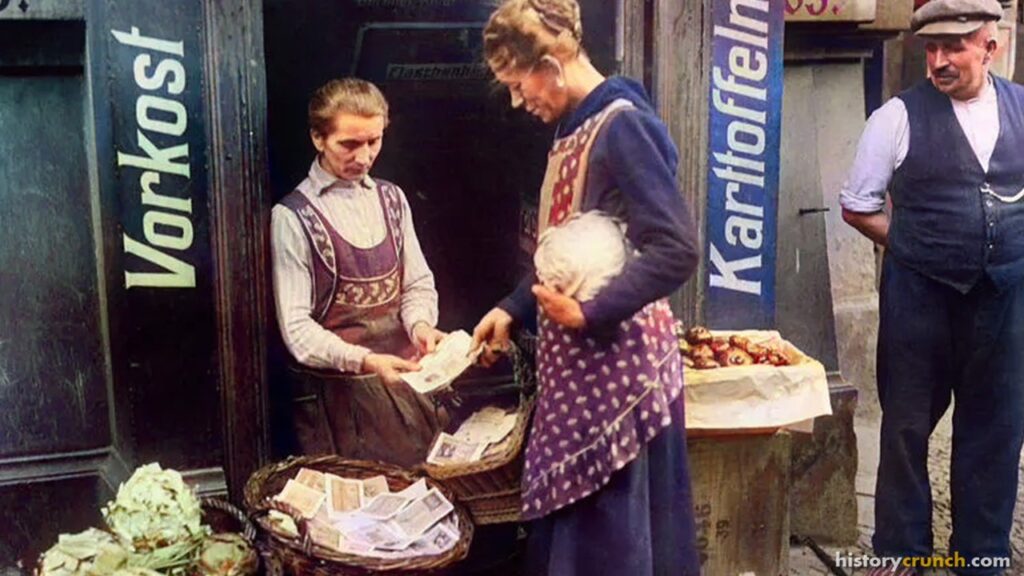
By 1923, hyperinflation in Germany became extreme. The value of the German currency (German Mark) fell so quickly that prices changed not just from month to month but often from day to day. In some places, workers were paid daily or even more than once a day because money lost value so quickly. People often hurried to spend their wages before prices rose again. Shops raised prices constantly and families were forced to carry money in bags and suitcases, since so much of it was needed to make purchases. Also, the crisis was so extreme that in some cases the paper money itself became less valuable than the goods it was meant to buy.
The scale of the collapse was astonishing. In January of 1920, one United States dollar was worth 64.8 marks. By November of 1923, one dollar was worth 4,200,000,000,000 marks. The numbers became so huge that people struggled even to think in ordinary financial terms. For instance, a loaf of bread could cost billions of marks by late 1923. This had a devastating impact on the lives of people and led to widespread anger among German people during the Interwar Years.
Daily life during hyperinflation in Germany became chaotic. Families found it difficult to plan ahead because prices changed so fast and shopkeepers had to rewrite prices constantly. The groups hit hardest were usually those with savings, fixed wages or pensions. Middle-class German families suffered especially badly because money they had carefully saved for years suddenly meant almost nothing. This was significant because the crisis of hyperinflation left many in the middle class feeling humiliated and betrayed.
Hyperinflation in Germany also had powerful political effects. The Weimar RepublicThe democratic government that ruled Germany after World War I and struggled to manage debt, reparations, and political unrest. already faced opposition from both the political left and the right. The collapse of the currency made the government seem even more weak and incapable. As such, this led many Germans to blame their struggles on the democratic government of Germany. Others blamed the Treaty of Versailles, the reparations system, or the occupation of the Ruhr in the Ruhr Crisis. Politically, this allowed extremist movements such as the Nazi Party to gain in popularity among the German people.
Hyperinflation in Germany – End of the Crisis
The worst stage of Hyperinflation in Germany ended in late 1923. By that point, it had become clear that passive resistance in the Ruhr could not continue. The policy had not forced France to withdraw, and Germany’s economy was collapsing under the strain. As a result, in September of 1923, the German Chancellor ended passive resistance in the Ruhr. This was unpopular with many Germans because it looked like surrender, but it was necessary if the government wanted to restore some kind of financial order. Soon afterward, the government introduced a new currency called the ‘RentenmarkA new currency introduced by the German government in late 1923 to replace the collapsed mark and restore financial stability.‘.
These steps helped stabilize Germany economically and the worst phase of hyperinflation in Germany came to an end. In 1924, the Dawes PlanA 1924 agreement that restructured Germany’s reparations payments and allowed American loans to flow into the German economy. restructured reparations and made the payment system more manageable. Under the plan, American loans flowed into Germany, and in 1925 the Locarno treaties settled Germany’s western borders and brought it back into European diplomacy. Those loans were withdrawn after the Wall Street crash of 1929, which is why the Great Depression hit Germany harder than almost any other country. This helped reduce international tension and gave Germany a better chance to recover.
Hyperinflation in Germany – Significance
Hyperinflation in Germany was important because it showed how quickly an economy could collapse when debt, political weakness, reparations, and reckless money printing came together. It ruined savings, disrupted daily life, and turned ordinary shopping, working, and planning for the future into a struggle. For many Germans, the crisis became one of the most painful memories of the Weimar Republic era.
Hyperinflation in Germany was also important because it damaged trust in democracy. The Weimar Republic was still a young government, and many people already doubted it. When the mark collapsed in 1923, faith in the republic weakened even more. This helped create the political culture necessary for the later rise of Adolf Hitler and the Nazi Party.
In the end, Hyperinflation in Germany was more than a financial event. It was a social and political crisis that changed the way many Germans viewed money, government, and stability. Its effects were felt far beyond 1923, and it remained one of the defining disasters of postwar Germany.
Explore World War II · 1939 – 1945
Keep exploring World War II with these History Crunch resources.
Key Vocabulary
Hyperinflation
Reparations
Passive resistance
Ruhr
Rentenmark
Dawes Plan
Weimar Republic
Frequently Asked Questions
What caused hyperinflation in Germany?
The main cause was the government’s decision to print huge amounts of paper money. Germany already owed heavy debts from World War I and faced reparations under the Treaty of Versailles. When France and Belgium occupied the Ruhr in 1923, the government funded worker strikes by printing even more money, which pushed inflation out of control.
How bad did the German mark get in 1923?
By November of 1923, one United States dollar was worth about 4.2 trillion marks. In January of 1920, that same dollar had been worth only 64.8 marks. Prices rose so fast that a loaf of bread could cost billions of marks, and families carried money in bags and suitcases.
Who was hurt most by the hyperinflation crisis?
People with savings, fixed wages, or pensions suffered the most because their money lost nearly all its value. Middle-class families were hit especially hard, since savings built over many years became almost worthless. Many felt humiliated and betrayed, which damaged their trust in the Weimar Republic.
How did hyperinflation in Germany end?
The worst stage ended in late 1923 after the government stopped passive resistance in the Ruhr in September. It then introduced a new currency called the Rentenmark, which helped restore confidence. In 1924 the Dawes Plan restructured reparations and brought American loans into Germany.
Why is hyperinflation linked to the rise of the Nazi Party?
The collapse of the mark made the Weimar Republic look weak and unable to protect its people. Many Germans blamed the democratic government, the Treaty of Versailles, or the reparations system. This anger helped extremist groups like the Nazi Party gain support during the Interwar Years.
Cite This Article
To cite this article as a source, use one of the formats below.
MLA: Millar, B. “Hyperinflation in Germany: A Detailed Summary.” HistoryCrunch, 1 October 2026, https://historycrunch.com/hyperinflation-in-germany/.
APA: Millar, B. (2026). Hyperinflation in Germany: A Detailed Summary. HistoryCrunch. https://historycrunch.com/hyperinflation-in-germany/
Chicago: Millar, B. “Hyperinflation in Germany: A Detailed Summary.” HistoryCrunch. October 1, 2026. https://historycrunch.com/hyperinflation-in-germany/
Sources
- Antony Beevor, The Second World War.
- Imperial War Museum