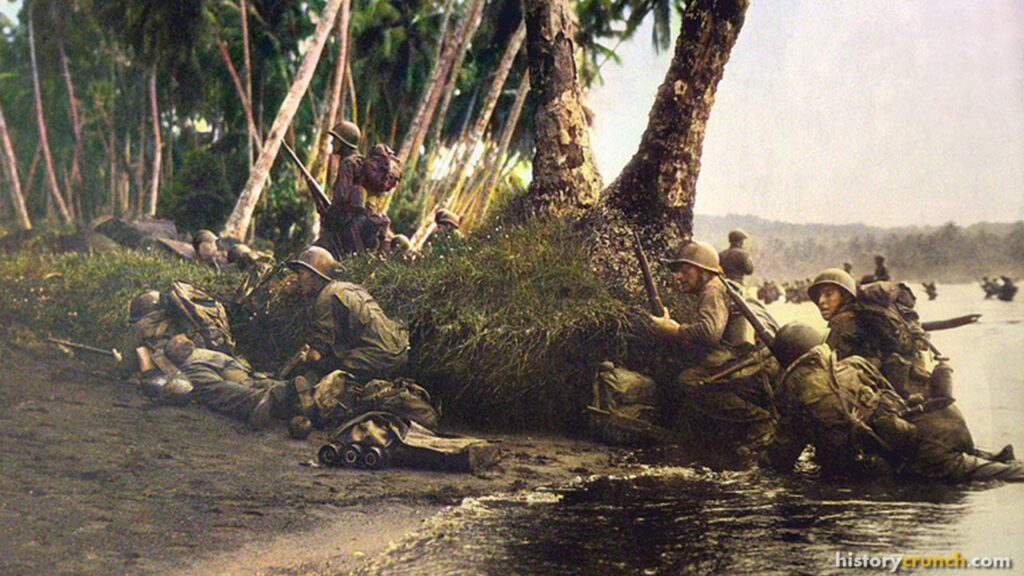
Island-hopping in World War II was a war strategy of the United States in its Pacific Campaign against the Japanese Empire. Also known as ‘leapfroggingSkipping over heavily defended enemy positions to attack weaker, more useful ones instead.‘, this strategy involved bypassing heavily fortified Japanese positions and instead focusing on strategically importantHaving military value that gives one side a real advantage in reaching its goal. islands. In fact, the strategically important islands were ones that had airstripsPaved or cleared strips of land where military aircraft can take off and land. or the ability to have ones built. This was important because the airstrips allowed the United States and its allies to advance faster towards the main islands of Japan.
 FactsthatCrunch
What were the main types of island that made a location strategically important in the Pacific Campaign of World War II?
Island-Hopping in World War II – Background
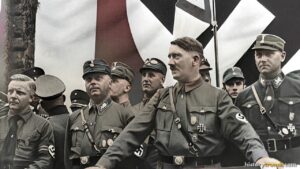
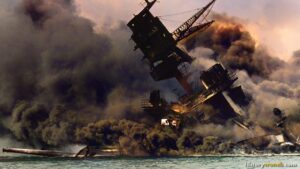
World War II in the Pacific began on December 7th, 1941, when Japanese forces surprise attacked the United States at Pearl Harbor. This attack is what brought the United States into the fighting of World War II. American forces joined the Allied nations in their fight against the Axis Powers of Nazi Germany, Imperial Japan and Italy. As such, in the years that followed the attack on Pearl Harbor, the United States mobilizedOrganized and prepared military forces to be ready for active combat. its forces against the Japanese strongholds in the Pacific. This ultimately led to the strategy of island-hopping, which was used by the United States throughout its campaign in the Pacific.
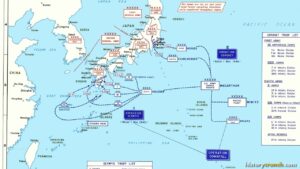
At the time the Japanese Empire was quite large and stretched from the Japanese main islands in the north to just off the shores of Australia in the south. Japan also controlled territory to the west in China and Indochina (Vietnam, Laos and Cambodia) and to the Marshall Islands in the east. This vast stretch of territory covered many different countries and thousands of different islands in the south of the Pacific Ocean. As such, the strategy of island-hopping was used by the Americans in the hopes of speeding up the eventual defeat of Japan.
FactsthatCrunch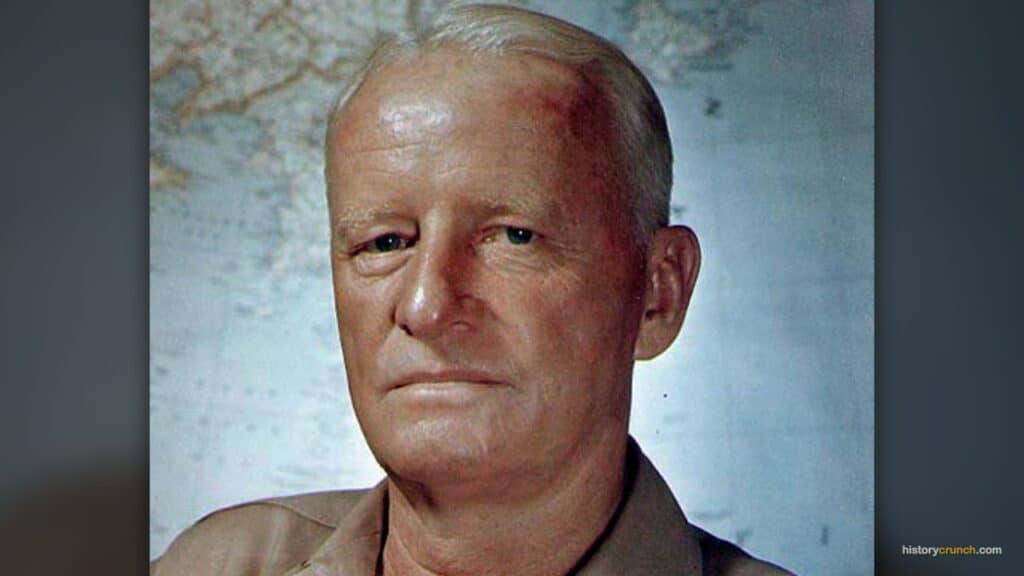
Island-Hopping in World War II – Summary
Once the United States undertook its attack against the Japanese Empire, a series of key battles took place throughout the Pacific region. The United States first met Japanese forces at the Battle of Midway, before American troops swept south and helped prevent Australia from falling to approaching Japanese forces. At this point the United States faced off against Japan at the Battle of Guadalcanal and began its strategy of island-hopping.
The American strategy of island-hopping was developed and overseen by General Douglas MacArthur and Admiral Chester W. Nimitz. In all, the vast empire of Japan included thousands of islands throughout the Pacific Ocean and the idea of capturing each and every island would have overwhelmed and slowed the American advance as they pushed forward towards conquering Japan. Therefore, American military strategists proposed a plan of island-hopping throughout the Pacific on their way to the Japanese main islands. This called for the American advance to only focus on strategically important islands, such as islands with landing strips and islands that were not heavily defended by Japanese forces. The purpose was to focus on Japanese held islands that would help the United States to advance as quickly as possible. Therefore, landing strips would allow American planes to advance quickly and to resupply troops on the ground. As well, avoiding heavily defended islands, if possible, allowed the United States to avoid being bogged downSlowed to a halt by difficult fighting that uses up time and resources. in long battles. As such, rather than launching full assaults on every Japanese-held island, the Allies selected specific islands to capture, establish bases, and use them as launch points for further advances across the Pacific.
The strategy of island-hopping was used in several of the major conflicts in the Pacific campaign of World War II. As stated above, the first major use of island-hopping was during the Battle of Guadalcanal in 1942. It was used further in other conflicts, such as: the Gilbert and Marshall Islands Campaign, the Mariana Islands Campaign, the Philippines Campaign and the Battles of Iwo Jima and Okinawa. All of these conflicts gave the United States a strategic advantage towards meeting its ultimate goal of preparing for a potential invasion of Japan and ending the Second World War.
FactsthatCrunchIn what order did these key events in the Pacific island-hopping campaign happen?
Island-Hopping in World War II – Significance
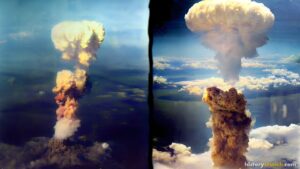
In the end, the strategy of island-hopping proved effective, as American forces were able to advance close to the Japanese main islands in about three years. This allowed the United States to get its aircraft carriers and ultimately its long range bombers close enough to the Japanese main islands in order to carry out the atomic bombingThe use of nuclear weapons, dropped by the United States on Japan to end World War II. of Japan in order to end World War II. As such, historians view the island-hopping strategy as significant to the overall success of the American war efforts in the Pacific Campaign of World War II. For instance, the strategy allowed the Americans to avoid heavily defended Japanese positions, which would have potentially cost the lives of many American soldiers. As such, it likely helped save lives and reduce losses for the American forces. Furthermore, it helped the Americans to cut off key Japanese supply-linesRoutes used to deliver food, weapons, and other necessities to troops in the field. and weaken the Japanese military capabilities.
FactsthatCrunchThe United States decision to bypass heavily defended Japanese islands and target only those with airstrips or space to build them reshaped the entire course of the Pacific War.
Explore World War II · 1939 – 1945
Keep exploring World War II with these History Crunch resources.
Key Vocabulary
Leapfrogging
Strategically important
Airstrips
Mobilized
Bogged down
Supply-lines
Atomic bombing
Frequently Asked Questions
What was island-hopping in World War II?
Island-hopping was a United States war strategy used in the Pacific against Japan. American forces skipped past heavily defended Japanese islands and captured weaker, more useful ones instead. This let them build bases and advance faster toward the Japanese main islands.
Why did the United States use island-hopping instead of attacking every island?
Japan controlled thousands of islands across the Pacific, so capturing each one would have taken far too long. Island-hopping let American forces focus only on islands that gave them a real advantage. This saved time, avoided costly battles, and sped up the advance toward Japan.
Who developed the island-hopping strategy?
General Douglas MacArthur and Admiral Chester W. Nimitz developed and oversaw the island-hopping strategy. They led American forces across different parts of the Pacific. Their plan focused on strategically important islands, especially those with airstrips or room to build them.
Which battles used island-hopping?
The first major use of island-hopping came at the Battle of Guadalcanal in 1942. The strategy was also used in the Gilbert and Marshall Islands Campaign and the Mariana Islands Campaign. Later campaigns included the Philippines and the battles of Iwo Jima and Okinawa.
Why was island-hopping important?
Island-hopping helped the United States reach positions close to the Japanese main islands within about three years. These bases let American aircraft carriers and long-range bombers get close enough to strike Japan directly. The strategy also cut Japanese supply lines and likely saved many American lives.
Cite This Article
To cite this article as a source, use one of the formats below.
MLA: Beck, Elias. “Island-Hopping in World War II: A Detailed Summary.” HistoryCrunch, 1 October 2026, https://historycrunch.com/island-hopping-in-world-war-ii/.
APA: Beck, E. (2026). Island-Hopping in World War II: A Detailed Summary. HistoryCrunch. https://historycrunch.com/island-hopping-in-world-war-ii/
Chicago: Beck, Elias. “Island-Hopping in World War II: A Detailed Summary.” HistoryCrunch. October 1, 2026. https://historycrunch.com/island-hopping-in-world-war-ii/
Sources
- Gerhard L. Weinberg, A World at Arms.
- Max Hastings, Inferno / All Hell Let Loose.
- Antony Beevor, The Second World War.