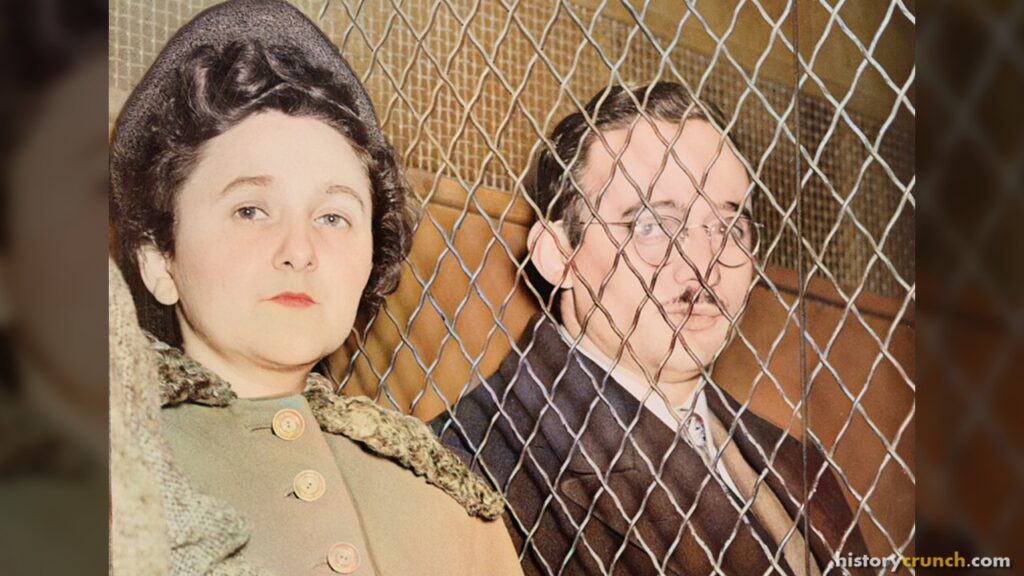
In 1951, Jewish-Americans Julius and Ethel Rosenberg were tried and convicted of espionage against the government of the United States for stealing and providing secret information to the Soviet Union. The information was about American military secrets and may have included information about American advancements in the development of the atomic bomb. Historians consider the case of Julius and Ethel Rosenberg as an important example of espionageSecretly gathering and passing a country’s private information to an enemy or rival nation. in the Cold War.
 FactsthatCrunch
The Rosenberg case became a lasting symbol of Cold War fear overriding fair legal process, raising questions that Americans and people around the world still debate today.
The Rosenbergs were the first American civilians executed for espionage during peacetime, making their deaths a permanent marker in Cold War history.
Many people, including world leaders and prominent public figures, believed Ethel was charged mainly to pressure Julius into confessing, which raised serious concerns about due process.
David Greenglass, Ethel's own brother, testified against them in exchange for a lighter sentence, and many questioned whether testimony given under that kind of deal was reliable enough to justify a death sentence.
Declassified documents and Soviet archives later confirmed Julius's involvement in espionage, but Ethel's role remained disputed among historians, meaning the government may have executed a person whose guilt was never clearly proven.
What Was Espionage in the Cold War?
Espionage was common during the Cold War. It was a key tool that helped both superpowers (the United States and the Soviet Union) in their policies to expand their influence. These countries conducted espionage against each other and other countries to get information on subjects such as military secrets, government secrets; or economic secrets.
The Cold War was a major world event that took place from approximately 1945 until 1991. In general, the Cold War was a period of increased tensions and hostility between the superpowers of the United States and the Soviet Union (USSR). It was characterized by a global struggle between capitalism and communism, with both sides competing for influence around the world. Although it never escalated into direct war between the superpowers, it involved proxy wars, nuclear arms races, and ideological confrontations. Many of the major events of the Cold War increased the tensions between the two nations, including: Cuban Missile Crisis, Vietnam War, Korean War and the nuclear arms race.
FactsthatCrunchSoviet atomic spies inside the Manhattan Project used a careful chain of dead drops and couriers to move stolen secrets from U.S. weapons labs to Soviet handlers without meeting face to face.
Julius and Ethel Rosenberg – Summary
Julius Rosenberg was born on May 12th, 1918, and Ethel Rosenberg was born on September 28th, 1915. Both of them were born in New York City to Jewish immigrant families. They met as young adults and were married in 1939. Julius studied electrical engineering and worked as a civilian engineer for the United States Army Signal Corps, while Ethel worked as a secretary and aspired to be a singer before focusing on family life.
FactsthatCrunchJulius and Ethel Rosenberg were both convicted of espionage in 1951, but their backgrounds, jobs, and roles in the case were different.
Julius and Ethel Rosenberg – Espionage
During the 1940s, as Cold War tensions escalated, the Rosenbergs became the focus of an investigation by the Federal Bureau of Investigation (FBI) into a Soviet spy ring operating in the United States. Julius was accused of passing classifiedOfficial government information kept secret and available only to people with special permission. information to the Soviet Union from the Manhattan Project, which was America’s top-secret atomic bomb program. Ethel’s role was less direct; she was accused of typing notes and helping to recruit others, including her own brother, David Greenglass, who testified against her and Julius in exchange for a lighter sentence.
Their trial in 1951 occurred during the height of anti-communist sentiment in America. Ultimately, they were convicted of espionage and sentenced to death, despite worldwide appeals for clemencyMercy shown to someone by reducing or canceling their punishment. and concerns about the fairness of their trial and the reliability of key witnesses. Many believed Ethel was charged mainly to pressure Julius into confessing. Nonetheless, both maintained their innocence and refused to name others involved in espionage.
On June 19th, 1953, Julius and Ethel Rosenberg were executed by the electric chair in New York. Despite numerous appeals, public protests, and international pleas for clemency, including from prominent figures and world leaders, President Dwight D. Eisenhower refused to grant a pardon. Their executions were carried out on the same day. Julius was executed first, followed shortly by Ethel. Their deaths sparked global protests and debates about Cold War justice, due processThe legal requirement that a government must follow fair rules and procedures before punishing someone., and government overreach. Over time, declassifiedFormerly secret government documents that have been officially released to the public. documents and Soviet archives confirmed Julius’s involvement in espionage, though Ethel’s role remains more disputed.
The case was highly controversial, with many questioning the fairness of their trial, the strength of the evidence, and whether Ethel deserved the death penalty. The Rosenbergs were the first American civilians to be executed for espionage during peacetime, and their deaths remain a significant aspect of the Cold War.
FactsthatCrunchGreenglass told prosecutors that Ethel had typed up his handwritten notes about atomic bomb secrets on a portable typewriter, making her look like an active part of the spy ring. He later admitted this was a lie, saying he gave that account to protect his wife Ruth from prosecution and to secure leniency for himself. In a 2001 interview he acknowledged that it was likely Ruth, not Ethel, who had typed the notes.
Explore Cold War · 1947 – 1991
Keep exploring Cold War with these History Crunch resources.
Key Vocabulary
Espionage
Classified
Manhattan Project
Clemency
Proxy wars
Due process
Declassified
Frequently Asked Questions
What were Julius and Ethel Rosenberg accused of?
Julius and Ethel Rosenberg were accused of spying for the Soviet Union against the United States. Julius was charged with passing secret information from the Manhattan Project, America’s atomic bomb program. Ethel was accused of helping by typing notes and recruiting others. Both were convicted of espionage in 1951.
When were the Rosenbergs executed?
Julius and Ethel Rosenberg were executed in the electric chair on June 19th, 1953, in New York. Julius was put to death first, followed shortly by Ethel. President Dwight D. Eisenhower refused to grant them a pardon. They were the first American civilians executed for espionage during peacetime.
Who testified against the Rosenbergs?
Ethel’s own brother, David Greenglass, testified against Julius and Ethel at their trial. He gave evidence in exchange for a lighter sentence for himself. Many people believed Ethel was charged mainly to pressure Julius into confessing. Both Rosenbergs maintained their innocence and refused to name others.
Were the Rosenbergs actually guilty?
Declassified documents and Soviet archives later confirmed that Julius was involved in espionage. Ethel’s role remains much more disputed among historians. Many have questioned the fairness of the trial, the strength of the evidence, and whether Ethel deserved the death penalty. The case stayed controversial for decades.
Why is the Rosenberg case important to Cold War history?
The Rosenberg case is an important example of espionage during the Cold War. Spying was a key tool used by both the United States and the Soviet Union to gain military and government secrets. Their trial took place during the height of anti-communist feeling in America. Their deaths sparked global protests and debates about due process and government overreach.
Cite This Article
To cite this article as a source, use one of the formats below.
MLA: Beck, Elias. “Julius and Ethel Rosenberg: A Detailed Summary.” HistoryCrunch, 13 October 2026, https://historycrunch.com/julius-and-ethel-rosenberg/.
APA: Beck, E. (2026). Julius and Ethel Rosenberg: A Detailed Summary. HistoryCrunch. https://historycrunch.com/julius-and-ethel-rosenberg/
Chicago: Beck, Elias. “Julius and Ethel Rosenberg: A Detailed Summary.” HistoryCrunch. October 13, 2026. https://historycrunch.com/julius-and-ethel-rosenberg/
Sources
- State Department — Office of the Historian
- Wilson Center Digital Archive
- Vladislav Zubok, A Failed Empire.
- John Lewis Gaddis, The Cold War: A New History.