The Strategic Arms Limitation Talks (SALT I and II) were two rounds of negotiationsFormal talks between two parties trying to reach an agreement on a difficult issue. between the United States and the Soviet Union during the Cold War which aimed to reduce or limit the number of nuclear weapons each side possessed. SALT I was agreed to in 1972, while SALT II was agreed to in 1979. Together, they are two of several important disarmament agreements in the Cold War and played a significant role in the period of detente.
 FactsthatCrunch
American leaders saw the SALT agreements as a practical way to slow the nuclear arms race without giving up military strength. They valued the freeze on Soviet strategic ballistic missile launchers and the caps on new missile production that SALT I put in place. When the U.S. Senate refused to ratify SALT II after Soviet forces invaded Afghanistan in 1979, many senators argued that trusting Soviet commitments had become impossible and that the agreement no longer served American security interests.
Soviet leaders under Leonid Brezhnev viewed the SALT talks as formal recognition that the United States accepted the USSR as an equal nuclear power. They saw the agreements as proof that both sides could manage competition through negotiation rather than open conflict. From the Soviet side, the collapse of SALT II ratification was blamed on American domestic politics rather than any failure of Soviet good faith at the negotiating table.
What Was the Cold War?
The Cold War was a major world event that took place from approximately 1945 until 1991. In general, the Cold War was a period of increased tensions and hostility between the superpowers of the United States and the Soviet Union (USSR). It was characterized by a global struggle between capitalism and communism, with both sides competing for influence around the world. Although it never escalated into direct war between the superpowers, it involved proxy wars, nuclear arms races, and ideological confrontations. Many of the major events of the Cold War increased the tensions between the two nations, including: Cuban Missile Crisis, Vietnam War, Korean War and the nuclear arms race. However, some of these events or periods of time also helped to decrease tensions between the two. This period of reduced tensions is often referred to as ‘detente’.
Strategic Arms Limitation Talks – Disarmament Agreements
The main events that historians focus on when discussing détenteA period when hostile countries ease tensions by cooperating instead of competing. during the Cold War are the series of agreements and treaties that the two superpowers agreed to throughout the 1960s and 1970s. The most significant of these treaties are collectively known as the disarmament agreements. The disarmamentThe process of reducing or eliminating a country’s weapons, especially nuclear ones. agreements were treaties in which the two superpowers agreed to limit or reduce the creation of new warheads and weapons of mass destruction. This is considered to be an example of détente because it involved the two countries discussing and working together to meet a common goal. In the past, the two had generally been very competitive and combative towards one another, which increased tensions. The best examples of detente during the Cold War are SALT I, SALT II, the Anti-Ballistic Missile Treaty and the Helsinki Accords.
FactsthatCrunch Détente and Its Key Agreements
Strategic Arms Limitation Talks – SALT I
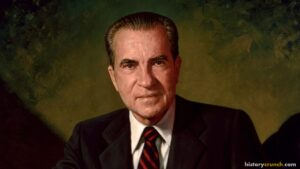
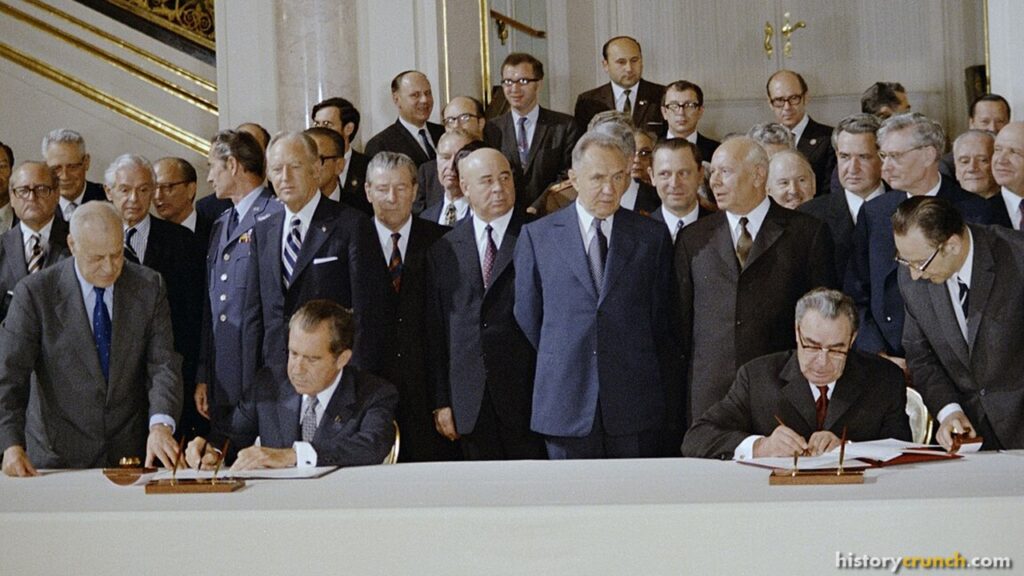
The first Strategic Arms Limitation Talks Agreement (SALT I) was signed on May 26th, 1972 after considerable discussions between the United States and the Soviet Union beginning in November of 1969. In general, SALT I saw the superpowers freeze the number of strategic ballistic missile launchersLong-range rocket systems designed to deliver nuclear warheads over great distances. at their current levels. While there were allowances for each country to increase some missile production, it placed caps and saw each nation also commit to dismantling older style weapons with the production of newer ones. For example, SALT I concluded with the signing of the Anti-Ballistic Missile Treaty (ABM Treaty) between the United States and Soviet Union on May 26th, 1972. The ABM Treaty limited each nation in terms of the number of anti-ballistic missile systemsWeapons designed to intercept and destroy incoming enemy missiles before they hit their target. and missiles. The treaty was signed during the 1972 Moscow Summit by American President Richard Nixon and the leader of the Soviet Union Leonid Brezhnev.
FactsthatCrunchThe Anti-Ballistic Missile Treaty, signed at the 1972 Moscow Summit, limited how many missile defense systems the United States and Soviet Union could each build and where they could place them.
Strategic Arms Limitation Talks – SALT II and the Helsinki Accords
Following the conclusion of SALT I, the two superpowers shifted and began a new series of talks that historians refer to as the second round of the Strategic Arms Limitation Talks (SALT II). SALT II focused on limiting the creation of strategic nuclear weapons and the talks began in 1972 and continued until 1979. While the overall hope of SALT II was to limit the production of nuclear missiles it ultimately failed due to the Soviet invasion of Afghanistan in 1979. American President Jimmy Carter actually signed an agreement in relation to SALT II on June 18th, 1979 with Soviet leader Leonid Brezhnev, but the terms of the agreement were never ratifiedFormally approved by a government body, making an agreement legally binding. by the United States Senate. Before the United States Senate could review and ultimately approve the agreement, Soviet forces invaded the nation of Afghanistan. Historians consider this event to be the end of the détente period of the Cold War since the conflict renewed tensions between the two superpowers. Throughout the 1980s, tensions increased until finally the Cold War ended in the late 1980s and early 1990s with the fall of the Berlin Wall and the reforms of ‘perestroika’ and ‘glasnost’ in the Soviet Union.
During the period of SALT II, another major event related to detente occurred called the Helsinki Accords. Also called the Helsinki Final Act, the agreement was signed by 35 member nations including the United States, Canada, Soviet Union and most of Europe. The act dealt with a range of significant global issues and, therefore, was important in the overall Cold War. The discussions for the Helsinki Final Act began in 1972 and continued with the formation of the Conference on Security and Cooperation in Europe (CSCE) in July of 1973. The act dealt with a variety of issues important at the time, including: political and military issues, economic issues, human rights and future negotiations between the member countries. Similar to SALT I and SALT II, the Helsinki Final Act was an important part of detente because it involved the United States and the Soviet Union working together, which resulted in a decrease of tensions at the time.
FactsthatCrunchSoviet forces invaded Afghanistan in late 1979, which immediately renewed Cold War tensions between the United States and the Soviet Union.
Detente was a period when the United States and the Soviet Union worked together to reduce tensions, most notably through arms limitation talks. The Afghanistan invasion ended that cooperation and set the tone for a harder, more confrontational relationship through most of the 1980s.
Explore Cold War · 1947 – 1991
Keep exploring Cold War with these History Crunch resources.
Key Vocabulary
Negotiations
Disarmament
Détente
Strategic ballistic missile launchers
Anti-ballistic missile systems
Ratified
Proxy wars
Frequently Asked Questions
What were the Strategic Arms Limitation Talks?
The Strategic Arms Limitation Talks were two rounds of negotiations between the United States and the Soviet Union during the Cold War. Their goal was to limit or reduce the number of nuclear weapons each side held. The two rounds are known as SALT I and SALT II.
When were SALT I and SALT II signed?
SALT I was signed on May 26th, 1972, after talks that began in November of 1969. The SALT II agreement was signed on June 18th, 1979. Both came during a period of reduced tensions known as detente.
Who signed the SALT agreements?
American President Richard Nixon and Soviet leader Leonid Brezhnev signed SALT I at the 1972 Moscow Summit. SALT II was signed by American President Jimmy Carter and Leonid Brezhnev in 1979. Both agreements were part of the wider Cold War effort to limit weapons.
Why did SALT II fail?
SALT II failed because the United States Senate never ratified the agreement. Before the Senate could approve it, Soviet forces invaded Afghanistan in 1979. Historians see this invasion as the end of the detente period of the Cold War.
How did the SALT talks relate to detente?
The SALT talks were key examples of detente, the period when Cold War tensions eased. They showed the two superpowers talking and working toward a shared goal instead of only competing. The Anti-Ballistic Missile Treaty and the Helsinki Accords were other important parts of detente.
What was the Anti-Ballistic Missile Treaty?
The Anti-Ballistic Missile Treaty, signed on May 26th, 1972, limited each nation’s anti-ballistic missile systems and missiles. It was signed along with SALT I at the Moscow Summit by Nixon and Brezhnev. The treaty helped reduce the danger of the nuclear arms race.
Cite This Article
To cite this article as a source, use one of the formats below.
MLA: Beck, Elias. “Strategic Arms Limitation Talks (SALT): A Detailed Summary.” HistoryCrunch, 9 October 2026, https://historycrunch.com/strategic-arms-limitation-talks/.
APA: Beck, E. (2026). Strategic Arms Limitation Talks (SALT): A Detailed Summary. HistoryCrunch. https://historycrunch.com/strategic-arms-limitation-talks/
Chicago: Beck, Elias. “Strategic Arms Limitation Talks (SALT): A Detailed Summary.” HistoryCrunch. October 9, 2026. https://historycrunch.com/strategic-arms-limitation-talks/
Sources
- John Lewis Gaddis, The Cold War: A New History.
- Wilson Center Digital Archive
- Odd Arne Westad, The Global Cold War.