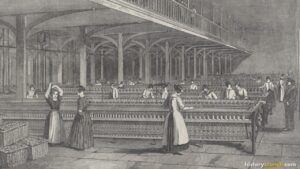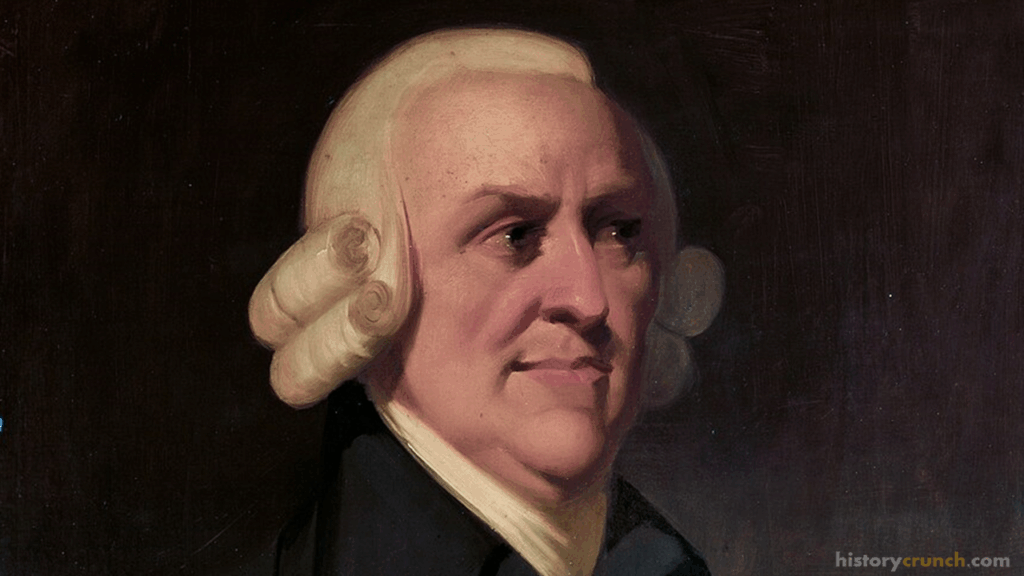
Adam Smith is one of the most important historical figures for liberal thought and economic freedom. He is best known for ‘Wealth of Nations’, which challenged the role of the government in economics and helped establish the basic foundation of modern capitalism. As such, he is often associated with historical events, such as the Industrial Revolution and the development of Economic Individualism.
 FactsthatCrunch
Adam Smith argued that free markets guided by supply and demand, not government control, produce the most prosperity for society. His book Wealth of Nations laid out the core principles of free trade and competition that became the foundation of modern capitalism.
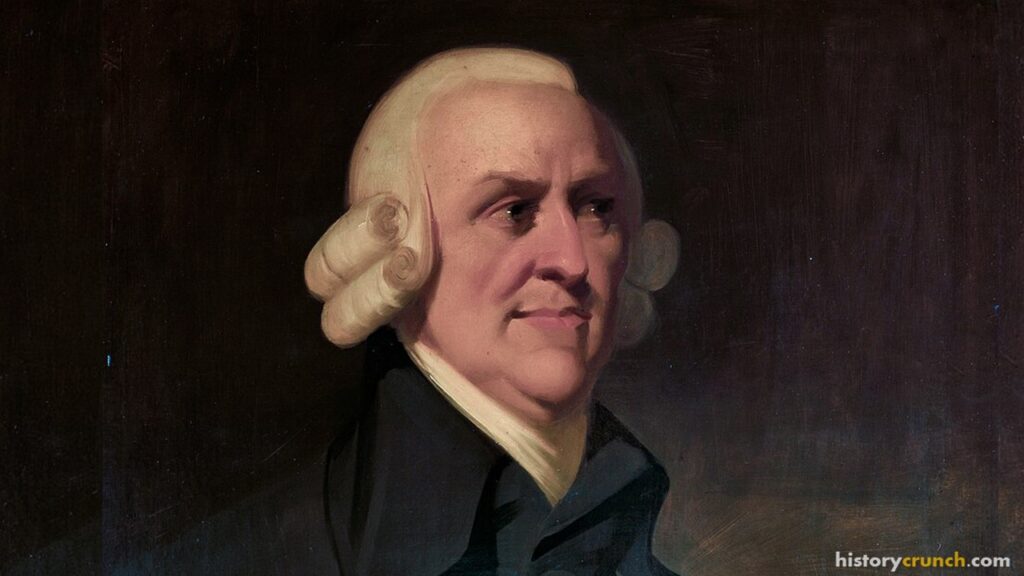
Adam Smith – Early Life
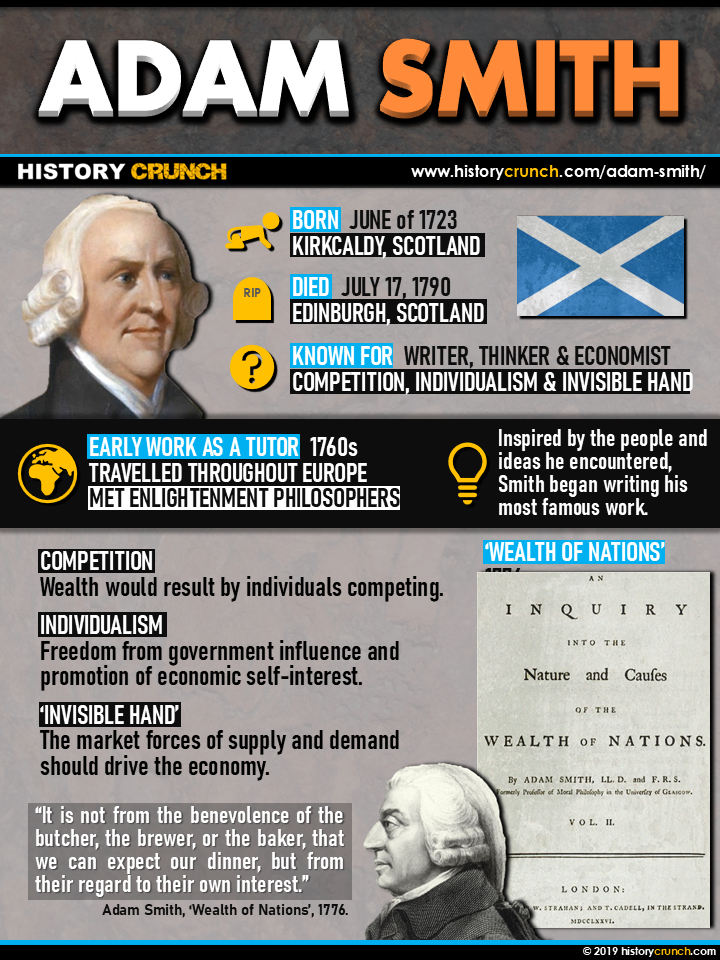
Smith was born in Kirkcaldy, Scotland in June of 1723. The exact date of his birth is unknown but many historians treat the day of his baptism, June 5th, 1723, as his official birthdate. His father, also named Adam Smith, died two months after he was born, leaving his mother, Margaret Douglas, a widow. Adam Smith pursued schooling from an early age, and attended the Burgh School of Kirkcaldy from 1729 to 1737.
Adam Smith – Education
Smith attended the University of Glasgow at the age of 14 and in 1740 he attended the University of Oxford. After leaving Oxford, he began delivering public lectures in 1748 in Edinburgh, Scotland. As well, around the same time he began to develop a friendship with David Hume, the famous Scottish philosopher. The two wrote to each other about a variety of topics, such as: history, economics, politics, etc. Throughout the 1750s and early 1760s Smith was a professor of logic and then moral philosophy at the University of Glasgow where he began to develop many of his ideas of the world.
FactsthatCrunchIn 1751, Adam Smith became a professor at the University of Glasgow, the same school he had entered at age 14.
He first taught logic and, a year later, moral philosophy. His Glasgow lectures on ethics became his first book, The Theory of Moral Sentiments, in 1759.
Adam Smith – Work and Travels
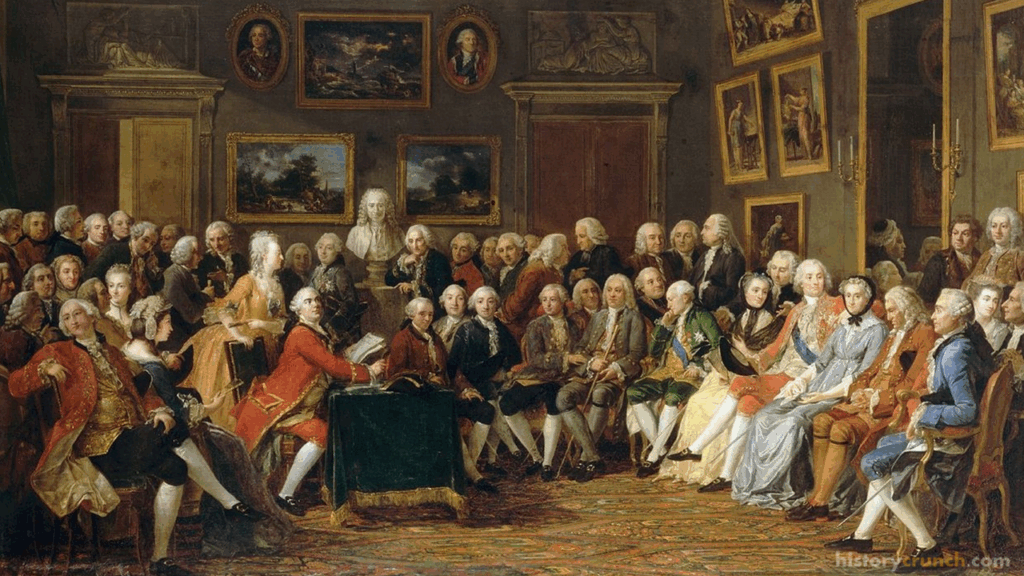
In 1763, Smith was offered a tutoring position by British politician Charles Townshend for his stepson Henry Scott. Smith accepted the position and spent the next several years travelling Europe with Henry Scott as part of his education. On these journeys, Smith came into contact with several key thinkers and philosophers from the Age of Enlightenment. For example, in Geneva, Smith met with Voltaire, and in Paris, he met with the famous PhysiocratsA group of French thinkers who opposed government control of trade and supported free markets. thinkers and philosophers. The physiocrats opposed mercantilism, the economic theory of the time, and instead supported free markets without government control. Smith would famously write about free markets, ideas later known as laissez-faire economics, which he developed from the ideas of the physiocrats.
 FactsthatCrunch
Adam Smith – Wealth of Nations
Adam Smith’s reputation as an economist rests largely on two important books that have shaped economic theory: ‘The Theory of Moral Sentiments’ and ‘Wealth of Nations’. Published in 1759, ‘The Theory of Moral Sentiments’ explores the nature of ethical judgments and the origin of human morality. It introduced the idea of the ‘impartial spectatorAn imaginary observer Smith invented as a tool for judging whether a person’s actions are moral.‘, an imaginary observer used to judge the morality of one’s actions.
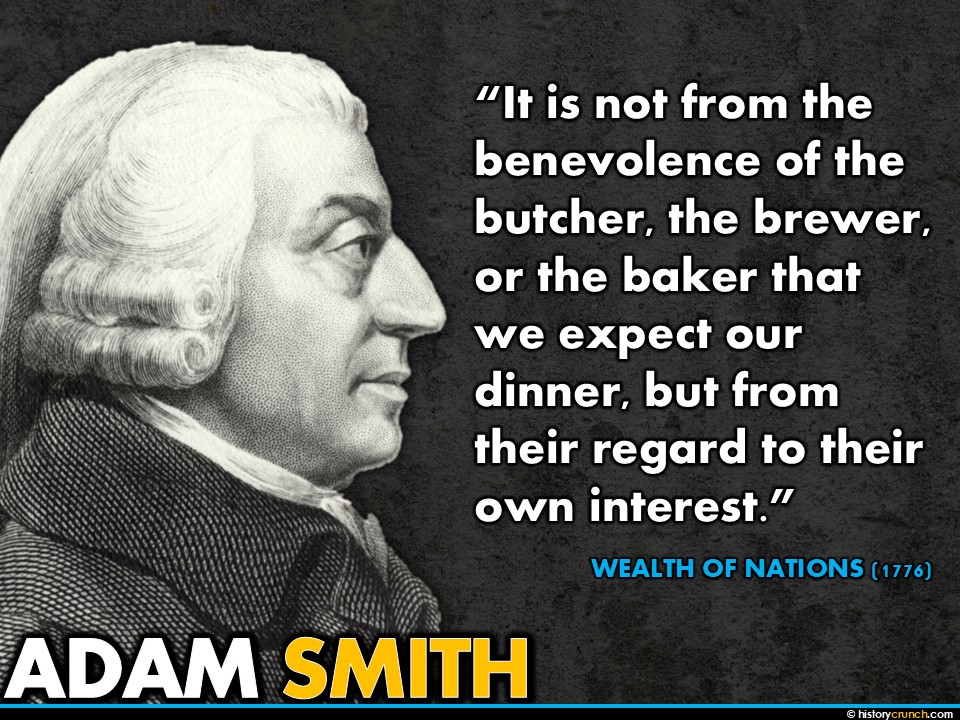
In 1766, Smith returned to Kirkcaldy, Scotland, where he began writing his most famous work. Its full title was ‘An Inquiry into the Nature and Causes of the Wealth of Nations’ which is just often shortened to ‘Wealth of Nations’. The book was published in 1776 and became one of the most influential economic writings of all time. It challenged the idea that the government should control the economy and instead proposed the idea of free trade and competition with a lesser role of the government. The ideas of this book would eventually lay the foundation for the principles of capitalismAn economic system that supports free trade and individual choice as the path to prosperity., which is an economic system that supports the idea of free trade and choice as a way of achieving prosperity. Like the physiocrats, Smith argued against mercantilismAn economic theory, dominant in Smith’s era, where governments tightly control trade to build national wealth. and government control of the economy and instead proposed the idea of the ‘invisible handThe idea that supply and demand, not government control, should naturally guide a country’s economy.’. Simply put, the invisible hand is the idea that the market forces of supply and demand should drive the economy of a country.
Also, Smith famously described the efficiency gained through the division of laborBreaking a production process into separate, distinct tasks so workers can produce more efficiently. using the example of a pin factory. He explained how dividing production processes into distinct tasks significantly enhances productivity.
Adam Smith – Death and Legacy
Adam Smith died on July 17th, 1790 in Edinburgh, Scotland. Today he is remembered for his immense contribution to economic theory and the development of free market capitalism, which has developed across much of the world. Many historians view him as one of the great liberal thinkers of the Enlightenment and helped the development of classical liberal thought.
FactsthatCrunchAdam Smith's idea of the invisible hand means that the government should actively direct a country's economy.
Adam Smith – Infographic
Industrial Revolution timeline · 1760 – 1840
Key Vocabulary
Mercantilism
Physiocrats
Laissez faire
Invisible hand
Division of labor
Impartial spectator
Capitalism
Frequently Asked Questions
Why is Adam Smith called the father of modern economics?
Adam Smith is called the father of modern economics because his ideas shaped how people think about markets and trade. His book “Wealth of Nations” laid out the basic principles of capitalism and free markets. He argued that competition and free trade, not government control, lead to prosperity. These ideas still guide economic thinking today.
What is the invisible hand?
The invisible hand is Adam Smith’s idea that supply and demand should guide a country’s economy. He believed markets work best when people freely pursue their own interests. This activity, without heavy government control, tends to benefit society as a whole. The term became one of the most famous ideas in economics.
What is the pin factory example?
The pin factory is the example Adam Smith used to explain the division of labor. He showed that breaking production into separate tasks greatly increases how much workers can make. One worker doing every step would produce very few pins alone. Many workers each handling one step produce far more together.
Who influenced Adam Smith’s economic ideas?
The Physiocrats, a group of French thinkers, strongly influenced Adam Smith’s economic ideas. He met them in Paris while traveling across Europe with a student. They opposed mercantilism and supported free markets without government control. Smith built on their views to develop his ideas about laissez faire economics.
What did Adam Smith write besides “Wealth of Nations”?
Adam Smith wrote “The Theory of Moral Sentiments,” published in 1759. This book explored how people form ethical judgments and where human morality comes from. It introduced the idea of the “impartial spectator,” an imaginary observer used to judge one’s actions. The work showed his interest in ethics before he turned fully to economics.
Cite This Article
To cite this article as a source, use one of the formats below.
MLA: Beck, Elias. “Adam Smith: A Detailed Biography.” HistoryCrunch, 28 September 2026, https://historycrunch.com/adam-smith/.
APA: Beck, E. (2026). Adam Smith: A Detailed Biography. HistoryCrunch. https://historycrunch.com/adam-smith/
Chicago: Beck, Elias. “Adam Smith: A Detailed Biography.” HistoryCrunch. September 28, 2026. https://historycrunch.com/adam-smith/
Sources
- Emma Griffin, A Short History of the British Industrial Revolution.
- The Science Museum Group