Matthew Ridgway was one of the most important American military leaders of the twentieth century, a general whose calm leadership helped shape the outcome of both World War II and the Korean War. He is best remembered for taking command of a beaten and demoralizedDescribing troops whose confidence and will to fight have been broken by defeat or hardship. army in Korea and turning it into an effective fighting force in a matter of weeks. His career stretched across nearly forty years of American military and political history, from the early days of paratroopers to the tense years of the Cold War.
 FactsthatCrunch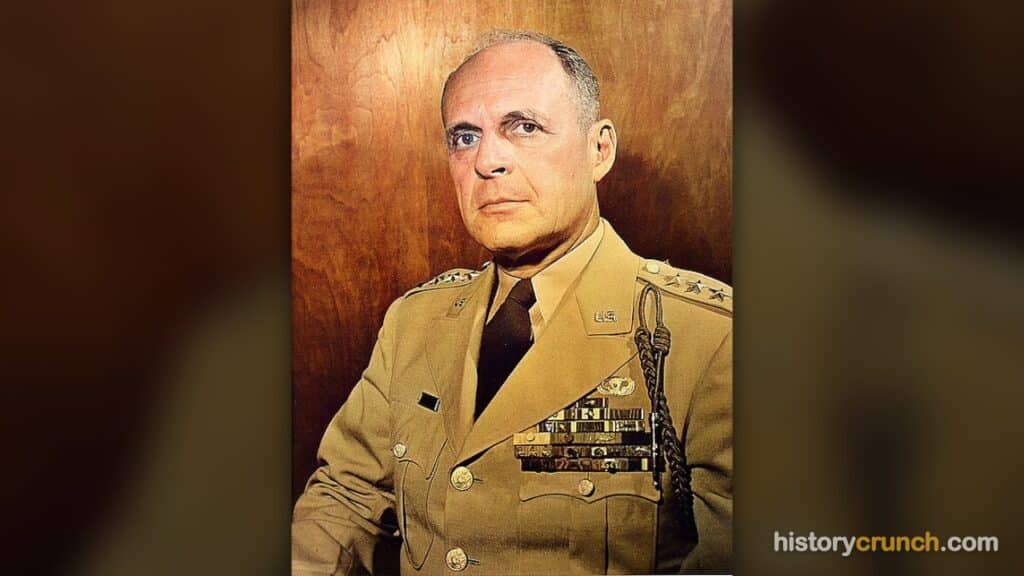
In simple terms, Matthew Ridgway was a career officer in the United States Army who rose to the highest levels of command. He led airborneTroops delivered behind enemy lines by parachute or glider, a new and risky method of warfare in the 1940s. troops in Europe during the Second World War, rescued United Nations forces during the Korean War, and later served as Supreme Allied Commander in Europe and as Chief of Staff of the United States Army. He was known throughout his life for leading by example, for personal courage, and for a plainspoken honesty that sometimes put him at odds with presidents.
Early Life and Background
Matthew Bunker Ridgway was born in Fort Monroe, Virginia, on March 3rd, 1895, the son of an artillery colonel who had also graduated from West Point. Because his father was a professional soldier, the family moved often from post to post. Growing up around army life gave the young Ridgway an early familiarity with military routines, discipline, and the world of the officer corps.
Following in his father’s footsteps, Ridgway sought admission to the United States Military Academy at West Point in New York. He failed his first attempt because of a mathematics test, but he was accepted the following year, in 1913, and graduated in 1917. In fact, his graduation came in the same year the United States entered the First World War, a moment that shaped the plans of many young officers of his generation.
The Army commissioned Ridgway as a second lieutenant immediately after his graduation from West Point. He hoped to fight in the trenches of France, but instead he was assigned to teach at the academy. In 1918 he returned to West Point as an instructor in Spanish. Though he was disappointed at missing combat, this early period allowed him to build a reputation as a capable and thoughtful officer.
FactsthatCrunchWhy did Matthew Ridgway fail his first attempt to enter West Point?
Ridgway failed his first attempt to gain admission to West Point because of a mathematics test. He did not give up, and was accepted the following year, in 1913. He went on to graduate from West Point in 1917.
Rise Through the Army
During the 1920s and 1930s, Ridgway held a wide range of assignments that broadened his experience far beyond the battlefield. He commanded troops with the 15th Infantry in China and later served in Nicaragua, where he helped supervise free elections in 1927. These postingsOfficial assignments to specific military positions or locations during a soldier’s career. gave him firsthand knowledge of foreign affairs and of the challenges of working with other nations, a skill that would matter greatly later in his career.
Considered an expert on foreign affairs, Ridgway became a military adviser to the Governor General of the Philippines in 1930. He also continued his professional education, attending the Army’s advanced schools for officers. He graduated from the Command and General Staff School at Fort Leavenworth in Kansas in 1935 and from the Army War College in 1937. More specifically, these schools prepared officers for high command by teaching them how to plan and manage large operations.
His talent drew the attention of General George Marshall, one of the most powerful figures in the Army. Marshall was impressed with Ridgway and took him along on a special assignment to Brazil, and soon after the outbreak of the Second World War Ridgway was brought into important planning work. At the outset of World War II, his distinguished service record earned him a billetAn assigned position or posting within a military organization. in the War Plans Division. This placed him at the very center of American strategy.
Major Achievements in World War II
Ridgway’s greatest wartime opportunity came with the rise of airborne warfare, a new and risky idea in which soldiers were dropped behind enemy lines by parachute or glider. In 1942 he attained the rank of brigadier general and took command of the 82nd Airborne Division, then a bold experiment in revolutionary paratrooper tactics, receiving the posting in large part because of his reputation for innovation, boldness, and leadership by example.
Ridgway planned and executed the first major airborne assault in United States military history with the attack on Sicily in July of 1943. This operation was dangerous and imperfect, but it proved that large airborne forces could be used in major campaigns. It also cemented Ridgway’s standing as one of the leading figures in a new kind of warfare.
The 82nd Airborne next played a central role in the invasion of Normandy, France. Ridgway helped prepare Operation Overlord, which began on June 6th, 1944, and he parachuted into France with his division on D-Day, fighting for thirty-three days across the Normandy countryside. Landing with his soldiers rather than directing them from safety became a hallmark of his command style.
As the war continued, Ridgway rose to command an even larger formation. After Normandy, his skills were called on for Operation Market Garden in Holland, and in August of 1944 he took command of the XVIII Airborne Corps, whose men were soon engaged against the German counterattack in the Ardennes. In March of 1945 he took part in Operation Varsity in Germany, during which he was wounded in the shoulder by fragments from a German grenade. By the end of the war he had earned a reputation as one of the finest combat leaders in the Army.
FactsthatCrunchIn what order did Matthew Ridgway's World War II airborne operations unfold?
Command in the Korean War
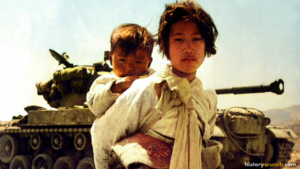
Ridgway’s most famous achievement came during the Korean War, the first major conflict of the Cold War, fought between communist North Korea and the American-backed South. By late 1950, United Nations forces had been thrown into a desperate retreat after China entered the war and poured troops across the border. The situation grew worse when the field commander, Lieutenant General Walton Walker, was killed in a jeep accident.
After General Walker was killed, Matthew Ridgway replaced him as commander of the Eighth Army, and the X Corps was also merged under his command. He arrived at the lowest point of the war, when American and allied troops were shaken and low on confidence. As he toured the front in an open jeep in freezing weather, meeting with his commanders and with South Korean President Syngman Rhee, Ridgway told them plainly, “I’ve come to stay.”
Ridgway set out at once to rebuild the fighting spirit of his forces. Because of his eminent career as a combat officer, he was extremely popular with the troops, and his approach concentrated on improving moraleThe confidence, spirit, and willingness to keep fighting felt by soldiers in a military unit., insisting on strict discipline, and inflicting heavy casualties on the enemy. In reality, his greatest early contribution was psychological, convincing exhausted soldiers that they could win.
He was also convinced that the enemy could not sustain its attacks for long. General Ridgway believed the enemy lacked the logisticalRelated to supplying and moving troops, equipment, and materials needed to keep an army fighting. system to maintain offensive operations for any extended period, and he began preparing a counteroffensiveA large-scale military attack launched in response to an enemy advance, aimed at pushing the enemy back.. After task forces encountered little Chinese opposition in probes to the north, on January 25th, 1951, he launched Operation Thunderbolt, a larger but still cautious advance supported by air power. Step by step, his forces pushed north and eventually retook the South Korean capital of Seoul.
His success in Korea led to even greater responsibility. Promoted in 1951 to the rank of general, he succeeded General Douglas MacArthur as Allied commander in the Far East and continued the successful defense of South Korea. He subsequently oversaw the end of the United States occupation of Japan in 1952.
Later Life
After Korea, Ridgway took on some of the highest posts in the Western military world. He replaced General Dwight D. Eisenhower as Supreme Allied Commander of Europe on May 30th, 1952. In this role he helped lead the military forces of the North Atlantic Treaty Organization, the alliance formed to defend Western Europe against the Soviet Union.
In August of 1953 he was brought back to the United States to serve as Chief of Staff of the United States Army. As the Army’s top officer, Ridgway did not hesitate to disagree with civilian leaders when he believed they were mistaken. He clashed with President Eisenhower’s administration over defense policy, especially over whether the United States should intervene in the French battle at Dien Bien Phu in Vietnam. His warnings against a costly land war in Asia reflected the hard lessons he had learned in Korea.
After retiring from the Army in June of 1955, he published his autobiography. He retired to suburban Pittsburgh, where he lived until he died of heart failure in 1993 at the age of 98, and he was buried at Arlington National Cemetery. His long life allowed him to witness much of the Cold War that his own decisions had helped shape.
FactsthatCrunchRidgway's experience fighting China in Korea convinced him that a land war in Asia would cost far more than any political gain was worth, and he brought that warning directly into his role as Army Chief of Staff.
As Army Chief of Staff from August 1953, Ridgway clashed with the Eisenhower administration over whether to intervene at Dien Bien Phu in 1954. His Korea-tested judgment that ground wars in Asia were prohibitively costly shaped his opposition and defined his final years in uniform.
Significance of Matthew Ridgway
Matthew Ridgway’s significance rests above all on what he accomplished in Korea. Military historians credit him not only with boosting the broken morale of the Eighth Army, but also with transforming the entire United Nations war effort. In a matter of weeks, he changed the course of a war that had appeared close to disaster, and his work made possible the survival of South Korea as an independent nation.
His career also demonstrated the value of a soldier who was as thoughtful as he was brave. From the airborne assaults of World War II to the highest commands of the Cold War, Ridgway combined personal courage with careful planning and honest advice. As stated above, he was willing to challenge presidents when he believed American lives were at stake, and his caution about land wars in Asia influenced how later leaders thought about conflict.
For these reasons, Ridgway is often remembered as one of the most capable American generals of his era. His leadership style, built on visiting the front lines, sharing danger with his troops, and speaking plainly, became a model for later officers. His legacy endures in the survival of South Korea and in the traditions of the modern United States Army.
FactsthatCrunchRidgway's rebuilding of the Eighth Army in early 1951 proved that trained leadership and restored morale could reverse a military collapse and keep South Korea from falling to communist forces.
Without Ridgway's counteroffensive, United Nations forces faced the real possibility of being pushed entirely off the Korean peninsula, which would have ended South Korea as an independent nation.
His launch of Operation Thunderbolt on January 25th, 1951 showed that careful, air-supported advances could reclaim ground lost to a numerically large enemy, a lesson the Army applied to later doctrine.
Ridgway's warnings against intervening in Vietnam after Korea, based directly on what he learned stabilizing the front near the 38th parallel, shaped how American military leaders thought about large land wars in Asia for decades.
His insistence on leading from the front, touring positions in freezing weather rather than directing from the rear, became a standard the Army held up when training officers in the years that followed.
Korean War timeline · 1950 – 1953
Key Vocabulary
Airborne
Billet
Demoralized
Logistical
Counteroffensive
Morale
Frequently Asked Questions
Who was Matthew Ridgway?
Matthew Ridgway was a United States Army general who led airborne troops in World War II and rescued United Nations forces during the Korean War. He also served in top Cold War posts, including Supreme Allied Commander in Europe and Chief of Staff of the United States Army. He is considered one of the most respected American military leaders of the twentieth century.
Why is Matthew Ridgway famous in the Korean War?
Ridgway is famous for saving the Eighth Army after it was thrown into retreat by Chinese forces in late 1950. He rebuilt the confidence of demoralized troops, launched a series of counterattacks, and drove enemy forces back, retaking the South Korean capital of Seoul. His turnaround is often described as one of the great feats of American military leadership.
What did Matthew Ridgway do in World War II?
During World War II, Ridgway commanded the 82nd Airborne Division and later a larger airborne corps. He organized the first major American airborne assault in Sicily and parachuted into France with his men on D-Day. He was known for personally sharing the dangers his soldiers faced in combat.
Did Matthew Ridgway replace Douglas MacArthur?
Yes, Ridgway succeeded Douglas MacArthur as Allied commander in the Far East in 1951 after MacArthur was removed from command. Ridgway continued the successful defense of South Korea and oversaw the end of the American occupation of Japan in 1952. The transfer marked an important shift in how the war in Korea was managed.
When and where did Matthew Ridgway die?
Matthew Ridgway died of heart failure in 1993 at the age of 98, near Pittsburgh, Pennsylvania. He had retired from the Army in 1955 after decades of service. He is buried at Arlington National Cemetery, a resting place reserved for many of the nation’s honored military figures.
Cite This Article
To cite this article as a source, use one of the formats below.
MLA: Millar, B. “Matthew Ridgway: A Detailed Biography.” HistoryCrunch, 15 August 2026, https://historycrunch.com/matthew-ridgway/.
APA: Millar, B. (2026). Matthew Ridgway: A Detailed Biography. HistoryCrunch. https://historycrunch.com/matthew-ridgway/
Chicago: Millar, B. “Matthew Ridgway: A Detailed Biography.” HistoryCrunch. August 15, 2026. https://historycrunch.com/matthew-ridgway/
Sources
- Jerry Bentley & Herbert Ziegler, Traditions & Encounters: A Global Perspective on the Past.
- J.M. Roberts & Odd Arne Westad, The Penguin History of the World.