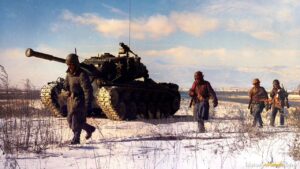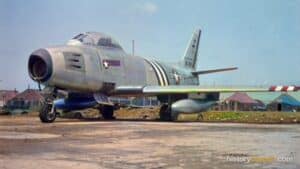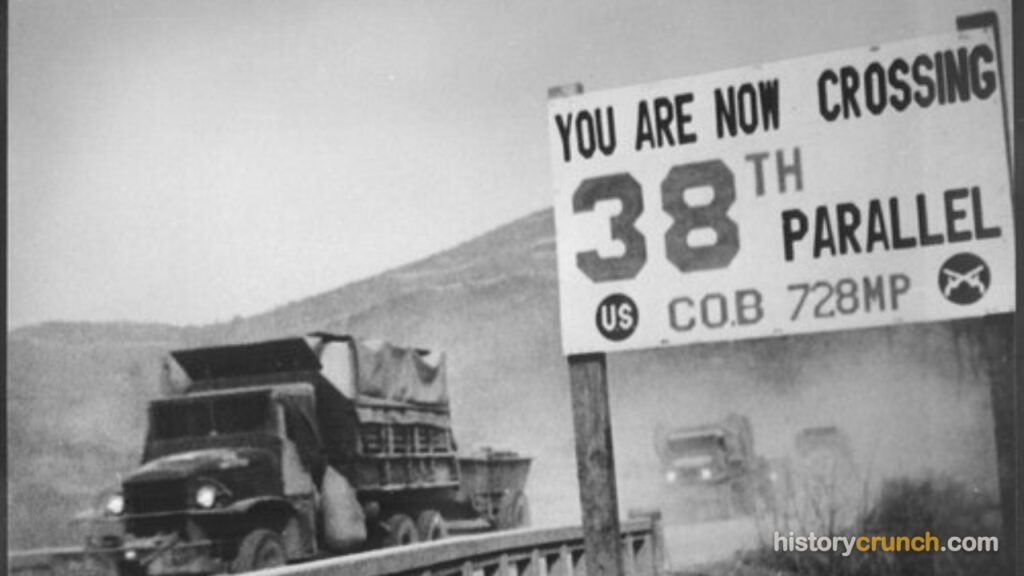
The 38th Parallel in the Korean WarThe line of latitude at 38 degrees north that divided the Korean Peninsula into a communist north and a capitalist south. is one of the most important geographic lines in modern history, because it split a single nation into two hostile states and set the stage for a war that still shapes East Asia today. It refers to the line of latitude at 38 degrees north, which cuts across the Korean Peninsula and came to serve as the border between communist North Korea and capitalistRelating to an economic system based on private ownership and free markets, as opposed to government control. South Korea. During the Korean War of 1950 to 1953, armies crossed this line again and again, and it became both the trigger for the fighting and the rough boundary where the war finally stopped. The story of the 38th parallelThe line of latitude at 38 degrees north that divided the Korean Peninsula into a communist north and a capitalist south. is closely tied to the start of the Cold War between the United States and the Soviet Union.
In simple terms, the 38th parallel began as a temporary military dividing line, not a real political border. American planners chose it at the end of World War II to decide which of the two victorious powers would accept the surrender of Japanese forces in each half of Korea. Over time, that quick decision hardened into a permanent divide between two very different governments and two very different ways of life.
What Was the Cold War?
The Cold War was a long period of tension and rivalry between the United States and the Soviet Union that lasted from the end of World War II in 1945 until the early 1990s. It was called “cold” because the two superpowers never fought each other directly in an all-out war. Instead, they competed through spying, propaganda, an arms race, and smaller conflicts in other countries around the world.
At the heart of the Cold War was a clash of ideas. The United States promoted capitalism and democracy, while the Soviet Union promoted communism, a system in which the government controls the economy and property is shared in theory by all. Since the beginning of the Cold War the United States had practiced a policy of containmentA U.S. policy aimed at stopping communism from spreading into new regions of the world. against the expansion of communismA system in which the government controls the economy and property is shared in theory by all., and wanted to prevent the ideology from taking root in different regions of the world. For its part, the Soviet Union worked to spread communism into new areas.
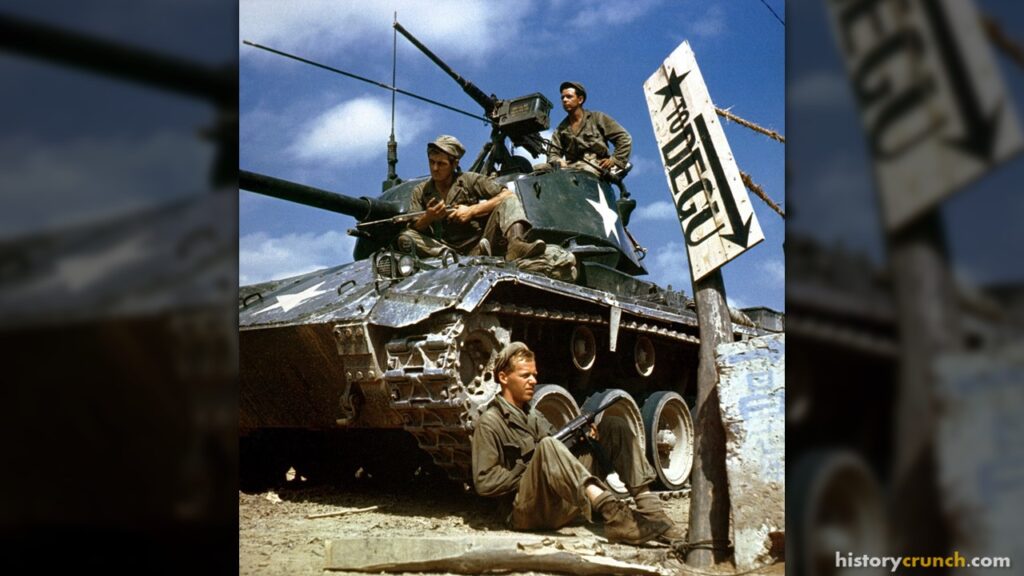
Korea became one of the first places where this rivalry turned violent. The Korean War was the first major conflict following the end of World War II and the first war of the Cold War between the United States and Soviet Union. Because both superpowers backed opposite sides, historians today consider it to be a Cold War era proxy warA conflict where two rival powers back opposite sides instead of fighting each other directly. between the United States and Soviet Union. The 38th parallel sat right in the middle of that struggle.
 FactsthatCrunch
The United States chose to send troops to Korea in 1950 to stop the spread of communism, but that choice came with serious dangers.
How Was the 38th Parallel Created?
Korea did not choose the 38th parallel for itself. Japan had ruled Korea as a colony since 1910, and when Japan collapsed at the end of World War II, someone had to decide how Japanese troops in Korea would surrender. In August of 1945, the Soviet Union had just entered the war against Japan and its army was moving quickly toward the peninsula, so American officials worried that all of Korea might fall under Soviet control.
To prevent this, two young American army officers were told to find a dividing line, and they did it in a great hurry. On August 10th, 1945, two young officers, Dean Rusk and Charles Bonesteel, were assigned to define an American occupation zone. Working on extremely short notice and completely unprepared, they used a National Geographic map to decide on the 38th parallel. The line was attractive because it split the country roughly in half while keeping the capital city of Seoul in the American zone.
The parallel was not based on geography or history. In fact, the 38th parallel followed no river or mountain range. It went indifferently through farms and villages, roads, and railroad lines. To the surprise of the Americans, the Soviet Union quickly agreed to the arrangement, and the peninsula was split into two zones of occupation, Soviet in the north and American in the south.
FactsthatCrunchWhy did Dean Rusk and Charles Bonesteel use a National Geographic map to divide Korea in 1945?
In August 1945, Rusk and Bonesteel had only about 30 minutes to propose a dividing line before a deadline, and a National Geographic map was the only map they could find quickly in the room. They chose the 38th parallel because it placed the capital, Seoul, in the American zone and split the peninsula roughly in half on the map they had. The decision was made under time pressure, not after careful study of Korean geography or politics.
How Did a Temporary Line Become a Permanent Border?
The division was meant to be short-lived, but the growing distrust of the Cold War made cooperation impossible. The United States and the Soviet Union could not agree on how to reunite Korea under a single government, and each side began building a state that reflected its own beliefs. As stated above, containment made American leaders unwilling to allow the north to spread communism south, while the Soviets refused any plan that might strengthen the west.
By the late 1940s, the two halves had gone their separate ways. By 1948, Korea had been officially split into two halves with separate governments, along the 38th parallel. In the north, a communist state took shape, while in the south a pro-western government was formed. North Korea would be led during the war by Kim Il-Sung, who ruled over the country as a dictator. South Korea would be led by President Syngman Rhee, an anti-communist statesman.
Both leaders claimed the right to rule the entire peninsula, and neither accepted the parallel as a real border. As a result, tensions along the line grew steadily. Between 1948 and 1950, the tensions between the two sides escalated until finally fighting began in 1950.
How Did the Korean War Begin at the 38th Parallel?
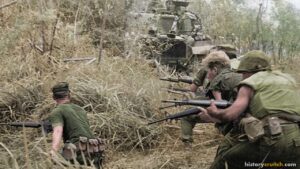
The war began with a massive invasion straight across the dividing line. On June 25th, 1950, about 75,000 North Korean soldiers moved south across most of the breadth of the 38th parallel by foot, train and Soviet tanks. Their goal was to take over American-supported South Korea. The attack was sudden and powerful, and North Korean forces pushed the South Korean army far to the south.
The invasion alarmed the United States and its allies, who saw it as communist aggression that had to be stopped. Within weeks, American troops entered the war on the side of South Korea, and they fought as part of a United Nations force. More specifically, the United Nations, led mainly by the United States, sent soldiers to defend the south and to reverse the North Korean advance.
For the rest of the war, control of the 38th parallel changed hands several times. After a bold American landing at Inchon, United Nations forces pushed the North Koreans back across the line and then drove deep into North Korea. After the outbreak of the Korean War between North and South Korea in June 1950, United Nations forces, which under U.S. Gen. Douglas MacArthur had come to the aid of the South, moved north of the 38th parallel in an attempt to occupy North Korea.
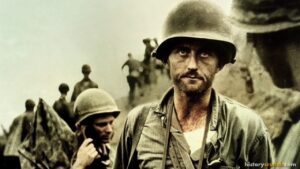
FactsthatCrunchThe U.S. Department of Defense recorded 36,574 American deaths during the Korean War, from the opening invasion on June 25th, 1950, through the armistice.
South Korea suffered even heavier losses, with United Nations Command figures recording 137,899 South Korean soldiers killed. Communist forces lost an estimated 1.1 million or more military casualties across the three years of fighting. The total death toll on all sides, military and civilian combined, is estimated at more than 2.5 million people.
Why Did the Fighting Return to the 38th Parallel?
The decision to cross north of the parallel changed the whole war. As United Nations troops moved toward the Chinese border, the People’s Republic of China warned that it would not stand by. When those warnings were ignored, China entered the war in force. As UNC troops crossed the 38th parallel, Chinese Communist Party Chairman Mao Zedong received a plea for direct military aid from Kim Il-sung. After much debate, Mao ordered the Chinese People’s Volunteers Force to cross into Korea.
The huge Chinese army pushed the United Nations forces back to the south, and the two sides ended up fighting near the same line where the war had started. With the intervention of Chinese troops in support of the North, the war came to a stalemateA situation where neither side in a conflict can win a clear victory and fighting grinds on without progress. roughly along that parallel. Neither side could win a clear victory, and the front settled into brutal, grinding combat.
Because the war had become a deadlock, both sides eventually turned to negotiations while the fighting continued. American leaders feared that pushing too hard might drag the Soviet Union into the conflict and spark a much larger war. The 38th parallel, once a quiet occupation line, had become the center of a long and costly struggle.
FactsthatCrunchIn late October 1950, United Nations forces under General Douglas MacArthur were advancing rapidly toward the Yalu River, the border between North Korea and China, expecting the Korean War to end within weeks. Chinese commanders had already sent roughly 180,000 soldiers across the Yalu River in secret, moving only at night and hiding by day to avoid aerial detection. By late November 1950, UN troops in the field were spread thin across frozen mountain terrain, and Chinese forces were about to strike in overwhelming numbers on multiple fronts at once.
How Did the 38th Parallel Change After the Armistice?
The fighting finally stopped with a cease-fire agreement rather than a true peace treaty. On July 27th, 1953, an armisticeA cease-fire agreement that stops fighting but does not officially end a war with a peace treaty. agreement brought fighting, though not the war itself, to an end in Korea. The armistice did not restore the exact 38th parallel. Instead, it froze the front line roughly where the armies stood at the moment the guns went silent.
To keep the two sides apart, a buffer zone was created along the new line. A demilitarized zoneA heavily guarded buffer strip of land created by pulling each side’s forces back 1.2 miles from the cease-fire boundary. was created by pulling back the respective forces 1.2 miles (2 km) along each side of the boundary. It runs for about 150 miles (240 km) across the peninsula, from the mouth of the Han River on the west coast to a little south of the North Korean town of Kosong on the east coast. This heavily guarded strip of land is known as the DMZ.
The new boundary was close to the old parallel but not identical to it. The cease-fire line gave South Korea possession of an eastern mountainous area north of the parallel, which was the major battlefront when the demarcation lineThe official boundary line drawn to separate two opposing sides after fighting stops. was fixed. Likewise, North Korea was given a roughly triangular portion of territory south of the 38th parallel and west of longitude 127 degrees east that includes the city of Kaesong.
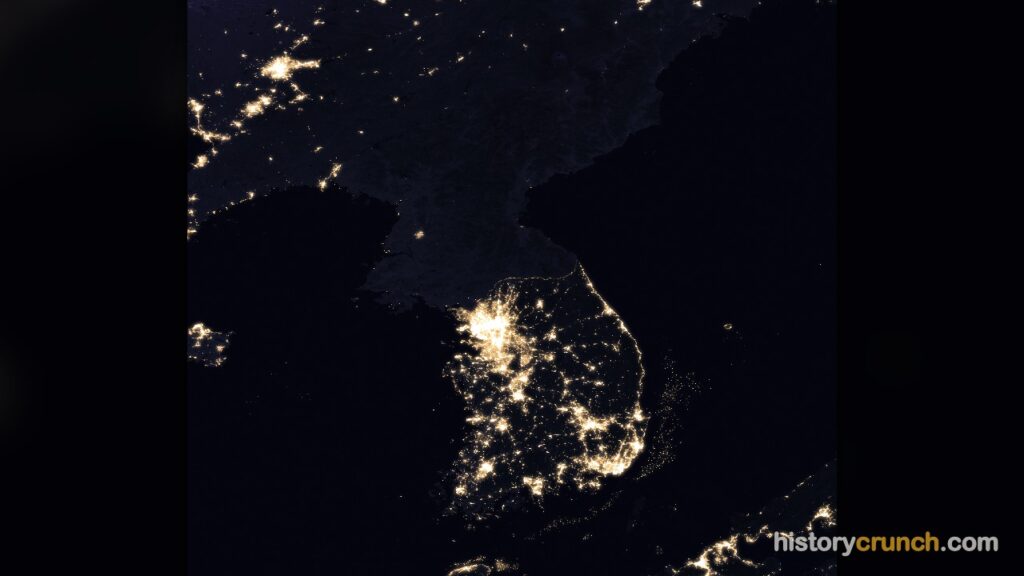
Significance of The 38th Parallel in the Korean War
The 38th parallel is significant because a line drawn in haste at the end of one war helped cause a second, far bloodier one. What began as a temporary way to organize the surrender of Japanese troops turned into the border between two rival nations, and that division became one of the sharpest fault lines of the entire Cold War.
The war fought over this line was enormously costly. The two new nations would be in a war that eventually left 3 million Koreans dead, injured, or reported missing. The conflict also drew in the United States, the Soviet Union, and China, showing how a local dispute could pull in the world’s most powerful nations.
Perhaps most importantly, the division never truly ended. Despite the armistice, both nations remain technically at war, as a formal peace treaty has never been established. Today the parallel and the DMZ near it stand as a lasting reminder of how the Cold War split one people in two, a divide that continues to affect global politics.
FactsthatCrunchIn August 1945, American planners chose the 38th parallel as a quick dividing line to split the Korean Peninsula into two occupation zones. The Soviet Union took control of the zone north of that line, and the United States took control of the zone south of it. The line was never meant to be a permanent border, but talks to reunify Korea under one government broke down by 1948.
Korea remains divided near the 38th parallel today, though the actual boundary is now the Military Demarcation Line set by the 1953 armistice agreement, which runs close to but not exactly along the original occupation line. A 2.5-mile-wide (4-kilometer-wide) strip called the Demilitarized Zone, or DMZ, runs along that line and is one of the most heavily fortified borders in the world. North Korea and South Korea still have no formal peace treaty and remain technically at war.
A boundary drawn in hours by two American Army officers in August 1945 shaped the lives of millions of Koreans for more than seventy years.
Korean War timeline · 1950 – 1953
Key Vocabulary
Containment
Proxy war
38th parallel
Armistice
Stalemate
Demilitarized zone
Demarcation line
Frequently Asked Questions
Why is it called the 38th parallel?
It is called the 38th parallel because it follows the line of latitude at 38 degrees north on a world map. Lines of latitude are imaginary circles that measure distance north or south of the equator, and this particular one happened to cut across the middle of the Korean Peninsula. American planners picked it mainly because it was easy to find on a map and split the country close to evenly.
Who decided to divide Korea at the 38th parallel?
Two junior American army officers, Dean Rusk and Charles Bonesteel, proposed the 38th parallel in August of 1945. They were given only a few hours and a National Geographic map to complete the task. Their recommendation was approved by top American officials and then accepted by the Soviet Union, which controlled the northern zone.
Is the 38th parallel the same as the DMZ?
No, the 38th parallel and the DMZ are not exactly the same. The 38th parallel is a straight line of latitude, while the Demilitarized Zone follows the twisting front line where the armies stopped fighting in 1953. In some places the DMZ sits north of the parallel and in others it sits south of it, so the two lines only roughly match.
Did crossing the 38th parallel change the Korean War?
Yes, crossing the 38th parallel dramatically changed the course of the war. When United Nations forces pushed north past the line, China felt threatened and entered the conflict with a massive army. This intervention turned an American advance into a long stalemate and greatly lengthened the war.
Why are North and South Korea still divided today?
North and South Korea are still divided because the Korean War ended in a cease-fire, not a peace treaty. The 1953 armistice halted the fighting but left the two governments deeply hostile and technically still at war. Decades of Cold War tension, plus very different political and economic systems, have kept the two nations apart ever since.
Cite This Article
To cite this article as a source, use one of the formats below.
MLA: Millar, B. “The 38th Parallel in the Korean War: A Detailed Summary.” HistoryCrunch, 15 August 2026, https://historycrunch.com/38th-parallel-in-the-korean-war/.
APA: Millar, B. (2026). The 38th Parallel in the Korean War: A Detailed Summary. HistoryCrunch. https://historycrunch.com/38th-parallel-in-the-korean-war/
Chicago: Millar, B. “The 38th Parallel in the Korean War: A Detailed Summary.” HistoryCrunch. August 15, 2026. https://historycrunch.com/38th-parallel-in-the-korean-war/
Sources
- Max Hastings, The Korean War.
- Wilson Center Digital Archive
- Truman Presidential Library
- Sheila Miyoshi Jager, Brothers at War: The Unending Conflict in Korea.