Work was the foundation of daily life in the Middle Ages, and it shaped almost everything about medieval European society, from where people lived to the class they belonged to. The Middle Ages, also called the Medieval Period, lasted from roughly the 5th century to the 15th century, and during this long stretch of time the vast majority of people spent their lives laboring to produce food, goods, and services. Most work was tied to the land through the feudal systemA way of organizing society where kings gave land to nobles, who gave land to knights, in exchange for loyalty and military service. and the Manor System, while over time trade and crafts created new kinds of work in growing towns and cities.
In simple terms, work in the Middle Ages meant the physical and skilled labor that people performed to survive and to meet the obligations they owed to those above them in society. For most people this meant farming the land, but it also included the specialized trades of craftsmen, the buying and selling done by merchants, the copying of texts done by monks, and the many services owed by peasants to their lords. Because society was so rigidly divided, the kind of work a person did was usually decided by the class they were born into rather than by choice.
 FactsthatCrunch
How did medieval work differ across the main social groups of the Middle Ages?
What Were the Middle Ages?
The Middle Ages were the long period in European history that followed the fall of the Western Roman Empire in 476 CE and lasted until roughly the beginning of the Renaissance in the 15th century. Historians usually divide the era into three parts: the Early Middle Ages, the High Middle Ages, and the Late Middle Ages. Each of these periods had its own patterns of work, but throughout all of them agriculture remained the single most important activity.
After the collapse of Roman rule, much of Europe lost its strong central government, and people began turning to local noble lords for protection. This gave rise to feudalism, a system of government in which society was structured in a very rigid and hierarchical way, with kings, nobles, and lords at the top and peasants at the bottom. Feudalism was closely tied to the Manor System, and together these two systems organized how nearly everyone in medieval Europe lived and worked.
During the Early Middle Ages, almost all work took place in the countryside on rural estates. As the centuries passed and the High Middle Ages began in the 11th century, towns and trade grew rapidly, and new kinds of work appeared. As such, the story of work in the Middle Ages is also the story of how European society slowly changed from a purely rural, farming world into one that included busy towns full of craftsmen and merchants.
How Did the Feudal System Organize Work?
Feudalism was the framework that shaped most work in the Middle Ages. Under this system, a king granted large areas of land to powerful nobles in exchange for their loyalty and military service. These nobles, in turn, granted portions of their land to lower lords and knights, who were expected to provide soldiers for the king’s armies when called upon.
At the very bottom of this hierarchy were the peasants, who made up the overwhelming majority of the population. In fact, peasants worked the land in exchange for protection from their local lord. This exchange of labor for safety and the right to live on the land was the basic bargain that held feudal society together for hundreds of years.
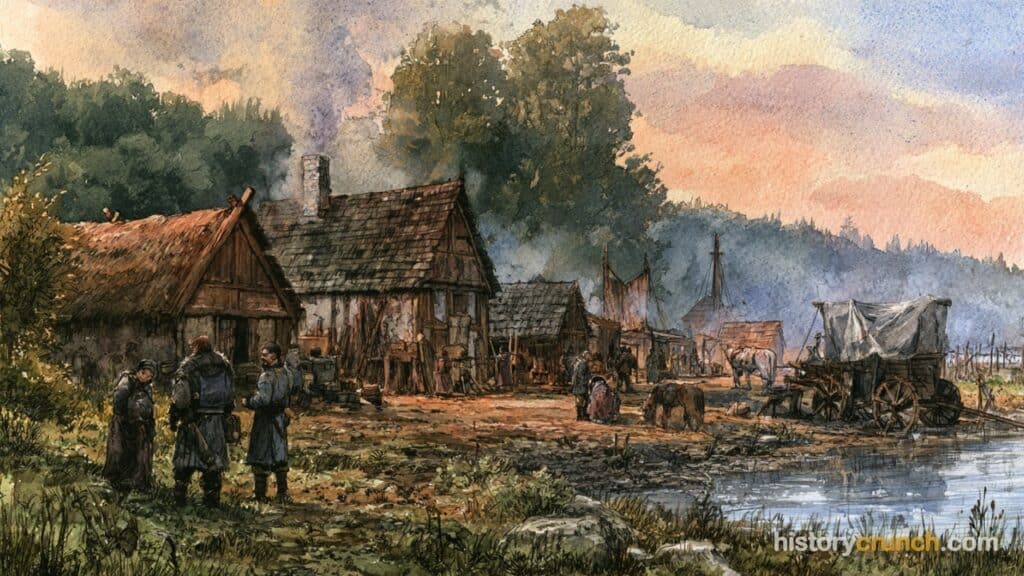
The place where this work happened was the manor, which formed the basic unit of European society at the time. A manor was a large estate controlled by a lord, and it usually included farmland, a village, a church, and the lord’s manor house or castle. Within this small world, nearly every kind of work needed for survival was carried out by the people who lived there.
FactsthatCrunchWhat did a medieval peasant get in return for working a lord's land?
What Work Did Peasants and Serfs Do?
The great majority of medieval workers were peasants, and most of these were serfsPeasants who were legally tied to a lord’s land and could not leave the manor without permission.. Serfdom is the term used to describe the social status of most peasants under feudalism in the Middle Ages. Serfs were not slaves, but they were not free either, because they were bound to the land of their lord and could not simply leave the manor whenever they wished.
Farming was the foundation of the medieval economy and the main source of food and income for most people in Europe. Serfs spent much of the week working the lord’s fields, and they were also allowed to farm strips of land for their own families. Beyond farming, serfs were required to do other work as needed, including constructing roads, working in mines, and completing tasks in the forests.
Farming work followed the rhythm of the seasons and was extremely labor intensive, requiring the participation of the entire family, including women and children. For instance, during the harvest season all members of a peasant family would work long hours in the fields to bring in the crops before the weather turned. During harvest, all members of the community worked together to bring in the crops as quickly as possible before bad weather could damage them, while winter was a quieter time when there was less to do in the fields.
Much of this farming was done through the open field systemA farming method where village land was split into large fields, each divided into strips shared among peasant families., the most common method of organizing agricultural land in medieval Europe, particularly in England, France, and Germany. Under this system, the farmland surrounding a village was divided into large open fields, which were then divided into long narrow strips. Each peasant family was assigned a number of these strips spread across the different fields, which meant that the quality of the land was shared more evenly among the peasants of the village.
Peasants used simple tools to do their work, most of them made by local blacksmiths. Other important farming tools included scythes and sickles for harvesting grain, hoes and rakes for tending crops, and flails for threshing grain after the harvest. In addition to their labor, peasants often owed a titheA tax of one-tenth of a peasant’s produce owed to the Church each year., which was a tax of one-tenth of their produce paid to the Church.
FactsthatCrunchMany people think medieval serfs were the same as slaves.
Serfs were not slaves, but they were not free either. They were bound to their lord's land and could not leave the manor without permission. They worked the lord's fields much of the week, farmed small strips for their own families, and also built roads, worked in mines and cut timber when the lord required it.
What Work Was Done in Medieval Towns?
While most people in Europe lived in the countryside during the early part of the Middle Ages, towns grew significantly in size and importance during the High Middle Ages, particularly from the 11th century onward. Medieval towns and cities became important centers of trade, craftsmanship, and community, and they offered ordinary people opportunities that were not available to them in the feudal countryside. This growth of towns created many new kinds of work that had little connection to farming.
As trade grew during the High Middle Ages, merchants became increasingly powerful and wealthy members of medieval society. In many towns the wealthiest merchants came to dominate local government and sat on town councils or held the position of mayor. This was a significant change from the feudal world of the countryside, where power was held by nobles and lords.
One of the most important features of medieval town life was the system of guildsOrganizations of craftsmen or merchants that regulated their trade, protected members, and controlled the quality of goods.. Guilds were organizations of craftsmen or merchants that worked together to regulate their trade, protect their members, and maintain the quality of goods produced or sold in the town. In fact, there were two main types of guilds in medieval towns: merchant guilds and craft guilds.
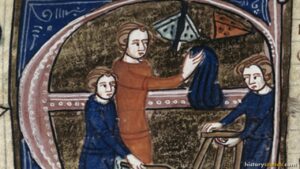
Craft guilds trained new workers through a careful system that allowed skills to be passed down over time. A young person would begin as an apprenticeA young person who lived with and learned a trade from a skilled master craftsman., learning a trade from a master, then become a journeymanA guild worker who had finished apprenticeship and worked for wages before becoming a master. who worked for wages, and finally, if successful, become a master craftsman with a workshop of his own. Common town trades included weavers, dyers, masons, bakers, leatherworkers, blacksmiths, and shoemakers, and each craft had its own guild to set standards and prices.
FactsthatCrunchWhat three stages did a medieval craftsman pass through to become a full member of a craft guild?
Tap a point to read its detail.
Who Else Worked in Medieval Society?
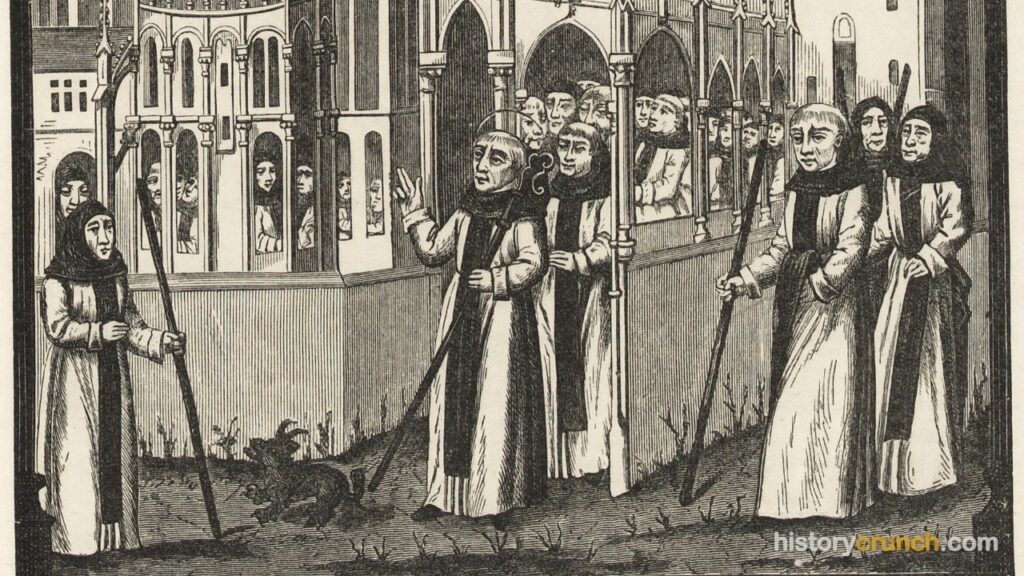
Not all medieval work was farming or crafts. The Catholic Church was one of the most powerful forces in the Middle Ages, and a great deal of important work was done by its clergy. More specifically, monasteries were among the most important centers of learning, and the monks who lived there devoted significant time to copying and preserving ancient texts by hand.
This work was enormously important because it helped keep alive the knowledge of ancient Greek and Roman writers, philosophers, and scientists that might otherwise have been lost during the turbulent centuries of the Early Middle Ages. In this way, the labor of monks preserved learning for future generations. Priests, nuns, and other members of the clergy also cared for the sick and poor, ran schools, and provided spiritual services to their communities.
Women worked in every part of medieval society, though their labor was often unpaid and overlooked. Peasant women worked in the fields alongside men, tended gardens and small livestock, made cloth, prepared food, and raised children. In towns, women often helped run family workshops and businesses, and some belonged to guilds in their own right.
How Did Work Change in the Late Middle Ages?
The Late Middle Ages, lasting from the start of the 14th century to the end of the 15th century, brought major changes to how people worked. The most important of these was the Black Death, a terrible plague that killed a large share of Europe’s population. With so many workers gone, those who survived found their labor was suddenly much more valuable than before.
As a result, the Black Death had significantly weakened the feudal system by giving peasants more bargaining power than they had previously held. Many peasants were now able to demand wages for their work or to move to towns in search of better opportunities. Serfdom became increasingly rare as a social system through both the Black Death and the Renaissance in the 14th and 15th centuries.
The growth of towns and trade during the High Middle Ages had also created a new class of merchants and craftsmen who did not fit neatly into the old feudal hierarchy. In reality, these changes slowly moved Europe away from a world where work was tied to the land and toward one where more work was based on wages and trade. By the end of the Middle Ages, the old feudal patterns of work were fading, setting the stage for the very different economy of the modern era.
Significance of Work in the Middle Ages
Work in the Middle Ages is one of the most important topics for understanding medieval Europe, because labor touched every part of society and defined where a person stood within it. The endless work of peasants and serfs produced the food that fed everyone, from the poorest villager to the most powerful king. Without this constant farming, no other part of medieval society could have survived.
The rise of new kinds of work also helped bring the Middle Ages to an end and shape the world that followed. The growth of towns, trade, and guilds created a wealthy middle class that gradually weakened feudalism and pointed toward a modern economy based on business and wages. As such, studying medieval work reveals how a society organized itself, how ordinary people lived, and how the slow changes in labor over many centuries helped transform Europe.
FactsthatCrunchHow did work tied to the land differ from work based on wages and trade in the Middle Ages?
Key Vocabulary
Feudal system
Serfs
Open field system
Tithe
Guilds
Apprentice
Journeyman
Frequently Asked Questions
What kind of work did most people do in the Middle Ages?
Most people in the Middle Ages worked as farmers on the land of a lord. It is estimated that around nine out of every ten people lived in the countryside and spent their days growing crops and raising animals. Only a small minority worked as nobles, clergy, merchants, or town craftsmen.
What is the difference between a serf and a peasant?
A peasant was any member of the lower rural class, while a serf was a specific type of peasant who was bound to the land. Not all peasants were serfs, because some were free peasants who rented land and could move about more freely. Serfs, by contrast, could not leave the manor without their lord’s permission and owed heavy labor obligations.
How did someone become a master craftsman in a guild?
A person became a master craftsman by moving through three stages of training over many years. He would first serve as an apprentice, living with and learning from a master, and then work as a paid journeyman to gain experience. Finally, he could produce a high-quality piece of work, sometimes called a masterpiece, to prove his skill and earn the rank of master.
Did children work during the Middle Ages?
Yes, children in the Middle Ages worked from a very young age. On farms, children helped with tasks such as tending animals, gathering firewood, chasing birds from crops, and helping bring in the harvest. In towns, children of craftsmen often began learning their family’s trade as soon as they were old enough to be useful.
How many hours a day did medieval workers work?
Medieval workers usually labored from sunrise to sunset, so their hours changed with the seasons. Days were long during the busy planting and harvest times but much shorter in winter. The Church calendar also provided many feast days and holy days when work stopped, giving medieval workers a fair amount of rest across the year.
Cite This Article
To cite this article as a source, use one of the formats below.
MLA: Millar, B. “Work in the Middle Ages: A Detailed Summary.” HistoryCrunch, 26 July 2026, https://historycrunch.com/work-in-the-middle-ages/.
APA: Millar, B. (2026). Work in the Middle Ages: A Detailed Summary. HistoryCrunch. https://historycrunch.com/work-in-the-middle-ages/
Chicago: Millar, B. “Work in the Middle Ages: A Detailed Summary.” HistoryCrunch. July 26, 2026. https://historycrunch.com/work-in-the-middle-ages/
Sources
- Barbara Rosenwein, A Short History of the Middle Ages.
- Fordham Medieval Sourcebook
- Chris Wickham, Medieval Europe.
- Jacques Le Goff, Medieval Civilization 400-1500.