The Marquis de Lafayette was a French aristocratA member of the highest social class, usually born into a noble family with wealth and inherited titles. who crossed the Atlantic at 19 years old to fight for American independence and became one of the most important foreign officers in the Revolutionary War. Born on September 6th, 1757, in Chavaniac, France, and dying on May 20th, 1834, in Paris, Lafayette served with distinction under George Washington, helped secure the French alliance that proved essential to winning the war, and played a key role in the Virginia campaign that ended at Yorktown in 1781. He later became a leading figure in the French Revolution. He is remembered in both France and the United States as the Hero of Two Worlds.
 FactsthatCrunch
Lafayette commanded roughly 3,000 American troops in Virginia against a larger British force under Lord Cornwallis, using careful movement to keep Cornwallis pinned at Yorktown until Washington and Rochambeau arrived with the main allied army. He also worked with Thomas Jefferson to help draft the Declaration of the Rights of Man and of the Citizen in 1789, carrying principles from the American Revolution into the French Revolution.
Marquis de Lafayette – Early Life
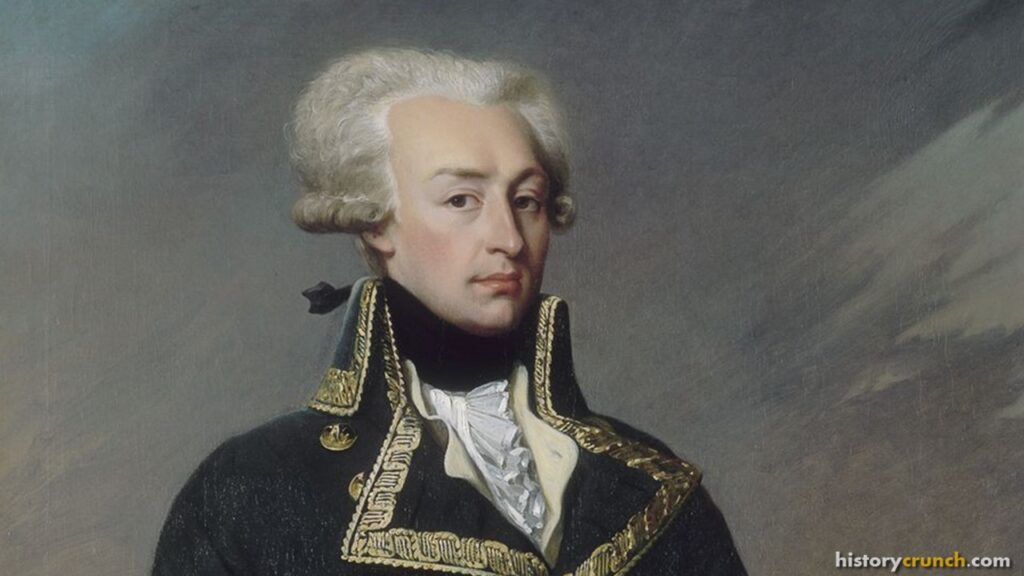
Lafayette’s full name was Marie-Joseph Paul Yves Roch Gilbert du Motier de Lafayette. He was born on September 6th, 1757, into one of the oldest and wealthiest noble families in France, at the family’s chateau in the Auvergne region of central France. His father, a colonel of grenadiers, was killed by a British cannonball at the Battle of Minden in 1759 during the Seven Years’ War, when Lafayette was just two years old. His mother died when he was thirteen. By the time he was a teenager, Lafayette had inherited an enormous fortune and was one of the richest young men in France.
He received a military education and was given a commissionAn official rank granted to an officer in a military force, authorizing them to lead soldiers. in the King’s Musketeers at age fourteen. At sixteen he married Adrienne de Noailles, the daughter of a powerful French duke, a union that brought him into some of the most influential social circles in France. In 1775, at a dinner in Metz, Lafayette heard the Duke of Gloucester, the younger brother of British King George III, mock the American colonists for believing in equality and the right of the people to govern themselves. The speech had the opposite effect from what the Duke intended. Lafayette later wrote in his memoirs that at that moment his heart was committed and he thought only of joining the American cause.
FactsthatCrunchIn 1775, nineteen-year-old Marie-Joseph Lafayette attended a dinner in Metz, France, where William Henry, Duke of Gloucester and younger brother of King George III, mocked the American colonists for believing in equality and the right of people to govern themselves. Lafayette, already a trained officer from one of France's wealthiest noble families, sat and listened as the Duke dismissed the colonial cause. Now Lafayette faced a choice about what to do with the anger and conviction the speech had lit in him.
Marquis de Lafayette – Coming to America
Lafayette made up his mind to go to America and fight for independence, despite a royal decree from King Louis XVI forbidding French officers from doing so. He paid for a ship out of his own pocket, naming it the Victoire, and sailed for America in April of 1777 at the age of 19. The crossing took 54 days. Lafayette used the time to study English.
When he arrived in Philadelphia in July of 1777, Congress was reluctant to give him a commission. The Americans had grown tired of French volunteers who arrived expecting high ranks without having proven themselves in battle. Lafayette offered to serve without pay and to start as a volunteer. His sincerity and clear commitment to the cause won Congress over, and on July 31st, 1777, he was commissioned a major general in the Continental Army. Congress initially intended the commission to be largely honoraryGiven as a title or rank without the full duties or responsibilities normally attached to it., but Lafayette had no intention of staying out of the fighting.
FactsthatCrunchIn July of 1777, Congress debated whether to give the young French volunteer Lafayette a military commission in the Continental Army.
Marquis de Lafayette – Service in the Revolutionary War
Lafayette met George Washington in Philadelphia in August of 1777, and the two men formed an immediate bond. Washington was struck by Lafayette’s genuine belief in the cause and his willingness to serve without pay or special treatment. The relationship that developed between the two men over the course of the war became one of the closest personal bonds of the Revolution. Washington, who had no children of his own, came to think of Lafayette almost as a son. Lafayette felt the same way about Washington.
Lafayette first saw combat at the Battle of Brandywine on September 11th, 1777. During the fighting, he was shot through the leg by a sniper but stayed on his horse and helped organize a retreat that prevented the American right flank from collapsing completely. He spent several weeks recovering from his wound before returning to duty. That winter he stayed with Washington’s army at Valley Forge, sharing the terrible conditions of the camp and becoming one of Washington’s strongest defenders during the difficult months of disease, cold, and short supplies.
In the spring of 1778, Lafayette commanded American forces at the Battle of Barren Hill, Pennsylvania, where British General Howe sent a large force to trap him. Lafayette skillfully withdrew his 2,200 men through a back road just ahead of the British, avoiding capture and bringing his troops safely back to Valley Forge. His handling of the retreat earned praise from Washington and Congress.
In 1778, after the French alliance was formalizedMade official through an agreed and recognized process, such as a signed treaty., Lafayette returned to France on leave. He was given a hero’s welcome by the French public and worked closely with Benjamin Franklin to push the French government to commit more troops and ships to the American cause. He successfully helped secure the commitment of 6,000 French soldiers under General Rochambeau, a contribution that proved vital in the war’s final stage. He returned to America in April of 1780 with the news, boosting morale across the Continental Army.
FactsthatCrunchHow Big Was the Battle of Brandywine, Where Lafayette Was Wounded on September 11th, 1777?
The Battle of Brandywine on September 11th, 1777, was the largest single-day battle of the American Revolution, with roughly 30,000 soldiers fighting across a ten-square-mile area in southeastern Pennsylvania. Lafayette was shot through the leg while helping rally the American right flank, which faced Cornwallis's column of about 9,000 men alone. He stayed in the saddle and helped organize the retreat to Chester, keeping the army intact despite the defeat.
Marquis de Lafayette – The Virginia Campaign and Yorktown
When Lafayette came back to America in 1780, the main fighting had shifted to the south. In early 1781, Washington sent Lafayette to Virginia with a force of roughly 3,000 men to contain the British forces under Lord Cornwallis, who had been raiding the state and causing widespread destruction. It was a difficult assignment. Cornwallis commanded a force significantly larger than Lafayette’s, and for several months the young French general had to rely on speed and careful movement to keep the British from destroying his army while also keeping pressure on them.
Lafayette managed the campaign skillfully, staying close enough to Cornwallis to keep him from moving freely but never giving the British a clean chance to destroy his force. When Cornwallis settled his army at Yorktown in August of 1781, Lafayette helped seal off the land routes to prevent the British from escaping while the French fleet under Admiral de Grasse moved to cut off the sea route. When Washington and Rochambeau arrived with the main allied force in September, Lafayette’s army formed part of the siege lines that surrounded Yorktown on three sides.
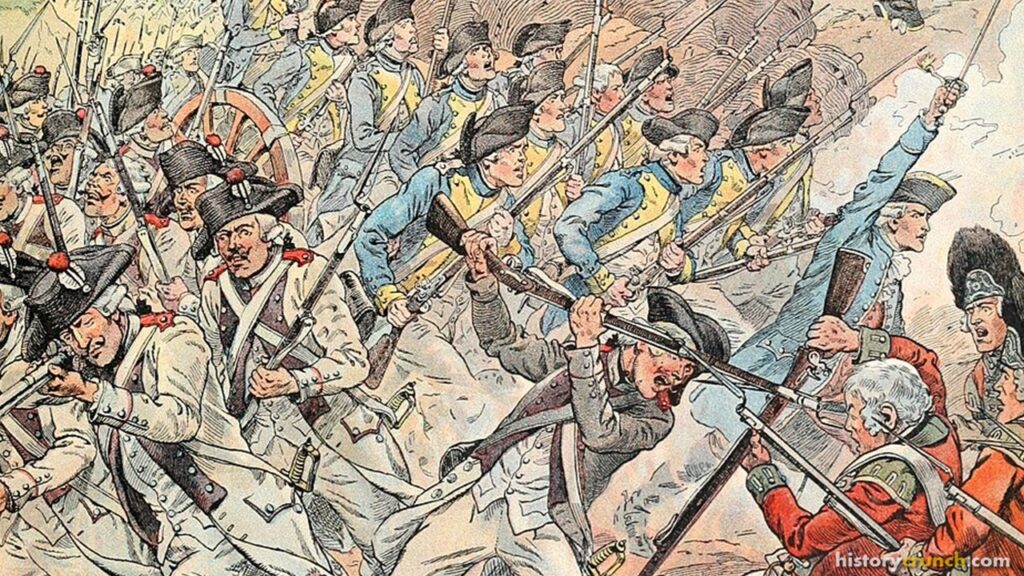
On the night of October 14th, 1781, Lafayette commanded the American forces that stormed and captured British Redoubt 10, one of two key defensive positions taken that night in coordinated assaults. The loss of the redoubts broke the British position. Cornwallis surrendered on October 19th, 1781, ending the last major battle of the war. Lafayette returned to France in December of 1781 to a rapturous welcome, celebrated as a hero who had helped the Americans win their independence.
Marquis de Lafayette – The French Revolution
When the French Revolution began in 1789, Lafayette stepped into one of the most dangerous political situations in modern history. He was elected to the Estates-General, the body that would eventually transform into the National Assembly, and became one of the most powerful men in France during the early years of the revolution. He was appointed commander of the Paris National Guard, the force responsible for keeping order in the capital, and worked to try to steer the revolution toward a constitutional monarchyA system of government where a king or queen rules but is limited by a constitution and elected representatives. rather than the radical change that more extreme factions wanted.
Working with Thomas Jefferson, who was then serving as American ambassador to France, Lafayette helped write the Declaration of the Rights of Man and of the Citizen, adopted in August of 1789. The document drew directly on the American Declaration of Independence and established the basic principles of individual rights and the limits of government power that would guide the French republic. Lafayette also sent the key to the Bastille, the notorious French prison stormed by a crowd on July 14th, 1789, to George Washington as a symbol of the end of tyranny in France. The key remains on display at Mount Vernon today.
As the revolution grew more violent, Lafayette’s position became increasingly difficult. He tried to protect the royal family and resist the most extreme revolutionary factions, but both the royalists and the radicals came to see him as the enemy. In August of 1792, radical factions ordered his arrest. He fled France and crossed into the Austrian Netherlands, where he was captured by Austrian troops and spent more than five years in prison. His wife Adrienne was arrested in France, where most of her family was executed during the Reign of Terror. She survived and was eventually freed through the efforts of the American ambassador to France, James Monroe, and his wife Elizabeth. Lafayette was released in 1797 after Napoleon Bonaparte helped secure his freedom.
Lafayette sent the key to the Bastille to George Washington as a symbol of the end of tyranny in France, and it remains on display at Mount Vernon today.
Marquis de Lafayette – Later Life and Death
Lafayette returned to France after his release but refused to take part in Napoleon’s government, believing Napoleon’s rule was not genuinely democratic. He lived quietly for several years before returning to political life after Napoleon’s fall. He served in the French Chamber of Deputies and continued to speak out for individual rights and against slavery.
In 1824, President James Monroe invited Lafayette to visit the United States as the guest of the nation, in honor of the fiftieth anniversary of the American Revolution. Lafayette spent thirteen months visiting all 24 states in the Union, receiving enormous and emotional welcomes everywhere he went. An estimated 50,000 people greeted him when he arrived in New York. He was the first foreign dignitaryA person who holds a high rank or important position and is treated with special honor. ever to address a joint session of Congress. He visited the graves of Washington and Jefferson, and made a final visit to the aging James Madison and James Monroe in Virginia. He returned to France in September of 1825 aboard a frigate the United States had named the Brandywine in his honor, a reference to the battle where he had been wounded in 1777.
Lafayette died on May 20th, 1834, in Paris, at the age of 76. He was buried at the Picpus Cemetery in Paris under soil brought from Bunker Hill, the site of one of the first battles of the American Revolution. His son Georges Washington Lafayette, named after his closest friend, stood at his graveside. The torch placed at his grave in 1934 by American soldiers on the 150th anniversary of his first visit to the United States burns to this day.
FactsthatCrunchOn May 22nd, 1834, Lafayette was buried at Picpus Cemetery in Paris under soil brought from Bunker Hill, the Massachusetts battlefield where American forces first stood against the British in 1775. His son Georges Washington Lafayette stood at the graveside. The burial united two countries in a single act: a French general laid to rest beneath American earth.
On July 4th, 1934, American soldiers placed a torch at Lafayette's grave to mark the 100th anniversary of his death, and that flame has burned ever since. Each year, American military and diplomatic personnel visit Picpus Cemetery to honor the grave. The site remains one of the few places outside the United States where American soil is permanently kept as a memorial.
A handful of Bunker Hill soil and a century-old flame together show how seriously both nations have treated the bond Lafayette helped build.
Significance of the Marquis de Lafayette
Lafayette’s significance in the American Revolution rests on several things working together. His arrival in 1777 as a wealthy young French nobleman willing to fight for American independence gave the Continental Army a morale boost and brought the cause international attention at a critical time. His close relationship with Washington gave him influence that he used well, both on the battlefield and in pushing the French government to commit fully to the alliance. His management of the Virginia campaign in 1781 helped trap Cornwallis at Yorktown, and his role in the assault on Redoubt 10 was part of the final push that ended the war.
Beyond the battlefield, Lafayette embodied the idea that the American Revolution was part of a larger global movement for human rights and self-government. His work on the Declaration of the Rights of Man helped carry the ideas of the American Revolution into France and beyond. His opposition to slavery, his defense of religious minorities, and his support for revolutionary movements in other countries throughout his long life reflected a genuine and consistent belief in the principles he had first fought for as a teenager in the fields of Pennsylvania and Virginia. He remains one of the most admired figures in the history of both the United States and France.
FactsthatCrunchDuring his 1779 leave in France, Lafayette worked with Benjamin Franklin to pressure the French government into committing 6,000 soldiers under General Rochambeau to the American war effort.
Lafayette returned to America in April of 1780 carrying the news of the French troop commitment, which lifted morale across the Continental Army. The political work he did in Paris in 1778, lobbying French ministers alongside Franklin, directly shaped the military outcome at Yorktown three years later.
American Revolution timeline · 1775 – 1783
Key Vocabulary
Commission
Honorary
Formalized
Constitutional monarchy
Reign of Terror
Dignitary
Frequently Asked Questions
Why did Lafayette come to America to fight?
Lafayette came to America because he believed in the colonists’ right to govern themselves. He first felt drawn to the cause in 1775, after hearing a British royal mock the American colonists at a dinner. He defied a royal order, bought his own ship, and sailed for America in 1777 at age 19.
What was Lafayette’s relationship with George Washington?
Lafayette and Washington formed one of the closest bonds of the Revolution, almost like father and son. They met in Philadelphia in August of 1777 and quickly grew to trust each other. Washington had no children of his own, and Lafayette later named his son Georges Washington Lafayette.
What did Lafayette do at Yorktown?
Lafayette helped trap Lord Cornwallis at Yorktown during the war’s final campaign. In 1781 he shadowed the larger British force in Virginia and then sealed off land routes at Yorktown. On October 14th, 1781, he led the American troops who stormed and captured British Redoubt 10.
What role did Lafayette play in the French Revolution?
Lafayette was a leading figure in the early French Revolution and commanded the Paris National Guard. Working with Thomas Jefferson, he helped write the Declaration of the Rights of Man in 1789. He tried to steer France toward a constitutional monarchy, but radicals later ordered his arrest in 1792.
Why is Lafayette called the Hero of Two Worlds?
Lafayette is called the Hero of Two Worlds because he fought for freedom in both America and France. He helped the Americans win independence and helped spread those same ideas across the Atlantic. He is still honored in both countries as a champion of individual rights.
What happened to Lafayette later in life?
Lafayette returned to French politics after Napoleon’s fall and spoke out against slavery. In 1824 President James Monroe invited him to tour the United States as the guest of the nation. He visited all 24 states over thirteen months, then died in Paris on May 20th, 1834.
Cite This Article
To cite this article as a source, use one of the formats below.
MLA: Millar, B. “Marquis de Lafayette: A Detailed Biography.” HistoryCrunch, 22 September 2026, https://historycrunch.com/marquis-de-lafayette/.
APA: Millar, B. (2026). Marquis de Lafayette: A Detailed Biography. HistoryCrunch. https://historycrunch.com/marquis-de-lafayette/
Chicago: Millar, B. “Marquis de Lafayette: A Detailed Biography.” HistoryCrunch. September 22, 2026. https://historycrunch.com/marquis-de-lafayette/
Sources
- Yale Avalon Project
- Robert Middlekauff, The Glorious Cause.
- National Archives — Founders Online
- Bernard Bailyn, The Ideological Origins of the American Revolution.