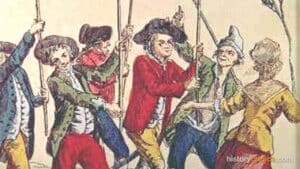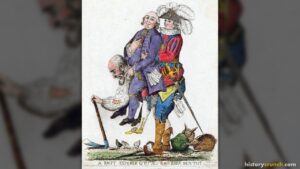
The sans-culottesTight, knee-length silk breeches worn by nobles and the wealthy in France. were one of the most important groups of the French Revolution, and their pressure helped push the revolution from a movement for reform into a radical fight for equality. The name sans-culottes was French for “without breeches,” and it referred to the ordinary working people of France’s cities, especially Paris. These were the shopkeepers, artisansSkilled workers who make goods by hand, such as cobblers, tailors, or blacksmiths., craftsmen, and laborers who wore long trousers instead of the fine knee-length silk breeches, called culottes, worn by the nobility and the wealthy. During the revolution, this simple difference in clothing became a proud symbol of the common people and their demand for a fairer society.
In simple terms, the sans-culottes were not a formal political party with rules and members. Instead, they were a loose movement of city workers who shared common goals, including social equality, economic fairness, and popular democracy in which ordinary people had a real voice. They gathered in local meetings and political clubs, took to the streets in mass protests, and were willing to use force to defend the revolution and push it further.
 FactsthatCrunch
What were the main groups within the Third Estate that made up the sans-culottes?
What Was the French Revolution?
The French Revolution was a major period of political and social change in France that began in 1789 and lasted until the late 1790s. During this time, the French people overthrew their absolute monarchy and worked to build a republic based on the ideas of liberty, equality, and fraternity. It was one of the most important events in the history of Western societies, and it changed the way people around the world thought about government and the rights of citizens.
Before the revolution, France was ruled by an absolute monarch, King Louis XVI, and its society was divided by the Estates SystemFrance’s official division of society into three groups, with the clergy first, nobles second, and everyone else third.. Under this system, the First Estate was the clergy, the Second Estate was the nobility, and the Third Estate included everyone else, from wealthy merchants down to the poorest peasants and city workers. The first two estates enjoyed great privileges and paid few taxes, while the Third Estate carried the heaviest tax burden and had little political power. This deep inequality, combined with Enlightenment ideas, economic crisis, and food shortages, helped spark the revolution in 1789. You can read more about it in the causes of the French Revolution.
Who Were the Sans-culottes?
The sans-culottes were the working people of France’s cities, and they belonged to the Third Estate. More specifically, their ranks were filled with small shopkeepers, artisans, skilled craftsmen, and those who did heavy manual labor for a living. Over time, their numbers were also joined by small landowners and other ordinary people who supported the goals of the revolution.
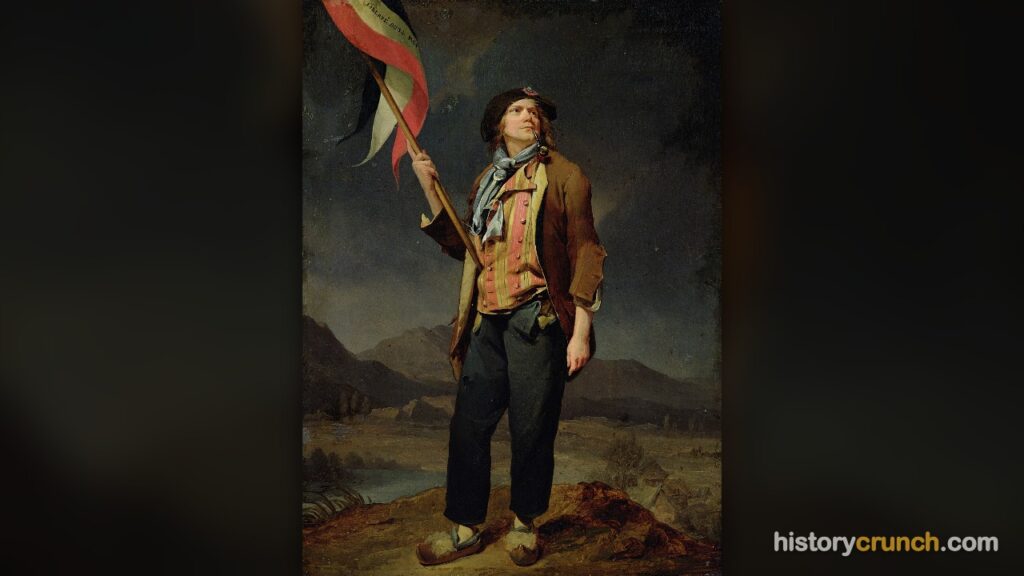
As stated above, the name came from their clothing. The word culottes referred to the tight, knee-length silk breeches worn by nobles and the rich. By choosing to wear plain long trousers instead, working people set themselves apart from the upper classes. In fact, the term was first used in a mocking way, but the sans-culottes turned it into a badge of honor and pride.
Their appearance became easy to recognize during the revolution. Along with their long trousers, the typical sans-culotte wore a short jacket called a carmagnoleA short jacket worn by sans-culottes that became a recognized symbol of the revolution. and a soft red cap known as the cap of libertyA soft red cap worn by sans-culottes to show loyalty to the revolutionary cause of the common people.. These items became powerful symbols of the revolution itself. For instance, revolutionaries sometimes forced others to wear the red cap to show their loyalty to the cause of the common people.
FactsthatCrunchThe term 'sans-culottes' was originally used as a mocking label before working people turned it into a badge of pride.
What Did the Sans-culottes Believe?
The political beliefs of the sans-culottes were based mainly on three ideas: social equality, economic equality, and popular democracy. They wanted to do away with the special privileges of the nobility and the clergy once and for all, and they dreamed of a republic in which all citizens were treated as equals. In reality, they had spent their whole lives at the bottom of the Estates System, and they wanted a society that no longer looked down on ordinary workers.
The sans-culottes also cared deeply about the price of bread and other basic goods. As city workers, they were hit hardest by rising prices and food shortages, so they demanded that the government set fair prices and make sure the poor could afford to eat. This concern for daily survival made their politics very direct and personal, and it often pushed them toward more radical demands than wealthier revolutionaries were willing to accept.
To act on these beliefs, the sans-culottes gathered in political clubs and local assemblies in Paris. There, ordinary people could debate the most pressing issues of the day and organize action. In this way, the movement gave a political voice to the masses who had been shut out of power for so long.
FactsthatCrunchWhat did the sans-culottes believe in during the French Revolution?
The sans-culottes held four core beliefs: social equality, economic fairness, popular democracy, and the right to use direct action to defend the revolution. They wanted to end the special privileges of the nobility and clergy, and they demanded that the government set fair prices for bread and basic goods so that ordinary workers could afford to eat. They also believed that common people should have a real voice in politics, gathering in local clubs and assemblies in Paris to debate issues and organize action.
How Did the Sans-culottes Influence the Revolution?
The sans-culottes shaped the French Revolution through direct action in the streets of Paris. They were the crowds who stormed the Bastille fortress in July of 1789, an event that many people consider the true start of the revolution. Their willingness to rise up in large numbers made them a force that the leaders of France could not ignore.
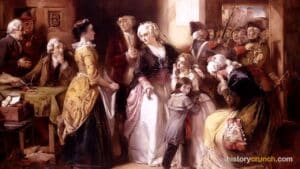
In October of 1789, crowds of ordinary Parisians, many of them women, marched all the way to the royal palace at Versailles. They forced the royal family to return with them to Paris, where the king could be watched more closely. This showed how the power of the common people could pressure even the monarchy itself.
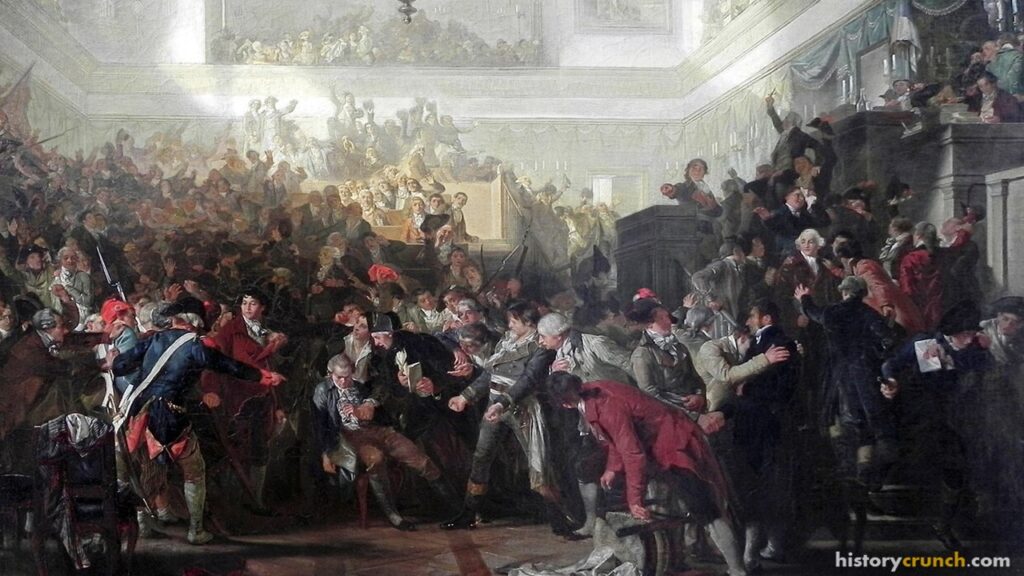
The height of the movement’s influence came between 1792 and 1794, the most radical years of the revolution. In August of 1792, sans-culottes and other insurgentsPeople who rise up violently against those in power. attacked the royal palace and helped bring an end to the monarchy. Soon afterward, France was declared a republic. More specifically, their constant pressure pushed the revolution in an ever more radical direction, demanding harsher action against anyone seen as an enemy of the people.
FactsthatCrunchSans-culottes and the Reign of Terror
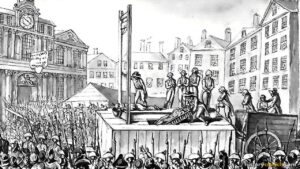
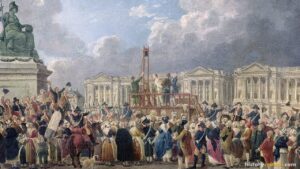
The sans-culottes were closely linked to the most violent phase of the revolution, known as the Reign of TerrorA violent phase of the French Revolution from 1793 to 1794 marked by mass executions of suspected enemies.. This period lasted from September of 1793 until July of 1794 and saw acts of extreme political violence and mass executions. It was led by the radical Jacobins and the Committee of Public Safety under Maximilien Robespierre, who aimed to purge enemies of the revolution and protect the young republic.
During these years, the sans-culottes often supported the Jacobins and pushed them to take strong action. They saw violence as a way to defend the revolution and to force the government to meet their demands, such as fair prices and punishment for suspected traitors. Thousands of people, including nobles, clergy, and even fellow revolutionaries, were executed by guillotineA machine used during the Reign of Terror to execute thousands of people by beheading. during the Terror.
In the end, however, the power of the sans-culottes began to fade. Leaders like Robespierre grew wary of their radical demands and moved against some of their most extreme spokesmen. After the fall and execution of Robespierre in July of 1794, the Terror came to an end, and the influence of the sans-culottes on the direction of the revolution steadily declined.
Significance of Sans-culottes
The sans-culottes were significant because they gave the French Revolution much of its energy and its radical direction. Without the mass support of these city workers, the storming of the Bastille, the fall of the monarchy, and the creation of the republic might not have happened the way they did. In this sense, they were the force that turned the ideas of the revolution into action.
They were also important because they showed the power of ordinary people to shape history. For centuries, workers and peasants in France had been shut out of politics under the Estates System. The sans-culottes proved that common people, when organized and united, could challenge kings and nobles and demand a say in how they were governed.
At the same time, the sans-culottes are remembered as one of the most debated groups of the revolution. To some, they were a brutal and violent mob, while to others they were passionate defenders of equality and democracy. In reality, both sides hold some truth, and their story remains a powerful example of how the hopes and anger of ordinary people can change the course of a nation.
FactsthatCrunchSans-culottes in Paris demanded price controls on bread and other basic goods, pressing the revolutionary government to act on economic fairness.
The sans-culottes were city workers, shopkeepers, and artisans who used street protests and political clubs to push the French Revolution toward greater equality. Their pressure shaped major decisions from 1789 through the end of the Reign of Terror in 1794.
French Revolution timeline · 1789 – 1799
Key Vocabulary
Artisans
Culottes
Estates System
Carmagnole
Cap of liberty
Insurgents
Guillotine
Frequently Asked Questions
What does sans-culottes mean in English?
The term sans-culottes means “without breeches” in English. It pointed to the fact that working people wore long trousers rather than the knee-length silk breeches, called culottes, that were popular among nobles and the wealthy. The name became a proud label for revolutionaries who came from the common classes.
Who were the sans-culottes in the French Revolution?
The sans-culottes were the working people of France’s cities, especially Paris, during the French Revolution. Most of them were shopkeepers, artisans, craftsmen, and laborers who belonged to the Third Estate. They became known for their strong support of the revolution and their willingness to take to the streets to defend it.
What did the sans-culottes wear?
The sans-culottes were known for wearing long trousers, a short jacket called a carmagnole, and a soft red cap known as the cap of liberty. Wooden shoes were also common among them, since they were plain working people. These items became well-known symbols of the revolution and its support among the common classes.
Why were the sans-culottes so important?
The sans-culottes were important because their mass support and street protests pushed the French Revolution in a more radical direction. Their power was strongest between 1792 and 1794, when they helped bring down the monarchy and supported harsh measures against suspected enemies. They showed how organized ordinary people could influence major political events.
What happened to the sans-culottes?
The influence of the sans-culottes faded after the Reign of Terror ended in July of 1794. Revolutionary leaders had grown fearful of their radical demands and moved against their most extreme leaders. As the revolution entered a more moderate phase, the sans-culottes lost much of the political power they once held in Paris.
Cite This Article
To cite this article as a source, use one of the formats below.
MLA: Millar, B. “Sans-culottes: A Detailed Summary.” HistoryCrunch, 11 August 2026, https://historycrunch.com/sans-culottes/.
APA: Millar, B. (2026). Sans-culottes: A Detailed Summary. HistoryCrunch. https://historycrunch.com/sans-culottes/
Chicago: Millar, B. “Sans-culottes: A Detailed Summary.” HistoryCrunch. August 11, 2026. https://historycrunch.com/sans-culottes/
Sources
- J.M. Roberts & Odd Arne Westad, The Penguin History of the World.
- Jerry Bentley & Herbert Ziegler, Traditions & Encounters: A Global Perspective on the Past.