
The Crusades were two centuries of wars in which the Christian rulers of Europe tried to take and hold Jerusalem and the land around it, and the Muslim rulers of Egypt and Syria tried to take it back. There were nine of them by the usual count. The first took Jerusalem in 1099 with a massacre; the third failed to retake it from Saladin and made a treaty instead; the fourth never reached the Holy Land and sacked Constantinople; and the last ended with a thousand men, a truce and an assassin. This timeline runs from the split of the Church in 1054 to the last outposts falling in 1303, and one of its eight chapters has no dates in it at all, because it is about what taking the cross actually meant.
From the Great Schism in 1054 to the last outposts falling in 1303.
The Crusades were two centuries of wars in which the Christian rulers of Europe tried to take and hold Jerusalem and the land around it, and the Muslim rulers of Egypt and Syria tried to take it back. There were nine of them by the usual count. The first took Jerusalem in 1099 with a massacre; the third failed to retake it from Saladin and made a treaty instead; the fourth never reached the Holy Land and sacked Constantinople; and the last ended with a thousand men, a truce and an assassin. This timeline runs from the split of the Church in 1054 to the last outposts falling in 1303, and one of its eight chapters has no dates in it at all, because it is about what taking the cross actually meant.
A sermon in France in 1095 sent tens of thousands of people 2,000 miles east. Sermons do not usually do that.
A schism, a lost battle, a letter and a speech.
It cost a fortune, took years, and most who went did not come back. Tens of thousands went anyway.
Faith, land, loot, adventure and orders from your lord.
One walled city, about a square mile, held sacred by three religions.
What the city meant to each side, and why none of them could let it go.
He asked for knights to help the emperor. He got a mass movement that took Jerusalem and never gave it back.
A reforming pope, a speech, and a result he did not live to see.
Four armies, no single commander, 2,000 miles from home, and three years later they held Jerusalem.
From Constantinople to the walls of Jerusalem in five steps.
Thousands of peasants set out before the knights did. Almost none of them came home.
A preacher, a crowd, and an ambush.
Eight months outside one city. The First Crusade is remembered for Jerusalem; it was decided at Antioch.
Starvation, a betrayal, a relic and a breakout.
The crusaders' own writers described the killing. They did not think it needed excusing.
The assault, the massacre, and how it was remembered.
Four small states of western settlers on a hostile coast, held for two centuries by castles and a sea route.
Founded in three years, defended for two hundred.
Not battles. Walking, hunger, disease, and waiting outside walls.
The vow, the journey, the siege and the return.
For a century the Church had tried to stop knights fighting. Then it found them somewhere to fight.
Turning a menace into an army.
Antioch, Jerusalem, Acre, Damietta, Constantinople. Not one of the turning points was a battle in the open.
Walls, engines, hunger and time.
A queen of France rode to Antioch with her own escort. She was not the only woman there.
Eleanor, and everyone the chroniclers did not name.
The Muslim ruler who took Jerusalem back, and the only one Christian writers praised.
Twenty years to unite the Muslim world, one summer to take the Holy Land.
Every castle emptied to make one army, and the army marched into hills with no water.
The battle that ended the first Kingdom of Jerusalem.
The largest army of the Crusades, three of Europe's most powerful rulers, and Jerusalem stayed where it was.
An emperor who drowned, a king who went home, and a king who could not take the city.
He is the crusader king of every legend. He spent six months of a ten-year reign in England and killed 3,000 prisoners.
The legend and the soldier.
The largest army of the Third Crusade, led by the most experienced soldier in Europe, and it fought no battle against Saladin.
Forty years after his first crusade, an emperor tries the same road again.
Two kings, 35,000 men, and the result was a five-day siege of the wrong city.
From the fall of Edessa to the walls of Damascus.
An army called to fight Islam destroyed the largest Christian city in the world and never saw the Holy Land.
A debt, a diversion, a claimant and three days of looting.
The city that built the fleet ended up with a quarter of the Byzantine Empire. Historians have argued about it for 800 years.
A merchant republic, a debt, and a rival broken.
The Fifth, Seventh and the planned Fourth all went for the Nile. All three failed at the same place.
Damietta, Damietta and the road to Cairo.
Frederick II talked the sultan into handing over the city. Neither side's clergy ever forgave him.
Diplomacy, a treaty, and a crown he placed on his own head.
A saint, a fortune, 15,000 men, and two crusades that ended in a prison and a tent.
Egypt in 1249, Tunis in 1270.
A thousand men under an English prince, a truce, and an assassin. The last crusade in the Holy Land.
Lord Edward's crusade.
The last Crusader city fell in six weeks. No king in Europe sent an army.
The end of the Crusader States.
Popes went on calling for crusades for two more centuries. Armies stopped answering.
Cost, failure, Egypt and Europe's own wars.
Two centuries of war for a city that was lost. What was different when it was over?
Trade, knowledge, power and a memory.
The First Crusade came because the emperor asked for help. The Fourth Crusade sacked his capital.
From Alexius's appeal to the sack of 1204.
For Europe the Crusades were the great event of the age. For the caliphate in Baghdad they were a frontier war.
The Franks arrive, the Franks are contained, the Franks leave.
The crusaders believed God willed it. So did the men who fought them. The question has not gone away.
Clermont, Jerusalem, Constantinople and Acre.
Forty years before anyone took the cross, the Church split into a Catholic west and an Orthodox east, and the Turks destroyed the Byzantine army at Manzikert and took most of Asia Minor. The emperor in Constantinople, short of soldiers, wrote to a pope his own church had excommunicated and asked for mercenaries. What Urban II offered at Clermont on November 27th, 1095 was something else: a war in which fighting was a way to salvation. The response was larger than he expected, and he never learned how it ended.
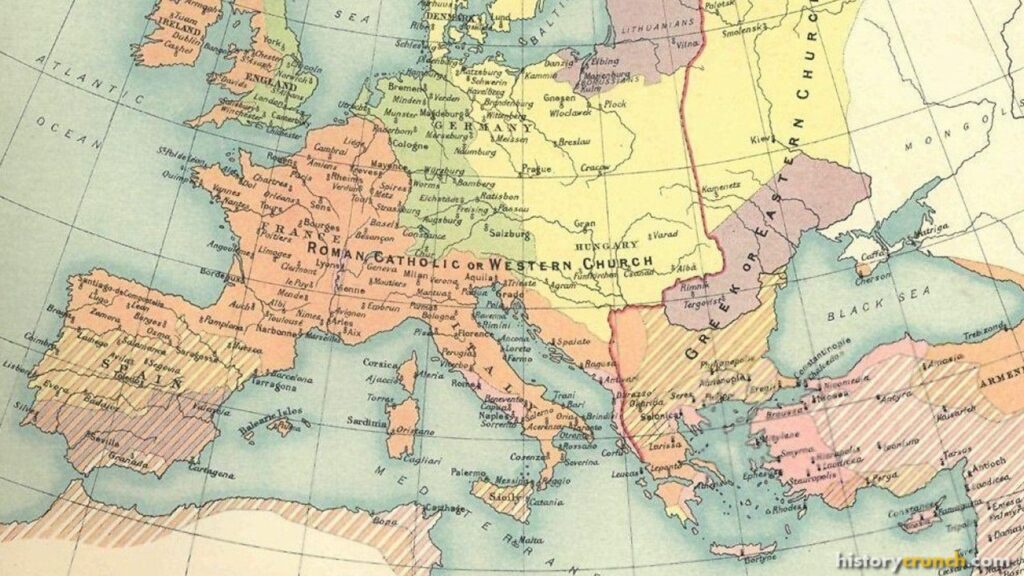
On July 16th, 1054, a cardinal sent from Rome laid a bull of excommunication on the altar of the Hagia Sophia in Constantinople. The patriarch there answered in kind. Historians use that date for the split between the Roman Catholic Church in the west and the Eastern Orthodox Church in the east.
LEARN MORESHOW LESSwhy it matters · key numbersRELIGIONForty-one years later a pope would send western armies to help the eastern emperor. They were helping a church they had just excommunicated, and that awkwardness runs under the whole story, all the way to a crusader army sacking Constantinople in 1204.
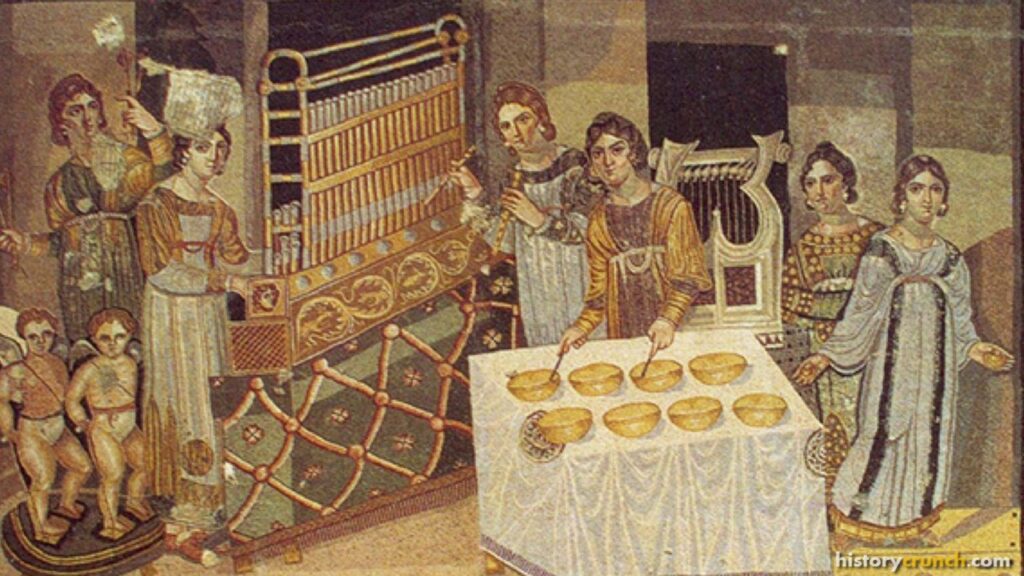
In 1071 the Seljuk Turks defeated a Byzantine army at Manzikert in eastern Anatolia and captured the emperor. Much of Asia Minor, the empire's main source of soldiers and grain, was opened to Turkish settlement.
LEARN MORESHOW LESSwhy it mattersWARThis is the loss that made the eastern emperor write to the west asking for soldiers. Without Manzikert there is no appeal from Constantinople, and without the appeal there is no sermon at Clermont.
Odo, a French monk of Cluny who had risen to Cardinal Bishop of Ostia, was elected pope on March 12th, 1088 at Terracina, south of Rome. His rivals kept him out of Rome itself for six years.
LEARN MORESHOW LESSwhy it matters · 1 key figureRELIGIONThe pope who called the First Crusade was a reformer from the most reform-minded monastery in Europe, and a pope who could not enter his own city. The crusade made him the most powerful man in the west.
Emperor Alexius I, still short of soldiers a generation after Manzikert, sent envoys to the pope asking western Europe for military help against the Turks. He wanted mercenaries he could command.
LEARN MORESHOW LESSwhy it mattersPOLITICSWhat he got was something else entirely: tens of thousands of armed pilgrims under their own leaders who did not intend to hand him anything they took. The gap between what Alexius asked for and what arrived explains most of the quarrels that followed.
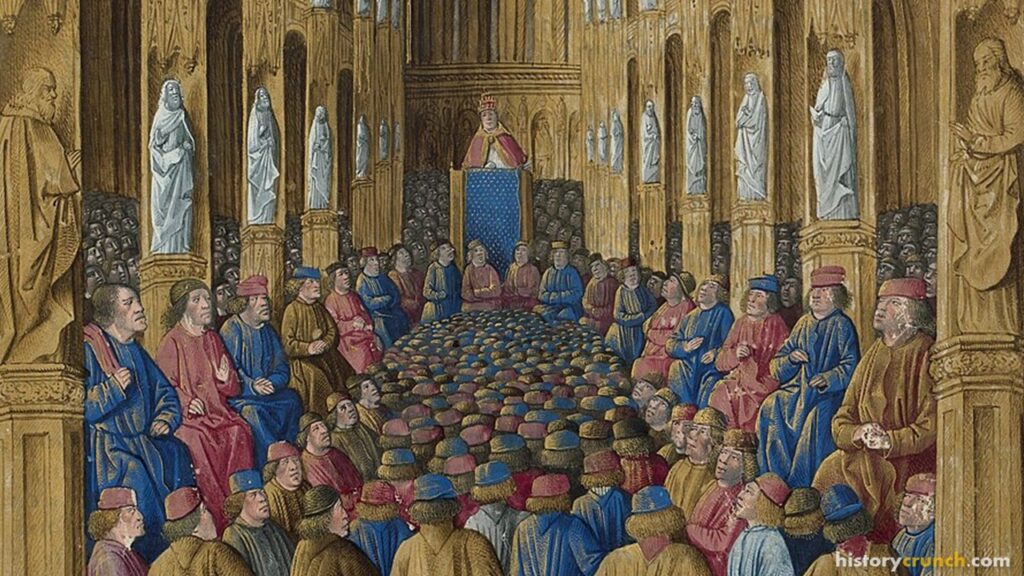
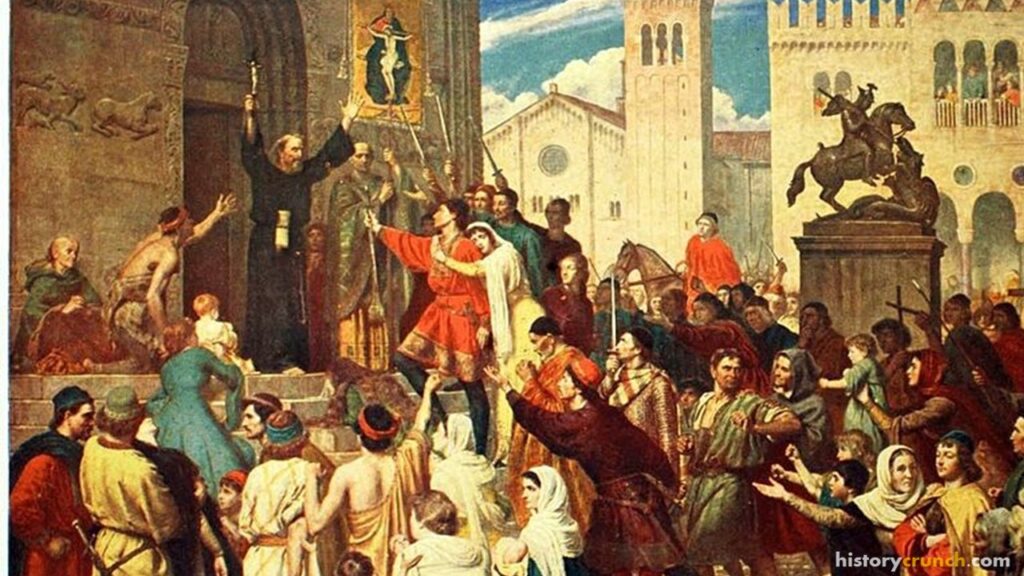
On November 27th, 1095, at the Council of Clermont in France, Pope Urban II preached a sermon calling on the knights of Europe to march east, help the Christians of the empire and free Jerusalem from Muslim control. Those who went were promised remission of sins, an indulgence no pope had offered for war before.
LEARN MORESHOW LESSwhy it matters · a source · 1 key figureRELIGIONThe response was larger than anyone expected. Within a year the first armies were on the road. This is the moment the Crusades begin, and the whole timeline comes back to it.
IN THEIR OWN WORDS“Deus vult”
the crowd at Clermont, as later chroniclers recorded itWHAT TO NOTICELatin for 'God wills it'. The words became the crusaders' cry.
The poor went first and were slaughtered at Civetot. Then four armies of princes, about 35,000 men with no single commander, crossed Anatolia, starved for eight months outside Antioch, and took Jerusalem on July 15th, 1099, killing most of the people in it. It is the only crusade that did what it set out to do, and it did it against a Muslim world too divided to answer. Within eighteen months there were four Crusader States and a king in Jerusalem, and the next two centuries were spent trying to keep them.
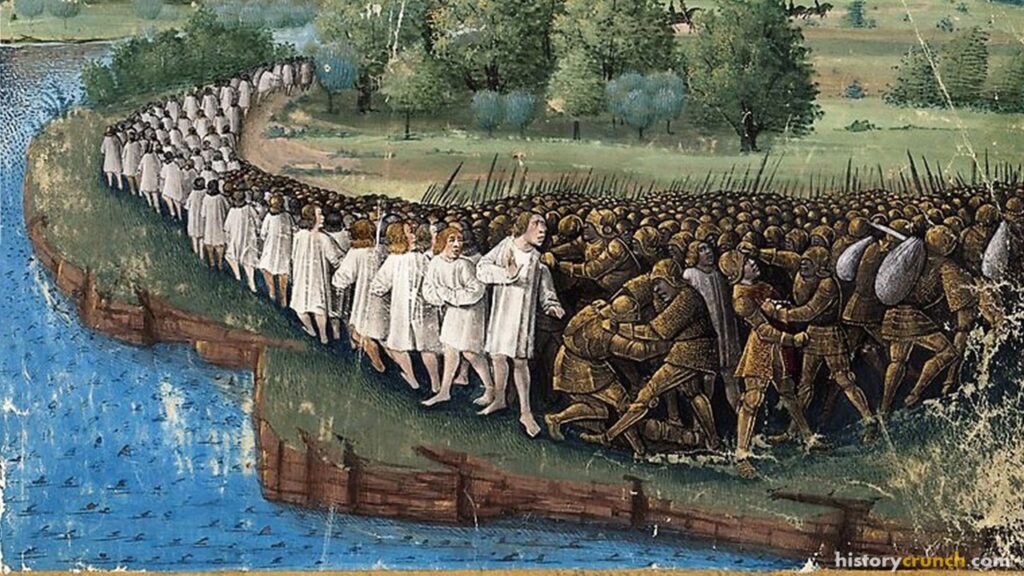
Before the official armies had left, a preacher called Peter the Hermit led thousands of poor pilgrims, with few knights and little food, east through Germany and Hungary. The People's Crusade ran from April to October of 1096.
LEARN MORESHOW LESSwhy it matters · 1 key figureRELIGIONUrban had called for knights. What answered first was a crowd. Their march shows how far the idea had spread beyond the people it was aimed at, and how little anyone had planned for what would happen when they arrived.
Godfrey, Duke of Lower Lorraine, set out in August of 1096 with his brothers Eustace and Baldwin, leading several thousand men along the land route through Hungary and the Byzantine Empire toward Constantinople.
LEARN MORESHOW LESSwhy it matters · 1 key figureWARGodfrey was one of four princes leading separate armies. He would be the first ruler of Jerusalem, and his brother Baldwin the first to carve out a state of his own on the way.
Shipped across to Asia Minor by Alexius, Peter the Hermit's followers were ambushed by the Turks at Civetot in October of 1096. Most were killed or enslaved. Peter, who was in Constantinople at the time, survived.
LEARN MORESHOW LESSwhy it mattersWARIt was the first fighting of the Crusades and a complete disaster. It also taught the Turks to expect very little from western armies, which they would regret the following summer.
The four main armies, roughly 35,000 crusaders and 5,000 cavalry by historians' estimates, reached the Byzantine capital between late 1096 and early 1097. Alexius made each leader swear to hand back any former imperial land they captured.
LEARN MORESHOW LESSwhy it matters · key numbersPOLITICSThe oath was the first quarrel. The princes took it reluctantly and most of them broke it, and the emperor's distrust of his rescuers shaped every crusade that came after.
In July of 1097 the Turks caught the crusaders' vanguard in the open at Dorylaeum. Godfrey and the main army came up in time to relieve it, and the Turkish force broke.
LEARN MORESHOW LESSwhy it matters · 1 key figureWARIt was the first time a crusader army beat the Turks in the field, and it opened the road across Anatolia. It is also why there is a second Dorylaeum on this timeline, fifty years later, that went the other way.
The crusaders reached Antioch, one of the great walled cities of the east, in October of 1097 and settled in to besiege it. The siege lasted until June of 1098, through a winter in which the besiegers starved almost as badly as the besieged.
LEARN MORESHOW LESSwhy it mattersSIEGEEight months outside one city. The First Crusade is remembered for taking Jerusalem, but it very nearly died at Antioch, and the men who survived it were a hardened army by the time they marched south.
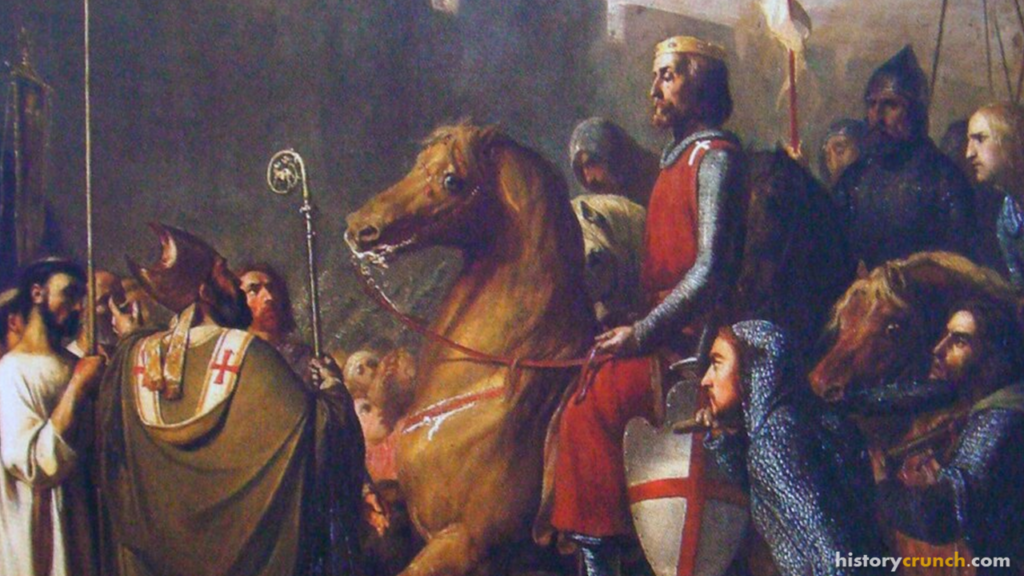
Godfrey's brother Baldwin left the main army, marched east, and in February of 1098 was adopted as heir by the Armenian ruler of Edessa. Within weeks he ruled the city. The County of Edessa was the first of the four Crusader States.
LEARN MORESHOW LESSwhy it mattersPOLITICSIt was a year before Jerusalem fell and already a crusader had a kingdom of his own. Edessa was also the first Crusader State to be lost, in 1144, and its fall is what called the Second Crusade.
In June of 1098 the crusaders got inside Antioch, found a relic they believed was the Holy Lance, then were themselves besieged by a Turkish relief army and broke out to defeat it. The city was theirs, and it became the second Crusader State.
LEARN MORESHOW LESSwhy it mattersSIEGEThe army that left Antioch was smaller, poorer and more sure than ever that God was with it. That belief is the only explanation for what it did at Jerusalem the following summer.
In June of 1099, three years after leaving home, the surviving crusaders came within sight of Jerusalem. The city was held by the Fatimids of Egypt, who had taken it from the Turks only the year before.
LEARN MORESHOW LESSwhy it mattersWAROf the tens of thousands who set out, perhaps a third were still there. Everyone who reached the walls had walked more than 2,000 miles to do it.
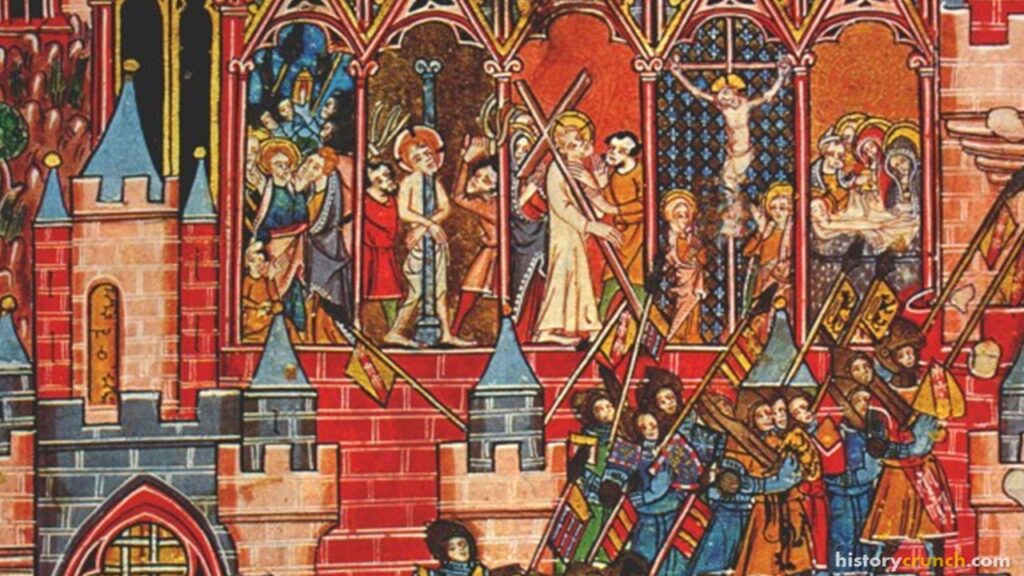
The main assault came on July 14th and 15th, 1099. Once the crusaders were over the wall they killed most of the Muslim and Jewish people in the city, a massacre the crusaders' own chroniclers described without embarrassment.
LEARN MORESHOW LESSwhy it matters · a debate · 1 key figureSIEGEThe goal of the whole enterprise was achieved in an afternoon, and the way it was achieved was remembered in the Muslim world for centuries. When Saladin retook the city in 1187, the contrast was deliberate.
Was the First Crusade a success?
By its own aim, completely. It set out to take Jerusalem and took it, and held it for eighty-eight years.
It took Jerusalem by massacre, broke every promise made to the emperor who had asked for help, and left four small states that Europe would spend two centuries and eight more crusades failing to defend.
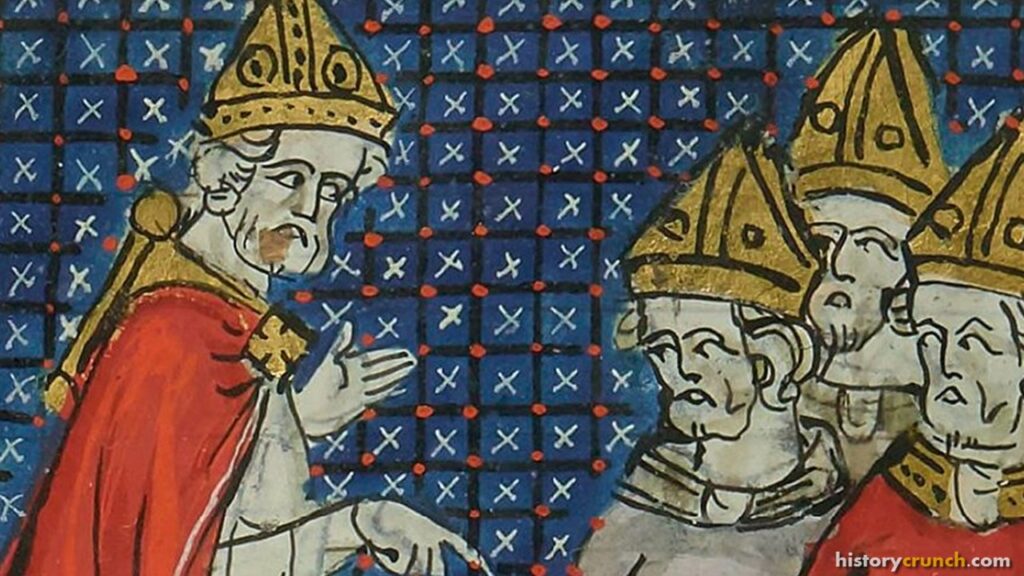
Pope Urban II died in Rome on July 29th, 1099, fourteen days after the city he had sent the crusaders to take had fallen. The news had not yet reached him.
LEARN MORESHOW LESSwhy it matters · 1 key figureRELIGIONThe man who started it never learned that it had worked. His speech at Clermont set off wars that ran for two centuries.
An Egyptian army marched north to retake Jerusalem. On August 12th, 1099, Godfrey led the crusaders out to meet it at Ascalon and won a decisive victory.
LEARN MORESHOW LESSwhy it matters · 1 key figureWARWithout Ascalon, Jerusalem would have been lost within the month. It bought the new kingdom its first years.
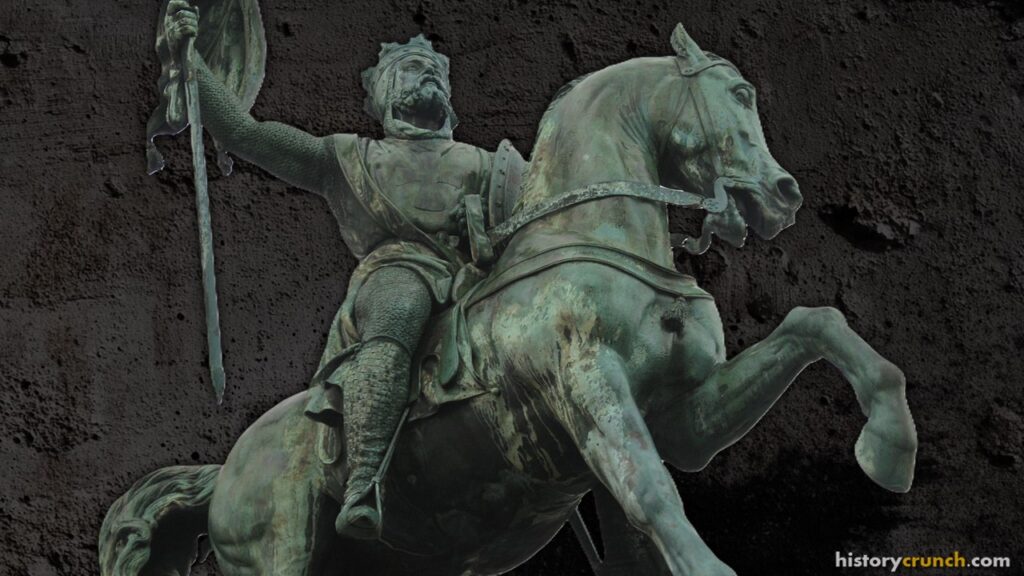
Godfrey, who had refused the title of king and ruled Jerusalem as its Defender, died in the city on July 18th, 1100, one year after taking it.
LEARN MORESHOW LESSwhy it matters · 1 key figurePOLITICSHe was the first ruler of Jerusalem and the last for a long time to decline a crown. Later writers made him the model crusader; the evidence for the man himself is thinner than the legend.
Godfrey's brother Baldwin, ruler of Edessa, came south and was crowned King of Jerusalem on Christmas Day, 1100. He had no such scruple about the title.
LEARN MORESHOW LESSwhy it mattersPOLITICSA kingdom now existed where a pilgrimage had been meant. From here on, the Crusader States needed defending, and every later crusade was called to defend them.
This chapter has no dates in it. Seven of the articles behind this timeline are about what going on crusade meant rather than when anything happened: what the Holy Land was and why Jerusalem above all, why a European would sew a cross on his cloak and walk 2,000 miles, what the vow committed him to, what a knight was, how a walled city was taken, and what the four small states the crusaders founded actually were. It sits here, after the First Crusade, because that is when all of it became real.
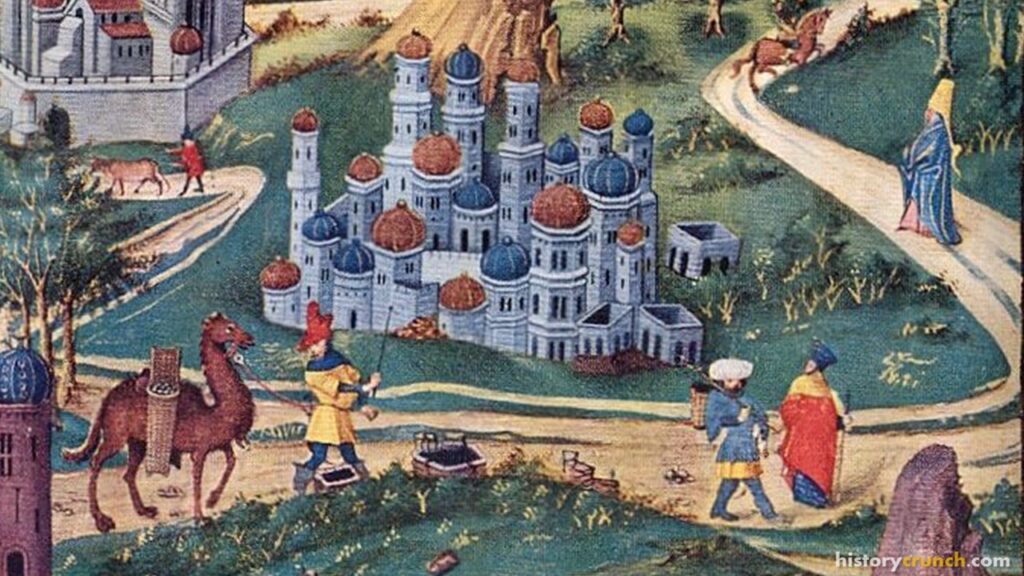
The Holy Land is the territory of the Bible: Jerusalem, Bethlehem, Nazareth and the country between them. It was holy to Christians, to Jews and to Muslims, all of whom had claims on it older than any crusade.
LEARN MORESHOW LESSwhy it mattersLIFEThe crusaders were not fighting over empty ground. Three faiths held the same places sacred, which is why control of them mattered so far beyond their size.
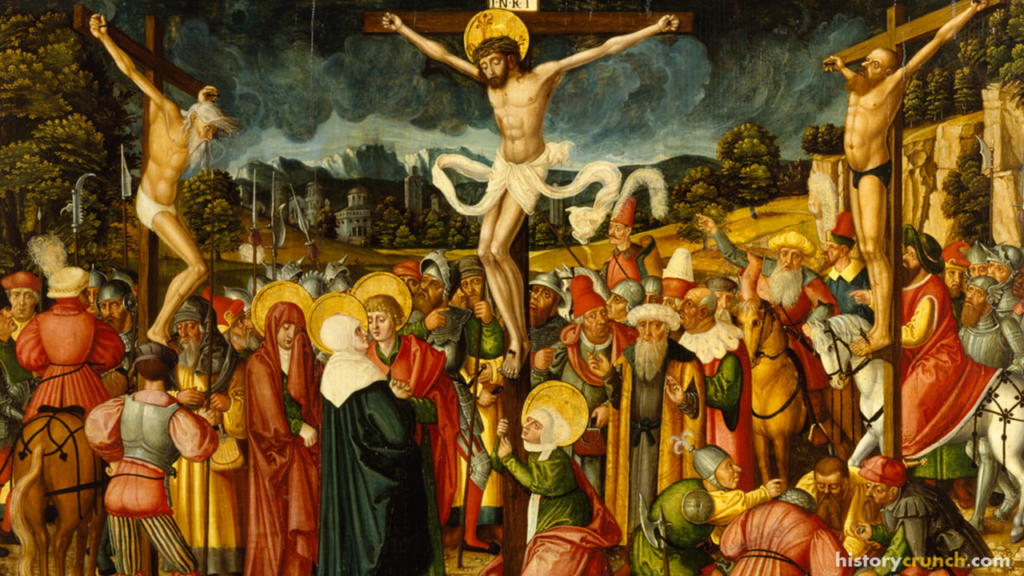
For Christians, Jerusalem was where Jesus was crucified and buried. For Muslims it was the place from which Muhammad ascended to heaven, the third holiest city in Islam. For Jews it was the site of the Temple.
LEARN MORESHOW LESSwhy it mattersLIFEA city that three religions could not give up is a city nobody could hold in peace. The Crusades were a two-hundred-year argument over one square mile.
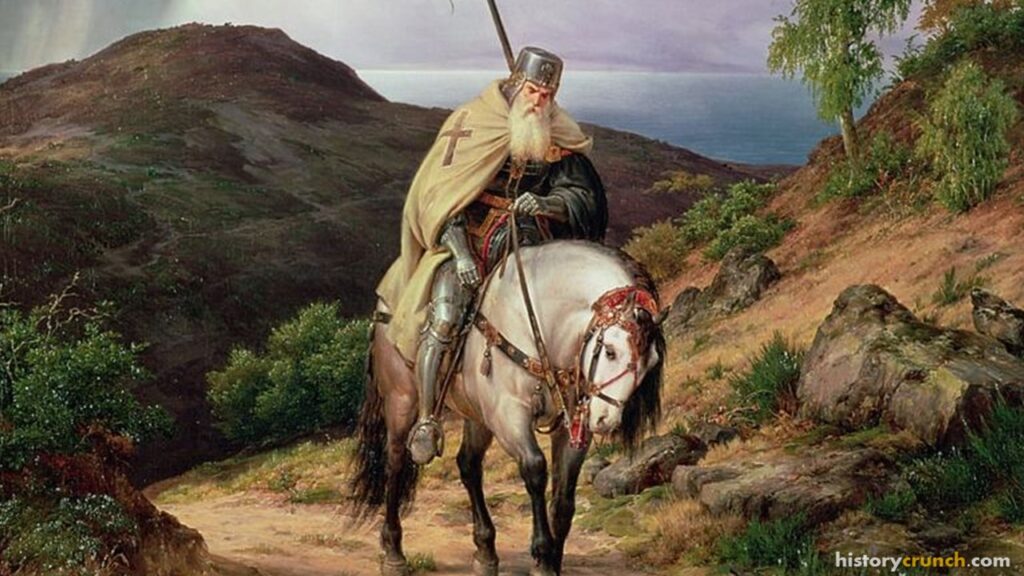
Some went for their faith and the promise that their sins would be forgiven. Some went for land, because younger sons of nobles inherited nothing. Some went for loot, for adventure, or because their lord went and they had to follow.
LEARN MORESHOW LESSwhy it matters · a debateLIFEMixed motives are not a modern discovery. The chroniclers of the time complained about crusaders who came for plunder, and the crusaders who came for God did most of the killing.
Did the crusaders go for God or for gain?
For God. Going was ruinously expensive, most who went came home poorer or did not come home, and the promise of remitted sins was the one thing the pope actually offered.
For gain. Younger sons with no land, merchants from Genoa and Venice, and kings who needed a war abroad all found what they were looking for in the east.
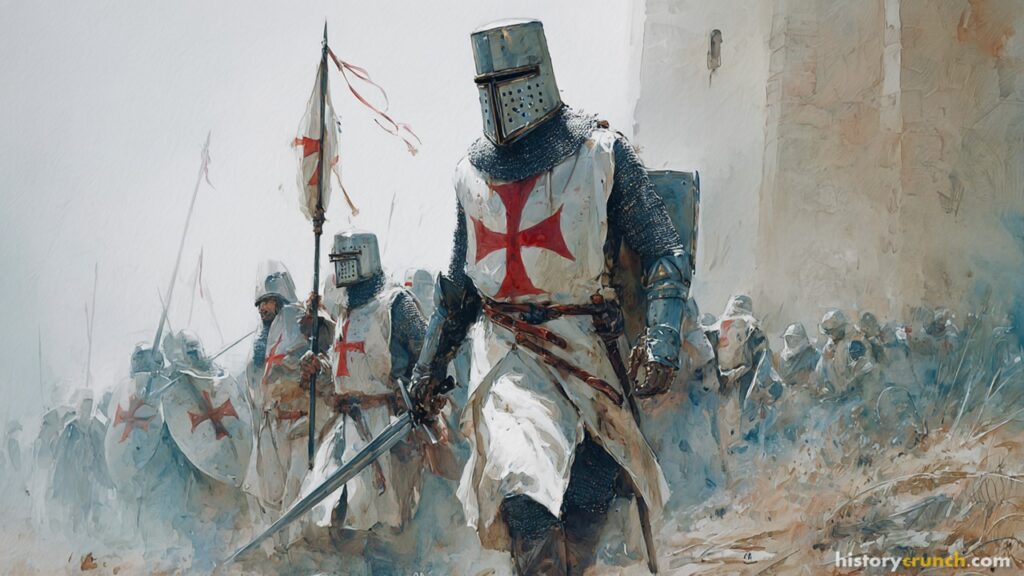
A crusader made a vow before God, sewed a cloth cross onto his clothing, and set out on a journey that could take a year each way. He paid his own costs, which for a knight could mean selling or mortgaging his land.
LEARN MORESHOW LESSwhy it mattersLIFETaking the cross was a religious act with a legal weight: the Church protected a crusader's property while he was away and punished those who failed to go. It was not a decision a man could take back.
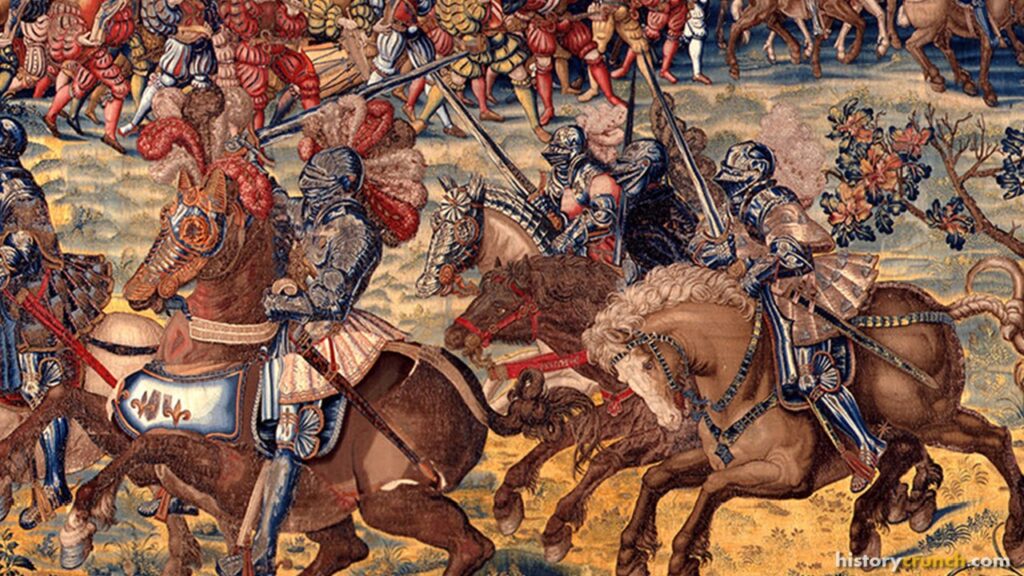
A knight was a mounted, armored fighter trained from boyhood. The idea of the Christian knight as a defender of the faith was one of the main reasons so many of them answered the call.
LEARN MORESHOW LESSwhy it mattersLIFEThe Church spent a century trying to turn knights from a menace into a force it could direct. The crusade was the answer: a war in which knightly violence was holy.
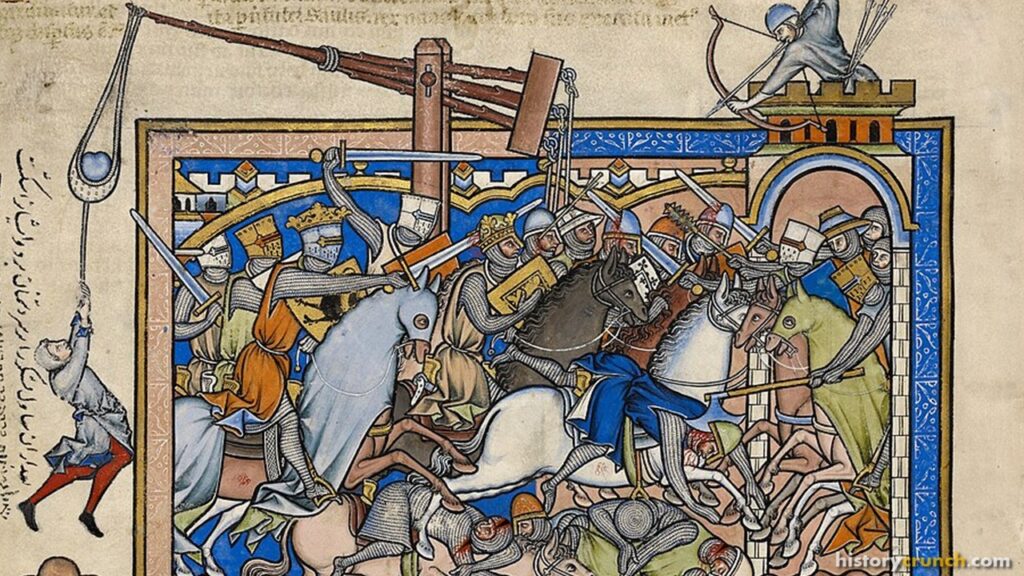
Antioch, Jerusalem, Acre, Damietta, Constantinople: every decisive moment of the Crusades was a siege. Crusaders built towers, rams and stone-throwing engines on the spot, from whatever timber they could find.
LEARN MORESHOW LESSwhy it mattersLIFEBattles in the open were rare and usually avoided. The Crusades were won and lost at walls, by hunger, disease and engineering rather than by charges.
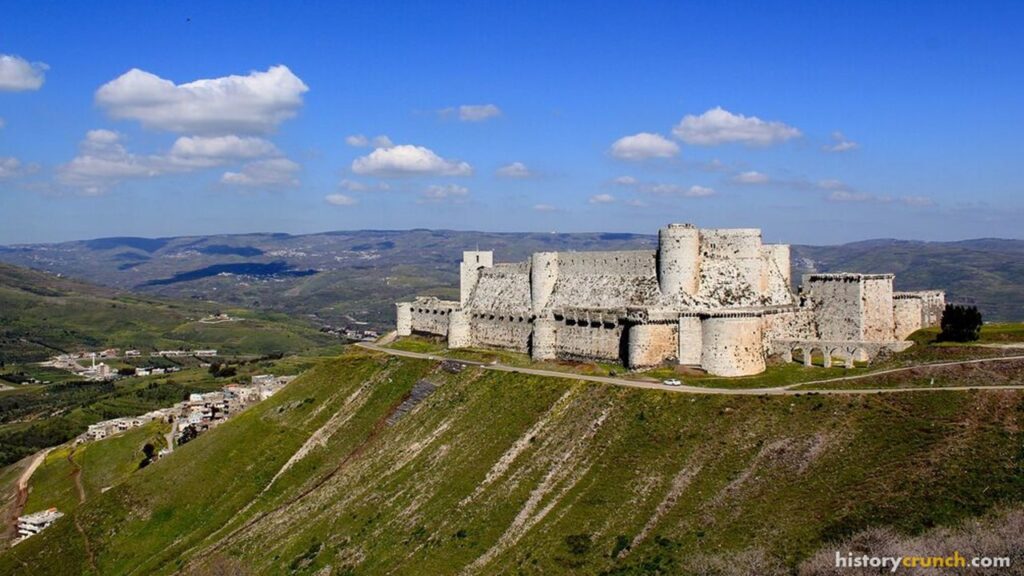
Edessa, Antioch, Tripoli and the Kingdom of Jerusalem: four states carved out by the First Crusade along the eastern Mediterranean coast, ruled by western nobles and defended by the Templars and Hospitallers from castles like Krak des Chevaliers.
LEARN MORESHOW LESSwhy it matters · key numbersLIFEThey were small, short of settlers and surrounded. Holding them is what the next eight crusades were for, and the last of them, Acre, fell in 1291.
Edessa, the first Crusader State founded, was the first lost, to Zengi in December 1144. The pope called for kings this time, and the kings of France and Germany raised 35,000 men. The Germans were destroyed at Dorylaeum before reaching Syria; the French arrived weak, quarrelled at Antioch, and the two kings then attacked Damascus, a friendly Muslim city, for five days and went home. The only lasting conquest was Lisbon, made by accident on the way. A queen of France rode the whole way and her marriage did not survive it.
In December of 1144, Imad ad-Din Zengi, the Turkish ruler of Mosul and Aleppo, attacked and captured Edessa, the northernmost and most exposed of the Crusader States. It had been the first one founded, forty-six years earlier.
LEARN MORESHOW LESSwhy it mattersSIEGEIt was the first time a Crusader State had been lost, and the shock in Europe was out of all proportion to Edessa's size. A second crusade was called within a year.
On December 1st, 1145, Pope Eugene III issued a call for a new crusade to recover Edessa and protect the Christian lands in the east. Unlike Urban, he wanted kings to lead it.
LEARN MORESHOW LESSwhy it mattersRELIGIONThe First Crusade had been led by counts and dukes. This one would be led by the kings of France and Germany, which made it far larger and, as it turned out, no more effective.
Louis VII announced at Christmas 1145 that he would go. Conrad III of Germany followed. Between them they raised roughly 35,000 crusaders, about 20,000 German and 15,000 French.
LEARN MORESHOW LESSwhy it matters · key numbersPOLITICSTwo kings and 35,000 men was the largest force Europe had yet sent east. It achieved less than the First Crusade's counts had with fewer.
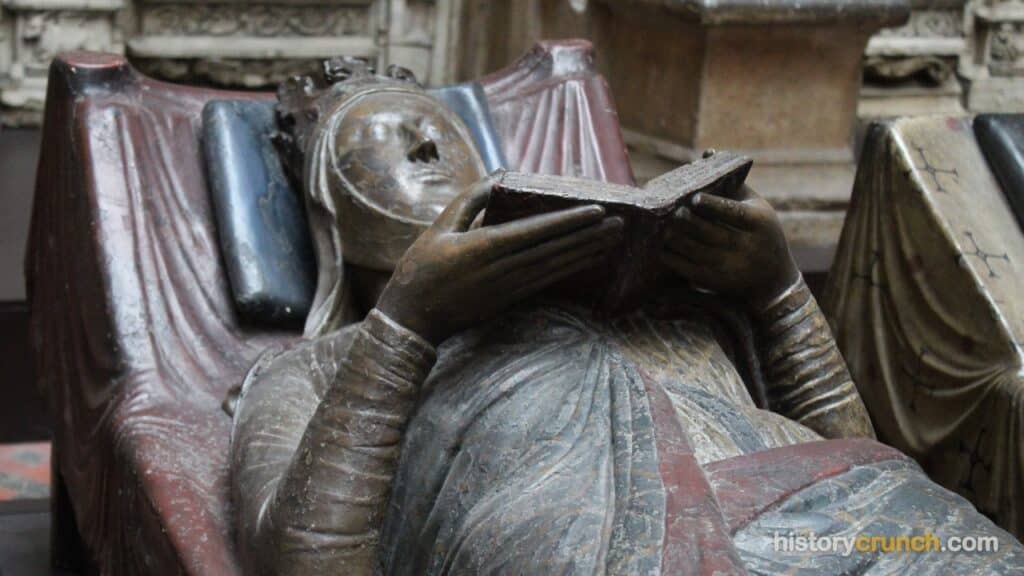
The armies began their march on June 15th, 1147. Louis VII's wife, Eleanor of Aquitaine, went with him, riding to the Holy Land with her own escort of ladies from Aquitaine.
LEARN MORESHOW LESSwhy it matters · 1 key figureWAREleanor is the most famous woman on this timeline and the only queen to go on crusade in person. Her marriage did not survive the journey; her next husband was the king of England.
A fleet of English, Flemish and German crusaders sailing round to the east stopped in Portugal and helped the king there besiege Lisbon. The siege ran from July 1st to October 25th, 1147, and the city was taken from the Moors.
LEARN MORESHOW LESSwhy it mattersSIEGEThe Second Crusade's only lasting conquest was 2,500 miles from Jerusalem and happened by accident. Lisbon has been Portuguese ever since.
Conrad's Germans reached Constantinople first, and Louis's French followed, arriving on September 10th, 1147. The Byzantine emperor, Manuel, hurried both armies across into Asia as fast as he could.
LEARN MORESHOW LESSwhy it mattersPOLITICSFifty years on, the eastern empire trusted crusaders even less than Alexius had. Manuel had made his own truce with the Turks, which the crusaders regarded as treachery.
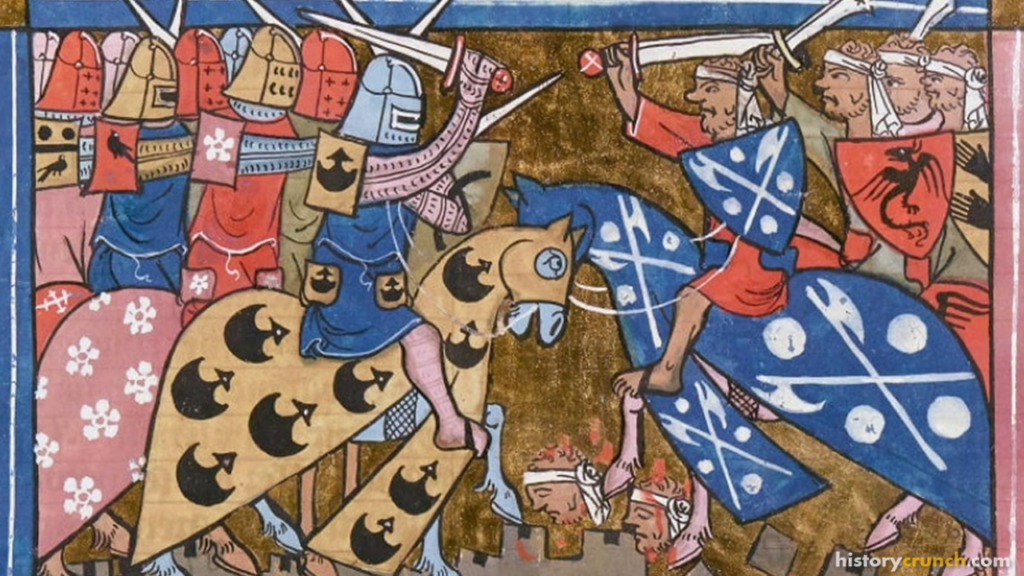
On October 25th, 1147, near the site of the First Crusade's victory, the Turks ambushed Conrad's army and nearly destroyed it. The young Frederick Barbarossa was among the survivors who fell back to the coast.
LEARN MORESHOW LESSwhy it matters · 1 key figureWARThe German half of the crusade was finished before it had reached Syria. Barbarossa would remember Anatolia forty years later, when he led his own crusade through it.
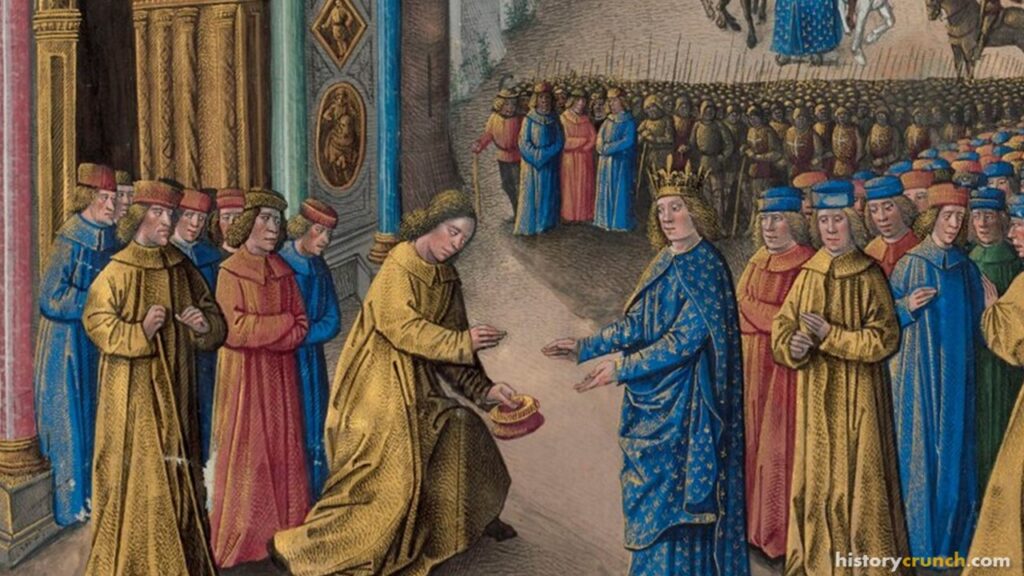
Louis and the French, having lost much of their army crossing Anatolia, reached Antioch in March of 1148. Its ruler, Raymond of Poitiers, was Eleanor's uncle and wanted the crusade to attack Aleppo and recover Edessa.
LEARN MORESHOW LESSwhy it mattersPOLITICSLouis refused and marched on to Jerusalem instead. The quarrel between Louis and Raymond, and Eleanor's siding with her uncle, is where the royal marriage began to break.
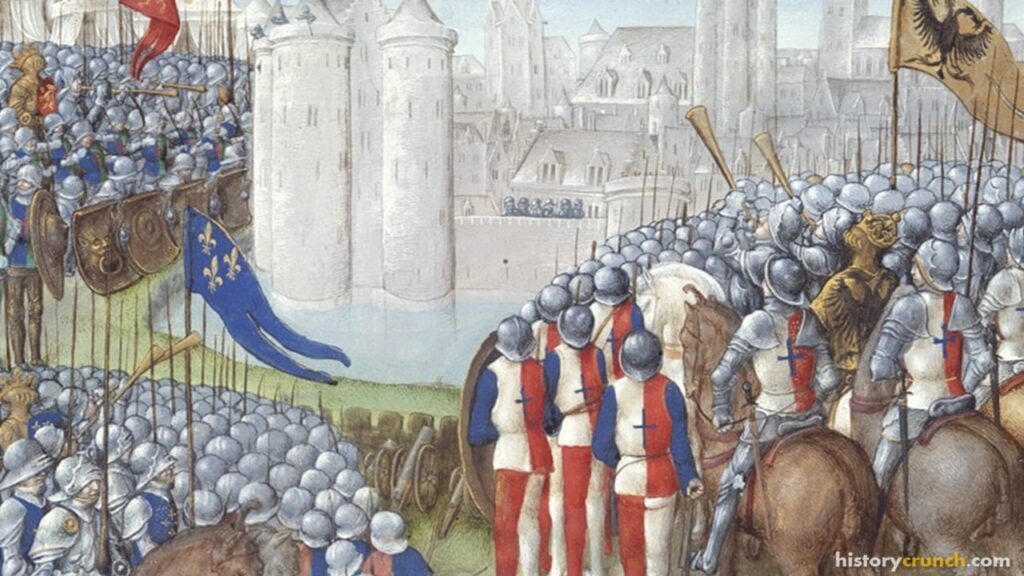
Instead of Edessa, the crusade attacked Damascus, a Muslim city that had until then been friendly to the Crusader States. The siege lasted from July 24th to July 29th, 1148, and collapsed. The kings went home in 1149 having recovered nothing.
LEARN MORESHOW LESSwhy it matters · a debateSIEGEThe Second Crusade turned a neutral into an enemy and took nothing back. Its failure left Europe with a bad taste for crusading that lasted until Saladin gave it a reason.
Why did the Second Crusade fail?
Bad luck and bad geography. The German army was destroyed in Anatolia before it had done anything, and the French arrived too weak to attempt Edessa.
Bad choices. Two kings who did not trust each other or the emperor chose to attack a friendly city rather than the one they had come to recover, and gave up after five days.
A Kurdish soldier who took command in Egypt at thirty-one spent seventeen years uniting Egypt and Syria, mostly by fighting other Muslims, and then destroyed the entire army of the Kingdom of Jerusalem in one day at Hattin. Jerusalem surrendered on terms, with no massacre, and the contrast with 1099 was the point. Europe's three most powerful rulers answered: an emperor who drowned in a river, a king of France who went home after Acre, and Richard of England, who beat Saladin at Arsuf, came within sight of Jerusalem, turned back, and made a treaty instead.
Saladin, a Kurdish soldier born in Tikrit around 1137, went to Egypt with his uncle Shirkuh in the service of the Syrian ruler Nur al-Din. When Shirkuh died in 1169, Saladin succeeded him as commander of the Syrian forces there.
LEARN MORESHOW LESSwhy it matters · 1 key figurePOLITICSHe was about thirty-one and nobody's first choice. Within twenty years he would be the ruler the Crusader States feared most.
In 1171 Saladin abolished the Shia Fatimid Caliphate that had ruled Egypt for two centuries and restored Sunni Islam as its official faith, in the name of the caliph in Baghdad.
LEARN MORESHOW LESSwhy it matters · 1 key figureRELIGIONEgypt and Syria had been on opposite sides of a religious divide, which the Crusader States had relied on. Saladin closed it.
When Nur al-Din died in 1174, Saladin declared himself the independent ruler of Egypt and began taking over Nur al-Din's lands in Syria as well.
LEARN MORESHOW LESSwhy it matters · 1 key figurePOLITICSFor the first time since the crusaders arrived, the two Muslim powers on either side of the Crusader States were about to be one power.
By 1186 Saladin had brought Egypt, Damascus, Aleppo and Mosul under his rule. The Crusader States were now surrounded on every land side by a single empire.
LEARN MORESHOW LESSwhy it matters · 1 key figurePOLITICSTwelve years of patient campaigning against fellow Muslims, and not one battle against the Franks, as the Muslim world called the crusaders, yet. That was the point: the jihad for Jerusalem could only be won once the rear was secure.
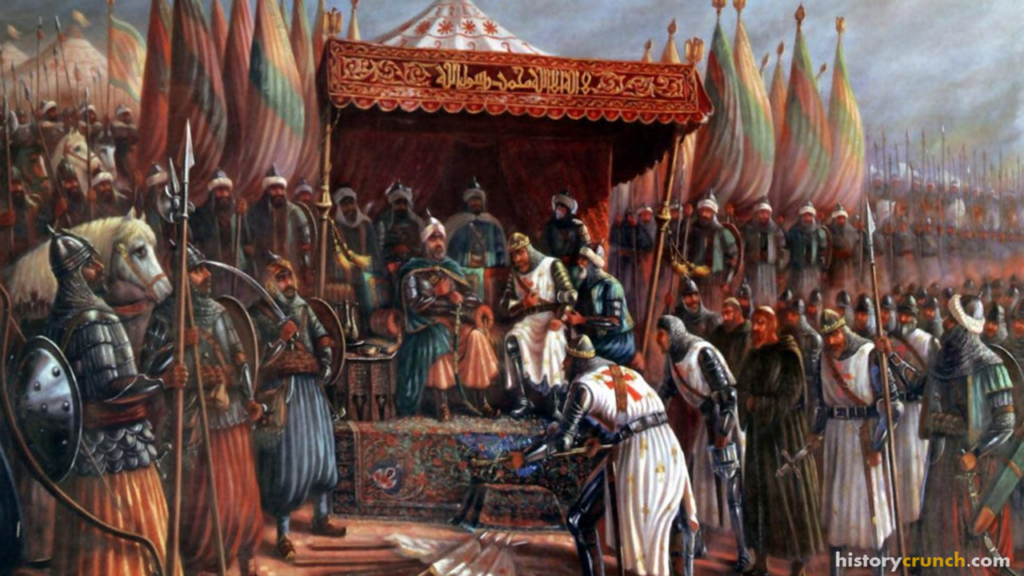
On July 4th, 1187, the full field army of the Kingdom of Jerusalem marched into waterless hills to relieve Tiberias and was surrounded by Saladin at the Horns of Hattin. Almost the whole army was killed or captured, the king among them.
LEARN MORESHOW LESSwhy it matters · 1 key figureWAREvery castle in the kingdom had been emptied to make that army. With it gone, there was nobody left to defend the walls, and the cities fell one after another through the summer.
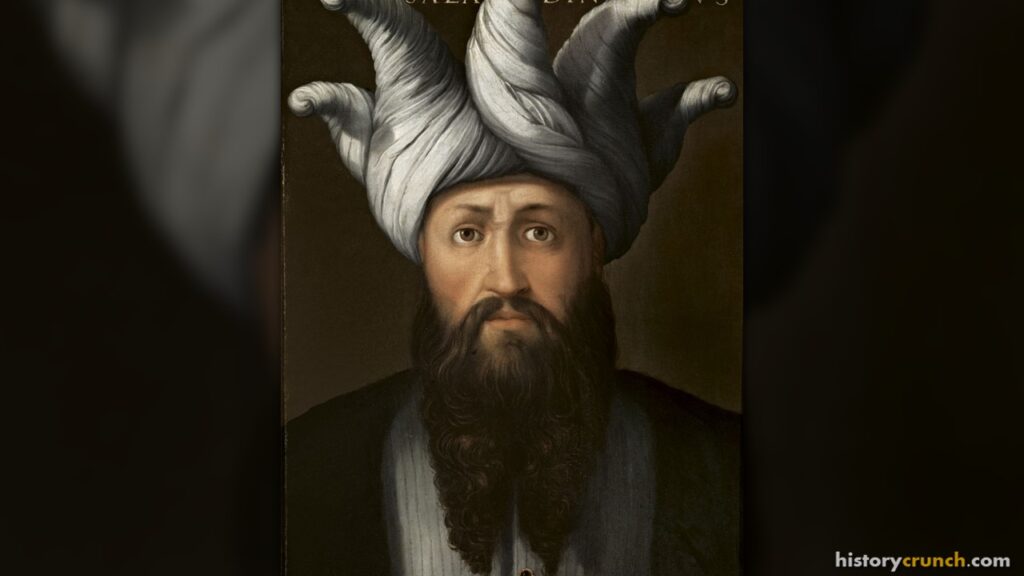
Saladin's siege of Jerusalem ran from September 20th to October 2nd, 1187. The city surrendered on terms: its Christian inhabitants could buy their freedom, and there was no massacre. It had been in Christian hands for eighty-eight years.
LEARN MORESHOW LESSwhy it matters · key numbers · 1 key figureSIEGEThe contrast with 1099 was deliberate and was noticed at the time. The loss of Jerusalem shocked Europe more than anything since Clermont, and the pope who heard the news is said to have died of it.
On October 29th, 1187, less than four weeks after Jerusalem fell, the new pope, Gregory VIII, called for a crusade to take it back. Historians estimate that somewhere between 36,000 and 70,000 people answered.
LEARN MORESHOW LESSwhy it matters · key numbersRELIGIONThis time the three most powerful rulers in Europe took the cross: the Holy Roman Emperor and the kings of France and England. It was the largest crusade of all, and it did not retake Jerusalem.
Frederick Barbarossa, Holy Roman Emperor and a survivor of the Second Crusade, left on May 11th, 1189 with about 15,000 men, taking the land route he remembered from forty years before.
LEARN MORESHOW LESSwhy it matters · key numbers · 1 key figureWARHe was nearly seventy and the most experienced soldier in Europe. Saladin took his army more seriously than either king's.
Henry II of England, who had taken the cross but never gone, died on July 6th, 1189. His son Richard succeeded him and was crowned at Westminster on September 3rd. He began raising money for the crusade at once.
LEARN MORESHOW LESSwhy it matters · 1 key figurePOLITICSRichard would spend six months of his ten-year reign in England. Everything else was crusade, captivity and war in France, and it is the crusade he is remembered for.
Harried across Anatolia by Turkish attacks, Barbarossa's army stormed the Seljuk capital of Iconium on May 18th, 1190 and came through the mountains toward Syria.
LEARN MORESHOW LESSwhy it matters · 1 key figureWARIt was the first time a crusader army had crossed Anatolia by force since 1097, and it was done by a man who had seen the last attempt fail. Three weeks later he was dead.
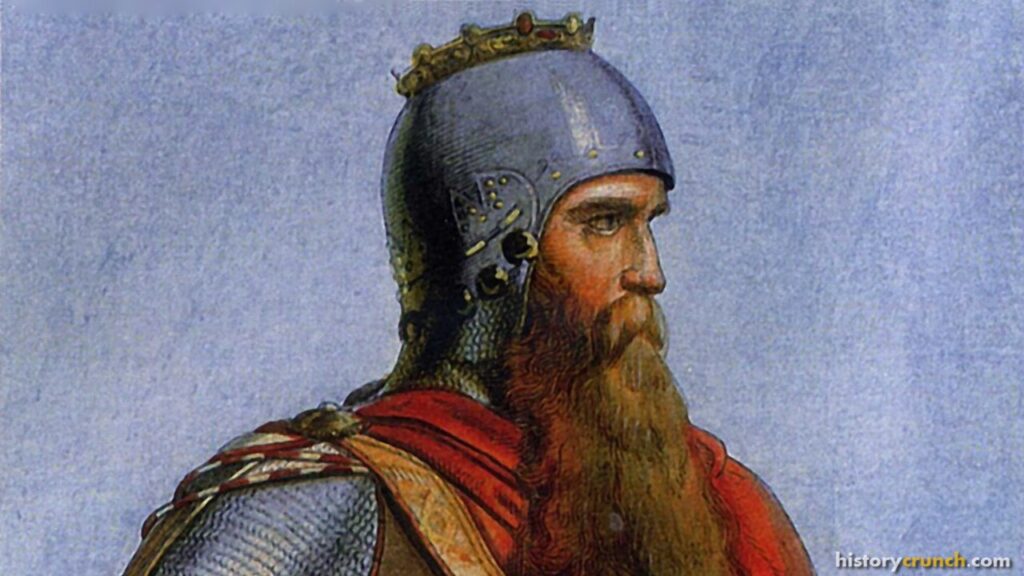
On June 10th, 1190, while crossing the Saleph River in what is now southern Turkey, Frederick Barbarossa fell from his horse and drowned. Most of his army turned back. Only a fraction reached Acre.
LEARN MORESHOW LESSwhy it matters · 1 key figureWARThe largest of the three crusading armies was gone without fighting Saladin. The Third Crusade became an Anglo-French affair, which meant a quarrel.
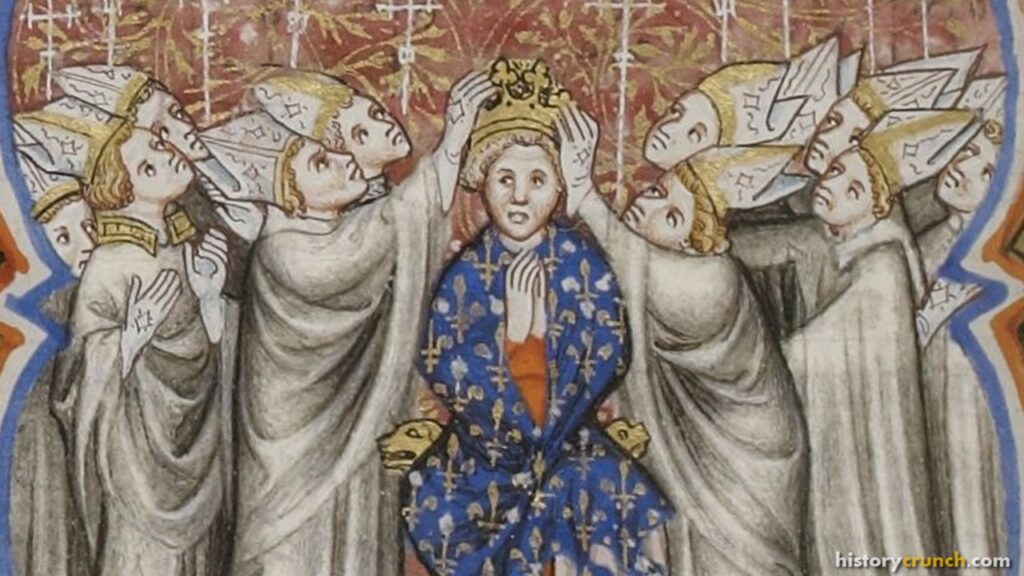
On July 4th, 1190, Richard of England and Philip II of France met at Vezelay in Burgundy and set out together for the Holy Land. They travelled together because neither trusted the other alone at home.
LEARN MORESHOW LESSwhy it matters · 2 key figuresPOLITICSRichard held more of France than Philip did, as Philip's vassal. The two kings were allies only for as long as it took to reach Acre.
In May of 1191, after the island's ruler mistreated shipwrecked English crusaders, Richard landed on Cyprus and conquered it in a matter of weeks.
LEARN MORESHOW LESSwhy it matters · 1 key figureWARCyprus stayed in western hands for nearly four hundred years, longer than any Crusader State on the mainland, and became the base from which the last of them were supplied.
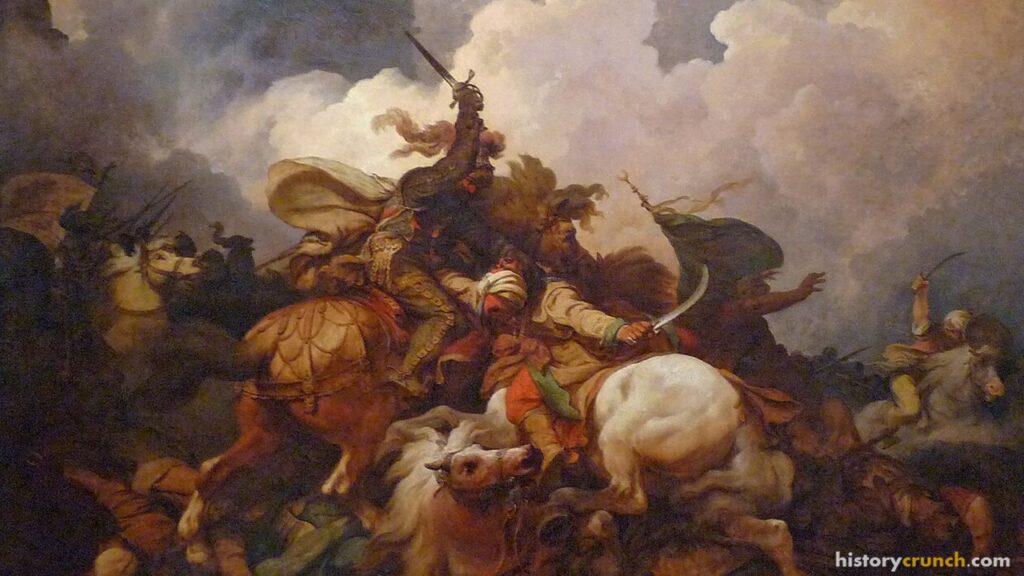
Acre had been under crusader siege since 1189. Philip arrived in May of 1191 and Richard in June, and with their forces added the city surrendered on July 12th.
LEARN MORESHOW LESSwhy it matters · 2 key figuresSIEGEAcre became the capital of what was left of the Kingdom of Jerusalem and the last Crusader city to fall, exactly a hundred years later.
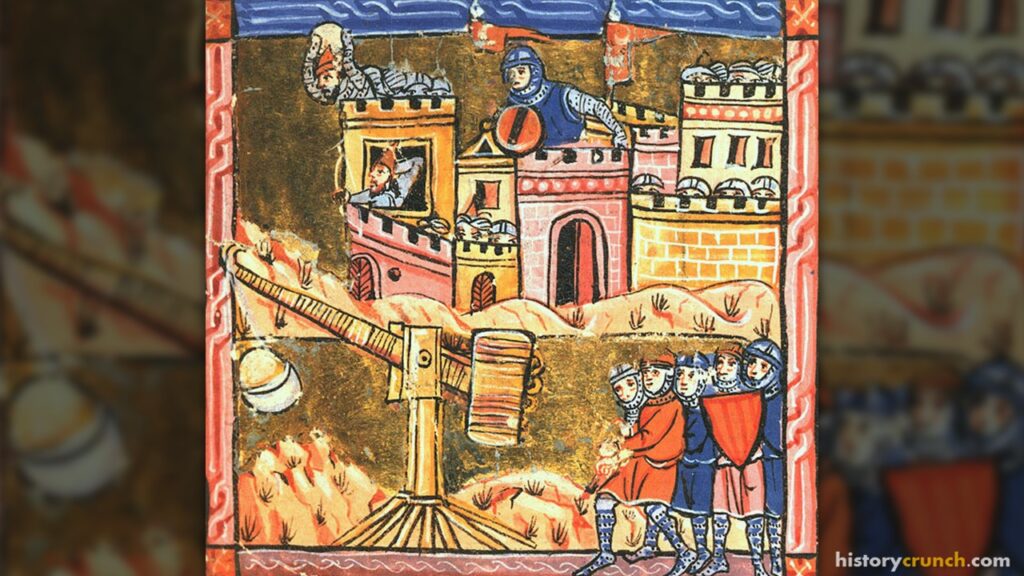
When negotiations with Saladin over the surrendered garrison stalled, Richard had somewhere between 2,500 and 3,000 Muslim prisoners killed in sight of Saladin's army.
LEARN MORESHOW LESSwhy it matters · key numbers · 1 key figureWARIt is the act Richard's reputation has never quite recovered from, and a reminder that the Lionheart of the legends was a twelfth-century soldier first.
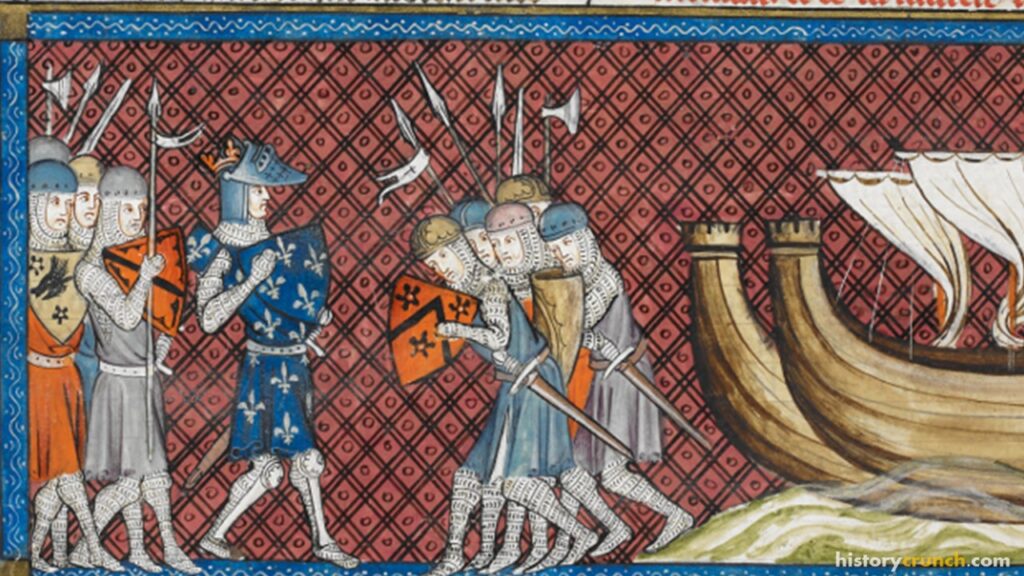
With Acre taken, Philip II decided he had done enough crusading. He left the army in August of 1191 and sailed for France, where he began taking Richard's lands while Richard was away.
LEARN MORESHOW LESSwhy it matters · 1 key figurePOLITICSPhilip got more out of the Third Crusade than anyone: a reputation for having gone, and a year's head start against a rival who could not come home.
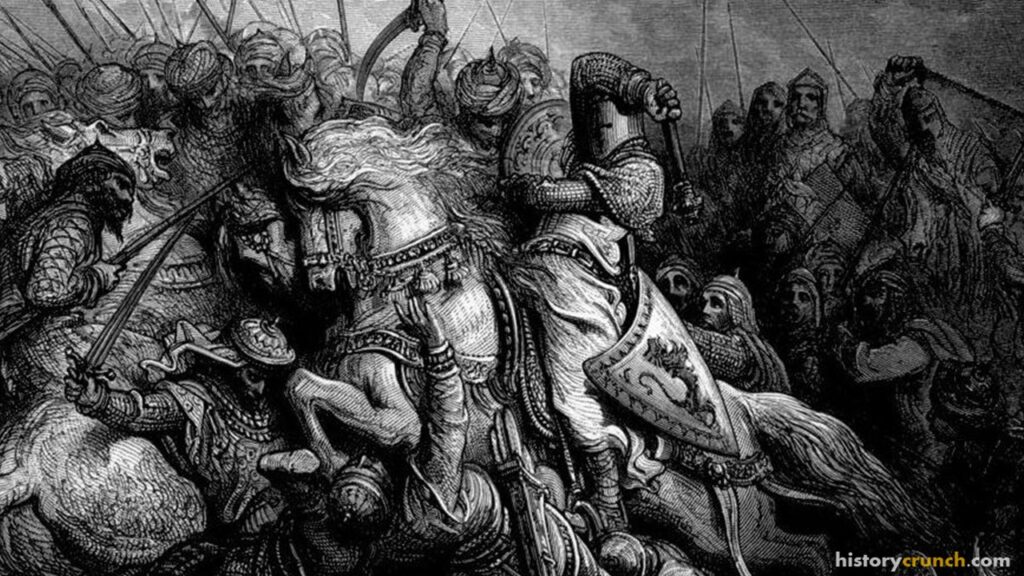
Marching south along the coast with the fleet beside him, Richard was attacked by Saladin near Arsuf on September 7th, 1191. He held his army together under hours of harassment and then broke Saladin's line with a single charge.
LEARN MORESHOW LESSwhy it matters · 2 key figuresWARIt was the only pitched battle of the Third Crusade and Saladin's first defeat in the field. It did not change the war, because Jerusalem was still fifty miles inland.
In June of 1192 the crusaders advanced to within a few miles of Jerusalem. Richard judged that he could take the city but not hold it once the crusaders went home, and the army turned back to the coast.
LEARN MORESHOW LESSwhy it matters · 1 key figureWAROne story has Richard refusing to look at the city he would not capture. Whether or not it is true, it is the moment the Third Crusade stopped being about Jerusalem.
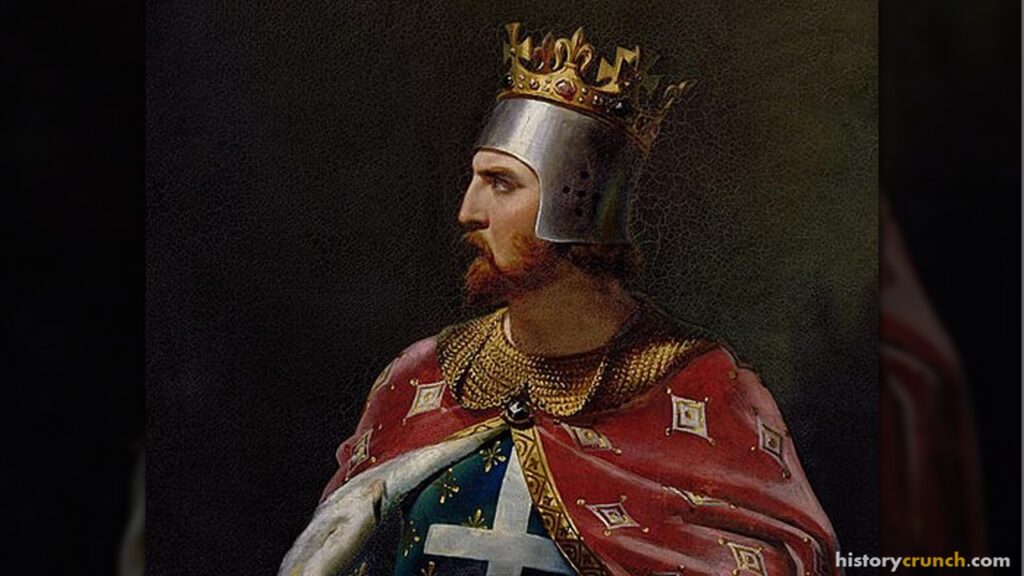
On September 2nd, 1192, Richard and Saladin agreed a three-year truce. The crusaders kept the coast from Tyre to Jaffa; Saladin kept Jerusalem, and unarmed Christian pilgrims were free to visit it.
LEARN MORESHOW LESSwhy it matters · a debate · 2 key figuresDIPLOMACYThe crusade ended by treaty with the city in Muslim hands, and pilgrims walking in unhindered, which is more or less what the First Crusade had been called to secure.
Did the Third Crusade fail?
Yes. It set out to retake Jerusalem and did not. The largest army of the Crusades ended with a truce that left the city where it was.
No. It saved the Crusader States, which were a week from extinction in 1187, recovered the whole coast, and won pilgrims access to Jerusalem without a garrison to defend it.
Travelling home in disguise through Austria, Richard was recognized and seized near Vienna in December of 1192 by Duke Leopold, whom he had publicly insulted at Acre. Leopold handed him to the emperor.
LEARN MORESHOW LESSwhy it matters · 1 key figurePOLITICSA crusader's person was supposed to be protected by the Church. That did not stop the duke or the emperor, who wanted money.
Saladin died in Damascus on March 4th, 1193, six months after the truce, aged about fifty-five. He had given away so much that there was said to be barely enough money left to bury him.
LEARN MORESHOW LESSwhy it matters · 1 key figurePOLITICSHis empire was divided among his relatives and never again pressed the Crusader States as hard. In the west he became the one Muslim ruler Christian writers praised, which tells you something about both.
The emperor demanded 150,000 marks of silver, several years of English royal income. It was raised by taxing the kingdom, and Richard was released in February of 1194.
LEARN MORESHOW LESSwhy it matters · key numbers · 1 key figurePOLITICSThe cost of one crusader's homecoming was felt by every taxpayer in England. Crusading was never only the crusaders' affair.
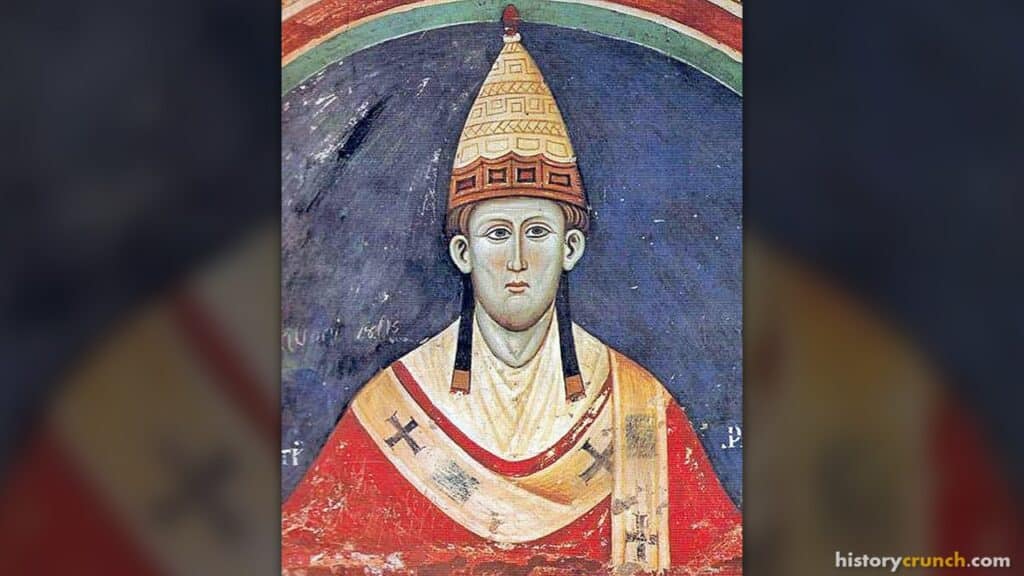
Innocent III, elected pope in 1198 at thirty-seven, called for a new crusade in the first year of his reign. The plan was to strike at Egypt, the center of Muslim power, rather than march on Jerusalem directly.
LEARN MORESHOW LESSwhy it mattersRELIGIONInnocent was the most powerful pope of the Middle Ages and the crusade was to be his. It ended up being the one crusade the papacy could least control.
Richard died on April 6th, 1199, aged forty-one, from a crossbow wound taken while besieging the small castle of Chalus-Chabrol in Aquitaine. His brother John succeeded him.
LEARN MORESHOW LESSwhy it matters · 1 key figurePOLITICSThe most famous crusader king died in a minor siege over a dispute about treasure. John lost most of the family's French lands within five years.
A crusade called against Egypt contracted Venice for a fleet three times larger than the army that turned up. To pay the debt it took a Catholic city for Venice and was excommunicated. To pay the rest it agreed to put a claimant on the Byzantine throne, sailed to Constantinople, put him there, and when he could not pay either, stormed the largest Christian city in the world on April 13th, 1204 and looted it for three days. It never saw the Holy Land. The empire it broke recovered its capital in 1261 and never its strength.
In 1201 the crusade's leaders contracted with Venice, the greatest naval power in the Mediterranean, to build and crew a fleet for 33,500 crusaders. The price was 85,000 marks, payable before sailing.
LEARN MORESHOW LESSwhy it matters · key numbersPOLITICSThe number was a guess and it was far too high. When only about a third of the expected crusaders turned up, the debt to Venice decided where the crusade went.
Unable to pay, the crusaders accepted Venice's offer to defer the debt in exchange for helping recapture Zara, a Christian city on the Adriatic that had rebelled against Venetian rule. They took it in November of 1202. The pope excommunicated the whole army.
LEARN MORESHOW LESSwhy it mattersWARA crusade called against Muslims began by sacking a Catholic city for a creditor. Once that line was crossed, Constantinople was only a larger version of the same decision.
A claimant to the Byzantine throne offered the crusaders money and soldiers if they would put him on it. The fleet sailed to Constantinople instead of Egypt and arrived on June 23rd, 1203, outside a city of about 500,000 people defended by 15,000 soldiers.
LEARN MORESHOW LESSwhy it matters · key numbersPOLITICSHistorians still argue over whether Venice steered the crusade there on purpose. Either way, an army sent to fight Islam was now outside the largest Christian city in the world.
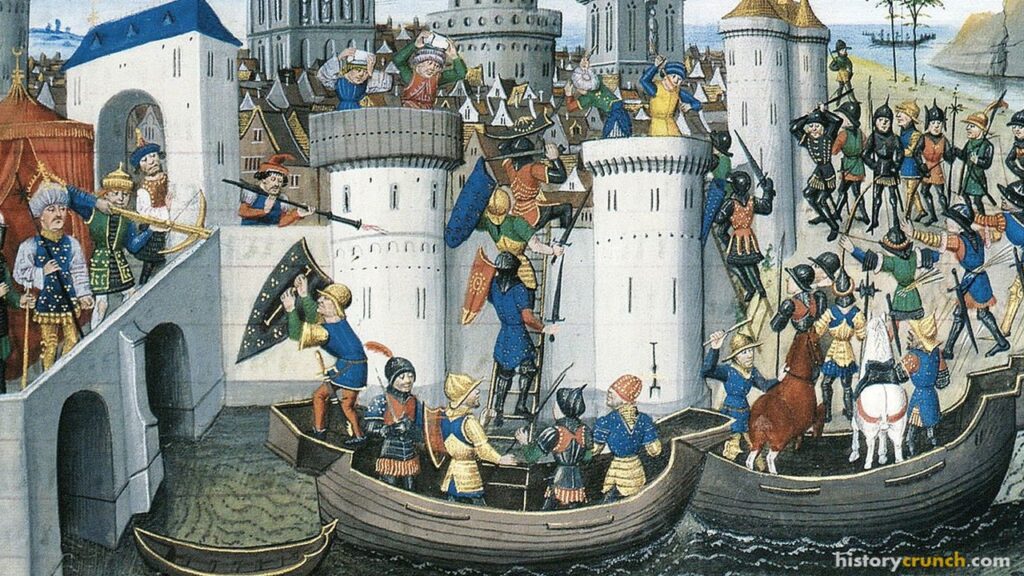
The crusaders attacked from July 11th, 1203. On August 1st the emperor fled and the crusaders' candidate was crowned, but he could not pay what he had promised, and the city turned against him and them.
LEARN MORESHOW LESSwhy it mattersSIEGEThe crusaders had done what they came for and got nothing. Over the winter the deal fell apart, and in the spring they attacked the city for themselves.
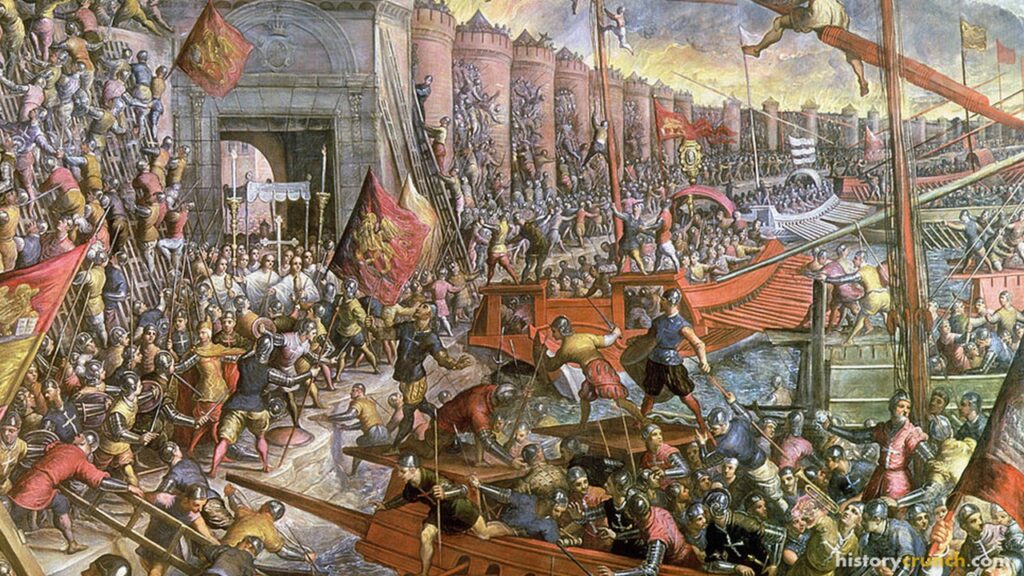
After fighting through the spring, the crusaders broke into Constantinople on April 13th, 1204 and sacked it for three days: churches stripped, the Hagia Sophia looted, and treasures that had survived since antiquity carried off or melted down. The empire was carved into crusader and Venetian states.
LEARN MORESHOW LESSwhy it matters · a debateWARThe Fourth Crusade never reached the Holy Land. It destroyed the Christian empire that had asked for the First Crusade, deepened the schism of 1054 beyond repair, and left Constantinople too weak to survive the Turks two centuries later.
Was the sack of Constantinople an accident?
Yes. A chain of debts and broken promises took a crusade somewhere no one had planned to go, and each step looked reasonable to the people taking it.
No. Venice had every reason to want its rival broken, the crusade's leaders had every reason to want a rich city, and the 'accident' happened to serve both perfectly.
The planners now reasoned that Jerusalem could not be held while Egypt was hostile. The Fifth Crusade took Damietta after sixteen months, was offered Jerusalem in exchange for leaving, refused, marched on Cairo and surrendered in the flooded delta. An excommunicated emperor then got Jerusalem back by treaty without a battle, and nobody rebuilt the walls, so it was lost again in 1244. Louis IX of France, the best-prepared crusader since Barbarossa, took Damietta in a day, marched on Cairo, and was captured in the same mud thirty years after the last army had been.
In April of 1213 Innocent III called for another crusade, this one planned and financed by the Church from the start so that no one could divert it. The target was Egypt again.
LEARN MORESHOW LESSwhy it mattersRELIGIONThe lesson of the Fourth Crusade was that the pope had to own the whole thing. He did, and it changed the outcome very little.
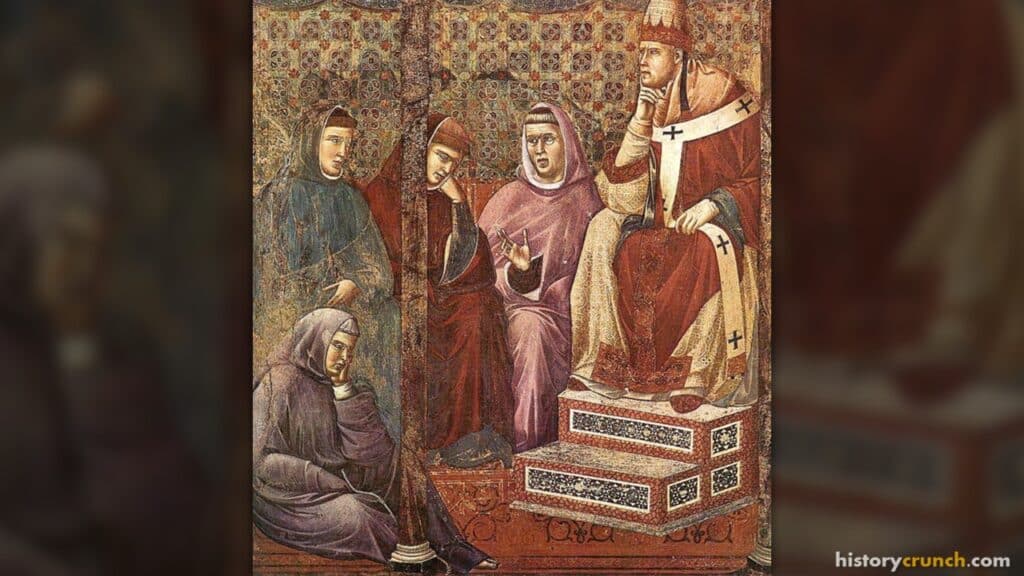
Innocent III died on July 16th, 1216, a year before the crusade he had organized set out. His successor, Honorius III, saw it through.
LEARN MORESHOW LESSwhy it mattersRELIGIONTwo crusades called, neither of them seen to its end. The most powerful pope of the age never saw a crusader army reach the Holy Land.
The Fifth Crusade began in July of 1217 when King Andrew II of Hungary left for the Holy Land. As many as 30,000 crusaders took part in all. Andrew fell ill early in 1218 and went home.
LEARN MORESHOW LESSwhy it matters · key numbersWARThe first king to go was gone within six months. The crusade fought on under a papal legate, which is where its trouble started.
In July of 1218 the crusaders landed in Egypt and besieged Damietta, the fortress city at the mouth of the Nile that controlled the way to Cairo.
LEARN MORESHOW LESSwhy it mattersSIEGETake Damietta, the thinking went, and Egypt would trade Jerusalem to get it back. The thinking was right, as it turned out, and the crusaders still lost.
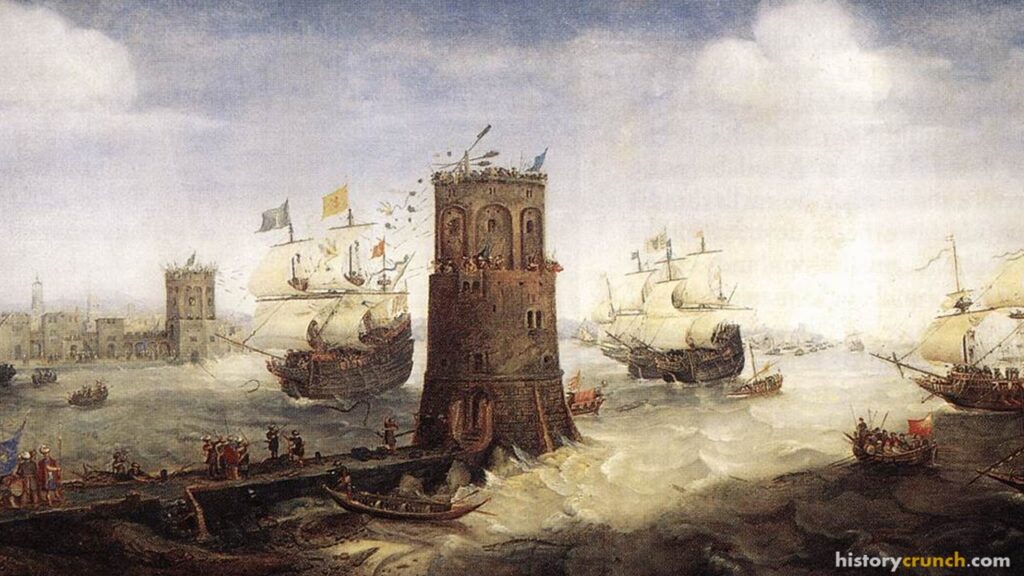
Damietta held out for sixteen months and fell in November of 1219. The sultan offered to hand over Jerusalem in return for the crusaders leaving Egypt. The papal legate refused.
LEARN MORESHOW LESSwhy it mattersSIEGEThe whole point of the crusades was on the table and the man in charge said no. He was holding out for Cairo, and Cairo was where the crusade died.
In July of 1221 the crusaders marched south toward Cairo. The Nile flooded, the Egyptians opened the sluices, and the army was trapped in the mud. It surrendered, gave up Damietta and left Egypt.
LEARN MORESHOW LESSwhy it mattersWARFour years, 30,000 men, and the crusade ended with less than it had started with. Jerusalem had been offered twice and refused twice.
The Holy Roman Emperor Frederick II had promised to crusade for years and kept postponing. The pope excommunicated him for it. In 1228 he went anyway, with a small army and no papal blessing.
LEARN MORESHOW LESSwhy it matters · 1 key figureDIPLOMACYA crusade led by a man the Church had cast out. Frederick spoke Arabic, knew the sultan's envoys, and had no intention of fighting if he could talk.
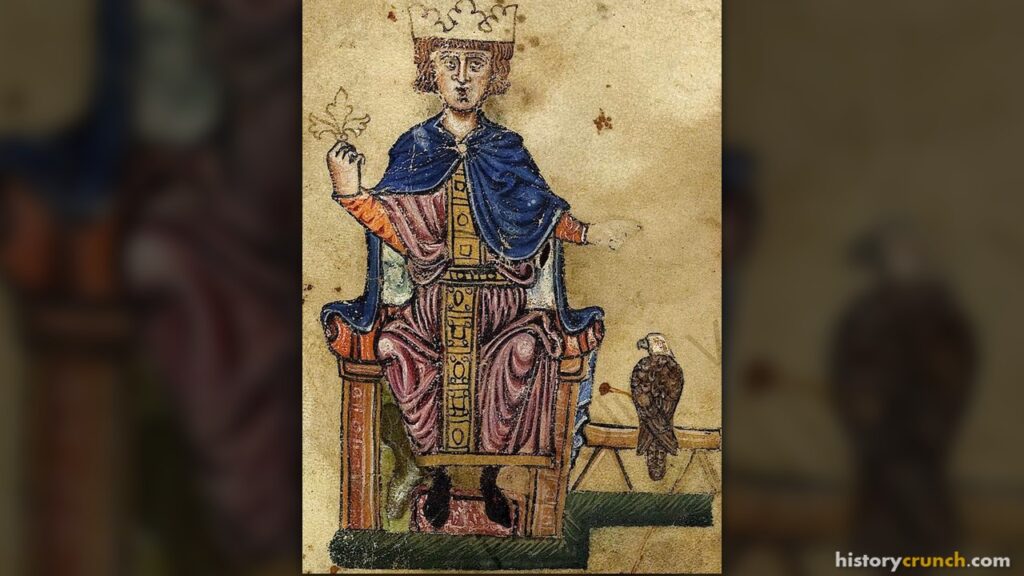
Frederick negotiated a ten-year treaty with the sultan of Egypt that handed Jerusalem, Bethlehem and Nazareth to the Christians, with the Muslim holy places left under Muslim control. He walked into Jerusalem on March 17th, 1229 and crowned himself.
LEARN MORESHOW LESSwhy it matters · a debate · 1 key figureDIPLOMACYThe only crusade to recover Jerusalem after the first did it without a battle, led by an excommunicate. Neither side's clergy forgave him for proving it could be done.
Was the Sixth Crusade a success?
Yes. It recovered Jerusalem, Bethlehem and Nazareth without a single battle, which no crusade since the first had managed by any means.
No. The treaty ran out, the city was indefensible without its walls, and it was lost again fifteen years later. Frederick gained a title and Jerusalem gained nothing lasting.
The treaty expired and nobody had rebuilt the walls. In 1244 Khwarazmian horsemen, allies of the Egyptian sultan, stormed Jerusalem and sacked it. The city was never in Christian hands again.
LEARN MORESHOW LESSwhy it mattersWARFifteen years after Frederick's treaty, Jerusalem was gone for good. It was the news that sent a king of France to Egypt.
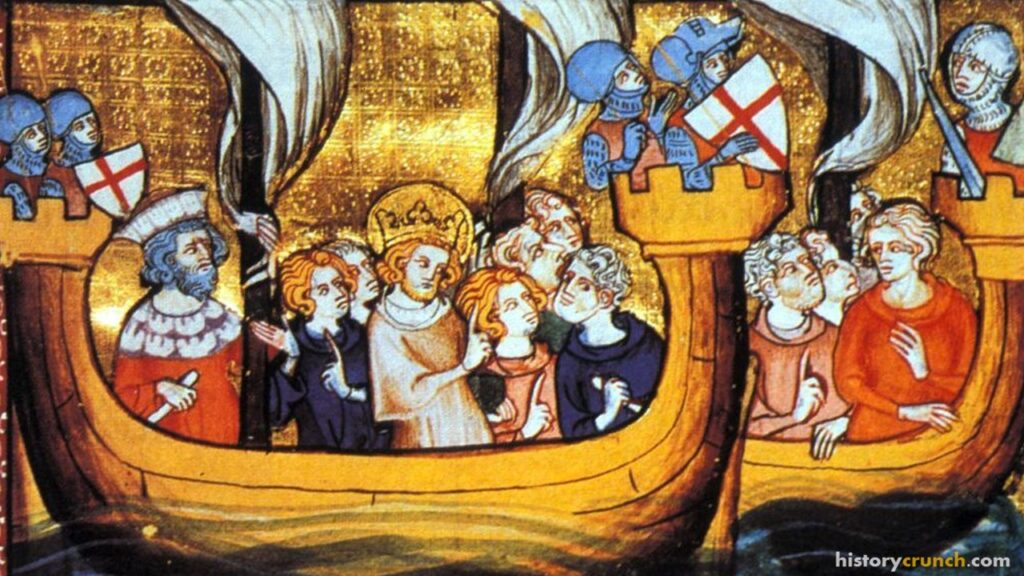
Louis IX of France, who had vowed to crusade during a near-fatal illness, sailed from Aigues-Mortes in 1248 with over 15,000 men, 3,000 of them knights, in thirty-six ships. He aimed at Egypt.
LEARN MORESHOW LESSwhy it matters · key numbers · 1 key figureWARLouis was the most devout king in Europe, later a saint, and the best-prepared crusader since the emperor Barbarossa. Preparation was not the problem.
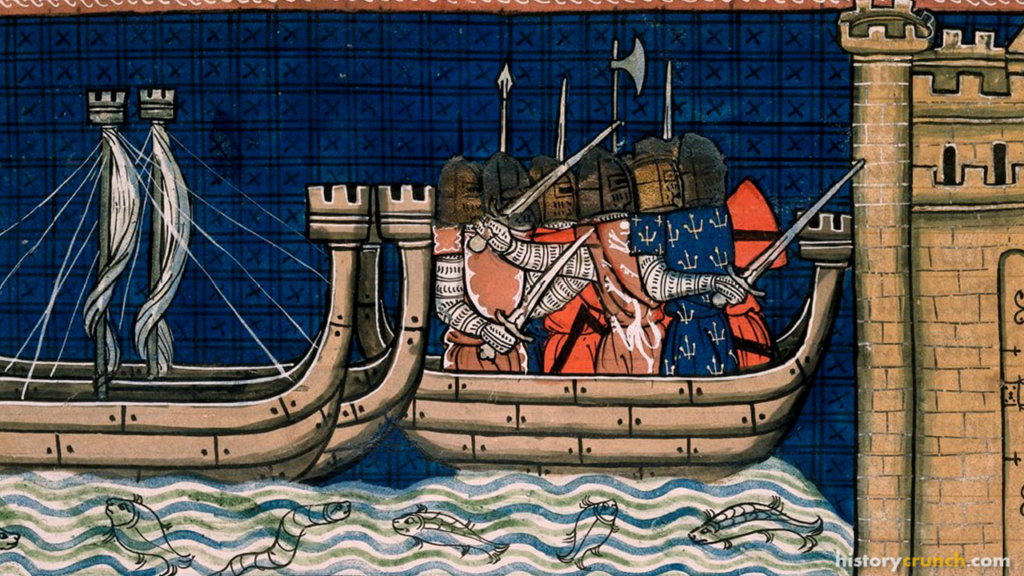
Louis landed at Damietta in 1249 and took it almost at once; the Egyptian garrison fled. It was the same city the Fifth Crusade had spent sixteen months besieging.
LEARN MORESHOW LESSwhy it matters · 1 key figureSIEGEIt looked like the Fifth Crusade's mistakes had been learned. Then the army marched south toward Cairo, exactly as the Fifth Crusade had.
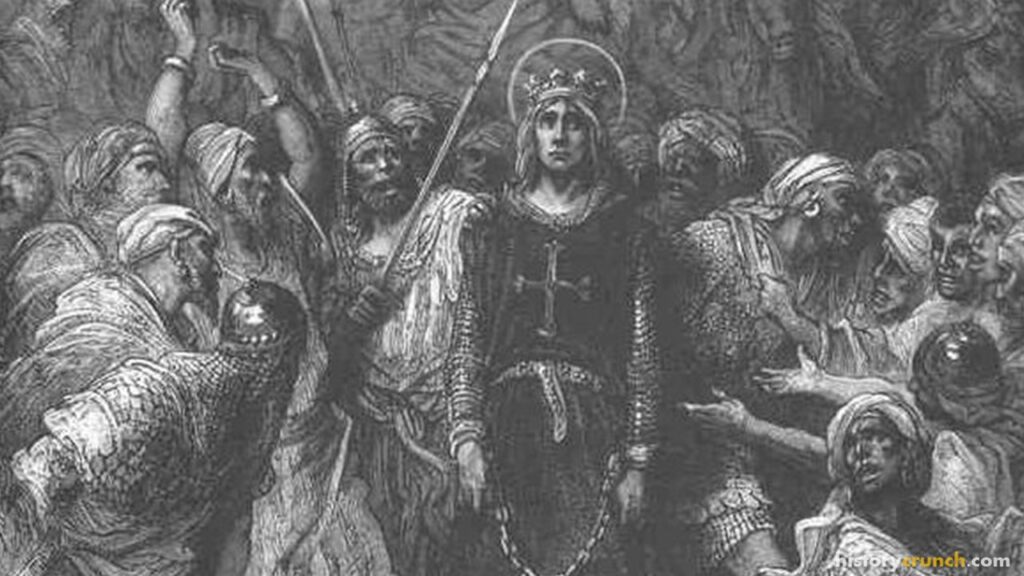
Beaten and sick with dysentery on the road to Cairo, Louis ordered a retreat to Damietta in March of 1250. The army was caught and destroyed, and the king of France was taken prisoner. He was ransomed for Damietta and 400,000 livres.
LEARN MORESHOW LESSwhy it matters · 1 key figureWARFor the second time in thirty years the road to Cairo had swallowed a crusade. This time it had swallowed a king.
Released, Louis spent four years in the Holy Land strengthening the coastal cities' walls at his own expense before returning to France in 1254. The Seventh Crusade had captured no lasting territory.
LEARN MORESHOW LESSwhy it matters · 1 key figurePOLITICSHe went home a failure by any military measure and a hero by every other one. Sixteen years later he tried again.
Louis IX took the cross a second time and went to Tunis, 1,500 miles from Jerusalem, for reasons historians still argue about, and died of dysentery in his camp within six weeks. Edward of England, sailing to join him, went on to Acre alone with a thousand men, helped it survive one attack, made a truce and survived an assassin. He was the last western prince to fight in the Holy Land. In 1291 the Mamluks took Acre in six weeks and no army came. Popes went on calling crusades for two more centuries; nobody answered.
On March 24th, 1267, Louis IX announced that he would go on crusade again. His nobles were unenthusiastic, and the target this time was not Egypt or the Holy Land but Tunis, in North Africa.
LEARN MORESHOW LESSwhy it matters · 1 key figureRELIGIONWhy Tunis has puzzled historians ever since. Louis may have believed its ruler could be converted; his brother, the king of Sicily, had interests there. Either way it was 1,500 miles from Jerusalem.
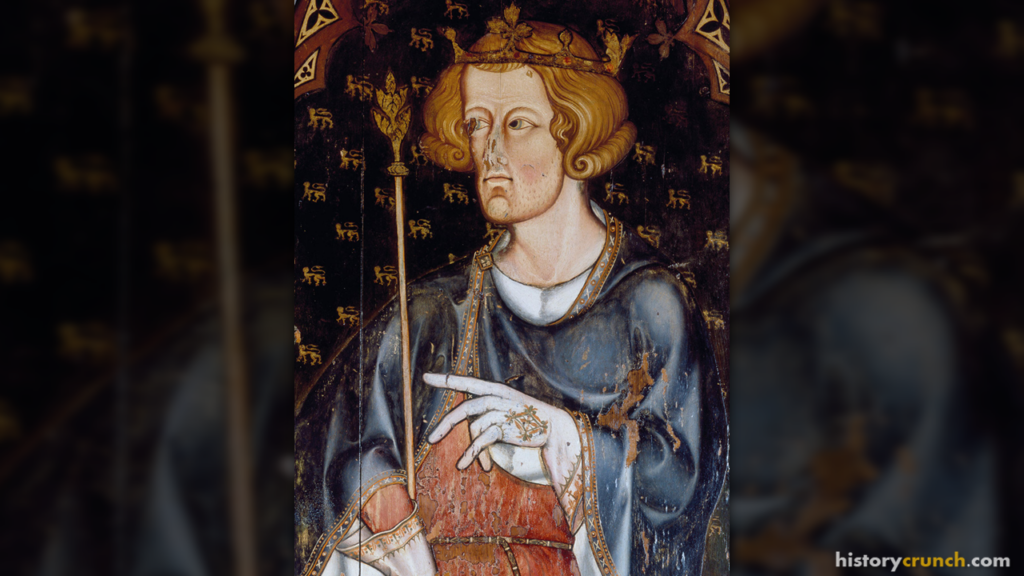
Inspired by Louis, Edward, the heir to the English throne, took the cross on June 24th, 1268 and began raising money and men to join the French king.
LEARN MORESHOW LESSwhy it matters · 1 key figureRELIGIONEdward would be the last major western leader to fight in the Holy Land. He is better known as the king who conquered Wales and hammered the Scots.
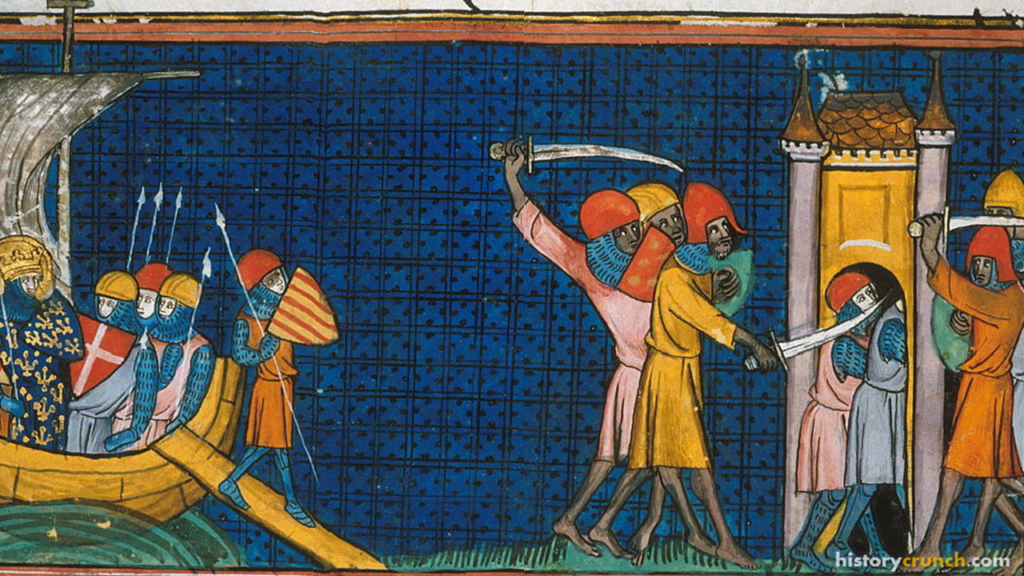
The French fleet sailed on July 1st, 1270 and landed on the coast near Tunis on July 18th, in the full heat of a North African summer, with the city's ruler in no hurry to convert.
LEARN MORESHOW LESSwhy it matters · 1 key figureWARThe crusaders had picked the worst season and the wrong enemy. Within weeks the camp was sick.
Lord Edward left Dover by ship on August 20th, 1270, meaning to join Louis at Tunis. By the time he arrived, the French king had been dead for weeks and the French were going home.
LEARN MORESHOW LESSwhy it matters · 1 key figureWAREdward decided to go on to the Holy Land anyway. His small force is what historians count as the Ninth Crusade.
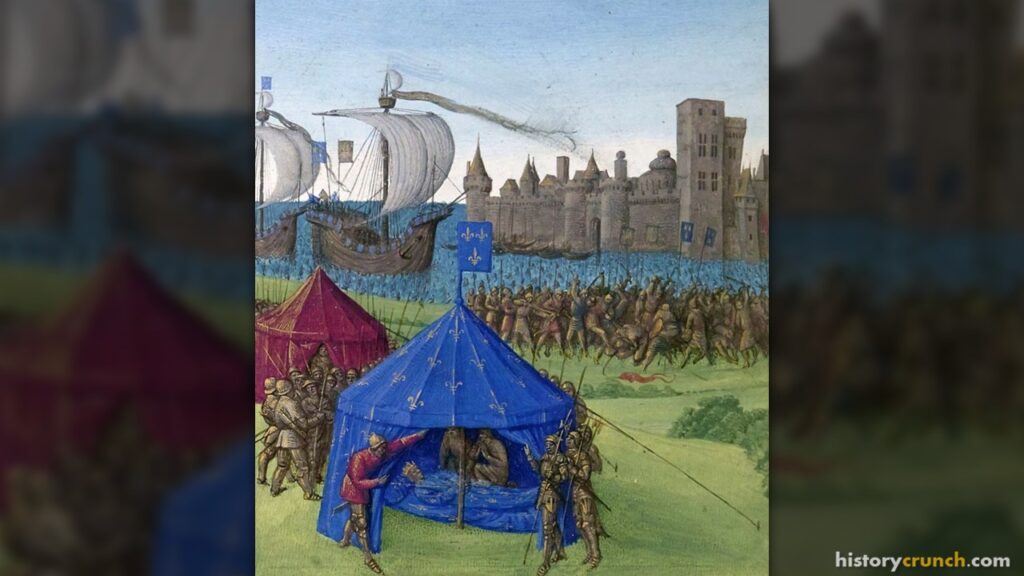
Dysentery spread through the French camp through the summer of 1270, killing a large part of the army. On August 25th it killed the king. The Eighth Crusade ended with him, and the survivors sailed home.
LEARN MORESHOW LESSwhy it matters · 1 key figureWARThe last crusade led by a king ended in a tent outside a city that had nothing to do with Jerusalem. Louis was made a saint twenty-seven years later, the only crusader king who was.
Lord Edward landed at Acre on May 9th, 1271 with about 1,000 men, including 225 knights. Acre was by then almost all that was left of the Kingdom of Jerusalem.
LEARN MORESHOW LESSwhy it matters · key numbers · 1 key figureWARA thousand men could not retake Jerusalem, and Edward knew it. What they could do was make the sultan think twice about finishing Acre off that year.
In December of 1271 Edward's crusaders helped drive off an attack on Acre. It was a small action that bought the city another twenty years.
LEARN MORESHOW LESSwhy it mattersSIEGEThe Ninth Crusade won no battles worth the name. It simply kept the last Crusader city alive a little longer.
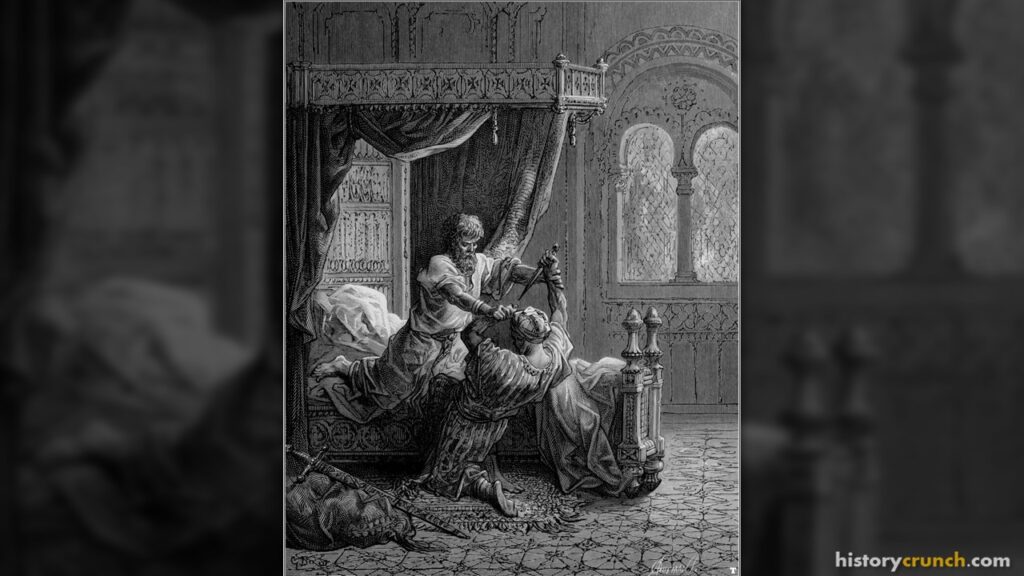
A ten-year truce was agreed in May of 1272. A month later an assassin sent in as a messenger stabbed Edward with a poisoned dagger. He killed the man and survived the wound.
LEARN MORESHOW LESSwhy it matters · 1 key figureDIPLOMACYThe attempt is the most famous thing that happened on the Ninth Crusade, which says something about the Ninth Crusade.
Edward's father died while he was on the way home, and he was crowned Edward I at Westminster on August 19th, 1274. He never went east again, though he talked about it for the rest of his life.
LEARN MORESHOW LESSwhy it matters · 1 key figurePOLITICSThe Ninth Crusade is sometimes called Lord Edward's Crusade because he was the only leader of note. It was the last time a western prince fought in the Holy Land.
In 1291 the Mamluks, the slave soldiers who now ruled Egypt, brought an army and siege engines against Acre. After six weeks the walls were breached and the city was stormed. The remaining coastal towns surrendered or were abandoned within months.
LEARN MORESHOW LESSwhy it matters · key numbers · a debateSIEGETwo hundred years after Clermont, there was no Crusader State left on the mainland. This is the card that ends the Crusades, whatever the dates say.
Why did the Crusader States fall?
Because Europe stopped sending armies. After Louis IX died, no king went east again, and Acre was left to a garrison and a handful of military orders.
Because they could never have lasted. Four small states of western settlers on a hostile coast, dependent on a sea route and on Muslim disunity, were finished the moment Saladin and then the Mamluks united Egypt and Syria.
Some Christian forces held out on islands and in scattered posts off the coast for another decade. By about 1303 the last of them had been defeated or withdrawn to Cyprus.
LEARN MORESHOW LESSwhy it mattersWARThe Crusades did not so much end as run out. Popes went on calling for crusades for another two centuries; armies stopped answering.

I'm a passionate history and geography teacher with over 15 years of experience working with students in the middle and high school years. I have an Education Degree with a focus in World History. I have been writing articles for History Crunch since 2015 and love the challenge of creating historical content for young learners!

I'm the founder of History Crunch, which I first began in 2015 with a small team of like-minded professionals. I have an Education Degree with a focus in Social Studies education. I spent nearly 15 years teaching history, geography and economics in secondary classrooms to thousands of students. Now I use my time and passion researching, writing and thinking about history education for today's students and teachers.
To cite this timeline as a source, use one of the formats below.
MLA: Beck, E., and B. Millar. “Crusades Timeline.” HistoryCrunch, 14 September 2026, https://historycrunch.com/crusades-timeline/.
APA: Beck, E., & Millar, B. (2026). Crusades Timeline. HistoryCrunch. https://historycrunch.com/crusades-timeline/
Chicago: Beck, E., and B. Millar. “Crusades Timeline.” HistoryCrunch. September 14, 2026. https://historycrunch.com/crusades-timeline/
© History Crunch
A sermon in France in 1095 sent tens of thousands of people 2,000 miles east. Sermons do not usually do that.
It cost a fortune, took years, and most who went did not come back. Tens of thousands went anyway.
One walled city, about a square mile, held sacred by three religions.
He asked for knights to help the emperor. He got a mass movement that took Jerusalem and never gave it back.
Four armies, no single commander, 2,000 miles from home, and three years later they held Jerusalem.
Thousands of peasants set out before the knights did. Almost none of them came home.
Eight months outside one city. The First Crusade is remembered for Jerusalem; it was decided at Antioch.
The crusaders' own writers described the killing. They did not think it needed excusing.
Four small states of western settlers on a hostile coast, held for two centuries by castles and a sea route.
Not battles. Walking, hunger, disease, and waiting outside walls.
For a century the Church had tried to stop knights fighting. Then it found them somewhere to fight.
Antioch, Jerusalem, Acre, Damietta, Constantinople. Not one of the turning points was a battle in the open.
A queen of France rode to Antioch with her own escort. She was not the only woman there.
The Muslim ruler who took Jerusalem back, and the only one Christian writers praised.
Every castle emptied to make one army, and the army marched into hills with no water.
The largest army of the Crusades, three of Europe's most powerful rulers, and Jerusalem stayed where it was.
He is the crusader king of every legend. He spent six months of a ten-year reign in England and killed 3,000 prisoners.
The largest army of the Third Crusade, led by the most experienced soldier in Europe, and it fought no battle against Saladin.
Two kings, 35,000 men, and the result was a five-day siege of the wrong city.
An army called to fight Islam destroyed the largest Christian city in the world and never saw the Holy Land.
The city that built the fleet ended up with a quarter of the Byzantine Empire. Historians have argued about it for 800 years.
The Fifth, Seventh and the planned Fourth all went for the Nile. All three failed at the same place.
Frederick II talked the sultan into handing over the city. Neither side's clergy ever forgave him.
A saint, a fortune, 15,000 men, and two crusades that ended in a prison and a tent.
A thousand men under an English prince, a truce, and an assassin. The last crusade in the Holy Land.
The last Crusader city fell in six weeks. No king in Europe sent an army.
Popes went on calling for crusades for two more centuries. Armies stopped answering.
Two centuries of war for a city that was lost. What was different when it was over?
The First Crusade came because the emperor asked for help. The Fourth Crusade sacked his capital.
For Europe the Crusades were the great event of the age. For the caliphate in Baghdad they were a frontier war.
The crusaders believed God willed it. So did the men who fought them. The question has not gone away.
No question matches that word.
Research question 1A sermon in France in 1095 sent tens of thousands of people 2,000 miles east. Sermons do not usually do that.
Research question 2It cost a fortune, took years, and most who went did not come back. Tens of thousands went anyway.
Research question 3One walled city, about a square mile, held sacred by three religions.
Research question 4He asked for knights to help the emperor. He got a mass movement that took Jerusalem and never gave it back.
Research question 5Four armies, no single commander, 2,000 miles from home, and three years later they held Jerusalem.
Research question 6Thousands of peasants set out before the knights did. Almost none of them came home.
Research question 7Eight months outside one city. The First Crusade is remembered for Jerusalem; it was decided at Antioch.
Research question 8The crusaders' own writers described the killing. They did not think it needed excusing.
Research question 9Four small states of western settlers on a hostile coast, held for two centuries by castles and a sea route.
Research question 10Not battles. Walking, hunger, disease, and waiting outside walls.
Research question 11For a century the Church had tried to stop knights fighting. Then it found them somewhere to fight.
Research question 12Antioch, Jerusalem, Acre, Damietta, Constantinople. Not one of the turning points was a battle in the open.
Research question 13A queen of France rode to Antioch with her own escort. She was not the only woman there.
Research question 14The Muslim ruler who took Jerusalem back, and the only one Christian writers praised.
Research question 15Every castle emptied to make one army, and the army marched into hills with no water.
Research question 16The largest army of the Crusades, three of Europe's most powerful rulers, and Jerusalem stayed where it was.
Research question 17He is the crusader king of every legend. He spent six months of a ten-year reign in England and killed 3,000 prisoners.
Research question 18The largest army of the Third Crusade, led by the most experienced soldier in Europe, and it fought no battle against Saladin.
Research question 19Two kings, 35,000 men, and the result was a five-day siege of the wrong city.
Research question 20An army called to fight Islam destroyed the largest Christian city in the world and never saw the Holy Land.
Research question 21The city that built the fleet ended up with a quarter of the Byzantine Empire. Historians have argued about it for 800 years.
Research question 22The Fifth, Seventh and the planned Fourth all went for the Nile. All three failed at the same place.
Research question 23Frederick II talked the sultan into handing over the city. Neither side's clergy ever forgave him.
Research question 24A saint, a fortune, 15,000 men, and two crusades that ended in a prison and a tent.
Research question 25A thousand men under an English prince, a truce, and an assassin. The last crusade in the Holy Land.
Research question 26The last Crusader city fell in six weeks. No king in Europe sent an army.
Research question 27Popes went on calling for crusades for two more centuries. Armies stopped answering.
Research question 28Two centuries of war for a city that was lost. What was different when it was over?
Research question 29The First Crusade came because the emperor asked for help. The Fourth Crusade sacked his capital.
Research question 30For Europe the Crusades were the great event of the age. For the caliphate in Baghdad they were a frontier war.
Research question 31The crusaders believed God willed it. So did the men who fought them. The question has not gone away.