Daily life in the Middle Ages was shaped largely by a person’s place in the feudal system, which determined where they lived, what they ate, what work they did, and how much freedom they had. For the vast majority of people in medieval Europe, life was hard and centered on farming, religion, and survival.
What Were the Middle Ages?
The Middle Ages, also known as the Medieval Period, was a period of European history that lasted from approximately 500 CE to 1500 CE. It began with the fall of the Western Roman Empire and ended with the start of the Renaissance. During this time, European society was organized around the feudal systemA social structure where a king granted land to nobles in exchange for military service, with peasants at the bottom doing farm work., in which a king sat at the top of society and granted land to nobles and lords in exchange for military service and loyalty. Below the nobles were the knights, and below the knights were the peasants, who made up the vast majority of the population. The Catholic Church also played an enormous role in the lives of all people during the Middle Ages, influencing everything from the laws of the land to the daily routines of ordinary people. Understanding daily life in the Middle Ages requires looking at how different groups of people, from peasants to nobles to clergy, lived and worked within this system.
Daily Life in the Middle Ages – Peasants
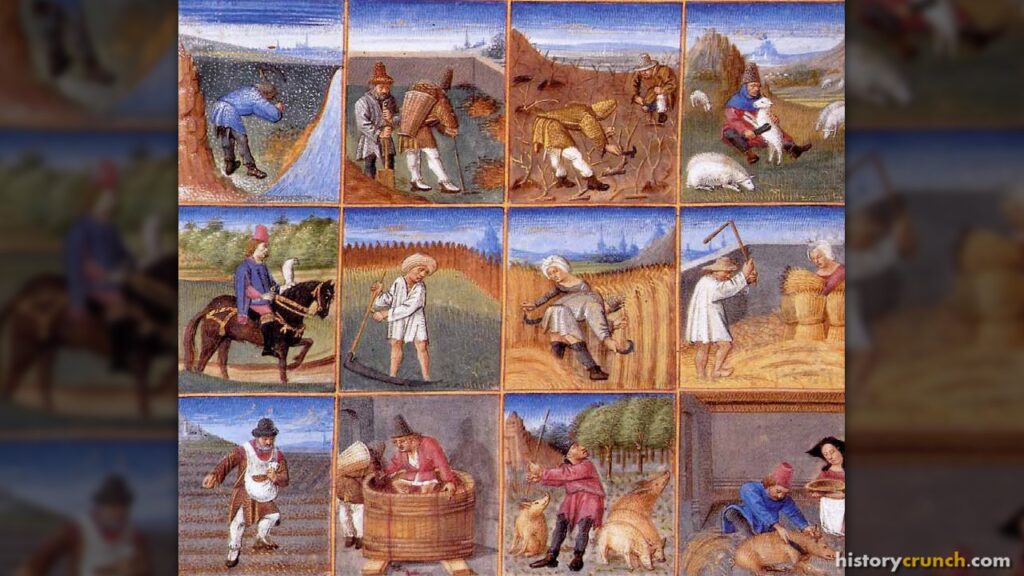
The majority of people living in the Middle Ages were peasants, and for most of them daily life meant long hours of hard physical labor. Peasants lived in small villages on the land of a local lord and were required to farm that land in exchange for protection and the right to live there. Their daily work followed the seasons closely, as the success of the harvest determined whether or not a family would have enough food to survive the winter. In spring and summer, peasants plowed fields and planted crops such as wheat, barley, and oats, and tended gardens that produced vegetables like beans, peas, and cabbage. In autumn they harvested, and in winter they carried out repairs, cared for animals, and prepared for the next growing season.
Peasant homes were simple and small, usually consisting of one or two rooms shared by the entire family. The walls were typically made from wattle and daubA wall-building method using woven wood strips packed with clay, common in peasant homes., which was a mixture of woven wood strips and clay, and the roofs were thatched with straw. There was little furniture, and a fire in the center of the room provided both heat and the means to cook food. The diet of a typical peasant was basic and repetitive. Most meals consisted of a thick soup called pottageA thick soup made from grains and available vegetables that formed the main meal for most medieval peasants., made from grains and whatever vegetables were available, along with coarse bread. Meat was a rare treat for peasants, and when it was available it was often salted or smoked to preserve it. Despite the hard conditions of their lives, peasants were not without any form of enjoyment. Religious festivals, feast days, and local celebrations offered breaks from the routine of work and gave communities a chance to come together.
 FactsthatCrunch
Daily Life in the Middle Ages – Nobles
Daily life for the nobility in the Middle Ages was considerably more comfortable than the lives of peasants, though it came with its own set of responsibilities and pressures. Nobles lived in large manorThe estate of a local lord where peasants lived and farmed in exchange for protection and the right to remain on the land. houses or castles and were responsible for managing their lands, collecting taxes from the peasants who worked on their property, and maintaining order within their territory. They also had military obligations to the king and were expected to provide soldiers and fight in wars when called upon. As well, nobles were expected to settle legal disputes among the people who lived on their land, which gave them considerable power over the lives of ordinary people.
In terms of food and lifestyle, the nobles of the Middle Ages enjoyed a standard of living that was far beyond what most people could imagine. Their meals included a wide variety of meats such as beef, pork, venison, and various birds, along with fine breads, sauces, and imported spices. Feasts were an important part of noble life and served as a way to show wealth and status. Noble households were also centers of entertainment, where musicians, storytellers, and jesters would perform. The children of nobles were given a formal education, either through private tutors or by being sent to serve in the household of another noble lord, where they would learn the skills expected of their class.
FactsthatCrunchNoble life in the Middle Ages came with real power and comfort, but also serious duties that could not be ignored.
Daily Life in the Middle Ages – Role of the Church
The Catholic Church was a central part of daily life for all people in the Middle Ages, regardless of their social class. Religion shaped the way people understood the world around them, and the teachings of the Church guided the moral decisions of kings, nobles, and peasants alike. Each day typically began with prayer, and the rhythm of the week was marked by church attendance and religious observances. The Church also controlled the calendar of the year, with important religious holidays such as Christmas and Easter bringing communities together for celebration and worship.
Beyond religion, the Church played a practical role in the lives of medieval people. MonasteriesReligious communities of monks that served as centers of education, healthcare, charity, and book preservation during the Middle Ages. and convents served as centers of education, healthcare, and charity. Monks and nuns ran schools, copied and preserved important books and manuscripts, and cared for the sick and the poor. The local parish church was often the most important building in a village and served as the center of community life. For most people in the Middle Ages, the Church provided not only spiritual guidance but also a sense of structure and meaning in a world that could be very difficult and unpredictable.
FactsthatCrunchWhich definition fits each monastery and convent role in medieval communities?
Daily Life in the Middle Ages – Life in Towns
While most people in the Middle Ages lived in the countryside, towns and cities were an important and growing part of medieval life. Towns developed around castles, cathedrals, and important trade routes, and they offered a different kind of daily life compared to the rural manor. People who lived in towns worked as craftsmen, merchants, bakers, blacksmiths, and in many other skilled jobs. Much of this work was organized through a system known as guildsGroups of skilled workers in the same trade that set craft standards, controlled prices, and trained newcomers through apprenticeship., which were groups of skilled workers in the same trade who set standards for their craft, controlled prices, and trained new workers through a system of apprenticeshipA training system where a young person spent years learning a trade directly from a skilled master craftsman.. Young boys would often spend several years learning a trade from a master craftsman before eventually becoming qualified workers themselves.
Life in medieval towns was crowded and could be quite difficult. Streets were narrow, homes were built close together, and sanitation was poor. Garbage and waste were often disposed of in the streets, which made towns prone to disease. Despite these challenges, towns offered opportunities that were not available on the manor. People in towns had more freedom than peasants tied to the land, and the growth of trade meant that skilled workers could earn a living and improve their position in society over time. As the Middle Ages progressed, towns grew in size and importance, eventually helping to bring about the major changes of the Renaissance.
FactsthatCrunchHow much freedom did a town craftsman have compared with a peasant tied to the manor in the Middle Ages?
Tap a point to read its detail.
Significance of Daily Life in the Middle Ages
Daily life in the Middle Ages was defined by hard work, strong religious faith, and a social system that determined the opportunities available to each person from birth. For peasants, life was a constant struggle to provide food and shelter for their families. For nobles, it meant managing land and fulfilling military duties. For the clergy, it meant a life of prayer, education, and service. Together, these groups formed a society that, while often harsh and unequal, was organized and functional for its time. Studying daily life in the Middle Ages helps students understand not only how people lived during this period but also how the foundations of modern European society were gradually built over centuries of struggle, faith, and change.
FactsthatCrunchStudying daily life in the Middle Ages reveals how institutions like guilds and the parish church directly shaped the economic and community structures that modern European societies still build on.
Guilds, which trained craftsmen through apprenticeship and set trade standards in medieval towns, established early models of organized labor and professional regulation that influenced European economies for centuries after the Middle Ages ended.
The Catholic Church ran schools and hospitals through monasteries and convents during the Middle Ages, creating the first widespread networks of public education and healthcare in Europe at a time when no government provided those services.
The growth of medieval towns along trade routes gave ordinary people opportunities to earn a living outside the feudal system, planting the seeds of a merchant middle class whose rise eventually changed how European society was organized.
Understanding how the feudal system assigned land, military duty, and legal power to different groups helps explain why questions of land rights, class, and inherited privilege remained central to European politics long after the medieval period closed.
Key Vocabulary
Feudal system
Wattle and daub
Pottage
Guilds
Apprenticeship
Monasteries
Manor
Frequently Asked Questions
What did peasants eat in the Middle Ages?
Peasants ate a basic and repetitive diet built around a thick soup called pottage. The soup was made from grains and whatever vegetables were on hand, and it was served with coarse bread. Meat was a rare treat, and when peasants had it, they often salted or smoked it to keep it from spoiling.
How were medieval peasant homes built?
Peasant homes were small and simple, usually just one or two rooms shared by the whole family. The walls were made from wattle and daub, which was woven wood strips packed with clay. Roofs were thatched with straw, and a central fire gave both heat and a way to cook.
How did daily life differ between nobles and peasants?
Nobles lived far more comfortably than peasants, in large manor houses or castles with rich food and feasts. They managed land, collected taxes, and had military duties to the king. Peasants, by contrast, spent long hours farming a lord’s land and struggled just to feed their families.
What role did the Catholic Church play in daily life?
The Catholic Church shaped daily life for everyone, no matter their social class. The day often began with prayer, and the week and year were marked by church services and holidays. Monasteries and convents also ran schools, cared for the sick and poor, and copied important books.
What was life like in medieval towns?
Town life centered on skilled trades such as baking, blacksmithing, and merchant work. Much of this work was organized through guilds, which set standards and trained new workers through apprenticeship. Towns were crowded and dirty with poor sanitation, but they gave people more freedom than peasants tied to the land.
When were the Middle Ages?
The Middle Ages lasted from about 500 CE to 1500 CE in European history. The period began with the fall of the Western Roman Empire and ended with the start of the Renaissance. Society during this time was organized around the feudal system, with the king at the top and peasants at the bottom.
Cite This Article
To cite this article as a source, use one of the formats below.
MLA: Millar, B. “Daily Life in the Middle Ages: A Detailed Summary.” HistoryCrunch, 16 October 2026, https://historycrunch.com/daily-life-in-the-middle-ages/.
APA: Millar, B. (2026). Daily Life in the Middle Ages: A Detailed Summary. HistoryCrunch. https://historycrunch.com/daily-life-in-the-middle-ages/
Chicago: Millar, B. “Daily Life in the Middle Ages: A Detailed Summary.” HistoryCrunch. October 16, 2026. https://historycrunch.com/daily-life-in-the-middle-ages/
Sources
- The Met (Heilbrunn Timeline): medieval art
- Jacques Le Goff, Medieval Civilization 400-1500.