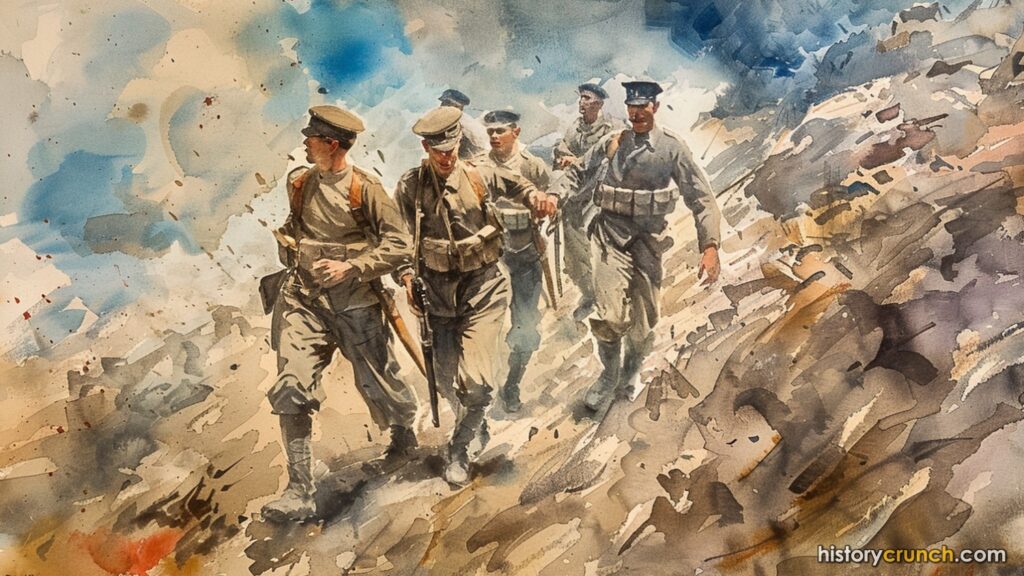
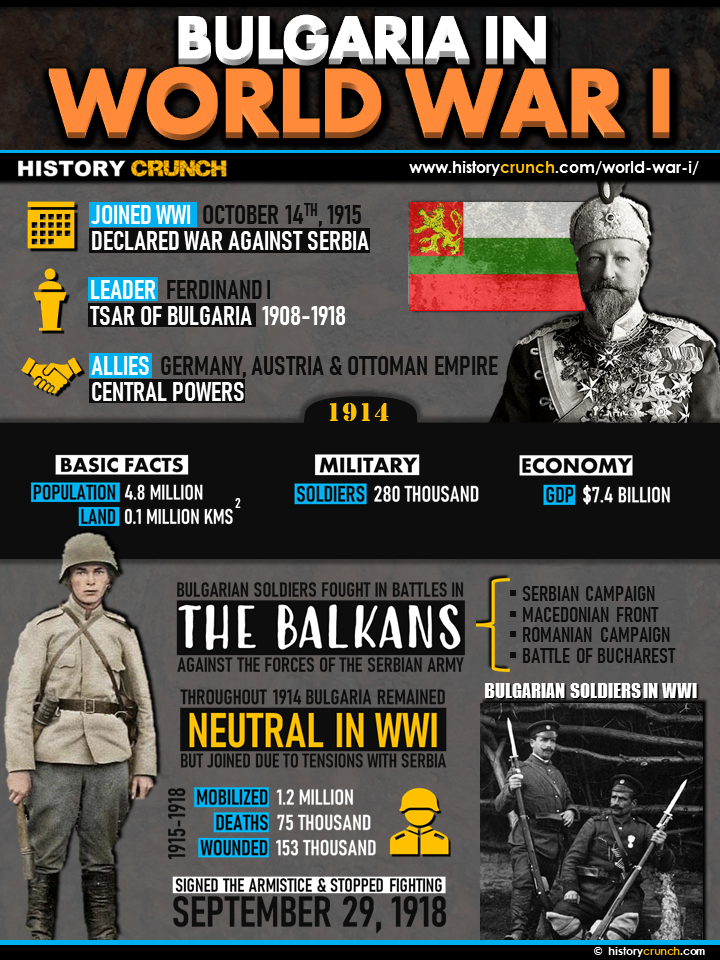
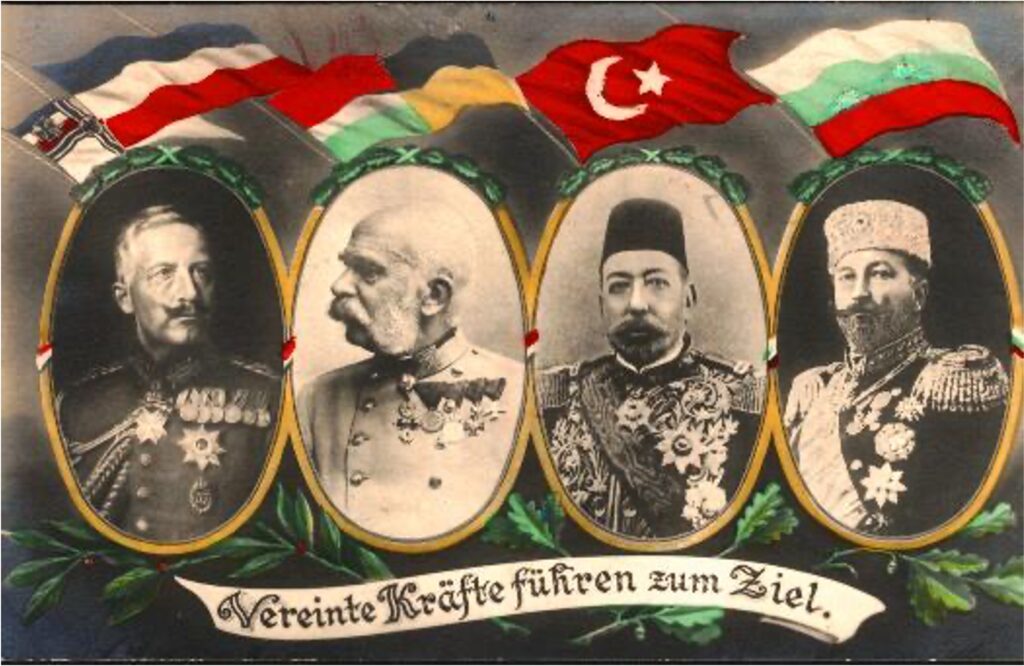
Bulgaria was an important nation in the events of World War I. In fact, Bulgaria joined the fighting of World War I on the side of the Central Powers alongside Germany, Austria-Hungary and the Ottoman Empire. More specifically, Bulgaria participated in World War I from October 14th, 1915 until September 30th, 1918. Throughout the war, they primarily fought in battles in the Balkans.
 FactsthatCrunch
Bulgaria Declares War on Serbia and Joins World War I on the Side of the Central Powers
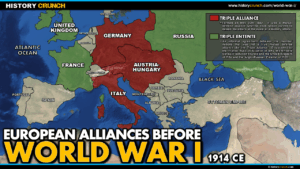
Bulgaria had stayed neutral since the war began in 1914, led by Prime Minister Vasil Radoslavov. On September 6th, 1915, Bulgaria signed a formal agreement with the Central Powers, and Germany and Austria-Hungary had already launched their own assault on Serbia before Bulgaria acted. On October 14th, 1915, Bulgaria declared war on Serbia and sent its First and Second Armies across the border, joining the Serbian Campaign as the fourth member of the Central Powers alongside Germany, Austria-Hungary, and the Ottoman Empire.
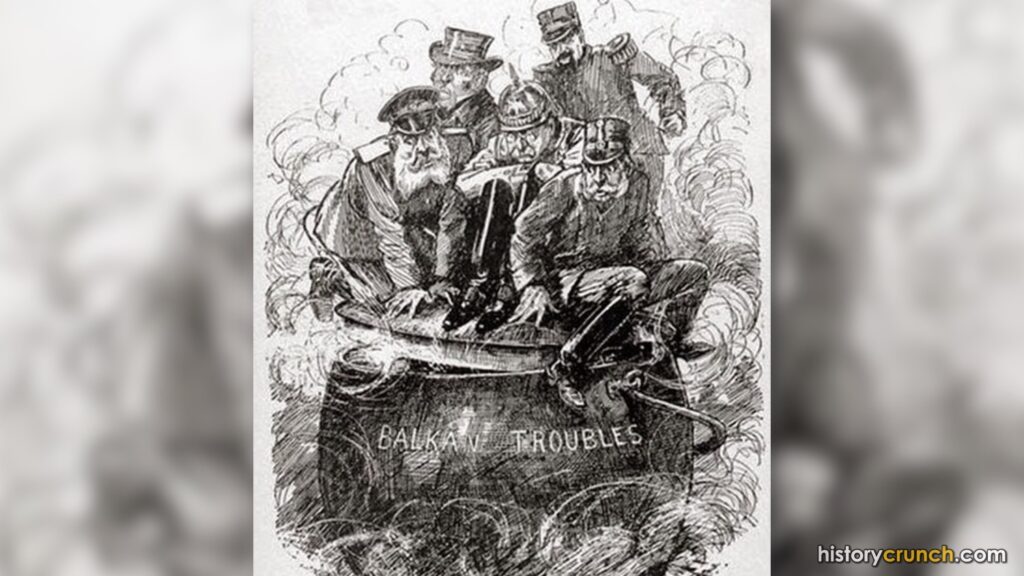
Bulgaria Enters World War I
World War I erupted during the summer of 1914 in an event that historians refer to as the July Crisis. In short, this crisis was caused by the assassination of Austrian Archduke Franz Ferdinand, which led to the major European powers engaging in a conflict. Ferdinand was assassinated on June 28th, 1914 due to a rise in nationalism in the southeastern region of Europe referred to as the Balkans. The Balkans actually experienced a great deal of conflict in the years before the outbreak of World War I. For example, two Balkan Wars (First Balkan War and Second Balkan War) took place in 1912 and 1913. Bulgaria was a significant nation in these conflicts, which ultimately helped set the stage for the outbreak of World War I.

Franz Ferdinand was the Archduke of Austria-Hungary and next in line to rule over the empire. Ferdinand and his wife Sophie were assassinated on June 28th, 1914 in Sarajevo, the capital of the Austro-Hungarian province of Bosnia and Herzegovina, while there on a visit to inspect the military forces. The assassin was Gavrilo Princip. Just nineteen years old at the time, Princip was a member of the Black Hand, which was a Serbian nationalist organization that existed in the early part of the 20th century. Historians consider this event to be one of the main causes of World War I, as it caused many of the European nations to increase their hostility against one another.
For its part, Bulgaria immediately declared itself neutralNot taking sides in a conflict between other countries or groups. in the conflict. This was due to several factors, but for the most part Bulgaria was not interested in getting involved in a major conflict with the other European powers. Bulgaria was still recovering economically and militarily from the two Balkan Wars, and did not want to commit itself to another conflict. As well, in the early days of World War I, it was assumed that the war would be over relatively quickly. As such, officials in Bulgaria did not see the benefit of participating in a conflict that would be over in just a few months. Regardless, both the Central Powers and the Allied Powers presented Bulgaria with options to join the war effort on their side. These included proposals directly given to Ferdinand I, the Tsar of Bulgaria. However, Bulgaria remained neutral throughout 1914, under the leadership of Bulgarian Prime Minister Vasil Radoslavov.
As the war raged on throughout the rest of Europe, the main European nations continued to put pressure on Bulgaria and the Bulgarian government to join the war effort. In fact, since World War I was characterized by a stalemateA situation in a war where neither side can gain an advantage or make progress. with little overall military movement, many of the European nations believed that Bulgaria could be an important factor in tipping the balance of power in their favor. Bulgaria finally committed to the war on September 6th, 1915, when it signed an agreement with the Central Powers. The agreement angered the government of Serbia, which viewed it as a threat in the Balkans. Soon after, on October 14th, 1915, Bulgaria declared war on Serbia and invaded it.
 FactsthatCrunch
Bulgaria in World War I – Army
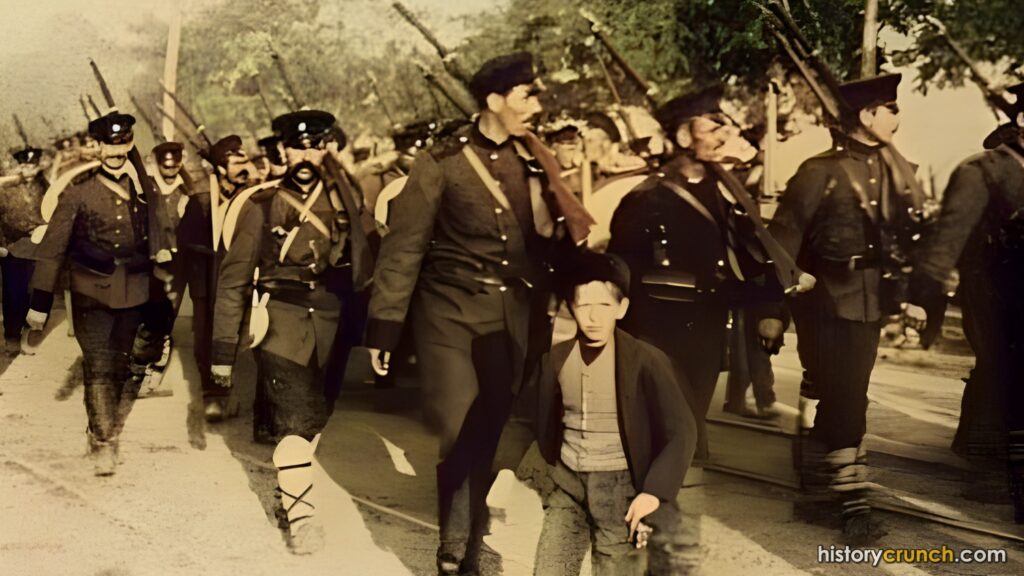
When it entered the war, Bulgaria had approximately 280,000 soldiers and by the end of the war over 1.2 million Bulgarians had served in the Bulgarian Army. In 1914, Bulgaria was still recovering from the events of the two Balkan Wars, which occurred from 1912 to 1913. As such, Bulgaria demobilized its army and was not militarily ready for the outbreak of World War I in 1914. Regardless, Bulgaria’s armed forces were divided into three armies, which were created through conscriptionA government law requiring citizens to serve in the military, also called a draft..
Bulgarian men were eligible for conscription at the age of 20, and served at least 5 years in the Bulgarian Army. Afterwards, the men served in either the infantry or Army Reserve until they were approximately 40 years old. Bulgarian men older than 40 years old served in the National Militia. As such, Bulgaria had a system of conscription that allowed it to boast a relatively large army. Therefore, when Bulgaria made the decision to join the fighting of World War I, it was easily able to mobilize its forces.
However, Bulgaria was a smaller nation and therefore lacked the ability to match the other European powers in other aspects of the military. For instance, while Bulgaria had over 1,200 artilleryLarge, heavy guns used by an army to fire shells over long distances. guns at the start of World War I, it struggled to produce the necessary ammunition for them. As well, Bulgaria had a small navy and air force in comparison to other nations of the time.
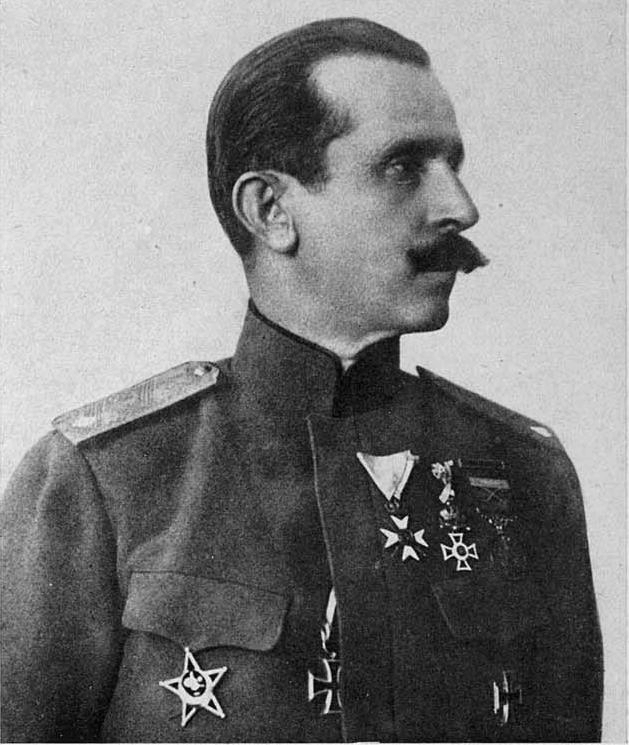
During World War I, the Bulgarian Army was led by commander-in-chief Nikola Zhekov. In fact, he led the Bulgarian Army throughout the entirety of Bulgaria’s time in the First World War.
Bulgaria in World War I – Major Battles
Although Bulgaria was not one of the major European nations of the time, it did exert a great deal of influence in the Balkans. As such, Bulgarian forces were primarily active in the Balkans, including the Serbian Campaign. In general, the landscape of Europe in World War I was divided into a few different ‘fronts’. For instance, the Western Front was located on the western-half of Europe and included a line of trenches that stretched throughout much of northern France and Belgium. Whereas the Serbian Campaign was fought throughout the region of the Balkans, including Serbia, Montenegro and Albania. As part of its agreement with the Central Powers, Bulgaria was responsible for helping the war effort in the Balkans. As well, Bulgaria wanted to gain control over sections of the region due to a rising sense of nationalism.
From the start of World War I, conflict between Bulgaria and Serbia was a certainty. This was due to several factors, but mostly a result of Bulgaria seeking new territories in the Balkans following the earlier Balkan Wars. As such, the Serbian Campaign of World War I was the first main military activity for Bulgarian forces in the war. In fact, Bulgaria invaded Serbia on October 14th, 1915 after Germany and Austria-Hungary had already begun their own attacks.
Regardless, the Bulgarian Army experienced a great deal of success at the start of the Serbian Campaign and was easily able to overrun the Serbian forces positioned along the border. In fact, the Bulgarian First and Second Armies were able to push into Serbia throughout October, which allowed them to capture several significant towns. Furthermore, the Serbian forces were in full retreat and lost control of several key railroads and other transportation routes.
The Serbian Campaign continued throughout 1915, with Austro-Hungarian, German and Bulgarian forces combining their efforts. This proved valuable as the Central Powers were able to defeat Serbia and occupied the country for the remainder of World War I. The Serbian Campaign ended on November 24th, 1915 and Serbia wasn’t liberated until November 1st, 1918.
 FactsthatCrunch
In what order did the Central Powers advance into Serbia unfold during the 1915 Serbian Campaign?
Bulgaria in World War I – Home Front
An important aspect of the First World War for all of the countries involved was the impact it had on the home front. This was also true in Bulgaria, which experienced impacts on daily life for its citizens. At the outbreak of World War I, in 1914, Bulgaria had a population of about 4.8 million people, which lived primarily in a rural setting. As such, the country lacked the industrial capabilities of the other European nations, since it did not have the industrial workers or factories required. This caused Bulgaria to struggle economically during the timeframe of World War I, which created hardships for the people on the home front.
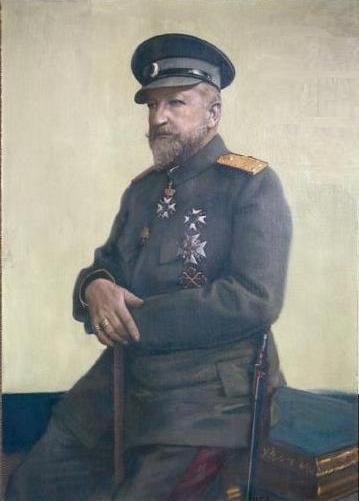
Another important factor of the Bulgarian home front in World War I was the role and structure of the government. At the time, Bulgaria was a constitutional monarchyA system of government where a king or queen rules but is limited by a set of laws. that was ruled over by a Tsar, which is a title for monarchs in Eastern Europe. In fact, Bulgaria gained its independence as a state in 1908, and Ferdinand I took the title of Tsar. Ferdinand I continued to reign as the Tsar of Bulgaria throughout World War I, until he abdicatedGave up a throne or position of royal power, usually under pressure. the throne in 1918, when Bulgaria accepted defeat for its roles in the war. The nature of Ferdinand’s rule over Bulgaria allowed the government to effectively control the civilian people and mobilize them for war.
One of the ways that the Bulgarian government controlled its citizens during World War I was through the use of propaganda. In fact, the use of propagandaInformation spread by a government to shape what citizens believe and how they act. was common throughout all of the countries of World War I, and played a significant role in the history of the war. In order to promote support for the war and other initiatives, the government of the time used propaganda to convince citizens of certain messages. For example, the Bulgarian government issued propaganda that worked to recruit soldiers for the war, ration certain items and to demonize the enemy. Bulgarian citizens on the home front were subjected to constant messaging to ensure they supported the war effort and to maintain the push towards victory.
 FactsthatCrunch
What happened to Bulgaria's Tsar Ferdinand I after the country's defeat in World War I?
Bulgaria in World War I – Significance
World War I was a highly important event in the history of Bulgaria. First, and foremost, over 1.2 million Bulgarian soldiers served during World War I. As well, approximately 87,500 Bulgarian soldiers died as a result of military action during the war.
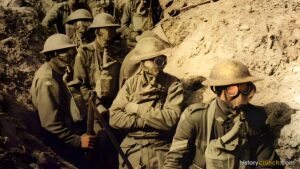
Second, the terrible losses suffered by Bulgaria were characteristic of the overall nature of the fighting in World War I. This was due to the terrible waste of humanity that resulted from trench warfare and the military strategy of World War I. As well, Bulgarian armies fought in the Serbian Campaign, against Romania in 1916, and for three years on the Macedonian Front, where an Allied breakthrough in September of 1918 forced Bulgaria out of the war.
Beyond this, World War I was significant for the country of Bulgaria due to the outcome of the war and the result for the country. As stated above, Bulgaria accepted its defeat in World War I, which led to the abdication of Tsar Ferdinand I. Following his abdication, Ferdinand’s son, Boris III, became the new Tsar of the country. Finally, Bulgaria’s participation in World War I was finalized in the Treaty of Neuilly of 1919.
FactsthatCrunchWorld War I timeline · 1914 – 1918
Key Vocabulary
Neutral
Stalemate
Conscription
Artillery
Propaganda
Abdicated
Constitutional monarchy
Frequently Asked Questions
Why did Bulgaria join World War I on the side of the Central Powers?
Bulgaria joined the Central Powers to gain land in the Balkans that it had lost in the earlier Balkan Wars. Both sides offered Bulgaria deals, but the Central Powers promised territory it wanted, especially in Serbia. Bulgaria signed its agreement on September 6th, 1915, then declared war on Serbia soon after.
When did Bulgaria fight in World War I?
Bulgaria fought in World War I from October 14th, 1915 until September 30th, 1918. It stayed neutral during the first year of the war while it recovered from the Balkan Wars. It entered the fighting when it invaded Serbia in October 1915.
Who led Bulgaria during World War I?
Tsar Ferdinand I ruled Bulgaria as a constitutional monarch throughout most of the war. Vasil Radoslavov served as prime minister and kept the country neutral in 1914. The army was led by commander-in-chief Nikola Zhekov for the entire time Bulgaria was in the war.
Where did Bulgarian forces fight during the war?
Bulgarian forces fought mainly in the Balkans, especially during the Serbian Campaign. They invaded Serbia in October 1915 and quickly pushed Serbian troops into retreat. Working with German and Austro-Hungarian armies, they helped defeat and occupy Serbia for most of the war.
What happened to Bulgaria after World War I?
Bulgaria accepted defeat in 1918, and Tsar Ferdinand I gave up his throne. His son, Boris III, became the new Tsar of Bulgaria. The country’s role in the war was finalized by the Treaty of Neuilly in 1919.
How many Bulgarian soldiers served and died in World War I?
Over 1.2 million Bulgarians served in the army by the end of World War I. About 87,500 Bulgarian soldiers died as a result of military action. Bulgaria started the war with roughly 280,000 soldiers and grew its force through conscription.
Cite This Article
To cite this article as a source, use one of the formats below.
MLA: Beck, Elias. “Bulgaria in World War I: A Detailed Summary.” HistoryCrunch, 30 September 2026, https://historycrunch.com/bulgaria-in-world-war-i/.
APA: Beck, E. (2026). Bulgaria in World War I: A Detailed Summary. HistoryCrunch. https://historycrunch.com/bulgaria-in-world-war-i/
Chicago: Beck, Elias. “Bulgaria in World War I: A Detailed Summary.” HistoryCrunch. September 30, 2026. https://historycrunch.com/bulgaria-in-world-war-i/
Sources
- Fordham Modern History Sourcebook
- Imperial War Museum