Germany was the most powerful of the Central Powers and the primary military force that the Allied nations faced on the Western Front throughout World War I. Entering the war in August 1914 with the largest and most capable army in Europe, Germany pursued an ambitious strategy to defeat France quickly before turning to face Russia in the east. The failure of that strategy condemned Germany to exactly the two-front war it had been designed to avoid. Over the course of the war 13.2 million Germans served and approximately 1.8 million died. The war ended with the abdication of Kaiser Wilhelm II, the establishment of the Weimar Republic and the punishing terms of the Treaty of Versailles that directly set the stage for World War II. This infographic was designed for students to visually summarize Germany’s role in World War I and is based on the History Crunch article titled Germany in World War I.
Germany in World War I – Infographic
About This Infographic
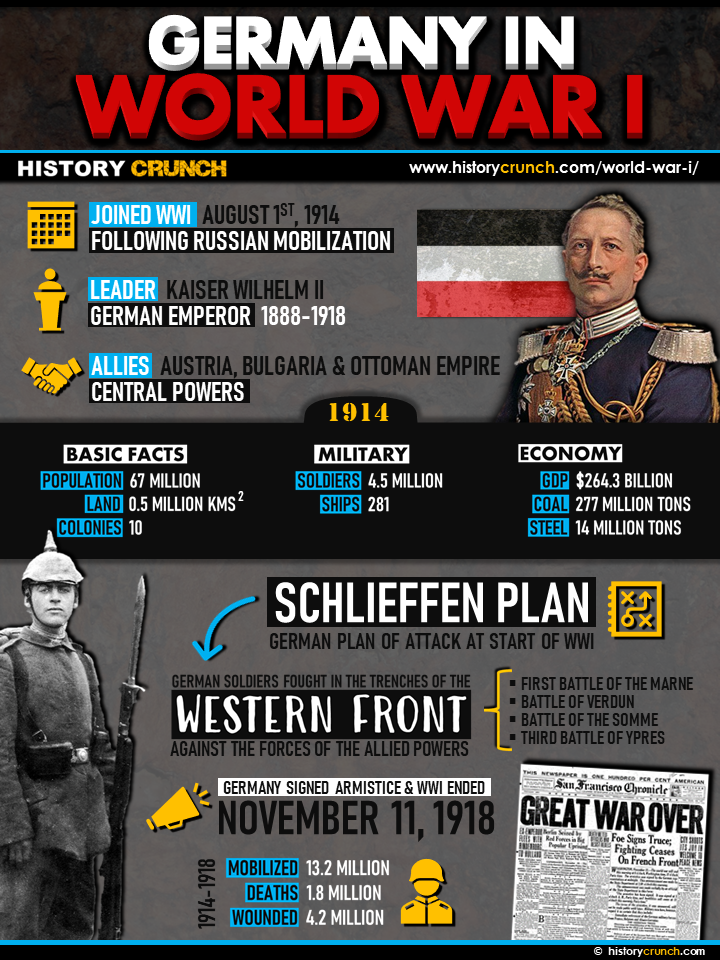
This Germany in World War I infographic was created by the History Crunch team to help students and teachers quickly understand the significance of Germany’s role in the First World War. It is designed as a visual learning and study tool, summarizing the essential information covered in our full article on Germany in World War I. Teachers may use it as a classroom display, a discussion prompt, or a study aid for students preparing for assessments.
What This Infographic Covers
The infographic begins with why Germany entered the war. Germany was a member of the Triple Alliance alongside Austria-Hungary and Italy. When Austria-Hungary threatened Serbia following the assassination of Franz Ferdinand, Germany issued a blank check of unlimited support to Austria-Hungary. When Russia mobilized in Serbia’s defense, Germany declared war on France, Belgium and Russia on August 1st, 1914, triggering Britain’s entry into the war on August 4th. Germany entered the war with over 4.5 million soldiers, an army built through decades of militarism and conscription. A deep historical rivalry with France, rooted in the Franco-Prussian War of 1870 to 1871 and Germany’s control of the disputed Alsace-Lorraine region, made France the primary target of Germany’s opening strategy.
The infographic covers the Schlieffen Plan, Germany’s pre-war strategy to avoid fighting on two fronts simultaneously. The plan called for a rapid invasion of France through neutral Belgium, designed to defeat France within weeks before turning to face Russia in the east. The German assault pushed deep into France and came within 30 miles of Paris before being stopped at the First Battle of the Marne in September 1914. The failure of the Schlieffen Plan condemned Germany to the two-front war it had been designed to prevent and resulted in four years of trench warfare on the Western Front.
The infographic covers Germany’s major battles on both fronts. On the Eastern Front, Germany’s decisive victory at the Battle of Tannenberg in August 1914 effectively destroyed the Russian Second Army and prevented Russia from ever again invading German territory. On the Western Front, Germany participated in all of the major battles of the trench stalemate including the First and Second Battles of Ypres, the Battle of Verdun in 1916 where Germany suffered an estimated 350,000 casualties and 143,000 deaths in the longest single battle in human history, and the Battle of the Somme where German forces suffered over 400,000 casualties. The Second Battle of Ypres in 1915 was also notable as the first use of poison gas on the Western Front, which Germany introduced.
The infographic also covers Germany’s naval strategy. Germany possessed the second largest navy in the world in 1914, with 17 dreadnought battleships. Unable to match Britain’s naval dominance in open battle, Germany relied heavily on its U-boat campaign, using submarines to attack Allied merchant shipping and attempting to starve Britain of the supplies it needed to sustain the war effort. An estimated 5,000 transport and merchant ships were sunk by German U-boats. The U-boat campaign eventually played a key role in bringing the United States into the war in 1917, after German submarines repeatedly sank ships carrying American citizens.
The infographic covers the German home front and its collapse. Food shortages caused by the British naval blockade of northern German ports became severe by 1916 to 1917, a period known as the Turnip Winter when German citizens were reduced to eating turnips normally used to feed livestock. Historians estimate as many as 474,000 German civilians died from malnutrition. By 1918 morale had collapsed completely. The German Revolution of 1918 began in October and November when German sailors mutinied at Kiel rather than obey orders. On November 9th Kaiser Wilhelm II abdicated, the German monarchy was abolished and Germany was proclaimed a republic. On November 11th Germany signed the armistice ending the war. The punishing terms of the Treaty of Versailles, which forced Germany to pay reparations, caused hyperinflation and destabilized the German economy, are considered by historians to be major contributing factors to the rise of Adolf Hitler and World War II.
How to Use This Infographic in the Classroom
This infographic works well as a visual introduction to Germany in World War I before students read the full article. It can also be used as a discussion prompt asking students to consider why the failure of the Schlieffen Plan was so decisive for Germany’s ultimate defeat, or to examine the connections between Germany’s experience in World War I and the rise of Hitler in the 1930s. Teachers may also use it alongside the Schlieffen Plan map and the Western Front map to help students understand the geographic dimensions of Germany’s war.
Related Articles
To learn more about the topics covered in this infographic, visit the following History Crunch articles: