Leonid Brezhnev was a major Soviet leader during the later Cold War years and ruled the Soviet Union from 1964 to 1982. He is remembered for détente with the United States, the Brezhnev DoctrineThe Soviet claim that it had the right to intervene militarily in any communist country where socialism seemed threatened., and the growing stagnationA condition in which an economy stops growing and living standards stop improving or begin to decline. that weakened the Soviet system over time. Leonid Brezhnev was significant because he led the Soviet Union for much of the later Cold War and shaped its policies in both Eastern Europe and global affairs.
 FactsthatCrunch
Brezhnev led the Soviet Union for nearly two decades and shaped its role in the later Cold War through arms-control agreements with the United States and the assertion of Soviet authority over Eastern Europe through the Brezhnev Doctrine. His rule also brought serious economic troubles, as heavy defense spending left agriculture, consumer goods, and health care weakened, and the invasion of Afghanistan in December of 1979 added a long and costly military burden.
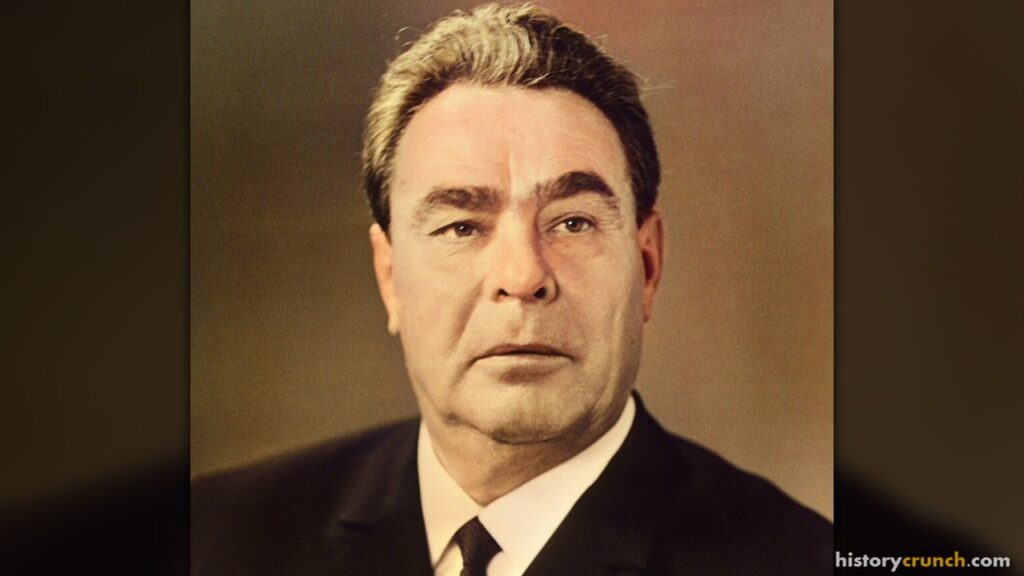
Leonid Brezhnev – Early Life
Leonid Ilyich Brezhnev was born on December 19th, 1906, in Kamenskoye, in the Russian Empire, which is now Kamianske in Ukraine. He came from a working-class background and trained in technical fields before moving fully into politics. In the 1920s he worked as a land surveyor, became a full member of the Communist Party in 1931, studied at the metallurgical institute in Kamenskoye, and later worked as an engineer and technical-school director.
Brezhnev began his rise during the Joseph Stalin years of the Soviet Union. By 1939, he had become secretary of the regional party committee of Dnepropetrovsk. During World War II, he served as a political commissarA military officer responsible for ensuring soldiers remained loyal to the Communist Party’s ideology and orders. in the Red Army and rose to the rank of major general in 1943. Therefore, before he became the leader of the Soviet Union, he had already built experience in both party organization and the military system of the Soviet state.
FactsthatCrunchDuring World War II, Leonid Brezhnev served as a political commissar in the Red Army and reached the rank of major general in 1943, the highest military grade he earned through active wartime service.
Brezhnev entered wartime service in 1941, working in political roles that kept soldiers loyal to Communist Party orders. By 1943, he had become head of the Political Department of the 18th Army, and that appointment came with his promotion to major general. The 18th Army later joined the 1st Ukrainian Front, where the senior political commissar above him was Nikita Khrushchev, a connection that shaped Brezhnev's career for years afterward.
Leonid Brezhnev – Rise in Soviet Politics
After World War II, Brezhnev continued to move upward in Soviet politics. For instance, he held important posts in Ukraine, was sent to Moldavia in 1950 as first secretary of the Moldavian Communist Party, and in 1952 became a member of the Central Committee and a candidate member of the Politburo. When Stalin died in March of 1953, Brezhnev temporarily lost influence, but Nikita Khrushchev soon brought him back into a stronger position.
In 1954, Khrushchev made Brezhnev second secretary of the Kazakhstan Communist Party, and Brezhnev soon became first secretary there in 1955. In 1956, he returned to the Central Committee and Politburo, and in 1960 he became chairman of the Presidium of the Supreme Soviet, which made him the formal head of state. Then, in July of 1964, he became Khrushchev’s assistant as second secretary of the Central Committee. Only a few months later, Brezhnev helped remove Khrushchev from power and became first secretary of the Communist Party on October 14th, 1964.
At first, Brezhnev ruled as part of a collective leadershipA system where power is shared among several top officials rather than held by one single ruler. with Aleksey Kosygin and Nikolay Podgorny. However, he gradually became the dominant figure. This was important because it marked the start of a new Soviet era that was generally more cautious, more conservative, and more focused on stability than the Khrushchev years had been.
FactsthatCrunchHow did Brezhnev's rise to power unfold between 1950 and 1964?
Leonid Brezhnev – Leadership of the Soviet Union
Brezhnev’s rule was marked by both strength abroad and growing weakness at home. In foreign policy, he supported a powerful military and expanded Soviet influence around the world. At the same time, he also pursued détente, which refers to a reduction of tensions with the United States during the 1970s. For instance, the SALT I agreements were signed in Moscow on May 26th, 1972, by Richard Nixon and Leonid Brezhnev, which made them one of the major achievements of détenteA deliberate effort to reduce hostility and tension between the United States and Soviet Union during the 1970s.. Later, SALT II was signed on June 18th, 1979, by Jimmy Carter and Brezhnev, although it was never ratifiedFormally approved by a governing body, making an agreement legally binding. by the United States Senate. SALT I and SALT II were arms control agreements between the United States and Soviet Union that aimed to limit nuclear weapons during the Cold War. They were important because they showed that both superpowers were willing to negotiate and reduce tensions, even while remaining rivals.
Regardless, Brezhnev is also remembered for using Soviet power to control Eastern Europe. In 1968, reformers in Czechoslovakia launched the Prague Spring, which was a period of political and economic liberalizationA loosening of strict government controls, allowing more political and economic freedom. under Alexander Dubček. Soviet leaders feared those reforms would weaken communist control. As a result, Soviet and Warsaw Pact forces invaded Czechoslovakia on August 20th, 1968. Brezhnev then became associated with what the West called the Brezhnev Doctrine, which claimed that the Soviet Union had the right to intervene when socialism in another communist country was seen as being under threat.
Brezhnev’s domestic record was far less successful. Although the Soviet Union remained a superpower and achieved military parity with the United States in strategic nuclear weapons, heavy spending on defense weakened other parts of the economy. Agriculture, consumer goods, and health care suffered, and living standards eventually stagnated or declined. As such, later Soviet leaders and historians often described much of his rule as a period of stagnation.
The later years of Brezhnev’s rule saw tensions rise again. In December of 1979, the Soviet Union invaded Afghanistan to support the Afghan communist government. This decision helped damage détente and pulled the Soviet Union into a long and costly conflict. Therefore, one of the most important foreign-policy decisions of the Brezhnev period also became one of its most damaging.
FactsthatCrunchOn August 20th, 1968, Soviet and Warsaw Pact forces invaded Czechoslovakia to crush the Prague Spring reforms led by Alexander Dubček. The West then named a new Soviet policy after Brezhnev, claiming the Soviet Union had the right to intervene in any communist country where socialism appeared threatened.
Czechoslovakia pursuing political and economic liberalization under Dubček, with Soviet leaders watching nervously
Soviet control over Eastern Europe locked in place, with any reform movement now facing the threat of military intervention
Leonid Brezhnev – Later Years and Death
By the late 1970s and early 1980s, Brezhnev’s health was declining, but he remained in power. In 1977, he also became chairman of the Presidium of the Supreme Soviet, which meant that he held both the top party leadership and the formal head-of-state position. He continued to lead the Soviet Union until his death on November 10th, 1982, in Moscow, at the age of 75.
After Brezhnev died, Yuri Andropov replaced him. However, many of the problems that had grown during the Brezhnev years remained in place, including economic weakness, political rigidity, and the burden of Afghanistan. These issues became even more serious in the years that followed.
Leonid Brezhnev – Significance
Leonid Brezhnev was significant because he dominated Soviet politics for nearly two decades and shaped the Soviet Union during a major phase of the Cold War. He oversaw détente and important arms-control agreements with the United States, but he also enforced Soviet control in Eastern Europe through the Brezhnev Doctrine and approved the invasion of Afghanistan.
At the same time, Brezhnev remains a debated historical figure. Some people see him as the leader who provided stability and maintained Soviet superpower status. Others focus on the stagnation, repression, and costly foreign commitments that weakened the Soviet Union in the long run. Regardless, Leonid Brezhnev played a central role in the later Cold War and in the problems that the Soviet Union faced before its final collapse.
FactsthatCrunchGorbachev argued that the Soviet Union under Brezhnev had fallen into what he called the Era of Stagnation, a period when problems in the economy built up faster than they were solved. He blamed heavy spending on defense for draining resources from agriculture, consumer goods, and health care, leaving the country weaker than it appeared. In his view, Brezhnev's preference for stability over reform stored up serious trouble that later leaders had to confront.
Explore Cold War · 1947 – 1991
Keep exploring Cold War with these History Crunch resources.
Key Vocabulary
Political commissar
Collective leadership
Détente
Ratified
Liberalization
Brezhnev Doctrine
Stagnation
Frequently Asked Questions
How long did Leonid Brezhnev rule the Soviet Union?
Leonid Brezhnev led the Soviet Union from 1964 until his death in 1982, nearly two decades. He first took power as first secretary of the Communist Party on October 14th, 1964. At the start he shared power in a collective leadership, but he soon became the dominant figure.
What was the Brezhnev Doctrine?
The Brezhnev Doctrine claimed the Soviet Union had the right to intervene when socialism in another communist country seemed under threat. The West named it after the 1968 invasion of Czechoslovakia. Soviet and Warsaw Pact forces entered the country on August 20th, 1968, to crush the reforms of the Prague Spring.
What was détente during the Brezhnev years?
Détente was a reduction of tensions between the Soviet Union and the United States during the 1970s. The SALT I arms control agreements were signed in Moscow on May 26th, 1972, by Brezhnev and Richard Nixon. SALT II followed on June 18th, 1979, though the United States Senate never ratified it.
Why is the Brezhnev era called a period of stagnation?
Heavy spending on defense weakened other parts of the Soviet economy during Brezhnev’s rule. Agriculture, consumer goods, and health care suffered, and living standards eventually stalled or fell. Later Soviet leaders and historians often described much of his time in power as stagnation.
Why did the Soviet Union invade Afghanistan under Brezhnev?
The Soviet Union invaded Afghanistan in December of 1979 to support the Afghan communist government. The decision damaged détente and pulled the country into a long and costly war. It became one of the most harmful choices of the Brezhnev period and burdened later leaders.
Cite This Article
To cite this article as a source, use one of the formats below.
MLA: Millar, B. “Leonid Brezhnev: A Detailed Biography.” HistoryCrunch, 12 October 2026, https://historycrunch.com/leonid-brezhnev/.
APA: Millar, B. (2026). Leonid Brezhnev: A Detailed Biography. HistoryCrunch. https://historycrunch.com/leonid-brezhnev/
Chicago: Millar, B. “Leonid Brezhnev: A Detailed Biography.” HistoryCrunch. October 12, 2026. https://historycrunch.com/leonid-brezhnev/
Sources
- John Lewis Gaddis, The Cold War: A New History.
- Odd Arne Westad, The Global Cold War.