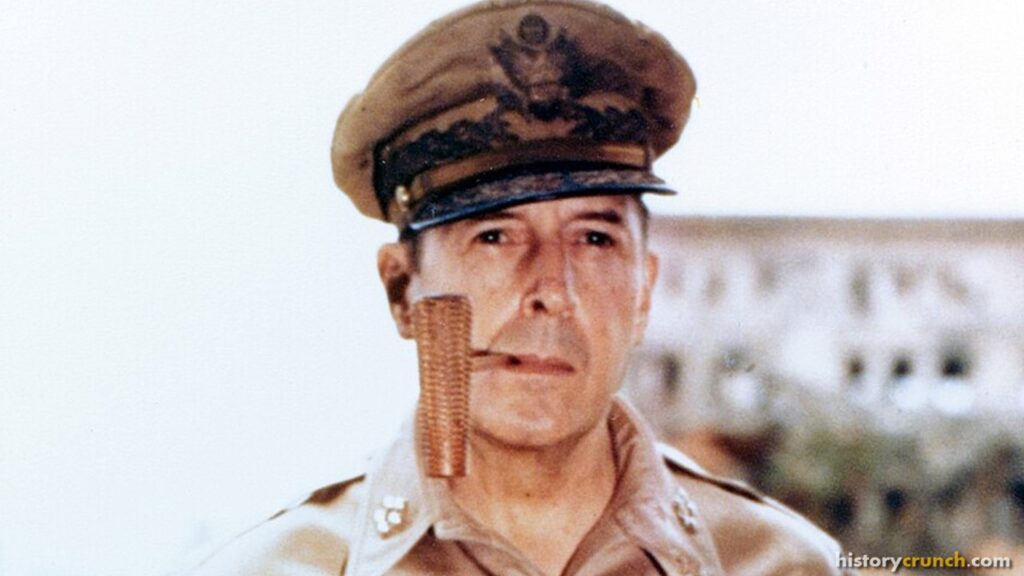
Douglas MacArthur was one of the most important American military leaders of the 20th century. He was an American general who served in World War I, became a leading Allied commander in the Pacific during World War II, directed the occupation of Japan after 1945, and led United Nations forces in the Korean War.
 FactsthatCrunch
Douglas MacArthur commanded Allied forces across the Southwest Pacific during World War II, directing the island-hopping campaign that pushed Japanese forces back toward the home islands. He presided over the formal Japanese surrender ceremony aboard the USS Missouri in Tokyo Bay and then led the postwar occupation of Japan, overseeing major political and economic reforms in the country.
Early Life
Douglas MacArthur was born in Little Rock, Arkansas, on January 26th, 1880. His father, Arthur MacArthur Jr., was a famous American officer, and that background helped shape Douglas MacArthur’s early path toward army life. In fact, he entered the United States Military Academy at West Point and graduated in 1903 at the top of his class, which immediately marked him as an officer with unusual promise.
MacArthur’s early military career took him to several posts, including service in the Philippines, as he continued to rise through the army before and during World War I. In fact, during World War I, he served with distinctionServing in a way that earns special honor or praise from others. in France and gained a reputation for bravery and aggressive leadership. This helped establish the military image that followed him for the rest of his life, since he was increasingly seen as a commander who combined personal courage with strong ambition.
 FactsthatCrunch
Can you match each part of Douglas MacArthur’s early life to the right detail?
World War II
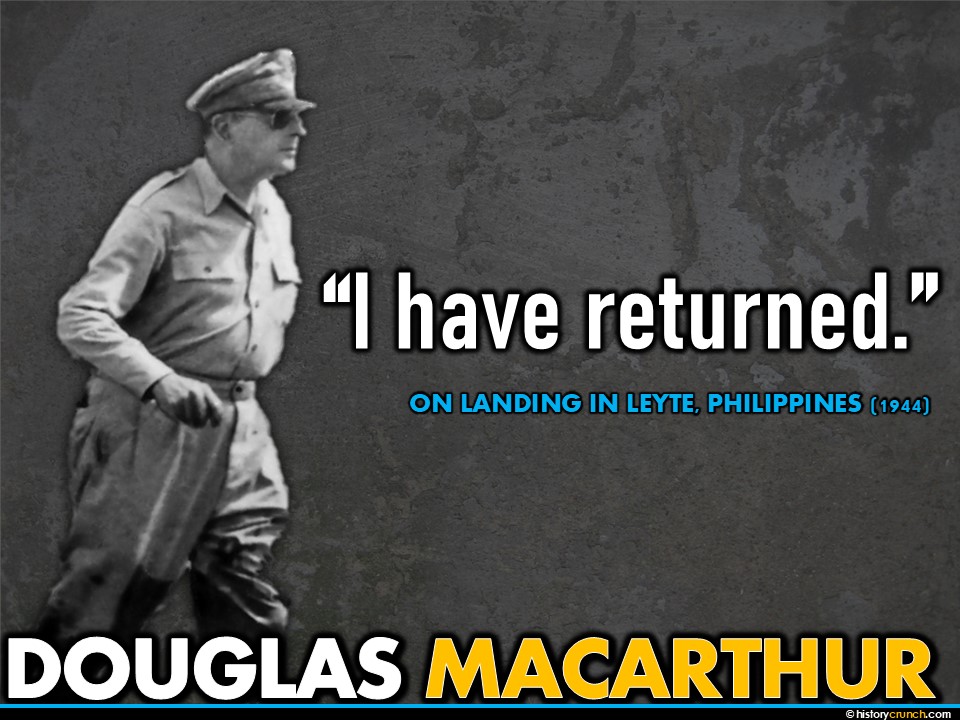
Douglas MacArthur became especially famous during World War II. After Japan attacked Pearl Harbor on December 7th, 1941, MacArthur was one of the most senior American commanders in the Pacific and was responsible for the defense of the Philippines. However, Japanese forces quickly overwhelmed American and Filipino resistance, and MacArthur was ordered to withdraw to Australia in March of 1942. It was after this retreat that he made his famous promise, “I shall return,” which later became one of the most remembered statements of the Pacific Theater of World War II.
From Australia, MacArthur became Supreme CommanderThe highest-ranking military officer in charge of all forces in a particular region or operation. of the Southwest Pacific Area and led major Allied operations against Imperial Japan. Rather than attack every Japanese-held position directly, American strategy in the Pacific often involved bypassing some enemy strongholds while concentrating on more important targets. This strategy was referred to as ‘island-hopping‘ and proved to be an important tactic against the Japanese forces in the Pacific. As such, MacArthur became closely associated with the push back through New Guinea and toward the Philippines.
MacArthur’s return to the Philippines began with the landing at Leyte on October 20th, 1944. That event was highly important to his reputation because it fulfilled his earlier promise and linked his name directly to the liberation of the islands from Japanese control. As well, the fighting in the Philippines became one of the major stages in the final defeat of Japan in the Pacific.
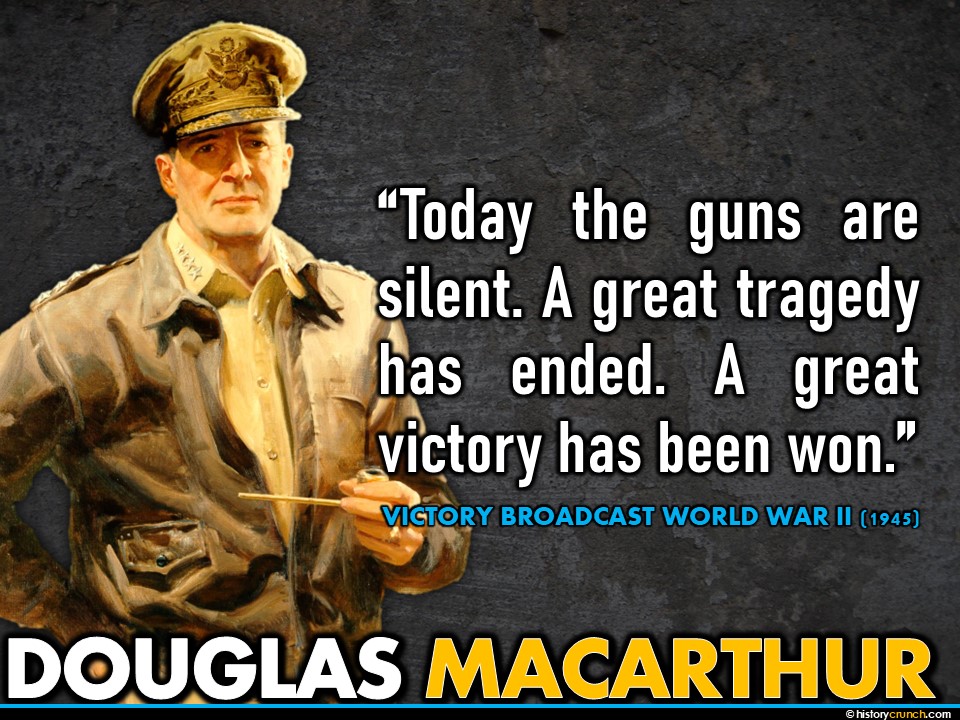
After Japan surrendered in August of 1945, MacArthur formally accepted the Japanese surrender on September 2nd, 1945, aboard the USS Missouri. This moment made him one of the most visible Allied commanders of the war, because he stood at the center of the official ending of the Pacific conflict.
 FactsthatCrunch
It is March 1942, and you are General Douglas MacArthur, commander of American and Filipino forces in the Philippines during World War II in the Pacific. Japanese forces have overwhelmed resistance across the islands, and President Franklin D. Roosevelt has ordered you to leave the Philippines and go to Australia. If you obey, you abandon the troops still fighting on Bataan and Corregidor; if you refuse or delay, you risk defying a direct presidential order during wartime.
Occupation of Japan
After World War II, MacArthur remained deeply important in Asia because he became Supreme Commander for the Allied Powers in occupied Japan. In that role, he oversaw a major transformation of Japanese government and society. For instance, occupation authorities worked to reduce militarismA belief that a country should build up strong armed forces and use military power aggressively., encourage democratic government, expand civil libertiesBasic rights and freedoms that a government guarantees to its people., and support a new constitution that ultimately took effect on May 3rd, 1947. This was one of the most important parts of MacArthur’s career, because he was no longer simply a battlefield commander. He had become a central figure in rebuilding a defeated nation.
Korean War
MacArthur later took on another major command in the Korean War. After North Korea invaded South Korea on June 25th, 1950, the United Nations organized a military response, and MacArthur became commander of UN forces. He is especially remembered for the Inchon LandingA surprise amphibious military operation in Korea that reversed early North Korean gains in the war. on September 15th, 1950, which helped reverse the course of the war after early North Korean successes. That operation was important, because it turned MacArthur once again into an international military hero and temporarily shifted momentum strongly in favor of UN forces.
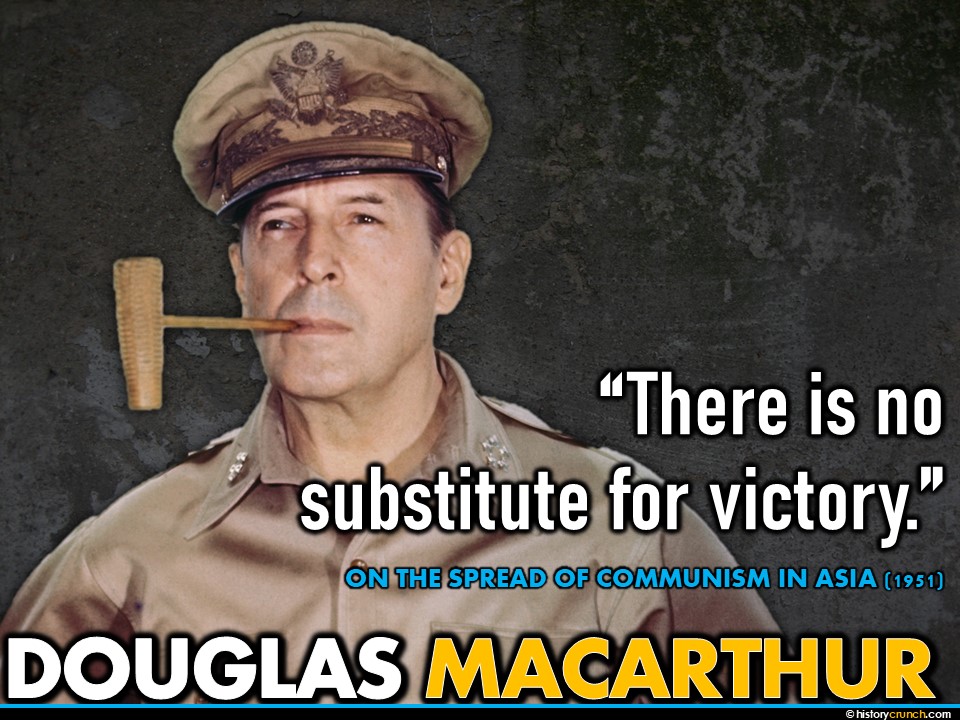
However, MacArthur’s role in Korea eventually became quite controversial. As Chinese forces entered the war and the conflict grew more dangerous, MacArthur argued for a wider war against China. President Harry S. Truman wanted a more limited war and feared that a wider conflict might lead to a much larger international crisis. This resulted in Truman removing MacArthur from command on April 11th, 1951, for insubordinationRefusing to follow the orders or authority of a superior., which means refusing to follow the authority of a superior. That dismissal was one of the most famous civil-military confrontations in American history.
 FactsthatCrunch
How did the Inchon Landing turn the Korean War around?
Death
After leaving command, MacArthur returned to the United States and remained a famous public figure. He died in Washington, D.C., on April 5th, 1964. Regardless of the controversy that surrounded the end of his active career, he remained one of the most recognizable American generals of the century.
Significance
Douglas MacArthur was significant because he played major roles in several of the most important events of the mid-20th century. For example, he was a leading American commander in the Pacific during World War II, he accepted Japan’s formal surrender in 1945, he directed the Allied occupation of Japan, and he led United Nations forces in the Korean War. Few military leaders were so closely tied to so many major turning points in modern Asian and American history.
MacArthur is also important because his career shows both the power and the limits of military leadership. His successes made him a celebrated wartime figure, but his dismissal in 1951 showed that even a famous general remained subject to civilian authority in the United States.
FactsthatCrunchTruman believed MacArthur had committed insubordination by publicly pushing for a wider war against China, directly undermining presidential authority. Truman wanted a limited war to avoid a larger international crisis. In his view, a military commander could not be allowed to set foreign policy against the wishes of the civilian government.
MacArthur believed that fighting a limited war in Korea while China supplied and supported North Korea made no military sense. He argued that full pressure on China was necessary to win. From his perspective, he was offering sound military judgment, not defying authority.
Explore World War II · 1939 – 1945
Keep exploring World War II with these History Crunch resources.
Key Vocabulary
Distinction
Island-hopping
Militarism
Civil liberties
Insubordination
Frequently Asked Questions
What did Douglas MacArthur mean by “I shall return”?
He promised to come back and free the Philippines after Japanese forces drove American and Filipino troops out in 1942. MacArthur was ordered to withdraw to Australia, leaving the islands under Japanese control. He kept his word with the landing at Leyte on October 20th, 1944.
Why did President Truman remove MacArthur from command?
Truman fired MacArthur on April 11th, 1951, for insubordination during the Korean War. MacArthur wanted a wider war against China, but Truman feared that could spark a much larger crisis. The dismissal became one of the most famous clashes between military and civilian leaders in American history.
What was the Inchon Landing?
The Inchon Landing was a surprise amphibious attack MacArthur led on September 15th, 1950, during the Korean War. It struck behind North Korean lines and reversed the war after early enemy gains. The bold operation made MacArthur an international military hero once again.
What was island-hopping in the Pacific?
Island-hopping was a strategy of bypassing some Japanese strongholds while attacking more important targets. This let Allied forces move toward Japan without fighting for every island. MacArthur used this approach as he pushed through New Guinea and back toward the Philippines.
What role did MacArthur play in the occupation of Japan?
MacArthur served as Supreme Commander for the Allied Powers in occupied Japan after 1945. He oversaw efforts to reduce militarism, expand civil liberties, and build democratic government. A new Japanese constitution took effect on May 3rd, 1947, during his time overseeing these changes.
When and where was Douglas MacArthur born?
MacArthur was born in Little Rock, Arkansas, on January 26th, 1880. His father, Arthur MacArthur Jr., was a famous army officer, which shaped his path toward military life. MacArthur later graduated at the top of his West Point class in 1903.
Cite This Article
To cite this article as a source, use one of the formats below.
MLA: Millar, B. “Douglas MacArthur: A Detailed Biography.” HistoryCrunch, 18 September 2026, https://historycrunch.com/douglas-macarthur/.
APA: Millar, B. (2026). Douglas MacArthur: A Detailed Biography. HistoryCrunch. https://historycrunch.com/douglas-macarthur/
Chicago: Millar, B. “Douglas MacArthur: A Detailed Biography.” HistoryCrunch. September 18, 2026. https://historycrunch.com/douglas-macarthur/
Sources
- J.M. Roberts & Odd Arne Westad, The Penguin History of the World.
- Jerry Bentley & Herbert Ziegler, Traditions & Encounters: A Global Perspective on the Past.