Emperor Hadrian was one of the most important rulers of ancient Rome, remembered for choosing to strengthen and defend the Roman Empire rather than expand it. He ruled from 117 CE to 138 CE and is counted among the group of leaders known as the Five Good Emperors, a run of rulers whose reigns are tied to the long stretch of peace and prosperity called the Pax Romana. Hadrian is best known today for the massive stone frontier in northern Britain that still carries his name, Hadrian’s Wall, as well as for his deep love of Greek culture and his tireless travels across the provinces.
A Roman emperor was the single supreme ruler of the Roman Empire. The emperor held control over the army, the government, the law, and the state religion, and his decisions could shape the lives of tens of millions of people spread across three continents. Emperors were not always chosen by birth. During Hadrian’s era, most rulers were adopted by the previous emperor and picked for their ability rather than their family bloodline.
Early Life and Background
Hadrian was born Publius Aelius Hadrianus on January 24th, 76 CE. Most sources identify his birthplace as Italica, located in modern Spain near Seville, although at least one source suggests he was actually born in Rome. His family came from the town of Hadria on the eastern coast of Italy, which is where the name Hadrian originally came from. Both of his parents belonged to respected Roman families with a long history in Spain.
When Hadrian’s parents died in 86 CE, Hadrian and his sister became the wards of Trajan, their father’s cousin, who like Hadrian had been born and raised in Italica. Trajan would later become emperor, which gave the young Hadrian a powerful connection at the very center of Roman politics. A second guardian, a Roman knight named Acilius Attianus, also helped raise him.
When Hadrian was 14, Trajan brought him to Rome, and there Hadrian showed enthusiasm for his studies, particularly Greek literature and culture. In fact, his passion for all things Greek was so strong that people jokingly nicknamed him the “Greekling.” This early education shaped him for the rest of his life, giving him lasting interests in literature, architecture, law, and hunting.
Rise to Power
As a young man, Hadrian began climbing the traditional ladder of Roman public offices known as the cursus honorum, the path that led to becoming a senator. He served three separate times as a military tribune, an officer’s post, which gave him valuable experience with the army. During his second tour as a military tribune, Emperor Nerva adopted Trajan as his heir, and when Nerva died in 98 CE, Trajan became emperor of Rome.
Hadrian’s close ties to Trajan helped his career move quickly. He was elected quaestor in 101 CE, a post in which he read Trajan’s messages to the Senate and may have even composed some of them. More specifically, he served at Trajan’s side during the wars in Dacia, a region in modern Romania, and was given command of a legion. Around 100 CE, he also married Vibia Sabina, the grandniece of Trajan, which tied him even more closely to the ruling family.
The circumstances of Hadrian becoming emperor remain one of the great mysteries of Roman history. Trajan died on campaign in 117 CE, with Hadrian in command of his rearguard, and is not believed by many to have clearly named a successor. The day after Trajan’s death, it was announced that he had adopted Hadrian as his son and heir. Trajan’s wife, Plotina, signed the papers of succession, claiming Trajan had selected Hadrian, and it is thought by many that she, not the emperor, was responsible for Hadrian’s adoption as heir.
Whatever the truth, the army recognized Hadrian as emperor, and the Senate accepted his rule. Yet his reign began with a dark act that many senators never forgot. Four senators who opposed his appointment were executed. This early bloodshed created a lasting distrust between Hadrian and the Senate that shadowed him for the rest of his life.
Major Achievements
Hadrian’s most important decision as emperor was a change in strategy. He assumed control over the vast Roman Empire in 117 CE following the death of his adoptive father, Trajan, and as emperor he broke with the expansionist policies of his predecessors to focus on securing the Roman Empire within its existing borders. Trajan had pushed the empire to its greatest size, but holding all that land was expensive and difficult. Hadrian therefore decided to implement a policy of security and stability within the empire’s existing boundaries, giving up some of the territory that Trajan had won in the east and focusing instead on reviewing his army and reforming military installations along the empire’s frontiers.
The greatest symbol of this new policy was the wall Hadrian ordered built in northern Britain. Hadrian’s Wall was the north-west frontier of the Roman Empire for nearly 300 years, and it was built by the Roman army on the orders of the emperor Hadrian following his visit to Britain in 122 CE. At 73 miles (80 Roman miles) long, it crossed northern Britain from Wallsend on the River Tyne in the east to Bowness-on-Solway in the west. A biography written about two centuries later recorded that Hadrian was the first to build such a wall, meant to separate the Romans from the peoples living beyond the frontier.
The wall was a huge engineering project. It took six years to build most of Hadrian’s Wall, with the work coming from three Roman legions totaling about 15,000 soldiers, plus some members of the Roman fleet. Along its length stood forts, smaller strongpoints called milecastles, and observation towers, all fronted by a deep ditch. While the exact purpose of Hadrian’s Wall remains debated, it likely served multiple functions, including controlling immigration, regulating trade, and providing a military defense against tribes to the north.
Beyond the wall, Hadrian was famous for the sheer amount of time he spent on the road. Hadrian undertook extensive travels across the empire, emphasizing cultural integration and reforming administration and law. Unlike his predecessors, who mainly ruled from Rome, Hadrian traveled across the provinces while emperor, visiting places such as Britain, Gaul, Spain, North Africa, Anatolia, Greece, Egypt, and Judea. These journeys let him inspect the army, review defenses, and see the needs of his people firsthand.
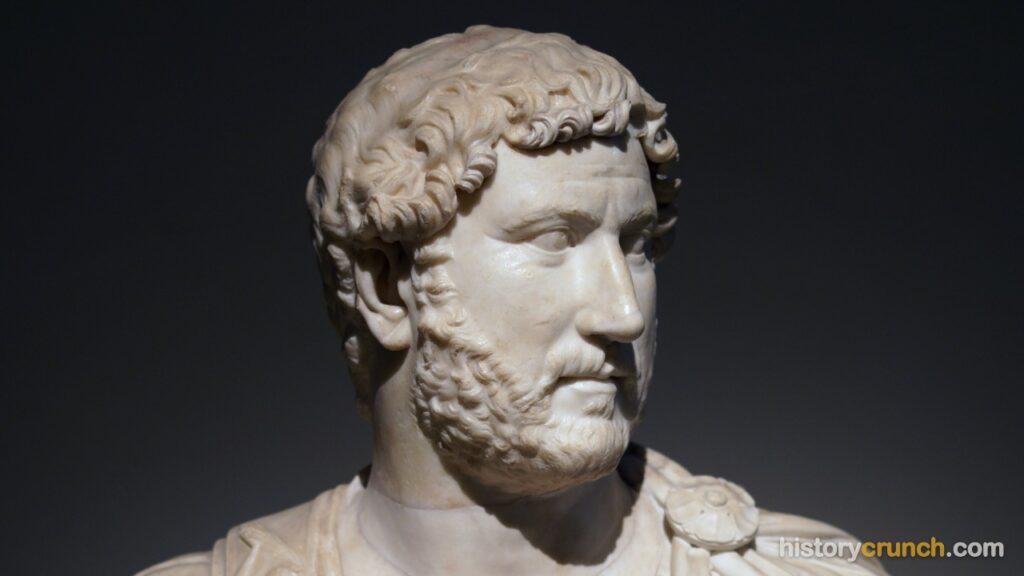
Hadrian was also a passionate builder and considered himself something of an architect. He had a passion for architecture, combining Greek and Roman styles in his building projects, and in Rome landmarks such as the Pantheon and the Temple of Venus and Roma stand as symbols of his dedication to art, culture, and architectural innovation. He also poured resources into Athens, promoting the Greek city as a cultural heart of the empire. In addition, he became the first Roman emperor to wear a full beard, in the Greek style, a look that made his portraits instantly recognizable.
Later Life
Hadrian’s personal life was often unhappy. His marriage to Vibia Sabina lasted for decades but was a political arrangement rather than a loving one, and the couple never had children. Around 125 CE, Hadrian formed a deep attachment to a Greek youth named Antinous, who became his close companion. When Antinous tragically drowned in the Nile in 130 CE, Hadrian was devastated. In his grief, the emperor declared Antinous a god and founded a city in Egypt named in his honor.
The most violent event of Hadrian’s later reign came in the Roman province of Judea. The Bar Kokhba Revolt broke out in Judaea, which Hadrian personally put down, and afterward he erased the old name of the region, renamed it Syria Palaestina, and exiled much of the Jewish population from the area. The war was long and brutal, and it took a heavy toll on the empire and on the emperor himself.
By this time, Hadrian’s health was failing. The revolt took an enormous toll on the emperor, who had suffered health problems since around 127 CE, and his health steadily declined after about 136 CE. With no son of his own and his health slipping away, he turned his attention to the future of the empire.
Hadrian carefully arranged the succession to keep the empire stable. In his final years, facing declining health and no natural heir, Hadrian adopted Antoninus Pius as his successor, and in exchange Antoninus Pius adopted Marcus Aurelius and Lucius Verus, securing the future of the Nerva-Antonine dynasty. Hadrian died of natural causes in 138 CE in his villa at Baiae, and despite some opposition from the Senate, Antoninus Pius had him deified.
Significance of Emperor Hadrian
Hadrian’s significance rests on the way he reshaped the very idea of what a Roman emperor should do. As stated above, he chose to defend and organize the empire rather than keep conquering new lands. Hadrian shifted Roman policy from expansion to consolidation, establishing strong defensive borders like Hadrian’s Wall in Britain and focusing on internal stability. This approach helped the empire enjoy a long stretch of relative peace.
His reign is also seen as a high point of Roman power and culture. Hadrian is recognized as the third of the Five Good Emperors, and his reign marked the height of the Roman Empire and provided a firm foundation for his successor. By handing power smoothly to Antoninus Pius, he helped extend the golden age of stable, capable rulers.
Perhaps his most visible legacy is physical. Hadrian’s Wall still stands across the north of England, and it draws visitors from all over the world. The most famous of all the frontiers of the Roman empire, Hadrian’s Wall was made a World Heritage Site in 1987. More than 1,900 years after it was built, it remains a powerful reminder of both Roman engineering skill and the emperor who ordered it. In reality, Hadrian’s mix of soldier, scholar, traveler, and builder made him one of the most complex and memorable rulers in all of Roman history.
Frequently Asked Questions
Who Was Emperor Hadrian?
Emperor Hadrian was a Roman emperor who ruled from 117 CE to 138 CE and is counted among the Five Good Emperors. He is remembered for defending the empire’s borders, for his love of Greek culture, and above all for building Hadrian’s Wall in Britain. He was also known for traveling to nearly every corner of the empire during his reign.
Why Did Hadrian Build Hadrian’s Wall?
Hadrian built his wall to mark and defend the northwestern edge of the Roman Empire in Britain. The stone barrier helped Roman soldiers control who crossed the frontier and protected the province from tribes to the north. In Hadrian’s words, they wanted to “separate Romans from the barbarians” to the north. The wall also acted as a customs post where trade and travel could be watched and taxed.
How Did Hadrian Become Emperor?
Hadrian became emperor in 117 CE after the death of his guardian and cousin, Trajan. It was announced that Trajan had adopted Hadrian as his heir just before dying, though many suspected that Trajan’s wife, Plotina, arranged the adoption. Because Hadrian had the loyalty of the army, the Senate accepted him as the new ruler.
What Was Hadrian Like as a Person?
Hadrian was a curious and highly educated man who loved art, poetry, and Greek learning. He was among the most highly cultured of the Roman emperors, wrote his own poetry and other works, and insisted on personally supervising as many of the building projects he had commissioned as he possibly could. At the same time, he could be distant and harsh, and his relationship with the Senate was often tense.
What Happened to Hadrian’s Wall After He Died?
After Hadrian died in 138 CE, his successor Antoninus Pius abandoned the wall and pushed the frontier farther north. Antoninus Pius moved the frontier up to the Forth-Clyde isthmus, where he built a new wall of turf, known as the Antonine Wall. The new frontier did not last long, however, and the Romans soon returned to using Hadrian’s Wall as their border in Britain for many more years.
Cite This Article
To cite this article as a source, use one of the formats below.
MLA: Millar, B. “Emperor Hadrian: A Detailed Biography.” HistoryCrunch, 9 July 2026, https://historycrunch.com/emperor-hadrian/.
APA: Millar, B. (2026). Emperor Hadrian: A Detailed Biography. HistoryCrunch. https://historycrunch.com/emperor-hadrian/
Chicago: Millar, B. “Emperor Hadrian: A Detailed Biography.” HistoryCrunch. July 9, 2026. https://historycrunch.com/emperor-hadrian/
Sources
- Jerry Bentley & Herbert Ziegler, Traditions & Encounters: A Global Perspective on the Past.
- J.M. Roberts & Odd Arne Westad, The Penguin History of the World.