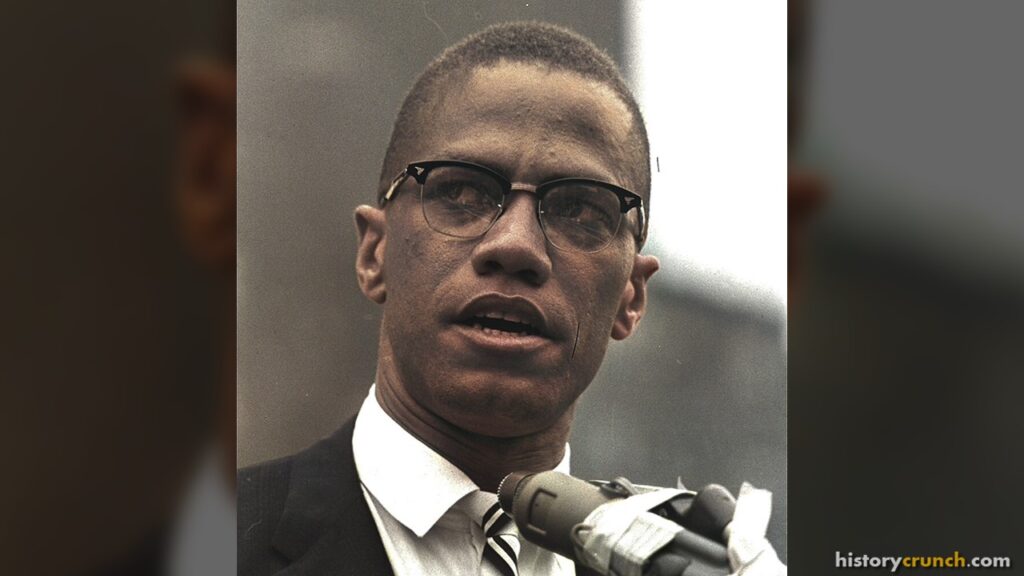
Malcolm X was an African American minister, activist, and public speaker. He is best known for his work as a spokesperson for the Nation of Islam, a religious and political organization that combined elements of Islam with Black nationalism, and for his powerful advocacy for African American pride, self-determination, and self-defense. Malcolm X’s approach to the struggle for racial equality differed significantly from that of the mainstream Civil Rights Movement, and his ideas had a lasting influence on African American political thought and culture.
MALCOLM X – EARLY LIFE
Malcolm was born Malcolm Little, on May 19th, 1925, in Omaha, Nebraska. He was the fourth of seven children. His father, Earl Little, was a Baptist preacher and follower of Black nationalist Marcus Garvey, whose ideas about Black pride and self-reliance had a lasting influence on Malcolm’s thinking. Earl Little died when Malcolm was six years old, in circumstances that the family believed involved violence from white supremacists, though this was never proven. Following his father’s death, the family fell into poverty and Malcolm’s mother, Louise, suffered a mental breakdown and was institutionalized. Malcolm and his siblings were placed in foster homes and state care.
Despite showing academic promise in school, Malcolm grew increasingly disengaged after a teacher told him that becoming a lawyer, which was his ambition, was not a realistic goal for a Black man. He eventually dropped out of school and moved to Boston and later New York City, where he became involved in petty crime. In 1946, at the age of twenty, Malcolm was convicted of burglary and sentenced to eight to ten years in prison. It was during his time in prison that his life changed direction.
MALCOLM X – NATION OF ISLAM
While in prison, Malcolm’s brother introduced him to the teachings of the Nation of Islam (NOI) and its leader, Elijah Muhammad. The NOI taught that white society had systematically oppressed African Americans and that Black people needed to separate themselves from white society and build their own independent communities and institutions. Malcolm converted to the NOI’s beliefs, began educating himself extensively through reading, and adopted the name Malcolm X. This means that the letter X replaced his family surname Little, which he considered to be a name imposed on his ancestors by slaveholders.
Malcolm was released from prison in 1952 and quickly rose through the ranks of the NOI to become its most prominent spokesperson. He founded several NOI temples, recruited thousands of new members, and became known across the country as a powerful and compelling public speaker. Unlike the mainstream Civil Rights Movement, which advocated for integration and nonviolent protest, Malcolm X argued that African Americans had the right to defend themselves against racial violence and that true freedom required economic and political independence from white society rather than integration into it.
MALCOLM X – CIVIL RIGHTS ACTIVISM
The Civil Rights Movement was a widespread social and political campaign for equal rights that took place primarily during the 1950s and 1960s in the United States. The movement was driven by African Americans and their allies who sought to end the system of racial segregation and discrimination that had existed in the United States for centuries. Racial segregation meant that African Americans were legally separated from white Americans in schools, restaurants, transportation, hospitals, and other public spaces, and were routinely denied the same rights and opportunities available to white citizens.
The Civil Rights Movement used a variety of methods to challenge this system, including: peaceful protests, legal challenges through the courts, boycotts, and political pressure on the United States government. Some of the most important events of the Civil Rights Movement included the Supreme Court ruling in Brown v. Board of Education in 1954, the Montgomery Bus Boycott of 1955, the March on Washington in 1963, and the passage of the Civil Rights Act of 1964 and the Voting Rights Act of 1965. Malcolm X occupied a unique position in this movement, offering a very different vision of how African Americans should pursue equality than that offered by leaders such as Dr. Martin Luther King Jr.
Malcolm X was one of the most widely recognized African American voices of the Civil Rights era, though his relationship with the mainstream movement was complex. He was a fierce critic of nonviolent protest, arguing that it placed an unfair burden on African Americans to absorb violence without responding. He also challenged the goal of racial integration, arguing that African Americans would be better served by building strong, independent communities of their own. His speeches drew large audiences and gave voice to the frustration and anger felt by many African Americans, particularly in northern cities, who felt that the mainstream Civil Rights Movement did not fully address their experiences.
In 1963, Malcolm’s relationship with the NOI began to break down following a series of disagreements with Elijah Muhammad. In March of 1964, Malcolm formally left the NOI and founded his own organization, Muslim Mosque, Inc. That same year, he made a pilgrimage to Mecca, the holy city of Islam in Saudi Arabia, which had a profound effect on his beliefs. During his time in Mecca, Malcolm prayed alongside Muslims of all races and returned to the United States with a more inclusive view of race and humanity than he had previously held. He began to move toward a more cooperative relationship with other civil rights organizations and founded the Organization of Afro-American Unity in June of 1964 to pursue racial justice through broader political and international means.
MALCOLM X – DEATH
Malcolm X was assassinated on February 21st, 1965, while delivering a speech at the Audubon Ballroom in Harlem, New York. Three members of the NOI were convicted of his murder. He was 39 years old.
MALCOLM X – SIGNIFICANCE
Malcolm X was significant for several reasons. First, Malcolm X was significant because he gave powerful voice to the experiences and frustrations of African Americans who felt that the mainstream Civil Rights Movement did not fully represent them. While leaders like Dr. Martin Luther King Jr. focused primarily on legal segregation in the South, Malcolm X spoke directly to African Americans in northern cities who faced poverty, police violence, and economic exclusion. His message of Black pride and self-determination resonated deeply with many people and expanded the conversation about what racial equality in America should look like.
Malcolm X was also significant because his ideas had a lasting influence on African American political thought and culture beyond the Civil Rights Movement itself. His emphasis on Black pride, self-reliance, and community empowerment directly shaped the Black Power movement that emerged in the late 1960s, and influenced organizations such as the Black Panther Party. His autobiography, written with Alex Haley and published shortly after his death, became one of the most widely read and influential books in American history and continues to be studied in schools and universities today.
Finally, Malcolm X was significant because his evolution in the final year of his life demonstrated the capacity for personal and political growth. Having spent years advocating racial separatism, Malcolm returned from his pilgrimage to Mecca with a broader and more inclusive view of humanity and began moving toward cooperation with other civil rights leaders. His assassination cut short what many historians believe could have been an important new chapter in his work. As such, Malcolm X remains one of the most complex and compelling figures in the history of the Civil Rights Movement and American history more broadly.