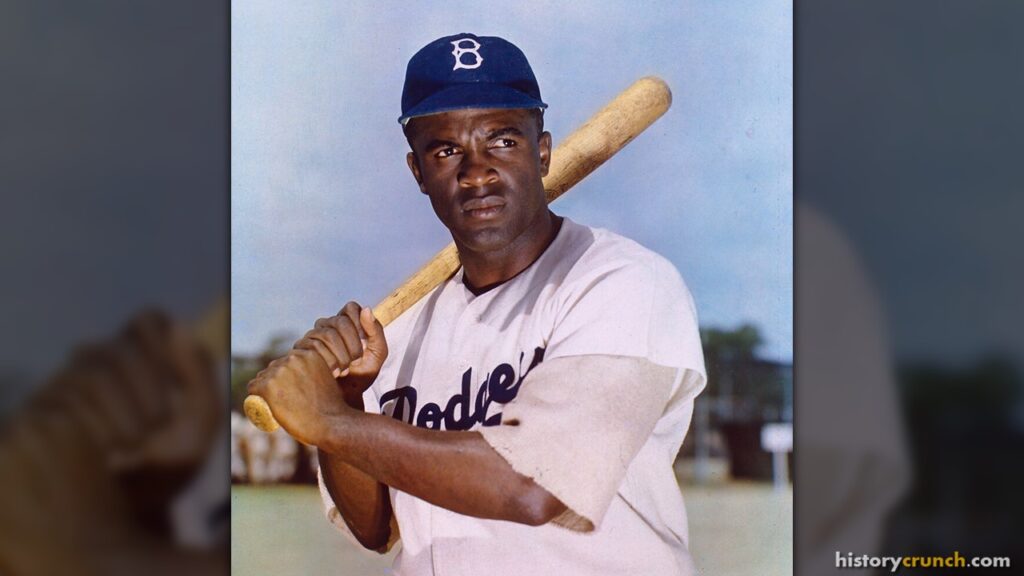
Jackie Robinson was an American athlete and civil rights activist who was born on January 31st, 1919, in Cairo, Georgia, and died on October 24th, 1972, in Stamford, Connecticut. Robinson is best known for breaking the color barrier in Major League Baseball on April 15th, 1947, when he took the field for the Brooklyn Dodgers. Before that point, African American players had been excluded from Major League Baseball for decades and were restricted to playing in the Negro Leagues. Robinson’s entry into the major leagues was one of the most significant moments in the history of both American sports and the Civil Rights Movement.
JACKIE ROBINSON – EARLY LIFE
Jackie Roosevelt Robinson was born in Cairo, Georgia, the youngest of five children. His father worked as a sharecropper and his mother raised the family largely on her own after his father left when Robinson was an infant. The family moved to Pasadena, California, when Robinson was a young child, where he grew up in a predominantly white neighborhood and experienced racial discrimination from an early age.
Robinson attended the University of California, Los Angeles (UCLA), where he became the first student in the university’s history to letter in four sports in a single year, excelling in baseball, football, basketball, and track and field. He left UCLA before completing his degree and was drafted into the United States Army in 1942. During his military service, Robinson was court-martialled after refusing to move to the back of a segregated military bus, an act of defiance that reflected his willingness to stand up against racial injustice. He was acquitted and received an honorable discharge in 1944.
JACKIE ROBINSON – BREAKING THE COLOR BARRIER
Following his military service, Robinson joined the Kansas City Monarchs of the Negro Leagues in 1945. That same year, Branch Rickey, the general manager of the Brooklyn Dodgers, was actively searching for an African American player to integrate Major League Baseball. Rickey selected Robinson not only for his athletic talent but for his character and his ability to withstand the pressure and hostility he would face. Rickey famously told Robinson that he needed a player with the courage not to fight back against the abuse he would inevitably receive. Robinson agreed to those terms and signed with the Dodgers organization.
Robinson spent the 1946 season with the Dodgers’ minor league affiliate, the Montreal Royals, where he performed exceptionally well. On April 15th, 1947, he made his Major League Baseball debut with the Brooklyn Dodgers at Ebbets Field in Brooklyn, New York, becoming the first African American to play in Major League Baseball in the modern era. Throughout his first season and beyond, Robinson endured racial abuse from opposing players, hostile fans, and even some of his own teammates, including death threats. He responded not with anger but with extraordinary play on the field. Robinson was named the inaugural Rookie of the Year in 1947, won the National League Most Valuable Player Award in 1949, appeared in six All-Star Games, and helped the Dodgers win the World Series championship in 1955. He retired from baseball in 1957 and was inducted into the Baseball Hall of Fame in 1962, the first African American to receive that honor.
JACKIE ROBINSON – CIVIL RIGHTS ACTIVISM
The Civil Rights Movement was a widespread social and political campaign for equal rights that took place primarily during the 1950s and 1960s in the United States. The movement was driven by African Americans and their allies who sought to end the system of racial segregation and discrimination that had existed in the United States for centuries. Racial segregation meant that African Americans were legally separated from white Americans in schools, restaurants, transportation, hospitals, and other public spaces, and were routinely denied the same rights and opportunities available to white citizens.
The Civil Rights Movement used a variety of methods to challenge this system, including: peaceful protests, legal challenges through the courts, boycotts, and political pressure on the United States government. Some of the most important events of the Civil Rights Movement included the Supreme Court ruling in Brown v. Board of Education in 1954, the Montgomery Bus Boycott of 1955, the March on Washington in 1963, and the passage of the Civil Rights Act of 1964 and the Voting Rights Act of 1965. Jackie Robinson’s integration of Major League Baseball in 1947 predated many of these events and is considered to be one of the earliest and most visible challenges to racial segregation in American public life.
Robinson’s contributions to the Civil Rights Movement extended well beyond his integration of baseball. Following his retirement from the sport, Robinson became an active and vocal advocate for racial equality. He served on the board of the NAACP, chaired the organization’s Freedom Fund Drive, and used his public platform to speak and write on civil rights issues. Robinson wrote a syndicated newspaper column in which he addressed racial injustice, politics, and the struggle for equality, reaching a wide national audience.
Robinson worked closely with Dr. Martin Luther King Jr. and attended the March on Washington in 1963. He also used his influence in the business world to advance economic opportunities for African Americans, co-founding Freedom National Bank in Harlem in 1964, a Black-owned bank designed to provide financial services to African American communities that were often excluded from mainstream banking. In 1970, he founded the Jackie Robinson Construction Company to build housing for low-income families. Robinson remained active in the cause of racial equality until his death from complications related to diabetes on October 24th, 1972.
JACKIE ROBINSON – SIGNIFICANCE
Jackie Robinson was significant for several reasons. First, Jackie Robinson was significant because his integration of Major League Baseball in 1947 was one of the earliest and most visible challenges to racial segregation in American public life. Baseball was the most popular sport in the United States at the time, and Robinson’s success demonstrated to millions of Americans that African Americans were fully capable of competing at the highest level alongside white athletes. His achievement came seven years before the Supreme Court’s ruling in Brown v. Board of Education and helped lay the groundwork for the broader Civil Rights Movement that followed.
Jackie Robinson was also significant because the manner in which he faced racial hostility helped change public attitudes toward segregation. By responding to abuse and discrimination with dignity and exceptional performance rather than anger, Robinson challenged the assumptions that underpinned racial segregation and forced many white Americans to confront the injustice of a system that had excluded talented and capable people based solely on their race. As such, Robinson’s example contributed to a gradual shift in public opinion that made further civil rights progress possible.
Finally, Jackie Robinson was significant because his legacy has endured as one of the most powerful symbols of the struggle for racial equality in American history. Every year on April 15th, Major League Baseball observes ‘Jackie Robinson Day’, on which all players wear his number 42 in his honor. His number is the only one retired across the entire league. Robinson was posthumously awarded the Presidential Medal of Freedom in 1984 and the Congressional Gold Medal in 2003. His life demonstrated that individual courage and excellence could challenge deeply entrenched systems of injustice and inspire broader social change.