Marxism is a political and economic theory that was first developed in the 19th century by Karl Marx and Friedrich Engels. At the time, Marx and Engels were writing about the inequalities they saw in capitalist industrial societies, such as Britain in the Industrial Revolution. Marxism, as a theory, argues that economic forces shape history, and that a classless, equal society can be achieved by ending private ownership of production. Regardless, Marxism had a profound impact on economic and political thought throughout the 20th century and influenced the development of modern socialism.
 FactsthatCrunch
Right can never be higher than the economic structure of society and its cultural development conditioned thereby. In a higher phase of communist society, after the enslaving subordination of the individual to the division of labor … has vanished … only then can the narrow horizon of bourgeois right be crossed in its entirety and society inscribe on its banners: From each according to his ability, to each according to his needs!
Marx wrote these words in the spring of 1875, in a private critique of the draft program that German socialist groups planned to adopt at their unity congress in the town of Gotha. Friedrich Engels published the text in 1891.
Marxism – Development and History
Marxism is a form of socialism that occurred after the earlier developments of Utopian Socialism. In particular, Marxism is the form of socialism that developed as a result of the ideas of the famous socialist thinker, Karl Marx. Karl Marx is perhaps one of the most influential philosophers of the last two centuries. His writings inspired revolutions in several countries and are still used today in support of workers’ rights and other socialist principles. Marx is most famous for writing different socialist-based works and often collaborated with his colleague Friedrich Engels. Their writings generally focused on the conditions of the working class, and the growing income gap of laissez-faire capitalist societies during the Industrial Revolution. Marx referred to his study of these conditions as the “critique of political economyThe term Marx used for his study of the economic conditions and inequalities affecting the working class.” whereas it has come today to be known as Marxism.
The most important and influential work that Marx and Engels collaborated on is known commonly as ‘The Communist Manifesto’. Written at the end of 1847, The Communist Manifesto was a political pamphlet first published in 1848 under the title ‘Manifesto of the Communist Party’. In it, Marx and Engels set forth the basic principles of Marxism that have gone on to influence many different thinkers and ideologies around the world. The basic ideas of The Communist Manifesto, and therefore Marxism, were centered on the nature of society and the struggles between different classes. For example, they argued that in England, at that time, the proletariatThe industrial working class who must sell their labor to survive, as opposed to those who own property. (industrial workers) and the bourgeoisieThe wealthy owners who control the means of production, such as factories, land, and capital. (wealthy owners) were engaged in class warfareOngoing conflict between different social classes, especially between workers and wealthy owners, over power and resources. with the proletariat being controlled by the bourgeoisie.
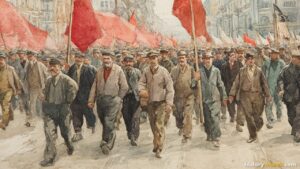
According to Marx and Engels, the only way to overthrow capitalism, and end this class warfare, was by means of a class struggle in which the proletariat violently overthrows the bourgeoisie and takes control over the means of productionThe resources, factories, and land used to create goods and wealth in an economy.. After doing so, the principles of socialism could be used to develop a classless society based upon cooperation and the common good. For example, Marx later wrote in his 1875 Critique of the Gotha Programme “from each according to his ability, to each according to his needs.” They argued that this workers’ revolution was necessary before any significant change could be made in society.
In general, they discussed the failings of laissez-faireAn economic system where the government leaves businesses alone to operate with little or no interference or regulation. capitalism and sought to bring about a final revolution that would end the struggle between different classes. For example, in The Communist Manifesto, Marx and Engels argued that a socialist society formed by workers should involve a move towards the following: a shift from private property to public property, factories controlled and owned by the proletariat, free public education for all children. In general, the ideas of Marxism have spread across the world and influenced many different people. While Marxism is often linked to the growth of communism in the 20th century, it should be noted that, communism is simply an interpretation of the ideals of Marxism and does not represent the true intentions of Marx or Engels.
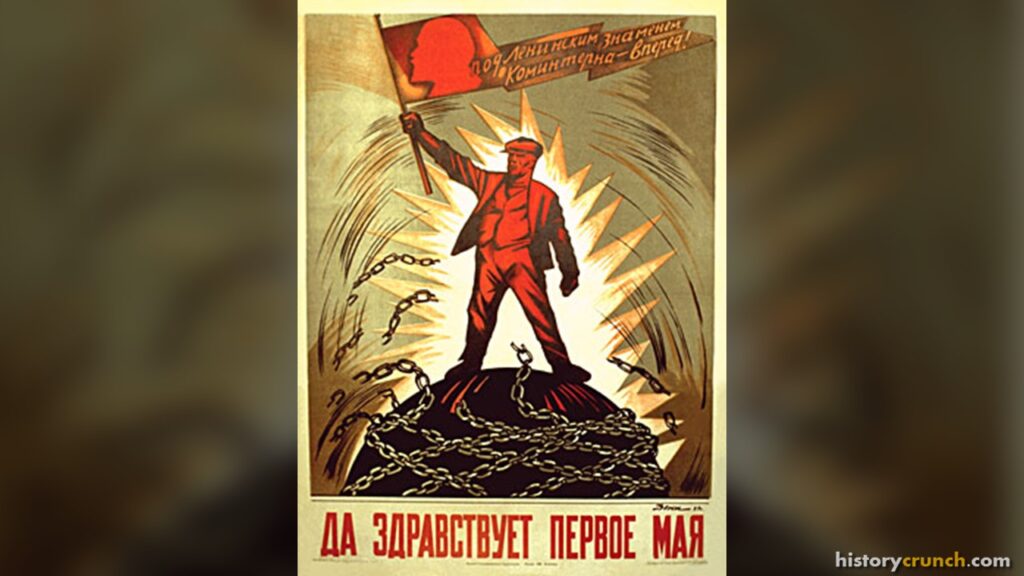
In the early 20th century, Marxism inspired revolutions, most notably the Russian Revolution of 1917, which established the world’s first communist state under Vladimir Lenin. Throughout the 20th century, Marxist ideas influenced movements in China with the leadership of Mao Zedong, and Cuba with the leadership of Fidel Castro.
FactsthatCrunchKarl Marx wrote The Communist Manifesto by himself.
Marxism – Main Principles
As stated above, Marxism as an ideology is based on several significant principles. For instance, historians have identified the following as important principles of Marxism: criticism of capitalist societies, collective ownershipA system where factories, land, and resources are owned together by the working class rather than by private individuals. of the means of production, the promotion of a classless society and a revolution led by the working class.
At its core, Marxism was a critique of laissez-faire capitalism by Karl Marx and Friedrich Engels. They were living and writing in Europe during the timeframe of the Industrial Revolution. As such, they witnessed the hardships created for the working class by the inequalities of capitalism and individualism. As a result, Marx and Engels argued that society would need to evolve from a capitalist system to a Marxist system in order to overcome the inequalities. For example, central to Marxism is the idea that society is divided into classes. In capitalism, the bourgeoisie (wealthy owners) own the means of production (factories, land, and capital), while the proletariat (poor and working class) sell their labor to survive. In fact, Marx argued that this class conflict would eventually lead to revolution and the creation of a classless society.
As well, Marxism argued for the end of private ownership of the means of production. Instead, factories, land, and resources should be owned collectively so that wealth benefits everyone, not just a few. As such, Marxism supported the idea of collective ownership, such that the working class could benefit from the wealth and production created from labor.
Karl Marx believed that after a workers’ revolution, a temporary government led by the working class would be needed to eliminate class differences before achieving true communism. This is because the ultimate goal of Marxism was to create a classless society where everyone contributes according to their ability and receives according to their needs. Marx referred to this as ‘communism’, which he believed was the eventual replacement for capitalism.
FactsthatCrunchWhich definition fits each Marxist term from the main principles of Marxism?
Marxism – Significance
Marxism was one of the most significant ideologies of the 19th century and had a profound impact on economic and political developments of the 20th century. As a result, historians consider Marxism to be highly important to understanding economic and political ideologies today.
First, and foremost, Marxism provided an important critique of laissez-faire capitalism, by exposing issues such as: the exploitation of the working class and inequality that resulted between the classes. This critique of capitalism was so profound that it influenced some nations around the world to shift economically and use more government intervention in economic matters. Furthermore, many modern social policies, such as labor rights, welfare systems, and economic reforms, were influenced by Marxist ideas.
Also, Marxism was significant because it directly resulted in several revolutions. It shaped the ideologies of countries such as the Soviet Union, China, Cuba, North Korea and Vietnam. The most significant of these revolutions was the Russian Revolution, which erupted in 1917. This revolution saw the nation of Russia transform into the first communist state in world history. Other revolutions also led to major conflicts, such as the Korean War, Vietnam War and the overall events of the Cold War. For this reason, historians view Marxism as a highly significant development that impacted the lives of millions of people.
FactsthatCrunchMarxist ideas, developed by Karl Marx and Friedrich Engels in the 19th century, argued that workers should violently overthrow wealthy owners and build a classless society, and this theory directly inspired communist revolutions across several countries in the 20th century.
Marx and Engels first published their ideas in The Communist Manifesto in 1848, writing about the inequality they saw in industrial capitalist societies. Their call for workers to seize control of factories and land became a blueprint used by revolutionary leaders across the world for more than a century.
Explore World War I
Keep exploring World War I with these History Crunch resources.
Key Vocabulary
Laissez-faire
Proletariat
Bourgeoisie
Means of production
Class warfare
Collective ownership
Political economy
Frequently Asked Questions
Who created Marxism?
Marxism was developed in the 19th century by Karl Marx and Friedrich Engels. The two men wrote about the inequalities they saw in capitalist industrial societies. Their most famous shared work, The Communist Manifesto, was published in 1848. Marx is often called one of the most influential philosophers of the last two centuries.
What are the main principles of Marxism?
Marxism rests on criticism of capitalism, collective ownership, a classless society, and a workers’ revolution. Marx and Engels argued that economic forces shape history and divide society into classes. They wanted to end private ownership of factories, land, and resources. Instead, these would be owned together so wealth benefits everyone.
What is the difference between the proletariat and the bourgeoisie?
The proletariat are the working class, while the bourgeoisie are the wealthy owners. The bourgeoisie own the means of production, such as factories, land, and capital. The proletariat must sell their labor to survive. Marx believed the conflict between these two classes would eventually lead to revolution.
Is Marxism the same as communism?
Marxism and communism are not exactly the same, though they are closely linked. Communism is one interpretation of the ideas of Marx and Engels. Many historians note that 20th century communism did not always reflect their true intentions. Marx saw communism as the classless society that would eventually replace capitalism.
Why is Marxism considered historically important?
Marxism is important because it gave a powerful critique of capitalism and shaped 20th century politics. It exposed the exploitation of workers and inequality between classes. Its ideas influenced labor rights, welfare systems, and economic reforms in many nations. It also inspired revolutions in Russia, China, Cuba, and other countries.
Cite This Article
To cite this article as a source, use one of the formats below.
MLA: Beck, Elias. “Marxism: A Detailed Summary.” HistoryCrunch, 27 September 2026, https://historycrunch.com/marxism/.
APA: Beck, E. (2026). Marxism: A Detailed Summary. HistoryCrunch. https://historycrunch.com/marxism/
Chicago: Beck, Elias. “Marxism: A Detailed Summary.” HistoryCrunch. September 27, 2026. https://historycrunch.com/marxism/
Sources
- Emma Griffin, A Short History of the British Industrial Revolution.
- Fordham Modern History Sourcebook
- The Science Museum Group
- Joel Mokyr, The Enlightened Economy.