Neville Chamberlain was an important figure in modern British history. For instance, he was the British Prime Minister who advocated for the policy of appeasement toward Adolf Hitler and Nazi aggression in the years before World War II. The failure of appeasementA foreign policy strategy of giving in to some of an aggressive leader’s demands in order to avoid war. to prevent the outbreak of the war created a controversial legacy of Chamberlain. Some have argued that he failed to handle the early crises of Hitler, while others have celebrated his contributions to Britain.
 FactsthatCrunch
Neville Chamberlain is best known for signing the Munich Agreement in 1938, which gave Germany the Sudetenland region of Czechoslovakia in exchange for a promise of no further territorial demands. His policy of appeasement failed when Germany invaded Poland on September 1st, 1939, forcing Britain to declare war and leading to his resignation the following year.
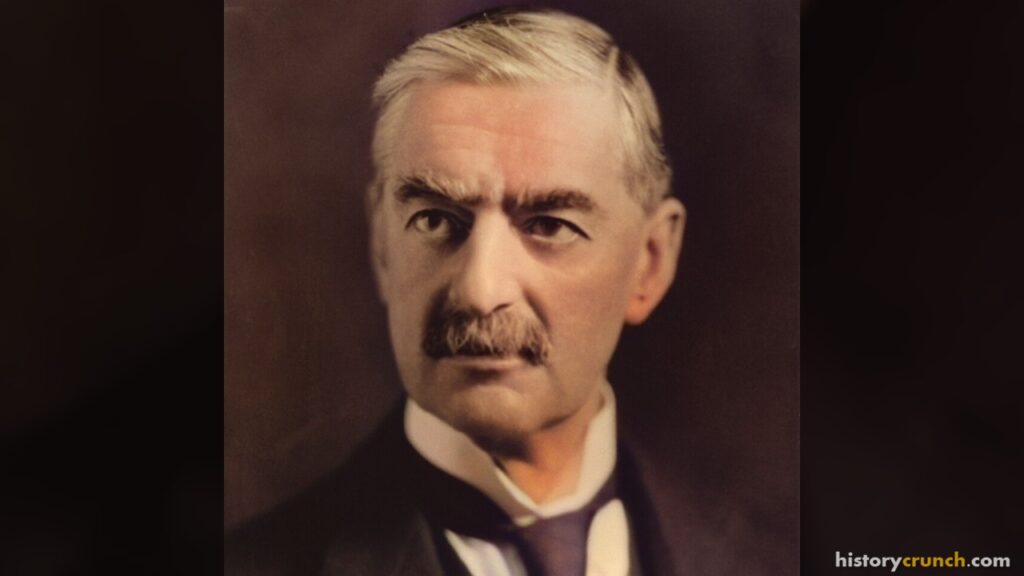
Neville Chamberlain – Early Life
Neville Chamberlain was born on March 18th, 1869. He was born in Birmingham, a large city located in the center of England. Chamberlain’s mother died when he was young, and so his father largely brought him up. Chamberlain’s father was interested in local politics, and became the Mayor of Birmingham when Chamberlain was a young boy. Chamberlain was not interested in education, and despite starting a degree, he ended up leaving university to become an accountant.
Chamberlain did not stay as an accountant, and ended up having a number of different jobs in business and local government during his adult life. For instance, he managed a plantation in the Bahamas for a while. While it ended in failure after just six years, the experience gave him experience for other aspects of his later life. He eventually returned to Birmingham where he built a successful career in manufacturing before transitioning to political service.
Neville Chamberlain managed a plantation in the Bahamas, but it lasted only six years before failing.
Neville Chamberlain – Early Political Life
Chamberlain’s political career began relatively late. For example, he served as Lord Mayor of Birmingham in 1915 at the age of 46 years old. During his time as mayor, he focused on municipalRelating to the local government and services of a city or town. reforms in housing, health, and education. His effective leadership caught the attention of national leaders, and in 1918, he was elected Member of Parliament for Birmingham Ladywood. Chamberlain was rapidly promoted when he joined parliament, and by 1923 he had been promoted to the Minister of Health. As Minister of Health, he introduced innovative policies promoting better housing and local government reform. Soon after that, Chamberlain was promoted to become the Chancellor of the ExchequerThe British government official responsible for overseeing all of the country’s economic and financial matters., in which he was responsible for all economic and financial matters. For instance, he was responsible for overseeing Britain’s finances during the Great Depression.
FactsthatCrunchChamberlain served as Chancellor of the Exchequer before becoming Prime Minister, and his record in that role drew both praise and criticism.
Neville Chamberlain – Prime Minister of Britain
Neville Chamberlain continued to find success within parliament, and in 1937, after Stanley Baldwin stepped down, Chamberlain became the Prime Minister of the United Kingdom. Throughout his time as Prime Minister, Chamberlain was heavily focused on the increasingly aggressive tactics of Adolf Hitler in Germany. The rise of Nazi Germany presented challenges few British leaders had faced before.
Believing that the horrors of the First World War should never be repeated, Chamberlain was determined to maintain peace, through a foreign policy strategy called ‘appeasement’. The policy essentially worked by conceding to some of Adolf Hitler’s, the Nazi leader, demands. It was driven by the desire to maintain peace in Europe, especially in relation to the death and destruction caused by the events of World War I. Appeasement reached its peak under Neville Chamberlain, who believed that giving in to some of Hitler’s territorial demands would prevent another large-scale war. The policy of appeasement was used throughout several significant events of the 1930s, including: the remilitarization of the Rhineland, the annexation of Austria, the Munich Conference, and the occupation of Czechoslovakia.
FactsthatCrunchNeville Chamberlain – Appeasement and World War II
His most notable act was the Munich Conference of 1938. The Munich Conference was held on September 29th and 30th, 1938, in Munich, Germany. It was an important event in the lead up to World War II, and had significant historical impacts. In general, it was a diplomatic meeting between the leaders of Germany (Adolf Hitler), Britain (Neville Chamberlain), France (Édouard Daladier), and Italy (Benito Mussolini). The main issue of the Munich Conference was to discuss Hitler’s demand that Nazi Germany receive the SudetenlandA region of Czechoslovakia that Hitler demanded Germany receive, which became the main issue at the Munich Conference. of Czechoslovakia.
After hours of discussions, Britain and France ultimately agreed to Hitler’s demands, which allowed Nazi Germany to occupy the Sudetenland immediately. More specifically, the agreement, which was signed on the morning of September 30th, 1938, allowed Germany to take control of the Sudetenland without any military action and caused Czechoslovakia to lose important defense and resources that weakened it militarily. This, unfortunately, made it difficult for Czechoslovakia to defend itself in the aftermath of the Munich Conference, which had devastating effects in 1939 when Nazi German forces invaded and occupied the rest of the Czechoslovakian nation-state.
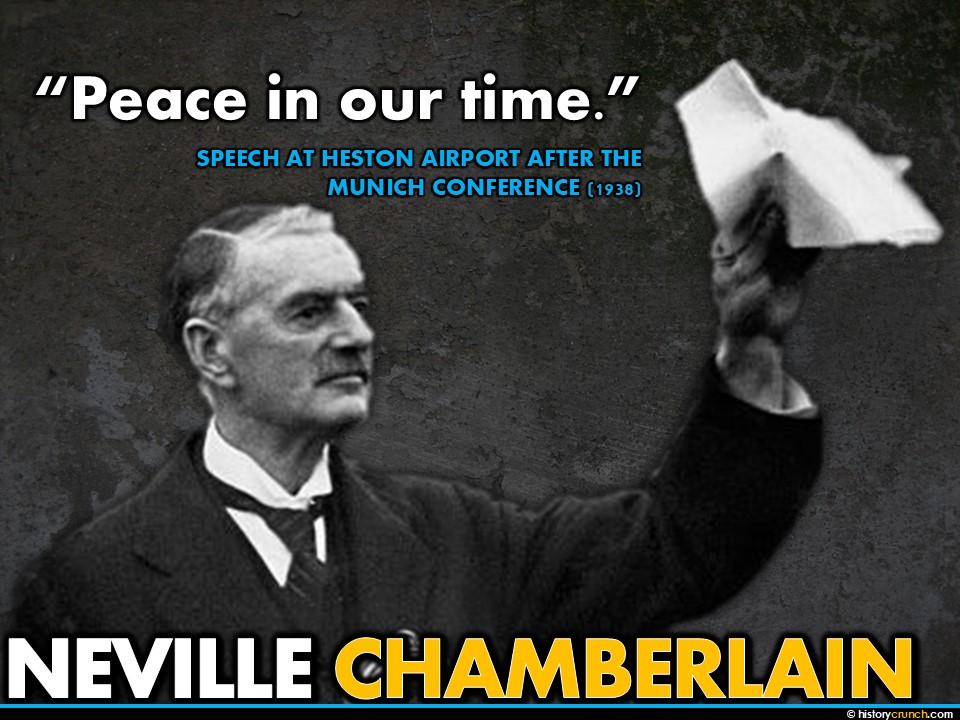
The Munich Conference was an embarrassment for Neville Chamberlain, who returned to Britain and announced that he had helped ensure ‘peace for our time’ while holding up the agreement signed by Hitler. Essentially, Hitler agreed to receiving the Sudetenland, in exchange for an end to his aggressive demands for territorial expansion. For Hitler though, the outcome of the Munich Conference furthered his belief that the Western democracies were weak and that they would not act in the face of Nazi aggression. In fact, Nazi Germany soon took control over the remainder of Czechoslovakia through a series of invasions.
All of this eventually culminatedWhen a series of events built up to a final and decisive result or outcome. in the Nazi Germany invasion of Poland in September of 1939, and the outbreak of World War II. In fact, on September 3rd, 1939, soon after Hitler invaded Poland, Britain, led by Chamberlain, declared war on Nazi Germany. Chamberlain remained in power in Britain, and led the country through the first eight months of World War II.
 FactsthatCrunch
In March 1939, Nazi Germany invaded and occupied the remainder of Czechoslovakia, the territory left after the Munich Agreement of 1938. Britain had agreed to that agreement hoping Hitler would stop expanding, but this invasion made clear that appeasement had failed.
Britain followed a policy of giving in to Hitler's demands to avoid war
Britain abandoned appeasement and began preparing for the possibility of war with Germany
Neville Chamberlain – Later Years and Death
Chamberlain stepped down as Prime Minister in May of 1940 after the disastrous Norwegian campaign. He was replaced as Prime Minister by Winston Churchill, who argued for a much different approach to Nazi aggression. Regardless, Neville Chamberlain died on November 9th, 1940, from complications due to bowel cancer. Chamberlain’s reputation as Prime Minister is a controversial topic. Some historians think that he led Britain well through a difficult time. However, some others think that Chamberlain and his associates did not prepare the country well enough for war, which led to many unnecessary deaths and the outbreak of World War II. Despite these failings, some historians argue that Chamberlain’s policies bought Britain crucial time to rearm and prepare for war. Furthermore, Chamberlain’s domestic contributions, particularly in public health and housing reform, have often been overshadowed by his foreign policy failures.
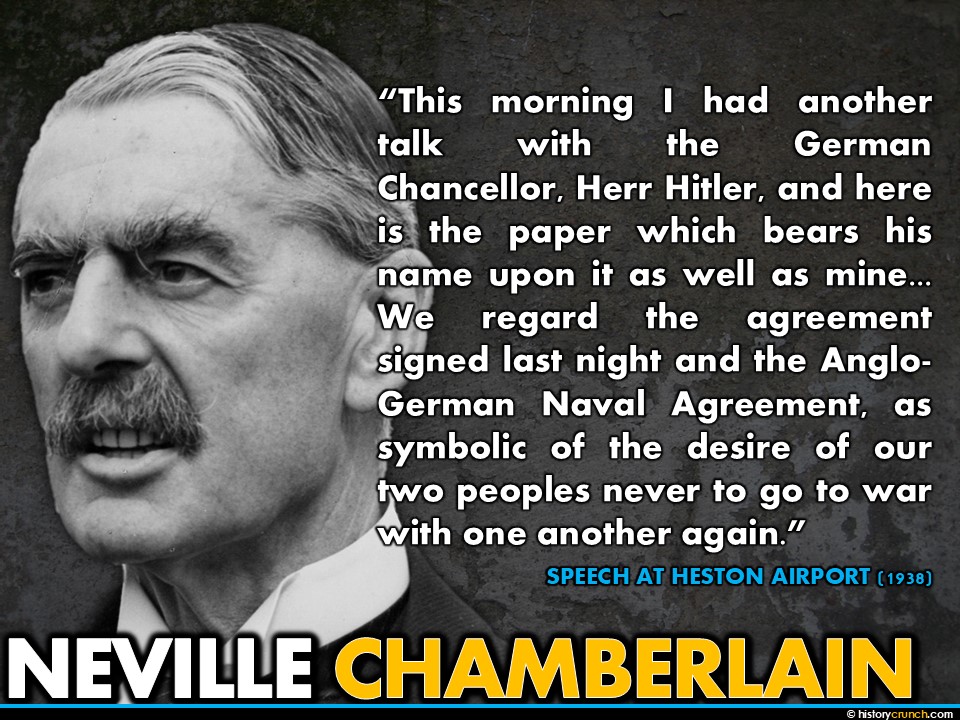
peace for our time
Key Vocabulary
Appeasement
Municipal
Chancellor of the Exchequer
Remilitarization
Annexation
Sudetenland
Culminated
Frequently Asked Questions
Who was Neville Chamberlain?
Neville Chamberlain was the British Prime Minister from 1937 to 1940. He is best known for his policy of appeasement toward Adolf Hitler before World War II. Before becoming Prime Minister, he held several important roles, including Chancellor of the Exchequer and Minister of Health.
What was Chamberlain’s policy of appeasement?
Appeasement was a strategy of giving in to some of Hitler’s demands to avoid another war. Chamberlain hoped that small concessions would satisfy Hitler and keep peace in Europe. The memory of the death and destruction from World War I strongly shaped this approach.
What happened at the Munich Conference of 1938?
At the Munich Conference, Britain and France agreed to let Germany take the Sudetenland region of Czechoslovakia. The meeting took place on September 29th and 30th, 1938, and included the leaders of Germany, Britain, France, and Italy. The deal weakened Czechoslovakia’s defenses and did not stop Hitler’s later aggression.
Why did Chamberlain say “peace for our time”?
Chamberlain said “peace for our time” after returning from the Munich Conference with the signed agreement. He believed the deal had secured lasting peace in Europe. Within a year, Germany invaded Poland and World War II began, making the phrase a symbol of failure.
Why did Chamberlain resign as Prime Minister?
Chamberlain resigned in May of 1940 after the failed Norwegian campaign early in World War II. He lost the confidence of Parliament and was replaced by Winston Churchill. Chamberlain died a few months later, on November 9th, 1940, from bowel cancer.
Was Chamberlain a good leader?
Historians still debate Chamberlain’s record, which makes his legacy controversial. Critics argue that appeasement failed to stop Hitler and left Britain unprepared for war. Others note that his policies bought time to rearm, and that his reforms in housing and public health are often overlooked.
Cite This Article
To cite this article as a source, use one of the formats below.
MLA: Beck, Elias. “Neville Chamberlain: A Detailed Biography.” HistoryCrunch, 3 October 2026, https://historycrunch.com/neville-chamberlain/.
APA: Beck, E. (2026). Neville Chamberlain: A Detailed Biography. HistoryCrunch. https://historycrunch.com/neville-chamberlain/
Chicago: Beck, Elias. “Neville Chamberlain: A Detailed Biography.” HistoryCrunch. October 3, 2026. https://historycrunch.com/neville-chamberlain/
Sources
- Imperial War Museum
- Gerhard L. Weinberg, A World at Arms.