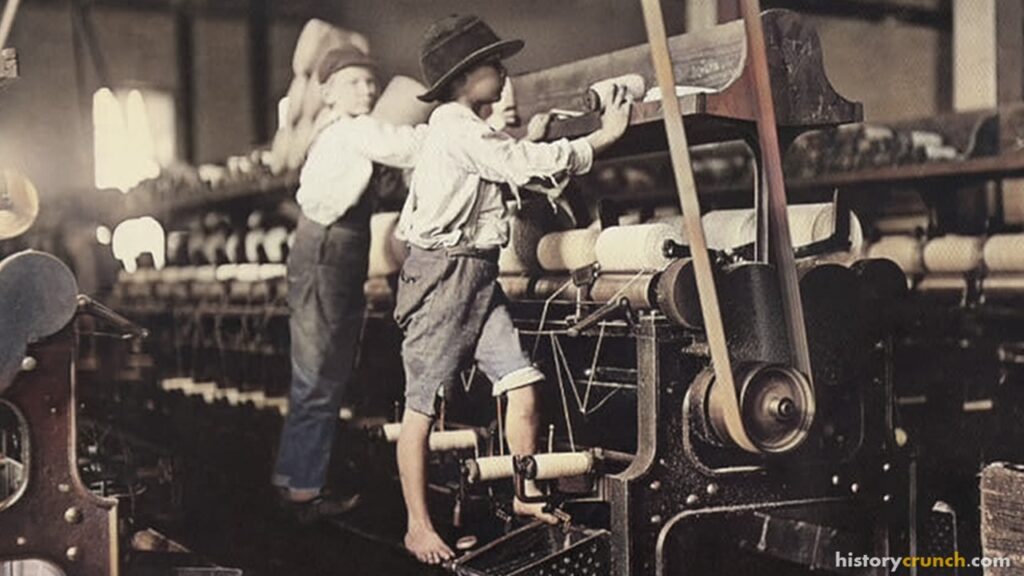
Textile manufacturing in the Industrial Revolution underwent many changes due to the advent of mechanizationThe process of replacing human hand labor with machines to produce goods faster and more efficiently. and the factory system. In fact, the development of the factory system was one of the main impacts of the Industrial Revolution. It led to more efficient and cost-effective production that benefitted several different industries. For instance, one of the main industries that benefitted from the effects of the Industrial Revolution was the textile industry.
 FactsthatCrunch
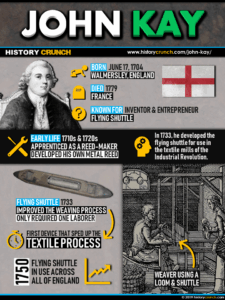
The flying shuttle, invented by John Kay in 1733, allowed a single weaver to send a bobbin of thread across a loom at greater speed than hand weaving had ever allowed.
What Was the Textile Industry in the Industrial Revolution?
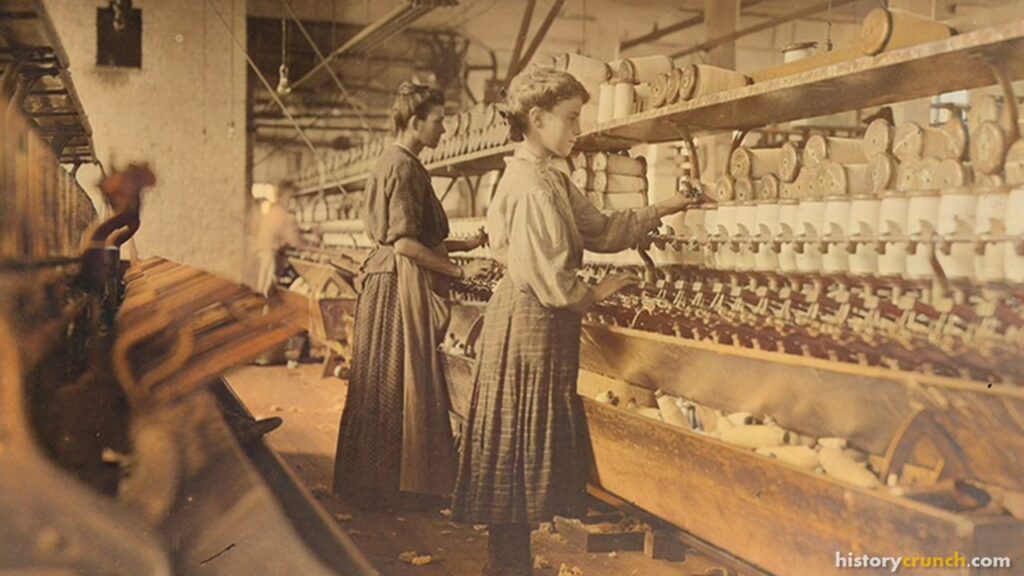
The textile industry was based on the development of cloth and clothing. Before the start of the Industrial Revolution, which began in the 1700s, the production of goods was done on a very small scale. Historians refer to this method of production as the ‘cottage industry’. Simply put, the cottage industryA system where people made goods for sale by hand at home, usually selling only to nearby communities. refers to a period of time in which goods for sale were produced on a very small scale, usually in a home. In this system, people produced goods, such as wool, in their homes or on their own farms and then sold it to local communities since long distance transportation was uncommon. This method of production was slow and inefficient and struggled to keep pace with the growing demand caused by the increased population. In contrast, industrialization allowed goods to be produced in a central location and on a mass scale. It also led to the creation of inventions that helped speed up the production method of many goods, but most noticeably in the textile industry.
 FactsthatCrunch
The cottage industry struggled to meet growing demand. What was the main reason it could not keep up?
Inventions That Impacted Textile Manufacturing
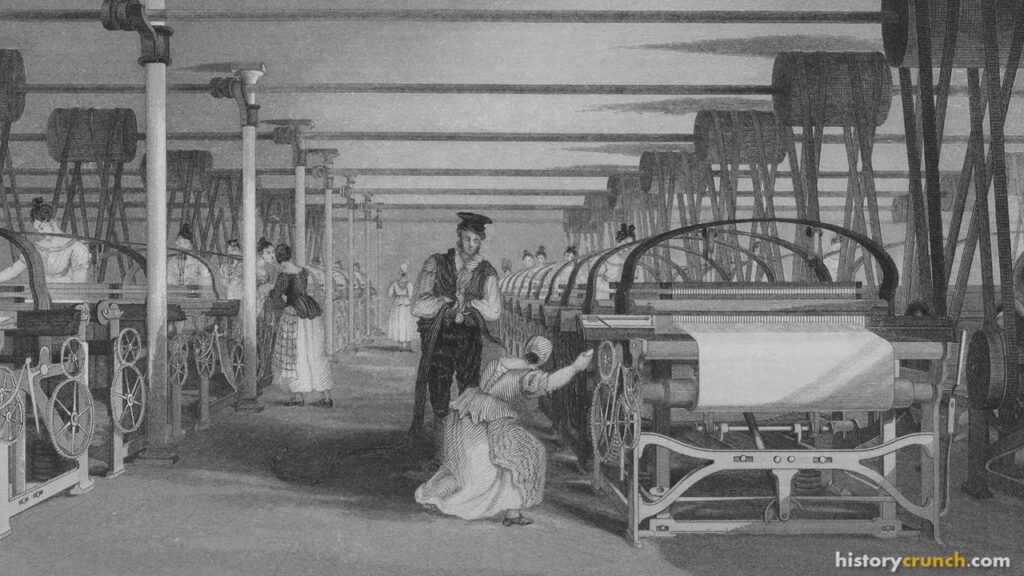
Throughout the 1700s, inventors such as Richard Arkwright, Eli Whitney, James Hargreaves, John Kay and Edmund Cartwright, developed machines and techniques that helped improve production, especially in terms of the textile industry. For example, in 1733 John Kay developed a wheel shuttle, later known as a flying shuttle. The machine improved weaving efficiency and reduced labor needs because it could be operated with only one operator. James Hargreaves created the spinning jenny in 1764, which allowed a machine with many spindles of thread to be spun at one time. Richard Arkwright added to this by developing the water frameA spinning machine built near rivers so flowing water could power it to spin many threads at once. in 1769. The water frame allowed dozens of spindles of thread to be spun at one time but was so large and needed so much energy that he built it next to rivers and creeks in order to use the force of the water to spin the machine. For his part, Edmund Cartwright developed the power loom in 1785 which allowed quicker production of cloth. Finally, American inventor, Eli Whitney developed the cotton gin in 1793, which allowed for quicker production of cotton. Previously, cotton had to be hand cleaned in order to remove fibers and seeds. Whitney’s cotton ginA machine that separated cotton fibers from their seeds, replacing slow hand-cleaning. sped up this process and allowed for much faster harvesting of the resource. In all, these inventions mechanized the textile industry and led to the establishment of factories throughout Britain, which was the first country to industrialize.
 FactsthatCrunch
In what order were the key textile inventions of the 1700s developed?
Key Vocabulary
Mechanization
Cottage industry
Flying shuttle
Spinning jenny
Water frame
Power loom
Cotton gin
Frequently Asked Questions
What was the textile industry during the Industrial Revolution?
The textile industry made cloth and clothing, and it became one of the first industries to mechanize. Before the 1700s, most cloth was made by hand in homes under the cottage industry system. New machines and factories then moved this work to central locations and increased output. This shift made Britain the leading maker of textiles in the world.
What was the cottage industry?
The cottage industry was a system where people made goods by hand on a small scale, usually in their own homes. Families produced items like wool and sold them to nearby communities. Long distance transportation was rare, so trade stayed local. This method was slow and could not keep up with the growing population’s demand.
What inventions changed textile manufacturing?
Key inventions included the flying shuttle, the spinning jenny, the water frame, the power loom, and the cotton gin. Each machine sped up a different step in making cloth, from spinning thread to weaving fabric. Together they replaced slow hand labor with faster mechanical work. These tools helped move textile production into large factories.
Who invented the spinning jenny?
James Hargreaves invented the spinning jenny in 1764. The machine allowed many spindles of thread to be spun at the same time by one worker. This greatly increased how much thread could be made in a day. It was one of several breakthroughs that transformed the textile trade.
What did the cotton gin do?
The cotton gin, invented by Eli Whitney in 1793, quickly separated the fibers of raw cotton from its seeds. Before this machine, workers had to clean cotton slowly by hand. The gin made cotton much faster and cheaper to process. This raised demand for cotton and changed farming in the American South.
Why did textile factories appear in Britain first?
Britain was the first country to industrialize, so its textile factories developed before those in other nations. New machines like the water frame needed large buildings and steady power. Some early mills stood next to rivers so flowing water could turn the equipment. These conditions helped Britain lead the shift to factory based production.
Cite This Article
To cite this article as a source, use one of the formats below.
MLA: Beck, Elias. “Textile Manufacturing in the Industrial Revolution: A Detailed Summary.” HistoryCrunch, 25 September 2026, https://historycrunch.com/textile-manufacturing-in-the-industrial-revolution/.
APA: Beck, E. (2026). Textile Manufacturing in the Industrial Revolution: A Detailed Summary. HistoryCrunch. https://historycrunch.com/textile-manufacturing-in-the-industrial-revolution/
Chicago: Beck, Elias. “Textile Manufacturing in the Industrial Revolution: A Detailed Summary.” HistoryCrunch. September 25, 2026. https://historycrunch.com/textile-manufacturing-in-the-industrial-revolution/
Sources
- Joel Mokyr, The Enlightened Economy.
- The Science Museum Group
- Emma Griffin, A Short History of the British Industrial Revolution.